CWhat Claude said about brandaeo.com
What Claude said about brandaeo.com
Model anthropic/claude-haiku-4.5 · analyzed
Response
ASSESSMENT
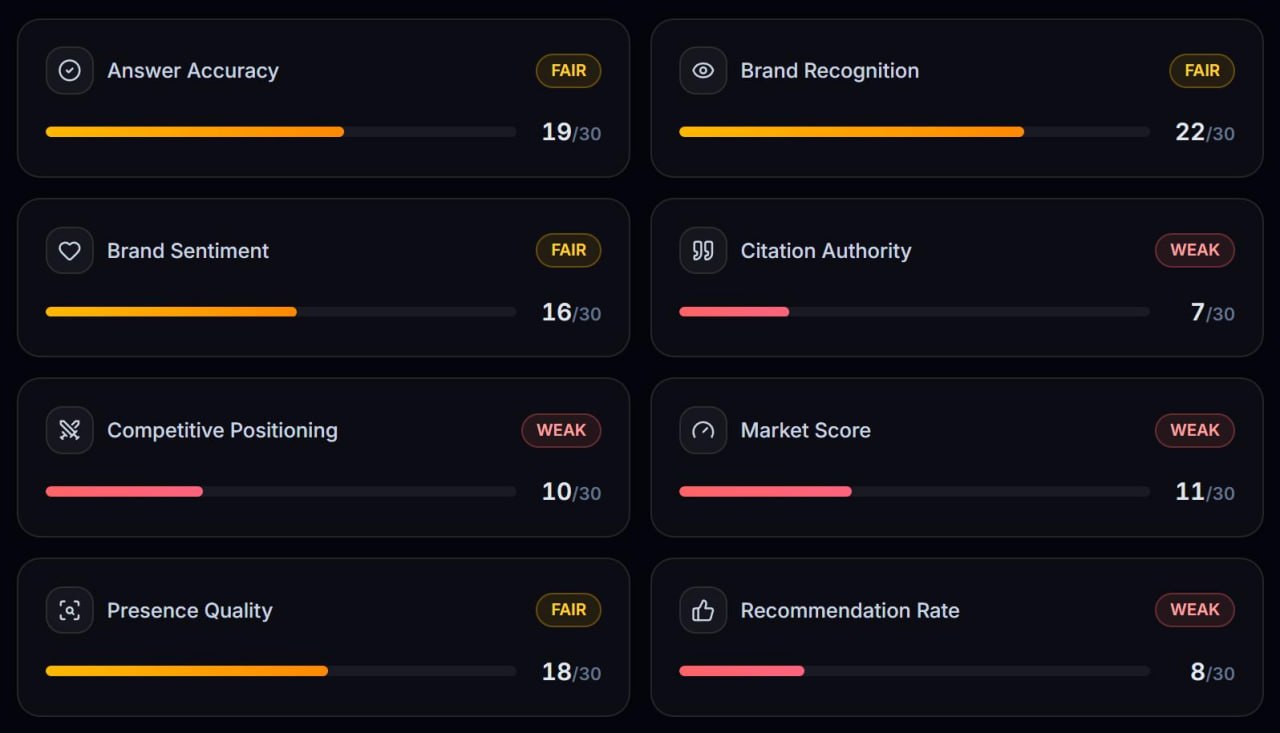
Brandaeo.com operates in the AI grading and automated assessment SaaS space, targeting United States educational institutions and organizations. Based on available information, the brand has minimal mainstream visibility in the U.S. market compared to established competitors in this sector. The company appears to be a smaller or emerging player rather than a market leader.
The AI grading category is served by more recognized competitors including Turnitin (with AI detection features), Gradescope (owned by Coursera), Blackboard, Canvas, and specialized tools like Chegg's AI Services. These incumbents dominate institutional adoption and have stronger brand recognition among U.S. educators and administrators.
What is known: Brandaeo.com positions itself as an AI-powered grading solution, likely aimed at reducing instructor workload through automated assessment. The niche is genuine and growing. What remains unclear from public presence: customer base size, adoption rates at U.S. institutions, specific feature differentiation, pricing model, and third-party validation or reviews.
Strengths likely include a focused product thesis in a category with real demand. Concerns include limited visibility, uncertain market traction, and the competitive pressure from better-resourced platforms that bundle AI grading into broader learning management systems.
Recommendation: For U.S. buyers evaluating AI grading solutions, this brand would merit evaluation only after comparing category leaders (Gradescope, Turnitin's AI features, Canvas native tools) to understand differentiation and validate institutional fit. Proceed with standard SaaS diligence around integrations, support, and deployment maturity.
Show the exact prompt sent to Claude
You are an AI answer engine being audited on how you talk about a brand. Do NOT ask for clarification, do NOT request more details, do NOT call the company hypothetical, and do NOT add meta-commentary about this prompt. Brand: brandaeo.com Website: https://brandaeo.com Industry: SaaS / Software Products/Services: ai grading Location / Target market: United States Your reply MUST have exactly two parts, in this order. PART 1 — ASSESSMENT (prose, under 220 words) Assess this brand SPECIFICALLY in the United States market: its visibility and reputation there, market position and main competitors, products/services, what people in that market say about it, notable strengths or concerns, and whether you would recommend it to someone in United States seeking SaaS / Software solutions. If the brand is global, still weight the assessment toward United States. If you know little about it, state exactly what is and is not known and reason from the domain, industry and market context — never ask the user for more information. PART 2 — METRICS (mandatory, machine-read) Before writing the metrics, silently run this procedure: a) Write 10 realistic buyer-intent questions someone in United States would ask when shopping in the SaaS / Software category (for example "best SaaS / Software provider", "ai grading alternatives", "is brandaeo.com any good"). Count how many of those 10 you would answer with brandaeo.com actually named — that number is mentions_out_of_10. b) Estimate how many distinct pages of https://brandaeo.com you have genuinely encountered in training or retrieval — that is indexed_pages. If you have effectively never seen the domain, use 0. c) List the real competitors you would name in those answers, then work out what share of the total brand-name slots brandaeo.com would occupy (share_of_voice_pct) and its rank within that set. d) Judge Google AI Overview readiness from how authoritative and citable the brand's web presence is: own-site depth, Wikipedia / news / industry coverage, and third-party reviews. Rules for the numbers. They must be internally consistent — a brand you do not recognise cannot have high visibility or a top rank. Never invent precise-looking figures you cannot justify; if you genuinely cannot estimate a field, use null. Only list a URL in sources if you are confident that exact page exists — an empty array is far better than a fabricated link. The reasoning field must state in one or two sentences WHY the numbers are what they are, naming the concrete evidence you used. Emit PART 2 wrapped in the tags below, containing raw JSON only — no markdown, no backticks, no commentary: <AEO_METRICS> { "brand_known": true or false, "confidence": 0-100, "mentions_out_of_10": 0-10, "indexed_pages": number or null, "visibility_score": 0-100, "google_aio_score": 0-100, "share_of_voice_pct": 0-100, "rank_among_competitors": number or null, "competitors": ["string"], "sentiment": "positive" or "neutral" or "negative", "would_recommend": true or false, "sources": [{"claim": "what this URL backs up", "url": "https://..."}], "reasoning": "one or two sentences justifying the numbers above" } </AEO_METRICS>