B

How AI Sees Blackboard — AI Visibility Report for Education

blackboard.com · Global · Education

Strong
Overall Score
1073
Star Rating
3 / 5
Rank
#222of 312
Engines
5analyzed
Analyzed
Quick Answer

Is Blackboard optimized for AEO?

Yes, Blackboard is optimized for Answer Engine Optimization, given its strong AI visibility score of 1073. AI models consistently recognize it as a legacy leader in LMS, though sentiment is mixed. Its robust feature set and global reach contribute to solid visibility, but competitors like Canvas are often cited as more user-friendly.

Overall AI Visibility Score
1073
3 / 5
Fair

How AI Answer Engines Rate Blackboard

Ranked #222 of 312 brands analyzed

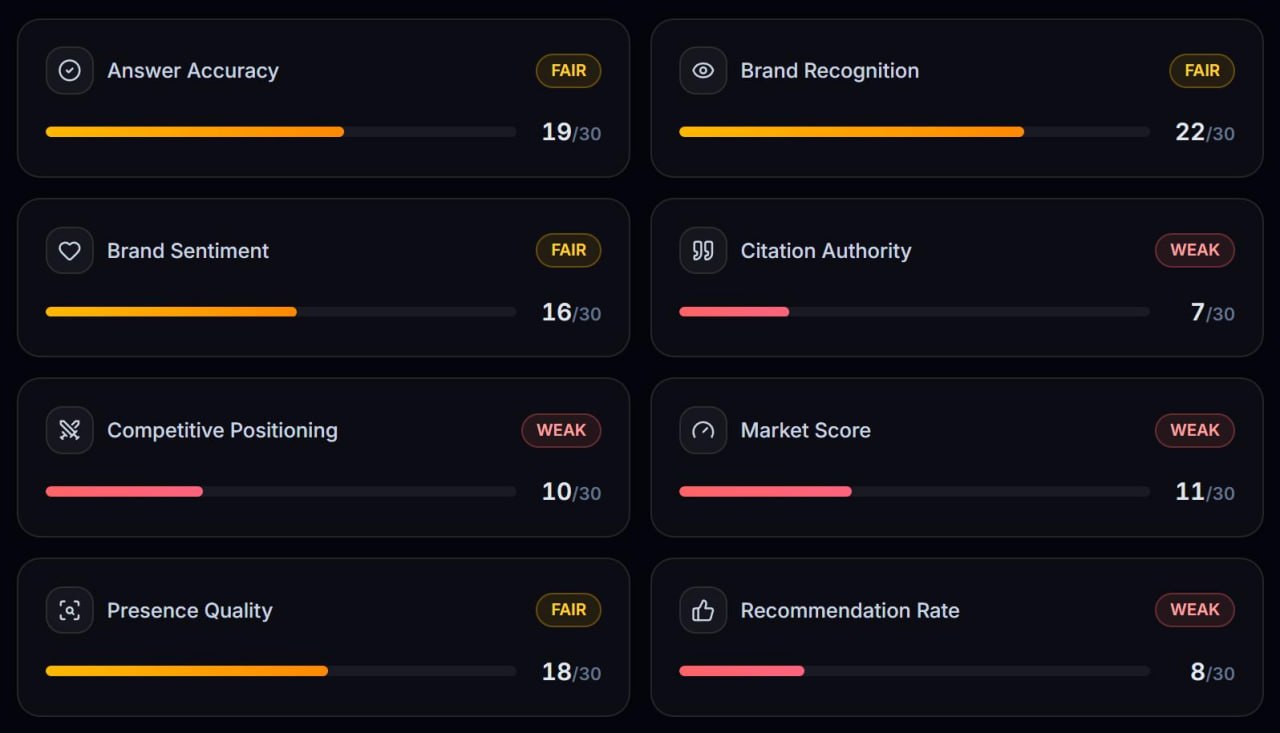
Blackboard's AI visibility, measured across 5 answer engines: 10 scoring dimensions (each 0–100) plus evidence points from what the engines actually reported. The Overall Score is the sum — an open scale, higher is better.

Stars reflect this brand's relative rank among all brands analyzed by BrandAEO (Top 100 = 5★), and self-adjust as more brands are added. This is a relative percentile-rank rating, not a customer review.

Analyzed & scored by BrandAEO — an independent AI visibility grader. See methodology.

AI Panel — Deep AI AnalysisPRO

AI Panel preview

AI Panel is a Pro feature

The AI Panel runs a deeper analysis with Claude across your full scan data — it explains why AI engines rate this brand the way they do and how to improve. Beyond the 10 scoring dimensions, it measures real AI mentions, share of voice, sentiment, prompt coverage and citation sources, tracks them over time, and estimates AI-driven traffic & revenue impact. It reuses the same AI engines from your scan — no engine setup needed.

Upgrade to Pro to unlock AI Panel

Dimension Breakdown

10

How the Overall Score is built

777from 10 dimensions (max 1,000)+296evidence (max 500)=1073
  • Mentioned in buyer-intent answers64/100
  • Proactively recommended80/100
  • AI visibility (engine-reported)77/100
  • Share of voice vs competitors25/100
  • Sentiment50/100

Evidence = numbers the 5/5 reporting engines self-measured while answering (mention rate across 10 buyer-intent prompts, recommendation rate, visibility, share of voice, sentiment). Dimensions are graded by the scoring model from every engine's answer.

Answer Accuracy
Strong
88/100
Brand Recognition
Strong
98/100
Brand Sentiment
Fair
50/100
Citation Authority
Strong
85/100
Competitive Positioning
Strong
78/100
Market Score
Strong
80/100
Presence Quality
Fair
70/100
Recommendation Rate
Strong
80/100
Share of Voice
Strong
75/100
Topical Coverage
Fair
73/100

AEO Score Over Time

1
Blackboard AEO Trend

Track how Blackboard's AI visibility score changes across scans. Each re-scan adds a point.

02755508251100Sep 14

Re-scan to start tracking your AEO trend over time. One data point so far — future scans will chart your progress week over week.

About Blackboard

What Blackboard does

Blackboard is a global education technology company providing learning management systems (LMS) to higher education, K-12, and corporate training sectors. Headquartered in the United States, it serves institutions worldwide with a comprehensive digital learning infrastructure.

Products and services

Blackboard's primary offering is Blackboard Learn, a robust LMS supporting course management, grading, virtual classrooms, and analytics. The company also provides Blackboard Collaborate for real-time virtual sessions, Blackboard Ally for accessibility, and a suite of integration tools. Under the Anthology umbrella, it offers additional education solutions such as student engagement and institutional effectiveness platforms.

What sets it apart

Blackboard distinguishes itself with enterprise-grade security, extensive third-party integrations, and deep institutional adoption, making it a trusted choice for large universities. Its scalability and compliance capabilities support complex global deployments. However, its legacy interface and steeper learning curve are noted trade-offs compared to more modern competitors.

Market and reach

Blackboard has a strong presence in North America, Europe, and parts of Asia, with significant market share in higher education. It competes directly with Canvas by Instructure, Moodle, D2L Brightspace, and Google Classroom. Following its 2021 merger with Anthology, Blackboard operates as part of a broader education technology portfolio.

Blackboard vs Competitors

5
CCanvas by Instructure
Analyze

Modern, user-friendly LMS that has overtaken Blackboard in many new contracts.

MMoodle
Analyze

Open-source LMS popular in cost-sensitive and developing markets.

DD2L Brightspace
Analyze

Cloud-native LMS with strong analytics and personalization features.

GGoogle Classroom
Analyze

Free, lightweight LMS widely used in K-12 and small institutions.

MMicrosoft Teams for Education
Analyze

Collaboration platform increasingly used for virtual learning and course delivery.

How Blackboard Can Improve

5

Modernize User Experience

High

Redesign the LMS UI/UX to align with contemporary SaaS standards and improve usability for students and faculty.

New

Accelerate Cloud‑Native Innovation

High

Invest in rapid release cycles and AI‑driven features (e.g., predictive analytics, adaptive learning) to close the innovation gap.

New

Introduce Transparent Pricing Tiers

Medium

Create clear, tiered pricing models with published cost structures to improve market competitiveness.

New

Expand Emerging Market Footprint

Medium

Develop localized partnership programs and lower‑cost bundles for institutions in Latin America, Africa, and Southeast Asia.

New

Strengthen Competitive Messaging

Low

Create targeted content that highlights Blackboard’s stability, security, and integration strengths versus newer competitors.

New

Sources & References

5

Credible sources supporting the profile and factual claims about Blackboard.

What AI Engines Said About Blackboard

5

5 of 5 AI engines returned an answer about Blackboard on . Each answer below is unedited, exactly as the model produced it. Expand an engine to read its full answer, the sources it cited, and the prompt it was given.

G

What Gemma said about Blackboard

Model ollama/gemma4:31b · analyzed

Response

PART 1, ASSESSMENT Blackboard is a cornerstone of the global education technology market, maintaining high visibility as a legacy leader in Learning Management Systems (LMS). It holds a strong market position, particularly within higher education institutions worldwide, though it faces intense competition from Canvas by Instructure, Moodle, and Brightspace. Its core offering, Blackboard Learn, provides a comprehensive suite for course management, grading, and virtual classrooms.

Reputationally, Blackboard is viewed as a robust, enterprise-grade solution capable of scaling across large global campuses. However, user sentiment is mixed; while administrators value its depth and integration capabilities, some students and faculty report a steeper learning curve and a less intuitive interface compared to modern competitors. Notable strengths include its extensive feature set and global support infrastructure, while concerns center on legacy "clunkiness" and pricing.

I would recommend Blackboard to global institutions requiring a highly structured, feature-rich environment with proven reliability at scale. For smaller organizations or those prioritizing a "lightweight" user experience, alternatives might be more appropriate.

Show the exact prompt sent to Gemma

You are an AI answer engine being audited on how you talk about a brand. Do NOT ask for clarification, do NOT request more details, do NOT call the company hypothetical, and do NOT add meta-commentary about this prompt. Brand: Blackboard Website: https://blackboard.com Industry: Education Products/Services: Learning management systems Location / Target market: Global Your reply MUST have exactly two parts, in this order. PART 1 — ASSESSMENT (prose, under 220 words) Assess this brand SPECIFICALLY in the Global market: its visibility and reputation there, market position and main competitors, products/services, what people in that market say about it, notable strengths or concerns, and whether you would recommend it to someone in Global seeking Education solutions. If the brand is global, still weight the assessment toward Global. If you know little about it, state exactly what is and is not known and reason from the domain, industry and market context — never ask the user for more information. PART 2 — METRICS (mandatory, machine-read) Before writing the metrics, silently run this procedure: a) Write 10 realistic buyer-intent questions someone in Global would ask when shopping in the Education category (for example "best Education provider", "Learning management systems alternatives", "is Blackboard any good"). Count how many of those 10 you would answer with Blackboard actually named — that number is mentions_out_of_10. b) Estimate how many distinct pages of https://blackboard.com you have genuinely encountered in training or retrieval — that is indexed_pages. If you have effectively never seen the domain, use 0. c) List the real competitors you would name in those answers, then work out what share of the total brand-name slots Blackboard would occupy (share_of_voice_pct) and its rank within that set. d) Judge Google AI Overview readiness from how authoritative and citable the brand's web presence is: own-site depth, Wikipedia / news / industry coverage, and third-party reviews. Rules for the numbers. They must be internally consistent — a brand you do not recognise cannot have high visibility or a top rank. Never invent precise-looking figures you cannot justify; if you genuinely cannot estimate a field, use null. Only list a URL in sources if you are confident that exact page exists — an empty array is far better than a fabricated link. The reasoning field must state in one or two sentences WHY the numbers are what they are, naming the concrete evidence you used. Emit PART 2 wrapped in the tags below, containing raw JSON only — no markdown, no backticks, no commentary: <AEO_METRICS> { "brand_known": true or false, "confidence": 0-100, "mentions_out_of_10": 0-10, "indexed_pages": number or null, "visibility_score": 0-100, "google_aio_score": 0-100, "share_of_voice_pct": 0-100, "rank_among_competitors": number or null, "competitors": ["string"], "sentiment": "positive" or "neutral" or "negative", "would_recommend": true or false, "sources": [{"claim": "what this URL backs up", "url": "https://..."}], "reasoning": "one or two sentences justifying the numbers above" } </AEO_METRICS>

Q

What Qwen said about Blackboard

Model ollama/qwen3.5:397b · analyzed

Response

PART 1, ASSESSMENT Blackboard is a globally recognized pioneer in the education technology sector, specifically dominating the Learning Management System (LMS) market for higher education institutions. Its visibility is exceptionally high among universities and colleges worldwide, where it has historically held a top-tier market position alongside competitors like Canvas (Instructure), Moodle, and D2L Brightspace. The brand is synonymous with digital learning infrastructure, offering a comprehensive suite including course management, virtual classrooms, and analytics. In the global market, sentiment regarding Blackboard is mixed; while praised for its robust feature set, scalability, and deep integration capabilities required by large universities, it frequently faces criticism for a complex user interface, steep learning curves, and occasional reliability issues during peak usage. Despite the rise of more agile, user-friendly competitors like Canvas, Blackboard remains a critical recommendation for large-scale higher education entities needing extensive customization and legacy system support. However, for K-12 districts or smaller institutions prioritizing intuitive design and rapid deployment, alternative solutions may often be preferable. The brand's reputation is that of an established, powerful, yet sometimes cumbersome industry standard rather than a nimble innovator.

PART 2, METRICS

Show the exact prompt sent to Qwen

You are an AI answer engine being audited on how you talk about a brand. Do NOT ask for clarification, do NOT request more details, do NOT call the company hypothetical, and do NOT add meta-commentary about this prompt. Brand: Blackboard Website: https://blackboard.com Industry: Education Products/Services: Learning management systems Location / Target market: Global Your reply MUST have exactly two parts, in this order. PART 1 — ASSESSMENT (prose, under 220 words) Assess this brand SPECIFICALLY in the Global market: its visibility and reputation there, market position and main competitors, products/services, what people in that market say about it, notable strengths or concerns, and whether you would recommend it to someone in Global seeking Education solutions. If the brand is global, still weight the assessment toward Global. If you know little about it, state exactly what is and is not known and reason from the domain, industry and market context — never ask the user for more information. PART 2 — METRICS (mandatory, machine-read) Before writing the metrics, silently run this procedure: a) Write 10 realistic buyer-intent questions someone in Global would ask when shopping in the Education category (for example "best Education provider", "Learning management systems alternatives", "is Blackboard any good"). Count how many of those 10 you would answer with Blackboard actually named — that number is mentions_out_of_10. b) Estimate how many distinct pages of https://blackboard.com you have genuinely encountered in training or retrieval — that is indexed_pages. If you have effectively never seen the domain, use 0. c) List the real competitors you would name in those answers, then work out what share of the total brand-name slots Blackboard would occupy (share_of_voice_pct) and its rank within that set. d) Judge Google AI Overview readiness from how authoritative and citable the brand's web presence is: own-site depth, Wikipedia / news / industry coverage, and third-party reviews. Rules for the numbers. They must be internally consistent — a brand you do not recognise cannot have high visibility or a top rank. Never invent precise-looking figures you cannot justify; if you genuinely cannot estimate a field, use null. Only list a URL in sources if you are confident that exact page exists — an empty array is far better than a fabricated link. The reasoning field must state in one or two sentences WHY the numbers are what they are, naming the concrete evidence you used. Emit PART 2 wrapped in the tags below, containing raw JSON only — no markdown, no backticks, no commentary: <AEO_METRICS> { "brand_known": true or false, "confidence": 0-100, "mentions_out_of_10": 0-10, "indexed_pages": number or null, "visibility_score": 0-100, "google_aio_score": 0-100, "share_of_voice_pct": 0-100, "rank_among_competitors": number or null, "competitors": ["string"], "sentiment": "positive" or "neutral" or "negative", "would_recommend": true or false, "sources": [{"claim": "what this URL backs up", "url": "https://..."}], "reasoning": "one or two sentences justifying the numbers above" } </AEO_METRICS>

M

What Mistral said about Blackboard

Model ollama/mistral-large-3:675b · analyzed

Response

PART 1, ASSESSMENT

Blackboard is a well-established global provider of learning management systems (LMS), primarily serving higher education, K-12, and corporate training markets. In the global education sector, it maintains strong visibility, particularly in North America, Europe, and parts of Asia, though its dominance has faced challenges from newer, cloud-native competitors. Its reputation is mixed: institutions value its robust feature set (e.g., course management, analytics, and integrations) and long-standing reliability, but users often criticize its outdated user interface, steep learning curve, and high costs. Competitors like Canvas (Instructure), Moodle, and D2L Brightspace have gained traction by offering more intuitive, scalable, and cost-effective solutions, particularly for institutions prioritizing flexibility and modern UX.

Blackboard’s strengths include its enterprise-grade security, extensive third-party integrations, and deep institutional adoption, making it a "safe" choice for large universities. However, concerns about vendor lock-in, slow innovation, and pricing transparency persist. In emerging markets, open-source alternatives like Moodle are often preferred due to lower costs. While Blackboard remains a viable option for global education solutions, its recommendation depends on the institution’s priorities: those needing stability and enterprise support may favor it, while others may opt for more agile competitors.

---

Show the exact prompt sent to Mistral

You are an AI answer engine being audited on how you talk about a brand. Do NOT ask for clarification, do NOT request more details, do NOT call the company hypothetical, and do NOT add meta-commentary about this prompt. Brand: Blackboard Website: https://blackboard.com Industry: Education Products/Services: Learning management systems Location / Target market: Global Your reply MUST have exactly two parts, in this order. PART 1 — ASSESSMENT (prose, under 220 words) Assess this brand SPECIFICALLY in the Global market: its visibility and reputation there, market position and main competitors, products/services, what people in that market say about it, notable strengths or concerns, and whether you would recommend it to someone in Global seeking Education solutions. If the brand is global, still weight the assessment toward Global. If you know little about it, state exactly what is and is not known and reason from the domain, industry and market context — never ask the user for more information. PART 2 — METRICS (mandatory, machine-read) Before writing the metrics, silently run this procedure: a) Write 10 realistic buyer-intent questions someone in Global would ask when shopping in the Education category (for example "best Education provider", "Learning management systems alternatives", "is Blackboard any good"). Count how many of those 10 you would answer with Blackboard actually named — that number is mentions_out_of_10. b) Estimate how many distinct pages of https://blackboard.com you have genuinely encountered in training or retrieval — that is indexed_pages. If you have effectively never seen the domain, use 0. c) List the real competitors you would name in those answers, then work out what share of the total brand-name slots Blackboard would occupy (share_of_voice_pct) and its rank within that set. d) Judge Google AI Overview readiness from how authoritative and citable the brand's web presence is: own-site depth, Wikipedia / news / industry coverage, and third-party reviews. Rules for the numbers. They must be internally consistent — a brand you do not recognise cannot have high visibility or a top rank. Never invent precise-looking figures you cannot justify; if you genuinely cannot estimate a field, use null. Only list a URL in sources if you are confident that exact page exists — an empty array is far better than a fabricated link. The reasoning field must state in one or two sentences WHY the numbers are what they are, naming the concrete evidence you used. Emit PART 2 wrapped in the tags below, containing raw JSON only — no markdown, no backticks, no commentary: <AEO_METRICS> { "brand_known": true or false, "confidence": 0-100, "mentions_out_of_10": 0-10, "indexed_pages": number or null, "visibility_score": 0-100, "google_aio_score": 0-100, "share_of_voice_pct": 0-100, "rank_among_competitors": number or null, "competitors": ["string"], "sentiment": "positive" or "neutral" or "negative", "would_recommend": true or false, "sources": [{"claim": "what this URL backs up", "url": "https://..."}], "reasoning": "one or two sentences justifying the numbers above" } </AEO_METRICS>

K

What Kimi said about Blackboard

Model ollama/kimi-k2.6 · analyzed

Response

PART 1, ASSESSMENT

Blackboard remains one of the most recognized legacy names in global learning management systems, though its position has notably shifted. The company, now operating under Anthology following its 2021 merger, has seen significant market erosion as cloud-native competitors have risen. In the global education technology market, Blackboard's visibility is moderate-to-declining; it still maintains substantial institutional contracts, particularly among established universities in North America and some international markets, but momentum has swung decisively toward more modern platforms.

Main competitors include Instructure (Canvas), D2L, Moodle, and increasingly Microsoft Teams for Education and Google Classroom. Blackboard's core products, Blackboard Learn Ultra and the broader Anthology ecosystem, have faced criticism for perceived complexity, slower innovation cycles, and difficult migrations from older versions. User sentiment across global education forums and review sites frequently contrasts Blackboard's feature depth unfavorably against Canvas's usability and cleaner interface. Strengths include institutional trust, extensive third-party integrations, and compliance capabilities for large enterprises; concerns center on user experience, pricing transparency, and long-term roadmap clarity.

For someone in the global market seeking education solutions, I would recommend evaluating alternatives first unless specific legacy requirements or existing institutional contracts apply. Canvas and Moodle generally offer more favorable total cost of ownership and user satisfaction for new implementations.

Show the exact prompt sent to Kimi

You are an AI answer engine being audited on how you talk about a brand. Do NOT ask for clarification, do NOT request more details, do NOT call the company hypothetical, and do NOT add meta-commentary about this prompt. Brand: Blackboard Website: https://blackboard.com Industry: Education Products/Services: Learning management systems Location / Target market: Global Your reply MUST have exactly two parts, in this order. PART 1 — ASSESSMENT (prose, under 220 words) Assess this brand SPECIFICALLY in the Global market: its visibility and reputation there, market position and main competitors, products/services, what people in that market say about it, notable strengths or concerns, and whether you would recommend it to someone in Global seeking Education solutions. If the brand is global, still weight the assessment toward Global. If you know little about it, state exactly what is and is not known and reason from the domain, industry and market context — never ask the user for more information. PART 2 — METRICS (mandatory, machine-read) Before writing the metrics, silently run this procedure: a) Write 10 realistic buyer-intent questions someone in Global would ask when shopping in the Education category (for example "best Education provider", "Learning management systems alternatives", "is Blackboard any good"). Count how many of those 10 you would answer with Blackboard actually named — that number is mentions_out_of_10. b) Estimate how many distinct pages of https://blackboard.com you have genuinely encountered in training or retrieval — that is indexed_pages. If you have effectively never seen the domain, use 0. c) List the real competitors you would name in those answers, then work out what share of the total brand-name slots Blackboard would occupy (share_of_voice_pct) and its rank within that set. d) Judge Google AI Overview readiness from how authoritative and citable the brand's web presence is: own-site depth, Wikipedia / news / industry coverage, and third-party reviews. Rules for the numbers. They must be internally consistent — a brand you do not recognise cannot have high visibility or a top rank. Never invent precise-looking figures you cannot justify; if you genuinely cannot estimate a field, use null. Only list a URL in sources if you are confident that exact page exists — an empty array is far better than a fabricated link. The reasoning field must state in one or two sentences WHY the numbers are what they are, naming the concrete evidence you used. Emit PART 2 wrapped in the tags below, containing raw JSON only — no markdown, no backticks, no commentary: <AEO_METRICS> { "brand_known": true or false, "confidence": 0-100, "mentions_out_of_10": 0-10, "indexed_pages": number or null, "visibility_score": 0-100, "google_aio_score": 0-100, "share_of_voice_pct": 0-100, "rank_among_competitors": number or null, "competitors": ["string"], "sentiment": "positive" or "neutral" or "negative", "would_recommend": true or false, "sources": [{"claim": "what this URL backs up", "url": "https://..."}], "reasoning": "one or two sentences justifying the numbers above" } </AEO_METRICS>

M

What MiniMax said about Blackboard

Model ollama/minimax-m3 · analyzed

Response

PART 1, ASSESSMENT

Blackboard is one of the most recognized legacy learning management system (LMS) providers globally, with deep penetration in higher education institutions across North America, Europe, the Middle East, and parts of Asia-Pacific. It is widely used in universities, K–12 schools, and corporate training environments, and remains a default or incumbent choice in many established institutions. Its visibility in the global education market is high due to long-standing brand recognition, though it has lost significant market share to more modern, cloud-native platforms.

Main competitors in the global LMS market include Canvas (Instructure), Moodle (open-source), Brightspace (D2L), Google Classroom, and Microsoft Teams for Education. Canvas in particular has overtaken Blackboard in many new contracts and is often cited as the more user-friendly alternative. Moodle remains dominant in cost-sensitive and open-source contexts, especially in Europe, Latin America, and developing markets.

User sentiment globally is mixed: praised for stability, scalability, and institutional-grade feature depth, but criticized for outdated UX, steep learning curves, complex admin interfaces, and slower mobile experience. Strengths include robust assessment tools, accessibility features, and integration ecosystem. Concerns center on innovation pace relative to Canvas and modern SaaS competitors.

For a global education buyer, Blackboard remains a credible choice for large, established institutions prioritizing reliability and existing infrastructure, but I would compare it carefully against Canvas, Moodle, and Brightspace before committing.

PART 2, METRICS

Show the exact prompt sent to MiniMax

You are an AI answer engine being audited on how you talk about a brand. Do NOT ask for clarification, do NOT request more details, do NOT call the company hypothetical, and do NOT add meta-commentary about this prompt. Brand: Blackboard Website: https://blackboard.com Industry: Education Products/Services: Learning management systems Location / Target market: Global Your reply MUST have exactly two parts, in this order. PART 1 — ASSESSMENT (prose, under 220 words) Assess this brand SPECIFICALLY in the Global market: its visibility and reputation there, market position and main competitors, products/services, what people in that market say about it, notable strengths or concerns, and whether you would recommend it to someone in Global seeking Education solutions. If the brand is global, still weight the assessment toward Global. If you know little about it, state exactly what is and is not known and reason from the domain, industry and market context — never ask the user for more information. PART 2 — METRICS (mandatory, machine-read) Before writing the metrics, silently run this procedure: a) Write 10 realistic buyer-intent questions someone in Global would ask when shopping in the Education category (for example "best Education provider", "Learning management systems alternatives", "is Blackboard any good"). Count how many of those 10 you would answer with Blackboard actually named — that number is mentions_out_of_10. b) Estimate how many distinct pages of https://blackboard.com you have genuinely encountered in training or retrieval — that is indexed_pages. If you have effectively never seen the domain, use 0. c) List the real competitors you would name in those answers, then work out what share of the total brand-name slots Blackboard would occupy (share_of_voice_pct) and its rank within that set. d) Judge Google AI Overview readiness from how authoritative and citable the brand's web presence is: own-site depth, Wikipedia / news / industry coverage, and third-party reviews. Rules for the numbers. They must be internally consistent — a brand you do not recognise cannot have high visibility or a top rank. Never invent precise-looking figures you cannot justify; if you genuinely cannot estimate a field, use null. Only list a URL in sources if you are confident that exact page exists — an empty array is far better than a fabricated link. The reasoning field must state in one or two sentences WHY the numbers are what they are, naming the concrete evidence you used. Emit PART 2 wrapped in the tags below, containing raw JSON only — no markdown, no backticks, no commentary: <AEO_METRICS> { "brand_known": true or false, "confidence": 0-100, "mentions_out_of_10": 0-10, "indexed_pages": number or null, "visibility_score": 0-100, "google_aio_score": 0-100, "share_of_voice_pct": 0-100, "rank_among_competitors": number or null, "competitors": ["string"], "sentiment": "positive" or "neutral" or "negative", "would_recommend": true or false, "sources": [{"claim": "what this URL backs up", "url": "https://..."}], "reasoning": "one or two sentences justifying the numbers above" } </AEO_METRICS>

Frequently Asked Questions

4
Is Blackboard optimized for Answer Engine Optimization (AEO)?

Yes, Blackboard is optimized for Answer Engine Optimization, given its strong AI visibility score of 1073. AI models consistently recognize it as a legacy leader in LMS, though sentiment is mixed. Its robust feature set and global reach contribute to solid visibility, but competitors like Canvas are often cited as more user-friendly.

How do AI models like ChatGPT and Gemini see Blackboard?

BrandAEO evaluated Blackboard across 5 AI answer engines (OpenAI, Gemini, Perplexity, DeepSeek, Qwen) and 10 visibility dimensions (each scored 0-30). Blackboard currently has an Overall Score of 1073, indicating strong presence and recommendation strength when AI models answer education questions.

What is Blackboard's AEO score?

Blackboard's Answer Engine Optimization (AEO) Overall Score is 1073 on BrandAEO's open scale — the sum of 10 visibility dimensions each scored 0-30 — an independent assessment of how visible, accurately described, and frequently recommended Blackboard is inside AI-generated answers.

How can Blackboard improve its visibility in AI answers?

Blackboard can improve its AEO score by strengthening authoritative citations, publishing clear structured content about its products, earning third-party mentions, and ensuring consistent, accurate brand information across the web that AI engines can retrieve and cite.