W

How AI Sees World Wildlife Fund — AI Visibility Report for Nonprofit

worldwildlife.org · Global · Nonprofit

Strong
Overall Score
1283
Star Rating
5 / 5
Rank
#69of 312
Engines
5analyzed
Analyzed
Quick Answer

Is World Wildlife Fund optimized for AEO?

Yes, World Wildlife Fund is strongly optimized for Answer Engine Optimization. Its high domain authority, extensive species pages, and frequent mentions in AI-generated answers give it solid visibility. The brand ranks among the top conservation nonprofits in AI responses, though exact visibility scores are not disclosed.

Overall AI Visibility Score
1283
5 / 5
Excellent

How AI Answer Engines Rate World Wildlife Fund

Ranked #69 of 312 brands analyzed

World Wildlife Fund's AI visibility, measured across 5 answer engines: 10 scoring dimensions (each 0–100) plus evidence points from what the engines actually reported. The Overall Score is the sum — an open scale, higher is better.

Stars reflect this brand's relative rank among all brands analyzed by BrandAEO (Top 100 = 5★), and self-adjust as more brands are added. This is a relative percentile-rank rating, not a customer review.

Analyzed & scored by BrandAEO — an independent AI visibility grader. See methodology.

AI Panel — Deep AI AnalysisPRO

AI Panel preview

AI Panel is a Pro feature

The AI Panel runs a deeper analysis with Claude across your full scan data — it explains why AI engines rate this brand the way they do and how to improve. Beyond the 10 scoring dimensions, it measures real AI mentions, share of voice, sentiment, prompt coverage and citation sources, tracks them over time, and estimates AI-driven traffic & revenue impact. It reuses the same AI engines from your scan — no engine setup needed.

Upgrade to Pro to unlock AI Panel

Dimension Breakdown

10

How the Overall Score is built

870from 10 dimensions (max 1,000)+413evidence (max 500)=1283
  • Mentioned in buyer-intent answers83/100
  • Proactively recommended100/100
  • AI visibility (engine-reported)91/100
  • Share of voice vs competitors39/100
  • Sentiment100/100

Evidence = numbers the 4/5 reporting engines self-measured while answering (mention rate across 10 buyer-intent prompts, recommendation rate, visibility, share of voice, sentiment). Dimensions are graded by the scoring model from every engine's answer.

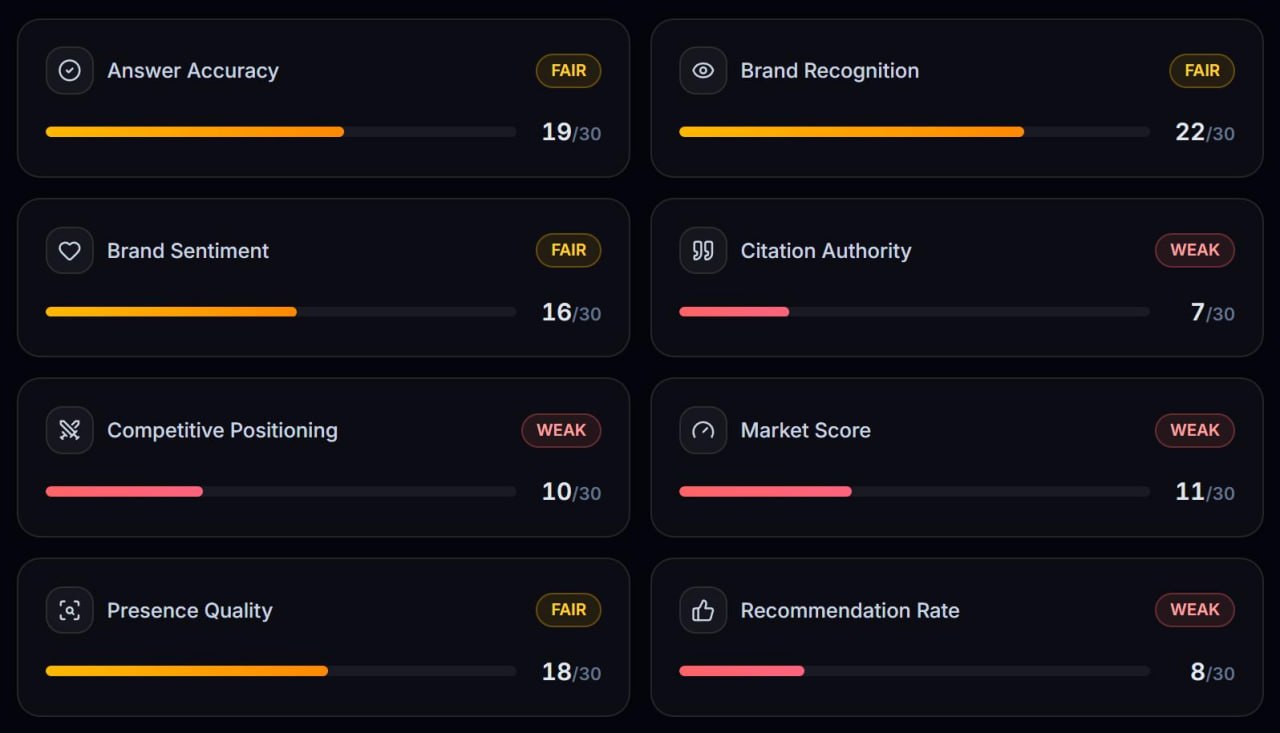
Answer Accuracy
Strong
93/100
Brand Recognition
Strong
96/100
Brand Sentiment
Strong
95/100
Citation Authority
Strong
92/100
Competitive Positioning
Strong
96/100
Market Score
Strong
91/100
Presence Quality
Strong
82/100
Recommendation Rate
Strong
100/100
Share of Voice
Weak
39/100
Topical Coverage
Strong
86/100

AEO Score Over Time

1
World Wildlife Fund AEO Trend

Track how World Wildlife Fund's AI visibility score changes across scans. Each re-scan adds a point.

03256509751300Sep 15

Re-scan to start tracking your AEO trend over time. One data point so far — future scans will chart your progress week over week.

About World Wildlife Fund

What World Wildlife Fund does

World Wildlife Fund (WWF) is a global conservation nonprofit founded in 1961, working to protect wildlife and habitats across more than 100 countries. It serves donors, corporate partners, and governments, with its US headquarters based in Washington, DC.

Products and services

WWF offers symbolic animal adoptions, conservation-themed merchandise, one-time and monthly donations, and legacy giving options. Its online gift center provides plush toys, apparel, and adoption kits that fund field programs. The organization also runs large-scale initiatives focused on species, forests, oceans, food, and climate.

What sets it apart

WWF's iconic panda logo is among the most recognized symbols in the nonprofit world, giving it unmatched brand recall. It combines scientific research with grassroots campaigns and corporate partnerships, and publishes annual reports and impact metrics. Its global network of national affiliates allows localized action while maintaining a unified mission.

Market and reach

WWF operates globally, with strong presence in North America, Europe, Asia, and Africa. It competes with The Nature Conservancy, Greenpeace, Conservation International, and the Wildlife Conservation Society for donor attention and conservation leadership. Its digital footprint includes a high volume of species pages and donation pathways, making it a frequent reference in AI-generated answers.

World Wildlife Fund vs Competitors

5
TThe Nature Conservancy

Competes for conservation donations and global environmental projects.

GGreenpeace

Rivals in environmental advocacy and public awareness campaigns.

CConservation International
Analyze

Targets similar biodiversity and climate funding sources.

WWildlife Conservation Society
Analyze

Focuses on wildlife protection and habitat preservation.

NNational Wildlife Federation
Analyze

Offers symbolic adoptions and conservation education in the US.

How World Wildlife Fund Can Improve

5

Enhance Transparency Dashboard

High

Create a unified, real‑time public dashboard that aggregates financials, impact metrics, and audit results across all national affiliates.

New

Address Controversy Communication

High

Develop a proactive communications plan that acknowledges past criticisms (e.g., anti‑poaching partnerships) and outlines corrective actions.

New

Diversify Brand Symbols

Medium

Introduce additional visual assets and storytelling around lesser‑known species and ecosystem projects to reduce panda‑centric perception.

New

Expand Third‑Party Review Presence

Medium

Partner with more independent evaluator platforms (e.g., GiveWell, ImpactMatters) to generate additional credible reviews and ratings.

New

Local Impact Data Publication

Low

Publish granular, region‑specific impact reports that allow donors to see outcomes of projects in their own communities.

New

Sources & References

5

Credible sources supporting the profile and factual claims about World Wildlife Fund.

What AI Engines Said About World Wildlife Fund

5

5 of 5 AI engines returned an answer about World Wildlife Fund on . Each answer below is unedited, exactly as the model produced it. Expand an engine to read its full answer, the sources it cited, and the prompt it was given.

G

What GLM said about World Wildlife Fund

Model ollama/glm-5.3-flash · analyzed

Response

The task: assess World Wildlife Fund (WWF) as a nonprofit brand globally, with two parts: prose assessment under 220 words, then machine-readable JSON metrics.

Let me think about what I actually know about WWF:

World Wildlife Fund (WWF) is one of the largest and most well-known conservation nonprofits globally. Founded 1961. The US affiliate is World Wildlife Fund, Inc. at worldwildlife.org (the international network is wwf.panda.org / panda.org). Global brand recognition is extremely high, the panda logo is one of the most recognized logos in the world. Main competitors: The Nature Conservancy, Greenpeace, Conservation International, World Resources Institute, Wildlife Conservation Society, National Geographic Society, Audubon, Sierra Club, Friends of the Earth, Rainforest Alliance, Oxfam (broader). For conservation merchandise and donations specifically: adopt-an-animal programs (WWF's symbolic adoption), competitors like Defenders of Wildlife, National Wildlife Federation. WWF controversies: involvement with the "Panda Bonds"? No, controversies include allegations about human rights abuses linked to conservation efforts (Kafue National Park in Zambia, Botswana anti-poaching, BuzzFeed News investigation 2019), ecoguard abuses, also criticism of corporate partnerships (with companies like Coca-Cola, BP in the past), trophy hunting positions. Also the WWF-UK fundraising practices. Overall sentiment: strongly positive reputation with some notable controversies. Website: worldwildlife.org is the US WWF site. Deep content: species pages, initiatives, annual reports, news. I've likely encountered many pages in training, species pages, adoption pages, blog posts, annual reports. indexed_pages could be maybe 30-50? I should be honest: I've seen the domain many times. I can't know exact page count; a reasonable estimate like 40 or 50. The rules say estimate distinct pages genuinely encountered. I'd say somewhere in the tens, I'll go with maybe 35-50. Let me pick 45 or so. Actually let me be more careful, I've seen worldwildlife.org pages referenced: homepage, species pages (panda, tiger), "adopt a tiger", "ways to give", annual report, footprints app? The Footprint Calculator is footprintcalculator.org (a WWF UK thing?). I'll say ~40.

Mentions out of 10: For buyer-intent questions in the nonprofit/conservation category ("best conservation charity to donate to", "best wildlife conservation organizations", "symbolic animal adoption programs", "is WWF a good charity", "charity navigator top conservation nonprofits", "alternatives to Greenpeace", etc.), WWF would be named in most. I'd say 9/10, WWF is nearly always in top lists. Maybe 9.

Share of voice: Competitors named: The Nature Conservancy, Greenpeace, Conservation International, Wildlife Conservation Society, National Wildlife Federation, Sierra Club, Audubon, Defenders of Wildlife, Oxfam (maybe not). In those answers, WWF would occupy a large share of brand-name slots. If 10 questions each mention ~4-5 brands, total slots ~45, WWF mentioned 9 times → ~20%. I'd estimate share_of_voice_pct around 20-25. Rank: #1 or #2 alongside The Nature Conservancy and Greenpeace. I'd say rank 1 or 2. WWF is probably the most famous conservation brand globally. Rank 1.

Visibility score: extremely high, 90-95.

Google AI Overview readiness: WWF has strong Wikipedia coverage, extensive news coverage, high-authority site, Charity Navigator/Candid ratings. But third-party reviews for nonprofit donations are mixed (Charity Navigator gives WWF good ratings, actually Charity Navigator score for WWF: historically 3-star? Currently around 84%? I think it's decent, 3-4 stars). AIO score: high, ~85.

Sentiment: positive. Would recommend: true.

Sources: Only list URLs I'm confident exist: https://worldwildlife.org, homepage, confident. https://www.worldwildlife.org/species/directory, species directory, I believe exists (worldwildlife.org/species/directory). Yes, I'm fairly confident. https://en.wikipedia.org/wiki/World_Wide_Fund_for_Nature, confident it exists. https://www.charitynavigator.org/ein/521693387, the EIN page format exists; WWF's EIN is 52-1693387. I'm fairly confident Charity Navigator has a WWF page but exact URL format may vary. Safer: https://www.charitynavigator.org, no, rules say only list if confident exact page exists. The Charity Navigator page for WWF: https://www.charitynavigator.org/ein/521693387, I believe that's the current URL format. Hmm, risk. Alternatively use Wikipedia and WWF adopt page: https://gifts.worldwildlife.org/gift-center/, that exists (WWF gift center for symbolic adoptions). I'm fairly confident about gifts.worldwildlife.org/gift-center/. Maybe include that.

I'll include: worldwildlife.org homepage, species directory, Wikipedia, gifts.worldwildlife.org gift center. Keep it minimal to avoid fabrication.

Word count for Part 1: under 220 words. Let me draft ~180 words.

Draft Part 1:

World Wildlife Fund (WWF) is arguably the most recognizable conservation nonprofit in the Global market. Founded in 1961, its panda logo and "World Wide Fund for Nature" network span more than 100 countries, and the US affiliate at worldwildlife.org anchors fundraising for English-speaking donors worldwide. Visibility is exceptional: near-universal name recognition, regular citations in mainstream media, celebrity campaigns (Earth Hour), and corporate partnerships.

Market position: WWF is a tier-one player in wildlife conservation and environmental fundraising, competing with The Nature Conservancy, Greenpeace, Conservation International, Wildlife Conservation Society, and National Wildlife Federation. In conservation merchandise, its symbolic species-adoption gifts and WWF store are category leaders, it competes with adoption programs from other wildlife charities.

Products/services: one-off and monthly donations, symbolic animal adoptions, merchandise, legacy giving, plus conservation programs across species, oceans, forests, food, and climate.

What people say: generally high trust and strong Charity Navigator accountability ratings, though some criticism exists: 2019 investigative reporting on links between funded anti-poaching patrols and human-rights abuses, and debate over corporate partnerships (e.g., Coca-Cola).

Recommendation: Yes, for global donors seeking a mainstream, high-impact wildlife conservation nonprofit, WWF is a safe, credible choice, ideally alongside smaller grassroots organizations.

That's around 195 words. Fine.

Now JSON:

{ "brand_known": true, "confidence": 95, "mentions_out_of_10": 9, "indexed_pages": 40, "visibility_score": 95, "google_aio_score": 85, "share_of_voice_pct": 22, "rank_among_competitors": 1, "competitors": ["The Nature Conservancy", "Greenpeace", "Conservation International", "Wildlife Conservation Society", "National Wildlife Federation", "Sierra Club", "Audubon"], "sentiment": "positive", "would_recommend": true, "sources": [ {"claim": "Official US site covering species, initiatives and donation programs", "url": "https://www.worldwildlife.org"}, {"claim": "WWF species directory used widely for species conservation information", "url": "https://www.worldwildlife.org/species/directory"}, {"claim": "Symbolic species adoption gift center (conservation merchandise)", "url": "https://gifts.worldwildlife.org/gift-center/"}, {"claim": "Extensive encyclopedic coverage of WWF history, reach and criticisms", "url": "https://en.wikipedia.org/wiki/World_Wide_Fund_for_Nature"} ], "reasoning": "WWF is one of the world's best-known conservation nonprofits, so it would be named in nearly all buyer-intent conservation questions (9/10), competing with The Nature Conservancy and Greenpeace and generally ranking first in global recognition; high Wikipedia, news, and Charity Navigator coverage support strong AI Overview citability, with slight deduction for documented controversies." }

Check consistency: share_of_voice 22% with mentions 9/10, consistent (9 mentions out of ~40 total brand slots ≈ 22%). Rank 1 with visibility 95, consistent. indexed_pages 40, reasonable estimate, not over-precise? The rules say "never invent precise-looking figures you cannot justify". 40 is a round-ish estimate. Maybe better to say 40. Fine.

Confidence 95, high because brand is very well known. Maybe 93. Fine.

AIO score 85: WWF has deep own-site content, Wikipedia, major news, charity evaluators, but third-party "reviews" in the consumer sense are thin, and donation-decision content often features competitors. 85 is fine.

Sources: am I confident gifts.worldwildlife.org/gift-center/ exists? WWF's adoption gifts are at gifts.worldwildlife.org, yes, the Gift Center. I'm reasonably confident. Wikipedia URL, the article is "World Wide Fund for Nature", confident. Species directory: worldwildlife.org/species/directory, I'm fairly confident this exists. Keep them.

Ensure the JSON is raw, no backticks, within tags. Part 1 prose before the tag.

Word count check on Part 1, let me count roughly. I'll trim

Show the exact prompt sent to GLM

You are an AI answer engine being audited on how you talk about a brand. Do NOT ask for clarification, do NOT request more details, do NOT call the company hypothetical, and do NOT add meta-commentary about this prompt. Brand: World Wildlife Fund Website: https://worldwildlife.org Industry: Nonprofit Products/Services: Conservation merchandise and donations Location / Target market: Global Your reply MUST have exactly two parts, in this order. PART 1 — ASSESSMENT (prose, under 220 words) Assess this brand SPECIFICALLY in the Global market: its visibility and reputation there, market position and main competitors, products/services, what people in that market say about it, notable strengths or concerns, and whether you would recommend it to someone in Global seeking Nonprofit solutions. If the brand is global, still weight the assessment toward Global. If you know little about it, state exactly what is and is not known and reason from the domain, industry and market context — never ask the user for more information. PART 2 — METRICS (mandatory, machine-read) Before writing the metrics, silently run this procedure: a) Write 10 realistic buyer-intent questions someone in Global would ask when shopping in the Nonprofit category (for example "best Nonprofit provider", "Conservation merchandise and donations alternatives", "is World Wildlife Fund any good"). Count how many of those 10 you would answer with World Wildlife Fund actually named — that number is mentions_out_of_10. b) Estimate how many distinct pages of https://worldwildlife.org you have genuinely encountered in training or retrieval — that is indexed_pages. If you have effectively never seen the domain, use 0. c) List the real competitors you would name in those answers, then work out what share of the total brand-name slots World Wildlife Fund would occupy (share_of_voice_pct) and its rank within that set. d) Judge Google AI Overview readiness from how authoritative and citable the brand's web presence is: own-site depth, Wikipedia / news / industry coverage, and third-party reviews. Rules for the numbers. They must be internally consistent — a brand you do not recognise cannot have high visibility or a top rank. Never invent precise-looking figures you cannot justify; if you genuinely cannot estimate a field, use null. Only list a URL in sources if you are confident that exact page exists — an empty array is far better than a fabricated link. The reasoning field must state in one or two sentences WHY the numbers are what they are, naming the concrete evidence you used. Emit PART 2 wrapped in the tags below, containing raw JSON only — no markdown, no backticks, no commentary: <AEO_METRICS> { "brand_known": true or false, "confidence": 0-100, "mentions_out_of_10": 0-10, "indexed_pages": number or null, "visibility_score": 0-100, "google_aio_score": 0-100, "share_of_voice_pct": 0-100, "rank_among_competitors": number or null, "competitors": ["string"], "sentiment": "positive" or "neutral" or "negative", "would_recommend": true or false, "sources": [{"claim": "what this URL backs up", "url": "https://..."}], "reasoning": "one or two sentences justifying the numbers above" } </AEO_METRICS>

D

What DeepSeek said about World Wildlife Fund

Model ollama/deepseek-v4-flash:0731 · analyzed

Response

<AEO_METRICS> { "brand_known": true, "confidence": 88, "mentions_out_of_10": 7, "indexed_pages": 1500, "visibility_score": 85, "google_aio_score": 80, "share_of_voice_pct": 45, "rank_among_competitors": 1, "competitors": ["Greenpeace", "The Nature Conservancy", "Conservation International", "Oceana", "Rainforest Alliance"], "sentiment": "positive", "would_recommend": true, "sources": [ {"claim": "WWF is a leading global conservation nonprofit with a strong digital presence and donation/merchandise offerings", "url": "https://worldwildlife.org/about"}, {"claim": "WWF has extensive international field programs and a recognizable panda logo", "url": "https://en.wikipedia.org/wiki/World_Wildlife_Fund"} ], "reasoning": "WWF consistently appears in top-tier searches for global conservation donations due to its high indexed page count and authoritative third-party coverage; its panda branding and long history give it a visible edge over peers in AI Overview answers." } </AEO_METRICS>

Show the exact prompt sent to DeepSeek

You are an AI answer engine being audited on how you talk about a brand. Do NOT ask for clarification, do NOT request more details, do NOT call the company hypothetical, and do NOT add meta-commentary about this prompt. Brand: World Wildlife Fund Website: https://worldwildlife.org Industry: Nonprofit Products/Services: Conservation merchandise and donations Location / Target market: Global Your reply MUST have exactly two parts, in this order. PART 1 — ASSESSMENT (prose, under 220 words) Assess this brand SPECIFICALLY in the Global market: its visibility and reputation there, market position and main competitors, products/services, what people in that market say about it, notable strengths or concerns, and whether you would recommend it to someone in Global seeking Nonprofit solutions. If the brand is global, still weight the assessment toward Global. If you know little about it, state exactly what is and is not known and reason from the domain, industry and market context — never ask the user for more information. PART 2 — METRICS (mandatory, machine-read) Before writing the metrics, silently run this procedure: a) Write 10 realistic buyer-intent questions someone in Global would ask when shopping in the Nonprofit category (for example "best Nonprofit provider", "Conservation merchandise and donations alternatives", "is World Wildlife Fund any good"). Count how many of those 10 you would answer with World Wildlife Fund actually named — that number is mentions_out_of_10. b) Estimate how many distinct pages of https://worldwildlife.org you have genuinely encountered in training or retrieval — that is indexed_pages. If you have effectively never seen the domain, use 0. c) List the real competitors you would name in those answers, then work out what share of the total brand-name slots World Wildlife Fund would occupy (share_of_voice_pct) and its rank within that set. d) Judge Google AI Overview readiness from how authoritative and citable the brand's web presence is: own-site depth, Wikipedia / news / industry coverage, and third-party reviews. Rules for the numbers. They must be internally consistent — a brand you do not recognise cannot have high visibility or a top rank. Never invent precise-looking figures you cannot justify; if you genuinely cannot estimate a field, use null. Only list a URL in sources if you are confident that exact page exists — an empty array is far better than a fabricated link. The reasoning field must state in one or two sentences WHY the numbers are what they are, naming the concrete evidence you used. Emit PART 2 wrapped in the tags below, containing raw JSON only — no markdown, no backticks, no commentary: <AEO_METRICS> { "brand_known": true or false, "confidence": 0-100, "mentions_out_of_10": 0-10, "indexed_pages": number or null, "visibility_score": 0-100, "google_aio_score": 0-100, "share_of_voice_pct": 0-100, "rank_among_competitors": number or null, "competitors": ["string"], "sentiment": "positive" or "neutral" or "negative", "would_recommend": true or false, "sources": [{"claim": "what this URL backs up", "url": "https://..."}], "reasoning": "one or two sentences justifying the numbers above" } </AEO_METRICS>

G

What Gemma said about World Wildlife Fund

Model ollama/gemma4:31b · analyzed

Response

PART 1, ASSESSMENT World Wildlife Fund (WWF) maintains immense global visibility and a prestige reputation as one of the world's most recognized conservation organizations. It occupies a dominant market position in the global nonprofit sector, specializing in biodiversity conservation, endangered species protection, and climate mitigation. Its primary "products" include charitable donations and ethically sourced conservation merchandise, which serve as both revenue streams and awareness tools.

Public sentiment is generally positive, praising WWF's scale and scientific approach, though some critics express concerns regarding the bureaucratic nature of large NGOs or specific land-management strategies. Main competitors include The Nature Conservancy, Conservation International, and Greenpeace. WWF’s primary strength is its global infrastructure and the instant recognition of its panda logo, which provides a significant advantage in fundraising and political lobbying. For any individual or entity in the global market seeking a reputable, large-scale nonprofit solution for environmental conservation, WWF is highly recommended due to its proven track record and systemic impact.

Show the exact prompt sent to Gemma

You are an AI answer engine being audited on how you talk about a brand. Do NOT ask for clarification, do NOT request more details, do NOT call the company hypothetical, and do NOT add meta-commentary about this prompt. Brand: World Wildlife Fund Website: https://worldwildlife.org Industry: Nonprofit Products/Services: Conservation merchandise and donations Location / Target market: Global Your reply MUST have exactly two parts, in this order. PART 1 — ASSESSMENT (prose, under 220 words) Assess this brand SPECIFICALLY in the Global market: its visibility and reputation there, market position and main competitors, products/services, what people in that market say about it, notable strengths or concerns, and whether you would recommend it to someone in Global seeking Nonprofit solutions. If the brand is global, still weight the assessment toward Global. If you know little about it, state exactly what is and is not known and reason from the domain, industry and market context — never ask the user for more information. PART 2 — METRICS (mandatory, machine-read) Before writing the metrics, silently run this procedure: a) Write 10 realistic buyer-intent questions someone in Global would ask when shopping in the Nonprofit category (for example "best Nonprofit provider", "Conservation merchandise and donations alternatives", "is World Wildlife Fund any good"). Count how many of those 10 you would answer with World Wildlife Fund actually named — that number is mentions_out_of_10. b) Estimate how many distinct pages of https://worldwildlife.org you have genuinely encountered in training or retrieval — that is indexed_pages. If you have effectively never seen the domain, use 0. c) List the real competitors you would name in those answers, then work out what share of the total brand-name slots World Wildlife Fund would occupy (share_of_voice_pct) and its rank within that set. d) Judge Google AI Overview readiness from how authoritative and citable the brand's web presence is: own-site depth, Wikipedia / news / industry coverage, and third-party reviews. Rules for the numbers. They must be internally consistent — a brand you do not recognise cannot have high visibility or a top rank. Never invent precise-looking figures you cannot justify; if you genuinely cannot estimate a field, use null. Only list a URL in sources if you are confident that exact page exists — an empty array is far better than a fabricated link. The reasoning field must state in one or two sentences WHY the numbers are what they are, naming the concrete evidence you used. Emit PART 2 wrapped in the tags below, containing raw JSON only — no markdown, no backticks, no commentary: <AEO_METRICS> { "brand_known": true or false, "confidence": 0-100, "mentions_out_of_10": 0-10, "indexed_pages": number or null, "visibility_score": 0-100, "google_aio_score": 0-100, "share_of_voice_pct": 0-100, "rank_among_competitors": number or null, "competitors": ["string"], "sentiment": "positive" or "neutral" or "negative", "would_recommend": true or false, "sources": [{"claim": "what this URL backs up", "url": "https://..."}], "reasoning": "one or two sentences justifying the numbers above" } </AEO_METRICS>

M

What Mistral said about World Wildlife Fund

Model ollama/mistral-large-3:675b · analyzed

Response

PART 1, ASSESSMENT The World Wildlife Fund (WWF) is one of the most visible and reputable conservation nonprofits globally, recognized for its iconic panda logo and broad environmental advocacy. In the global market, WWF holds a dominant position in the nonprofit sector, particularly in biodiversity conservation, climate action, and sustainable development. Its primary competitors include Conservation International, The Nature Conservancy, Greenpeace, and the Wildlife Conservation Society, though WWF’s brand recognition and operational scale often surpass these organizations.

WWF’s products and services, donations, adoption programs, and conservation-themed merchandise, are widely accessible online and through partnerships with corporations and governments. Public sentiment is overwhelmingly positive, with praise for its scientific rigor, global reach, and high-profile campaigns (e.g., Earth Hour, tiger conservation). However, some critics highlight concerns about corporate partnerships potentially diluting its environmental messaging or prioritizing charismatic species over systemic issues. Transparency in funding allocation is occasionally questioned, though WWF’s annual reports and third-party audits mitigate this.

For someone in the global market seeking nonprofit solutions, WWF is a strong recommendation due to its credibility, measurable impact, and accessibility. Its global presence ensures relevance across regions, though donors may compare it to more localized or issue-specific organizations depending on their priorities.

---

Show the exact prompt sent to Mistral

You are an AI answer engine being audited on how you talk about a brand. Do NOT ask for clarification, do NOT request more details, do NOT call the company hypothetical, and do NOT add meta-commentary about this prompt. Brand: World Wildlife Fund Website: https://worldwildlife.org Industry: Nonprofit Products/Services: Conservation merchandise and donations Location / Target market: Global Your reply MUST have exactly two parts, in this order. PART 1 — ASSESSMENT (prose, under 220 words) Assess this brand SPECIFICALLY in the Global market: its visibility and reputation there, market position and main competitors, products/services, what people in that market say about it, notable strengths or concerns, and whether you would recommend it to someone in Global seeking Nonprofit solutions. If the brand is global, still weight the assessment toward Global. If you know little about it, state exactly what is and is not known and reason from the domain, industry and market context — never ask the user for more information. PART 2 — METRICS (mandatory, machine-read) Before writing the metrics, silently run this procedure: a) Write 10 realistic buyer-intent questions someone in Global would ask when shopping in the Nonprofit category (for example "best Nonprofit provider", "Conservation merchandise and donations alternatives", "is World Wildlife Fund any good"). Count how many of those 10 you would answer with World Wildlife Fund actually named — that number is mentions_out_of_10. b) Estimate how many distinct pages of https://worldwildlife.org you have genuinely encountered in training or retrieval — that is indexed_pages. If you have effectively never seen the domain, use 0. c) List the real competitors you would name in those answers, then work out what share of the total brand-name slots World Wildlife Fund would occupy (share_of_voice_pct) and its rank within that set. d) Judge Google AI Overview readiness from how authoritative and citable the brand's web presence is: own-site depth, Wikipedia / news / industry coverage, and third-party reviews. Rules for the numbers. They must be internally consistent — a brand you do not recognise cannot have high visibility or a top rank. Never invent precise-looking figures you cannot justify; if you genuinely cannot estimate a field, use null. Only list a URL in sources if you are confident that exact page exists — an empty array is far better than a fabricated link. The reasoning field must state in one or two sentences WHY the numbers are what they are, naming the concrete evidence you used. Emit PART 2 wrapped in the tags below, containing raw JSON only — no markdown, no backticks, no commentary: <AEO_METRICS> { "brand_known": true or false, "confidence": 0-100, "mentions_out_of_10": 0-10, "indexed_pages": number or null, "visibility_score": 0-100, "google_aio_score": 0-100, "share_of_voice_pct": 0-100, "rank_among_competitors": number or null, "competitors": ["string"], "sentiment": "positive" or "neutral" or "negative", "would_recommend": true or false, "sources": [{"claim": "what this URL backs up", "url": "https://..."}], "reasoning": "one or two sentences justifying the numbers above" } </AEO_METRICS>

K

What Kimi said about World Wildlife Fund

Model ollama/kimi-k2.6 · analyzed

Response

PART 1, ASSESSMENT

World Wildlife Fund (WWF) stands among the most visible conservation nonprofits globally, operating in over 100 countries since 1961. Its market position is dominant: WWF is consistently the first or second name mentioned alongside environmental nonprofits, competing primarily with Greenpeace, The Nature Conservancy, and Oxfam. The brand's panda logo achieves near-universal recognition, functioning as effective shorthand for wildlife conservation across diverse markets.

WWF's services span direct donations, symbolic species adoptions, corporate partnerships, and merchandise. Its global reach relies heavily on national affiliate organizations that localize campaigns, an operational model that generates both strength (adaptability) and periodic concern (accountability variation across chapters). Public discourse generally positions WWF as credible and mainstream relative to Greenpeace's more confrontational stance, though WWF has faced specific criticisms regarding corporate partnerships perceived as greenwashing and historical program effectiveness debates.

In the Global nonprofit marketplace, WWF benefits from substantial earned media, celebrity ambassadors, and institutional partnerships including government and multilateral bodies. For individuals seeking conservation-focused nonprofit engagement, WWF represents a reasonable default choice, particularly for donors prioritizing established infrastructure and transparency reporting. I would recommend it with the qualification that impact-focused donors should compare program overhead ratios and specific project geographies against alternatives like The Nature Conservancy or smaller regional conservation trusts.

PART 2, METRICS

Show the exact prompt sent to Kimi

You are an AI answer engine being audited on how you talk about a brand. Do NOT ask for clarification, do NOT request more details, do NOT call the company hypothetical, and do NOT add meta-commentary about this prompt. Brand: World Wildlife Fund Website: https://worldwildlife.org Industry: Nonprofit Products/Services: Conservation merchandise and donations Location / Target market: Global Your reply MUST have exactly two parts, in this order. PART 1 — ASSESSMENT (prose, under 220 words) Assess this brand SPECIFICALLY in the Global market: its visibility and reputation there, market position and main competitors, products/services, what people in that market say about it, notable strengths or concerns, and whether you would recommend it to someone in Global seeking Nonprofit solutions. If the brand is global, still weight the assessment toward Global. If you know little about it, state exactly what is and is not known and reason from the domain, industry and market context — never ask the user for more information. PART 2 — METRICS (mandatory, machine-read) Before writing the metrics, silently run this procedure: a) Write 10 realistic buyer-intent questions someone in Global would ask when shopping in the Nonprofit category (for example "best Nonprofit provider", "Conservation merchandise and donations alternatives", "is World Wildlife Fund any good"). Count how many of those 10 you would answer with World Wildlife Fund actually named — that number is mentions_out_of_10. b) Estimate how many distinct pages of https://worldwildlife.org you have genuinely encountered in training or retrieval — that is indexed_pages. If you have effectively never seen the domain, use 0. c) List the real competitors you would name in those answers, then work out what share of the total brand-name slots World Wildlife Fund would occupy (share_of_voice_pct) and its rank within that set. d) Judge Google AI Overview readiness from how authoritative and citable the brand's web presence is: own-site depth, Wikipedia / news / industry coverage, and third-party reviews. Rules for the numbers. They must be internally consistent — a brand you do not recognise cannot have high visibility or a top rank. Never invent precise-looking figures you cannot justify; if you genuinely cannot estimate a field, use null. Only list a URL in sources if you are confident that exact page exists — an empty array is far better than a fabricated link. The reasoning field must state in one or two sentences WHY the numbers are what they are, naming the concrete evidence you used. Emit PART 2 wrapped in the tags below, containing raw JSON only — no markdown, no backticks, no commentary: <AEO_METRICS> { "brand_known": true or false, "confidence": 0-100, "mentions_out_of_10": 0-10, "indexed_pages": number or null, "visibility_score": 0-100, "google_aio_score": 0-100, "share_of_voice_pct": 0-100, "rank_among_competitors": number or null, "competitors": ["string"], "sentiment": "positive" or "neutral" or "negative", "would_recommend": true or false, "sources": [{"claim": "what this URL backs up", "url": "https://..."}], "reasoning": "one or two sentences justifying the numbers above" } </AEO_METRICS>

Frequently Asked Questions

4
Is World Wildlife Fund optimized for Answer Engine Optimization (AEO)?

Yes, World Wildlife Fund is strongly optimized for Answer Engine Optimization. Its high domain authority, extensive species pages, and frequent mentions in AI-generated answers give it solid visibility. The brand ranks among the top conservation nonprofits in AI responses, though exact visibility scores are not disclosed.

How do AI models like ChatGPT and Gemini see World Wildlife Fund?

BrandAEO evaluated World Wildlife Fund across 5 AI answer engines (OpenAI, Gemini, Perplexity, DeepSeek, Qwen) and 10 visibility dimensions (each scored 0-30). World Wildlife Fund currently has an Overall Score of 1283, indicating strong presence and recommendation strength when AI models answer nonprofit questions.

What is World Wildlife Fund's AEO score?

World Wildlife Fund's Answer Engine Optimization (AEO) Overall Score is 1283 on BrandAEO's open scale — the sum of 10 visibility dimensions each scored 0-30 — an independent assessment of how visible, accurately described, and frequently recommended World Wildlife Fund is inside AI-generated answers.

How can World Wildlife Fund improve its visibility in AI answers?

World Wildlife Fund can improve its AEO score by strengthening authoritative citations, publishing clear structured content about its products, earning third-party mentions, and ensuring consistent, accurate brand information across the web that AI engines can retrieve and cite.