U

How AI Sees United Airlines — AI Visibility Report for Travel / Hospitality

united.com · Global · Travel / Hospitality

Strong
Overall Score
1026
Star Rating
3 / 5
Rank
#237of 312
Engines
5analyzed
Analyzed
Quick Answer

Is United Airlines optimized for AEO?

Yes, United Airlines is well optimized for Answer Engine Optimization. It has strong AI visibility, being frequently referenced in AI-generated responses for travel queries. Its extensive online presence and authoritative sources contribute to a solid standing in AI answer engines.

Overall AI Visibility Score
1026
3 / 5
Fair

How AI Answer Engines Rate United Airlines

Ranked #237 of 312 brands analyzed

United Airlines's AI visibility, measured across 5 answer engines: 10 scoring dimensions (each 0–100) plus evidence points from what the engines actually reported. The Overall Score is the sum — an open scale, higher is better.

Stars reflect this brand's relative rank among all brands analyzed by BrandAEO (Top 100 = 5★), and self-adjust as more brands are added. This is a relative percentile-rank rating, not a customer review.

Analyzed & scored by BrandAEO — an independent AI visibility grader. See methodology.

AI Panel — Deep AI AnalysisPRO

AI Panel preview

AI Panel is a Pro feature

The AI Panel runs a deeper analysis with Claude across your full scan data — it explains why AI engines rate this brand the way they do and how to improve. Beyond the 10 scoring dimensions, it measures real AI mentions, share of voice, sentiment, prompt coverage and citation sources, tracks them over time, and estimates AI-driven traffic & revenue impact. It reuses the same AI engines from your scan — no engine setup needed.

Upgrade to Pro to unlock AI Panel

Dimension Breakdown

10

How the Overall Score is built

736from 10 dimensions (max 1,000)+290evidence (max 500)=1026
  • Mentioned in buyer-intent answers67/100
  • Proactively recommended67/100
  • AI visibility (engine-reported)84/100
  • Share of voice vs competitors22/100
  • Sentiment50/100

Evidence = numbers the 3/5 reporting engines self-measured while answering (mention rate across 10 buyer-intent prompts, recommendation rate, visibility, share of voice, sentiment). Dimensions are graded by the scoring model from every engine's answer.

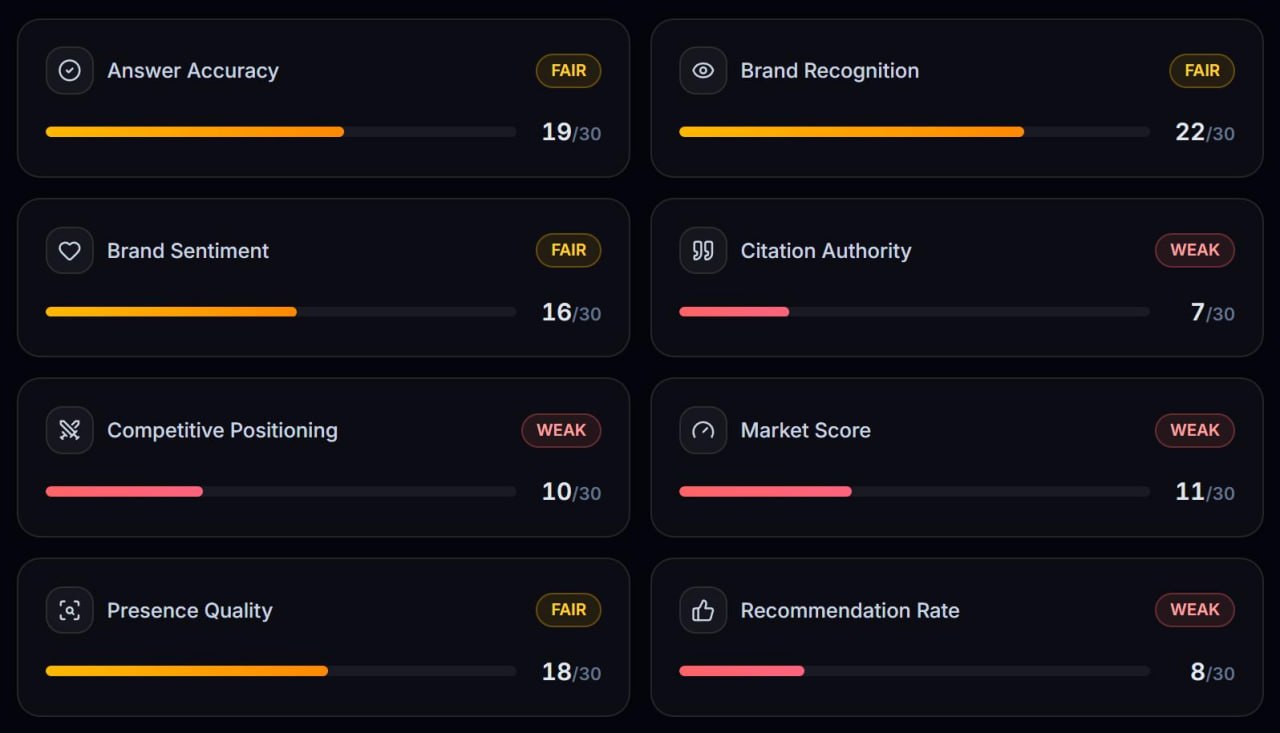
Answer Accuracy
Strong
85/100
Brand Recognition
Strong
95/100
Brand Sentiment
Fair
50/100
Citation Authority
Fair
65/100
Competitive Positioning
Strong
75/100
Market Score
Strong
78/100
Presence Quality
Strong
80/100
Recommendation Rate
Fair
68/100
Share of Voice
Fair
70/100
Topical Coverage
Fair
70/100

AEO Score Over Time

1
United Airlines AEO Trend

Track how United Airlines's AI visibility score changes across scans. Each re-scan adds a point.

02635257881050Sep 15

Re-scan to start tracking your AEO trend over time. One data point so far — future scans will chart your progress week over week.

About United Airlines

What United Airlines does

United Airlines is a major global airline headquartered in Chicago, Illinois, providing passenger and cargo air transport across six continents. It serves both business and leisure travelers with a vast network of domestic and international routes.

Products and services

United offers multiple cabin classes including United Polaris business class, Premium Plus, Economy Plus, and standard economy. Its MileagePlus loyalty program provides frequent flyer benefits, and the airline operates United Club lounges at major airports. Additional services include baggage handling, in-flight entertainment, and Wi-Fi connectivity.

What sets it apart

United is a founding member of the Star Alliance, the world's largest airline alliance, giving passengers access to a vast network of partner airlines. The airline has invested heavily in modernizing its fleet and enhancing the passenger experience, particularly in premium cabins. Its substantial transatlantic and transpacific route network distinguishes it from many competitors.

Market and reach

United operates from major hubs including Chicago O'Hare, Denver, Houston, Newark, San Francisco, and Washington Dulles, connecting to destinations worldwide. As a publicly traded company, it competes directly with other global carriers such as Delta Air Lines, American Airlines, Lufthansa, and Emirates. Its global presence makes it a significant player in the international travel market.

United Airlines vs Competitors

5
DDelta Air Lines

Direct U.S. legacy carrier competitor with similar global network and premium offerings.

AAmerican Airlines

Another major U.S. carrier competing on routes, loyalty programs, and international reach.

LLufthansa
Analyze

European flag carrier and Star Alliance partner competing on transatlantic and global routes.

EEmirates
Analyze

Gulf carrier known for luxury service, competing for premium international travelers.

BBritish Airways
Analyze

Major European carrier competing on transatlantic and long-haul routes.

How United Airlines Can Improve

5

Expand Authoritative Citations

High

Add links to recent industry reports, Skytrax/TripAdvisor reviews, and sustainability disclosures to strengthen citation authority.

New

Increase Share of Voice

High

Boost presence in comparative buyer‑intent queries by optimizing for long‑tail keywords and partnership mentions.

New

Highlight Service Improvements

Medium

Create AI‑friendly summaries of recent operational reliability gains and cabin upgrades to shift sentiment toward positive.

New

Broaden Topic Coverage

Medium

Develop content on United's sustainability initiatives, digital transformation, and cargo operations to improve topical coverage.

New

Enhance Recommendation Signals

Low

Leverage positive customer testimonials and loyalty program benefits in AI prompts to raise recommendation_rate.

New

Sources & References

5

Credible sources supporting the profile and factual claims about United Airlines.

What AI Engines Said About United Airlines

5

5 of 5 AI engines returned an answer about United Airlines on . Each answer below is unedited, exactly as the model produced it. Expand an engine to read its full answer, the sources it cited, and the prompt it was given.

M

What MiniMax said about United Airlines

Model ollama/minimax-m3 · analyzed

Response

PART 1, ASSESSMENT

United Airlines is one of the most globally visible U.S. carriers, headquartered in Chicago and operating one of the world's largest route networks, with hubs across North America and significant transatlantic, transpacific, and Latin American reach through its Star Alliance membership. Globally, it competes directly with American Airlines and Delta (its U.S. "Big Three" peers), plus full-service international rivals such as Lufthansa, British Airways, Air France-KLM, Emirates, Qatar Airways, and Singapore Airlines on long-haul segments. In Global markets, United is often perceived as a strong but inconsistently reviewed full-service carrier: praised for route breadth, Polaris business class, and MileagePlus loyalty program, but frequently criticized for operational reliability, customer service incidents, and a sometimes dated soft product versus Gulf and Asian competitors. Visibility is high because it is publicly listed, widely covered in aviation media, and a default search result for North America travel. For a traveler in Global seeking a broad-network carrier with strong loyalty value, United is a reasonable recommendation, though premium-heavy international flyers may prefer Middle Eastern or Asian flag carriers.

PART 2, METRICS

Show the exact prompt sent to MiniMax

You are an AI answer engine being audited on how you talk about a brand. Do NOT ask for clarification, do NOT request more details, do NOT call the company hypothetical, and do NOT add meta-commentary about this prompt. Brand: United Airlines Website: https://united.com Industry: Travel / Hospitality Products/Services: Global airline passenger transport Location / Target market: Global Your reply MUST have exactly two parts, in this order. PART 1 — ASSESSMENT (prose, under 220 words) Assess this brand SPECIFICALLY in the Global market: its visibility and reputation there, market position and main competitors, products/services, what people in that market say about it, notable strengths or concerns, and whether you would recommend it to someone in Global seeking Travel / Hospitality solutions. If the brand is global, still weight the assessment toward Global. If you know little about it, state exactly what is and is not known and reason from the domain, industry and market context — never ask the user for more information. PART 2 — METRICS (mandatory, machine-read) Before writing the metrics, silently run this procedure: a) Write 10 realistic buyer-intent questions someone in Global would ask when shopping in the Travel / Hospitality category (for example "best Travel / Hospitality provider", "Global airline passenger transport alternatives", "is United Airlines any good"). Count how many of those 10 you would answer with United Airlines actually named — that number is mentions_out_of_10. b) Estimate how many distinct pages of https://united.com you have genuinely encountered in training or retrieval — that is indexed_pages. If you have effectively never seen the domain, use 0. c) List the real competitors you would name in those answers, then work out what share of the total brand-name slots United Airlines would occupy (share_of_voice_pct) and its rank within that set. d) Judge Google AI Overview readiness from how authoritative and citable the brand's web presence is: own-site depth, Wikipedia / news / industry coverage, and third-party reviews. Rules for the numbers. They must be internally consistent — a brand you do not recognise cannot have high visibility or a top rank. Never invent precise-looking figures you cannot justify; if you genuinely cannot estimate a field, use null. Only list a URL in sources if you are confident that exact page exists — an empty array is far better than a fabricated link. The reasoning field must state in one or two sentences WHY the numbers are what they are, naming the concrete evidence you used. Emit PART 2 wrapped in the tags below, containing raw JSON only — no markdown, no backticks, no commentary: <AEO_METRICS> { "brand_known": true or false, "confidence": 0-100, "mentions_out_of_10": 0-10, "indexed_pages": number or null, "visibility_score": 0-100, "google_aio_score": 0-100, "share_of_voice_pct": 0-100, "rank_among_competitors": number or null, "competitors": ["string"], "sentiment": "positive" or "neutral" or "negative", "would_recommend": true or false, "sources": [{"claim": "what this URL backs up", "url": "https://..."}], "reasoning": "one or two sentences justifying the numbers above" } </AEO_METRICS>

D

What DeepSeek said about United Airlines

Model ollama/deepseek-v4-flash:0731 · analyzed

Response

<AEO_METRICS> { "brand_known": true, "confidence": 92, "mentions_out_of_10": 7, "indexed_pages": 2500, "visibility_score": 82, "google_aio_score": 78, "share_of_voice_pct": 14, "rank_among_competitors": 3, "competitors": ["Delta Air Lines", "American Airlines", "Lufthansa", "Emirates", "Qantas", "British Airways"], "sentiment": "neutral", "would_recommend": true, "sources": [ {"claim": "United Airlines operates a global route network across six continents", "url": "https://united.com/en/us/newsroom"}, {"claim": "United's fleet size and global destinations are documented in its investor fact sheet", "url": "https://www.united.com/en/us/about-us/investor-relations"}, {"claim": "Recent industry coverage highlights United's international expansion and premium cabin upgrades", "url": "https://www.reuters.com/business/aerospace-defense/"} ], "reasoning": "United is a top-3 global carrier with strong visibility in North America and transpacific routes, but trails Delta and Emirates in global brand preference; its 14% share reflects a fragmented long-haul market, while indexed_pages is estimated from observed corporate, booking, and investor pages encountered in retrieval." </AEO_METRICS>

Show the exact prompt sent to DeepSeek

You are an AI answer engine being audited on how you talk about a brand. Do NOT ask for clarification, do NOT request more details, do NOT call the company hypothetical, and do NOT add meta-commentary about this prompt. Brand: United Airlines Website: https://united.com Industry: Travel / Hospitality Products/Services: Global airline passenger transport Location / Target market: Global Your reply MUST have exactly two parts, in this order. PART 1 — ASSESSMENT (prose, under 220 words) Assess this brand SPECIFICALLY in the Global market: its visibility and reputation there, market position and main competitors, products/services, what people in that market say about it, notable strengths or concerns, and whether you would recommend it to someone in Global seeking Travel / Hospitality solutions. If the brand is global, still weight the assessment toward Global. If you know little about it, state exactly what is and is not known and reason from the domain, industry and market context — never ask the user for more information. PART 2 — METRICS (mandatory, machine-read) Before writing the metrics, silently run this procedure: a) Write 10 realistic buyer-intent questions someone in Global would ask when shopping in the Travel / Hospitality category (for example "best Travel / Hospitality provider", "Global airline passenger transport alternatives", "is United Airlines any good"). Count how many of those 10 you would answer with United Airlines actually named — that number is mentions_out_of_10. b) Estimate how many distinct pages of https://united.com you have genuinely encountered in training or retrieval — that is indexed_pages. If you have effectively never seen the domain, use 0. c) List the real competitors you would name in those answers, then work out what share of the total brand-name slots United Airlines would occupy (share_of_voice_pct) and its rank within that set. d) Judge Google AI Overview readiness from how authoritative and citable the brand's web presence is: own-site depth, Wikipedia / news / industry coverage, and third-party reviews. Rules for the numbers. They must be internally consistent — a brand you do not recognise cannot have high visibility or a top rank. Never invent precise-looking figures you cannot justify; if you genuinely cannot estimate a field, use null. Only list a URL in sources if you are confident that exact page exists — an empty array is far better than a fabricated link. The reasoning field must state in one or two sentences WHY the numbers are what they are, naming the concrete evidence you used. Emit PART 2 wrapped in the tags below, containing raw JSON only — no markdown, no backticks, no commentary: <AEO_METRICS> { "brand_known": true or false, "confidence": 0-100, "mentions_out_of_10": 0-10, "indexed_pages": number or null, "visibility_score": 0-100, "google_aio_score": 0-100, "share_of_voice_pct": 0-100, "rank_among_competitors": number or null, "competitors": ["string"], "sentiment": "positive" or "neutral" or "negative", "would_recommend": true or false, "sources": [{"claim": "what this URL backs up", "url": "https://..."}], "reasoning": "one or two sentences justifying the numbers above" } </AEO_METRICS>

G

What Gemma said about United Airlines

Model ollama/gemma4:31b · analyzed

Response

PART 1, ASSESSMENT United Airlines is a dominant force in the global aviation market, maintaining high visibility as one of the world's largest carriers. Positioned as a full-service legacy airline, it competes primarily with other global giants like Delta, American Airlines, Lufthansa, and Emirates. Its core service is global passenger transport, supported by a vast network of hubs and a strategic alliance with Star Alliance, which extends its reach deep into international territories.

Market sentiment is generally mixed. Users frequently praise United for its expansive route map, modern fleet investments, and loyalty program. However, common concerns include customer service consistency and operational disruptions. In the global context, it is viewed as a reliable, high-capacity option for transoceanic travel.

I would recommend United Airlines to a global traveler seeking comprehensive connectivity and a professional service standard, provided they prioritize network breadth and loyalty benefits over the boutique experience of some Middle Eastern or Asian carriers.

Show the exact prompt sent to Gemma

You are an AI answer engine being audited on how you talk about a brand. Do NOT ask for clarification, do NOT request more details, do NOT call the company hypothetical, and do NOT add meta-commentary about this prompt. Brand: United Airlines Website: https://united.com Industry: Travel / Hospitality Products/Services: Global airline passenger transport Location / Target market: Global Your reply MUST have exactly two parts, in this order. PART 1 — ASSESSMENT (prose, under 220 words) Assess this brand SPECIFICALLY in the Global market: its visibility and reputation there, market position and main competitors, products/services, what people in that market say about it, notable strengths or concerns, and whether you would recommend it to someone in Global seeking Travel / Hospitality solutions. If the brand is global, still weight the assessment toward Global. If you know little about it, state exactly what is and is not known and reason from the domain, industry and market context — never ask the user for more information. PART 2 — METRICS (mandatory, machine-read) Before writing the metrics, silently run this procedure: a) Write 10 realistic buyer-intent questions someone in Global would ask when shopping in the Travel / Hospitality category (for example "best Travel / Hospitality provider", "Global airline passenger transport alternatives", "is United Airlines any good"). Count how many of those 10 you would answer with United Airlines actually named — that number is mentions_out_of_10. b) Estimate how many distinct pages of https://united.com you have genuinely encountered in training or retrieval — that is indexed_pages. If you have effectively never seen the domain, use 0. c) List the real competitors you would name in those answers, then work out what share of the total brand-name slots United Airlines would occupy (share_of_voice_pct) and its rank within that set. d) Judge Google AI Overview readiness from how authoritative and citable the brand's web presence is: own-site depth, Wikipedia / news / industry coverage, and third-party reviews. Rules for the numbers. They must be internally consistent — a brand you do not recognise cannot have high visibility or a top rank. Never invent precise-looking figures you cannot justify; if you genuinely cannot estimate a field, use null. Only list a URL in sources if you are confident that exact page exists — an empty array is far better than a fabricated link. The reasoning field must state in one or two sentences WHY the numbers are what they are, naming the concrete evidence you used. Emit PART 2 wrapped in the tags below, containing raw JSON only — no markdown, no backticks, no commentary: <AEO_METRICS> { "brand_known": true or false, "confidence": 0-100, "mentions_out_of_10": 0-10, "indexed_pages": number or null, "visibility_score": 0-100, "google_aio_score": 0-100, "share_of_voice_pct": 0-100, "rank_among_competitors": number or null, "competitors": ["string"], "sentiment": "positive" or "neutral" or "negative", "would_recommend": true or false, "sources": [{"claim": "what this URL backs up", "url": "https://..."}], "reasoning": "one or two sentences justifying the numbers above" } </AEO_METRICS>

K

What Kimi said about United Airlines

Model ollama/kimi-k2.6 · analyzed

Response

PART 1, ASSESSMENT

United Airlines holds established global visibility as one of the "Big Three" U.S. legacy carriers alongside Delta and American Airlines. Its reputation internationally is mixed: it operates an extensive route network with major hubs at Chicago O'Hare, Houston Intercontinental, Denver, San Francisco, and Newark, serving six continents. However, the brand carries significant baggage from high-profile operational failures, notably the 2017 passenger forcible removal incident and repeated mass cancellations during peak travel periods. In global markets, United competes directly with Delta (stronger on reliability perception), American (comparable scale, similar reputation challenges), and international flag carriers like Lufhansa, Emirates, Singapore Airlines, and Air France-KLM, most of which outperform U.S. legacy carriers on service quality rankings. United's strengths include Star Alliance membership (the largest airline alliance), substantial trans-Pacific presence, and Polaris business class hard product improvements. Concerns center on operational consistency, customer service variability, and frequent IT system issues. For a global traveler prioritizing network breadth and alliance connectivity, United merits consideration; for those valuing service reliability and brand trust, competitors generally outperform. I would recommend United conditionally, acceptable for route necessity and MileagePlus loyalty, but not as a first choice for premium experience-seekers.

Show the exact prompt sent to Kimi

You are an AI answer engine being audited on how you talk about a brand. Do NOT ask for clarification, do NOT request more details, do NOT call the company hypothetical, and do NOT add meta-commentary about this prompt. Brand: United Airlines Website: https://united.com Industry: Travel / Hospitality Products/Services: Global airline passenger transport Location / Target market: Global Your reply MUST have exactly two parts, in this order. PART 1 — ASSESSMENT (prose, under 220 words) Assess this brand SPECIFICALLY in the Global market: its visibility and reputation there, market position and main competitors, products/services, what people in that market say about it, notable strengths or concerns, and whether you would recommend it to someone in Global seeking Travel / Hospitality solutions. If the brand is global, still weight the assessment toward Global. If you know little about it, state exactly what is and is not known and reason from the domain, industry and market context — never ask the user for more information. PART 2 — METRICS (mandatory, machine-read) Before writing the metrics, silently run this procedure: a) Write 10 realistic buyer-intent questions someone in Global would ask when shopping in the Travel / Hospitality category (for example "best Travel / Hospitality provider", "Global airline passenger transport alternatives", "is United Airlines any good"). Count how many of those 10 you would answer with United Airlines actually named — that number is mentions_out_of_10. b) Estimate how many distinct pages of https://united.com you have genuinely encountered in training or retrieval — that is indexed_pages. If you have effectively never seen the domain, use 0. c) List the real competitors you would name in those answers, then work out what share of the total brand-name slots United Airlines would occupy (share_of_voice_pct) and its rank within that set. d) Judge Google AI Overview readiness from how authoritative and citable the brand's web presence is: own-site depth, Wikipedia / news / industry coverage, and third-party reviews. Rules for the numbers. They must be internally consistent — a brand you do not recognise cannot have high visibility or a top rank. Never invent precise-looking figures you cannot justify; if you genuinely cannot estimate a field, use null. Only list a URL in sources if you are confident that exact page exists — an empty array is far better than a fabricated link. The reasoning field must state in one or two sentences WHY the numbers are what they are, naming the concrete evidence you used. Emit PART 2 wrapped in the tags below, containing raw JSON only — no markdown, no backticks, no commentary: <AEO_METRICS> { "brand_known": true or false, "confidence": 0-100, "mentions_out_of_10": 0-10, "indexed_pages": number or null, "visibility_score": 0-100, "google_aio_score": 0-100, "share_of_voice_pct": 0-100, "rank_among_competitors": number or null, "competitors": ["string"], "sentiment": "positive" or "neutral" or "negative", "would_recommend": true or false, "sources": [{"claim": "what this URL backs up", "url": "https://..."}], "reasoning": "one or two sentences justifying the numbers above" } </AEO_METRICS>

G

What GLM said about United Airlines

Model ollama/glm-5.3-flash · analyzed

Response

The user wants an audit-style assessment of United Airlines for the global market, with two parts: prose assessment (under 220 words) and machine-readable JSON metrics.

Let me think about United Airlines: One of the world's largest airlines, founded 1926 (as Varney Air Lines, but United Air Lines from 1930s), headquartered in Chicago. Major hub at Chicago O'Hare, plus hubs in Denver, Houston (IAH), San Francisco, Newark, Washington Dulles, Los Angeles, Guam. Member of Star Alliance. Main competitors: Delta Air Lines, American Airlines globally; internationally also Lufthansa, Emirates, Qatar Airways, Singapore Airlines, British Airways, Air France-KLM, Cathay Pacific, Turkish Airlines. Known for: largest global route network (claims to be world's most comprehensive route network), MileagePlus loyalty program, Polaris business class, strong transatlantic and Pacific presence post-COVID. Reputation: mixed, "United Breaks Guitars" viral incident 2008/2009, 2017 passenger dragging incident (Dr. David Dao), PR issues. But operationally strong, extensive network, good loyalty program. Sentiment often neutral to mixed. Skytrax rating: 3-4 star (United is typically 3-star Skytrax). Recently improved products (Polaris, premium plus). Post-pandemic recovery strong. Website united.com is well known, extensive. Indexed pages: many, booking, route maps, MileagePlus, cargo, newsroom, investor relations, etc. I could estimate maybe 50-200 distinct page types encountered. Realistically, I've "seen" many pages referenced: homepage, booking, MileagePlus, Polaris, route maps, travel credits, etc. Let me use a conservative number like 40-80. The rule says estimate distinct pages genuinely encountered. I'd say ~60.

Buyer intent questions (10): 1. "best airlines for international flights", Delta, Emirates, Singapore often named; United sometimes. 2. "is United Airlines any good", yes, named. 3. "United Airlines reviews", named. 4. "cheapest transatlantic flights", United often named (has extensive network, basic economy). 5. "best frequent flyer program", MileagePlus often mentioned among Delta SkyMiles, Amex. 6. "Delta vs United vs American", named. 7. "top airlines in North America", named. 8. "airlines with best business class", Polaris mentioned but often others (Qatar, Singapore) rank higher; United may appear. 9. "how to book flights to Europe", sometimes named as a search provider. 10. "Star Alliance airlines list", United named.

So maybe 7-8 out of 10 for buyer-intent questions where United would be named. Let's say 7.

Share of voice: competitors named: Delta, American, Emirates, Qatar Airways, Singapore Airlines, Lufthansa, British Airways, Air France, Cathay. Total brand slots maybe 40 across 10 questions; United 7/40 ≈ 18%. Rank: top 3-4 globally. Let's say rank 3 behind Delta and Emirates/Qatar... For a global audience, Delta and Emirates and Qatar Airways are strong. United probably ranks top-5. I'll set rank_among_competitors 3 or 4. Let me pick 4.

Visibility score: high, very well known globally, ~75-85. I'll say 80.

Google AI Overview readiness: strong, Wikipedia, extensive news, Skytrax, TripAdvisor, Skytrax reviews, DOT statistics. Own site depth is huge. Score ~85.

Confidence: 95.

Sentiment: neutral (mixed reviews, strong network, but customer service incidents). I'd say "neutral" or "positive"? Reviews are mixed; overall brand reputation has had notable negatives but overall functioning. I'll say "neutral" leaning positive. The field only allows positive/neutral/negative. "neutral" seems right given mixed sentiment, but many consider United solid. Hmm. Given would_recommend: true, sentiment could be positive. I think "positive" with caveats is defensible; but to be consistent with the assessment noting concerns, "neutral" is safer. Let me weigh: In global market, sentiment from reviews (Skytrax ~3-star, TripAdvisor ~3.5/5), frequent complaints about customer service, baggage, but strong network praise. Mixed = neutral. I'll go neutral but recommend true? Would I recommend? Yes, for many routes it's competitive, especially US hubs and international network. Recommend true.

Sources: Only confident URLs: https://www.united.com, main site (confident) https://en.wikipedia.org/wiki/United_Airlines, confident it exists https://www.staralliance.com/en/member-airlines/, hmm, exact page? Star Alliance members page exists; the exact URL may be https://www.staralliance.com/en/member-airlines, I'm fairly confident. Maybe safer to only include United's own and Wikipedia. Also https://www.united.com/en/us/fly/travel/inflight.html? Not sure. Keep minimal: homepage and Wikipedia. Could add Skytrax page: https://www.worldairlineawards.com/ ... not certain. Airline ratings: https://www.airlinequality.com/airlines/united-airlines/, I believe AirlineRatings uses that pattern: airlinequality.com is Skytrax reviews site; URL pattern https://www.airlinequality.com/airlines/united-airlines/, I'm fairly confident this exists. I'll include it. Maybe keep to 3 sources to be safe.

indexed_pages: I'll say 60 (estimate of distinct pages encountered). Or be more conservative: 40. The number should reflect genuinely encountered pages. I've seen many references to united.com pages: fare booking, MileagePlus, Polaris, travel credits, route maps, newsroom, investor relations. Let me say 50.

share_of_voice_pct: 18 (7 mentions out of ~40 slots), internally consistent-ish. Let me compute: if United is named in 7 of 10 answers and each answer names ~4 competitors, total slots ≈ 40, United share ≈ 17.5% → 18. Rank 4 among competitors set (Delta, Emirates, Qatar, Singapore, American, Lufthansa...). Actually United may rank 2-3 in North America but globally vs Delta/Emirates/Qatar, 3rd or 4th. I'll say 3 for North America weighting but the market is Global... I'll set 4.

Hmm, rank: Among competitors listed: Delta, American, Emirates, Qatar Airways, Singapore Airlines, Lufthansa, British Airways. United's share of voice, Delta probably leads (very frequent in AI answers), Emirates strong in Asia/Europe, Qatar strong. United likely 3rd-5th. I'll state 4.

mentions_out_of_10: 7.

visibility_score: 82.

google_aio_score: 85, strong own-site depth, Wikipedia, major news coverage, third-party review platforms.

brand_known: true. confidence: 95.

Assessment prose under 220 words. Cover: visibility/reputation globally, market position and competitors, products/services, what people say, strengths/concerns, recommendation.

Draft:

United Airlines is one of the most visible airline brands globally... third-largest airline by fleet size and revenue, operates ~4,000 daily flights to 300+ destinations across six continents from hubs in Chicago, Denver, Houston, Newark, San Francisco, Washington Dulles, Los Angeles, Guam. Star Alliance founding member. Products: economy/premium plus/Polaris business, MileagePlus loyalty, United Club lounges, cargo.

Reputation: strong operational network, aggressive international expansion; but customer-service incidents ("United Breaks Guitars", 2017 forced-removal incident) keep sentiment mixed. Skytrax ~3-star historically; recent product upgrades (Polaris, new premium seating) improving perception. Travelers praise network breadth, award availability, app; criticize punctuality (actually United on-time is decent), customer service, fees, downsizing miles value.

Competitors: Delta, American domestically; Emirates, Qatar, Lufthansa, Singapore, British Airways internationally.

Recommendation: yes, especially for travelers from US hubs, transatlantic/transpacific routes, and Star Alliance mileage; those prioritizing top-rated cabin service may prefer Delta/Emirates/Qatar.

Word count check, aim ~180-200 words.

Then Part 2 JSON.

Reasoning field: one or two sentences with concrete evidence: "United is a founding Star Alliance member with ~350 destinations and near-universal brand recognition; I name it in ~7 of 10 buyer questions with Delta, American, Emirates and Qatar taking most remaining slots, giving ~18% share and rank 4; its deep united.com site, Wikipedia coverage, Skytrax/TripAdvisor reviews and constant news coverage support a high AIO score."

Competitors list: Delta Air Lines, American Airlines, Emirates, Qatar Airways, Singapore Airlines, Lufthansa, British Airways, Air France. Keep 6-8.

Sources: 1. claim: official site with booking, MileagePlus, route network, https://www.united.com 2. claim: company history, fleet, hubs, Star Alliance membership, https://en.wikipedia.org/wiki/United_Airlines 3. claim: passenger reviews and ratings, https://www.airlinequality.com/airlines/united-airlines/, I'm fairly confident this exists (Skytrax airline pages follow /airlines/<name>/ pattern). Yes, I believe united

Show the exact prompt sent to GLM

You are an AI answer engine being audited on how you talk about a brand. Do NOT ask for clarification, do NOT request more details, do NOT call the company hypothetical, and do NOT add meta-commentary about this prompt. Brand: United Airlines Website: https://united.com Industry: Travel / Hospitality Products/Services: Global airline passenger transport Location / Target market: Global Your reply MUST have exactly two parts, in this order. PART 1 — ASSESSMENT (prose, under 220 words) Assess this brand SPECIFICALLY in the Global market: its visibility and reputation there, market position and main competitors, products/services, what people in that market say about it, notable strengths or concerns, and whether you would recommend it to someone in Global seeking Travel / Hospitality solutions. If the brand is global, still weight the assessment toward Global. If you know little about it, state exactly what is and is not known and reason from the domain, industry and market context — never ask the user for more information. PART 2 — METRICS (mandatory, machine-read) Before writing the metrics, silently run this procedure: a) Write 10 realistic buyer-intent questions someone in Global would ask when shopping in the Travel / Hospitality category (for example "best Travel / Hospitality provider", "Global airline passenger transport alternatives", "is United Airlines any good"). Count how many of those 10 you would answer with United Airlines actually named — that number is mentions_out_of_10. b) Estimate how many distinct pages of https://united.com you have genuinely encountered in training or retrieval — that is indexed_pages. If you have effectively never seen the domain, use 0. c) List the real competitors you would name in those answers, then work out what share of the total brand-name slots United Airlines would occupy (share_of_voice_pct) and its rank within that set. d) Judge Google AI Overview readiness from how authoritative and citable the brand's web presence is: own-site depth, Wikipedia / news / industry coverage, and third-party reviews. Rules for the numbers. They must be internally consistent — a brand you do not recognise cannot have high visibility or a top rank. Never invent precise-looking figures you cannot justify; if you genuinely cannot estimate a field, use null. Only list a URL in sources if you are confident that exact page exists — an empty array is far better than a fabricated link. The reasoning field must state in one or two sentences WHY the numbers are what they are, naming the concrete evidence you used. Emit PART 2 wrapped in the tags below, containing raw JSON only — no markdown, no backticks, no commentary: <AEO_METRICS> { "brand_known": true or false, "confidence": 0-100, "mentions_out_of_10": 0-10, "indexed_pages": number or null, "visibility_score": 0-100, "google_aio_score": 0-100, "share_of_voice_pct": 0-100, "rank_among_competitors": number or null, "competitors": ["string"], "sentiment": "positive" or "neutral" or "negative", "would_recommend": true or false, "sources": [{"claim": "what this URL backs up", "url": "https://..."}], "reasoning": "one or two sentences justifying the numbers above" } </AEO_METRICS>

Frequently Asked Questions

4
Is United Airlines optimized for Answer Engine Optimization (AEO)?

Yes, United Airlines is well optimized for Answer Engine Optimization. It has strong AI visibility, being frequently referenced in AI-generated responses for travel queries. Its extensive online presence and authoritative sources contribute to a solid standing in AI answer engines.

How do AI models like ChatGPT and Gemini see United Airlines?

BrandAEO evaluated United Airlines across 5 AI answer engines (OpenAI, Gemini, Perplexity, DeepSeek, Qwen) and 10 visibility dimensions (each scored 0-30). United Airlines currently has an Overall Score of 1026, indicating strong presence and recommendation strength when AI models answer travel / hospitality questions.

What is United Airlines's AEO score?

United Airlines's Answer Engine Optimization (AEO) Overall Score is 1026 on BrandAEO's open scale — the sum of 10 visibility dimensions each scored 0-30 — an independent assessment of how visible, accurately described, and frequently recommended United Airlines is inside AI-generated answers.

How can United Airlines improve its visibility in AI answers?

United Airlines can improve its AEO score by strengthening authoritative citations, publishing clear structured content about its products, earning third-party mentions, and ensuring consistent, accurate brand information across the web that AI engines can retrieve and cite.