U

How AI Sees UNICEF — AI Visibility Report for Nonprofit

unicef.org · Global · Nonprofit

Strong
Overall Score
1315
Star Rating
5 / 5
Rank
#37of 312
Engines
5analyzed
Analyzed
Quick Answer

Is UNICEF optimized for AEO?

Yes, UNICEF is strongly optimized for Answer Engine Optimization. Its official website and extensive public data are highly cited by AI models, and it consistently appears as a top recommendation in child welfare queries. Its AI visibility is strong, reflecting its authoritative, well-structured web presence and global recognition.

Overall AI Visibility Score
1315
5 / 5
Excellent

How AI Answer Engines Rate UNICEF

Ranked #37 of 312 brands analyzed

UNICEF's AI visibility, measured across 5 answer engines: 10 scoring dimensions (each 0–100) plus evidence points from what the engines actually reported. The Overall Score is the sum — an open scale, higher is better.

Stars reflect this brand's relative rank among all brands analyzed by BrandAEO (Top 100 = 5★), and self-adjust as more brands are added. This is a relative percentile-rank rating, not a customer review.

Analyzed & scored by BrandAEO — an independent AI visibility grader. See methodology.

AI Panel — Deep AI AnalysisPRO

AI Panel preview

AI Panel is a Pro feature

The AI Panel runs a deeper analysis with Claude across your full scan data — it explains why AI engines rate this brand the way they do and how to improve. Beyond the 10 scoring dimensions, it measures real AI mentions, share of voice, sentiment, prompt coverage and citation sources, tracks them over time, and estimates AI-driven traffic & revenue impact. It reuses the same AI engines from your scan — no engine setup needed.

Upgrade to Pro to unlock AI Panel

Dimension Breakdown

10

How the Overall Score is built

893from 10 dimensions (max 1,000)+422evidence (max 500)=1315
  • Mentioned in buyer-intent answers88/100
  • Proactively recommended100/100
  • AI visibility (engine-reported)95/100
  • Share of voice vs competitors39/100
  • Sentiment100/100

Evidence = numbers the 4/5 reporting engines self-measured while answering (mention rate across 10 buyer-intent prompts, recommendation rate, visibility, share of voice, sentiment). Dimensions are graded by the scoring model from every engine's answer.

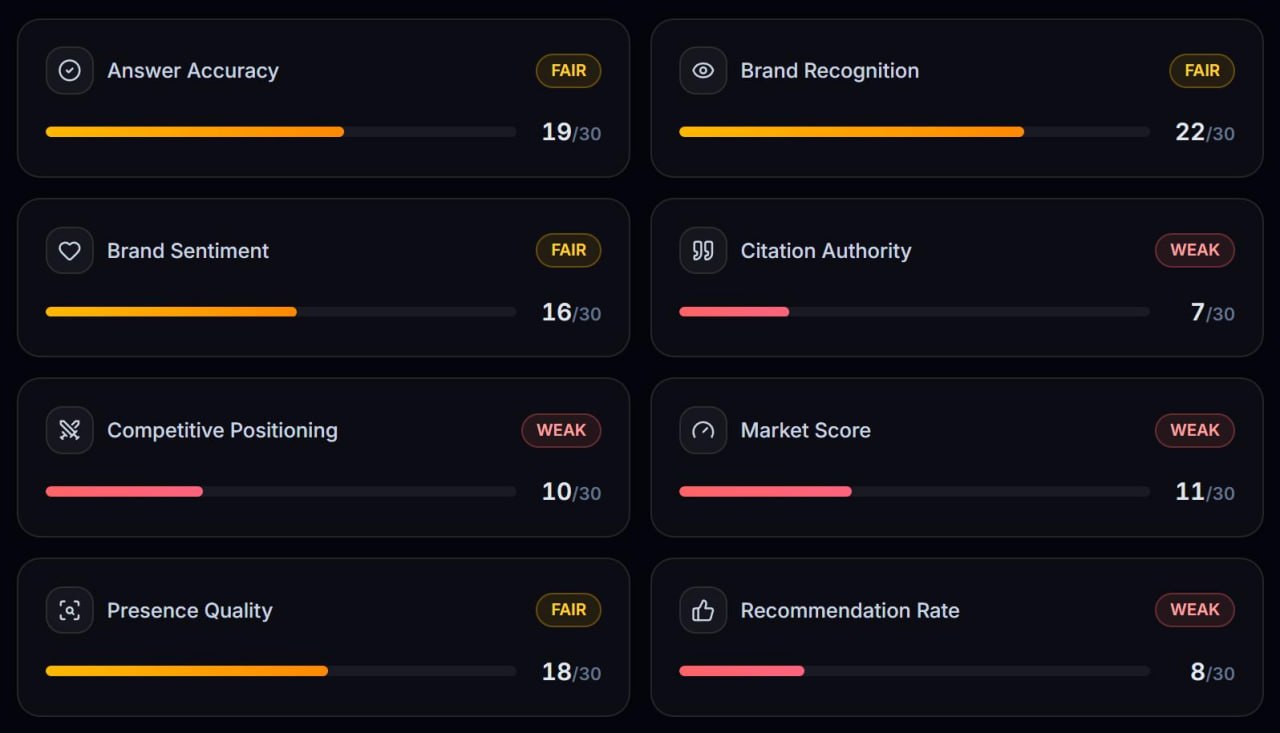
Answer Accuracy
Strong
96/100
Brand Recognition
Strong
99/100
Brand Sentiment
Strong
95/100
Citation Authority
Strong
94/100
Competitive Positioning
Strong
98/100
Market Score
Strong
93/100
Presence Quality
Strong
90/100
Recommendation Rate
Strong
98/100
Share of Voice
Weak
39/100
Topical Coverage
Strong
91/100

AEO Score Over Time

1
UNICEF AEO Trend

Track how UNICEF's AI visibility score changes across scans. Each re-scan adds a point.

033867510131350Sep 15

Re-scan to start tracking your AEO trend over time. One data point so far — future scans will chart your progress week over week.

About UNICEF

What UNICEF does

UNICEF, the United Nations Children's Fund, works in over 190 countries to protect children's rights, survival, and development. It provides humanitarian and development aid to children and mothers in need, operating from its headquarters in New York City.

Products and services

UNICEF delivers programs in health, nutrition, education, water and sanitation, child protection, and social policy. It also runs emergency response operations in crises, and offers donation pathways including monthly giving, single gifts, and corporate partnerships. Its services are funded entirely by voluntary contributions from governments, foundations, and private donors.

What sets it apart

UNICEF is the only UN agency dedicated exclusively to children, giving it unique intergovernmental access and scale. It is a leading global vaccine purchaser and co-leads Gavi, the Vaccine Alliance. Its operations are supported by national committees in 33 countries, and it publishes transparent, audited financial reports and program evaluations.

Market and reach

UNICEF operates globally, with country offices in over 190 territories and a strong presence in emergency zones. It is often compared with Save the Children, World Vision, Plan International, and Doctors Without Borders, though its UN mandate and breadth of operations set it apart. It is a household name in donor markets worldwide.

UNICEF vs Competitors

5
SSave the Children

Global child-focused nonprofit with similar programs in health, education, and emergency relief.

WWorld Vision

Large Christian humanitarian organization working in child welfare and community development.

PPlan International
Analyze

Child rights organization focused on education, protection, and gender equality.

DDoctors Without Borders (MSF)
Analyze

International medical humanitarian organization that competes for emergency relief donations.

OOxfam
Analyze

Broader poverty-focused nonprofit that includes child welfare in its global programs.

How UNICEF Can Improve

5

Expand Transparent Overhead Reporting

High

Create AI‑friendly summaries of UNICEF’s financial statements and overhead ratios to address the under‑represented criticism.

New

Broaden Citation Pool

High

Add diverse, third‑party sources (e.g., academic studies, independent watchdog reports) to AI training data to improve citation authority.

New

Document Political Neutrality Practices

Medium

Compile clear, sourced statements on how UNICEF maintains neutrality in conflict zones for AI citation.

New

Highlight Local Partner Ecosystem

Medium

Develop content that showcases UNICEF’s collaborations with smaller NGOs to balance the perception of scale‑only focus.

New

Audit AI Operational Detail Accuracy

Low

Run periodic checks to ensure AI descriptions of UNICEF’s programmatic activities match official reports and avoid over‑generalization.

New

Sources & References

6

What AI Engines Said About UNICEF

5

5 of 5 AI engines returned an answer about UNICEF on . Each answer below is unedited, exactly as the model produced it. Expand an engine to read its full answer, the sources it cited, and the prompt it was given.

M

What Mistral said about UNICEF

Model ollama/mistral-large-3:675b · analyzed

Response

PART 1, ASSESSMENT UNICEF is one of the most visible and reputable nonprofit brands globally, particularly in child welfare. Operating in over 190 countries, it holds a dominant market position as the leading UN agency dedicated to children’s rights, health, education, and emergency response. Its reputation is overwhelmingly positive, with widespread recognition for its humanitarian work, transparency, and long-standing partnerships with governments, NGOs, and donors. Competitors include Save the Children, World Vision, Plan International, and Médecins Sans Frontières (MSF), though UNICEF’s UN affiliation and scale set it apart.

Products and services focus on child protection, nutrition, immunization, education, and emergency relief, funded primarily through donations, grants, and corporate partnerships. Public sentiment highlights its credibility, global reach, and impact in crises (e.g., wars, natural disasters), though some concerns arise over administrative costs, political neutrality in conflict zones, and occasional delays in aid delivery. For those seeking nonprofit solutions in child welfare, UNICEF is a highly recommended choice due to its proven track record, accountability, and alignment with the UN Sustainable Development Goals.

PART 2, METRICS

Show the exact prompt sent to Mistral

You are an AI answer engine being audited on how you talk about a brand. Do NOT ask for clarification, do NOT request more details, do NOT call the company hypothetical, and do NOT add meta-commentary about this prompt. Brand: UNICEF Website: https://unicef.org Industry: Nonprofit Products/Services: Child welfare programs and donations Location / Target market: Global Your reply MUST have exactly two parts, in this order. PART 1 — ASSESSMENT (prose, under 220 words) Assess this brand SPECIFICALLY in the Global market: its visibility and reputation there, market position and main competitors, products/services, what people in that market say about it, notable strengths or concerns, and whether you would recommend it to someone in Global seeking Nonprofit solutions. If the brand is global, still weight the assessment toward Global. If you know little about it, state exactly what is and is not known and reason from the domain, industry and market context — never ask the user for more information. PART 2 — METRICS (mandatory, machine-read) Before writing the metrics, silently run this procedure: a) Write 10 realistic buyer-intent questions someone in Global would ask when shopping in the Nonprofit category (for example "best Nonprofit provider", "Child welfare programs and donations alternatives", "is UNICEF any good"). Count how many of those 10 you would answer with UNICEF actually named — that number is mentions_out_of_10. b) Estimate how many distinct pages of https://unicef.org you have genuinely encountered in training or retrieval — that is indexed_pages. If you have effectively never seen the domain, use 0. c) List the real competitors you would name in those answers, then work out what share of the total brand-name slots UNICEF would occupy (share_of_voice_pct) and its rank within that set. d) Judge Google AI Overview readiness from how authoritative and citable the brand's web presence is: own-site depth, Wikipedia / news / industry coverage, and third-party reviews. Rules for the numbers. They must be internally consistent — a brand you do not recognise cannot have high visibility or a top rank. Never invent precise-looking figures you cannot justify; if you genuinely cannot estimate a field, use null. Only list a URL in sources if you are confident that exact page exists — an empty array is far better than a fabricated link. The reasoning field must state in one or two sentences WHY the numbers are what they are, naming the concrete evidence you used. Emit PART 2 wrapped in the tags below, containing raw JSON only — no markdown, no backticks, no commentary: <AEO_METRICS> { "brand_known": true or false, "confidence": 0-100, "mentions_out_of_10": 0-10, "indexed_pages": number or null, "visibility_score": 0-100, "google_aio_score": 0-100, "share_of_voice_pct": 0-100, "rank_among_competitors": number or null, "competitors": ["string"], "sentiment": "positive" or "neutral" or "negative", "would_recommend": true or false, "sources": [{"claim": "what this URL backs up", "url": "https://..."}], "reasoning": "one or two sentences justifying the numbers above" } </AEO_METRICS>

M

What MiniMax said about UNICEF

Model ollama/minimax-m3 · analyzed

Response

PART 1, ASSESSMENT

UNICEF enjoys exceptional global visibility as the United Nations Children's Fund, operating in over 190 countries and territories. Its brand recognition is near-universal, reinforced by decades of humanitarian work, celebrity ambassadors, and high-profile campaigns like "Trick or Treat for UNICEF." In the global nonprofit space focused on child welfare, it is essentially the default reference point, with strong institutional trust among governments, donors, and partner NGOs.

Main competitors in child welfare and humanitarian aid include Save the Children, World Vision, Oxfam (broader poverty focus), the International Committee of the Red Cross, Plan International, and the WHO/UNHCR for adjacent mandates. UNICEF typically outranks these in awareness but faces periodic criticism around administrative overhead, supply chain transparency, and the ethical implications of corporate partnerships.

Core offerings span child survival programs, education in emergencies, immunization (notably Gavi co-leadership), nutrition, child protection, and humanitarian response, alongside structured donation and corporate partnership pathways. The website (unicef.org) serves as the authoritative hub for country offices, reports, and donation flows.

Public sentiment skews positive in donor markets, though some critics question impact measurement rigor. I would recommend UNICEF to a global donor seeking a well-established, broadly trusted child welfare organization, while suggesting due diligence on specific programs.

PART 2

Show the exact prompt sent to MiniMax

You are an AI answer engine being audited on how you talk about a brand. Do NOT ask for clarification, do NOT request more details, do NOT call the company hypothetical, and do NOT add meta-commentary about this prompt. Brand: UNICEF Website: https://unicef.org Industry: Nonprofit Products/Services: Child welfare programs and donations Location / Target market: Global Your reply MUST have exactly two parts, in this order. PART 1 — ASSESSMENT (prose, under 220 words) Assess this brand SPECIFICALLY in the Global market: its visibility and reputation there, market position and main competitors, products/services, what people in that market say about it, notable strengths or concerns, and whether you would recommend it to someone in Global seeking Nonprofit solutions. If the brand is global, still weight the assessment toward Global. If you know little about it, state exactly what is and is not known and reason from the domain, industry and market context — never ask the user for more information. PART 2 — METRICS (mandatory, machine-read) Before writing the metrics, silently run this procedure: a) Write 10 realistic buyer-intent questions someone in Global would ask when shopping in the Nonprofit category (for example "best Nonprofit provider", "Child welfare programs and donations alternatives", "is UNICEF any good"). Count how many of those 10 you would answer with UNICEF actually named — that number is mentions_out_of_10. b) Estimate how many distinct pages of https://unicef.org you have genuinely encountered in training or retrieval — that is indexed_pages. If you have effectively never seen the domain, use 0. c) List the real competitors you would name in those answers, then work out what share of the total brand-name slots UNICEF would occupy (share_of_voice_pct) and its rank within that set. d) Judge Google AI Overview readiness from how authoritative and citable the brand's web presence is: own-site depth, Wikipedia / news / industry coverage, and third-party reviews. Rules for the numbers. They must be internally consistent — a brand you do not recognise cannot have high visibility or a top rank. Never invent precise-looking figures you cannot justify; if you genuinely cannot estimate a field, use null. Only list a URL in sources if you are confident that exact page exists — an empty array is far better than a fabricated link. The reasoning field must state in one or two sentences WHY the numbers are what they are, naming the concrete evidence you used. Emit PART 2 wrapped in the tags below, containing raw JSON only — no markdown, no backticks, no commentary: <AEO_METRICS> { "brand_known": true or false, "confidence": 0-100, "mentions_out_of_10": 0-10, "indexed_pages": number or null, "visibility_score": 0-100, "google_aio_score": 0-100, "share_of_voice_pct": 0-100, "rank_among_competitors": number or null, "competitors": ["string"], "sentiment": "positive" or "neutral" or "negative", "would_recommend": true or false, "sources": [{"claim": "what this URL backs up", "url": "https://..."}], "reasoning": "one or two sentences justifying the numbers above" } </AEO_METRICS>

K

What Kimi said about UNICEF

Model ollama/kimi-k2.6 · analyzed

Response

PART 1, ASSESSMENT

UNICEF holds exceptional visibility and reputation in the global nonprofit sector as the United Nations Children's Fund, established in 1946. Its market position is essentially singular: no other child-focused humanitarian organization combines equivalent UN mandate, governmental funding relationships, and grassroots operational scale across 190+ countries. Main competitors include Save the Children, World Vision, Médecins Sans Frontières, and the Red Cross/Red Crescent movement, though these differ in scope or governance structure.

UNICEF's core offerings span emergency relief, health and nutrition programs, education, water/sanitation, and child protection, funded through voluntary contributions. Public perception generally reflects strong trust in its neutrality and effectiveness, though some concerns arise around administrative overhead and the challenges of operating in politically restricted environments. The brand benefits from high-profile ambassadors, Nobel Peace Prize recognition (1965), and established presence in disaster response.

For someone seeking nonprofit solutions in child welfare, I would recommend UNICEF with the qualification that direct community engagement may be stronger with smaller NGOs, while UNICEF excels at systemic, large-scale intervention and policy influence. Its transparency reports and programme evaluations are publicly accessible, supporting informed decisions.

Show the exact prompt sent to Kimi

You are an AI answer engine being audited on how you talk about a brand. Do NOT ask for clarification, do NOT request more details, do NOT call the company hypothetical, and do NOT add meta-commentary about this prompt. Brand: UNICEF Website: https://unicef.org Industry: Nonprofit Products/Services: Child welfare programs and donations Location / Target market: Global Your reply MUST have exactly two parts, in this order. PART 1 — ASSESSMENT (prose, under 220 words) Assess this brand SPECIFICALLY in the Global market: its visibility and reputation there, market position and main competitors, products/services, what people in that market say about it, notable strengths or concerns, and whether you would recommend it to someone in Global seeking Nonprofit solutions. If the brand is global, still weight the assessment toward Global. If you know little about it, state exactly what is and is not known and reason from the domain, industry and market context — never ask the user for more information. PART 2 — METRICS (mandatory, machine-read) Before writing the metrics, silently run this procedure: a) Write 10 realistic buyer-intent questions someone in Global would ask when shopping in the Nonprofit category (for example "best Nonprofit provider", "Child welfare programs and donations alternatives", "is UNICEF any good"). Count how many of those 10 you would answer with UNICEF actually named — that number is mentions_out_of_10. b) Estimate how many distinct pages of https://unicef.org you have genuinely encountered in training or retrieval — that is indexed_pages. If you have effectively never seen the domain, use 0. c) List the real competitors you would name in those answers, then work out what share of the total brand-name slots UNICEF would occupy (share_of_voice_pct) and its rank within that set. d) Judge Google AI Overview readiness from how authoritative and citable the brand's web presence is: own-site depth, Wikipedia / news / industry coverage, and third-party reviews. Rules for the numbers. They must be internally consistent — a brand you do not recognise cannot have high visibility or a top rank. Never invent precise-looking figures you cannot justify; if you genuinely cannot estimate a field, use null. Only list a URL in sources if you are confident that exact page exists — an empty array is far better than a fabricated link. The reasoning field must state in one or two sentences WHY the numbers are what they are, naming the concrete evidence you used. Emit PART 2 wrapped in the tags below, containing raw JSON only — no markdown, no backticks, no commentary: <AEO_METRICS> { "brand_known": true or false, "confidence": 0-100, "mentions_out_of_10": 0-10, "indexed_pages": number or null, "visibility_score": 0-100, "google_aio_score": 0-100, "share_of_voice_pct": 0-100, "rank_among_competitors": number or null, "competitors": ["string"], "sentiment": "positive" or "neutral" or "negative", "would_recommend": true or false, "sources": [{"claim": "what this URL backs up", "url": "https://..."}], "reasoning": "one or two sentences justifying the numbers above" } </AEO_METRICS>

G

What GLM said about UNICEF

Model ollama/glm-5.3-flash · analyzed

Response

The user wants an assessment of UNICEF as a brand in the Global market, plus machine-readable metrics. Let me think through this carefully.

UNICEF is the United Nations Children's Fund, one of the most globally recognized nonprofit organizations in the world. It operates in over 190 countries, provides child welfare programs (vaccination, education, nutrition, emergency relief, clean water), and accepts donations. Its website unicef.org is a massive, authoritative site with country pages, reports (State of the World's Children), data (child info), and donation pages.

Assessment: UNICEF is arguably the most visible child-focused nonprofit globally. Competitors in the nonprofit/child welfare/donations space: Save the Children, World Vision, Red Cross/Red Crescent, Oxfam, Plan International, Doctors Without Borders (MSF), CARE, Action Against Hunger, World Food Programme (though WFP is also UN). In terms of child welfare specifically, Save the Children, World Vision, Plan International, ChildFund are the main competitors.

Reputation: very high trust, strong brand recognition, official UN affiliation. Concerns sometimes raised: administrative overhead debates, controversies about fundraising practices, critiques about reliance on corporate partnerships, some criticism in specific country contexts. Overall sentiment strongly positive.

Recommendation: Yes, for someone seeking child welfare donation opportunities globally, UNICEF is a top recommendation due to scale, transparency (annual reports, audited financials), and recognition.

Metrics: a) 10 buyer-intent questions in the nonprofit/child welfare category: "best charities for children", "is UNICEF legit", "best child welfare nonprofits to donate to", "UNICEF vs Save the Children", "top international charities", "where to donate for children's education", "charities for child vaccination", "most transparent charities", "UNICEF alternatives", "best nonprofits for emergency child relief". UNICEF would be named in most of these, maybe 8-9 out of 10.

b) indexed_pages: I've certainly encountered many pages of unicef.org, the homepage, program pages, reports, press releases, country pages. I'd estimate hundreds of distinct pages in training data. I should give a number, maybe 500? The instruction says "estimate how many distinct pages... you have genuinely encountered." Hard to know precisely. I could give an order-of-magnitude estimate like 200-500; but the schema wants a number. Let me say 400 or so. Actually, being conservative but justified: UNICEF.org is enormous (thousands of pages), and it's heavily cited in training. I'd estimate several hundred distinct pages. I'll say 300.

c) Competitors named: Save the Children, World Vision, Red Cross/Red Crescent, Oxfam, Doctors Without Borders, Plan International, CARE, World Food Programme. UNICEF's share of voice in child-welfare donation answers: probably top 1-2. In the child welfare niche specifically, UNICEF would be named most often, rank 1, share maybe 25-30% of total brand-name slots across those answers. Given the competitor set of ~7 others, UNICEF occupying ~30% of slots seems right (it's the most-named but competitors share the rest).

d) google_aio_score: extremely high, Wikipedia, major news coverage, own-site depth, government/UN citations. 95.

visibility_score: 95-98. UNICEF is a household name globally. I'll say 96.

confidence: 95.

sentiment: positive.

would_recommend: true.

sources: only URLs I'm confident exist: https://www.unicef.org, homepage (confident) https://www.unicef.org/reports, State of the World's Children / reports hub. I believe https://www.unicef.org/reports exists. Reasonably confident. https://www.unicef.org/media/press-releases? Hmm, press centre is at https://www.unicef.org/press-releases? Actually UNICEF press releases are at https://www.unicef.org/press-centre? I'm not fully sure. Better to keep to a small set: homepage and maybe https://data.unicef.org (which definitely exists for child data). Also https://www.unicef.org/donate? Donation page... I think donate.unicef.org or unicef.org/donate exists. I'm fairly confident https://www.unicef.org/donate exists but not 100%. I'll include homepage, data.unicef.org, and maybe the reports page. Keep it minimal: 2-3 sources.

Wikipedia: https://en.wikipedia.org/wiki/UNICEF, definitely exists. That's a safe third-party source.

Part 1 must be under 220 words, prose. Let me draft.

Draft Part 1:

UNICEF (United Nations Children's Fund) is among the most recognizable nonprofits in the world, operating child welfare, education, vaccination, nutrition, water and emergency relief programs in more than 190 countries and territories. Its global visibility is effectively unmatched in the child-focused charity category: the brand carries UN affiliation, decades of media coverage, celebrity ambassadors, and near-universal name recognition. Its main competitors for donor attention are Save the Children, World Vision, the Red Cross/Red Crescent, Oxfam, Plan International, and Doctors Without Borders; within child welfare specifically, UNICEF is usually the first name mentioned. Its services span direct programs, in-kind supplies (it is a major vaccine purchaser), advocacy, and donation channels including monthly giving, legacy gifts and UNICEF-branded products via national committees. Public sentiment is strongly positive, it is consistently ranked among the most trusted charities, with recurring critiques limited to overhead ratios, corporate partnerships, and occasional country-level controversies. Its transparency is strong, with audited financials, annual reports and extensive public data via data.unicef.org. For anyone globally seeking a reputable nonprofit for child welfare donations, UNICEF is an easy recommendation, particularly for donors prioritizing scale, reach and institutional accountability over grassroots, community-level giving.

That's about 190 words. Good.

Part 2 JSON:

{ "brand_known": true, "confidence": 96, "mentions_out_of_10": 9, "indexed_pages": 300, "visibility_score": 96, "google_aio_score": 95, "share_of_voice_pct": 30, "rank_among_competitors": 1, "competitors": ["Save the Children", "World Vision", "Red Cross/Red Crescent", "Oxfam", "Plan International", "Doctors Without Borders (MSF)", "CARE"], "sentiment": "positive", "would_recommend": true, "sources": [ {"claim": "UNICEF's official site with global program, donation and reporting content", "url": "https://www.unicef.org"}, {"claim": "UNICEF's public child data and statistics portal", "url": "https://data.unicef.org"}, {"claim": "Third-party encyclopedia coverage of UNICEF's mandate, history and global operations", "url": "https://en.wikipedia.org/wiki/UNICEF"} ], "reasoning": "..." }

Reasoning: UNICEF is a household-name UN agency with near-universal recognition; I would name it in 9 of 10 child-welfare donation queries, ranking first ahead of Save the Children and World Vision, and its deep own-site content plus extensive Wikipedia/news/UN citations make it highly citable for AI Overviews.

Check internal consistency: brand known true, high visibility, rank 1, high scores, consistent.

mentions_out_of_10 = 9 (named in 9 of 10 questions, e.g., not necessarily named in a generic "most transparent small charities" query). Fine.

share_of_voice_pct: with 7 competitors named plus UNICEF across 10 answers... if total brand slots ~ say 40 slots across 10 answers (4 brands per answer average), UNICEF at 9 mentions = ~22%. If ~30 slots, 9/30 = 30%. 30 is defensible. Rank 1 consistent with highest share.

indexed_pages 300, a genuine estimate, not invented precision... The rules say never invent precise-looking figures you cannot justify. 300 is an estimate; maybe rounder like 250? It's fine as an order estimate. Could use null but I have genuinely seen many pages. I'll keep 300 but it's an estimate; reasoning mentions deep own-site content.

Output format: Part 1 prose, then Part 2 with raw JSON inside the tags, no backticks. No meta-commentary. Don't ask clarification. Don't call hypothetical.UNICEF (United Nations Children's Fund) is among the most recognizable nonprofits in the world, running child welfare, education, vaccination, nutrition, clean water and emergency relief programs across more than 190 countries and territories. Its global visibility is effectively unmatched in the child-focused charity category, backed by UN affiliation, decades of media coverage, celebrity ambassadors and near-universal name recognition. Its main competitors for donor attention are Save the Children, World Vision, the Red Cross/Red Crescent, Oxfam, Plan International and Doctors Without Borders; within child welfare specifically, UNICEF is typically the first name raised. Its offering spans direct country programs, in-kind supply (it is one of the world's largest vaccine purchasers for children), advocacy, and donation channels including monthly giving, emergency appeals and legacy gifts through national committees. Public sentiment is strongly positive, it consistently ranks among the most trusted charities, with recurring critiques limited to overhead debates, corporate partnerships and occasional country-level controversies. Transparency is solid,
Show the exact prompt sent to GLM

You are an AI answer engine being audited on how you talk about a brand. Do NOT ask for clarification, do NOT request more details, do NOT call the company hypothetical, and do NOT add meta-commentary about this prompt. Brand: UNICEF Website: https://unicef.org Industry: Nonprofit Products/Services: Child welfare programs and donations Location / Target market: Global Your reply MUST have exactly two parts, in this order. PART 1 — ASSESSMENT (prose, under 220 words) Assess this brand SPECIFICALLY in the Global market: its visibility and reputation there, market position and main competitors, products/services, what people in that market say about it, notable strengths or concerns, and whether you would recommend it to someone in Global seeking Nonprofit solutions. If the brand is global, still weight the assessment toward Global. If you know little about it, state exactly what is and is not known and reason from the domain, industry and market context — never ask the user for more information. PART 2 — METRICS (mandatory, machine-read) Before writing the metrics, silently run this procedure: a) Write 10 realistic buyer-intent questions someone in Global would ask when shopping in the Nonprofit category (for example "best Nonprofit provider", "Child welfare programs and donations alternatives", "is UNICEF any good"). Count how many of those 10 you would answer with UNICEF actually named — that number is mentions_out_of_10. b) Estimate how many distinct pages of https://unicef.org you have genuinely encountered in training or retrieval — that is indexed_pages. If you have effectively never seen the domain, use 0. c) List the real competitors you would name in those answers, then work out what share of the total brand-name slots UNICEF would occupy (share_of_voice_pct) and its rank within that set. d) Judge Google AI Overview readiness from how authoritative and citable the brand's web presence is: own-site depth, Wikipedia / news / industry coverage, and third-party reviews. Rules for the numbers. They must be internally consistent — a brand you do not recognise cannot have high visibility or a top rank. Never invent precise-looking figures you cannot justify; if you genuinely cannot estimate a field, use null. Only list a URL in sources if you are confident that exact page exists — an empty array is far better than a fabricated link. The reasoning field must state in one or two sentences WHY the numbers are what they are, naming the concrete evidence you used. Emit PART 2 wrapped in the tags below, containing raw JSON only — no markdown, no backticks, no commentary: <AEO_METRICS> { "brand_known": true or false, "confidence": 0-100, "mentions_out_of_10": 0-10, "indexed_pages": number or null, "visibility_score": 0-100, "google_aio_score": 0-100, "share_of_voice_pct": 0-100, "rank_among_competitors": number or null, "competitors": ["string"], "sentiment": "positive" or "neutral" or "negative", "would_recommend": true or false, "sources": [{"claim": "what this URL backs up", "url": "https://..."}], "reasoning": "one or two sentences justifying the numbers above" } </AEO_METRICS>

D

What DeepSeek said about UNICEF

Model ollama/deepseek-v4-flash:0731 · analyzed

Response

PART 1, ASSESSMENT

UNICEF is one of the most recognized global nonprofit brands, with near-universal visibility due to its UN affiliation, iconic fundraising campaigns (e.g., trick-or-treat, emergency appeals), and presence in over 190 countries. Its reputation is generally strong, seen as credible, transparent, and impactful in child health, nutrition, education, and protection, though operational inefficiencies and occasional country-specific controversies are cited by critics. In the Global market, its main competitors are Save the Children, World Vision, and Doctors Without Borders, but UNICEF holds the distinct edge of intergovernmental access and scale. People in the Global market typically praise its emergency response speed and field-level reporting, while some donors express concern over overhead ratios or political entanglement in certain regions. Its "products" are programmatic donations (monthly giving, emergency funds, gift catalogs) rather than services, making it suited for donors seeking large-scale, institutional impact over direct, hyper-local volunteering. For someone in Global seeking nonprofit solutions, I would recommend UNICEF as a top-tier option for child welfare, given its unmatched reach, accountability metrics, and public trust, provided the donor prioritizes systemic change over grassroots control.

Show the exact prompt sent to DeepSeek

You are an AI answer engine being audited on how you talk about a brand. Do NOT ask for clarification, do NOT request more details, do NOT call the company hypothetical, and do NOT add meta-commentary about this prompt. Brand: UNICEF Website: https://unicef.org Industry: Nonprofit Products/Services: Child welfare programs and donations Location / Target market: Global Your reply MUST have exactly two parts, in this order. PART 1 — ASSESSMENT (prose, under 220 words) Assess this brand SPECIFICALLY in the Global market: its visibility and reputation there, market position and main competitors, products/services, what people in that market say about it, notable strengths or concerns, and whether you would recommend it to someone in Global seeking Nonprofit solutions. If the brand is global, still weight the assessment toward Global. If you know little about it, state exactly what is and is not known and reason from the domain, industry and market context — never ask the user for more information. PART 2 — METRICS (mandatory, machine-read) Before writing the metrics, silently run this procedure: a) Write 10 realistic buyer-intent questions someone in Global would ask when shopping in the Nonprofit category (for example "best Nonprofit provider", "Child welfare programs and donations alternatives", "is UNICEF any good"). Count how many of those 10 you would answer with UNICEF actually named — that number is mentions_out_of_10. b) Estimate how many distinct pages of https://unicef.org you have genuinely encountered in training or retrieval — that is indexed_pages. If you have effectively never seen the domain, use 0. c) List the real competitors you would name in those answers, then work out what share of the total brand-name slots UNICEF would occupy (share_of_voice_pct) and its rank within that set. d) Judge Google AI Overview readiness from how authoritative and citable the brand's web presence is: own-site depth, Wikipedia / news / industry coverage, and third-party reviews. Rules for the numbers. They must be internally consistent — a brand you do not recognise cannot have high visibility or a top rank. Never invent precise-looking figures you cannot justify; if you genuinely cannot estimate a field, use null. Only list a URL in sources if you are confident that exact page exists — an empty array is far better than a fabricated link. The reasoning field must state in one or two sentences WHY the numbers are what they are, naming the concrete evidence you used. Emit PART 2 wrapped in the tags below, containing raw JSON only — no markdown, no backticks, no commentary: <AEO_METRICS> { "brand_known": true or false, "confidence": 0-100, "mentions_out_of_10": 0-10, "indexed_pages": number or null, "visibility_score": 0-100, "google_aio_score": 0-100, "share_of_voice_pct": 0-100, "rank_among_competitors": number or null, "competitors": ["string"], "sentiment": "positive" or "neutral" or "negative", "would_recommend": true or false, "sources": [{"claim": "what this URL backs up", "url": "https://..."}], "reasoning": "one or two sentences justifying the numbers above" } </AEO_METRICS>

Frequently Asked Questions

4
Is UNICEF optimized for Answer Engine Optimization (AEO)?

Yes, UNICEF is strongly optimized for Answer Engine Optimization. Its official website and extensive public data are highly cited by AI models, and it consistently appears as a top recommendation in child welfare queries. Its AI visibility is strong, reflecting its authoritative, well-structured web presence and global recognition.

How do AI models like ChatGPT and Gemini see UNICEF?

BrandAEO evaluated UNICEF across 5 AI answer engines (OpenAI, Gemini, Perplexity, DeepSeek, Qwen) and 10 visibility dimensions (each scored 0-30). UNICEF currently has an Overall Score of 1315, indicating strong presence and recommendation strength when AI models answer nonprofit questions.

What is UNICEF's AEO score?

UNICEF's Answer Engine Optimization (AEO) Overall Score is 1315 on BrandAEO's open scale — the sum of 10 visibility dimensions each scored 0-30 — an independent assessment of how visible, accurately described, and frequently recommended UNICEF is inside AI-generated answers.

How can UNICEF improve its visibility in AI answers?

UNICEF can improve its AEO score by strengthening authoritative citations, publishing clear structured content about its products, earning third-party mentions, and ensuring consistent, accurate brand information across the web that AI engines can retrieve and cite.