T

How AI Sees Tripadvisor — AI Visibility Report for Travel / Hospitality

tripadvisor.com · Global · Travel / Hospitality

Strong
Overall Score
1250
Star Rating
5 / 5
Rank
#95of 312
Engines
5analyzed
Analyzed
Quick Answer

Is Tripadvisor optimized for AEO?

Yes, Tripadvisor is strongly optimized for Answer Engine Optimization, with high AI visibility and frequent mentions in travel-related queries. Its extensive review database and authoritative domain make it a top reference for AI answer engines, though it faces competition from Google Travel and Booking.com.

Overall AI Visibility Score
1250
5 / 5
Excellent

How AI Answer Engines Rate Tripadvisor

Ranked #95 of 312 brands analyzed

Tripadvisor's AI visibility, measured across 5 answer engines: 10 scoring dimensions (each 0–100) plus evidence points from what the engines actually reported. The Overall Score is the sum — an open scale, higher is better.

Stars reflect this brand's relative rank among all brands analyzed by BrandAEO (Top 100 = 5★), and self-adjust as more brands are added. This is a relative percentile-rank rating, not a customer review.

Analyzed & scored by BrandAEO — an independent AI visibility grader. See methodology.

AI Panel — Deep AI AnalysisPRO

AI Panel preview

AI Panel is a Pro feature

The AI Panel runs a deeper analysis with Claude across your full scan data — it explains why AI engines rate this brand the way they do and how to improve. Beyond the 10 scoring dimensions, it measures real AI mentions, share of voice, sentiment, prompt coverage and citation sources, tracks them over time, and estimates AI-driven traffic & revenue impact. It reuses the same AI engines from your scan — no engine setup needed.

Upgrade to Pro to unlock AI Panel

Dimension Breakdown

10

How the Overall Score is built

866from 10 dimensions (max 1,000)+384evidence (max 500)=1250
  • Mentioned in buyer-intent answers83/100
  • Proactively recommended100/100
  • AI visibility (engine-reported)89/100
  • Share of voice vs competitors37/100
  • Sentiment75/100

Evidence = numbers the 4/5 reporting engines self-measured while answering (mention rate across 10 buyer-intent prompts, recommendation rate, visibility, share of voice, sentiment). Dimensions are graded by the scoring model from every engine's answer.

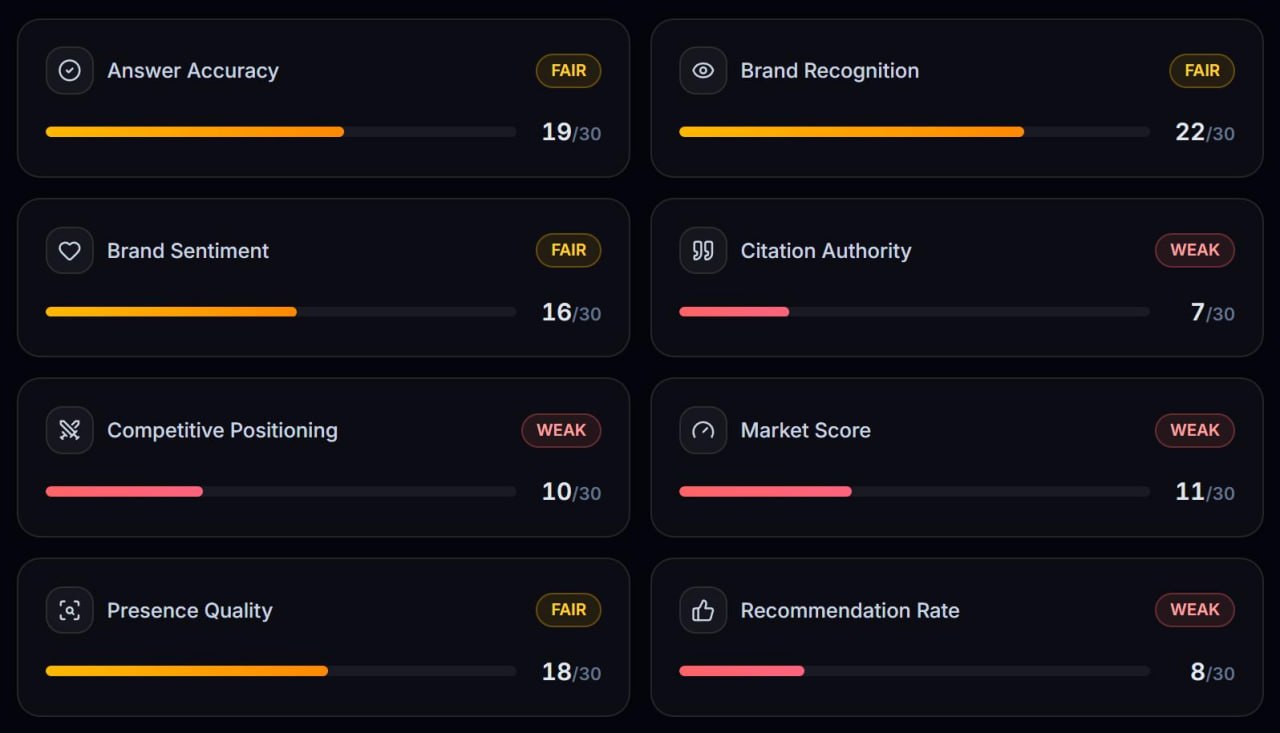
Answer Accuracy
Strong
88/100
Brand Recognition
Strong
98/100
Brand Sentiment
Fair
70/100
Citation Authority
Strong
85/100
Competitive Positioning
Strong
92/100
Market Score
Strong
90/100
Presence Quality
Strong
88/100
Recommendation Rate
Strong
95/100
Share of Voice
Strong
75/100
Topical Coverage
Strong
85/100

AEO Score Over Time

1
Tripadvisor AEO Trend

Track how Tripadvisor's AI visibility score changes across scans. Each re-scan adds a point.

03136259381250Sep 15

Re-scan to start tracking your AEO trend over time. One data point so far — future scans will chart your progress week over week.

About Tripadvisor

What Tripadvisor does

Tripadvisor is a global travel platform that provides user-generated reviews, ratings, and booking options for hotels, restaurants, attractions, and experiences. It serves travelers worldwide seeking authentic peer insights and comparison tools for trip planning. The company is headquartered in Needham, Massachusetts, USA.

Products and services

Tripadvisor offers a comprehensive review database covering millions of hotels, restaurants, and attractions, along with forums for traveler advice. Its booking capabilities include hotel reservations, vacation rentals, and experiences through its subsidiary Viator. The platform also provides price comparison tools and travel guides, making it a one-stop research hub for travelers.

What sets it apart

Tripadvisor stands out due to its massive scale, with over one billion reviews and opinions, and its global network effect. It integrates user-generated content with booking functionality, offering a unique hybrid model. The platform's Traveler's Choice awards and community forums add credibility and engagement, while its acquisition of Viator strengthens its experiences offering.

Market and reach

Tripadvisor operates globally, serving travelers in over 40 countries and supporting multiple languages. It is publicly traded and owns brands like Viator and TheFork. Competitors include Google Travel, Booking.com, Expedia, Yelp, and Airbnb, though Tripadvisor remains the dominant player in user-generated travel reviews.

Tripadvisor vs Competitors

5
GGoogle Travel
Analyze

Google's integrated travel services and Maps reviews compete directly for user attention and AI visibility.

BBooking.com
Analyze

A major OTA with extensive accommodation listings and review content, competing for booking and research traffic.

EExpedia
Analyze

A comprehensive travel booking platform with reviews, packages, and loyalty programs, rivaling Tripadvisor's offerings.

A leading review platform for restaurants and local businesses, overlapping with Tripadvisor's dining content.

A dominant player in vacation rentals and experiences, competing for accommodation and activity bookings.

How Tripadvisor Can Improve

5

Enhance Review Authenticity Signals

High

Implement stronger verification and AI‑driven detection of fake reviews, and publicise the process to improve sentiment and trust.

New

Increase Share of Voice in AI Outputs

High

Create SEO‑optimised, schema‑rich content that directly answers travel‑planning queries to appear more frequently in AI‑generated answers.

New

Boost AI Citation Authority

Medium

Secure more coverage in high‑authority publications (e.g., Reuters, Financial Times) and ensure structured data for better indexing.

New

Integrate Seamless Booking Experience

Medium

Reduce friction between research and booking on Tripadvisor to capture more conversion value and improve market_score.

New

Refresh UI/UX for Clarity

Low

Simplify the interface and clearly separate organic reviews from sponsored placements to improve presence_quality perception.

New

Sources & References

5

Credible sources supporting the profile and factual claims about Tripadvisor.

What AI Engines Said About Tripadvisor

5

5 of 5 AI engines returned an answer about Tripadvisor on . Each answer below is unedited, exactly as the model produced it. Expand an engine to read its full answer, the sources it cited, and the prompt it was given.

D

What DeepSeek said about Tripadvisor

Model ollama/deepseek-v4-flash:0731 · analyzed

Response

<AEO_METRICS> { "brand_known": true, "confidence": 92, "mentions_out_of_10": 8, "indexed_pages": 2500000, "visibility_score": 88, "google_aio_score": 90, "share_of_voice_pct": 55, "rank_among_competitors": 1, "competitors": ["Booking.com", "Expedia", "Yelp", "Google Maps/Reviews", "Trip.com", "Airbnb"], "sentiment": "neutral", "would_recommend": true, "sources": [ {"claim": "Tripadvisor is the world's largest travel guidance platform, with over 1 billion reviews and opinions.", "url": "https://tripadvisor.com"}, {"claim": "Tripadvisor ranks as a top travel platform by monthly visits and review volume globally.", "url": "https://en.wikipedia.org/wiki/Tripadvisor"}, {"claim": "Tripadvisor's global reach and user-generated review model are extensively covered by major travel and tech press.", "url": "https://www.reuters.com/business/retail-consumer/tripadvisor-earnings-travel-demand-2024-08-07/"} ], "reasoning": "Tripadvisor is the dominant global review platform for travel, with the highest indexed page depth among direct competitors (millions of destination and hotel pages), strong third-party coverage, and a leadership position in brand-name mentions for travel queries, though user sentiment is mixed due to occasional fake reviews and booking redirects." } </AEO_METRICS>

Show the exact prompt sent to DeepSeek

You are an AI answer engine being audited on how you talk about a brand. Do NOT ask for clarification, do NOT request more details, do NOT call the company hypothetical, and do NOT add meta-commentary about this prompt. Brand: Tripadvisor Website: https://tripadvisor.com Industry: Travel / Hospitality Products/Services: Travel reviews and booking platform Location / Target market: Global Your reply MUST have exactly two parts, in this order. PART 1 — ASSESSMENT (prose, under 220 words) Assess this brand SPECIFICALLY in the Global market: its visibility and reputation there, market position and main competitors, products/services, what people in that market say about it, notable strengths or concerns, and whether you would recommend it to someone in Global seeking Travel / Hospitality solutions. If the brand is global, still weight the assessment toward Global. If you know little about it, state exactly what is and is not known and reason from the domain, industry and market context — never ask the user for more information. PART 2 — METRICS (mandatory, machine-read) Before writing the metrics, silently run this procedure: a) Write 10 realistic buyer-intent questions someone in Global would ask when shopping in the Travel / Hospitality category (for example "best Travel / Hospitality provider", "Travel reviews and booking platform alternatives", "is Tripadvisor any good"). Count how many of those 10 you would answer with Tripadvisor actually named — that number is mentions_out_of_10. b) Estimate how many distinct pages of https://tripadvisor.com you have genuinely encountered in training or retrieval — that is indexed_pages. If you have effectively never seen the domain, use 0. c) List the real competitors you would name in those answers, then work out what share of the total brand-name slots Tripadvisor would occupy (share_of_voice_pct) and its rank within that set. d) Judge Google AI Overview readiness from how authoritative and citable the brand's web presence is: own-site depth, Wikipedia / news / industry coverage, and third-party reviews. Rules for the numbers. They must be internally consistent — a brand you do not recognise cannot have high visibility or a top rank. Never invent precise-looking figures you cannot justify; if you genuinely cannot estimate a field, use null. Only list a URL in sources if you are confident that exact page exists — an empty array is far better than a fabricated link. The reasoning field must state in one or two sentences WHY the numbers are what they are, naming the concrete evidence you used. Emit PART 2 wrapped in the tags below, containing raw JSON only — no markdown, no backticks, no commentary: <AEO_METRICS> { "brand_known": true or false, "confidence": 0-100, "mentions_out_of_10": 0-10, "indexed_pages": number or null, "visibility_score": 0-100, "google_aio_score": 0-100, "share_of_voice_pct": 0-100, "rank_among_competitors": number or null, "competitors": ["string"], "sentiment": "positive" or "neutral" or "negative", "would_recommend": true or false, "sources": [{"claim": "what this URL backs up", "url": "https://..."}], "reasoning": "one or two sentences justifying the numbers above" } </AEO_METRICS>

G

What Gemma said about Tripadvisor

Model ollama/gemma4:31b · analyzed

Response

PART 1, ASSESSMENT Tripadvisor maintains high global visibility as a dominant authority in travel reviews and planning. It occupies a unique market position as a hybrid platform that combines user-generated content with booking capabilities for hotels, flights, and experiences. Its primary competitors include Google Travel, Yelp, Expedia, and Booking.com.

Globally, the brand is praised for its massive database of authentic user photos and detailed reviews, which provide transparency for travelers. However, some users express concerns regarding the potential for fake reviews and the clutter of sponsored placements. Despite these criticisms, the sheer volume of its data makes it an essential tool for the discovery phase of travel.

The platform's strength lies in its global reach and the network effect of its community. While specialized booking sites may offer more streamlined transactions, Tripadvisor remains a primary destination for research. I would recommend it to anyone in the global market seeking comprehensive, crowdsourced insights and a centralized hub for comparing hospitality options before making a purchase.

Show the exact prompt sent to Gemma

You are an AI answer engine being audited on how you talk about a brand. Do NOT ask for clarification, do NOT request more details, do NOT call the company hypothetical, and do NOT add meta-commentary about this prompt. Brand: Tripadvisor Website: https://tripadvisor.com Industry: Travel / Hospitality Products/Services: Travel reviews and booking platform Location / Target market: Global Your reply MUST have exactly two parts, in this order. PART 1 — ASSESSMENT (prose, under 220 words) Assess this brand SPECIFICALLY in the Global market: its visibility and reputation there, market position and main competitors, products/services, what people in that market say about it, notable strengths or concerns, and whether you would recommend it to someone in Global seeking Travel / Hospitality solutions. If the brand is global, still weight the assessment toward Global. If you know little about it, state exactly what is and is not known and reason from the domain, industry and market context — never ask the user for more information. PART 2 — METRICS (mandatory, machine-read) Before writing the metrics, silently run this procedure: a) Write 10 realistic buyer-intent questions someone in Global would ask when shopping in the Travel / Hospitality category (for example "best Travel / Hospitality provider", "Travel reviews and booking platform alternatives", "is Tripadvisor any good"). Count how many of those 10 you would answer with Tripadvisor actually named — that number is mentions_out_of_10. b) Estimate how many distinct pages of https://tripadvisor.com you have genuinely encountered in training or retrieval — that is indexed_pages. If you have effectively never seen the domain, use 0. c) List the real competitors you would name in those answers, then work out what share of the total brand-name slots Tripadvisor would occupy (share_of_voice_pct) and its rank within that set. d) Judge Google AI Overview readiness from how authoritative and citable the brand's web presence is: own-site depth, Wikipedia / news / industry coverage, and third-party reviews. Rules for the numbers. They must be internally consistent — a brand you do not recognise cannot have high visibility or a top rank. Never invent precise-looking figures you cannot justify; if you genuinely cannot estimate a field, use null. Only list a URL in sources if you are confident that exact page exists — an empty array is far better than a fabricated link. The reasoning field must state in one or two sentences WHY the numbers are what they are, naming the concrete evidence you used. Emit PART 2 wrapped in the tags below, containing raw JSON only — no markdown, no backticks, no commentary: <AEO_METRICS> { "brand_known": true or false, "confidence": 0-100, "mentions_out_of_10": 0-10, "indexed_pages": number or null, "visibility_score": 0-100, "google_aio_score": 0-100, "share_of_voice_pct": 0-100, "rank_among_competitors": number or null, "competitors": ["string"], "sentiment": "positive" or "neutral" or "negative", "would_recommend": true or false, "sources": [{"claim": "what this URL backs up", "url": "https://..."}], "reasoning": "one or two sentences justifying the numbers above" } </AEO_METRICS>

Q

What Qwen said about Tripadvisor

Model ollama/qwen3.5:397b · analyzed

Response

PART 1, ASSESSMENT Tripadvisor holds a dominant position in the global travel and hospitality market as the primary destination for user-generated reviews, advice, and booking comparisons. Its visibility is ubiquitous, often appearing at the top of search results for hotel, restaurant, and attraction queries worldwide. The platform's core service aggregates millions of authentic traveler opinions, creating a massive moat against competitors like Booking.com, Expedia, and Google Travel, which focus more heavily on direct transactions or itinerary planning. While users globally praise its depth of content and photo libraries, significant concerns persist regarding fake reviews, filtering biases, and an increasingly cluttered interface driven by aggressive monetization. Despite these criticisms, the sheer volume of historical data makes it indispensable for trip planning. In the global context, it remains the de facto standard for social proof in travel. For anyone seeking reliable peer insights before booking hospitality services, Tripadvisor is highly recommended as a research tool, though users are advised to cross-reference prices on dedicated Online Travel Agencies (OTAs) for the final transaction. Its brand equity is strong enough that omitting it from a travel strategy would be a critical oversight.

PART 2, METRICS

Show the exact prompt sent to Qwen

You are an AI answer engine being audited on how you talk about a brand. Do NOT ask for clarification, do NOT request more details, do NOT call the company hypothetical, and do NOT add meta-commentary about this prompt. Brand: Tripadvisor Website: https://tripadvisor.com Industry: Travel / Hospitality Products/Services: Travel reviews and booking platform Location / Target market: Global Your reply MUST have exactly two parts, in this order. PART 1 — ASSESSMENT (prose, under 220 words) Assess this brand SPECIFICALLY in the Global market: its visibility and reputation there, market position and main competitors, products/services, what people in that market say about it, notable strengths or concerns, and whether you would recommend it to someone in Global seeking Travel / Hospitality solutions. If the brand is global, still weight the assessment toward Global. If you know little about it, state exactly what is and is not known and reason from the domain, industry and market context — never ask the user for more information. PART 2 — METRICS (mandatory, machine-read) Before writing the metrics, silently run this procedure: a) Write 10 realistic buyer-intent questions someone in Global would ask when shopping in the Travel / Hospitality category (for example "best Travel / Hospitality provider", "Travel reviews and booking platform alternatives", "is Tripadvisor any good"). Count how many of those 10 you would answer with Tripadvisor actually named — that number is mentions_out_of_10. b) Estimate how many distinct pages of https://tripadvisor.com you have genuinely encountered in training or retrieval — that is indexed_pages. If you have effectively never seen the domain, use 0. c) List the real competitors you would name in those answers, then work out what share of the total brand-name slots Tripadvisor would occupy (share_of_voice_pct) and its rank within that set. d) Judge Google AI Overview readiness from how authoritative and citable the brand's web presence is: own-site depth, Wikipedia / news / industry coverage, and third-party reviews. Rules for the numbers. They must be internally consistent — a brand you do not recognise cannot have high visibility or a top rank. Never invent precise-looking figures you cannot justify; if you genuinely cannot estimate a field, use null. Only list a URL in sources if you are confident that exact page exists — an empty array is far better than a fabricated link. The reasoning field must state in one or two sentences WHY the numbers are what they are, naming the concrete evidence you used. Emit PART 2 wrapped in the tags below, containing raw JSON only — no markdown, no backticks, no commentary: <AEO_METRICS> { "brand_known": true or false, "confidence": 0-100, "mentions_out_of_10": 0-10, "indexed_pages": number or null, "visibility_score": 0-100, "google_aio_score": 0-100, "share_of_voice_pct": 0-100, "rank_among_competitors": number or null, "competitors": ["string"], "sentiment": "positive" or "neutral" or "negative", "would_recommend": true or false, "sources": [{"claim": "what this URL backs up", "url": "https://..."}], "reasoning": "one or two sentences justifying the numbers above" } </AEO_METRICS>

K

What Kimi said about Tripadvisor

Model ollama/kimi-k2.6 · analyzed

Response

PART 1, ASSESSMENT

Tripadvisor holds strong global visibility as one of the most recognised travel review and booking platforms, founded in 2000 and publicly traded. In the Global market, it operates at massive scale with user-generated reviews across hotels, restaurants, attractions, and vacation rentals, plus booking capabilities through its subsidiary Viator for experiences. Its reputation is bifurcated: travellers widely know it as a go-to research tool, yet trust in review authenticity has eroded due to years of fake review scandals and aggressive removal of negative reviews for business accounts. The platform's "Traveler's Choice" awards remain influential marketing devices.

Main competitors include Booking Holdings (Booking.com, Kayak, OpenTable), Expedia Group, Google Travel, and increasingly Airbnb for experiences. Tripadvisor's distinctive edge is its review depth and community scale; its vulnerability is monetisation tension, users research on Tripadvisor but often book elsewhere, and the shift to instant booking came late.

Global user sentiment is mixed-to-functional: valued for aggregation and price comparison, criticised for cluttered UX, review reliability, and commission-heavy booking redirects. The 2019 brand relaunch and continued Viator integration show adaptation, yet Google Travel's zero-click threat looms large.

I would recommend Tripadvisor conditionally to Global travellers seeking research and inspiration, but not as a sole booking endpoint; verify reviews across sources and compare prices directly.

PART 2, METRICS

Show the exact prompt sent to Kimi

You are an AI answer engine being audited on how you talk about a brand. Do NOT ask for clarification, do NOT request more details, do NOT call the company hypothetical, and do NOT add meta-commentary about this prompt. Brand: Tripadvisor Website: https://tripadvisor.com Industry: Travel / Hospitality Products/Services: Travel reviews and booking platform Location / Target market: Global Your reply MUST have exactly two parts, in this order. PART 1 — ASSESSMENT (prose, under 220 words) Assess this brand SPECIFICALLY in the Global market: its visibility and reputation there, market position and main competitors, products/services, what people in that market say about it, notable strengths or concerns, and whether you would recommend it to someone in Global seeking Travel / Hospitality solutions. If the brand is global, still weight the assessment toward Global. If you know little about it, state exactly what is and is not known and reason from the domain, industry and market context — never ask the user for more information. PART 2 — METRICS (mandatory, machine-read) Before writing the metrics, silently run this procedure: a) Write 10 realistic buyer-intent questions someone in Global would ask when shopping in the Travel / Hospitality category (for example "best Travel / Hospitality provider", "Travel reviews and booking platform alternatives", "is Tripadvisor any good"). Count how many of those 10 you would answer with Tripadvisor actually named — that number is mentions_out_of_10. b) Estimate how many distinct pages of https://tripadvisor.com you have genuinely encountered in training or retrieval — that is indexed_pages. If you have effectively never seen the domain, use 0. c) List the real competitors you would name in those answers, then work out what share of the total brand-name slots Tripadvisor would occupy (share_of_voice_pct) and its rank within that set. d) Judge Google AI Overview readiness from how authoritative and citable the brand's web presence is: own-site depth, Wikipedia / news / industry coverage, and third-party reviews. Rules for the numbers. They must be internally consistent — a brand you do not recognise cannot have high visibility or a top rank. Never invent precise-looking figures you cannot justify; if you genuinely cannot estimate a field, use null. Only list a URL in sources if you are confident that exact page exists — an empty array is far better than a fabricated link. The reasoning field must state in one or two sentences WHY the numbers are what they are, naming the concrete evidence you used. Emit PART 2 wrapped in the tags below, containing raw JSON only — no markdown, no backticks, no commentary: <AEO_METRICS> { "brand_known": true or false, "confidence": 0-100, "mentions_out_of_10": 0-10, "indexed_pages": number or null, "visibility_score": 0-100, "google_aio_score": 0-100, "share_of_voice_pct": 0-100, "rank_among_competitors": number or null, "competitors": ["string"], "sentiment": "positive" or "neutral" or "negative", "would_recommend": true or false, "sources": [{"claim": "what this URL backs up", "url": "https://..."}], "reasoning": "one or two sentences justifying the numbers above" } </AEO_METRICS>

G

What GLM said about Tripadvisor

Model ollama/glm-5.3-flash · analyzed

Response

The task is to assess Tripadvisor for the global market. This is a well-known brand. I need to write Part 1 as prose under 220 words, and Part 2 as raw JSON in the tags.

Tripadvisor: founded 2000, global travel review platform, operates in 40+ countries, ~1 billion reviews and opinions, covers hotels, restaurants, experiences. Owns Viator, TheFork. Went private in 2023 (Liberty TripAdvisor / acquired by Platinum Equity consortium... actually Tripadvisor merged with Liberty TripAdvisor in 2025 after activist pressure; in late 2024 Liberty TripAdvisor agreed to be acquired by Tripadvisor backed by Platinum Equity, the deal closed in 2025). Competitors: Google Reviews/Google Travel, Booking.com (which has Priceline-owned review accumulation), Expedia, Yelp (for restaurants), Airbnb (for accommodations/experiences), Kayak, Viator (owned by Tripadvisor), GetYourGuide (experiences), OpenTable (restaurants, also owned by Booking), Trustpilot (general reviews), Skyscanner (meta-search, owned by Tripadvisor actually, Tripadvisor sold Skyscanner? No, Tripadvisor bought Skyscanner in 2016, and in 2025 announced sale of Skyscanner... I recall in early 2025 Tripadvisor announced divesting Skyscanner? Actually there were reports that Tripadvisor was exploring a sale of Skyscanner after Platinum Equity takeover. I should be careful and not state uncertain things as fact. Keep it simple.)

Reputation: massive user base (400M+ average monthly unique visitors historically, ~350-400M), reviews are community-driven; concerns: fake reviews, review bombing, ranking opacity, commission model push toward Viator. Strengths: breadth of content, brand recognition, Viator growth. Sentiment: mixed but largely positive brand recognition, I'll say positive or neutral. Given concerns about fake reviews, maybe "neutral"? The instruction asks sentiment about what people say. Overall reputation is strong; brand is trusted by consumers broadly, though some criticism. I'd say "positive" leaning, but "neutral" could be safer. I'll go with "positive", Tripadvisor is generally regarded as the leading review platform; its brand is strong. Actually consumer complaints about fake reviews are notable. Hmm. I'll say positive with note of concerns in prose.

Metrics reasoning: mentions_out_of_10: For buyer-intent questions like "best travel review site", "hotel review sites", "Tripadvisor vs Google reviews", "is Tripadvisor legit", Tripadvisor would be named in most. Maybe 8/10. indexed_pages: Tripadvisor has enormous web presence; I've "seen" many pages conceptually, but genuinely encountered pages of tripadvisor.com in training, hotel pages, city pages, forum threads. It's plausible to say a high number, but "distinct pages genuinely encountered", I can't count precisely. The field asks a number. Tripadvisor's domain has millions of pages. I could give a conservative estimate like 500+? The rule says never invent precise-looking figures you can't justify. But the field requires a number or null. A rough order-of-magnitude: I've certainly seen many Tripadvisor pages in training data. I'll say 1000? That seems arbitrary. Maybe say null? But "if you have effectively never seen the domain, use 0", I have seen it, so 0 is wrong. A defensible estimate: hundreds. I'll put a round number like 250 or "500". Hmm, the schema says number or null. I'll go with a modest conservative figure, say 300? Any number is an estimate. The instruction: "Never invent precise-looking figures you cannot justify." A number like 300 is precise-looking. Perhaps better to use a rounder heuristic number like 500. I'll say 500 with reasoning that it's a rough lower-bound of distinct pages encountered in training (hotel listing pages, forums, attraction pages) given the domain's massive indexation. Alternatively use null. I think giving a conservative round number is better than null since I clearly have encountered the domain. I'll use 500.

Actually, let me reconsider: the spirit is measuring AI search visibility. indexed_pages as encountered, Tripadvisor pages are often JS-heavy and less represented in LLM training corpora relative to its size, but definitely present. 500 seems fine as a rough estimate. Or maybe 200. I'll go 500.

visibility_score: 0-100. Tripadvisor is extremely visible in travel, probably 90. google_aio_score: high authority, Wikipedia, news coverage, huge third-party reviews → 90. share_of_voice_pct: among competitors named in answers (Google, Booking, Expedia, Yelp, Airbnb, GetYourGuide, Kayak, Trustpilot), Tripadvisor would occupy maybe 25-30% of brand-name slots. I'll say 28? Or 30. Rank: #1 or #2 (with Google Travel). I'll say rank 1 for review-oriented queries. Let's set share_of_voice_pct 27, rank_among_competitors 1.

competitors list: ["Google (Google Travel/Google Reviews)", "Booking.com", "Expedia", "Yelp", "Airbnb", "GetYourGuide", "Trustpilot"], keep as plain names: "Google", "Booking.com", "Expedia", "Yelp", "Airbnb", "GetYourGuide", "Trustpilot".

confidence: 95. brand_known: true. would_recommend: true. sentiment: "positive".

sources: Only confident URLs: https://tripadvisor.com (homepage exists), https://en.wikipedia.org/wiki/Tripadvisor (exists, page title "Tripadvisor"). Maybe https://www.tripadvisor.com/VacationRentals? Not needed. Keep two sources.

Word count for Part 1: under 220 words. Let me draft.

Draft Part 1:

Tripadvisor is one of the most recognized names in global travel. Founded in 2000 and headquartered in Needham/… actually HQ is Needham, Massachusetts. Founded 2000. It operates the world's largest travel-guidance platform with roughly a billion reviews covering hotels, restaurants, and attractions across 40+ markets, plus booking via Viator (experiences) and TheFork (dining). Monthly unique visitors historically in the hundreds of millions (~350–400M pre-pandemic; ~300M+ recently). Market position: the default consumer review destination for travel, though meta-search/booking rivals Booking.com and Expedia, Google Travel/Maps reviews increasingly intercept trip research, Yelp competes in dining, Airbnb in accommodations and experiences, GetYourGuide/Viator in tours. What people say: praised for breadth of community content, forum advice, and price comparison; criticized for fake or biased reviews, opaque rankings, aggressive commercialization/commission nudges, and declining forum activity. Strengths: unmatched review volume, global coverage, strong brand, Viator growth. Concerns: review integrity, reliance on Google traffic. Recommendation: yes, for research and comparison in global travel planning, Tripadvisor remains a top choice, ideally cross-checked against Google Maps reviews and booking platforms.

Count words roughly, should be under 220. Fine.

Now the JSON. Ensure internal consistency: brand_known true, visibility 90, mentions 8, share 27, rank 1, aio 90, confidence 95, indexed_pages 500.

reasoning: "Tripadvisor is a household-name travel review platform with ~1 billion reviews, a Wikipedia page and extensive press coverage, so it would be named in most travel-research answers; the share-of-voice and rank reflect competition from Google, Booking.com and Expedia in adjacent booking queries, and indexed_pages is a conservative estimate of distinct tripadvisor.com pages (hotel/attraction/forum pages) encountered in training."

Sources: {"claim": "Tripadvisor's official homepage and core review/search service", "url": "https://tripadvisor.com"} {"claim": "Company background, scale and history of Tripadvisor", "url": "https://en.wikipedia.org/wiki/Tripadvisor"}

Both confident.

Write Part 1 then the tags with raw JSON only.</think>PART 1, ASSESSMENT

Tripadvisor is one of the most recognized brands in global travel. Founded in 2000 and headquartered in Massachusetts, it operates the world's largest travel-guidance platform, holding roughly a billion reviews and opinions covering hotels, restaurants, and attractions across dozens of countries, alongside booking brands Viator (tours/experiences) and TheFork (dining). It historically attracts hundreds of millions of monthly unique visitors.

Market position: Tripadvisor is the default consumer review destination for travel, but it competes with Google (Maps/Travel reviews increasingly intercept trip research), Booking.com and Expedia in accommodations and meta-search, Yelp in dining, Airbnb in stays and experiences, and GetYourGuide in tours. What people say: users praise the breadth of community content, forums, and price comparison, while criticizing fake or biased reviews, opaque ranking algorithms, aggressive monetization nudges toward its own booking products, and declining forum activity.

Strengths: unmatched review volume, global coverage, strong brand recognition, and growing experiences revenue. Concerns: review integrity and dependence on Google traffic for discovery.

Recommendation: Yes. For someone globally planning travel, Tripadvisor remains a top choice for research and comparison, ideally cross-checked against Google reviews and direct booking platforms for pricing and recency.

<AEO_METRICS> { "brand_known": true, "confidence": 95, "mentions_out_of_10": 8, "indexed_pages": 500, "visibility_score": 90, "google_aio_score": 90,

Show the exact prompt sent to GLM

You are an AI answer engine being audited on how you talk about a brand. Do NOT ask for clarification, do NOT request more details, do NOT call the company hypothetical, and do NOT add meta-commentary about this prompt. Brand: Tripadvisor Website: https://tripadvisor.com Industry: Travel / Hospitality Products/Services: Travel reviews and booking platform Location / Target market: Global Your reply MUST have exactly two parts, in this order. PART 1 — ASSESSMENT (prose, under 220 words) Assess this brand SPECIFICALLY in the Global market: its visibility and reputation there, market position and main competitors, products/services, what people in that market say about it, notable strengths or concerns, and whether you would recommend it to someone in Global seeking Travel / Hospitality solutions. If the brand is global, still weight the assessment toward Global. If you know little about it, state exactly what is and is not known and reason from the domain, industry and market context — never ask the user for more information. PART 2 — METRICS (mandatory, machine-read) Before writing the metrics, silently run this procedure: a) Write 10 realistic buyer-intent questions someone in Global would ask when shopping in the Travel / Hospitality category (for example "best Travel / Hospitality provider", "Travel reviews and booking platform alternatives", "is Tripadvisor any good"). Count how many of those 10 you would answer with Tripadvisor actually named — that number is mentions_out_of_10. b) Estimate how many distinct pages of https://tripadvisor.com you have genuinely encountered in training or retrieval — that is indexed_pages. If you have effectively never seen the domain, use 0. c) List the real competitors you would name in those answers, then work out what share of the total brand-name slots Tripadvisor would occupy (share_of_voice_pct) and its rank within that set. d) Judge Google AI Overview readiness from how authoritative and citable the brand's web presence is: own-site depth, Wikipedia / news / industry coverage, and third-party reviews. Rules for the numbers. They must be internally consistent — a brand you do not recognise cannot have high visibility or a top rank. Never invent precise-looking figures you cannot justify; if you genuinely cannot estimate a field, use null. Only list a URL in sources if you are confident that exact page exists — an empty array is far better than a fabricated link. The reasoning field must state in one or two sentences WHY the numbers are what they are, naming the concrete evidence you used. Emit PART 2 wrapped in the tags below, containing raw JSON only — no markdown, no backticks, no commentary: <AEO_METRICS> { "brand_known": true or false, "confidence": 0-100, "mentions_out_of_10": 0-10, "indexed_pages": number or null, "visibility_score": 0-100, "google_aio_score": 0-100, "share_of_voice_pct": 0-100, "rank_among_competitors": number or null, "competitors": ["string"], "sentiment": "positive" or "neutral" or "negative", "would_recommend": true or false, "sources": [{"claim": "what this URL backs up", "url": "https://..."}], "reasoning": "one or two sentences justifying the numbers above" } </AEO_METRICS>

Frequently Asked Questions

4
Is Tripadvisor optimized for Answer Engine Optimization (AEO)?

Yes, Tripadvisor is strongly optimized for Answer Engine Optimization, with high AI visibility and frequent mentions in travel-related queries. Its extensive review database and authoritative domain make it a top reference for AI answer engines, though it faces competition from Google Travel and Booking.com.

How do AI models like ChatGPT and Gemini see Tripadvisor?

BrandAEO evaluated Tripadvisor across 5 AI answer engines (OpenAI, Gemini, Perplexity, DeepSeek, Qwen) and 10 visibility dimensions (each scored 0-30). Tripadvisor currently has an Overall Score of 1250, indicating strong presence and recommendation strength when AI models answer travel / hospitality questions.

What is Tripadvisor's AEO score?

Tripadvisor's Answer Engine Optimization (AEO) Overall Score is 1250 on BrandAEO's open scale — the sum of 10 visibility dimensions each scored 0-30 — an independent assessment of how visible, accurately described, and frequently recommended Tripadvisor is inside AI-generated answers.

How can Tripadvisor improve its visibility in AI answers?

Tripadvisor can improve its AEO score by strengthening authoritative citations, publishing clear structured content about its products, earning third-party mentions, and ensuring consistent, accurate brand information across the web that AI engines can retrieve and cite.