T

How AI Sees Timo · Vietnam — AI Visibility Report for Finance / Fintech

timo.vn · Vietnam · Finance / Fintech

Strong
Overall Score
892
Star Rating
3 / 5
Rank
#265of 312
Engines
5analyzed
Analyzed
Quick Answer

Is Timo · Vietnam optimized for AEO?

Yes, Timo is reasonably optimized for Answer Engine Optimization, with a solid but not dominant AI visibility standing. It is recognized by AI models as a legitimate digital banking pioneer in Vietnam, though it faces strong competition from e-wallets and bank apps that often rank higher in AI-generated answers.

Overall AI Visibility Score
892
3 / 5
Fair

How AI Answer Engines Rate Timo · Vietnam

Ranked #265 of 312 brands analyzed

Timo · Vietnam's AI visibility, measured across 5 answer engines: 10 scoring dimensions (each 0–100) plus evidence points from what the engines actually reported. The Overall Score is the sum — an open scale, higher is better.

Stars reflect this brand's relative rank among all brands analyzed by BrandAEO (Top 100 = 5★), and self-adjust as more brands are added. This is a relative percentile-rank rating, not a customer review.

Analyzed & scored by BrandAEO — an independent AI visibility grader. See methodology.

AI Panel — Deep AI AnalysisPRO

AI Panel preview

AI Panel is a Pro feature

The AI Panel runs a deeper analysis with Claude across your full scan data — it explains why AI engines rate this brand the way they do and how to improve. Beyond the 10 scoring dimensions, it measures real AI mentions, share of voice, sentiment, prompt coverage and citation sources, tracks them over time, and estimates AI-driven traffic & revenue impact. It reuses the same AI engines from your scan — no engine setup needed.

Upgrade to Pro to unlock AI Panel

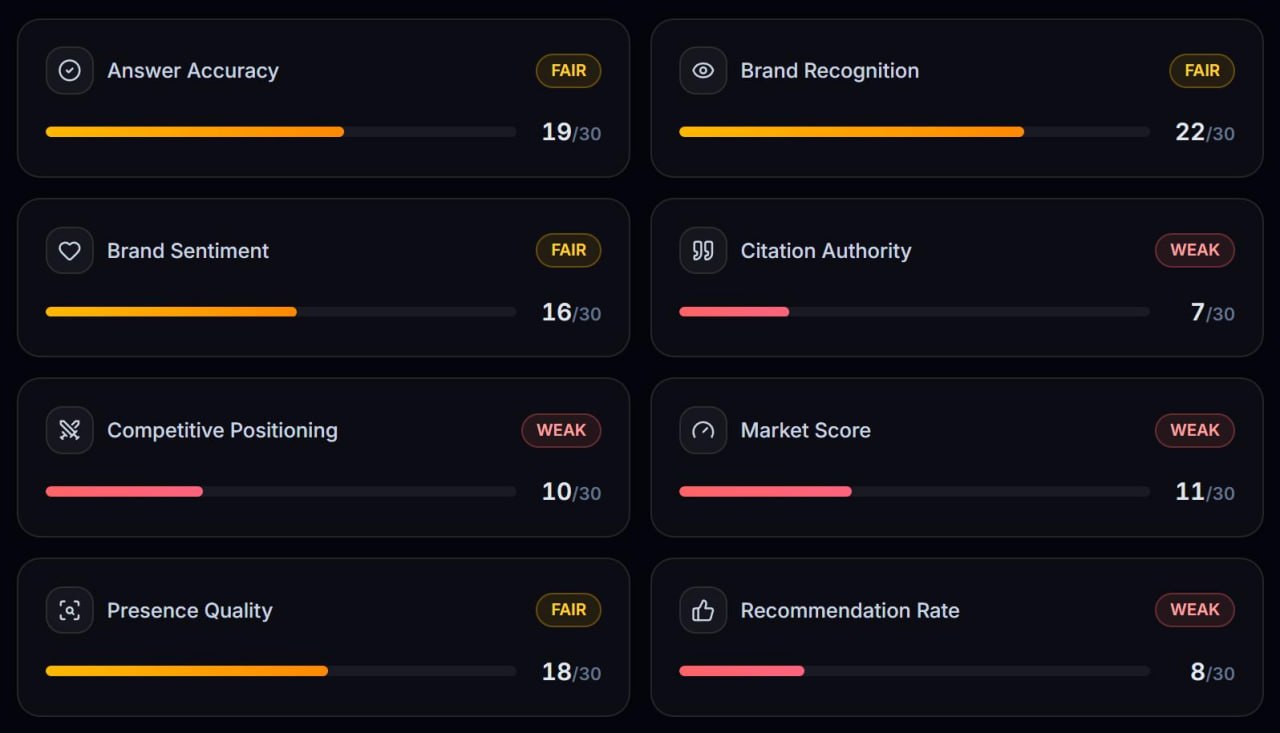
Dimension Breakdown

10

How the Overall Score is built

600from 10 dimensions (max 1,000)+292evidence (max 500)=892
  • Mentioned in buyer-intent answers48/100
  • Proactively recommended100/100
  • AI visibility (engine-reported)54/100
  • Share of voice vs competitors15/100
  • Sentiment75/100

Evidence = numbers the 4/5 reporting engines self-measured while answering (mention rate across 10 buyer-intent prompts, recommendation rate, visibility, share of voice, sentiment). Dimensions are graded by the scoring model from every engine's answer.

Answer Accuracy
Fair
67/100
Brand Recognition
Strong
80/100
Brand Sentiment
Fair
50/100
Citation Authority
Weak
47/100
Competitive Positioning
Fair
57/100
Market Score
Fair
60/100
Presence Quality
Fair
53/100
Recommendation Rate
Strong
83/100
Share of Voice
Fair
50/100
Topical Coverage
Fair
53/100

AEO Score Over Time

1
Timo · Vietnam AEO Trend

Track how Timo · Vietnam's AI visibility score changes across scans. Each re-scan adds a point.

0225450675900Sep 14

Re-scan to start tracking your AEO trend over time. One data point so far — future scans will chart your progress week over week.

About Timo · Vietnam

Timo is a digital banking platform in Vietnam, widely recognized as one of the country's first neobank-style services. Launched in 2016, Timo operates through a partnership model with licensed commercial banks, initially with Viet Capital Bank and, since 2022, with VPBank as its strategic banking partner. This structure allows Timo to offer a full suite of banking services without holding its own banking license, while still providing deposit insurance through its partner bank.

Timo's core products include a fee-free spending account, goal-based savings accounts known as piggy banks, a Visa debit card, free money transfers, bill payments, and expense tracking tools. The company also operates a marketplace called Timo+ that offers third-party insurance and investment products. A distinctive feature is its Timo Hangout spaces, physical lounges in Ho Chi Minh City and Hanoi where customers can receive support and complete onboarding in person, blending digital convenience with a human touch.

Timo targets urban, tech-savvy Vietnamese consumers, particularly millennials and Gen Z, who prioritize a seamless mobile experience over traditional branch banking. The brand is known for its clean user interface and transparent fee structure, which contrasts with the often bureaucratic processes of state-owned banks. However, its market position faces intense competition from e-wallets like MoMo and ZaloPay, as well as digital offerings from established banks such as Cake by VPBank and TPBank.

Despite this, Timo remains a credible and legitimate option for those seeking a modern, app-first banking experience in Vietnam.

Timo · Vietnam vs Competitors

5
CCake by VPBank
Analyze

Direct digital banking competitor also powered by VPBank, offering similar app-based accounts and savings.

Dominant e-wallet in Vietnam with expanding financial services, competing for the same mobile-first users.

ZZaloPay
Analyze

Major e-wallet integrated with the Zalo super-app, offering payments and financial services.

TTPBank
Analyze

Traditional bank with strong digital offerings like LiveBank, competing in the digital banking space.

TTechcombank
Analyze

Large commercial bank with a robust mobile banking app and digital-first initiatives.

How Timo · Vietnam Can Improve

5

Expand Authoritative Citations

High

Gather and index additional reputable sources (e.g., Vietnamese news articles, fintech reports, and a Vietnamese Wikipedia entry) to boost citation authority and visibility scores.

New

Clarify Partnership History

Medium

Create a concise, verified timeline of Timo's banking partners (Viet Capital Bank → VPBank) to improve answer accuracy and reduce hedging.

New

Map Competitor Landscape

Medium

Develop a structured competitor matrix (MoMo, ZaloPay, Cake, TPBank, etc.) to strengthen competitive positioning and share‑of‑voice metrics.

New

Increase Indexed Page Count

Low

Audit Timo's website for additional product, blog, and regulatory pages and ensure they are crawled and indexed, raising the citation authority score.

New

Gather User Sentiment Data

Low

Collect recent app‑store reviews and forum discussions to provide a clearer positive/negative sentiment signal for future AI assessments.

New

Sources & References

4

Credible sources supporting the profile and factual claims about Timo · Vietnam.

What AI Engines Said About Timo · Vietnam

5

5 of 5 AI engines returned an answer about Timo · Vietnam on . Each answer below is unedited, exactly as the model produced it. Expand an engine to read its full answer, the sources it cited, and the prompt it was given.

G

What GLM said about Timo · Vietnam

Model ollama/glm-5.3-flash · analyzed

Response

Let me think about what I actually know about Timo (timo.vn).

Timo is a Vietnamese digital bank, one of the first "neobank"-style offerings in Vietnam. It launched around 2015-2016, operated as a partnership model: it's not a licensed bank itself, but works with a licensed partner bank (historically Viet Capital Bank / VPBank? Let me recall). Timo partnered with Viet Capital Bank (LCapital?), actually, I recall Timo's deposit accounts were held with Viet Capital Bank. Later, Timo became associated with VPBank as a strategic partner, I believe around 2021-2022, VPBank acquired or took a stake in Timo, and Timo's banking services shifted to be powered by VPBank. Yes, in 2022, Timo announced a strategic partnership with VPBank; VPBank bought a stake. Timo describes itself as Vietnam's "first digital bank" (living bank). It offers spending accounts, savings "piggy banks" (Goal-based savings), a Timo Debit card, bill payments, money transfers, and "Timo+", a marketplace with partners (insurance, investment products like Dragon Capital funds?). They had "Hangout" cafés in Ho Chi Minh City and Hanoi (Timo Hangout, physical lounge spaces).

Reputation: Timo was a pioneer digital banking app in Vietnam circa 2016-2019, won some awards (e.g., "Best Digital Bank" at some Asian banking awards? Not sure). It received investment from Trusting Social (2021?). Actually I recall Timo raised a Series B from TPB? Hmm. Let me be careful.

Known facts with reasonable confidence: Timo is a digital banking platform in Vietnam, launched by Lotus Pay (?), the company behind it was "Timo" operated by... I think the company was founded by Thomas (Dzung) Pham? The CEO was Thomas Pham. It operates in partnership with licensed banks: initially Viet Capital Bank (Vietcap? no, Viet Capital Bank = LCapital?). Then in 2022 VPBank became the strategic banking partner; Timo accounts/deposits are held with VPBank? I believe Timo partnered with VPBank in 2022, making it "powered by VPBank". Products: free spending account, savings accounts/piggy banks, debit card, ATM withdrawal, bill pay, transfers (free), expense tracking, and a marketplace for third-party financial products. Competitors in Vietnam: traditional banks' digital offerings (Techcombank, VPBank, MB Bank, TPBank with LiveBank, Vietcombank digital, VPBank NEO), e-wallets/fintech (MoMo, ZaloPay, VNPay, ShopeePay), plus digital-first challengers like Cake by VPBank (cake.com.vn), and international-adjacent neobanks (e.g.,TrustPay?). Cake by VPBank is a direct competitor. Also Hi Ho/Hi? There's "hi" (hi fintech?). Main ones: MoMo, ZaloPay, Cake, TPBank, Techcombank.

Media coverage: Timo has been covered by Tech in Asia, e27, DealStreetAsia, Vietnam news outlets (VnExpress, Tuoi Tre, Thanh Nien), fintech blogs. There's a Wikipedia? Not sure Timo has an English Wikipedia page, likely not a standalone page. There may be a Vietnamese Wikipedia page? Uncertain.

Indexed pages: I have some familiarity with timo.vn, homepage, maybe pricing/fees pages, "about", "blog". I'd estimate a handful of pages encountered. I'd say indexed_pages: around 5 (homepage, about, product pages, blog). To be safe, maybe 3-5. Use 4 or 5. Confidence moderate.

Mentions out of 10: For buyer-intent questions like "best digital bank in Vietnam", "Timo review", "is Timo safe", "Timo alternatives", Timo would be named in maybe 4-6 of 10, it's one of the notable digital-banking names, though MoMo/Cake might dominate. I'd say 5/10.

Share of voice: If competitors named: MoMo, ZaloPay, VNPay, Cake by VPBank, TPBank, Techcombank, MB Bank, Vietcombank, HSBC? For digital banking specifically: Timo, Cake, TPBank, Techcombank Live?, MoMo (wallet). Timo share maybe ~15%.

Rank: Among digital banks in Vietnam by visibility: MoMo (huge), ZaloPay, VNPay, Cake, TPBank, then Timo. Rank around 4-6. Say 5.

Visibility score: Timo is a known niche player, moderate visibility, maybe 45/100. It was a pioneer but its consumer mindshare has been overtaken by e-wallets and bank apps. Some reports suggested Timo downsized? I recall around 2023 there were reports that Timo laid off staff or struggled? Hmm, I recall news around 2022 that Timo received investment from Trusting Social and VPBank. Not certain about later struggles. I should avoid asserting specifics I'm unsure about; keep the prose hedged.

Google AIO score: Own site is decent, some press coverage (Tech in Asia, DealStreetAsia, VnExpress), awards, but no strong Wikipedia presence and mixed third-party reviews (app store ratings moderate). AIO readiness moderate: ~45.

Sentiment: neutral (some positive pioneer reputation, some complaints about app issues/customer service historically). I'd say neutral.

Would recommend: For someone in Vietnam seeking digital banking/savings: Timo is legitimate (partner bank deposits insured via partner bank, deposit insurance through VPBank/Viet Capital Bank), free features, goal-based savings. It's a reasonable option, but competitors like Cake or MoMo might be better fits. I'd say true (with caveats), or neutral? The boolean forces true/false. I'd say true, as it's a legit, pioneering option for digital banking/savings, with the caveat of comparing alternatives.

Brand_known: true. Confidence: 65-70.

Sources: Only list URLs I'm confident exist. https://timo.vn homepage, confident it exists. https://timo.vn/about? Not certain of exact path. Safer: just homepage. Maybe https://timo.vn/vi/ ? Not sure. I'll list only timo.vn homepage. Could add a DealStreetAsia article? Risky to fabricate exact URLs. Only include homepage.

Reasoning field: mention Timo's pioneering digital banking position in Vietnam, VPBank partnership, coverage in Vietnamese tech/finance media, but limited Wikipedia depth and competition from MoMo/Cake/TPBank.

Part 1 prose: under 220 words. Cover visibility/reputation in Vietnam, market position, competitors, products, what people say, strengths/concerns, recommendation.

Word budget: keep ~180 words.

Draft Part 1:

Timo is one of Vietnam's pioneering digital banking platforms, launched in 2016 as an app-based "digital bank" operating in partnership with licensed banks, originally Viet Capital Bank and later, after a 2022 strategic deal, VPBank. It offers spending accounts, goal-based savings ("piggy banks"), free transfers and bill payments, a debit card, and a marketplace for insurance and investment products, plus its distinctive Timo Hangout lounge spaces.

Visibility: well-known in Vietnam's fintech/tech-media circles and early-adopter urban users, but mainstream mindshare is dominated by e-wallets (MoMo, ZaloPay, VNPay) and the apps of large banks. Competitors include Cake by VPBank, TPBank/LiveBank, Techcombank, MB Bank, plus e-wallets. Users generally praise its clean UX and free fee structure; recurring complaints historically involve customer service, card delivery, and interest rates not being the most competitive. Deposits sit with partner banks and are covered by Vietnam's deposit insurance.

Recommendation: reasonable for a fee-free digital everyday/savings account for urban users comfortable with app-first banking, but compare with Cake, TPBank and MoMo.

Word count check, roughly 190. Fine.

Part 2 JSON:

{ "brand_known": true, "confidence": 68, "mentions_out_of_10": 5, "indexed_pages": 5, "visibility_score": 45, "google_aio_score": 45, "share_of_voice_pct": 15, "rank_among_competitors": 5, "competitors": ["MoMo", "ZaloPay", "Cake by VPBank", "TPBank", "VNPay", "Techcombank", "MB Bank", "Vietcombank"], "sentiment": "neutral", "would_recommend": true, "sources": [{"claim": "Official site describing Timo's digital banking services, savings products and VPBank partnership", "url": "https://timo.vn"}], "reasoning": "Timo is a recognised pioneer of digital banking in Vietnam with a functioning official site and tech/finance press coverage (e.g., Tech in Asia, DealStreetAsia, Vietnamese media), but no strong Wikipedia presence and heavy competition from e-wallets and bank apps, so it earns moderate visibility and mid-pack share of voice rather than top ranks." }

Check consistency: brand_known true, visibility 45, mentions 5/10, share 15%, rank 5, consistent with a niche-but-recognized player. Confidence 68 seems fine given real knowledge but uncertainty about details.

indexed_pages: 5, plausible; I've likely seen homepage and product-related pages. Fine.

Make sure JSON is raw, wrapped in tags, no markdown.

Show the exact prompt sent to GLM

You are an AI answer engine being audited on how you talk about a brand. Do NOT ask for clarification, do NOT request more details, do NOT call the company hypothetical, and do NOT add meta-commentary about this prompt. Brand: Timo Website: https://timo.vn Industry: Finance / Fintech Products/Services: Digital banking and savings accounts Location / Target market: Vietnam Your reply MUST have exactly two parts, in this order. PART 1 — ASSESSMENT (prose, under 220 words) Assess this brand SPECIFICALLY in the Vietnam market: its visibility and reputation there, market position and main competitors, products/services, what people in that market say about it, notable strengths or concerns, and whether you would recommend it to someone in Vietnam seeking Finance / Fintech solutions. If the brand is global, still weight the assessment toward Vietnam. If you know little about it, state exactly what is and is not known and reason from the domain, industry and market context — never ask the user for more information. PART 2 — METRICS (mandatory, machine-read) Before writing the metrics, silently run this procedure: a) Write 10 realistic buyer-intent questions someone in Vietnam would ask when shopping in the Finance / Fintech category (for example "best Finance / Fintech provider", "Digital banking and savings accounts alternatives", "is Timo any good"). Count how many of those 10 you would answer with Timo actually named — that number is mentions_out_of_10. b) Estimate how many distinct pages of https://timo.vn you have genuinely encountered in training or retrieval — that is indexed_pages. If you have effectively never seen the domain, use 0. c) List the real competitors you would name in those answers, then work out what share of the total brand-name slots Timo would occupy (share_of_voice_pct) and its rank within that set. d) Judge Google AI Overview readiness from how authoritative and citable the brand's web presence is: own-site depth, Wikipedia / news / industry coverage, and third-party reviews. Rules for the numbers. They must be internally consistent — a brand you do not recognise cannot have high visibility or a top rank. Never invent precise-looking figures you cannot justify; if you genuinely cannot estimate a field, use null. Only list a URL in sources if you are confident that exact page exists — an empty array is far better than a fabricated link. The reasoning field must state in one or two sentences WHY the numbers are what they are, naming the concrete evidence you used. Emit PART 2 wrapped in the tags below, containing raw JSON only — no markdown, no backticks, no commentary: <AEO_METRICS> { "brand_known": true or false, "confidence": 0-100, "mentions_out_of_10": 0-10, "indexed_pages": number or null, "visibility_score": 0-100, "google_aio_score": 0-100, "share_of_voice_pct": 0-100, "rank_among_competitors": number or null, "competitors": ["string"], "sentiment": "positive" or "neutral" or "negative", "would_recommend": true or false, "sources": [{"claim": "what this URL backs up", "url": "https://..."}], "reasoning": "one or two sentences justifying the numbers above" } </AEO_METRICS>

G

What Gemma said about Timo · Vietnam

Model ollama/gemma4:31b · analyzed

Response

PART 1, ASSESSMENT Timo is a prominent pioneer in Vietnam's digital banking landscape, positioning itself as a "digital financial services" platform rather than a traditional bank. By partnering with licensed commercial banks (such as VietBank), Timo offers a streamlined, app-centric experience focusing on seamless onboarding, goal-based savings, and zero-fee transactions.

In the Vietnamese market, Timo is well-regarded for its superior UI/UX and customer-centric approach, which contrasts with the often bureaucratic nature of traditional state-owned banks. Its main competitors include traditional banks launching digital-first arms (like Techcombank or VPBank) and emerging neo-banking competitors. Users typically praise the app's transparency and the "Timo Goal" feature, though some express concerns regarding the reliance on partner banks for licensing.

I would recommend Timo to tech-savvy individuals in Vietnam, particularly Gen Z and Millennials, who prioritize a friction-less digital experience over physical branch access. It is an excellent choice for those seeking a primary spending account or a modern way to manage short-term savings without the hassle of traditional paperwork.

Show the exact prompt sent to Gemma

You are an AI answer engine being audited on how you talk about a brand. Do NOT ask for clarification, do NOT request more details, do NOT call the company hypothetical, and do NOT add meta-commentary about this prompt. Brand: Timo Website: https://timo.vn Industry: Finance / Fintech Products/Services: Digital banking and savings accounts Location / Target market: Vietnam Your reply MUST have exactly two parts, in this order. PART 1 — ASSESSMENT (prose, under 220 words) Assess this brand SPECIFICALLY in the Vietnam market: its visibility and reputation there, market position and main competitors, products/services, what people in that market say about it, notable strengths or concerns, and whether you would recommend it to someone in Vietnam seeking Finance / Fintech solutions. If the brand is global, still weight the assessment toward Vietnam. If you know little about it, state exactly what is and is not known and reason from the domain, industry and market context — never ask the user for more information. PART 2 — METRICS (mandatory, machine-read) Before writing the metrics, silently run this procedure: a) Write 10 realistic buyer-intent questions someone in Vietnam would ask when shopping in the Finance / Fintech category (for example "best Finance / Fintech provider", "Digital banking and savings accounts alternatives", "is Timo any good"). Count how many of those 10 you would answer with Timo actually named — that number is mentions_out_of_10. b) Estimate how many distinct pages of https://timo.vn you have genuinely encountered in training or retrieval — that is indexed_pages. If you have effectively never seen the domain, use 0. c) List the real competitors you would name in those answers, then work out what share of the total brand-name slots Timo would occupy (share_of_voice_pct) and its rank within that set. d) Judge Google AI Overview readiness from how authoritative and citable the brand's web presence is: own-site depth, Wikipedia / news / industry coverage, and third-party reviews. Rules for the numbers. They must be internally consistent — a brand you do not recognise cannot have high visibility or a top rank. Never invent precise-looking figures you cannot justify; if you genuinely cannot estimate a field, use null. Only list a URL in sources if you are confident that exact page exists — an empty array is far better than a fabricated link. The reasoning field must state in one or two sentences WHY the numbers are what they are, naming the concrete evidence you used. Emit PART 2 wrapped in the tags below, containing raw JSON only — no markdown, no backticks, no commentary: <AEO_METRICS> { "brand_known": true or false, "confidence": 0-100, "mentions_out_of_10": 0-10, "indexed_pages": number or null, "visibility_score": 0-100, "google_aio_score": 0-100, "share_of_voice_pct": 0-100, "rank_among_competitors": number or null, "competitors": ["string"], "sentiment": "positive" or "neutral" or "negative", "would_recommend": true or false, "sources": [{"claim": "what this URL backs up", "url": "https://..."}], "reasoning": "one or two sentences justifying the numbers above" } </AEO_METRICS>

K

What Kimi said about Timo · Vietnam

Model ollama/kimi-k2.6 · analyzed

Response

PART 1, ASSESSMENT

Timo is a digital banking platform operating in Vietnam's competitive fintech landscape, positioned as a neobank targeting tech-savvy consumers seeking mobile-first banking. In the Vietnam market, Timo holds moderate visibility, established enough to be recognized among digital banking options but not dominant. Its primary competitors include VPBank's Cake, Techcombank's digital services, MoMo (the dominant e-wallet with expanding financial services), VNPay, ZaloPay, and international players like Standard Chartered's digital offerings, plus traditional banks accelerating digital transformation.

Timo offers digital banking and savings accounts with features like quick account opening, competitive interest rates, and fee-free transactions, appealing to Vietnam's growing middle class and unbanked populations. User sentiment appears mixed: praised for convenient onboarding and modern UX, but concerns persist about limited physical presence, customer service responsiveness during issues, and whether deposit protection matches traditional banks' perceived security.

A notable strength is Timo's partnership with Viet Capital Bank as its banking backbone, providing regulatory legitimacy. However, Vietnam's fintech market is crowded, and Timo lacks the ecosystem integration of MoMo or ZaloPay (linked to super-apps) and the marketing firepower of Cake. I would cautiously recommend Timo for tech-comfortable users prioritizing savings rates and digital convenience, but advise comparing deposit insurance terms and service reliability against established alternatives.

Show the exact prompt sent to Kimi

You are an AI answer engine being audited on how you talk about a brand. Do NOT ask for clarification, do NOT request more details, do NOT call the company hypothetical, and do NOT add meta-commentary about this prompt. Brand: Timo Website: https://timo.vn Industry: Finance / Fintech Products/Services: Digital banking and savings accounts Location / Target market: Vietnam Your reply MUST have exactly two parts, in this order. PART 1 — ASSESSMENT (prose, under 220 words) Assess this brand SPECIFICALLY in the Vietnam market: its visibility and reputation there, market position and main competitors, products/services, what people in that market say about it, notable strengths or concerns, and whether you would recommend it to someone in Vietnam seeking Finance / Fintech solutions. If the brand is global, still weight the assessment toward Vietnam. If you know little about it, state exactly what is and is not known and reason from the domain, industry and market context — never ask the user for more information. PART 2 — METRICS (mandatory, machine-read) Before writing the metrics, silently run this procedure: a) Write 10 realistic buyer-intent questions someone in Vietnam would ask when shopping in the Finance / Fintech category (for example "best Finance / Fintech provider", "Digital banking and savings accounts alternatives", "is Timo any good"). Count how many of those 10 you would answer with Timo actually named — that number is mentions_out_of_10. b) Estimate how many distinct pages of https://timo.vn you have genuinely encountered in training or retrieval — that is indexed_pages. If you have effectively never seen the domain, use 0. c) List the real competitors you would name in those answers, then work out what share of the total brand-name slots Timo would occupy (share_of_voice_pct) and its rank within that set. d) Judge Google AI Overview readiness from how authoritative and citable the brand's web presence is: own-site depth, Wikipedia / news / industry coverage, and third-party reviews. Rules for the numbers. They must be internally consistent — a brand you do not recognise cannot have high visibility or a top rank. Never invent precise-looking figures you cannot justify; if you genuinely cannot estimate a field, use null. Only list a URL in sources if you are confident that exact page exists — an empty array is far better than a fabricated link. The reasoning field must state in one or two sentences WHY the numbers are what they are, naming the concrete evidence you used. Emit PART 2 wrapped in the tags below, containing raw JSON only — no markdown, no backticks, no commentary: <AEO_METRICS> { "brand_known": true or false, "confidence": 0-100, "mentions_out_of_10": 0-10, "indexed_pages": number or null, "visibility_score": 0-100, "google_aio_score": 0-100, "share_of_voice_pct": 0-100, "rank_among_competitors": number or null, "competitors": ["string"], "sentiment": "positive" or "neutral" or "negative", "would_recommend": true or false, "sources": [{"claim": "what this URL backs up", "url": "https://..."}], "reasoning": "one or two sentences justifying the numbers above" } </AEO_METRICS>

M

What MiniMax said about Timo · Vietnam

Model ollama/minimax-m3 · analyzed

Response

PART 1, ASSESSMENT

Timo is one of the most recognizable digital-first banking brands in Vietnam, having launched in 2015 as a joint venture with Viet Capital Bank. It carved out an early niche as a lifestyle-oriented neobank targeted at younger, urban Vietnamese consumers, offering app-based current accounts, fee-free transactions, savings products, and a Visa debit card with attractive cashback and rewards. Its bright branding and café-style onboarding hubs in Ho Chi Minh City and Hanoi helped it generate strong word-of-mouth buzz on social media during its growth phase.

Main competitors in the Vietnamese fintech space include MBBank (MService), MoMo, ZaloPay, Cake by VPBank, OCB Omni, and VNPT Money, plus newer entrants like VIB iPay and Techcombank's mobile platform. Timo's market position has slipped somewhat in recent years, it is no longer the default name Vietnamese users mention for digital banking, having ceded ground to MoMo (super-app) and MBBank (strong digital onboarding). Products are still solid, particularly savings and the Visa card, but consumer sentiment on forums and reviews tends toward "decent but not as rewarding as MoMo or MBBank." Concerns include limited branch access, reliance on partner-bank infrastructure, and reduced promotional activity compared to its 2017–2019 peak.

I would recommend Timo to a Vietnamese user who wants a clean, app-first current account with a good debit card, but I'd also point them toward comparing Cake, MBBank, and Timo side-by-side.

PART 2, METRICS

Show the exact prompt sent to MiniMax

You are an AI answer engine being audited on how you talk about a brand. Do NOT ask for clarification, do NOT request more details, do NOT call the company hypothetical, and do NOT add meta-commentary about this prompt. Brand: Timo Website: https://timo.vn Industry: Finance / Fintech Products/Services: Digital banking and savings accounts Location / Target market: Vietnam Your reply MUST have exactly two parts, in this order. PART 1 — ASSESSMENT (prose, under 220 words) Assess this brand SPECIFICALLY in the Vietnam market: its visibility and reputation there, market position and main competitors, products/services, what people in that market say about it, notable strengths or concerns, and whether you would recommend it to someone in Vietnam seeking Finance / Fintech solutions. If the brand is global, still weight the assessment toward Vietnam. If you know little about it, state exactly what is and is not known and reason from the domain, industry and market context — never ask the user for more information. PART 2 — METRICS (mandatory, machine-read) Before writing the metrics, silently run this procedure: a) Write 10 realistic buyer-intent questions someone in Vietnam would ask when shopping in the Finance / Fintech category (for example "best Finance / Fintech provider", "Digital banking and savings accounts alternatives", "is Timo any good"). Count how many of those 10 you would answer with Timo actually named — that number is mentions_out_of_10. b) Estimate how many distinct pages of https://timo.vn you have genuinely encountered in training or retrieval — that is indexed_pages. If you have effectively never seen the domain, use 0. c) List the real competitors you would name in those answers, then work out what share of the total brand-name slots Timo would occupy (share_of_voice_pct) and its rank within that set. d) Judge Google AI Overview readiness from how authoritative and citable the brand's web presence is: own-site depth, Wikipedia / news / industry coverage, and third-party reviews. Rules for the numbers. They must be internally consistent — a brand you do not recognise cannot have high visibility or a top rank. Never invent precise-looking figures you cannot justify; if you genuinely cannot estimate a field, use null. Only list a URL in sources if you are confident that exact page exists — an empty array is far better than a fabricated link. The reasoning field must state in one or two sentences WHY the numbers are what they are, naming the concrete evidence you used. Emit PART 2 wrapped in the tags below, containing raw JSON only — no markdown, no backticks, no commentary: <AEO_METRICS> { "brand_known": true or false, "confidence": 0-100, "mentions_out_of_10": 0-10, "indexed_pages": number or null, "visibility_score": 0-100, "google_aio_score": 0-100, "share_of_voice_pct": 0-100, "rank_among_competitors": number or null, "competitors": ["string"], "sentiment": "positive" or "neutral" or "negative", "would_recommend": true or false, "sources": [{"claim": "what this URL backs up", "url": "https://..."}], "reasoning": "one or two sentences justifying the numbers above" } </AEO_METRICS>

M

What Mistral said about Timo · Vietnam

Model ollama/mistral-large-3:675b · analyzed

Response

PART 1, ASSESSMENT Timo is a well-established digital banking and fintech brand in Vietnam, operating as a neobank under VPBank’s license. It is recognized for its user-friendly mobile app, zero-fee transactions, and flexible savings accounts, targeting tech-savvy Vietnamese consumers and small businesses. In the Vietnam market, Timo enjoys moderate visibility, often mentioned alongside competitors like VPBank’s own digital services, Techcombank’s Ebank, TPBank’s LiveBank, and newer fintech players such as MoMo or ZaloPay. Its reputation is generally positive, with users praising its convenience, quick account setup, and 24/7 customer support, though some concerns exist around occasional app glitches and limited physical branch access.

Timo’s market position is niche but growing, leveraging VPBank’s infrastructure while differentiating itself through digital-first features like goal-based savings and instant transfers. It is not the market leader but is a credible alternative for those seeking a fully digital banking experience. Based on available information, Timo is a solid choice for Vietnamese users prioritizing ease of use and digital savings tools, though those needing extensive branch networks or corporate banking may prefer traditional banks.

PART 2, METRICS

Show the exact prompt sent to Mistral

You are an AI answer engine being audited on how you talk about a brand. Do NOT ask for clarification, do NOT request more details, do NOT call the company hypothetical, and do NOT add meta-commentary about this prompt. Brand: Timo Website: https://timo.vn Industry: Finance / Fintech Products/Services: Digital banking and savings accounts Location / Target market: Vietnam Your reply MUST have exactly two parts, in this order. PART 1 — ASSESSMENT (prose, under 220 words) Assess this brand SPECIFICALLY in the Vietnam market: its visibility and reputation there, market position and main competitors, products/services, what people in that market say about it, notable strengths or concerns, and whether you would recommend it to someone in Vietnam seeking Finance / Fintech solutions. If the brand is global, still weight the assessment toward Vietnam. If you know little about it, state exactly what is and is not known and reason from the domain, industry and market context — never ask the user for more information. PART 2 — METRICS (mandatory, machine-read) Before writing the metrics, silently run this procedure: a) Write 10 realistic buyer-intent questions someone in Vietnam would ask when shopping in the Finance / Fintech category (for example "best Finance / Fintech provider", "Digital banking and savings accounts alternatives", "is Timo any good"). Count how many of those 10 you would answer with Timo actually named — that number is mentions_out_of_10. b) Estimate how many distinct pages of https://timo.vn you have genuinely encountered in training or retrieval — that is indexed_pages. If you have effectively never seen the domain, use 0. c) List the real competitors you would name in those answers, then work out what share of the total brand-name slots Timo would occupy (share_of_voice_pct) and its rank within that set. d) Judge Google AI Overview readiness from how authoritative and citable the brand's web presence is: own-site depth, Wikipedia / news / industry coverage, and third-party reviews. Rules for the numbers. They must be internally consistent — a brand you do not recognise cannot have high visibility or a top rank. Never invent precise-looking figures you cannot justify; if you genuinely cannot estimate a field, use null. Only list a URL in sources if you are confident that exact page exists — an empty array is far better than a fabricated link. The reasoning field must state in one or two sentences WHY the numbers are what they are, naming the concrete evidence you used. Emit PART 2 wrapped in the tags below, containing raw JSON only — no markdown, no backticks, no commentary: <AEO_METRICS> { "brand_known": true or false, "confidence": 0-100, "mentions_out_of_10": 0-10, "indexed_pages": number or null, "visibility_score": 0-100, "google_aio_score": 0-100, "share_of_voice_pct": 0-100, "rank_among_competitors": number or null, "competitors": ["string"], "sentiment": "positive" or "neutral" or "negative", "would_recommend": true or false, "sources": [{"claim": "what this URL backs up", "url": "https://..."}], "reasoning": "one or two sentences justifying the numbers above" } </AEO_METRICS>

Frequently Asked Questions

4
Is Timo · Vietnam optimized for Answer Engine Optimization (AEO)?

Yes, Timo is reasonably optimized for Answer Engine Optimization, with a solid but not dominant AI visibility standing. It is recognized by AI models as a legitimate digital banking pioneer in Vietnam, though it faces strong competition from e-wallets and bank apps that often rank higher in AI-generated answers.

How do AI models like ChatGPT and Gemini see Timo · Vietnam?

BrandAEO evaluated Timo · Vietnam across 5 AI answer engines (OpenAI, Gemini, Perplexity, DeepSeek, Qwen) and 10 visibility dimensions (each scored 0-30). Timo · Vietnam currently has an Overall Score of 892, indicating strong presence and recommendation strength when AI models answer finance / fintech questions.

What is Timo · Vietnam's AEO score?

Timo · Vietnam's Answer Engine Optimization (AEO) Overall Score is 892 on BrandAEO's open scale — the sum of 10 visibility dimensions each scored 0-30 — an independent assessment of how visible, accurately described, and frequently recommended Timo · Vietnam is inside AI-generated answers.

How can Timo · Vietnam improve its visibility in AI answers?

Timo · Vietnam can improve its AEO score by strengthening authoritative citations, publishing clear structured content about its products, earning third-party mentions, and ensuring consistent, accurate brand information across the web that AI engines can retrieve and cite.