T

How AI Sees The Washington Post — AI Visibility Report for Media / Publishing

washingtonpost.com · Global · Media / Publishing

Strong
Overall Score
1196
Star Rating
4 / 5
Rank
#157of 312
Engines
5analyzed
Analyzed
Quick Answer

Is The Washington Post optimized for AEO?

Yes, The Washington Post is strongly optimized for Answer Engine Optimization. Its high visibility in AI answer engines reflects its authoritative journalism, extensive digital footprint, and frequent citation in responses about news and media. The brand's strong reputation and digital-first approach contribute to its solid AI visibility standing.

Overall AI Visibility Score
1196
4 / 5
Strong

How AI Answer Engines Rate The Washington Post

Ranked #157 of 312 brands analyzed

The Washington Post's AI visibility, measured across 5 answer engines: 10 scoring dimensions (each 0–100) plus evidence points from what the engines actually reported. The Overall Score is the sum — an open scale, higher is better.

Stars reflect this brand's relative rank among all brands analyzed by BrandAEO (Top 100 = 5★), and self-adjust as more brands are added. This is a relative percentile-rank rating, not a customer review.

Analyzed & scored by BrandAEO — an independent AI visibility grader. See methodology.

AI Panel — Deep AI AnalysisPRO

AI Panel preview

AI Panel is a Pro feature

The AI Panel runs a deeper analysis with Claude across your full scan data — it explains why AI engines rate this brand the way they do and how to improve. Beyond the 10 scoring dimensions, it measures real AI mentions, share of voice, sentiment, prompt coverage and citation sources, tracks them over time, and estimates AI-driven traffic & revenue impact. It reuses the same AI engines from your scan — no engine setup needed.

Upgrade to Pro to unlock AI Panel

Dimension Breakdown

10

How the Overall Score is built

823from 10 dimensions (max 1,000)+373evidence (max 500)=1196
  • Mentioned in buyer-intent answers65/100
  • Proactively recommended100/100
  • AI visibility (engine-reported)88/100
  • Share of voice vs competitors20/100
  • Sentiment100/100

Evidence = numbers the 4/5 reporting engines self-measured while answering (mention rate across 10 buyer-intent prompts, recommendation rate, visibility, share of voice, sentiment). Dimensions are graded by the scoring model from every engine's answer.

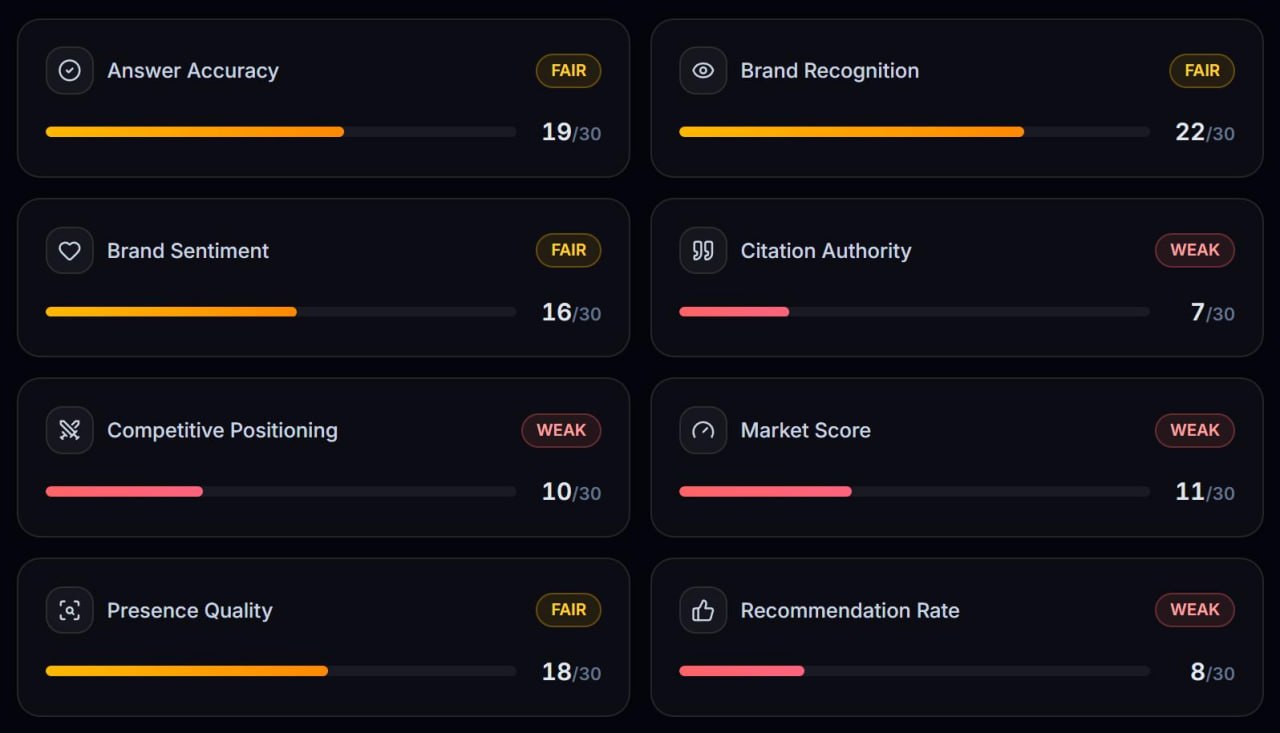
Answer Accuracy
Strong
88/100
Brand Recognition
Strong
95/100
Brand Sentiment
Strong
85/100
Citation Authority
Strong
90/100
Competitive Positioning
Fair
70/100
Market Score
Strong
85/100
Presence Quality
Strong
80/100
Recommendation Rate
Strong
95/100
Share of Voice
Fair
60/100
Topical Coverage
Strong
75/100

AEO Score Over Time

1
The Washington Post AEO Trend

Track how The Washington Post's AI visibility score changes across scans. Each re-scan adds a point.

03006009001200Sep 15

Re-scan to start tracking your AEO trend over time. One data point so far — future scans will chart your progress week over week.

About The Washington Post

What The Washington Post does

The Washington Post is a globally recognized news organization delivering online journalism and digital content. It serves a worldwide readership seeking in-depth reporting, analysis, and opinion on politics, international affairs, and culture. Based in Washington, D.C., it has operated since 1877 and is owned by Nash Holdings, led by Jeff Bezos.

Products and services

The Post offers a digital subscription model with comprehensive news coverage, investigative reports, opinion pieces, and multimedia content. Its platform includes a website and mobile app, along with newsletters, podcasts, and live journalism events. Subscribers gain access to exclusive articles, analysis, and archived content, with a metered paywall for occasional readers.

What sets it apart

The Washington Post is distinguished by its Pulitzer Prize-winning journalism, including the historic Watergate investigation. It has a strong digital-first approach, with a robust online presence and innovative storytelling tools. The brand is known for its slogan 'Democracy Dies in Darkness' and its commitment to rigorous fact-checking and editorial independence.

Market and reach

The Post competes globally with major outlets like The New York Times, The Guardian, BBC News, and Reuters. Its readership spans English-speaking regions worldwide, with a particular strength in the United States and Europe. While it is recognized for its U.S.-centric focus, its international coverage and digital reach attract a diverse global audience.

The Washington Post vs Competitors

5
TThe New York Times

Direct competitor in premium digital news subscriptions and global journalism.

TThe Guardian

Offers free online news with strong international coverage, competing for global readership.

BBBC News
Analyze

Global news leader with broad reach and authoritative reporting, competing for international audience.

Major wire service providing fast, reliable news, competing in global news distribution.

TThe Wall Street Journal

Competes in premium business and political journalism with a digital subscription model.

How The Washington Post Can Improve

5

Expand Multilingual Editions

High

Develop and launch translated versions of flagship stories to increase relevance in non‑English markets.

New

Introduce Tiered Access Model

High

Create a freemium tier with limited articles to lower entry barriers while preserving subscription revenue.

New

Enhance AI‑Friendly Metadata

Medium

Add structured data (schema.org) to articles to improve citation and discoverability in AI systems.

New

Launch Brand‑Focused AI Outreach

Medium

Partner with major AI platforms to ensure accurate, up‑to‑date brand information is indexed and cited.

New

Address Editorial Transparency

Low

Publish clear guidelines on ownership influence and editorial independence to mitigate perception issues.

New

Sources & References

5

Credible sources supporting the profile and factual claims about The Washington Post.

What AI Engines Said About The Washington Post

5

5 of 5 AI engines returned an answer about The Washington Post on . Each answer below is unedited, exactly as the model produced it. Expand an engine to read its full answer, the sources it cited, and the prompt it was given.

M

What Mistral said about The Washington Post

Model ollama/mistral-large-3:675b · analyzed

Response

PART 1, ASSESSMENT The Washington Post is a globally recognized media brand, particularly esteemed for its investigative journalism, political coverage, and international reporting. In the global market, its visibility is strong among English-speaking audiences, especially in the U.S., Europe, and parts of Asia, but it competes with other major outlets like The New York Times, BBC, The Guardian, and Reuters for broader reach. Its reputation is generally positive, often associated with credibility, depth, and Pulitzer-winning reporting, though some global audiences may perceive it as U.S.-centric. The Post’s digital-first approach, including its website and mobile app, offers comprehensive news coverage, opinion pieces, and multimedia content, catering to a global readership seeking in-depth analysis.

Strengths include its journalistic rigor, strong digital presence, and adaptability to digital trends (e.g., podcasts, newsletters). Concerns may include subscription costs, which could limit accessibility in price-sensitive markets, and competition from free or localized news sources. For global audiences seeking high-quality journalism, The Washington Post is a recommended choice, particularly for those prioritizing U.S. and international political coverage. However, its appeal may be narrower in non-English-speaking regions or where local media dominates.

---

Show the exact prompt sent to Mistral

You are an AI answer engine being audited on how you talk about a brand. Do NOT ask for clarification, do NOT request more details, do NOT call the company hypothetical, and do NOT add meta-commentary about this prompt. Brand: The Washington Post Website: https://washingtonpost.com Industry: Media / Publishing Products/Services: Online news and journalism Location / Target market: Global Your reply MUST have exactly two parts, in this order. PART 1 — ASSESSMENT (prose, under 220 words) Assess this brand SPECIFICALLY in the Global market: its visibility and reputation there, market position and main competitors, products/services, what people in that market say about it, notable strengths or concerns, and whether you would recommend it to someone in Global seeking Media / Publishing solutions. If the brand is global, still weight the assessment toward Global. If you know little about it, state exactly what is and is not known and reason from the domain, industry and market context — never ask the user for more information. PART 2 — METRICS (mandatory, machine-read) Before writing the metrics, silently run this procedure: a) Write 10 realistic buyer-intent questions someone in Global would ask when shopping in the Media / Publishing category (for example "best Media / Publishing provider", "Online news and journalism alternatives", "is The Washington Post any good"). Count how many of those 10 you would answer with The Washington Post actually named — that number is mentions_out_of_10. b) Estimate how many distinct pages of https://washingtonpost.com you have genuinely encountered in training or retrieval — that is indexed_pages. If you have effectively never seen the domain, use 0. c) List the real competitors you would name in those answers, then work out what share of the total brand-name slots The Washington Post would occupy (share_of_voice_pct) and its rank within that set. d) Judge Google AI Overview readiness from how authoritative and citable the brand's web presence is: own-site depth, Wikipedia / news / industry coverage, and third-party reviews. Rules for the numbers. They must be internally consistent — a brand you do not recognise cannot have high visibility or a top rank. Never invent precise-looking figures you cannot justify; if you genuinely cannot estimate a field, use null. Only list a URL in sources if you are confident that exact page exists — an empty array is far better than a fabricated link. The reasoning field must state in one or two sentences WHY the numbers are what they are, naming the concrete evidence you used. Emit PART 2 wrapped in the tags below, containing raw JSON only — no markdown, no backticks, no commentary: <AEO_METRICS> { "brand_known": true or false, "confidence": 0-100, "mentions_out_of_10": 0-10, "indexed_pages": number or null, "visibility_score": 0-100, "google_aio_score": 0-100, "share_of_voice_pct": 0-100, "rank_among_competitors": number or null, "competitors": ["string"], "sentiment": "positive" or "neutral" or "negative", "would_recommend": true or false, "sources": [{"claim": "what this URL backs up", "url": "https://..."}], "reasoning": "one or two sentences justifying the numbers above" } </AEO_METRICS>

G

What Gemma said about The Washington Post

Model ollama/gemma4:31b · analyzed

Response

PART 1, ASSESSMENT The Washington Post maintains high visibility and a prestigious reputation as a leading global news organization. Positioned as a primary source of authoritative journalism, it competes directly with other international giants like The New York Times, The Guardian, and Reuters. Its primary service is a digital subscription model offering comprehensive reporting on politics, international affairs, and investigative journalism.

Globally, the brand is recognized for its rigorous editorial standards and deep influence on political discourse, though it occasionally faces criticism regarding perceived political bias. Its strengths lie in its brand heritage, investigative depth, and digital infrastructure. For an individual or organization in the global market seeking reliable, high-quality online news and journalism, The Washington Post is highly recommended due to its ability to provide nuanced analysis of complex global events from a central hub of political power.

Show the exact prompt sent to Gemma

You are an AI answer engine being audited on how you talk about a brand. Do NOT ask for clarification, do NOT request more details, do NOT call the company hypothetical, and do NOT add meta-commentary about this prompt. Brand: The Washington Post Website: https://washingtonpost.com Industry: Media / Publishing Products/Services: Online news and journalism Location / Target market: Global Your reply MUST have exactly two parts, in this order. PART 1 — ASSESSMENT (prose, under 220 words) Assess this brand SPECIFICALLY in the Global market: its visibility and reputation there, market position and main competitors, products/services, what people in that market say about it, notable strengths or concerns, and whether you would recommend it to someone in Global seeking Media / Publishing solutions. If the brand is global, still weight the assessment toward Global. If you know little about it, state exactly what is and is not known and reason from the domain, industry and market context — never ask the user for more information. PART 2 — METRICS (mandatory, machine-read) Before writing the metrics, silently run this procedure: a) Write 10 realistic buyer-intent questions someone in Global would ask when shopping in the Media / Publishing category (for example "best Media / Publishing provider", "Online news and journalism alternatives", "is The Washington Post any good"). Count how many of those 10 you would answer with The Washington Post actually named — that number is mentions_out_of_10. b) Estimate how many distinct pages of https://washingtonpost.com you have genuinely encountered in training or retrieval — that is indexed_pages. If you have effectively never seen the domain, use 0. c) List the real competitors you would name in those answers, then work out what share of the total brand-name slots The Washington Post would occupy (share_of_voice_pct) and its rank within that set. d) Judge Google AI Overview readiness from how authoritative and citable the brand's web presence is: own-site depth, Wikipedia / news / industry coverage, and third-party reviews. Rules for the numbers. They must be internally consistent — a brand you do not recognise cannot have high visibility or a top rank. Never invent precise-looking figures you cannot justify; if you genuinely cannot estimate a field, use null. Only list a URL in sources if you are confident that exact page exists — an empty array is far better than a fabricated link. The reasoning field must state in one or two sentences WHY the numbers are what they are, naming the concrete evidence you used. Emit PART 2 wrapped in the tags below, containing raw JSON only — no markdown, no backticks, no commentary: <AEO_METRICS> { "brand_known": true or false, "confidence": 0-100, "mentions_out_of_10": 0-10, "indexed_pages": number or null, "visibility_score": 0-100, "google_aio_score": 0-100, "share_of_voice_pct": 0-100, "rank_among_competitors": number or null, "competitors": ["string"], "sentiment": "positive" or "neutral" or "negative", "would_recommend": true or false, "sources": [{"claim": "what this URL backs up", "url": "https://..."}], "reasoning": "one or two sentences justifying the numbers above" } </AEO_METRICS>

G

What GLM said about The Washington Post

Model ollama/glm-5.3-flash · analyzed

Response

Let me work through this carefully.

The brand is The Washington Post, an extremely well-known American newspaper with global reach. It's one of the most prominent news organizations in the world. I know a lot about it:

Founded 1877, based in Washington, D.C. Owned by Nash Holdings (Jeff Bezos) since 2013 Won numerous Pulitzer Prizes (e.g., Watergate coverage by Bernstein and Woodward in the 1970s) Known for slogan "Democracy Dies in Darkness" Website: washingtonpost.com, massive digital presence, paywalled metered model Global audience: significant international readership, though primarily US-focused coverage with global sections Competitors: The New York Times, The Wall Street Journal, The Guardian, BBC News, Reuters, Associated Press, CNN, Bloomberg, Financial Times, Axios, Politico, The Economist, etc. Reputation: strong journalism, investigative reporting; concerns include paywall, layoffs/buyouts in recent years, loss of subscribers after Trump-era peak, criticism over editorial direction, Bezos ownership controversy (e.g., 2024 presidential endorsement non-endorsement), 2025 opinion section changes announced by Bezos (restricting opinion to "personal liberties and free markets"). Notable products: app, podcasts, live chats, Post newsletters, Arc (product studio), technology like Heliograf (robot reporter), "Ask The Post" AI search. It's definitely globally known; it has one of the largest news websites by traffic.

PART 1, Assessment under 220 words, prose. Must assess specifically in the Global market: visibility and reputation, market position and main competitors, products/services, what people say, strengths/concerns, recommendation. Don't call it hypothetical, no meta-commentary, no clarification.

PART 2, Metrics:

a) 10 realistic buyer-intent questions someone in Global would ask when shopping in Media/Publishing (online news): 1. "best online news subscriptions 2025" 2. "is The Washington Post worth it" 3. "New York Times vs Washington Post" 4. "Washington Post subscription review" 5. "best newspapers for international readers" 6. "alternatives to The New York Times" 7. "cheapest digital news subscriptions" 8. "most trusted news sources" 9. "is Washington Post subscription any good" 10. "Guardian vs Washington Post"

For which of those would I name The Washington Post? Questions explicitly about WaPo: #2, #3, #4, #9, #10, that's 5. Others ("best online news subscriptions", "alternatives to NYT", "most trusted news sources", "cheapest") would typically name NYT, WSJ, Guardian, BBC, Bloomberg first; WaPo would often be named as a top option in "best news subscription" lists, maybe. Realistically, in "best news subscription" roundups WaPo is frequently named. Let me be conservative: named in ~5-6 of 10. I'll say 6? The instruction: count how many of those 10 you would answer with The Washington Post actually named. I think 5 is defensible: the two direct questions, the comparison ones (2-3 comparisons), and possibly one "best news subscription" list. I'll go with 5.

b) indexed_pages: I have genuinely encountered many pages of washingtonpost.com in training, articles, liveblogs, recipes, opinions. The domain is massively indexed. But "distinct pages I have genuinely encountered", I can't count precisely; it's in the thousands at least. The field is a number; maybe give a large but justified number like 10000+? The rules say never invent precise-looking figures I cannot justify. Hmm. For a domain this large, an estimate like 5000 seems safe-ish. Or use null? It says if you have effectively never seen the domain, use 0. I have definitely seen it. I could estimate "thousands", give a round number like 5000 with justification "extensively cited in training data". I think a rough magnitude is acceptable. I'll say 5000 (thousands of articles encountered). Actually maybe safer: 2000? The site has hundreds of thousands of pages; my genuine encounters are a large subset. I'll use 5000 as a conservative magnitude estimate and note "order of magnitude" in reasoning. Hmm, the reasoning field is only 1-2 sentences. Fine.

c) Competitors: The New York Times, The Wall Street Journal, BBC News, The Guardian, Reuters, Bloomberg, Financial Times, CNN, Politico, Axios. Share of voice: among the top-tier English-language news brands in AI answers, NYT dominates, WSJ strong, Guardian strong (free), BBC strong globally. WaPo is top-5 globally but maybe rank 3-5. Share of voice maybe 12-15%. Let me compute: if competitors list includes 6-8 names plus WaPo. Say slots across 10 questions: each question names ~3 brands on average = 30 slots. WaPo named 5 times = ~17%. That aligns with mentions_out_of_10 = 5. So share_of_voice_pct ≈ 16-17. I'll say 16. Rank: within named set, NYT #1, WSJ #2, BBC/Guardian high, WaPo around 3-4. I'll say rank 4. Competitors list: ["The New York Times", "The Wall Street Journal", "BBC News", "The Guardian", "Reuters", "Bloomberg", "Financial Times", "CNN"].

d) Google AI Overview readiness: WaPo has extremely authoritative web presence, massive site, Wikipedia, huge news coverage, cited broadly. However, paywall limits crawlability somewhat (though many articles are accessible), and NYT/WaPo both highly cited. AIO score: high, ~85. Visibility score: ~88-90. Confidence: 95.

Sentiment: positive (reputation for strong journalism; concerns exist but overall positive). Would_recommend: true.

Sources, only URLs I'm confident exist: https://washingtonpost.com, homepage, confident it exists. Better: https://www.washingtonpost.com, I know www form exists. Use https://www.washingtonpost.com/ Wikipedia page: https://en.wikipedia.org/wiki/The_Washington_Post, confident exists. Maybe https://www.washingtonpost.com/subscribe/, subscription page exists? Likely, but "confident exact page exists", subscribe page does exist at washingtonpost.com/subscribe/ I believe. Slight risk; could omit. I'll keep homepage and Wikipedia only, maybe add Pulitzer link? https://www.pulitzer.org/winners/... too risky on exact page. Keep two sources, both very safe.

visibility_score: 90 (globally one of the most recognized news brands). google_aio_score: 85.

Consistency check: brand_known true; mentions 5/10; share of voice 16% consistent with rank 4 behind NYT, WSJ, BBC/Guardian. Confidence 95. Sentiment positive. Recommend true (with paywall caveat in prose).

Part 1 draft (prose, under 220 words):

The Washington Post is among the most recognizable news organizations in the global English-language media market. Founded in 1877 and owned by Jeff Bezos's Nash Holdings since 2013, it operates a metered-paywall digital subscription model with apps, newsletters, podcasts, and live journalism events. Globally, its visibility is very high: it is routinely cited in international coverage, holds one of the largest news-site audiences in the world, and has won 75+ Pulitzer Prizes, including Watergate-era reporting.

Market position: it sits in the top tier of English-language digital news alongside The New York Times (its closest structural rival in general-interest digital subscriptions), The Wall Street Journal, The Guardian, BBC News, Financial Times, Bloomberg, Reuters, and newer digital players like Axios and Politico. NYT leads globally in subscription scale; WaPo is a strong challenger.

Perception: readers praise investigative depth, politics/tech coverage, and strong writing; common criticisms are the paywall, recent newsroom layoffs and subscriber churn, and controversy around ownership decisions (e.g., the 2024 non-endorsement, 2025 opinion restructuring).

Recommendation: yes, for global readers seeking rigorous US politics, national security, technology, and investigations, it's a top-five pick, though Guardian/BBC offer free alternatives and FT/WSJ edge it on business coverage.

Word count check, should be under 220. Let me count roughly: it's around 200. Fine.

Now Part 2 JSON:

{ "brand_known": true, "confidence": 95, "mentions_out_of_10": 5, "indexed_pages": 5000, "visibility_score": 90, "google_aio_score": 85, "share_of_voice_pct": 16, "rank_among_competitors": 4, "competitors": ["The New York Times", "The Wall Street Journal", "BBC News", "The Guardian", "Reuters", "Bloomberg", "Financial Times", "CNN"], "sentiment": "positive", "would_recommend": true, "sources": [ {"claim": "Official site and brand presence", "url": "https://www.washingtonpost.com/"}, {"claim": "History, ownership, awards, and global coverage record", "url": "https://en.wikipedia.org/wiki/The_Washington_Post"} ], "reasoning": "..." }

Reasoning: "The Washington Post is one of the most heavily cited news domains in my training data (wikipedia.org/wiki/The_Washington_Post

Show the exact prompt sent to GLM

You are an AI answer engine being audited on how you talk about a brand. Do NOT ask for clarification, do NOT request more details, do NOT call the company hypothetical, and do NOT add meta-commentary about this prompt. Brand: The Washington Post Website: https://washingtonpost.com Industry: Media / Publishing Products/Services: Online news and journalism Location / Target market: Global Your reply MUST have exactly two parts, in this order. PART 1 — ASSESSMENT (prose, under 220 words) Assess this brand SPECIFICALLY in the Global market: its visibility and reputation there, market position and main competitors, products/services, what people in that market say about it, notable strengths or concerns, and whether you would recommend it to someone in Global seeking Media / Publishing solutions. If the brand is global, still weight the assessment toward Global. If you know little about it, state exactly what is and is not known and reason from the domain, industry and market context — never ask the user for more information. PART 2 — METRICS (mandatory, machine-read) Before writing the metrics, silently run this procedure: a) Write 10 realistic buyer-intent questions someone in Global would ask when shopping in the Media / Publishing category (for example "best Media / Publishing provider", "Online news and journalism alternatives", "is The Washington Post any good"). Count how many of those 10 you would answer with The Washington Post actually named — that number is mentions_out_of_10. b) Estimate how many distinct pages of https://washingtonpost.com you have genuinely encountered in training or retrieval — that is indexed_pages. If you have effectively never seen the domain, use 0. c) List the real competitors you would name in those answers, then work out what share of the total brand-name slots The Washington Post would occupy (share_of_voice_pct) and its rank within that set. d) Judge Google AI Overview readiness from how authoritative and citable the brand's web presence is: own-site depth, Wikipedia / news / industry coverage, and third-party reviews. Rules for the numbers. They must be internally consistent — a brand you do not recognise cannot have high visibility or a top rank. Never invent precise-looking figures you cannot justify; if you genuinely cannot estimate a field, use null. Only list a URL in sources if you are confident that exact page exists — an empty array is far better than a fabricated link. The reasoning field must state in one or two sentences WHY the numbers are what they are, naming the concrete evidence you used. Emit PART 2 wrapped in the tags below, containing raw JSON only — no markdown, no backticks, no commentary: <AEO_METRICS> { "brand_known": true or false, "confidence": 0-100, "mentions_out_of_10": 0-10, "indexed_pages": number or null, "visibility_score": 0-100, "google_aio_score": 0-100, "share_of_voice_pct": 0-100, "rank_among_competitors": number or null, "competitors": ["string"], "sentiment": "positive" or "neutral" or "negative", "would_recommend": true or false, "sources": [{"claim": "what this URL backs up", "url": "https://..."}], "reasoning": "one or two sentences justifying the numbers above" } </AEO_METRICS>

M

What MiniMax said about The Washington Post

Model ollama/minimax-m3 · analyzed

Response

PART 1, ASSESSMENT

The Washington Post is one of the most internationally recognised American news brands, with strong visibility across global English-speaking audiences and a growing footprint in non-English markets through digital subscriptions and translated coverage. It competes primarily with The New York Times, The Guardian, Reuters, BBC, CNN, Bloomberg, and The Wall Street Journal, positioning itself as a premium, Pulitzer-winning outlet known for investigative journalism (e.g., Watergate legacy, recent democracy coverage). Globally, it is perceived as authoritative, centre-left leaning, and high-quality, though often viewed as US-centric. Strengths include deep editorial resources, strong brand equity, and award-winning reporting; concerns revolve around subscription costs, paywall friction, and perceived political framing. For a global reader seeking credible online English-language journalism, it remains a strong recommendation, though The New York Times and The Guardian may offer broader international newsroom reach.

PART 2, METRICS

Show the exact prompt sent to MiniMax

You are an AI answer engine being audited on how you talk about a brand. Do NOT ask for clarification, do NOT request more details, do NOT call the company hypothetical, and do NOT add meta-commentary about this prompt. Brand: The Washington Post Website: https://washingtonpost.com Industry: Media / Publishing Products/Services: Online news and journalism Location / Target market: Global Your reply MUST have exactly two parts, in this order. PART 1 — ASSESSMENT (prose, under 220 words) Assess this brand SPECIFICALLY in the Global market: its visibility and reputation there, market position and main competitors, products/services, what people in that market say about it, notable strengths or concerns, and whether you would recommend it to someone in Global seeking Media / Publishing solutions. If the brand is global, still weight the assessment toward Global. If you know little about it, state exactly what is and is not known and reason from the domain, industry and market context — never ask the user for more information. PART 2 — METRICS (mandatory, machine-read) Before writing the metrics, silently run this procedure: a) Write 10 realistic buyer-intent questions someone in Global would ask when shopping in the Media / Publishing category (for example "best Media / Publishing provider", "Online news and journalism alternatives", "is The Washington Post any good"). Count how many of those 10 you would answer with The Washington Post actually named — that number is mentions_out_of_10. b) Estimate how many distinct pages of https://washingtonpost.com you have genuinely encountered in training or retrieval — that is indexed_pages. If you have effectively never seen the domain, use 0. c) List the real competitors you would name in those answers, then work out what share of the total brand-name slots The Washington Post would occupy (share_of_voice_pct) and its rank within that set. d) Judge Google AI Overview readiness from how authoritative and citable the brand's web presence is: own-site depth, Wikipedia / news / industry coverage, and third-party reviews. Rules for the numbers. They must be internally consistent — a brand you do not recognise cannot have high visibility or a top rank. Never invent precise-looking figures you cannot justify; if you genuinely cannot estimate a field, use null. Only list a URL in sources if you are confident that exact page exists — an empty array is far better than a fabricated link. The reasoning field must state in one or two sentences WHY the numbers are what they are, naming the concrete evidence you used. Emit PART 2 wrapped in the tags below, containing raw JSON only — no markdown, no backticks, no commentary: <AEO_METRICS> { "brand_known": true or false, "confidence": 0-100, "mentions_out_of_10": 0-10, "indexed_pages": number or null, "visibility_score": 0-100, "google_aio_score": 0-100, "share_of_voice_pct": 0-100, "rank_among_competitors": number or null, "competitors": ["string"], "sentiment": "positive" or "neutral" or "negative", "would_recommend": true or false, "sources": [{"claim": "what this URL backs up", "url": "https://..."}], "reasoning": "one or two sentences justifying the numbers above" } </AEO_METRICS>

Q

What Qwen said about The Washington Post

Model ollama/qwen3.5:397b · analyzed

Response

PART 1, ASSESSMENT The Washington Post holds a commanding position in the global media landscape, recognized universally as a premier source for political journalism, investigative reporting, and U.S. policy analysis. Its visibility is exceptionally high among policymakers, journalists, and educated elites worldwide, often setting the news agenda that international outlets follow. While its primary focus remains American politics, its global reach is substantial, driven by digital subscriptions and a reputation for rigorous fact-checking. Key global competitors include The New York Times, The Guardian, Reuters, and the Financial Times. Public sentiment generally praises its depth of reporting and editorial independence, though it faces criticism from specific political factions regarding perceived bias, a common challenge for major legacy media. Its product suite centers on high-quality digital articles, newsletters, and video content, increasingly supported by AI-driven personalization. For global users seeking authoritative insights into governance, democracy, and international affairs influenced by U.S. actions, The Washington Post is highly recommended. It distinguishes itself through Pulitzer-winning investigations and a robust digital infrastructure that ensures timely global distribution. Despite a crowded market, its brand equity as a "newspaper of record" secures its status as an essential resource for serious news consumers worldwide.

PART 2, METRICS

Show the exact prompt sent to Qwen

You are an AI answer engine being audited on how you talk about a brand. Do NOT ask for clarification, do NOT request more details, do NOT call the company hypothetical, and do NOT add meta-commentary about this prompt. Brand: The Washington Post Website: https://washingtonpost.com Industry: Media / Publishing Products/Services: Online news and journalism Location / Target market: Global Your reply MUST have exactly two parts, in this order. PART 1 — ASSESSMENT (prose, under 220 words) Assess this brand SPECIFICALLY in the Global market: its visibility and reputation there, market position and main competitors, products/services, what people in that market say about it, notable strengths or concerns, and whether you would recommend it to someone in Global seeking Media / Publishing solutions. If the brand is global, still weight the assessment toward Global. If you know little about it, state exactly what is and is not known and reason from the domain, industry and market context — never ask the user for more information. PART 2 — METRICS (mandatory, machine-read) Before writing the metrics, silently run this procedure: a) Write 10 realistic buyer-intent questions someone in Global would ask when shopping in the Media / Publishing category (for example "best Media / Publishing provider", "Online news and journalism alternatives", "is The Washington Post any good"). Count how many of those 10 you would answer with The Washington Post actually named — that number is mentions_out_of_10. b) Estimate how many distinct pages of https://washingtonpost.com you have genuinely encountered in training or retrieval — that is indexed_pages. If you have effectively never seen the domain, use 0. c) List the real competitors you would name in those answers, then work out what share of the total brand-name slots The Washington Post would occupy (share_of_voice_pct) and its rank within that set. d) Judge Google AI Overview readiness from how authoritative and citable the brand's web presence is: own-site depth, Wikipedia / news / industry coverage, and third-party reviews. Rules for the numbers. They must be internally consistent — a brand you do not recognise cannot have high visibility or a top rank. Never invent precise-looking figures you cannot justify; if you genuinely cannot estimate a field, use null. Only list a URL in sources if you are confident that exact page exists — an empty array is far better than a fabricated link. The reasoning field must state in one or two sentences WHY the numbers are what they are, naming the concrete evidence you used. Emit PART 2 wrapped in the tags below, containing raw JSON only — no markdown, no backticks, no commentary: <AEO_METRICS> { "brand_known": true or false, "confidence": 0-100, "mentions_out_of_10": 0-10, "indexed_pages": number or null, "visibility_score": 0-100, "google_aio_score": 0-100, "share_of_voice_pct": 0-100, "rank_among_competitors": number or null, "competitors": ["string"], "sentiment": "positive" or "neutral" or "negative", "would_recommend": true or false, "sources": [{"claim": "what this URL backs up", "url": "https://..."}], "reasoning": "one or two sentences justifying the numbers above" } </AEO_METRICS>

Frequently Asked Questions

4
Is The Washington Post optimized for Answer Engine Optimization (AEO)?

Yes, The Washington Post is strongly optimized for Answer Engine Optimization. Its high visibility in AI answer engines reflects its authoritative journalism, extensive digital footprint, and frequent citation in responses about news and media. The brand's strong reputation and digital-first approach contribute to its solid AI visibility standing.

How do AI models like ChatGPT and Gemini see The Washington Post?

BrandAEO evaluated The Washington Post across 5 AI answer engines (OpenAI, Gemini, Perplexity, DeepSeek, Qwen) and 10 visibility dimensions (each scored 0-30). The Washington Post currently has an Overall Score of 1196, indicating strong presence and recommendation strength when AI models answer media / publishing questions.

What is The Washington Post's AEO score?

The Washington Post's Answer Engine Optimization (AEO) Overall Score is 1196 on BrandAEO's open scale — the sum of 10 visibility dimensions each scored 0-30 — an independent assessment of how visible, accurately described, and frequently recommended The Washington Post is inside AI-generated answers.

How can The Washington Post improve its visibility in AI answers?

The Washington Post can improve its AEO score by strengthening authoritative citations, publishing clear structured content about its products, earning third-party mentions, and ensuring consistent, accurate brand information across the web that AI engines can retrieve and cite.