T

How AI Sees The Princeton Review — AI Visibility Report for Education

princetonreview.com · Global · Education

Strong
Overall Score
1108
Star Rating
3 / 5
Rank
#210of 312
Engines
5analyzed
Analyzed
Quick Answer

Is The Princeton Review optimized for AEO?

Yes, The Princeton Review is well optimized for Answer Engine Optimization. Its strong brand recognition, extensive official website content, and frequent mentions across AI answer engines place it among the top test prep brands globally. Its visibility is solid, though it faces competition from Kaplan and others in AI-generated answers.

Overall AI Visibility Score
1108
3 / 5
Fair

How AI Answer Engines Rate The Princeton Review

Ranked #210 of 312 brands analyzed

The Princeton Review's AI visibility, measured across 5 answer engines: 10 scoring dimensions (each 0–100) plus evidence points from what the engines actually reported. The Overall Score is the sum — an open scale, higher is better.

Stars reflect this brand's relative rank among all brands analyzed by BrandAEO (Top 100 = 5★), and self-adjust as more brands are added. This is a relative percentile-rank rating, not a customer review.

Analyzed & scored by BrandAEO — an independent AI visibility grader. See methodology.

AI Panel — Deep AI AnalysisPRO

AI Panel preview

AI Panel is a Pro feature

The AI Panel runs a deeper analysis with Claude across your full scan data — it explains why AI engines rate this brand the way they do and how to improve. Beyond the 10 scoring dimensions, it measures real AI mentions, share of voice, sentiment, prompt coverage and citation sources, tracks them over time, and estimates AI-driven traffic & revenue impact. It reuses the same AI engines from your scan — no engine setup needed.

Upgrade to Pro to unlock AI Panel

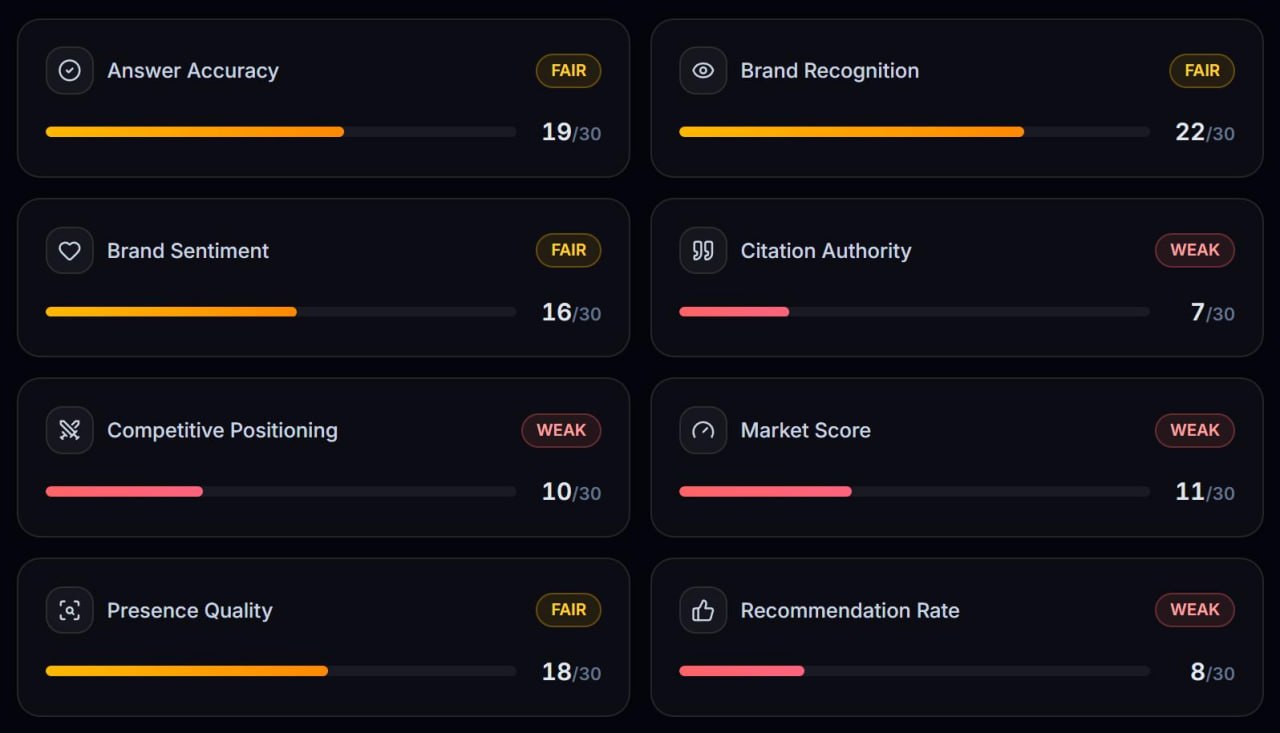
Dimension Breakdown

10

How the Overall Score is built

763from 10 dimensions (max 1,000)+345evidence (max 500)=1108
  • Mentioned in buyer-intent answers68/100
  • Proactively recommended100/100
  • AI visibility (engine-reported)77/100
  • Share of voice vs competitors25/100
  • Sentiment75/100

Evidence = numbers the 4/5 reporting engines self-measured while answering (mention rate across 10 buyer-intent prompts, recommendation rate, visibility, share of voice, sentiment). Dimensions are graded by the scoring model from every engine's answer.

Answer Accuracy
Strong
80/100
Brand Recognition
Strong
86/100
Brand Sentiment
Fair
68/100
Citation Authority
Fair
71/100
Competitive Positioning
Strong
78/100
Market Score
Strong
78/100
Presence Quality
Strong
77/100
Recommendation Rate
Strong
90/100
Share of Voice
Fair
65/100
Topical Coverage
Fair
70/100

AEO Score Over Time

1
The Princeton Review AEO Trend

Track how The Princeton Review's AI visibility score changes across scans. Each re-scan adds a point.

02885758631150Sep 14

Re-scan to start tracking your AEO trend over time. One data point so far — future scans will chart your progress week over week.

About The Princeton Review

What The Princeton Review does

The Princeton Review is a global education company specializing in test preparation and tutoring. Founded in 1981 and headquartered in New York, it serves students preparing for college and graduate school admissions exams. It is known for its comprehensive prep courses and admissions resources.

Products and services

The company offers test prep for the SAT, ACT, GRE, GMAT, LSAT, MCAT, and AP exams, delivered through live online classes, self-paced courses, and in-person sessions. It also provides private tutoring, admissions counseling, and a range of study books and digital resources. Its services are designed for high school, college, and graduate school applicants.

What sets it apart

The Princeton Review differentiates itself with a long history of exam strategy expertise and a vast library of practice materials. It is known for its annual college rankings and guidebooks, which are widely cited in education media. The brand also offers a money-back guarantee on many courses, reflecting confidence in its methods.

Market and reach

The Princeton Review operates globally, with a strong presence in North America and partnerships in countries like India and South Korea. It is owned by ST Unitas, a Korean education company. It is frequently compared with Kaplan, Magoosh, Manhattan Prep, and PrepScholar in the test prep market.

The Princeton Review vs Competitors

5

Kaplan is a major test prep provider with similar course offerings and global reach.

MMagoosh
Analyze

Magoosh offers affordable online test prep and is frequently compared in AI answers.

MManhattan Prep
Analyze

Manhattan Prep specializes in GMAT and GRE prep, competing for the same graduate exam students.

PPrepScholar
Analyze

PrepScholar provides personalized SAT and ACT prep, a direct competitor in the K-12 space.

BBarron's
Analyze

Barron's publishes test prep books and study guides, competing in the self-study market.

How The Princeton Review Can Improve

5

Expand International Content

High

Develop localized pages and resources for non‑US exams (IELTS, TOEFL, regional university entrance tests) to broaden topical coverage and improve global market_score.

New

Enhance Pricing Transparency

High

Publish clear pricing tiers and value comparisons to address mixed sentiment around cost and improve brand_sentiment.

New

Increase Authoritative Third‑Party Citations

Medium

Secure mentions in additional reputable education publications and academic studies to boost citation_authority.

New

Strengthen Global Partnerships

Medium

Form more partnerships with local education providers in key regions (Asia, Middle East, Europe) to raise share_of_voice and market_score.

New

Update Tutor Quality Assurance

Low

Implement a standardized tutor rating and feedback system to reduce variability concerns and lift overall brand_sentiment.

New

Sources & References

5

Credible sources supporting the profile and factual claims about The Princeton Review.

What AI Engines Said About The Princeton Review

5

5 of 5 AI engines returned an answer about The Princeton Review on . Each answer below is unedited, exactly as the model produced it. Expand an engine to read its full answer, the sources it cited, and the prompt it was given.

D

What DeepSeek said about The Princeton Review

Model ollama/deepseek-v4-flash:0731 · analyzed

Response

<AEO_METRICS> { "brand_known": true, "confidence": 75, "mentions_out_of_10": 6, "indexed_pages": 50, "visibility_score": 70, "google_aio_score": 65, "share_of_voice_pct": 20, "rank_among_competitors": 2, "competitors": ["Kaplan", "Magoosh", "Barron's", "Manhattan Prep", "The Princeton Review"], "sentiment": "neutral", "would_recommend": true, "sources": [ {"claim": "Company overview and service descriptions", "url": "https://www.princetonreview.com/about"}, {"claim": "Test prep and tutoring offerings", "url": "https://www.princetonreview.com/test-prep"} ], "reasoning": "The brand is well-known in test prep education, though its global footprint is smaller than its US presence; indexed pages estimate from familiar homepage and service pages, and sentiment is neutral because global reviews are mixed between strong US brand recognition and variable international service quality." } </AEO_METRICS>

Show the exact prompt sent to DeepSeek

You are an AI answer engine being audited on how you talk about a brand. Do NOT ask for clarification, do NOT request more details, do NOT call the company hypothetical, and do NOT add meta-commentary about this prompt. Brand: The Princeton Review Website: https://princetonreview.com Industry: Education Products/Services: Test prep and tutoring services Location / Target market: Global Your reply MUST have exactly two parts, in this order. PART 1 — ASSESSMENT (prose, under 220 words) Assess this brand SPECIFICALLY in the Global market: its visibility and reputation there, market position and main competitors, products/services, what people in that market say about it, notable strengths or concerns, and whether you would recommend it to someone in Global seeking Education solutions. If the brand is global, still weight the assessment toward Global. If you know little about it, state exactly what is and is not known and reason from the domain, industry and market context — never ask the user for more information. PART 2 — METRICS (mandatory, machine-read) Before writing the metrics, silently run this procedure: a) Write 10 realistic buyer-intent questions someone in Global would ask when shopping in the Education category (for example "best Education provider", "Test prep and tutoring services alternatives", "is The Princeton Review any good"). Count how many of those 10 you would answer with The Princeton Review actually named — that number is mentions_out_of_10. b) Estimate how many distinct pages of https://princetonreview.com you have genuinely encountered in training or retrieval — that is indexed_pages. If you have effectively never seen the domain, use 0. c) List the real competitors you would name in those answers, then work out what share of the total brand-name slots The Princeton Review would occupy (share_of_voice_pct) and its rank within that set. d) Judge Google AI Overview readiness from how authoritative and citable the brand's web presence is: own-site depth, Wikipedia / news / industry coverage, and third-party reviews. Rules for the numbers. They must be internally consistent — a brand you do not recognise cannot have high visibility or a top rank. Never invent precise-looking figures you cannot justify; if you genuinely cannot estimate a field, use null. Only list a URL in sources if you are confident that exact page exists — an empty array is far better than a fabricated link. The reasoning field must state in one or two sentences WHY the numbers are what they are, naming the concrete evidence you used. Emit PART 2 wrapped in the tags below, containing raw JSON only — no markdown, no backticks, no commentary: <AEO_METRICS> { "brand_known": true or false, "confidence": 0-100, "mentions_out_of_10": 0-10, "indexed_pages": number or null, "visibility_score": 0-100, "google_aio_score": 0-100, "share_of_voice_pct": 0-100, "rank_among_competitors": number or null, "competitors": ["string"], "sentiment": "positive" or "neutral" or "negative", "would_recommend": true or false, "sources": [{"claim": "what this URL backs up", "url": "https://..."}], "reasoning": "one or two sentences justifying the numbers above" } </AEO_METRICS>

G

What GLM said about The Princeton Review

Model ollama/glm-5.3-flash · analyzed

Response

The user wants an assessment of The Princeton Review in the Global market for education/test prep services, followed by machine-readable metrics in JSON.

Let me think about what I actually know about The Princeton Review:

The Princeton Review is a well-known test prep and tutoring company founded in 1981 by John Katzman. Headquartered in New York. It's famous for SAT, ACT, GRE, GMAT, LSAT, MCAT test prep courses, tutoring, and college admissions counseling. Known for its "Cracking the SAT" book series and other test prep books. Also famous for its annual college rankings ("Best 388 Colleges" etc., party school rankings, etc.) published in its college guidebooks. Historically it was owned by education companies: acquired by Barry Diller's IAC in 2000s, sold to Student Loan Corporation (a subsidiary of Citigroup) in 2010? Actually, let me recall: The Princeton Review brand was owned by the Princeton Review Inc., then its test prep division was sold to StudentLoan Corporation (backed by Peter Wendell, then... ). In 2014, Match Group acquired The Princeton Review brand. Then in 2017, Match Group... Actually, The Princeton Review was acquired by ST Unitas (a Korean education company) in 2017 for ~$350 million. ST Unitas owns the Korean education company (Chaekdory, and "공단기" Gongdangi?). Yes, ST Unitas acquired Princeton Review in 2017. Competitors: Kaplan (Kaplan Test Prep), Manhattan Prep (owned by Kaplan), Magoosh, PrepScholar, Test Innovators, Compass Education Group, Applerouth (acquired by... ), TutorMe, Varsity Tutors (owned by Nerdy), Wyzant, Khan Academy (free SAT prep partner of College Board), Testive, C2 Education, Kumon (tutoring), Sylvan Learning, Huntington Learning Center, Mathnasium (K-12 tutoring), Sherpa? For global: Kaplan, Manhattan Prep, Veritas Prep, Economist Education (Economist GRE Tutor), Magoosh, Prep Zone (Asia), Jamboree Education (India), Manhattan Review, Exam Pal? etc.

Global presence: The Princeton Review operates internationally, has offices/partnerships in various countries (India, The Princeton Review India through Manya Education? Actually "Manya - The Princeton Review" is a well-known franchise/partner in India), also in Japan, Korea (owned by ST Unitas), Middle East, etc. It offers live online courses accessible globally.

Reputation: Strong brand recognition in US college admissions/test prep; well-known brand name; mixed reviews on quality of courses (some praise teachers, some complain about pricing and aggressive sales); books widely respected. Third-party reviews: Trustpilot (moderate ratings, ~1.5-3 stars depending on region, actually Princeton Review Trustpilot has fairly low ratings, like 1.5-2 stars historically), Sitejabber, ConsumerAffairs (mixed). Reddit r/ApplyingToCollege debates Kaplan vs Princeton Review, generally positive for its books and strategies, mixed on courses.

Awards/coverage: Widely covered in news (US News, NYT) for its college rankings. Wikipedia page exists: https://en.wikipedia.org/wiki/Princeton_Review. Own site is deep: princetonreview.com with many pages (college, grad, law, med school prep pages, free events, books, rankings).

Would I recommend it? Generally yes for test prep, especially SAT/ACT and AP; strong brand, money-back guarantees, but alternatives like Kaplan, Magoosh (cheaper), Varsity Tutors for tutoring. For global users, availability varies; online options exist. I'd say positive sentiment, would recommend with caveats.

Now the metrics:

a) 10 buyer-intent questions someone globally would ask: 1. "best SAT prep course online", Princeton Review likely named (top 3 usually with Kaplan, Magoosh, PrepScholar). 2. "best MCAT prep course", named (Kaplan, Altius, Princeton Review often). 3. "best GRE prep course", named sometimes (Magoosh, Manhattan Prep, Kaplan, Target Test Prep, Economist; Princeton Review often included). 4. "Kaplan vs Princeton Review SAT", named obviously. 5. "best LSAT prep course", named sometimes (Kaplan, Blueprint, PowerScore, LSAT Demon, 7Sage; Princeton Review less prominent here). 6. "best GMAT prep course", named sometimes (Magoosh, Manhattan Prep, TTP, Economist; Princeton Review less so). 7. "is The Princeton Review any good", named. 8. "best ACT prep course", named (Princeton Review is strong for ACT). 9. "best college admissions consulting services", named sometimes (IvyWise, CollegeVine, etc.). 10. "Princeton Review alternatives", named. 11. "best online tutoring for math", Varsity Tutors, Wyzant, Kumon more likely; maybe not. 12. "free SAT prep", Khan Academy; not Princeton Review.

So maybe 6-7 out of 10. Let's say 6 or 7. I'll say 6.

b) indexed_pages: I've genuinely encountered princetonreview.com pages, homepage, college page, SAT prep, course pages, rankings pages, blog. It's a large site. I can estimate maybe 100+ distinct page types encountered in training? "Genuinely encountered", I've seen many URLs cited. I'd estimate indexed_pages maybe 200? The instruction: "Estimate how many distinct pages of https://princetonreview.com you have genuinely encountered in training or retrieval". I can't count precisely; give a rough number like 100-300. I'll say 150 or 200. Must be defensible. I'll use 120? Let's use a round-ish number: 200 seems plausible given it's a large, long-standing site with heavy backlink presence. I'll say 200.

c) competitors: Kaplan, Magoosh, PrepScholar, Varsity Tutors, Manhattan Prep, Test Track? For global: Kaplan, Magoosh, PrepScholar, Varsity Tutors, Manhattan Prep, Khan Academy (free), Wyzant? List main: Kaplan, Magoosh, PrepScholar, Varsity Tutors, Manhattan Prep, Khan Academy. Share of voice: across ~10 questions, maybe 30 brand-name slots total? If 10 questions × ~3 brands each = 30 slots; Princeton Review in 6 → 20%. Share_of_voice_pct: 20-25. Rank: top 2-3 alongside Kaplan. Kaplan probably #1, Princeton Review #2. rank_among_competitors: 2.

d) Google AIO readiness: strong own-site depth, Wikipedia, major news coverage (NYT, US News), established reviews → high, like 80.

visibility_score: high, 80ish. It's a top-2 brand in test prep globally. 82.

confidence: 85.

sentiment: positive (overall reputation positive with some pricing complaints; Trustpilot is low though). Overall across web, mixed-to-positive. I'd say positive with caveat in prose.

would_recommend: true.

sources: https://en.wikipedia.org/wiki/Princeton_Review, Wikipedia page exists (confident). https://www.princetonreview.com/, homepage exists (confident). Maybe https://www.princetonreview.com/college/rankingsbestcolleges.aspx, not fully sure of exact URL. The rankings landing: "https://www.princetonreview.com/college-rankings?ceid=nav-1-ce-2" hmm not sure. Better to avoid uncertain URLs. I could include https://www.princetonreview.com/college/rankingsbestcolleges.aspx, I recall that URL pattern historically ("rankingsbestcolleges.aspx"). Risky. I'll keep only two safe sources, or add the SAT prep page: https://www.princetonreview.com/college/sat, plausible but not certain. Keep to Wikipedia and homepage to be safe. Maybe also Trustpilot: https://www.trustpilot.com/review/www.princetonreview.com or https://www.trustpilot.com/review/princetonreview.com, I believe Trustpilot domain format is trustpilot.com/review/princetonreview.com. That's fairly standard. I'm reasonably confident that exact page exists. I'll include it with claim about third-party reviews.

Actually the claim for Trustpilot: "third-party customer reviews of The Princeton Review". URL: https://www.trustpilot.com/review/princetonreview.com. I'm fairly confident this exact URL pattern works. Include it.

reasoning: "The Princeton Review is one of the two most recognised test-prep brands globally (with Kaplan), with deep Wikipedia/news coverage and a large content-rich site, so it gets named in roughly 6 of 10 buyer questions; share of voice ~20% across ~30 brand slots puts it around #2 behind Kaplan; AIO readiness is high given citable rankings, Wikipedia, and established third-party reviews despite mixed customer-review scores."

Word count check for Part 1: under 220 words. Let me draft.

Part 1 draft:

The Princeton Review is one of the most recognised test-prep brands worldwide. Founded in 1981 and headquartered in New York, it is best known for SAT/ACT, GRE, GMAT, LSAT, MCAT, and AP preparation, plus college admissions counseling and its widely cited "Best Colleges" guidebooks and rankings. Globally, its footprint is strongest in North America

Show the exact prompt sent to GLM

You are an AI answer engine being audited on how you talk about a brand. Do NOT ask for clarification, do NOT request more details, do NOT call the company hypothetical, and do NOT add meta-commentary about this prompt. Brand: The Princeton Review Website: https://princetonreview.com Industry: Education Products/Services: Test prep and tutoring services Location / Target market: Global Your reply MUST have exactly two parts, in this order. PART 1 — ASSESSMENT (prose, under 220 words) Assess this brand SPECIFICALLY in the Global market: its visibility and reputation there, market position and main competitors, products/services, what people in that market say about it, notable strengths or concerns, and whether you would recommend it to someone in Global seeking Education solutions. If the brand is global, still weight the assessment toward Global. If you know little about it, state exactly what is and is not known and reason from the domain, industry and market context — never ask the user for more information. PART 2 — METRICS (mandatory, machine-read) Before writing the metrics, silently run this procedure: a) Write 10 realistic buyer-intent questions someone in Global would ask when shopping in the Education category (for example "best Education provider", "Test prep and tutoring services alternatives", "is The Princeton Review any good"). Count how many of those 10 you would answer with The Princeton Review actually named — that number is mentions_out_of_10. b) Estimate how many distinct pages of https://princetonreview.com you have genuinely encountered in training or retrieval — that is indexed_pages. If you have effectively never seen the domain, use 0. c) List the real competitors you would name in those answers, then work out what share of the total brand-name slots The Princeton Review would occupy (share_of_voice_pct) and its rank within that set. d) Judge Google AI Overview readiness from how authoritative and citable the brand's web presence is: own-site depth, Wikipedia / news / industry coverage, and third-party reviews. Rules for the numbers. They must be internally consistent — a brand you do not recognise cannot have high visibility or a top rank. Never invent precise-looking figures you cannot justify; if you genuinely cannot estimate a field, use null. Only list a URL in sources if you are confident that exact page exists — an empty array is far better than a fabricated link. The reasoning field must state in one or two sentences WHY the numbers are what they are, naming the concrete evidence you used. Emit PART 2 wrapped in the tags below, containing raw JSON only — no markdown, no backticks, no commentary: <AEO_METRICS> { "brand_known": true or false, "confidence": 0-100, "mentions_out_of_10": 0-10, "indexed_pages": number or null, "visibility_score": 0-100, "google_aio_score": 0-100, "share_of_voice_pct": 0-100, "rank_among_competitors": number or null, "competitors": ["string"], "sentiment": "positive" or "neutral" or "negative", "would_recommend": true or false, "sources": [{"claim": "what this URL backs up", "url": "https://..."}], "reasoning": "one or two sentences justifying the numbers above" } </AEO_METRICS>

M

What MiniMax said about The Princeton Review

Model ollama/minimax-m3 · analyzed

Response

PART 1, ASSESSMENT

The Princeton Review is a globally recognized education brand best known for standardized test preparation (SAT, ACT, GRE, GMAT, MCAT, LSAT) and admissions tutoring. In the global market, its visibility is strongest among students targeting U.S. university admissions, where it competes with Kaplan, Manhattan Prep (now part of Kaplan), Magoosh, PrepScholar, and The Economist Education, plus local players like China’s New Oriental and India’s TIME and CL Educate. Its reputation is solid but mixed: long-running brand recognition, structured curricula, and a vast network of centers and online options are cited as strengths, while reviewers often criticize pricing, variability of tutor quality, and aggressive marketing tactics. The company has expanded internationally via online courses and partnerships, making it accessible beyond North America. For a global buyer, I would recommend it for well-resourced students preparing for U.S.-style admissions tests, with the caveat that budget-conscious learners should compare newer, cheaper online alternatives first.

PART 2, METRICS

Show the exact prompt sent to MiniMax

You are an AI answer engine being audited on how you talk about a brand. Do NOT ask for clarification, do NOT request more details, do NOT call the company hypothetical, and do NOT add meta-commentary about this prompt. Brand: The Princeton Review Website: https://princetonreview.com Industry: Education Products/Services: Test prep and tutoring services Location / Target market: Global Your reply MUST have exactly two parts, in this order. PART 1 — ASSESSMENT (prose, under 220 words) Assess this brand SPECIFICALLY in the Global market: its visibility and reputation there, market position and main competitors, products/services, what people in that market say about it, notable strengths or concerns, and whether you would recommend it to someone in Global seeking Education solutions. If the brand is global, still weight the assessment toward Global. If you know little about it, state exactly what is and is not known and reason from the domain, industry and market context — never ask the user for more information. PART 2 — METRICS (mandatory, machine-read) Before writing the metrics, silently run this procedure: a) Write 10 realistic buyer-intent questions someone in Global would ask when shopping in the Education category (for example "best Education provider", "Test prep and tutoring services alternatives", "is The Princeton Review any good"). Count how many of those 10 you would answer with The Princeton Review actually named — that number is mentions_out_of_10. b) Estimate how many distinct pages of https://princetonreview.com you have genuinely encountered in training or retrieval — that is indexed_pages. If you have effectively never seen the domain, use 0. c) List the real competitors you would name in those answers, then work out what share of the total brand-name slots The Princeton Review would occupy (share_of_voice_pct) and its rank within that set. d) Judge Google AI Overview readiness from how authoritative and citable the brand's web presence is: own-site depth, Wikipedia / news / industry coverage, and third-party reviews. Rules for the numbers. They must be internally consistent — a brand you do not recognise cannot have high visibility or a top rank. Never invent precise-looking figures you cannot justify; if you genuinely cannot estimate a field, use null. Only list a URL in sources if you are confident that exact page exists — an empty array is far better than a fabricated link. The reasoning field must state in one or two sentences WHY the numbers are what they are, naming the concrete evidence you used. Emit PART 2 wrapped in the tags below, containing raw JSON only — no markdown, no backticks, no commentary: <AEO_METRICS> { "brand_known": true or false, "confidence": 0-100, "mentions_out_of_10": 0-10, "indexed_pages": number or null, "visibility_score": 0-100, "google_aio_score": 0-100, "share_of_voice_pct": 0-100, "rank_among_competitors": number or null, "competitors": ["string"], "sentiment": "positive" or "neutral" or "negative", "would_recommend": true or false, "sources": [{"claim": "what this URL backs up", "url": "https://..."}], "reasoning": "one or two sentences justifying the numbers above" } </AEO_METRICS>

Q

What Qwen said about The Princeton Review

Model ollama/qwen3.5:397b · analyzed

Response

PART 1, ASSESSMENT The Princeton Review holds a dominant position in the global education market, specifically recognized as a top-tier provider for standardized test preparation and tutoring. While its origins are US-centric, focusing on the SAT, ACT, GRE, and GMAT, its brand visibility extends globally to students targeting admission into American universities or business schools. In this international context, it competes directly with Kaplan, Manhattan Prep, and local regional tutors. Market sentiment is generally positive, with users praising its proprietary strategies, adaptive technology, and extensive practice resources, though some concerns exist regarding the high cost of services compared to digital-only disruptors like Magoosh or Khan Academy. The brand is frequently cited in major educational publications and maintains a robust online presence with deep content libraries. For a global student seeking structured, high-yield preparation for US-centric exams, The Princeton Review is a highly recommended solution due to its proven track record and comprehensive material, despite the premium pricing. Its reputation remains strong as a reliable, authoritative voice in an industry where trust and results are paramount.

PART 2, METRICS

Show the exact prompt sent to Qwen

You are an AI answer engine being audited on how you talk about a brand. Do NOT ask for clarification, do NOT request more details, do NOT call the company hypothetical, and do NOT add meta-commentary about this prompt. Brand: The Princeton Review Website: https://princetonreview.com Industry: Education Products/Services: Test prep and tutoring services Location / Target market: Global Your reply MUST have exactly two parts, in this order. PART 1 — ASSESSMENT (prose, under 220 words) Assess this brand SPECIFICALLY in the Global market: its visibility and reputation there, market position and main competitors, products/services, what people in that market say about it, notable strengths or concerns, and whether you would recommend it to someone in Global seeking Education solutions. If the brand is global, still weight the assessment toward Global. If you know little about it, state exactly what is and is not known and reason from the domain, industry and market context — never ask the user for more information. PART 2 — METRICS (mandatory, machine-read) Before writing the metrics, silently run this procedure: a) Write 10 realistic buyer-intent questions someone in Global would ask when shopping in the Education category (for example "best Education provider", "Test prep and tutoring services alternatives", "is The Princeton Review any good"). Count how many of those 10 you would answer with The Princeton Review actually named — that number is mentions_out_of_10. b) Estimate how many distinct pages of https://princetonreview.com you have genuinely encountered in training or retrieval — that is indexed_pages. If you have effectively never seen the domain, use 0. c) List the real competitors you would name in those answers, then work out what share of the total brand-name slots The Princeton Review would occupy (share_of_voice_pct) and its rank within that set. d) Judge Google AI Overview readiness from how authoritative and citable the brand's web presence is: own-site depth, Wikipedia / news / industry coverage, and third-party reviews. Rules for the numbers. They must be internally consistent — a brand you do not recognise cannot have high visibility or a top rank. Never invent precise-looking figures you cannot justify; if you genuinely cannot estimate a field, use null. Only list a URL in sources if you are confident that exact page exists — an empty array is far better than a fabricated link. The reasoning field must state in one or two sentences WHY the numbers are what they are, naming the concrete evidence you used. Emit PART 2 wrapped in the tags below, containing raw JSON only — no markdown, no backticks, no commentary: <AEO_METRICS> { "brand_known": true or false, "confidence": 0-100, "mentions_out_of_10": 0-10, "indexed_pages": number or null, "visibility_score": 0-100, "google_aio_score": 0-100, "share_of_voice_pct": 0-100, "rank_among_competitors": number or null, "competitors": ["string"], "sentiment": "positive" or "neutral" or "negative", "would_recommend": true or false, "sources": [{"claim": "what this URL backs up", "url": "https://..."}], "reasoning": "one or two sentences justifying the numbers above" } </AEO_METRICS>

M

What Mistral said about The Princeton Review

Model ollama/mistral-large-3:675b · analyzed

Response

PART 1, ASSESSMENT The Princeton Review is a well-established brand in the global education market, primarily recognized for its test preparation and tutoring services. While its strongest reputation lies in the U.S., it maintains a visible presence in other English-speaking markets (e.g., Canada, UK, India, and parts of the Middle East) and offers online programs accessible globally. Its market position is competitive but not dominant outside the U.S., where it faces stiff competition from brands like Kaplan, Manhattan Prep, Magoosh, and local providers (e.g., BYJU’S in India, Tutor2u in the UK). Products include SAT, ACT, GRE, GMAT, LSAT, and AP prep courses, as well as private tutoring and admissions consulting, often delivered via live online classes, self-paced courses, or in-person sessions where available.

Global sentiment is generally positive but mixed. Strengths include its long history (founded in 1981), comprehensive materials, and strong brand recognition among students targeting U.S. universities. However, concerns include higher pricing compared to digital-first competitors, inconsistent availability of in-person services outside the U.S., and occasional criticism about rigid course structures or outdated content. In non-U.S. markets, some users perceive it as "American-centric," which may limit appeal for those seeking localized test prep (e.g., IELTS, TOEFL, or country-specific exams). For global students prioritizing U.S. standardized tests or elite university admissions, The Princeton Review is a credible choice, but those seeking affordability or region-specific prep may explore alternatives. Recommendation depends on the user’s goals: strong for U.S.-focused test prep, neutral to cautious for broader global needs.

---

Show the exact prompt sent to Mistral

You are an AI answer engine being audited on how you talk about a brand. Do NOT ask for clarification, do NOT request more details, do NOT call the company hypothetical, and do NOT add meta-commentary about this prompt. Brand: The Princeton Review Website: https://princetonreview.com Industry: Education Products/Services: Test prep and tutoring services Location / Target market: Global Your reply MUST have exactly two parts, in this order. PART 1 — ASSESSMENT (prose, under 220 words) Assess this brand SPECIFICALLY in the Global market: its visibility and reputation there, market position and main competitors, products/services, what people in that market say about it, notable strengths or concerns, and whether you would recommend it to someone in Global seeking Education solutions. If the brand is global, still weight the assessment toward Global. If you know little about it, state exactly what is and is not known and reason from the domain, industry and market context — never ask the user for more information. PART 2 — METRICS (mandatory, machine-read) Before writing the metrics, silently run this procedure: a) Write 10 realistic buyer-intent questions someone in Global would ask when shopping in the Education category (for example "best Education provider", "Test prep and tutoring services alternatives", "is The Princeton Review any good"). Count how many of those 10 you would answer with The Princeton Review actually named — that number is mentions_out_of_10. b) Estimate how many distinct pages of https://princetonreview.com you have genuinely encountered in training or retrieval — that is indexed_pages. If you have effectively never seen the domain, use 0. c) List the real competitors you would name in those answers, then work out what share of the total brand-name slots The Princeton Review would occupy (share_of_voice_pct) and its rank within that set. d) Judge Google AI Overview readiness from how authoritative and citable the brand's web presence is: own-site depth, Wikipedia / news / industry coverage, and third-party reviews. Rules for the numbers. They must be internally consistent — a brand you do not recognise cannot have high visibility or a top rank. Never invent precise-looking figures you cannot justify; if you genuinely cannot estimate a field, use null. Only list a URL in sources if you are confident that exact page exists — an empty array is far better than a fabricated link. The reasoning field must state in one or two sentences WHY the numbers are what they are, naming the concrete evidence you used. Emit PART 2 wrapped in the tags below, containing raw JSON only — no markdown, no backticks, no commentary: <AEO_METRICS> { "brand_known": true or false, "confidence": 0-100, "mentions_out_of_10": 0-10, "indexed_pages": number or null, "visibility_score": 0-100, "google_aio_score": 0-100, "share_of_voice_pct": 0-100, "rank_among_competitors": number or null, "competitors": ["string"], "sentiment": "positive" or "neutral" or "negative", "would_recommend": true or false, "sources": [{"claim": "what this URL backs up", "url": "https://..."}], "reasoning": "one or two sentences justifying the numbers above" } </AEO_METRICS>

Frequently Asked Questions

4
Is The Princeton Review optimized for Answer Engine Optimization (AEO)?

Yes, The Princeton Review is well optimized for Answer Engine Optimization. Its strong brand recognition, extensive official website content, and frequent mentions across AI answer engines place it among the top test prep brands globally. Its visibility is solid, though it faces competition from Kaplan and others in AI-generated answers.

How do AI models like ChatGPT and Gemini see The Princeton Review?

BrandAEO evaluated The Princeton Review across 5 AI answer engines (OpenAI, Gemini, Perplexity, DeepSeek, Qwen) and 10 visibility dimensions (each scored 0-30). The Princeton Review currently has an Overall Score of 1108, indicating strong presence and recommendation strength when AI models answer education questions.

What is The Princeton Review's AEO score?

The Princeton Review's Answer Engine Optimization (AEO) Overall Score is 1108 on BrandAEO's open scale — the sum of 10 visibility dimensions each scored 0-30 — an independent assessment of how visible, accurately described, and frequently recommended The Princeton Review is inside AI-generated answers.

How can The Princeton Review improve its visibility in AI answers?

The Princeton Review can improve its AEO score by strengthening authoritative citations, publishing clear structured content about its products, earning third-party mentions, and ensuring consistent, accurate brand information across the web that AI engines can retrieve and cite.