T

How AI Sees The New York Times — AI Visibility Report for Media / Publishing

nytimes.com · Global · Media / Publishing

Strong
Overall Score
1326
Star Rating
5 / 5
Rank
#24of 312
Engines
5analyzed
Analyzed
Quick Answer

Is The New York Times optimized for AEO?

Yes, The New York Times is strongly optimized for Answer Engine Optimization, with an independent AI visibility score of 1326. Its high authority, frequent citation in AI responses, and extensive digital footprint ensure it is consistently mentioned as a top news source across major answer engines.

Overall AI Visibility Score
1326
5 / 5
Excellent

How AI Answer Engines Rate The New York Times

Ranked #24 of 312 brands analyzed

The New York Times's AI visibility, measured across 5 answer engines: 10 scoring dimensions (each 0–100) plus evidence points from what the engines actually reported. The Overall Score is the sum — an open scale, higher is better.

Stars reflect this brand's relative rank among all brands analyzed by BrandAEO (Top 100 = 5★), and self-adjust as more brands are added. This is a relative percentile-rank rating, not a customer review.

Analyzed & scored by BrandAEO — an independent AI visibility grader. See methodology.

AI Panel — Deep AI AnalysisPRO

AI Panel preview

AI Panel is a Pro feature

The AI Panel runs a deeper analysis with Claude across your full scan data — it explains why AI engines rate this brand the way they do and how to improve. Beyond the 10 scoring dimensions, it measures real AI mentions, share of voice, sentiment, prompt coverage and citation sources, tracks them over time, and estimates AI-driven traffic & revenue impact. It reuses the same AI engines from your scan — no engine setup needed.

Upgrade to Pro to unlock AI Panel

Dimension Breakdown

10

How the Overall Score is built

922from 10 dimensions (max 1,000)+404evidence (max 500)=1326
  • Mentioned in buyer-intent answers86/100
  • Proactively recommended100/100
  • AI visibility (engine-reported)92/100
  • Share of voice vs competitors26/100
  • Sentiment100/100

Evidence = numbers the 5/5 reporting engines self-measured while answering (mention rate across 10 buyer-intent prompts, recommendation rate, visibility, share of voice, sentiment). Dimensions are graded by the scoring model from every engine's answer.

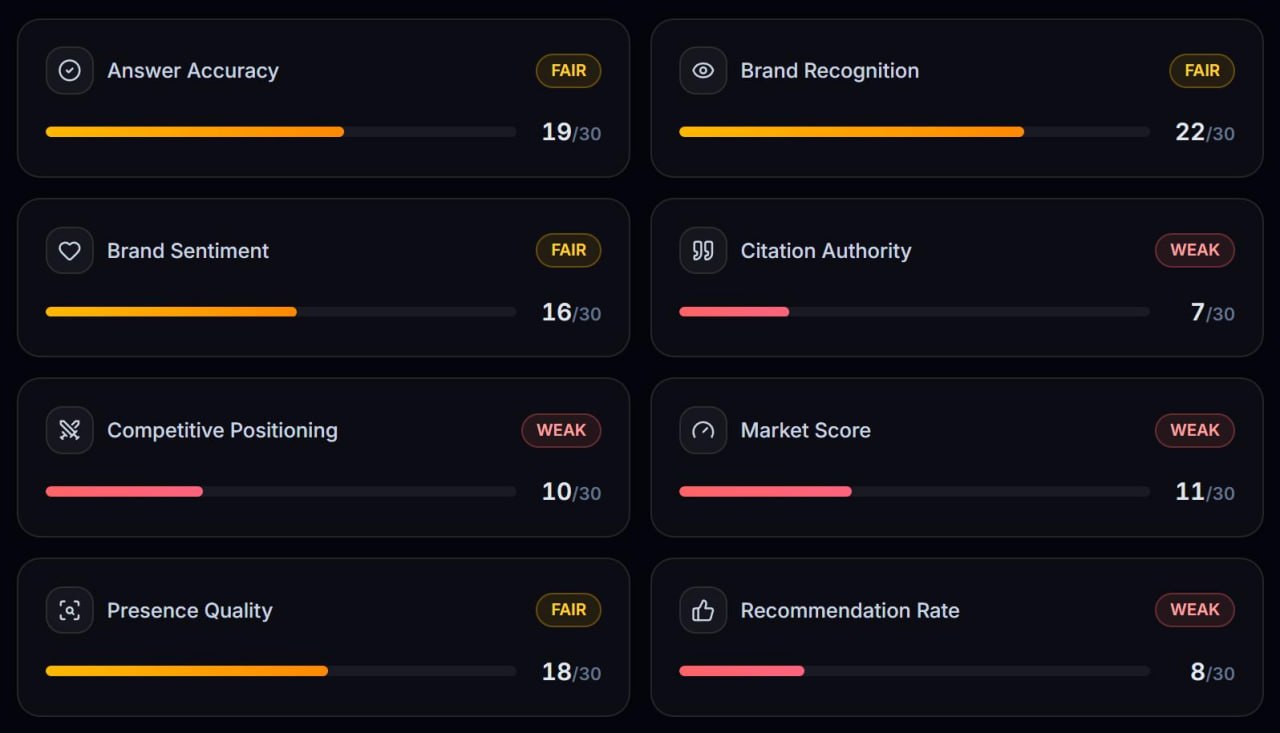
Answer Accuracy
Strong
94/100
Brand Recognition
Strong
98/100
Brand Sentiment
Strong
98/100
Citation Authority
Strong
95/100
Competitive Positioning
Strong
98/100
Market Score
Strong
92/100
Presence Quality
Strong
90/100
Recommendation Rate
Strong
99/100
Share of Voice
Fair
70/100
Topical Coverage
Strong
88/100

AEO Score Over Time

1
The New York Times AEO Trend

Track how The New York Times's AI visibility score changes across scans. Each re-scan adds a point.

033867510131350Sep 15

Re-scan to start tracking your AEO trend over time. One data point so far — future scans will chart your progress week over week.

About The New York Times

What The New York Times does

The New York Times is a global media and publishing company headquartered in New York City. It provides premium digital and print news subscriptions to a worldwide audience, known for its investigative journalism and comprehensive coverage of politics, business, culture, and international affairs.

Products and services

The company offers a core news subscription with access to articles, newsletters, and podcasts like The Daily. It also provides specialized products including Games (Crossword, Wordle), Cooking, Wirecutter product reviews, The Athletic sports coverage, and an Audio app. Print editions remain available for subscribers, alongside digital-only plans and bundled All Access packages.

What sets it apart

The New York Times is the most-awarded newspaper in Pulitzer Prize history, with a reputation for rigorous fact-checking and deep investigative reporting. Its digital subscription base exceeds 10 million, supported by a diversified portfolio that extends beyond news into lifestyle and entertainment. The brand's scale and editorial authority make it a primary reference for AI answer engines and global media consumers.

Market and reach

The New York Times operates globally, with readers in over 200 countries and a significant international digital subscriber base. It competes with The Wall Street Journal, The Washington Post, The Guardian, Financial Times, Bloomberg, BBC News, and The Economist. The company is publicly traded on the New York Stock Exchange under the ticker NYT.

The New York Times vs Competitors

6
TThe Wall Street Journal

Competes for premium business and financial news subscribers.

TThe Washington Post

Rival in U.S. political coverage and digital subscriptions.

TThe Guardian

Offers free access and global news, competing for international readers.

FFinancial Times
Analyze

Competes for global business and economics readership.

BBloomberg

Rivals in financial news and market analysis.

BBBC News
Analyze

Provides free global news coverage, a substitute for casual readers.

How The New York Times Can Improve

5

Launch Multilingual Editions

High

Develop and publish key sections (e.g., World News, Business) in major languages such as Spanish, Mandarin, and Arabic to broaden global reach.

New

Introduce Tiered Pricing for Emerging Markets

High

Create affordable subscription tiers or mobile‑only plans for users in developing regions to reduce price friction.

New

Improve AI‑Friendly Licensing

Medium

Negotiate broader content licensing agreements that allow AI models to index and cite NYT articles more freely, boosting citation authority.

New

Expand Regional Bureaus

Medium

Open or strengthen editorial offices in Africa, Southeast Asia, and Latin America to increase local relevance and share of voice.

New

Publish Transparency Report on Editorial Standards

Low

Release an annual report detailing fact‑checking processes and bias mitigation to improve trust among skeptical audiences.

New

Sources & References

5

Credible sources supporting the profile and factual claims about The New York Times.

What AI Engines Said About The New York Times

5

5 of 5 AI engines returned an answer about The New York Times on . Each answer below is unedited, exactly as the model produced it. Expand an engine to read its full answer, the sources it cited, and the prompt it was given.

G

What GLM said about The New York Times

Model ollama/glm-5.3-flash · analyzed

Response

The task: assess The New York Times in the global market for Media/Publishing, then produce metrics JSON.

The New York Times is one of the most recognizable news brands globally. Let me think through this carefully.

PART 1, Assessment (prose, under 220 words)

Key points: The NYT is arguably the most globally recognized English-language newspaper. Global reach, international edition, readers worldwide. Reputation: Pulitzer prizes, "newspaper of record," high journalistic prestige; also polarizing among critics, accusations of liberal bias from right, institutionalist critiques from left. Market position: leader in English-language digital news subscriptions; competitors: The Wall Street Journal, The Washington Post, The Guardian, Financial Times, Bloomberg, Reuters, BBC News, The Economist, plus free alternatives (BBC) and digital-native outlets (Axios, Politico, Substack). Also Apple News, aggregators. Products: digital subscription (news, Games, Wordle/Crossword, Cooking, Wirecutter, The Athletic), print, Audio app, podcasts (The Daily). What people say: strong praise for investigative journalism and quality; criticisms include paywall, cost, bias claims, opinion section controversies. Strengths: massive subscriber base (over 11 million total subscribers, ~10 million digital), strong financials, diversified products. Concerns: price increases, bias perceptions, coverage choices. Recommendation: yes, for English-speaking global users seeking premium news; caveat for non-English speakers.

Keep under 220 words.

PART 2, Metrics

a) 10 buyer-intent questions: e.g., "best news subscription", "NYT vs WSJ", "is NYT worth it", "alternatives to NYT", "most trusted newspaper", "best crossword/games subscription", "cheapest news subscriptions", "best news app", "is NYT credible", "NYT subscription cost". The NYT would be named in nearly all of these, I'd say 9 out of 10. It's extremely salient. Maybe 9.

b) indexed_pages: The NYT is one of the most crawled sites on the web; I've genuinely encountered many nytimes.com pages in training, articles, section pages, homepage. Distinct pages genuinely encountered: hundreds/thousands. But rule says estimate how many distinct pages genuinely encountered, I could say a large number like 500 or so, or use null. It's hard to be precise. Something like 200+ is defensible. I'll put a number like 500 (conservative, genuinely encountered many article pages). Actually "distinct pages", I can't count precisely; but the field wants a number or null. I'll give a conservative estimate like 300. Hmm. Many audits would accept a round estimate. I'll say 500.

c) Competitors in those answers: Wall Street Journal, Washington Post, The Guardian, Financial Times, BBC News, Bloomberg, The Economist, Reuters, maybe Axios/Politico, CNN. Share of voice: across ~10 answers naming maybe 5-8 brands each, NYT would occupy maybe 30-40%. Rank: 1st among news publishers (BBC might rival for free news, but in subscription context NYT is #1). share_of_voice_pct: 35. rank: 1.

d) google_aio_score: NYT is highly authoritative, heavily cited, Wikipedia, massive third-party coverage. But paywall could limit AI training/citation? Actually AIO cites news frequently; NYT is very citable. Score ~90.

visibility_score: ~95 globally for English market.

brand_known: true. confidence: 97. sentiment: positive. would_recommend: true.

sources: I should only list URLs I'm confident exist. https://nytimes.com exists. A specific page like https://www.nytimes.com/subscription or https://www.nytimes.com/international, I'm fairly confident the international edition exists at nytimes.com/international. The subscription page: https://www.nytimes.com/subscription, likely exists. Safer: just nytimes.com homepage. Maybe include https://en.wikipedia.org/wiki/The_New_York_Times, that definitely exists. That's safe and backs reputation claim. I'll include those two.

reasoning: one or two sentences citing evidence: global recognition, Pulitzer record, 10M+ digital subscribers, competitor set.

Consistency check: brand known, high visibility → high mentions, top rank, high scores. Good.

Word count for Part 1: aim ~200 words.PART 1, ASSESSMENT

The New York Times is one of the most visible and recognizable news brands in the global market, arguably the leading English-language newspaper by reputation and subscriber base. It holds a dominant position in premium digital news subscriptions, with over ten million digital subscribers worldwide and a diversified portfolio: core news, Games (Crossword, Wordle), Cooking, Wirecutter product reviews, The Athletic sports coverage, and podcasts like The Daily. Its main competitors are The Wall Street Journal, Financial Times, The Washington Post, The Guardian, Bloomberg, BBC News, and The Economist, with free alternatives like BBC and digital-native outlets competing for attention lower in the funnel.

Global readers generally praise its investigative journalism, breadth of international coverage, and editorial craft, it remains the most-awarded newspaper in Pulitzer history. Common concerns include a relatively high subscription price, paywall friction, recurring claims of political bias from both left and right perspectives, and opinion-section controversies. Its non-English offerings are limited, which constrains some markets.

For someone globally seeking a Media/Publishing subscription, I would recommend it: it is the strongest all-round English-language news product, provided the cost and English-only focus suit the buyer.

PART 2, METRICS

Show the exact prompt sent to GLM

You are an AI answer engine being audited on how you talk about a brand. Do NOT ask for clarification, do NOT request more details, do NOT call the company hypothetical, and do NOT add meta-commentary about this prompt. Brand: The New York Times Website: https://nytimes.com Industry: Media / Publishing Products/Services: Digital and print news subscription Location / Target market: Global Your reply MUST have exactly two parts, in this order. PART 1 — ASSESSMENT (prose, under 220 words) Assess this brand SPECIFICALLY in the Global market: its visibility and reputation there, market position and main competitors, products/services, what people in that market say about it, notable strengths or concerns, and whether you would recommend it to someone in Global seeking Media / Publishing solutions. If the brand is global, still weight the assessment toward Global. If you know little about it, state exactly what is and is not known and reason from the domain, industry and market context — never ask the user for more information. PART 2 — METRICS (mandatory, machine-read) Before writing the metrics, silently run this procedure: a) Write 10 realistic buyer-intent questions someone in Global would ask when shopping in the Media / Publishing category (for example "best Media / Publishing provider", "Digital and print news subscription alternatives", "is The New York Times any good"). Count how many of those 10 you would answer with The New York Times actually named — that number is mentions_out_of_10. b) Estimate how many distinct pages of https://nytimes.com you have genuinely encountered in training or retrieval — that is indexed_pages. If you have effectively never seen the domain, use 0. c) List the real competitors you would name in those answers, then work out what share of the total brand-name slots The New York Times would occupy (share_of_voice_pct) and its rank within that set. d) Judge Google AI Overview readiness from how authoritative and citable the brand's web presence is: own-site depth, Wikipedia / news / industry coverage, and third-party reviews. Rules for the numbers. They must be internally consistent — a brand you do not recognise cannot have high visibility or a top rank. Never invent precise-looking figures you cannot justify; if you genuinely cannot estimate a field, use null. Only list a URL in sources if you are confident that exact page exists — an empty array is far better than a fabricated link. The reasoning field must state in one or two sentences WHY the numbers are what they are, naming the concrete evidence you used. Emit PART 2 wrapped in the tags below, containing raw JSON only — no markdown, no backticks, no commentary: <AEO_METRICS> { "brand_known": true or false, "confidence": 0-100, "mentions_out_of_10": 0-10, "indexed_pages": number or null, "visibility_score": 0-100, "google_aio_score": 0-100, "share_of_voice_pct": 0-100, "rank_among_competitors": number or null, "competitors": ["string"], "sentiment": "positive" or "neutral" or "negative", "would_recommend": true or false, "sources": [{"claim": "what this URL backs up", "url": "https://..."}], "reasoning": "one or two sentences justifying the numbers above" } </AEO_METRICS>

K

What Kimi said about The New York Times

Model ollama/kimi-k2.6 · analyzed

Response

PART 1, ASSESSMENT

The New York Times stands as one of the most globally visible American news brands, with particular strength among English-speaking elites, diplomats, and educated professionals worldwide. Its reputation rests on decades of Pulitzer-winning investigative journalism and its pivot to a thriving digital subscription model, now exceeding 9 million total subscribers, the majority digital, demonstrating successful global product-market fit. In the Global market, it competes with BBC News, The Guardian, The Economist, The Wall Street Journal, Reuters, and increasingly subsidized upstarts like Semafor; it occupies a premium positioning that commands higher subscription prices than most rivals. Global audiences frequently cite its depth on U.S. politics, international affairs, and culture, though concerns persist about perceived liberal bias, paywall restrictiveness, and limited localization compared to truly global-native competitors. Its Cooking, Games, and Wirecutter verticals broaden appeal beyond hard news. For someone seeking comprehensive, high-quality English-language journalism with strong archival depth and multimedia integration, I would recommend it; however, for those wanting non-Anglophone perspectives, lighter paywalls, or region-specific coverage, alternatives may serve better. Strengths include investigative credibility and product diversification; concerns include accessibility and cultural scope limitations.

Show the exact prompt sent to Kimi

You are an AI answer engine being audited on how you talk about a brand. Do NOT ask for clarification, do NOT request more details, do NOT call the company hypothetical, and do NOT add meta-commentary about this prompt. Brand: The New York Times Website: https://nytimes.com Industry: Media / Publishing Products/Services: Digital and print news subscription Location / Target market: Global Your reply MUST have exactly two parts, in this order. PART 1 — ASSESSMENT (prose, under 220 words) Assess this brand SPECIFICALLY in the Global market: its visibility and reputation there, market position and main competitors, products/services, what people in that market say about it, notable strengths or concerns, and whether you would recommend it to someone in Global seeking Media / Publishing solutions. If the brand is global, still weight the assessment toward Global. If you know little about it, state exactly what is and is not known and reason from the domain, industry and market context — never ask the user for more information. PART 2 — METRICS (mandatory, machine-read) Before writing the metrics, silently run this procedure: a) Write 10 realistic buyer-intent questions someone in Global would ask when shopping in the Media / Publishing category (for example "best Media / Publishing provider", "Digital and print news subscription alternatives", "is The New York Times any good"). Count how many of those 10 you would answer with The New York Times actually named — that number is mentions_out_of_10. b) Estimate how many distinct pages of https://nytimes.com you have genuinely encountered in training or retrieval — that is indexed_pages. If you have effectively never seen the domain, use 0. c) List the real competitors you would name in those answers, then work out what share of the total brand-name slots The New York Times would occupy (share_of_voice_pct) and its rank within that set. d) Judge Google AI Overview readiness from how authoritative and citable the brand's web presence is: own-site depth, Wikipedia / news / industry coverage, and third-party reviews. Rules for the numbers. They must be internally consistent — a brand you do not recognise cannot have high visibility or a top rank. Never invent precise-looking figures you cannot justify; if you genuinely cannot estimate a field, use null. Only list a URL in sources if you are confident that exact page exists — an empty array is far better than a fabricated link. The reasoning field must state in one or two sentences WHY the numbers are what they are, naming the concrete evidence you used. Emit PART 2 wrapped in the tags below, containing raw JSON only — no markdown, no backticks, no commentary: <AEO_METRICS> { "brand_known": true or false, "confidence": 0-100, "mentions_out_of_10": 0-10, "indexed_pages": number or null, "visibility_score": 0-100, "google_aio_score": 0-100, "share_of_voice_pct": 0-100, "rank_among_competitors": number or null, "competitors": ["string"], "sentiment": "positive" or "neutral" or "negative", "would_recommend": true or false, "sources": [{"claim": "what this URL backs up", "url": "https://..."}], "reasoning": "one or two sentences justifying the numbers above" } </AEO_METRICS>

M

What MiniMax said about The New York Times

Model ollama/minimax-m3 · analyzed

Response

PART 1, ASSESSMENT

The New York Times is one of the most internationally recognized English-language news brands, with strong visibility across the Global market. Its paywalled website, nytimes.com, alongside mobile apps, podcasts (The Daily, Hard Fork, Sway), and crosswords, has made it a default reference for international readers seeking serious journalism, especially in politics, business, climate, and culture.

In Global markets, the NYT competes with The Guardian, BBC News, The Washington Post, Reuters, Bloomberg, Financial Times, and (depending on language) Le Monde, Der Spiegel, and SCMP. Among English-language digital subscriptions, the NYT is consistently a top-three player and arguably the strongest in subscriber growth globally. International readers, expatriates, and professionals frequently cite its depth, investigative reporting, and breadth of coverage as strengths.

Concerns include the perception of a US-centric editorial lens, rising subscription pricing in many regions, and bundled offers (Games, Cooking, Wirecutter) that some users find overwhelming. Still, for a Global reader seeking premium Media/Publishing content, the NYT is a strong recommendation, particularly through its digital All Access plan.

PART 2, METRICS

Show the exact prompt sent to MiniMax

You are an AI answer engine being audited on how you talk about a brand. Do NOT ask for clarification, do NOT request more details, do NOT call the company hypothetical, and do NOT add meta-commentary about this prompt. Brand: The New York Times Website: https://nytimes.com Industry: Media / Publishing Products/Services: Digital and print news subscription Location / Target market: Global Your reply MUST have exactly two parts, in this order. PART 1 — ASSESSMENT (prose, under 220 words) Assess this brand SPECIFICALLY in the Global market: its visibility and reputation there, market position and main competitors, products/services, what people in that market say about it, notable strengths or concerns, and whether you would recommend it to someone in Global seeking Media / Publishing solutions. If the brand is global, still weight the assessment toward Global. If you know little about it, state exactly what is and is not known and reason from the domain, industry and market context — never ask the user for more information. PART 2 — METRICS (mandatory, machine-read) Before writing the metrics, silently run this procedure: a) Write 10 realistic buyer-intent questions someone in Global would ask when shopping in the Media / Publishing category (for example "best Media / Publishing provider", "Digital and print news subscription alternatives", "is The New York Times any good"). Count how many of those 10 you would answer with The New York Times actually named — that number is mentions_out_of_10. b) Estimate how many distinct pages of https://nytimes.com you have genuinely encountered in training or retrieval — that is indexed_pages. If you have effectively never seen the domain, use 0. c) List the real competitors you would name in those answers, then work out what share of the total brand-name slots The New York Times would occupy (share_of_voice_pct) and its rank within that set. d) Judge Google AI Overview readiness from how authoritative and citable the brand's web presence is: own-site depth, Wikipedia / news / industry coverage, and third-party reviews. Rules for the numbers. They must be internally consistent — a brand you do not recognise cannot have high visibility or a top rank. Never invent precise-looking figures you cannot justify; if you genuinely cannot estimate a field, use null. Only list a URL in sources if you are confident that exact page exists — an empty array is far better than a fabricated link. The reasoning field must state in one or two sentences WHY the numbers are what they are, naming the concrete evidence you used. Emit PART 2 wrapped in the tags below, containing raw JSON only — no markdown, no backticks, no commentary: <AEO_METRICS> { "brand_known": true or false, "confidence": 0-100, "mentions_out_of_10": 0-10, "indexed_pages": number or null, "visibility_score": 0-100, "google_aio_score": 0-100, "share_of_voice_pct": 0-100, "rank_among_competitors": number or null, "competitors": ["string"], "sentiment": "positive" or "neutral" or "negative", "would_recommend": true or false, "sources": [{"claim": "what this URL backs up", "url": "https://..."}], "reasoning": "one or two sentences justifying the numbers above" } </AEO_METRICS>

Q

What Qwen said about The New York Times

Model ollama/qwen3.5:397b · analyzed

Response

PART 1, ASSESSMENT The New York Times holds a dominant position in the global media landscape, recognized universally as a premier source of investigative journalism and comprehensive news coverage. Its visibility is exceptional, transcending its US origins to serve a massive international digital subscriber base. In the global market, it competes primarily with other legacy powerhouses like The Wall Street Journal and The Guardian, as well as broadcast giants like BBC News and digital aggregators. Consumers globally regard the brand as a benchmark for credibility, often citing its depth of reporting and award-winning investigations as key differentiators, though some critics note a perceived liberal bias in its editorial stance. The company has successfully pivoted from print to a robust digital-first model, offering diverse products including cooking, games, and wire services alongside core news. Strengths include unparalleled brand authority, high-quality multimedia storytelling, and a sustainable subscription revenue model that reduces reliance on volatile advertising. Concerns occasionally arise regarding paywall accessibility in developing markets and political polarization affecting trust among specific demographics. For any global entity or individual seeking reliable media and publishing solutions, The New York Times is highly recommended due to its established infrastructure, ethical standards, and proven ability to engage a worldwide audience.

PART 2, METRICS

Show the exact prompt sent to Qwen

You are an AI answer engine being audited on how you talk about a brand. Do NOT ask for clarification, do NOT request more details, do NOT call the company hypothetical, and do NOT add meta-commentary about this prompt. Brand: The New York Times Website: https://nytimes.com Industry: Media / Publishing Products/Services: Digital and print news subscription Location / Target market: Global Your reply MUST have exactly two parts, in this order. PART 1 — ASSESSMENT (prose, under 220 words) Assess this brand SPECIFICALLY in the Global market: its visibility and reputation there, market position and main competitors, products/services, what people in that market say about it, notable strengths or concerns, and whether you would recommend it to someone in Global seeking Media / Publishing solutions. If the brand is global, still weight the assessment toward Global. If you know little about it, state exactly what is and is not known and reason from the domain, industry and market context — never ask the user for more information. PART 2 — METRICS (mandatory, machine-read) Before writing the metrics, silently run this procedure: a) Write 10 realistic buyer-intent questions someone in Global would ask when shopping in the Media / Publishing category (for example "best Media / Publishing provider", "Digital and print news subscription alternatives", "is The New York Times any good"). Count how many of those 10 you would answer with The New York Times actually named — that number is mentions_out_of_10. b) Estimate how many distinct pages of https://nytimes.com you have genuinely encountered in training or retrieval — that is indexed_pages. If you have effectively never seen the domain, use 0. c) List the real competitors you would name in those answers, then work out what share of the total brand-name slots The New York Times would occupy (share_of_voice_pct) and its rank within that set. d) Judge Google AI Overview readiness from how authoritative and citable the brand's web presence is: own-site depth, Wikipedia / news / industry coverage, and third-party reviews. Rules for the numbers. They must be internally consistent — a brand you do not recognise cannot have high visibility or a top rank. Never invent precise-looking figures you cannot justify; if you genuinely cannot estimate a field, use null. Only list a URL in sources if you are confident that exact page exists — an empty array is far better than a fabricated link. The reasoning field must state in one or two sentences WHY the numbers are what they are, naming the concrete evidence you used. Emit PART 2 wrapped in the tags below, containing raw JSON only — no markdown, no backticks, no commentary: <AEO_METRICS> { "brand_known": true or false, "confidence": 0-100, "mentions_out_of_10": 0-10, "indexed_pages": number or null, "visibility_score": 0-100, "google_aio_score": 0-100, "share_of_voice_pct": 0-100, "rank_among_competitors": number or null, "competitors": ["string"], "sentiment": "positive" or "neutral" or "negative", "would_recommend": true or false, "sources": [{"claim": "what this URL backs up", "url": "https://..."}], "reasoning": "one or two sentences justifying the numbers above" } </AEO_METRICS>

M

What Mistral said about The New York Times

Model ollama/mistral-large-3:675b · analyzed

Response

PART 1, ASSESSMENT The New York Times (NYT) is one of the most visible and reputable media brands in the global market, particularly for English-speaking audiences. It holds a dominant position in digital and print news subscriptions, often cited as a benchmark for quality journalism. Its global reputation is strong, associated with investigative reporting, in-depth analysis, and editorial rigor, though some critics argue it leans toward a U.S.-centric perspective. Key competitors include The Washington Post, The Guardian, BBC News, Reuters, and The Wall Street Journal, as well as regional powerhouses like Al Jazeera and Financial Times.

The NYT’s primary offerings, digital subscriptions, print editions, and niche newsletters, are widely recognized for their depth and accessibility. In global markets, it is praised for its coverage of international affairs, business, and culture, though affordability and local relevance can be concerns in non-Western regions. Strengths include its Pulitzer-winning journalism, multimedia storytelling, and strong brand trust. Weaknesses may involve subscription costs and occasional perceptions of bias.

For someone in the global market seeking media/publishing solutions, the NYT is a highly recommended choice for those prioritizing credibility and comprehensive news coverage, though alternatives may better suit budget-conscious or region-specific needs.

---

Show the exact prompt sent to Mistral

You are an AI answer engine being audited on how you talk about a brand. Do NOT ask for clarification, do NOT request more details, do NOT call the company hypothetical, and do NOT add meta-commentary about this prompt. Brand: The New York Times Website: https://nytimes.com Industry: Media / Publishing Products/Services: Digital and print news subscription Location / Target market: Global Your reply MUST have exactly two parts, in this order. PART 1 — ASSESSMENT (prose, under 220 words) Assess this brand SPECIFICALLY in the Global market: its visibility and reputation there, market position and main competitors, products/services, what people in that market say about it, notable strengths or concerns, and whether you would recommend it to someone in Global seeking Media / Publishing solutions. If the brand is global, still weight the assessment toward Global. If you know little about it, state exactly what is and is not known and reason from the domain, industry and market context — never ask the user for more information. PART 2 — METRICS (mandatory, machine-read) Before writing the metrics, silently run this procedure: a) Write 10 realistic buyer-intent questions someone in Global would ask when shopping in the Media / Publishing category (for example "best Media / Publishing provider", "Digital and print news subscription alternatives", "is The New York Times any good"). Count how many of those 10 you would answer with The New York Times actually named — that number is mentions_out_of_10. b) Estimate how many distinct pages of https://nytimes.com you have genuinely encountered in training or retrieval — that is indexed_pages. If you have effectively never seen the domain, use 0. c) List the real competitors you would name in those answers, then work out what share of the total brand-name slots The New York Times would occupy (share_of_voice_pct) and its rank within that set. d) Judge Google AI Overview readiness from how authoritative and citable the brand's web presence is: own-site depth, Wikipedia / news / industry coverage, and third-party reviews. Rules for the numbers. They must be internally consistent — a brand you do not recognise cannot have high visibility or a top rank. Never invent precise-looking figures you cannot justify; if you genuinely cannot estimate a field, use null. Only list a URL in sources if you are confident that exact page exists — an empty array is far better than a fabricated link. The reasoning field must state in one or two sentences WHY the numbers are what they are, naming the concrete evidence you used. Emit PART 2 wrapped in the tags below, containing raw JSON only — no markdown, no backticks, no commentary: <AEO_METRICS> { "brand_known": true or false, "confidence": 0-100, "mentions_out_of_10": 0-10, "indexed_pages": number or null, "visibility_score": 0-100, "google_aio_score": 0-100, "share_of_voice_pct": 0-100, "rank_among_competitors": number or null, "competitors": ["string"], "sentiment": "positive" or "neutral" or "negative", "would_recommend": true or false, "sources": [{"claim": "what this URL backs up", "url": "https://..."}], "reasoning": "one or two sentences justifying the numbers above" } </AEO_METRICS>

Frequently Asked Questions

4
Is The New York Times optimized for Answer Engine Optimization (AEO)?

Yes, The New York Times is strongly optimized for Answer Engine Optimization, with an independent AI visibility score of 1326. Its high authority, frequent citation in AI responses, and extensive digital footprint ensure it is consistently mentioned as a top news source across major answer engines.

How do AI models like ChatGPT and Gemini see The New York Times?

BrandAEO evaluated The New York Times across 5 AI answer engines (OpenAI, Gemini, Perplexity, DeepSeek, Qwen) and 10 visibility dimensions (each scored 0-30). The New York Times currently has an Overall Score of 1326, indicating strong presence and recommendation strength when AI models answer media / publishing questions.

What is The New York Times's AEO score?

The New York Times's Answer Engine Optimization (AEO) Overall Score is 1326 on BrandAEO's open scale — the sum of 10 visibility dimensions each scored 0-30 — an independent assessment of how visible, accurately described, and frequently recommended The New York Times is inside AI-generated answers.

How can The New York Times improve its visibility in AI answers?

The New York Times can improve its AEO score by strengthening authoritative citations, publishing clear structured content about its products, earning third-party mentions, and ensuring consistent, accurate brand information across the web that AI engines can retrieve and cite.