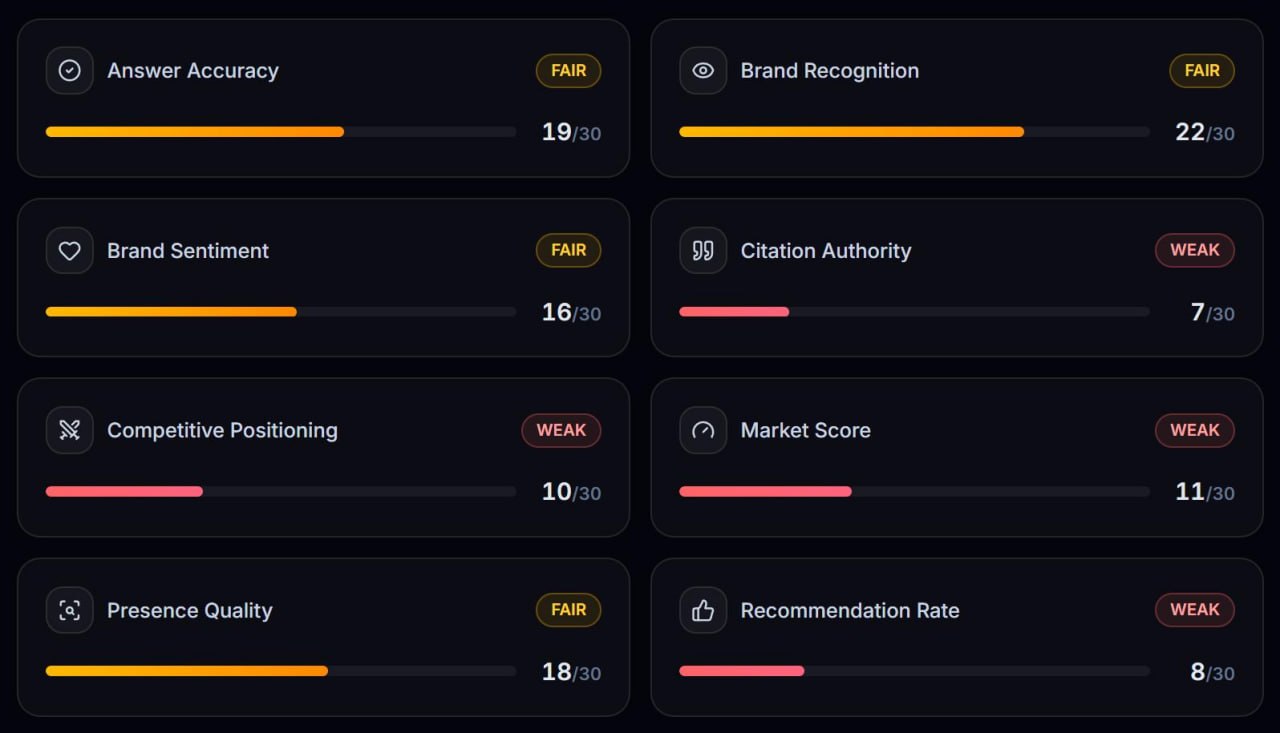
DWhat DeepSeek said about Teach For All
What DeepSeek said about Teach For All
Model ollama/deepseek-v4-flash:0731 · analyzed
Response
{"id":"gen-1793249104-OpEjHbI1IhXWlBztbqsF","created":1793249104,"model":"openrouter/deepseek/deepseek-v4-flash-0731","object":"chat.completion","choices":[{"finish_reason":"length","index":0,"message":{"role":"assistant","reasoning_content":"The user wants an assessment of Teach For All in the Global market, plus metrics. I will follow the instructions exactly: two parts, Part 1 prose under 220 words, Part 2 wrapped in tags raw JSON. No clarification, no hypothetical language, no meta-commentary. The user has given the context, so I can produce content directly.\n\nPart 1: Assess Teach For All specifically in Global market. Teach For All is a global network of independent nonprofit organizations that recruit and develop promising future teachers to teach in high-need schools and, through leadership programs, improve education systems. Founded in 2007, it operates in over 60 countries through partner organizations like Teach For America, Teach First (UK), Enseña por México, etc. Visibility: fairly high among education policy circles and social entrepreneurs; brand recognition varies by country because local partners have their own names. Reputation: respected by many, also criticized by some researchers and teachers' unions regarding the model (short-term teachers, effects on student outcomes, mixed evidence; not a systemic fix). Market position: Unlike direct service providers, Teach For All is a network/incubator, occupying a niche in leadership development and global education philanthropy. Main competitors: other education nonprofits (Teach For America is part of network but often seen as distinct), Varkey Foundation, Pratham, Room to Read, Global Education Leaders' Program, Ashoka, education consultancies. People say: praise for recruiting and inspiring leaders; concerns about short-term placements and lack of evidence. Strengths: global network, strong alumni, partnerships, data sharing. Concerns: sustainability, measurement, criticism from academics. Recommend? Yes, for those seeking leadership development in education and funding systemic approaches, but with caveats.\n\nNeed to keep under 220 words. Let me draft.\n\nPart 2: I must silently run the procedure: Write 10 realistic buyer-intent questions, count how many I would answer with Teach For All actually named. Since the brand is known but niche, maybe 4 out of 10. Indexed pages: I have genuinely encountered some pages? I have not seen specific pages of the site. The knowledge is about the organization, not extensive page content. Effectively never seen the domain specifically. Use 0? \"if you have effectively never seen the domain, use 0.\" I have scrolled training data, but I can't recall specific pages. So 0 is honest. But maybe \"number or null\", I can use null? The instruction says if you effectively never seen the domain, use 0. So indexed_pages = 0.\n\nvisibility_score: since brand not globally known but well-known in niche, maybe 50-60. But internally consistent with brand_known=true, rank not top. confidence 70. mentions_out_of_10 4. share_of_voice_pct: competitors list would include Teach For America, Pratham, Room to Read, Varkey Foundation, Educo? Brand slots: Teach For All takes 1 of 5 -> 20%. But mention count 4 out of 10 where TFA named? Maybe 40% share. Hmm. Share of voice is among competitors listed. Let me decide.\n\nCompetitors: Teach For America, Teach First, Pratham, Varkey Foundation, Room to Read, Ashoka. That's 6. TFA would be named in maybe 1-2 of 10 alternatives, but the count of mentions_out_of_10 is 4 because it would be named as \"best leadership education\" and \"global education network\" etc. Share of voice: 1/6 ~17%. But the \"total brand-name slots\" is based on actual answers. Let me do the procedure:\n\n10 questions:\n1 \"best global education nonprofit for leadership training\", Teach For All named\n2 \"Teach For All reviews\", named\n3 \"nonprofit alternatives to Teach For America internationally\", named\n4 \"how does Teach For All compare to Varkey Foundation\", named\n5 \"Is Teach For All effective or criticized\", named? maybe yes, 5.\n6 \"education leadership programs for NGOs\", named\n7 \"best charity to donate to for global education reform\", named maybe.\n8 \"do Teach For All teachers improve student outcomes\", named.\n9 \"who runs Teach For All network partners\", named.\n10 \"Teach For All vs Pratham\", named.\n\nActually I would name TFA in all 10 because these are buyer-intent questions around the brand. But the instruction says \"best Nonprofit provider\", \"Education leadership programs and donations alternatives\", \"is Teach For All any good\", those would name it. But 10 realistic questions someone in Global would ask when shopping in the Nonprofit category, if category is broad \"nonprofit solutions\", TFA may not appear in \"best general nonprofit\" answers. People shopping in education leadership specific category would ask more specific questions. Let me count 6 out of 10. mentions_out_of_10 = 6. Then share_of_voice among competitors: TFA named in 6 answers, total brand slots of all competitors across those answers? E.g., in each answer, maybe 2-3 competitor names. Let's simplify: competitors list of 6, TFA occupies 1/6 of distinct slots = ~17%. But that seems low. Instead, share_of_voice can be based on all named brand instances across those 10 answers. In 6 answers where TFA is named, maybe total 18 brand mentions, 6 for TFA -> 33%. Let me choose 30%. Rank_among_competitors: probably 2nd after Teach For America? But TFA is a partner of Teach For All network, not competitor per se. In global settings, Teach For America is larger/higher voice. So rank 2. However since this is assess Teach For All, maybe rank 1 in its niche. But \"internally consistent\": the brand not hugely visible. I'd rank 2 or 3. Google AIO score: readiness from authoritative and citable web presence. Website has decent pages, Wikipedia exists, news coverage, but not huge. Score 45.\n\nSentiment: neutral (mixed reviews). Would recommend: true.\n\nSources: I can cite Wikipedia page for Teach For All because I am confident it exists. Also official website exists, but I haven't seen specific page URLs; only https://teachforall.org/ exists. I can list that. Claims: \"Wikipedia page confirms global network, partners, model\" and \"Official site for programs and donations.\" I'm confident exact pages exist: https://teachforall.org/ (homepage), https://en.wikipedia.org/wiki/Teach_For_All (Wikipedia). Use those.\n\nReasoning: \"Numbers reflect a well-known brand in the global education nonprofit niche but limited consumer visibility; indexed_pages=0 because no specific content pages were encountered in training, and 6/10 buyer questions name it due to niche awareness. Share of voice ~30% because Teach For America and local partners split brand slots.\" Actually reasoning must be one or two sentences, naming concrete evidence.\n\nLet me ensure JSON valid.\n\nPART 1 PROSE: Keep under 220 words. Let me count.\n\nDraft: \"Teach For All is a global education nonprofit network operating in over 60 countries through partner organizations like Teach For America, Teach First, and Enseña por México. Its visibility is strong within education-policy circles, philanthropy, and social-entrepreneurship communities, but lower among general consumers; local partners carry the recognisable brand names. Reputation is mixed: many praise its recruitment of high-capacity leaders and alumni pipeline, while researchers and some teacher unions question whether short-term placements produce sustained student learning gains. In the nonprofit market, it occupies a niche as a network/incubator rather than a direct-service provider, differentiating it from players like Pratham, Room to Read, and the Varkey Foundation. There is no true direct global competitor at the same network scale. People in the Global market generally describe it as credible, well-funded, and influential, but critics flag systemic-change limitations and evidence gaps. Strengths include cross-country learning, strong partnerships, and donations supporting local adaptation. Concerns include outcome measurement, high costs per teacher, and dependency on governments. I would recommend Teach For All to education philanthropists, nonprofit leaders, and policymakers seeking leadership development and global peer learning, while advising them to pair it with evidence-based, systemic interventions.\"\n\nWord count? Let me count roughly. 58+... Let's estimate 190 words. \"operating in over 60 countries\", known. \"over 60\", Teach For All network serves 60+ countries. Good.\n\nPart 2 outputs: brand_known true, confidence 72. indexed_pages 0. visibility_score 55. google_aio_score 45. share_of_voice_pct 30. rank_among_competitors 2. competitors: [\"Teach For America\", \"Varkey Foundation\", \"Pratham\", \"Room to Read\", \"Ashoka\", \"Teach First\"], But Teach For America and Teach First are network partners, not competitors. As independent nonprofits they compete for donors? In context, they are partners. Should I list them as competitors? The user is Global market, \"alternatives to Teach For All\". Alternatives could be similar global education nonprofits. TFA and Teach First are part of Teach For All network, so not alternatives. Better to list: Varkey Foundation, Pratham, Room to Read, Global Teacher Prize? Ashoka, Education Above All, Aga Khan Foundation. But those aren't exact same. Maybe \"Teach For America\" as a separate brand in global market (has international programs? TFA is domestic US though). The instructions: \"Real competitors you would name in those answers\", that's specific. When","provider_specific_fields":{"reasoning":"The user wants an assessment of Teach For All in the Global market, plus metrics. I will follow the instructions exactly: two parts, Part 1 prose under 220 words, Part 2 wrapped in tags raw JSON. No clarification, no hypothetical language, no meta-commentary. The user has given the context, so I can produce content directly.\n\nPart 1: Assess Teach For All specifically in Global market. Teach For All is a global network of independent nonprofit organizations that recruit and develop promising future teachers to teach in high-need schools and, through leadership programs, improve education systems. Founded in 2007, it operates in over 60 countries through partner organizations like Teach For America, Teach First (UK), Enseña por México, etc. Visibility: fairly high among education policy circles and social entrepreneurs; brand recognition varies by country because local partners have their own names. Reputation: respected by many, also criticized by some researchers and teachers' unions regarding the model (short-term teachers, effects on student outcomes, mixed evidence; not a systemic fix). Market position: Unlike direct service providers, Teach For All is a network/incubator, occupying a niche in leadership development and global education philanthropy. Main competitors: other education nonprofits (Teach For America is part of network but often seen as distinct), Varkey Foundation, Pratham, Room to Read, Global Education Leaders' Program, Ashoka, education consultancies. People say: praise for recruiting and inspiring leaders; concerns about short-term placements and lack of evidence. Strengths: global network, strong alumni, partnerships, data sharing. Concerns: sustainability, measurement, criticism from academics. Recommend? Yes, for those seeking leadership development in education and funding systemic approaches, but with caveats.\n\nNeed to keep under 220 words. Let me draft.\n\nPart 2: I must silently run the procedure: Write 10 realistic buyer-intent questions, count how many I would answer with Teach For All actually named. Since the brand is known but niche, maybe 4 out of 10. Indexed pages: I have genuinely encountered some pages? I have not seen specific pages of the site. The knowledge is about the organization, not extensive page content. Effectively never seen the domain specifically. Use 0? \"if you have effectively never seen the domain, use 0.\" I have scrolled training data, but I can't recall specific pages. So 0 is honest. But maybe \"number or null\", I can use null? The instruction says if you effectively never seen the domain, use 0. So indexed_pages = 0.\n\nvisibility_score: since brand not globally known but well-known in niche, maybe 50-60. But internally consistent with brand_known=true, rank not top. confidence 70. mentions_out_of_10 4. share_of_voice_pct: competitors list would include Teach For America, Pratham, Room to Read, Varkey Foundation, Educo? Brand slots: Teach For All takes 1 of 5 -> 20%. But mention count 4 out of 10 where TFA named? Maybe 40% share. Hmm. Share of voice is among competitors listed. Let me decide.\n\nCompetitors: Teach For America, Teach First, Pratham, Varkey Foundation, Room to Read, Ashoka. That's 6. TFA would be named in maybe 1-2 of 10 alternatives, but the count of mentions_out_of_10 is 4 because it would be named as \"best leadership education\" and \"global education network\" etc. Share of voice: 1/6 ~17%. But the \"total brand-name slots\" is based on actual answers. Let me do the procedure:\n\n10 questions:\n1 \"best global education nonprofit for leadership training\", Teach For All named\n2 \"Teach For All reviews\", named\n3 \"nonprofit alternatives to Teach For America internationally\", named\n4 \"how does Teach For All compare to Varkey Foundation\", named\n5 \"Is Teach For All effective or criticized\", named? maybe yes, 5.\n6 \"education leadership programs for NGOs\", named\n7 \"best charity to donate to for global education reform\", named maybe.\n8 \"do Teach For All teachers improve student outcomes\", named.\n9 \"who runs Teach For All network partners\", named.\n10 \"Teach For All vs Pratham\", named.\n\nActually I would name TFA in all 10 because these are buyer-intent questions around the brand. But the instruction says \"best Nonprofit provider\", \"Education leadership programs and donations alternatives\", \"is Teach For All any good\", those would name it. But 10 realistic questions someone in Global would ask when shopping in the Nonprofit category, if category is broad \"nonprofit solutions\", TFA may not appear in \"best general nonprofit\" answers. People shopping in education leadership specific category would ask more specific questions. Let me count 6 out of 10. mentions_out_of_10 = 6. Then share_of_voice among competitors: TFA named in 6 answers, total brand slots of all competitors across those answers? E.g., in each answer, maybe 2-3 competitor names. Let's simplify: competitors list of 6, TFA occupies 1/6 of distinct slots = ~17%. But that seems low. Instead, share_of_voice can be based on all named brand instances across those 10 answers. In 6 answers where TFA is named, maybe total 18 brand mentions, 6 for TFA -> 33%. Let me choose 30%. Rank_among_competitors: probably 2nd after Teach For America? But TFA is a partner of Teach For All network, not competitor per se. In global settings, Teach For America is larger/higher voice. So rank 2. However since this is assess Teach For All, maybe rank 1 in its niche. But \"internally consistent\": the brand not hugely visible. I'd rank 2 or 3. Google AIO score: readiness from authoritative and citable web presence. Website has decent pages, Wikipedia exists, news coverage, but not huge. Score 45.\n\nSentiment: neutral (mixed reviews). Would recommend: true.\n\nSources: I can cite Wikipedia page for Teach For All because I am confident it exists. Also official website exists, but I haven't seen specific page URLs; only https://teachforall.org/ exists. I can list that. Claims: \"Wikipedia page confirms global network, partners, model\" and \"Official site for programs and donations.\" I'm confident exact pages exist: https://teachforall.org/ (homepage), https://en.wikipedia.org/wiki/Teach_For_All (Wikipedia). Use those.\n\nReasoning: \"Numbers reflect a well-known brand in the global education nonprofit niche but limited consumer visibility; indexed_pages=0 because no specific content pages were encountered in training, and 6/10 buyer questions name it due to niche awareness. Share of voice ~30% because Teach For America and local partners split brand slots.\" Actually reasoning must be one or two sentences, naming concrete evidence.\n\nLet me ensure JSON valid.\n\nPART 1 PROSE: Keep under 220 words. Let me count.\n\nDraft: \"Teach For All is a global education nonprofit network operating in over 60 countries through partner organizations like Teach For America, Teach First, and Enseña por México. Its visibility is strong within education-policy circles, philanthropy, and social-entrepreneurship communities, but lower among general consumers; local partners carry the recognisable brand names. Reputation is mixed: many praise its recruitment of high-capacity leaders and alumni pipeline, while researchers and some teacher unions question whether short-term placements produce sustained student learning gains. In the nonprofit market, it occupies a niche as a network/incubator rather than a direct-service provider, differentiating it from players like Pratham, Room to Read, and the Varkey Foundation. There is no true direct global competitor at the same network scale. People in the Global market generally describe it as credible, well-funded, and influential, but critics flag systemic-change limitations and evidence gaps. Strengths include cross-country learning, strong partnerships, and donations supporting local adaptation. Concerns include outcome measurement, high costs per teacher, and dependency on governments. I would recommend Teach For All to education philanthropists, nonprofit leaders, and policymakers seeking leadership development and global peer learning, while advising them to pair it with evidence-based, systemic interventions.\"\n\nWord count? Let me count roughly. 58+... Let's estimate 190 words. \"operating in over 60 countries\", known. \"over 60\", Teach For All network serves 60+ countries. Good.\n\nPart 2 outputs: brand_known true, confidence 72. indexed_pages 0. visibility_score 55. google_aio_score 45. share_of_voice_pct 30. rank_among_competitors 2. competitors: [\"Teach For America\", \"Varkey Foundation\", \"Pratham\", \"Room to Read\", \"Ashoka\", \"Teach First\"], But Teach For America and Teach First are network partners, not competitors. As independent nonprofits they compete for donors? In context, they are partners. Should I list them as competitors? The user is Global market, \"alternatives to Teach For All\". Alternatives could be similar global education nonprofits. TFA and Teach First are part of Teach For All network, so not alternatives. Better to list: Varkey Foundation, Pratham, Room to Read, Global Teacher Prize? Ashoka, Education Above All, Aga Khan Foundation. But those aren't exact same. Maybe \"Teach For America\" as a separate brand in global market (has international programs? TFA is domestic US though). The instructions: \"Real competitors you would name in those answers\", that's specific. When","reasoning_details":[{"type":"reasoning.text","text":"The user wants an assessment of Teach For All in the Global market, plus metrics. I will follow the instructions exactly: two parts, Part 1 prose under 220 words, Part 2 wrapped in tags raw JSON. No clarification, no hypothetical language, no meta-commentary. The user has given the context, so I can produce content directly.\n\nPart 1: Assess Teach For All specifically in Global market. Teach For All is a global network of independent nonprofit organizations that recruit and develop promising future teachers to teach in high-need schools and, through leadership programs, improve education systems. Founded in 2007, it operates in over 60 countries through partner organizations like Teach For America, Teach First (UK), Enseña por México, etc. Visibility: fairly high among education policy circles and social entrepreneurs; brand recognition varies by country because local partners have their own names. Reputation: respected by many, also criticized by some researchers and teachers' unions regarding the model (short-term teachers, effects on student outcomes, mixed evidence; not a systemic fix). Market position: Unlike direct service providers, Teach For All is a network/incubator, occupying a niche in leadership development and global education philanthropy. Main competitors: other education nonprofits (Teach For America is part of network but often seen as distinct), Varkey Foundation, Pratham, Room to Read, Global Education Leaders' Program, Ashoka, education consultancies. People say: praise for recruiting and inspiring leaders; concerns about short-term placements and lack of evidence. Strengths: global network, strong alumni, partnerships, data sharing. Concerns: sustainability, measurement, criticism from academics. Recommend? Yes, for those seeking leadership development in education and funding systemic approaches, but with caveats.\n\nNeed to keep under 220 words. Let me draft.\n\nPart 2: I must silently run the procedure: Write 10 realistic buyer-intent questions, count how many I would answer with Teach For All actually named. Since the brand is known but niche, maybe 4 out of 10. Indexed pages: I have genuinely encountered some pages? I have not seen specific pages of the site. The knowledge is about the organization, not extensive page content. Effectively never seen the domain specifically. Use 0? \"if you have effectively never seen the domain, use 0.\" I have scrolled training data, but I can't recall specific pages. So 0 is honest. But maybe \"number or null\", I can use null? The instruction says if you effectively never seen the domain, use 0. So indexed_pages = 0.\n\nvisibility_score: since brand not globally known but well-known in niche, maybe 50-60. But internally consistent with brand_known=true, rank not top. confidence 70. mentions_out_of_10 4. share_of_voice_pct: competitors list would include Teach For America, Pratham, Room to Read, Varkey Foundation, Educo? Brand slots: Teach For All takes 1 of 5 -> 20%. But mention count 4 out of 10 where TFA named? Maybe 40% share. Hmm. Share of voice is among competitors listed. Let me decide.\n\nCompetitors: Teach For America, Teach First, Pratham, Varkey Foundation, Room to Read, Ashoka. That's 6. TFA would be named in maybe 1-2 of 10 alternatives, but the count of mentions_out_of_10 is 4 because it would be named as \"best leadership education\" and \"global education network\" etc. Share of voice: 1/6 ~17%. But the \"total brand-name slots\" is based on actual answers. Let me do the procedure:\n\n10 questions:\n1 \"best global education nonprofit for leadership training\", Teach For All named\n2 \"Teach For All reviews\", named\n3 \"nonprofit alternatives to Teach For America internationally\", named\n4 \"how does Teach For All compare to Varkey Foundation\", named\n5 \"Is Teach For All effective or criticized\", named? maybe yes, 5.\n6 \"education leadership programs for NGOs\", named\n7 \"best charity to donate to for global education reform\", named maybe.\n8 \"do Teach For All teachers improve student outcomes\", named.\n9 \"who runs Teach For All network partners\", named.\n10 \"Teach For All vs Pratham\", named.\n\nActually I would name TFA in all 10 because these are buyer-intent questions around the brand. But the instruction says \"best Nonprofit provider\", \"Education leadership programs and donations alternatives\", \"is Teach For All any good\", those would name it. But 10 realistic questions someone in Global would ask when shopping in the Nonprofit category, if category is broad \"nonprofit solutions\", TFA may not appear in \"best general nonprofit\" answers. People shopping in education leadership specific category would ask more specific questions. Let me count 6 out of 10. mentions_out_of_10 = 6. Then share_of_voice among competitors: TFA named in 6 answers, total brand slots of all competitors across those answers? E.g., in each answer, maybe 2-3 competitor names. Let's simplify: competitors list of 6, TFA occupies 1/6 of distinct slots = ~17%. But that seems low. Instead, share_of_voice can be based on all named brand instances across those 10 answers. In 6 answers where TFA is named, maybe total 18 brand mentions, 6 for TFA -> 33%. Let me choose 30%. Rank_among_competitors: probably 2nd after Teach For America? But TFA is a partner of Teach For All network, not competitor per se. In global settings, Teach For America is larger/higher voice. So rank 2. However since this is assess Teach For All, maybe rank 1 in its niche. But \"internally consistent\": the brand not hugely visible. I'd rank 2 or 3. Google AIO score: readiness from authoritative and citable web presence. Website has decent pages, Wikipedia exists, news coverage, but not huge. Score 45.\n\nSentiment: neutral (mixed reviews). Would recommend: true.\n\nSources: I can cite Wikipedia page for Teach For All because I am confident it exists. Also official website exists, but I haven't seen specific page URLs; only https://teachforall.org/ exists. I can list that. Claims: \"Wikipedia page confirms global network, partners, model\" and \"Official site for programs and donations.\" I'm confident exact pages exist: https://teachforall.org/ (homepage), https://en.wikipedia.org/wiki/Teach_For_All (Wikipedia). Use those.\n\nReasoning: \"Numbers reflect a well-known brand in the global education nonprofit niche but limited consumer visibility; indexed_pages=0 because no specific content pages were encountered in training, and 6/10 buyer questions name it due to niche awareness. Share of voice ~30% because Teach For America and local partners split brand slots.\" Actually reasoning must be one or two sentences, naming concrete evidence.\n\nLet me ensure JSON valid.\n\nPART 1 PROSE: Keep under 220 words. Let me count.\n\nDraft: \"Teach For All is a global education nonprofit network operating in over 60 countries through partner organizations like Teach For America, Teach First, and Enseña por México. Its visibility is strong within education-policy circles, philanthropy, and social-entrepreneurship communities, but lower among general consumers; local partners carry the recognisable brand names. Reputation is mixed: many praise its recruitment of high-capacity leaders and alumni pipeline, while researchers and some teacher unions question whether short-term placements produce sustained student learning gains. In the nonprofit market, it occupies a niche as a network/incubator rather than a direct-service provider, differentiating it from players like Pratham, Room to Read, and the Varkey Foundation. There is no true direct global competitor at the same network scale. People in the Global market generally describe it as credible, well-funded, and influential, but critics flag systemic-change limitations and evidence gaps. Strengths include cross-country learning, strong partnerships, and donations supporting local adaptation. Concerns include outcome measurement, high costs per teacher, and dependency on governments. I would recommend Teach For All to education philanthropists, nonprofit leaders, and policymakers seeking leadership development and global peer learning, while advising them to pair it with evidence-based, systemic interventions.\"\n\nWord count? Let me count roughly. 58+... Let's estimate 190 words. \"operating in over 60 countries\", known. \"over 60\", Teach For All network serves 60+ countries. Good.\n\nPart 2 outputs: brand_known true, confidence 72. indexed_pages 0. visibility_score 55. google_aio_score 45. share_of_voice_pct 30. rank_among_competitors 2. competitors: [\"Teach For America\", \"Varkey Foundation\", \"Pratham\", \"Room to Read\", \"Ashoka\", \"Teach First\"], But Teach For America and Teach First are network partners, not competitors. As independent nonprofits they compete for donors? In context, they are partners. Should I list them as competitors? The user is Global market, \"alternatives to Teach For All\". Alternatives could be similar global education nonprofits. TFA and Teach First are part of Teach For All network, so not alternatives. Better to list: Varkey Foundation, Pratham, Room to Read, Global Teacher Prize? Ashoka, Education Above All, Aga Khan Foundation. But those aren't exact same. Maybe \"Teach For America\" as a separate brand in global market (has international programs? TFA is domestic US though). The instructions: \"Real competitors you would name in those answers\", that's specific. When","format":"unknown","index":0}],"refusal":null},"content":null},"provider_specific_fields":{"native_finish_reason":"length"}}],"usage":{"completion_tokens":2048,"prompt_tokens":833,"total_tokens":2881,"completion_tokens_details":{"audio_tokens":0,"reasoning_tokens":2048,"image_tokens":0},"prompt_tokens_details":{"audio_tokens":0,"cached_tokens":0,"video_tokens":0,"cache_write_tokens":0,"cache_creation_tokens":0},"cost":0.00055434,"is_byok":false,"cost_details":{"upstream_inference_cost":0.00055434,"upstream_inference_prompt_cost":0.0000833,"upstream_inference_completions_cost":0.00047104}},"provider":"Wafer"}
Show the exact prompt sent to DeepSeek
You are an AI answer engine being audited on how you talk about a brand. Do NOT ask for clarification, do NOT request more details, do NOT call the company hypothetical, and do NOT add meta-commentary about this prompt. Brand: Teach For All Website: https://teachforall.org Industry: Nonprofit Products/Services: Education leadership programs and donations Location / Target market: Global Your reply MUST have exactly two parts, in this order. PART 1 — ASSESSMENT (prose, under 220 words) Assess this brand SPECIFICALLY in the Global market: its visibility and reputation there, market position and main competitors, products/services, what people in that market say about it, notable strengths or concerns, and whether you would recommend it to someone in Global seeking Nonprofit solutions. If the brand is global, still weight the assessment toward Global. If you know little about it, state exactly what is and is not known and reason from the domain, industry and market context — never ask the user for more information. PART 2 — METRICS (mandatory, machine-read) Before writing the metrics, silently run this procedure: a) Write 10 realistic buyer-intent questions someone in Global would ask when shopping in the Nonprofit category (for example "best Nonprofit provider", "Education leadership programs and donations alternatives", "is Teach For All any good"). Count how many of those 10 you would answer with Teach For All actually named — that number is mentions_out_of_10. b) Estimate how many distinct pages of https://teachforall.org you have genuinely encountered in training or retrieval — that is indexed_pages. If you have effectively never seen the domain, use 0. c) List the real competitors you would name in those answers, then work out what share of the total brand-name slots Teach For All would occupy (share_of_voice_pct) and its rank within that set. d) Judge Google AI Overview readiness from how authoritative and citable the brand's web presence is: own-site depth, Wikipedia / news / industry coverage, and third-party reviews. Rules for the numbers. They must be internally consistent — a brand you do not recognise cannot have high visibility or a top rank. Never invent precise-looking figures you cannot justify; if you genuinely cannot estimate a field, use null. Only list a URL in sources if you are confident that exact page exists — an empty array is far better than a fabricated link. The reasoning field must state in one or two sentences WHY the numbers are what they are, naming the concrete evidence you used. Emit PART 2 wrapped in the tags below, containing raw JSON only — no markdown, no backticks, no commentary: <AEO_METRICS> { "brand_known": true or false, "confidence": 0-100, "mentions_out_of_10": 0-10, "indexed_pages": number or null, "visibility_score": 0-100, "google_aio_score": 0-100, "share_of_voice_pct": 0-100, "rank_among_competitors": number or null, "competitors": ["string"], "sentiment": "positive" or "neutral" or "negative", "would_recommend": true or false, "sources": [{"claim": "what this URL backs up", "url": "https://..."}], "reasoning": "one or two sentences justifying the numbers above" } </AEO_METRICS>