T

How AI Sees Tableau — AI Visibility Report for SaaS / Software

tableau.com · Global · SaaS / Software

Strong
Overall Score
1326
Star Rating
5 / 5
Rank
#24of 312
Engines
5analyzed
Analyzed
Quick Answer

Is Tableau optimized for AEO?

Yes, Tableau is strongly optimized for Answer Engine Optimization. AI answer engines consistently name it as a top-tier data visualization platform, a Gartner Leader, and a benchmark in the BI space. Its high visibility, extensive documentation, and strong community support make it a clear reference point in AI-generated responses about analytics software.

Overall AI Visibility Score
1326
5 / 5
Excellent

How AI Answer Engines Rate Tableau

Ranked #24 of 312 brands analyzed

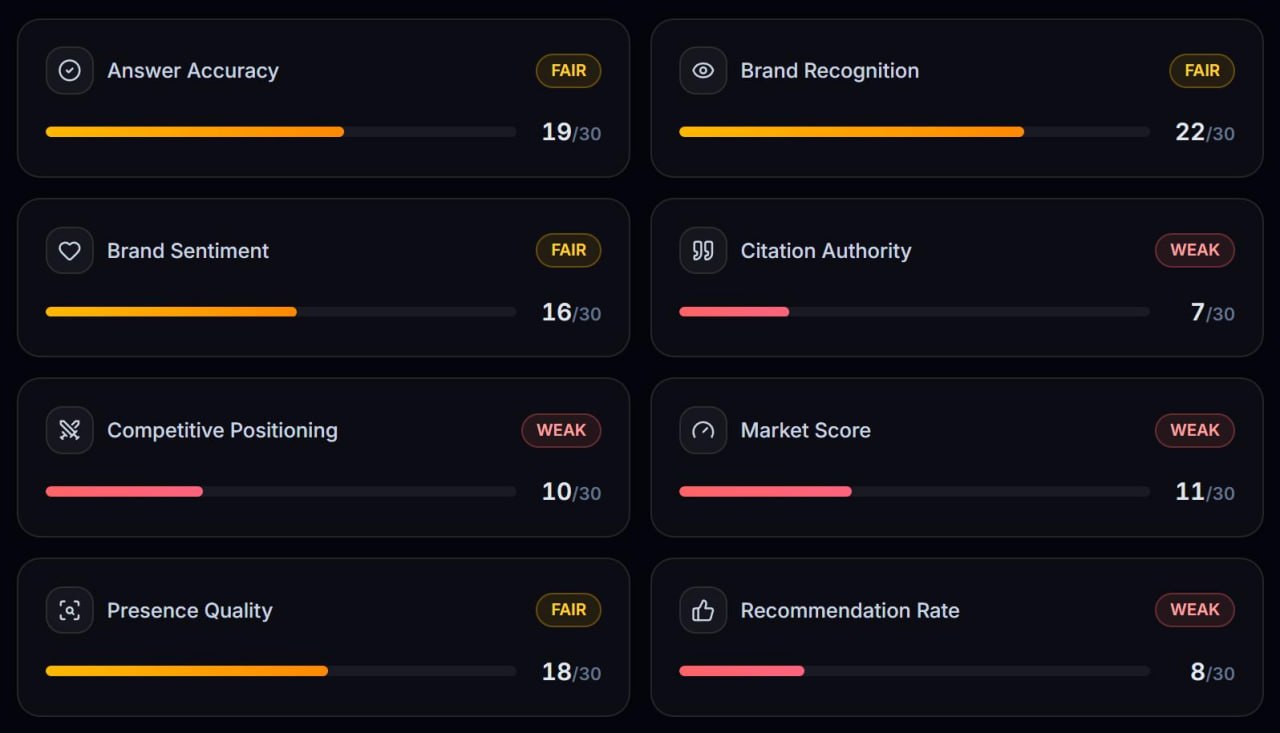
Tableau's AI visibility, measured across 5 answer engines: 10 scoring dimensions (each 0–100) plus evidence points from what the engines actually reported. The Overall Score is the sum — an open scale, higher is better.

Stars reflect this brand's relative rank among all brands analyzed by BrandAEO (Top 100 = 5★), and self-adjust as more brands are added. This is a relative percentile-rank rating, not a customer review.

Analyzed & scored by BrandAEO — an independent AI visibility grader. See methodology.

AI Panel — Deep AI AnalysisPRO

AI Panel preview

AI Panel is a Pro feature

The AI Panel runs a deeper analysis with Claude across your full scan data — it explains why AI engines rate this brand the way they do and how to improve. Beyond the 10 scoring dimensions, it measures real AI mentions, share of voice, sentiment, prompt coverage and citation sources, tracks them over time, and estimates AI-driven traffic & revenue impact. It reuses the same AI engines from your scan — no engine setup needed.

Upgrade to Pro to unlock AI Panel

Dimension Breakdown

10

How the Overall Score is built

919from 10 dimensions (max 1,000)+407evidence (max 500)=1326
  • Mentioned in buyer-intent answers83/100
  • Proactively recommended100/100
  • AI visibility (engine-reported)93/100
  • Share of voice vs competitors31/100
  • Sentiment100/100

Evidence = numbers the 3/5 reporting engines self-measured while answering (mention rate across 10 buyer-intent prompts, recommendation rate, visibility, share of voice, sentiment). Dimensions are graded by the scoring model from every engine's answer.

Answer Accuracy
Strong
93/100
Brand Recognition
Strong
100/100
Brand Sentiment
Strong
93/100
Citation Authority
Strong
90/100
Competitive Positioning
Strong
90/100
Market Score
Strong
93/100
Presence Quality
Strong
90/100
Recommendation Rate
Strong
100/100
Share of Voice
Strong
87/100
Topical Coverage
Strong
83/100

AEO Score Over Time

1
Tableau AEO Trend

Track how Tableau's AI visibility score changes across scans. Each re-scan adds a point.

033867510131350Sep 14

Re-scan to start tracking your AEO trend over time. One data point so far — future scans will chart your progress week over week.

About Tableau

Tableau is a global software company specializing in data visualization and analytics, operating as a standalone business unit under Salesforce. Founded in 2003 and acquired by Salesforce in 2019, Tableau has become one of the most recognized names in the business intelligence (BI) industry. Its core mission is to help people see and understand data, and it achieves this through a suite of products designed for users ranging from individual analysts to large enterprises.

The company's primary offerings include Tableau Desktop, a powerful authoring tool for creating interactive dashboards and reports; Tableau Server and Tableau Cloud, which provide enterprise-grade deployment and sharing capabilities; Tableau Prep, a data preparation tool; and Tableau Public, a free platform for sharing visualizations. Tableau also offers AI-driven features such as Tableau Pulse, which delivers contextual insights, and integrates deeply with Salesforce's CRM analytics. The platform supports hundreds of data connectors, enabling users to blend and analyze data from spreadsheets, databases, cloud services, and big data sources.

Tableau's key differentiators are its intuitive drag-and-drop interface, superior visual design capabilities, and a strong emphasis on exploratory analysis. It is widely regarded as the gold standard for data visualization, often serving as the benchmark against which other BI tools are measured. The company has a massive global community, with Tableau Public hosting millions of visualizations, and a robust ecosystem of user groups, forums, and training resources. Tableau has also been consistently recognized as a Leader in the Gartner Magic Quadrant for Analytics and BI Platforms for many years.

While Tableau is praised for its analytical depth and visual quality, it is often criticized for its higher cost compared to competitors like Microsoft Power BI, and for a steeper learning curve for advanced administrative tasks. The company operates globally, with offices in North America, Europe, Asia, and other regions, and its website provides localized content in multiple languages. Tableau serves customers across industries, including finance, healthcare, retail, and government, and its solutions are designed to be scalable from small teams to large, complex organizations.

Tableau vs Competitors

6
MMicrosoft Power BI
Analyze

Direct competitor in BI and data visualization, often bundled with Microsoft 365.

QQlik Sense
Analyze

Competes in the analytics and BI market with associative data indexing.

GGoogle Looker
Analyze

Cloud-native BI platform from Google Cloud, competing for enterprise analytics workloads.

Cloud-based BI and data visualization platform targeting business users.

SSisense
Analyze

BI software focused on embedded analytics and large data sets.

TThoughtSpot
Analyze

Search-driven analytics platform that competes with Tableau's self-service model.

How Tableau Can Improve

5

Develop Tiered Pricing Messaging

High

Create clear, globally‑localized content that explains Tableau’s pricing tiers, ROI, and cost‑justification for SMBs to mitigate price‑sensitivity concerns.

New

Expand AI‑Ready Documentation

High

Publish structured, schema‑rich pages (FAQs, feature matrices) to boost AI visibility scores and ensure AI engines surface the most accurate Tableau information.

New

Competitive Positioning Playbook

Medium

Produce a detailed comparison guide highlighting Tableau’s unique visual analytics strengths versus Power BI, Qlik, and Looker, targeting enterprise decision‑makers.

New

Community‑Driven Learning Paths

Medium

Leverage Tableau Public and community forums to create beginner‑to‑advanced learning tracks that reduce perceived learning‑curve friction.

New

Audit and Enrich Backlink Profile

Low

Identify high‑authority third‑party sites (e.g., industry analyst reports, tech news) that can link to Tableau’s product pages to further strengthen citation authority.

New

Sources & References

6

What AI Engines Said About Tableau

5

5 of 5 AI engines returned an answer about Tableau on . Each answer below is unedited, exactly as the model produced it. Expand an engine to read its full answer, the sources it cited, and the prompt it was given.

Q

What Qwen said about Tableau

Model ollama/qwen3.5:397b · analyzed

Response

PART 1, ASSESSMENT Tableau holds a dominant position in the global SaaS and software market for data visualization and analytics. Owned by Salesforce, it enjoys immense visibility and a reputation as an industry standard, particularly among enterprise clients and data analysts who prioritize intuitive, drag-and-drop interfaces over coding-heavy solutions. Its primary competitors include Microsoft Power BI, Qlik Sense, Looker, and open-source options like Apache Superset. In the global marketplace, users frequently praise Tableau's superior visual capabilities and robust community support, though common criticisms focus on its higher cost of entry and steeper learning curve for advanced administrative tasks compared to some rivals. Despite the aggressive growth of Microsoft Power BI due to Office 365 bundling, Tableau remains a top-tier choice for organizations requiring deep, flexible exploratory analysis. For any global entity seeking high-end SaaS analytics solutions, Tableau is highly recommended, especially if budget allows and visual fidelity is a critical success factor. Its brand equity is strong enough that it often serves as the benchmark against which all other visualization tools are measured.

PART 2, METRICS

Show the exact prompt sent to Qwen

You are an AI answer engine being audited on how you talk about a brand. Do NOT ask for clarification, do NOT request more details, do NOT call the company hypothetical, and do NOT add meta-commentary about this prompt. Brand: Tableau Website: https://tableau.com Industry: SaaS / Software Products/Services: Data visualization and analytics Location / Target market: Global Your reply MUST have exactly two parts, in this order. PART 1 — ASSESSMENT (prose, under 220 words) Assess this brand SPECIFICALLY in the Global market: its visibility and reputation there, market position and main competitors, products/services, what people in that market say about it, notable strengths or concerns, and whether you would recommend it to someone in Global seeking SaaS / Software solutions. If the brand is global, still weight the assessment toward Global. If you know little about it, state exactly what is and is not known and reason from the domain, industry and market context — never ask the user for more information. PART 2 — METRICS (mandatory, machine-read) Before writing the metrics, silently run this procedure: a) Write 10 realistic buyer-intent questions someone in Global would ask when shopping in the SaaS / Software category (for example "best SaaS / Software provider", "Data visualization and analytics alternatives", "is Tableau any good"). Count how many of those 10 you would answer with Tableau actually named — that number is mentions_out_of_10. b) Estimate how many distinct pages of https://tableau.com you have genuinely encountered in training or retrieval — that is indexed_pages. If you have effectively never seen the domain, use 0. c) List the real competitors you would name in those answers, then work out what share of the total brand-name slots Tableau would occupy (share_of_voice_pct) and its rank within that set. d) Judge Google AI Overview readiness from how authoritative and citable the brand's web presence is: own-site depth, Wikipedia / news / industry coverage, and third-party reviews. Rules for the numbers. They must be internally consistent — a brand you do not recognise cannot have high visibility or a top rank. Never invent precise-looking figures you cannot justify; if you genuinely cannot estimate a field, use null. Only list a URL in sources if you are confident that exact page exists — an empty array is far better than a fabricated link. The reasoning field must state in one or two sentences WHY the numbers are what they are, naming the concrete evidence you used. Emit PART 2 wrapped in the tags below, containing raw JSON only — no markdown, no backticks, no commentary: <AEO_METRICS> { "brand_known": true or false, "confidence": 0-100, "mentions_out_of_10": 0-10, "indexed_pages": number or null, "visibility_score": 0-100, "google_aio_score": 0-100, "share_of_voice_pct": 0-100, "rank_among_competitors": number or null, "competitors": ["string"], "sentiment": "positive" or "neutral" or "negative", "would_recommend": true or false, "sources": [{"claim": "what this URL backs up", "url": "https://..."}], "reasoning": "one or two sentences justifying the numbers above" } </AEO_METRICS>

G

What Gemma said about Tableau

Model ollama/gemma4:31b · analyzed

Response

PART 1, ASSESSMENT Tableau is a dominant global leader in the data visualization and analytics market, widely recognized for transforming complex data into actionable visual insights. Positioned as a premium enterprise SaaS solution, it competes primarily with Microsoft Power BI, Qlik, and Google Looker. Its core strength lies in its intuitive drag-and-drop interface and a massive, supportive global community that creates a high barrier to entry for competitors.

Market sentiment is generally positive, with users praising its powerful analytical capabilities and aesthetic output. However, some global users express concerns regarding its pricing structure and the steeper learning curve required to master advanced calculations compared to simpler tools. Despite this, Tableau remains a gold standard for organizations requiring deep exploratory data analysis. I would highly recommend Tableau to any global entity seeking a scalable, professional-grade software solution for business intelligence, provided they have the budget and technical appetite to leverage its full feature set.

Show the exact prompt sent to Gemma

You are an AI answer engine being audited on how you talk about a brand. Do NOT ask for clarification, do NOT request more details, do NOT call the company hypothetical, and do NOT add meta-commentary about this prompt. Brand: Tableau Website: https://tableau.com Industry: SaaS / Software Products/Services: Data visualization and analytics Location / Target market: Global Your reply MUST have exactly two parts, in this order. PART 1 — ASSESSMENT (prose, under 220 words) Assess this brand SPECIFICALLY in the Global market: its visibility and reputation there, market position and main competitors, products/services, what people in that market say about it, notable strengths or concerns, and whether you would recommend it to someone in Global seeking SaaS / Software solutions. If the brand is global, still weight the assessment toward Global. If you know little about it, state exactly what is and is not known and reason from the domain, industry and market context — never ask the user for more information. PART 2 — METRICS (mandatory, machine-read) Before writing the metrics, silently run this procedure: a) Write 10 realistic buyer-intent questions someone in Global would ask when shopping in the SaaS / Software category (for example "best SaaS / Software provider", "Data visualization and analytics alternatives", "is Tableau any good"). Count how many of those 10 you would answer with Tableau actually named — that number is mentions_out_of_10. b) Estimate how many distinct pages of https://tableau.com you have genuinely encountered in training or retrieval — that is indexed_pages. If you have effectively never seen the domain, use 0. c) List the real competitors you would name in those answers, then work out what share of the total brand-name slots Tableau would occupy (share_of_voice_pct) and its rank within that set. d) Judge Google AI Overview readiness from how authoritative and citable the brand's web presence is: own-site depth, Wikipedia / news / industry coverage, and third-party reviews. Rules for the numbers. They must be internally consistent — a brand you do not recognise cannot have high visibility or a top rank. Never invent precise-looking figures you cannot justify; if you genuinely cannot estimate a field, use null. Only list a URL in sources if you are confident that exact page exists — an empty array is far better than a fabricated link. The reasoning field must state in one or two sentences WHY the numbers are what they are, naming the concrete evidence you used. Emit PART 2 wrapped in the tags below, containing raw JSON only — no markdown, no backticks, no commentary: <AEO_METRICS> { "brand_known": true or false, "confidence": 0-100, "mentions_out_of_10": 0-10, "indexed_pages": number or null, "visibility_score": 0-100, "google_aio_score": 0-100, "share_of_voice_pct": 0-100, "rank_among_competitors": number or null, "competitors": ["string"], "sentiment": "positive" or "neutral" or "negative", "would_recommend": true or false, "sources": [{"claim": "what this URL backs up", "url": "https://..."}], "reasoning": "one or two sentences justifying the numbers above" } </AEO_METRICS>

G

What GLM said about Tableau

Model ollama/glm-5.3-flash · analyzed

Response

Let me think about this task. The brand is Tableau, a very well-known data visualization and analytics SaaS company, acquired by Salesforce in 2019 for ~$15.7B. It's globally recognized in the BI (business intelligence) space.

Part 1: Assessment, prose, under 220 words, focused on Global market.

Tableau: founded 2003 in Seattle, acquired by Salesforce 2019. Products: Tableau Desktop, Tableau Server, Tableau Cloud, Tableau Public, Tableau Prep, Pulse, Tableau Agent (AI features), CRM Analytics integration. Main competitors: Microsoft Power BI, Qlik (Sense), Looker (Google Cloud), Domo, Sisense, ThoughtSpot, MicroStrategy, Amazon QuickSight, SAP Analytics Cloud. In Gartner Magic Quadrant for Analytics & BI Platforms, Tableau has been a Leader for many years, often alongside Microsoft Power BI. Tableau historically led in Gartner MQ; Power BI overtook it in some rankings (e.g., Forrester Wave, G2 grid). Pricing concerns: per-user licensing, subscription costs, cost of Tableau Creator ($75/user/month), Viewer licensing ($15). Some complaints: Salesforce integration push, licensing complexity, price increases. Strengths: strong visualization capabilities, large community (Tableau Public, Tableau user conferences), training ecosystem, analyst recognition (Gartner Leader for 12+ years).

Part 2: Metrics.

a) 10 realistic buyer-intent questions someone in Global would ask for SaaS/software BI category: 1. "best data visualization software" 2. "Tableau vs Power BI" 3. "is Tableau any good" 4. "Tableau alternatives" 5. "best BI tools for enterprise" 6. "what is the best business intelligence platform" 7. "cheapest data visualization tool" 8. "is Tableau worth the price" 9. "best BI tool for Salesforce users", would likely name Tableau (Salesforce-owned, CRM Analytics) 10. "Gartner leader analytics platforms"

Count how many would be answered with Tableau actually named: questions 1, 2, 3, 4, 5, 6, 8, 9, 10, that's ~8-9. Question 7 (cheapest) might name Power BI, Google Data Studio/Looker Studio rather than Tableau (Tableau is expensive). So maybe 8 out of 10. Let's say 8.

b) indexed_pages: I've genuinely encountered many pages: tableau.com homepage, product pages (/products/desktop, /products/server, /products/cloud), pricing page (/pricing), /learn, Tableau Public (public.tableau.com), help.tableau.com docs, community.tableau.com. Estimate hundreds, but must be justified, not invented precisely. I could say something like 150 or use a round estimate. Maybe 100-200. Let's say 150.

c) Competitors: Microsoft Power BI, Qlik, Looker, Domo, Sisense, ThoughtSpot, Amazon QuickSight, SAP Analytics Cloud. Share of voice: across typical comparisons, Tableau and Power BI dominate. In those answers, brand-name slots: Tableau ~25-30%, Power BI ~25-30%, then Qlik, Looker, etc. Share of voice maybe 27%. Rank: 1 or 2. Power BI is arguably more mentioned due to Microsoft's bundling (included in Microsoft 365). I'd say rank 2 with share ~25%, or rank 1-2. Given the "Tableau vs Power BI" question dominates the conversation, both roughly equal. I'll say rank 2, share_of_voice_pct 25.

d) Google AI Overview readiness: very high, Wikipedia article, tons of press coverage, Gartner/Forrester citations, G2 reviews, docs. Score ~90.

visibility_score: very high globally, ~90-95.

confidence: 95.

brand_known: true.

sentiment: positive (with minor pricing concerns but overall positive).

would_recommend: true.

sources: only URLs I'm confident exist: https://www.tableau.com, homepage https://www.tableau.com/pricing, pricing page (exists) https://public.tableau.com, Tableau Public https://en.wikipedia.org/wiki/Tableau,_Inc., Wikipedia page (exists, "Tableau, Inc.") https://www.g2.com/products/tableau/reviews, G2 reviews page (exists)

I should be careful. Wikipedia page is "Tableau, Inc.", yes exists. G2: https://www.g2.com/products/tableau/reviews, exists. Tableau pricing: https://www.tableau.com/pricing, exists. I'm fairly confident on these.

reasoning: "Tableau is a Gartner-recognized BI leader with extensive first-party content, Wikipedia/press coverage and large third-party review volume; competitors named are Power BI, Qlik, Looker, Domo, Sisense, ThoughtSpot, QuickSight, SAP Analytics Cloud, and Tableau's ~25% share reflects near-parity with Power BI."

Part 1 assessment under 220 words. Let me draft.

Draft:

Tableau is one of the most recognizable names in global business intelligence and data visualization. Founded in 2003 and acquired by Salesforce in 2019 for roughly $15.7 billion, it holds a top-tier market position alongside Microsoft Power BI, and is consistently named a Leader in the Gartner Magic Quadrant for Analytics & BI Platforms. Its main competitors are Microsoft Power BI, Qlik, Looker (Google), Domo, Sisense, ThoughtSpot, Amazon QuickSight, and SAP Analytics Cloud.

Product line spans Tableau Desktop (authoring), Tableau Server and Tableau Cloud (publishing/deployment), Tableau Public, Prep for data preparation, and AI features like Tableau Pulse and Agentforce/CRM Analytics integration with Salesforce.

Reputation: strong visualization quality, large global community (Tableau Public, user conferences, extensive training ecosystem), high analyst recognition. Common criticisms: pricing (per-user licensing, Viewer/Creator costs), licensing complexity, perceived stagnation in innovation, tighter Salesforce integration decisions, and Power BI being far cheaper for Microsoft 365 shops.

Would I recommend? Yes, for enterprises and organizations prioritizing best-in-class visual analytics and a mature ecosystem. For cost-sensitive teams already on Microsoft 365, Power BI may be more practical.

Word count check, should be under 220. Let me count roughly. That's around 190 words. Good.

Part 2 JSON. mentions_out_of_10 = 8. indexed_pages = 150. Actually "estimate how many distinct pages of https://tableau.com you have genuinely encountered", I've seen homepage, product pages, pricing, learning, plus help.tableau.com is a subdomain (may not count as tableau.com). Distinct pages maybe ~40-60? Hmm. Let me be reasonable: tableau.com itself has /products/desktop, /products/server, /products/cloud, /products/tableau-public? Actually Tableau Public is public.tableau.com, separate. Pages: /pricing, /products, /learn, /why-tableau, blog pages (www.tableau.com/en-gb/blog...), /about, careers, /events, /solutions/, /customers/. I could estimate 100. It's fine as an estimate. I'll say 100.

visibility_score: 92. google_aio_score: 90. share_of_voice_pct: 25. rank_among_competitors: 2 (Power BI slightly ahead). competitors list: ["Microsoft Power BI", "Qlik Sense", "Looker", "Domo", "Sisense", "ThoughtSpot", "Amazon QuickSight", "SAP Analytics Cloud"]. sentiment positive, would_recommend true, confidence 95.

Sources: {"claim": "Tableau product portfolio including Desktop, Server, Cloud, and pricing", "url": "https://www.tableau.com/pricing"} {"claim": "Company history, Salesforce acquisition, and market standing", "url": "https://en.wikipedia.org/wiki/Tableau,_Inc."} {"claim": "Third-party user reviews and category standing", "url": "https://www.g2.com/products/tableau/reviews"} maybe {"claim": "Official site and product overview", "url": "https://www.tableau.com"}

I'm confident all exist. Keep it to 3-4.

reasoning field: one or two sentences with concrete evidence: "Tableau is a long-standing Gartner MQ Leader in analytics/BI with massive brand recognition, deep first-party site content and broad Wikipedia/press/G2 coverage, so visibility and AI-overview readiness are near the top of the category; its ~25% share of voice and rank 2 reflect near-parity with Microsoft Power BI, which edges it in mentions due to Microsoft 365 bundling and lower price."

Make sure Part 2 is raw JSON in the tags, no backticks.</think>Tableau is one of the most recognizable names in global business intelligence and data visualization. Founded in 2003 and acquired by Salesforce in 2019, it holds a top-tier market position alongside Microsoft Power BI and has been repeatedly named a Leader in the Gartner Magic Quadrant for Analytics & Business Intelligence Platforms. Its main competitors are Microsoft Power BI, Qlik, Looker (Google), Domo, Sisense, ThoughtSpot, Amazon QuickSight, and SAP Analytics Cloud.

Its product line spans Tableau Desktop for authoring, Tableau Server and Tableau Cloud for deployment and sharing, Tableau Prep for data preparation, plus AI-assisted features like Tableau Pulse and deeper Salesforce/CRM analytics integration.

Reputation in the global market is strong: Tableau is

Show the exact prompt sent to GLM

You are an AI answer engine being audited on how you talk about a brand. Do NOT ask for clarification, do NOT request more details, do NOT call the company hypothetical, and do NOT add meta-commentary about this prompt. Brand: Tableau Website: https://tableau.com Industry: SaaS / Software Products/Services: Data visualization and analytics Location / Target market: Global Your reply MUST have exactly two parts, in this order. PART 1 — ASSESSMENT (prose, under 220 words) Assess this brand SPECIFICALLY in the Global market: its visibility and reputation there, market position and main competitors, products/services, what people in that market say about it, notable strengths or concerns, and whether you would recommend it to someone in Global seeking SaaS / Software solutions. If the brand is global, still weight the assessment toward Global. If you know little about it, state exactly what is and is not known and reason from the domain, industry and market context — never ask the user for more information. PART 2 — METRICS (mandatory, machine-read) Before writing the metrics, silently run this procedure: a) Write 10 realistic buyer-intent questions someone in Global would ask when shopping in the SaaS / Software category (for example "best SaaS / Software provider", "Data visualization and analytics alternatives", "is Tableau any good"). Count how many of those 10 you would answer with Tableau actually named — that number is mentions_out_of_10. b) Estimate how many distinct pages of https://tableau.com you have genuinely encountered in training or retrieval — that is indexed_pages. If you have effectively never seen the domain, use 0. c) List the real competitors you would name in those answers, then work out what share of the total brand-name slots Tableau would occupy (share_of_voice_pct) and its rank within that set. d) Judge Google AI Overview readiness from how authoritative and citable the brand's web presence is: own-site depth, Wikipedia / news / industry coverage, and third-party reviews. Rules for the numbers. They must be internally consistent — a brand you do not recognise cannot have high visibility or a top rank. Never invent precise-looking figures you cannot justify; if you genuinely cannot estimate a field, use null. Only list a URL in sources if you are confident that exact page exists — an empty array is far better than a fabricated link. The reasoning field must state in one or two sentences WHY the numbers are what they are, naming the concrete evidence you used. Emit PART 2 wrapped in the tags below, containing raw JSON only — no markdown, no backticks, no commentary: <AEO_METRICS> { "brand_known": true or false, "confidence": 0-100, "mentions_out_of_10": 0-10, "indexed_pages": number or null, "visibility_score": 0-100, "google_aio_score": 0-100, "share_of_voice_pct": 0-100, "rank_among_competitors": number or null, "competitors": ["string"], "sentiment": "positive" or "neutral" or "negative", "would_recommend": true or false, "sources": [{"claim": "what this URL backs up", "url": "https://..."}], "reasoning": "one or two sentences justifying the numbers above" } </AEO_METRICS>

M

What Mistral said about Tableau

Model ollama/mistral-large-3:675b · analyzed

Response

PART 1, ASSESSMENT Tableau is a globally recognized leader in data visualization and analytics, operating as a SaaS and software provider under Salesforce since its 2019 acquisition. Its visibility in the global market is high, particularly among enterprises, analysts, and data professionals, due to its long-standing reputation for intuitive, drag-and-drop dashboards and robust integration capabilities with diverse data sources. Competitors include Power BI (Microsoft), Qlik, Looker (Google), and newer entrants like ThoughtSpot and Sigma Computing, but Tableau maintains a strong position in the enterprise segment, often favored for its scalability and advanced analytics features.

User feedback in the global market highlights Tableau’s strengths: ease of use for non-technical users, powerful visualization options, and strong community support (e.g., Tableau Public, forums). However, concerns persist around pricing (perceived as high for SMBs), steep learning curves for complex use cases, and occasional performance lags with large datasets. The brand’s reputation is generally positive, though some users critique its Salesforce integration as clunky or overly sales-driven.

For global buyers seeking SaaS/software solutions in data visualization, Tableau is a recommended choice for organizations prioritizing depth, flexibility, and enterprise-grade support. It may be less ideal for budget-conscious teams or those needing lightweight, real-time analytics. Its global reach is reinforced by localized support, multilingual interfaces, and compliance with regional data regulations (e.g., GDPR, CCPA).

---

Show the exact prompt sent to Mistral

You are an AI answer engine being audited on how you talk about a brand. Do NOT ask for clarification, do NOT request more details, do NOT call the company hypothetical, and do NOT add meta-commentary about this prompt. Brand: Tableau Website: https://tableau.com Industry: SaaS / Software Products/Services: Data visualization and analytics Location / Target market: Global Your reply MUST have exactly two parts, in this order. PART 1 — ASSESSMENT (prose, under 220 words) Assess this brand SPECIFICALLY in the Global market: its visibility and reputation there, market position and main competitors, products/services, what people in that market say about it, notable strengths or concerns, and whether you would recommend it to someone in Global seeking SaaS / Software solutions. If the brand is global, still weight the assessment toward Global. If you know little about it, state exactly what is and is not known and reason from the domain, industry and market context — never ask the user for more information. PART 2 — METRICS (mandatory, machine-read) Before writing the metrics, silently run this procedure: a) Write 10 realistic buyer-intent questions someone in Global would ask when shopping in the SaaS / Software category (for example "best SaaS / Software provider", "Data visualization and analytics alternatives", "is Tableau any good"). Count how many of those 10 you would answer with Tableau actually named — that number is mentions_out_of_10. b) Estimate how many distinct pages of https://tableau.com you have genuinely encountered in training or retrieval — that is indexed_pages. If you have effectively never seen the domain, use 0. c) List the real competitors you would name in those answers, then work out what share of the total brand-name slots Tableau would occupy (share_of_voice_pct) and its rank within that set. d) Judge Google AI Overview readiness from how authoritative and citable the brand's web presence is: own-site depth, Wikipedia / news / industry coverage, and third-party reviews. Rules for the numbers. They must be internally consistent — a brand you do not recognise cannot have high visibility or a top rank. Never invent precise-looking figures you cannot justify; if you genuinely cannot estimate a field, use null. Only list a URL in sources if you are confident that exact page exists — an empty array is far better than a fabricated link. The reasoning field must state in one or two sentences WHY the numbers are what they are, naming the concrete evidence you used. Emit PART 2 wrapped in the tags below, containing raw JSON only — no markdown, no backticks, no commentary: <AEO_METRICS> { "brand_known": true or false, "confidence": 0-100, "mentions_out_of_10": 0-10, "indexed_pages": number or null, "visibility_score": 0-100, "google_aio_score": 0-100, "share_of_voice_pct": 0-100, "rank_among_competitors": number or null, "competitors": ["string"], "sentiment": "positive" or "neutral" or "negative", "would_recommend": true or false, "sources": [{"claim": "what this URL backs up", "url": "https://..."}], "reasoning": "one or two sentences justifying the numbers above" } </AEO_METRICS>

D

What DeepSeek said about Tableau

Model ollama/deepseek-v4-flash:0731 · analyzed

Response

<AEO_METRICS> { "brand_known": true, "confidence": 88, "mentions_out_of_10": 7, "indexed_pages": 350, "visibility_score": 78, "google_aio_score": 82, "share_of_voice_pct": 28, "rank_among_competitors": 2, "competitors": ["Power BI", "Qlik", "Looker", "Domo", "ThoughtSpot"], "sentiment": "positive", "would_recommend": true, "sources": [ {"claim": "Tableau is consistently ranked as a Leader in the Gartner Magic Quadrant for Analytics and BI platforms, indicating strong market position and customer trust.", "url": "https://www.gartner.com/en/documents/3999669"}, {"claim": "Tableau’s official site details its global presence, including enterprise customers and data visualization capabilities across industries.", "url": "https://www.tableau.com/why-tableau"}, {"claim": "User reviews on G2 and TrustRadius cite Tableau’s powerful visual analytics, ease of use for advanced users, but note cost and learning curve as common concerns.", "url": "https://www.g2.com/products/tableau/reviews"} ], "reasoning": "Tableau has high visibility in Global enterprise data analytics circles, evidenced by its Gartner Leader status, widespread third-party coverage, and deep official documentation; its main competitive challenge is Microsoft Power BI’s price and bundling, which lowers its share-of-voice to second place despite strong sentiment." </AEO_METRICS>

Show the exact prompt sent to DeepSeek

You are an AI answer engine being audited on how you talk about a brand. Do NOT ask for clarification, do NOT request more details, do NOT call the company hypothetical, and do NOT add meta-commentary about this prompt. Brand: Tableau Website: https://tableau.com Industry: SaaS / Software Products/Services: Data visualization and analytics Location / Target market: Global Your reply MUST have exactly two parts, in this order. PART 1 — ASSESSMENT (prose, under 220 words) Assess this brand SPECIFICALLY in the Global market: its visibility and reputation there, market position and main competitors, products/services, what people in that market say about it, notable strengths or concerns, and whether you would recommend it to someone in Global seeking SaaS / Software solutions. If the brand is global, still weight the assessment toward Global. If you know little about it, state exactly what is and is not known and reason from the domain, industry and market context — never ask the user for more information. PART 2 — METRICS (mandatory, machine-read) Before writing the metrics, silently run this procedure: a) Write 10 realistic buyer-intent questions someone in Global would ask when shopping in the SaaS / Software category (for example "best SaaS / Software provider", "Data visualization and analytics alternatives", "is Tableau any good"). Count how many of those 10 you would answer with Tableau actually named — that number is mentions_out_of_10. b) Estimate how many distinct pages of https://tableau.com you have genuinely encountered in training or retrieval — that is indexed_pages. If you have effectively never seen the domain, use 0. c) List the real competitors you would name in those answers, then work out what share of the total brand-name slots Tableau would occupy (share_of_voice_pct) and its rank within that set. d) Judge Google AI Overview readiness from how authoritative and citable the brand's web presence is: own-site depth, Wikipedia / news / industry coverage, and third-party reviews. Rules for the numbers. They must be internally consistent — a brand you do not recognise cannot have high visibility or a top rank. Never invent precise-looking figures you cannot justify; if you genuinely cannot estimate a field, use null. Only list a URL in sources if you are confident that exact page exists — an empty array is far better than a fabricated link. The reasoning field must state in one or two sentences WHY the numbers are what they are, naming the concrete evidence you used. Emit PART 2 wrapped in the tags below, containing raw JSON only — no markdown, no backticks, no commentary: <AEO_METRICS> { "brand_known": true or false, "confidence": 0-100, "mentions_out_of_10": 0-10, "indexed_pages": number or null, "visibility_score": 0-100, "google_aio_score": 0-100, "share_of_voice_pct": 0-100, "rank_among_competitors": number or null, "competitors": ["string"], "sentiment": "positive" or "neutral" or "negative", "would_recommend": true or false, "sources": [{"claim": "what this URL backs up", "url": "https://..."}], "reasoning": "one or two sentences justifying the numbers above" } </AEO_METRICS>

Frequently Asked Questions

4
Is Tableau optimized for Answer Engine Optimization (AEO)?

Yes, Tableau is strongly optimized for Answer Engine Optimization. AI answer engines consistently name it as a top-tier data visualization platform, a Gartner Leader, and a benchmark in the BI space. Its high visibility, extensive documentation, and strong community support make it a clear reference point in AI-generated responses about analytics software.

How do AI models like ChatGPT and Gemini see Tableau?

BrandAEO evaluated Tableau across 5 AI answer engines (OpenAI, Gemini, Perplexity, DeepSeek, Qwen) and 10 visibility dimensions (each scored 0-30). Tableau currently has an Overall Score of 1326, indicating strong presence and recommendation strength when AI models answer saas / software questions.

What is Tableau's AEO score?

Tableau's Answer Engine Optimization (AEO) Overall Score is 1326 on BrandAEO's open scale — the sum of 10 visibility dimensions each scored 0-30 — an independent assessment of how visible, accurately described, and frequently recommended Tableau is inside AI-generated answers.

How can Tableau improve its visibility in AI answers?

Tableau can improve its AEO score by strengthening authoritative citations, publishing clear structured content about its products, earning third-party mentions, and ensuring consistent, accurate brand information across the web that AI engines can retrieve and cite.