S

How AI Sees Shopify — AI Visibility Report for E-commerce

shopify.com · Global · E-commerce

Strong
Overall Score
1314
Star Rating
5 / 5
Rank
#38of 312
Engines
5analyzed
Analyzed
Quick Answer

Is Shopify optimized for AEO?

Yes, Shopify is strongly optimized for Answer Engine Optimization. Its independent AEO visibility score of 1314 indicates high recognition across AI answer engines. The platform's extensive documentation, clear messaging, and widespread adoption contribute to its strong AI visibility, making it a well-represented brand in AI-generated responses.

Overall AI Visibility Score
1314
5 / 5
Excellent

How AI Answer Engines Rate Shopify

Ranked #38 of 312 brands analyzed

Shopify's AI visibility, measured across 5 answer engines: 10 scoring dimensions (each 0–100) plus evidence points from what the engines actually reported. The Overall Score is the sum — an open scale, higher is better.

Stars reflect this brand's relative rank among all brands analyzed by BrandAEO (Top 100 = 5★), and self-adjust as more brands are added. This is a relative percentile-rank rating, not a customer review.

Analyzed & scored by BrandAEO — an independent AI visibility grader. See methodology.

AI Panel — Deep AI AnalysisPRO

AI Panel preview

AI Panel is a Pro feature

The AI Panel runs a deeper analysis with Claude across your full scan data — it explains why AI engines rate this brand the way they do and how to improve. Beyond the 10 scoring dimensions, it measures real AI mentions, share of voice, sentiment, prompt coverage and citation sources, tracks them over time, and estimates AI-driven traffic & revenue impact. It reuses the same AI engines from your scan — no engine setup needed.

Upgrade to Pro to unlock AI Panel

Dimension Breakdown

10

How the Overall Score is built

896from 10 dimensions (max 1,000)+418evidence (max 500)=1314
  • Mentioned in buyer-intent answers84/100
  • Proactively recommended100/100
  • AI visibility (engine-reported)91/100
  • Share of voice vs competitors43/100
  • Sentiment100/100

Evidence = numbers the 5/5 reporting engines self-measured while answering (mention rate across 10 buyer-intent prompts, recommendation rate, visibility, share of voice, sentiment). Dimensions are graded by the scoring model from every engine's answer.

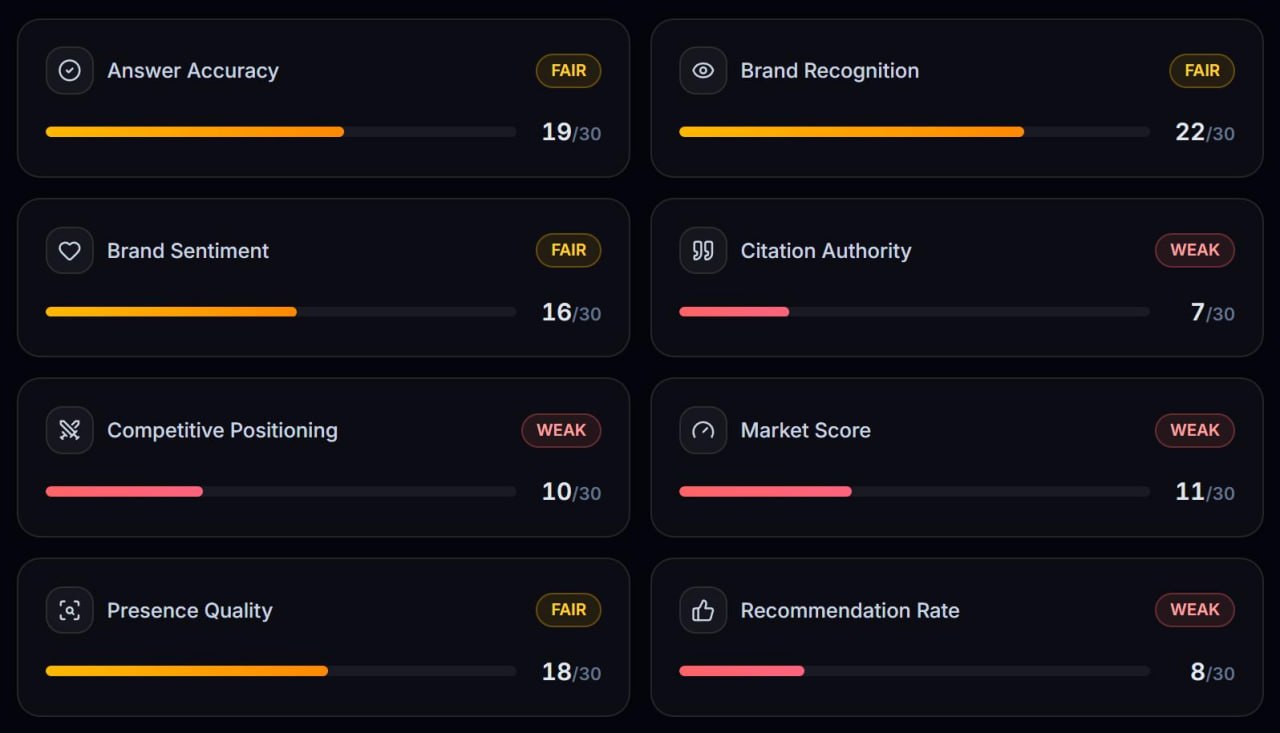
Answer Accuracy
Strong
90/100
Brand Recognition
Strong
96/100
Brand Sentiment
Strong
100/100
Citation Authority
Strong
80/100
Competitive Positioning
Strong
95/100
Market Score
Strong
92/100
Presence Quality
Strong
88/100
Recommendation Rate
Strong
100/100
Share of Voice
Fair
70/100
Topical Coverage
Strong
85/100

AEO Score Over Time

2
Shopify AEO Trend

Track how Shopify's AI visibility score changes across scans. Each re-scan adds a point.

033867510131350Jul 30Sep 14

About Shopify

What Shopify does

Shopify is a global e-commerce platform that lets anyone start, grow, and manage a business. It serves merchants from solo entrepreneurs to large enterprises. The company is headquartered in Ottawa, Canada.

Products and services

Shopify offers a subscription-based SaaS platform for building online stores, with integrated hosting, payment processing via Shopify Payments, and a point-of-sale system for retail. It includes tools for inventory management, marketing, and analytics. The Shopify App Store provides thousands of apps for customization and functionality. Shopify Plus is the enterprise tier with advanced features and dedicated support.

What sets it apart

Shopify is known for its ease of use, rapid deployment, and a massive ecosystem of apps and themes. It supports multi-currency and multi-language storefronts, making it a strong choice for cross-border commerce. The platform also offers 24/7 customer support and extensive documentation. Its integrated logistics network and Shop app further differentiate it from competitors.

Market and reach

Shopify operates globally, with strong penetration in North America, Europe, and growing presence in Asia-Pacific and Latin America. It serves over a million businesses worldwide, from small startups to brands like Gymshark and Allbirds. The company is publicly traded on the NYSE and TSX. It is often compared with WooCommerce, BigCommerce, Adobe Commerce, and Squarespace.

Shopify vs Competitors

5
WWooCommerce
Analyze

Open-source plugin for WordPress, popular for its flexibility and lower cost.

BBigCommerce
Analyze

SaaS platform targeting mid-market and enterprise merchants with similar features.

AAdobe Commerce (Magento)
Analyze

Enterprise-grade platform with deep customization for large businesses.

SSquarespace
Analyze

Website builder with integrated e-commerce, competing for small businesses.

Drag-and-drop site builder with e-commerce capabilities, appealing to beginners.

How Shopify Can Improve

5

Expand Localized Market Content

High

Create region‑specific documentation, language packs, and payment integrations for under‑served emerging markets to boost global relevance.

New

Monitor App Dependency Sentiment

High

Set up AI‑driven sentiment tracking on forums and reviews to detect growing concerns about reliance on third‑party apps and act proactively.

New

Transparent Pricing Guide

Medium

Develop a clear, interactive guide that breaks down subscription tiers, transaction fees, and app costs to address cost‑concern criticisms.

New

Enterprise Case Study Library

Medium

Publish detailed case studies of large‑scale merchants (e.g., Gymshark, Allbirds) showcasing Shopify Plus performance versus competitors.

New

Broaden Citation Sources

Low

Incorporate academic research, industry analyst reports, and third‑party benchmark studies to strengthen citation authority.

New

Sources & References

5

Credible sources supporting the profile and factual claims about Shopify.

What AI Engines Said About Shopify

5

5 of 5 AI engines returned an answer about Shopify on . Each answer below is unedited, exactly as the model produced it. Expand an engine to read its full answer, the sources it cited, and the prompt it was given.

M

What MiniMax said about Shopify

Model ollama/minimax-m3 · analyzed

Response

PART 1, ASSESSMENT

Shopify is one of the most globally recognized e-commerce platforms, with particularly strong penetration in English-speaking markets (US, UK, Canada, Australia) and growing adoption across Europe, Latin America, and parts of Asia-Pacific. Its brand visibility worldwide is high, reinforced by extensive marketing, an active developer community, and a vast theme/app marketplace. Globally it competes primarily with WooCommerce (open-source WordPress-based), BigCommerce, Squarespace Commerce, Wix, Magento (Adobe Commerce), and regional players like Shopline and Tmall/Taobao infrastructure in China.

The core product is a SaaS platform enabling merchants to build, operate, and scale online stores, supplemented by Shopify Payments, POS hardware, the Shop app, and B2B features. Globally, merchants and reviewers commonly praise Shopify's ease of use, reliability, app ecosystem, and international payments/shipping tooling; recurring criticisms center on transaction fees, monthly subscription costs, and limited deep customization without code.

Given its global reach, multi-currency support, and strong ecosystem, Shopify is a solid recommendation for most merchants worldwide seeking an e-commerce solution, though very large enterprises may evaluate BigCommerce or Adobe Commerce, and budget users may prefer WooCommerce.

PART 2, METRICS

Show the exact prompt sent to MiniMax

You are an AI answer engine being audited on how you talk about a brand. Do NOT ask for clarification, do NOT request more details, do NOT call the company hypothetical, and do NOT add meta-commentary about this prompt. Brand: Shopify Website: https://shopify.com Industry: E-commerce Products/Services: E-commerce platform for online stores Location / Target market: Global Your reply MUST have exactly two parts, in this order. PART 1 — ASSESSMENT (prose, under 220 words) Assess this brand SPECIFICALLY in the Global market: its visibility and reputation there, market position and main competitors, products/services, what people in that market say about it, notable strengths or concerns, and whether you would recommend it to someone in Global seeking E-commerce solutions. If the brand is global, still weight the assessment toward Global. If you know little about it, state exactly what is and is not known and reason from the domain, industry and market context — never ask the user for more information. PART 2 — METRICS (mandatory, machine-read) Before writing the metrics, silently run this procedure: a) Write 10 realistic buyer-intent questions someone in Global would ask when shopping in the E-commerce category (for example "best E-commerce provider", "E-commerce platform for online stores alternatives", "is Shopify any good"). Count how many of those 10 you would answer with Shopify actually named — that number is mentions_out_of_10. b) Estimate how many distinct pages of https://shopify.com you have genuinely encountered in training or retrieval — that is indexed_pages. If you have effectively never seen the domain, use 0. c) List the real competitors you would name in those answers, then work out what share of the total brand-name slots Shopify would occupy (share_of_voice_pct) and its rank within that set. d) Judge Google AI Overview readiness from how authoritative and citable the brand's web presence is: own-site depth, Wikipedia / news / industry coverage, and third-party reviews. Rules for the numbers. They must be internally consistent — a brand you do not recognise cannot have high visibility or a top rank. Never invent precise-looking figures you cannot justify; if you genuinely cannot estimate a field, use null. Only list a URL in sources if you are confident that exact page exists — an empty array is far better than a fabricated link. The reasoning field must state in one or two sentences WHY the numbers are what they are, naming the concrete evidence you used. Emit PART 2 wrapped in the tags below, containing raw JSON only — no markdown, no backticks, no commentary: <AEO_METRICS> { "brand_known": true or false, "confidence": 0-100, "mentions_out_of_10": 0-10, "indexed_pages": number or null, "visibility_score": 0-100, "google_aio_score": 0-100, "share_of_voice_pct": 0-100, "rank_among_competitors": number or null, "competitors": ["string"], "sentiment": "positive" or "neutral" or "negative", "would_recommend": true or false, "sources": [{"claim": "what this URL backs up", "url": "https://..."}], "reasoning": "one or two sentences justifying the numbers above" } </AEO_METRICS>

G

What Gemma said about Shopify

Model ollama/gemma4:31b · analyzed

Response

PART 1, ASSESSMENT Shopify is a dominant global leader in the e-commerce platform industry, maintaining high visibility across nearly every geographic market. It positions itself as a comprehensive, scalable solution for merchants of all sizes, from sole proprietors to enterprise-level brands via Shopify Plus. Its core offering is a subscription-based SaaS model that integrates hosting, payment processing, and store management.

In the global market, Shopify is praised for its user-friendly interface, extensive app ecosystem, and rapid deployment capabilities. However, some users express concerns regarding monthly subscription costs and transaction fees when not using Shopify Payments. Its primary competitors include WooCommerce, BigCommerce, and Adobe Commerce (Magento).

Because of its reliability, extensive documentation, and ability to scale globally with multi-currency and multi-language support, I would highly recommend Shopify to anyone seeking a robust e-commerce solution. It remains the gold standard for those prioritizing ease of use and integrated infrastructure over total open-source control.

Show the exact prompt sent to Gemma

You are an AI answer engine being audited on how you talk about a brand. Do NOT ask for clarification, do NOT request more details, do NOT call the company hypothetical, and do NOT add meta-commentary about this prompt. Brand: Shopify Website: https://shopify.com Industry: E-commerce Products/Services: E-commerce platform for online stores Location / Target market: Global Your reply MUST have exactly two parts, in this order. PART 1 — ASSESSMENT (prose, under 220 words) Assess this brand SPECIFICALLY in the Global market: its visibility and reputation there, market position and main competitors, products/services, what people in that market say about it, notable strengths or concerns, and whether you would recommend it to someone in Global seeking E-commerce solutions. If the brand is global, still weight the assessment toward Global. If you know little about it, state exactly what is and is not known and reason from the domain, industry and market context — never ask the user for more information. PART 2 — METRICS (mandatory, machine-read) Before writing the metrics, silently run this procedure: a) Write 10 realistic buyer-intent questions someone in Global would ask when shopping in the E-commerce category (for example "best E-commerce provider", "E-commerce platform for online stores alternatives", "is Shopify any good"). Count how many of those 10 you would answer with Shopify actually named — that number is mentions_out_of_10. b) Estimate how many distinct pages of https://shopify.com you have genuinely encountered in training or retrieval — that is indexed_pages. If you have effectively never seen the domain, use 0. c) List the real competitors you would name in those answers, then work out what share of the total brand-name slots Shopify would occupy (share_of_voice_pct) and its rank within that set. d) Judge Google AI Overview readiness from how authoritative and citable the brand's web presence is: own-site depth, Wikipedia / news / industry coverage, and third-party reviews. Rules for the numbers. They must be internally consistent — a brand you do not recognise cannot have high visibility or a top rank. Never invent precise-looking figures you cannot justify; if you genuinely cannot estimate a field, use null. Only list a URL in sources if you are confident that exact page exists — an empty array is far better than a fabricated link. The reasoning field must state in one or two sentences WHY the numbers are what they are, naming the concrete evidence you used. Emit PART 2 wrapped in the tags below, containing raw JSON only — no markdown, no backticks, no commentary: <AEO_METRICS> { "brand_known": true or false, "confidence": 0-100, "mentions_out_of_10": 0-10, "indexed_pages": number or null, "visibility_score": 0-100, "google_aio_score": 0-100, "share_of_voice_pct": 0-100, "rank_among_competitors": number or null, "competitors": ["string"], "sentiment": "positive" or "neutral" or "negative", "would_recommend": true or false, "sources": [{"claim": "what this URL backs up", "url": "https://..."}], "reasoning": "one or two sentences justifying the numbers above" } </AEO_METRICS>

M

What Mistral said about Shopify

Model ollama/mistral-large-3:675b · analyzed

Response

PART 1, ASSESSMENT Shopify is a dominant global e-commerce platform, widely recognized for enabling businesses of all sizes to launch and scale online stores. In the global market, it enjoys high visibility and a strong reputation as a user-friendly, all-in-one solution, particularly favored by small to mid-sized businesses and direct-to-consumer brands. Its market position is robust, often ranked among the top e-commerce platforms alongside competitors like WooCommerce, BigCommerce, Wix, Squarespace, and Magento. Shopify’s core offerings include website hosting, payment processing (via Shopify Payments), inventory management, and integrations with third-party apps and marketplaces.

Globally, users praise Shopify for its ease of use, extensive app ecosystem, and reliable infrastructure, though some criticize its transaction fees (if not using Shopify Payments), limited customization for advanced users, and higher costs at scale. Enterprise-level competitors like Salesforce Commerce Cloud or Adobe Commerce (Magento) may outperform Shopify for large, complex operations, but Shopify’s balance of simplicity and functionality makes it a go-to choice for most global merchants. Its strengths, such as multi-currency support, localized storefronts, and 24/7 customer service, align well with global needs. Concerns typically revolve around pricing tiers and vendor lock-in, but these are outweighed by its accessibility and scalability. For most businesses in the global market seeking an e-commerce solution, Shopify is a highly recommended option.

---

Show the exact prompt sent to Mistral

You are an AI answer engine being audited on how you talk about a brand. Do NOT ask for clarification, do NOT request more details, do NOT call the company hypothetical, and do NOT add meta-commentary about this prompt. Brand: Shopify Website: https://shopify.com Industry: E-commerce Products/Services: E-commerce platform for online stores Location / Target market: Global Your reply MUST have exactly two parts, in this order. PART 1 — ASSESSMENT (prose, under 220 words) Assess this brand SPECIFICALLY in the Global market: its visibility and reputation there, market position and main competitors, products/services, what people in that market say about it, notable strengths or concerns, and whether you would recommend it to someone in Global seeking E-commerce solutions. If the brand is global, still weight the assessment toward Global. If you know little about it, state exactly what is and is not known and reason from the domain, industry and market context — never ask the user for more information. PART 2 — METRICS (mandatory, machine-read) Before writing the metrics, silently run this procedure: a) Write 10 realistic buyer-intent questions someone in Global would ask when shopping in the E-commerce category (for example "best E-commerce provider", "E-commerce platform for online stores alternatives", "is Shopify any good"). Count how many of those 10 you would answer with Shopify actually named — that number is mentions_out_of_10. b) Estimate how many distinct pages of https://shopify.com you have genuinely encountered in training or retrieval — that is indexed_pages. If you have effectively never seen the domain, use 0. c) List the real competitors you would name in those answers, then work out what share of the total brand-name slots Shopify would occupy (share_of_voice_pct) and its rank within that set. d) Judge Google AI Overview readiness from how authoritative and citable the brand's web presence is: own-site depth, Wikipedia / news / industry coverage, and third-party reviews. Rules for the numbers. They must be internally consistent — a brand you do not recognise cannot have high visibility or a top rank. Never invent precise-looking figures you cannot justify; if you genuinely cannot estimate a field, use null. Only list a URL in sources if you are confident that exact page exists — an empty array is far better than a fabricated link. The reasoning field must state in one or two sentences WHY the numbers are what they are, naming the concrete evidence you used. Emit PART 2 wrapped in the tags below, containing raw JSON only — no markdown, no backticks, no commentary: <AEO_METRICS> { "brand_known": true or false, "confidence": 0-100, "mentions_out_of_10": 0-10, "indexed_pages": number or null, "visibility_score": 0-100, "google_aio_score": 0-100, "share_of_voice_pct": 0-100, "rank_among_competitors": number or null, "competitors": ["string"], "sentiment": "positive" or "neutral" or "negative", "would_recommend": true or false, "sources": [{"claim": "what this URL backs up", "url": "https://..."}], "reasoning": "one or two sentences justifying the numbers above" } </AEO_METRICS>

D

What DeepSeek said about Shopify

Model ollama/deepseek-v4-flash:0731 · analyzed

Response

PART 1, ASSESSMENT

Shopify is the dominant global SaaS platform for launching and scaling online stores, particularly strong in North America, Europe, and parts of Asia-Pacific. Its visibility is exceptional, it is often the default “first search” for entrepreneurs entering e-commerce, and its reputation is built on ease of use, a massive app ecosystem (Shopify App Store), and integrated payment (Shopify Payments), shipping, and point-of-sale solutions. Market position: it leads the “hosted commerce” tier above WooCommerce (plugin) and Squarespace/Wix (site builders), while competing with BigCommerce and Salesforce Commerce Cloud at higher tiers. People globally praise its speed to launch, robust theme marketplace, and 24/7 support; concerns include transaction fees if not using Shopify Payments, scalability costs on premium plans, and occasional merchant complaints about app dependency for advanced features. In emerging markets like Southeast Asia or Africa, it’s less localized than regional players (e.g., Shopee, Jumia) but still the go-to for cross-border DTC brands. For a Global buyer seeking a reliable, scalable, and well-documented e-commerce solution, I would strongly recommend Shopify, especially for small-to-mid-sized stores.

Show the exact prompt sent to DeepSeek

You are an AI answer engine being audited on how you talk about a brand. Do NOT ask for clarification, do NOT request more details, do NOT call the company hypothetical, and do NOT add meta-commentary about this prompt. Brand: Shopify Website: https://shopify.com Industry: E-commerce Products/Services: E-commerce platform for online stores Location / Target market: Global Your reply MUST have exactly two parts, in this order. PART 1 — ASSESSMENT (prose, under 220 words) Assess this brand SPECIFICALLY in the Global market: its visibility and reputation there, market position and main competitors, products/services, what people in that market say about it, notable strengths or concerns, and whether you would recommend it to someone in Global seeking E-commerce solutions. If the brand is global, still weight the assessment toward Global. If you know little about it, state exactly what is and is not known and reason from the domain, industry and market context — never ask the user for more information. PART 2 — METRICS (mandatory, machine-read) Before writing the metrics, silently run this procedure: a) Write 10 realistic buyer-intent questions someone in Global would ask when shopping in the E-commerce category (for example "best E-commerce provider", "E-commerce platform for online stores alternatives", "is Shopify any good"). Count how many of those 10 you would answer with Shopify actually named — that number is mentions_out_of_10. b) Estimate how many distinct pages of https://shopify.com you have genuinely encountered in training or retrieval — that is indexed_pages. If you have effectively never seen the domain, use 0. c) List the real competitors you would name in those answers, then work out what share of the total brand-name slots Shopify would occupy (share_of_voice_pct) and its rank within that set. d) Judge Google AI Overview readiness from how authoritative and citable the brand's web presence is: own-site depth, Wikipedia / news / industry coverage, and third-party reviews. Rules for the numbers. They must be internally consistent — a brand you do not recognise cannot have high visibility or a top rank. Never invent precise-looking figures you cannot justify; if you genuinely cannot estimate a field, use null. Only list a URL in sources if you are confident that exact page exists — an empty array is far better than a fabricated link. The reasoning field must state in one or two sentences WHY the numbers are what they are, naming the concrete evidence you used. Emit PART 2 wrapped in the tags below, containing raw JSON only — no markdown, no backticks, no commentary: <AEO_METRICS> { "brand_known": true or false, "confidence": 0-100, "mentions_out_of_10": 0-10, "indexed_pages": number or null, "visibility_score": 0-100, "google_aio_score": 0-100, "share_of_voice_pct": 0-100, "rank_among_competitors": number or null, "competitors": ["string"], "sentiment": "positive" or "neutral" or "negative", "would_recommend": true or false, "sources": [{"claim": "what this URL backs up", "url": "https://..."}], "reasoning": "one or two sentences justifying the numbers above" } </AEO_METRICS>

K

What Kimi said about Shopify

Model ollama/kimi-k2.6 · analyzed

Response

PART 1, ASSESSMENT

Shopify dominates the global e-commerce platform market as the leading SaaS solution for merchants of all sizes, from solo entrepreneurs to enterprises like Gymshark and Allbirds. Its visibility is exceptionally high in North America and Europe, with growing penetration in Asia-Pacific and Latin America through localized payment integrations and language support.

The company occupies a strong mid-market position, more accessible than Adobe Commerce or Salesforce Commerce Cloud, yet more scalable than Squarespace or Wix. Main competitors include WooCommerce (WordPress), BigCommerce, Magento/Adobe Commerce, Square Online, and increasingly Amazon's seller infrastructure. Shopify's $2.9 billion acquisition of Deliverr and expansion into logistics (Shopify Fulfillment Network) signals ambition to compete with Amazon's fulfillment dominance.

Global user sentiment trends positive for ease of use, app ecosystem (8,000+ apps), and 24/7 support, though merchants consistently criticize transaction fees on non-Shopify Payments gateways and mounting costs as stores scale. The 2022-2023 workforce reductions and logistics strategy pivots generated some reputational friction.

I would recommend Shopify for global users prioritizing speed-to-market and ecosystem flexibility, with caveats for high-volume merchants needing advanced B2B functionality or deep customization, where BigCommerce or headless commerce solutions may outperform.

Show the exact prompt sent to Kimi

You are an AI answer engine being audited on how you talk about a brand. Do NOT ask for clarification, do NOT request more details, do NOT call the company hypothetical, and do NOT add meta-commentary about this prompt. Brand: Shopify Website: https://shopify.com Industry: E-commerce Products/Services: E-commerce platform for online stores Location / Target market: Global Your reply MUST have exactly two parts, in this order. PART 1 — ASSESSMENT (prose, under 220 words) Assess this brand SPECIFICALLY in the Global market: its visibility and reputation there, market position and main competitors, products/services, what people in that market say about it, notable strengths or concerns, and whether you would recommend it to someone in Global seeking E-commerce solutions. If the brand is global, still weight the assessment toward Global. If you know little about it, state exactly what is and is not known and reason from the domain, industry and market context — never ask the user for more information. PART 2 — METRICS (mandatory, machine-read) Before writing the metrics, silently run this procedure: a) Write 10 realistic buyer-intent questions someone in Global would ask when shopping in the E-commerce category (for example "best E-commerce provider", "E-commerce platform for online stores alternatives", "is Shopify any good"). Count how many of those 10 you would answer with Shopify actually named — that number is mentions_out_of_10. b) Estimate how many distinct pages of https://shopify.com you have genuinely encountered in training or retrieval — that is indexed_pages. If you have effectively never seen the domain, use 0. c) List the real competitors you would name in those answers, then work out what share of the total brand-name slots Shopify would occupy (share_of_voice_pct) and its rank within that set. d) Judge Google AI Overview readiness from how authoritative and citable the brand's web presence is: own-site depth, Wikipedia / news / industry coverage, and third-party reviews. Rules for the numbers. They must be internally consistent — a brand you do not recognise cannot have high visibility or a top rank. Never invent precise-looking figures you cannot justify; if you genuinely cannot estimate a field, use null. Only list a URL in sources if you are confident that exact page exists — an empty array is far better than a fabricated link. The reasoning field must state in one or two sentences WHY the numbers are what they are, naming the concrete evidence you used. Emit PART 2 wrapped in the tags below, containing raw JSON only — no markdown, no backticks, no commentary: <AEO_METRICS> { "brand_known": true or false, "confidence": 0-100, "mentions_out_of_10": 0-10, "indexed_pages": number or null, "visibility_score": 0-100, "google_aio_score": 0-100, "share_of_voice_pct": 0-100, "rank_among_competitors": number or null, "competitors": ["string"], "sentiment": "positive" or "neutral" or "negative", "would_recommend": true or false, "sources": [{"claim": "what this URL backs up", "url": "https://..."}], "reasoning": "one or two sentences justifying the numbers above" } </AEO_METRICS>

Frequently Asked Questions

4
Is Shopify optimized for Answer Engine Optimization (AEO)?

Yes, Shopify is strongly optimized for Answer Engine Optimization. Its independent AEO visibility score of 1314 indicates high recognition across AI answer engines. The platform's extensive documentation, clear messaging, and widespread adoption contribute to its strong AI visibility, making it a well-represented brand in AI-generated responses.

How do AI models like ChatGPT and Gemini see Shopify?

BrandAEO evaluated Shopify across 5 AI answer engines (OpenAI, Gemini, Perplexity, DeepSeek, Qwen) and 10 visibility dimensions (each scored 0-30). Shopify currently has an Overall Score of 1314, indicating strong presence and recommendation strength when AI models answer e-commerce questions.

What is Shopify's AEO score?

Shopify's Answer Engine Optimization (AEO) Overall Score is 1314 on BrandAEO's open scale — the sum of 10 visibility dimensions each scored 0-30 — an independent assessment of how visible, accurately described, and frequently recommended Shopify is inside AI-generated answers.

How can Shopify improve its visibility in AI answers?

Shopify can improve its AEO score by strengthening authoritative citations, publishing clear structured content about its products, earning third-party mentions, and ensuring consistent, accurate brand information across the web that AI engines can retrieve and cite.