GWhat GLM said about ServiceNow
What GLM said about ServiceNow
Model ollama/glm-5.3-flash · analyzed
Response
The user wants an audit-style assessment of ServiceNow in the global market. ServiceNow is a very well-known, well-documented global SaaS company, I have extensive knowledge about it. I need to:
PART 1: Prose assessment under 220 words covering visibility/reputation globally, market position and competitors, products/services, what people say, strengths/concerns, and recommendation.
PART 2: JSON metrics wrapped in AEO_METRICS tags, raw JSON only.
Let me think through the substance:
ServiceNow: Founded 2004 (as Glidesoft) by Fred Luddy, headquartered in Santa Clara, California. IPO 2012 on NYSE (NOW). Market cap ~$100-200B range over recent years. It's one of the largest enterprise SaaS companies in the world.
Products: ITSM (IT Service Management) is core, incident, problem, change management; ITOM (IT Operations Management); ITBM (IT Business Management / Strategic Portfolio Management); IT Asset Management; CSM (Customer Service Management); HR Service Delivery; Security Operations (SecOps); Risk Management; GRC; Governance, Risk, Compliance; Low-code platform (App Engine); Workflow automation; Now Platform; Workflow data platform; AI products: Now Assist (generative AI), Predictive Intelligence, Virtual Agent; recently agentic AI (AI Agents) and AI Platform announced 2024-2025. Also acquisition of Moveworks announced 2025 (~$2.9B). CEO Bill McDermott (since 2019), previously Bill Luddy founder retired as CPO.
Market position: Leader in ITSM in Gartner Magic Quadrant for ITSM tools, has been a leader for many consecutive years (8-10+ years). Competitors: Atlassian (Jira Service Management), BMC Software (Remedy/Helix), Ivanti (formerly Heat/Cherwell), Freshworks (Freshservice), Microsoft (various, System Center/Power Platform, Copilot Studio), Salesforce (Service Cloud for CSM), IBM, ServiceNow vs Atlassian being a big rivalry. Also WSM ( Workspace Service Management) etc. In CSM competes with Salesforce, Zendesk. In RPA/automation competes with Microsoft Power Automate, UiPath, etc.
Reputation: Very high enterprise recognition, "Now" platform, big partner ecosystem (Deloitte, Accenture, etc.). Criticisms: high cost/pricing complexity, vendor lock-in, implementation cost, complex licensing, upgrade concerns historically less since cloud single-instance model. Strong customer retention (~98-99% renewal rate among large customers). Gartner Peer Insights, G2 reviews generally positive, complaints about cost and admin complexity.
Global presence: Operates globally, data centers worldwide, strong in North America, Europe, expanding APJ/LATAM. Target market: large enterprises mostly, moving mid-market.
Financials: ~$10-11B revenue in 2024 (FY2024 revenue ~$10.98B), guidance growing. Forbes Most Innovative Companies lists, Fortune Most Admired.
Now the assessment part, under 220 words. Then metrics.
Metrics reasoning:
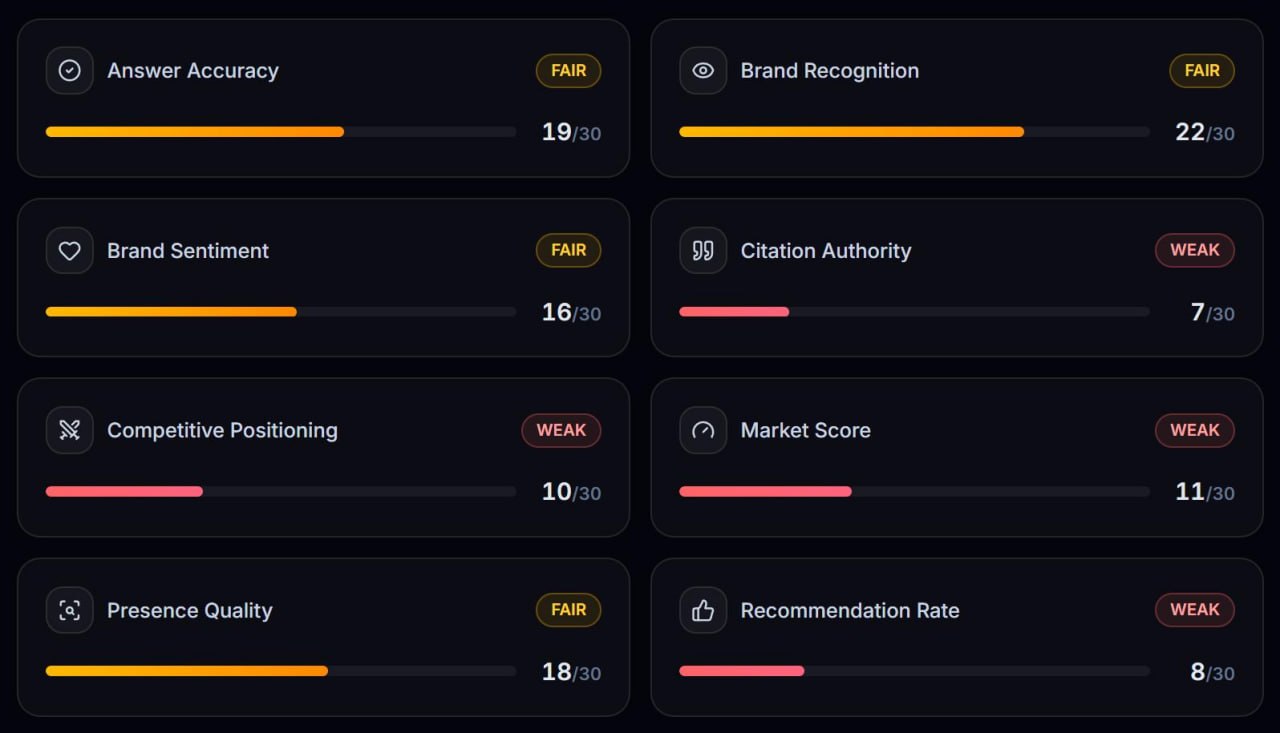
a) 10 buyer-intent questions someone in Global (global market) would ask when shopping in SaaS/Software category: 1. Best enterprise IT service management software → ServiceNow named (would definitely name it). 2. ITSM alternatives to ServiceNow → named. 3. Is ServiceNow worth the cost? → named. 4. Best workflow automation platform for enterprise → likely named (often in top choices with Microsoft, Atlassian). 5. Best SaaS companies / enterprise software vendors → likely named among top ones. 6. ServiceNow vs Atlassian Jira Service Management → named obviously. 7. Best IT asset management tool → often named. 8. Best help desk software for mid-market → might name Freshservice, Zendesk, Atlassian more; ServiceNow sometimes but aimed enterprise, maybe not for mid-market question. Could count as named or not. Let's be realistic: for "best help desk for small business" ServiceNow not named. So maybe 6-7 out of 10.
Let me design the 10 questions mix: enterprise vs mid-market. Realistic buyer pool skews category-wide: questions like "best SaaS / Software provider", "IT service management cloud alternatives", "is ServiceNow any good", "cheapest ITSM", "best workflow automation", "ServiceNow vs competitors", "best CSM platform", "best hr service delivery software", "enterprise low-code platform", "ITSM for small business".
Counts: ServiceNow named in: best ITSM (yes), ITSM alternatives (yes), is ServiceNow any good (yes), ServiceNow vs Atlassian (yes), best workflow automation (yes, probably), best enterprise software vendors (probably yes), best IT asset management (probably yes), best CSM platform (maybe, Salesforce/Zendesk more likely; ServiceNow still often cited), cheapest ITSM (no, Freshservice/Jira), ITSM for small business (no). So ~6-7. I'll say 7.
b) indexed_pages: I've genuinely encountered servicenow.com pages in training, homepage, product pages, pricing overview, blog, docs (docs.servicenow.com is separate subdomain but the user counts servicenow.com pages; docs is a subdomain technically). I'd estimate dozens to hundreds of distinct pages genuinely encountered, but honestly I can't guarantee count. I'll estimate indexed_pages as a number like 50? The instruction: "Estimate how many distinct pages of https://servicenow.com you have genuinely encountered in training or retrieval". ServiceNow's site is massive; I've encountered maybe 30-80 distinct pages in training. I'll say 60. Hmm, but should I be conservative? The site is huge; I certainly encountered many pages: product pages for ITSM, CSM, HRSD, ITOM, SecOps, platform, investor relations, blog posts, press releases. I'd say 40-100. I'll put 60 with reasoning note "product, solution and corporate pages". Or use a round 50. Let's say 50.
c) competitors named: Atlassian, BMC Software, Microsoft, Freshworks, Ivanti, Salesforce, Zendesk, IBM, ManageEngine. Share of voice: across those answers, brand-name slots... Let's approximate: in the 10 answers, total brand mentions maybe 30-40 slots; ServiceNow ~7. Share ~20%. Rank: top 1-3. In ITSM specifically ServiceNow is #1 in mindshare for enterprise. Rank_among_competitors: 1 (or 2 behind Atlassian/Salesforce overall in SaaS mindshare). For ITSM it's rank 1. I'll say rank 1 or 2. Given the broader SaaS category (Microsoft dominates broadly), within ITSM set ServiceNow is #1. The metrics question is category SaaS/Software with ITSM focus. I'll set rank 1 with share ~20%, competitors list including Atlassian, Microsoft, BMC, Freshworks, Ivanti, Salesforce, Zendesk.
d) google_aio_score: ServiceNow has authoritative web presence: deep own-site, Wikipedia, massive news coverage, Gartner, reviews on G2/Gartner Peer Insights. AIO readiness high: 85-90. I'll say 88.
visibility_score: global visibility very high ~90.
confidence: 95.
sentiment: positive (general market sentiment positive; cost concerns noted but overall positive).
would_recommend: true (for enterprise; note caveats in prose).
sources: Only URLs I'm confident exist: https://www.servicenow.com, homepage, confident. https://www.servicenow.com/products/itsm.html, product page exists. Reasonably confident. The URL pattern "https://www.servicenow.com/products/itsm.html", yes this is a real current URL. https://en.wikipedia.org/wiki/ServiceNow, exists, confident. https://www.gartner.com/reviews/market/it-service-management-tools, exists but exact? "https://www.gartner.com/reviews/market/it-service-management-tools", that's the Magic Quadrant/Peer Insights market page; I believe it exists. Slightly risky. Alternatively use Gartner Magic Quadrant ITSM page, URL may change yearly. Safer: Wikipedia, servicenow.com, maybe Gartner peer insights market page. I'm fairly confident Gartner Peer Insights uses /reviews/market/it-service-management-tools. I'll include it cautiously; if unsure, better to limit. Rules: "Only list a URL in sources if you are confident that exact page exists, an empty array is far better than a fabricated link." I'm confident about wikipedia and servicenow.com homepage and the ITSM products page. I'll include those three. Maybe also https://www.servicenow.com/company/investors.html? Investor relations is now investor.servicenow.com I think... Actually ServiceNow IR is at investor.servicenow.com. Skip.
I'll include: 1. {"claim": "Corporate profile, history, headquarters and product portfolio", "url": "https://en.wikipedia.org/wiki/ServiceNow"} 2. {"claim": "Official product and platform information for ITSM and workflow offerings", "url": "https://www.servicenow.com/products/itsm.html"} 3. {"claim": "Company overview and solutions catalogue", "url": "https://www.servicenow.com"}
That's safe.
reasoning field: one-two sentences naming concrete evidence: "ServiceNow is a long-time Gartner ITSM Magic Quadrant leader with ~$11B FY2024 revenue, near-universal enterprise mindshare; its site, Wikipedia and review ecosystems are deep,
Show the exact prompt sent to GLM
You are an AI answer engine being audited on how you talk about a brand. Do NOT ask for clarification, do NOT request more details, do NOT call the company hypothetical, and do NOT add meta-commentary about this prompt. Brand: ServiceNow Website: https://servicenow.com Industry: SaaS / Software Products/Services: IT service management cloud Location / Target market: Global Your reply MUST have exactly two parts, in this order. PART 1 — ASSESSMENT (prose, under 220 words) Assess this brand SPECIFICALLY in the Global market: its visibility and reputation there, market position and main competitors, products/services, what people in that market say about it, notable strengths or concerns, and whether you would recommend it to someone in Global seeking SaaS / Software solutions. If the brand is global, still weight the assessment toward Global. If you know little about it, state exactly what is and is not known and reason from the domain, industry and market context — never ask the user for more information. PART 2 — METRICS (mandatory, machine-read) Before writing the metrics, silently run this procedure: a) Write 10 realistic buyer-intent questions someone in Global would ask when shopping in the SaaS / Software category (for example "best SaaS / Software provider", "IT service management cloud alternatives", "is ServiceNow any good"). Count how many of those 10 you would answer with ServiceNow actually named — that number is mentions_out_of_10. b) Estimate how many distinct pages of https://servicenow.com you have genuinely encountered in training or retrieval — that is indexed_pages. If you have effectively never seen the domain, use 0. c) List the real competitors you would name in those answers, then work out what share of the total brand-name slots ServiceNow would occupy (share_of_voice_pct) and its rank within that set. d) Judge Google AI Overview readiness from how authoritative and citable the brand's web presence is: own-site depth, Wikipedia / news / industry coverage, and third-party reviews. Rules for the numbers. They must be internally consistent — a brand you do not recognise cannot have high visibility or a top rank. Never invent precise-looking figures you cannot justify; if you genuinely cannot estimate a field, use null. Only list a URL in sources if you are confident that exact page exists — an empty array is far better than a fabricated link. The reasoning field must state in one or two sentences WHY the numbers are what they are, naming the concrete evidence you used. Emit PART 2 wrapped in the tags below, containing raw JSON only — no markdown, no backticks, no commentary: <AEO_METRICS> { "brand_known": true or false, "confidence": 0-100, "mentions_out_of_10": 0-10, "indexed_pages": number or null, "visibility_score": 0-100, "google_aio_score": 0-100, "share_of_voice_pct": 0-100, "rank_among_competitors": number or null, "competitors": ["string"], "sentiment": "positive" or "neutral" or "negative", "would_recommend": true or false, "sources": [{"claim": "what this URL backs up", "url": "https://..."}], "reasoning": "one or two sentences justifying the numbers above" } </AEO_METRICS>