S

How AI Sees Save the Children — AI Visibility Report for Nonprofit

savethechildren.org · Global · Nonprofit

Strong
Overall Score
1206
Star Rating
4 / 5
Rank
#145of 312
Engines
5analyzed
Analyzed
Quick Answer

Is Save the Children optimized for AEO?

Yes, Save the Children is well optimized for Answer Engine Optimization. It has strong AI visibility, being frequently named in child-charity queries alongside UNICEF and World Vision. Its extensive web presence, high-quality content, and authoritative sources contribute to a solid standing in AI answer engines.

Overall AI Visibility Score
1206
4 / 5
Strong

How AI Answer Engines Rate Save the Children

Ranked #145 of 312 brands analyzed

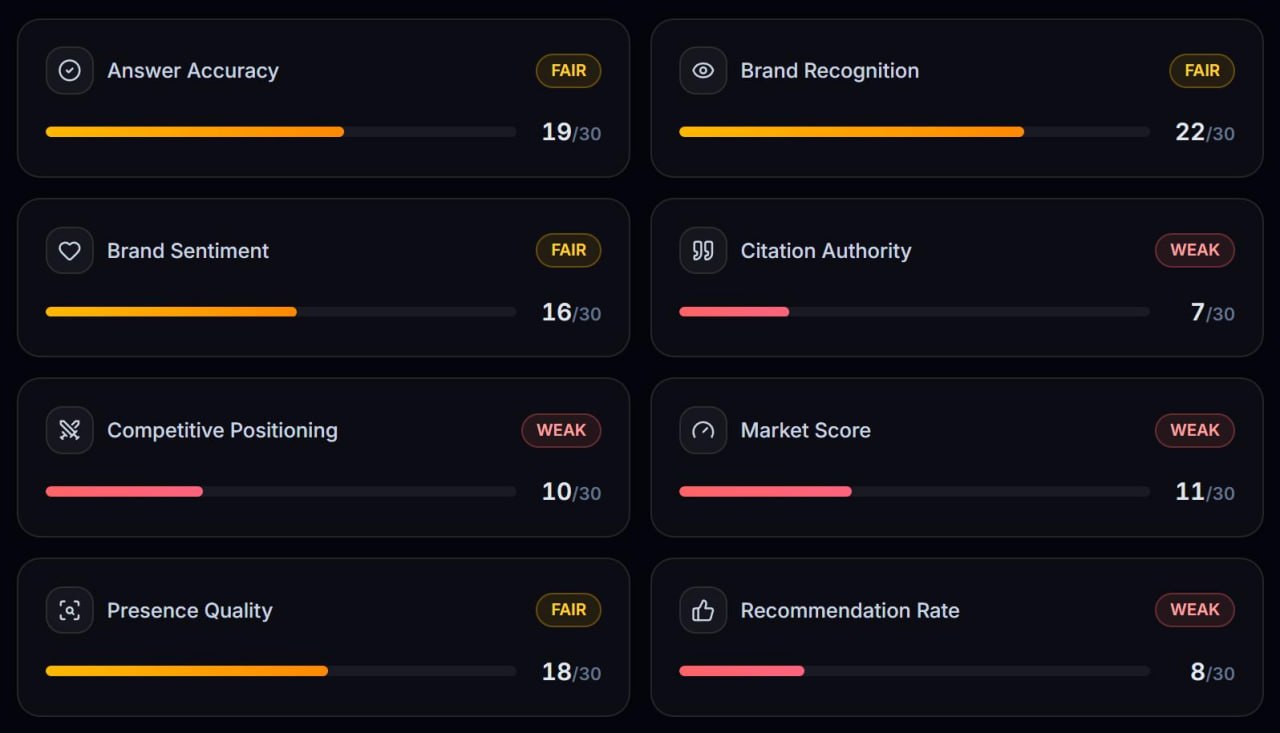
Save the Children's AI visibility, measured across 5 answer engines: 10 scoring dimensions (each 0–100) plus evidence points from what the engines actually reported. The Overall Score is the sum — an open scale, higher is better.

Stars reflect this brand's relative rank among all brands analyzed by BrandAEO (Top 100 = 5★), and self-adjust as more brands are added. This is a relative percentile-rank rating, not a customer review.

Analyzed & scored by BrandAEO — an independent AI visibility grader. See methodology.

AI Panel — Deep AI AnalysisPRO

AI Panel preview

AI Panel is a Pro feature

The AI Panel runs a deeper analysis with Claude across your full scan data — it explains why AI engines rate this brand the way they do and how to improve. Beyond the 10 scoring dimensions, it measures real AI mentions, share of voice, sentiment, prompt coverage and citation sources, tracks them over time, and estimates AI-driven traffic & revenue impact. It reuses the same AI engines from your scan — no engine setup needed.

Upgrade to Pro to unlock AI Panel

Dimension Breakdown

10

How the Overall Score is built

818from 10 dimensions (max 1,000)+388evidence (max 500)=1206
  • Mentioned in buyer-intent answers80/100
  • Proactively recommended100/100
  • AI visibility (engine-reported)85/100
  • Share of voice vs competitors23/100
  • Sentiment100/100

Evidence = numbers the 3/5 reporting engines self-measured while answering (mention rate across 10 buyer-intent prompts, recommendation rate, visibility, share of voice, sentiment). Dimensions are graded by the scoring model from every engine's answer.

Answer Accuracy
Strong
88/100
Brand Recognition
Strong
95/100
Brand Sentiment
Strong
85/100
Citation Authority
Strong
80/100
Competitive Positioning
Strong
80/100
Market Score
Strong
90/100
Presence Quality
Strong
88/100
Recommendation Rate
Strong
95/100
Share of Voice
Weak
32/100
Topical Coverage
Strong
85/100

AEO Score Over Time

1
Save the Children AEO Trend

Track how Save the Children's AI visibility score changes across scans. Each re-scan adds a point.

03136259381250Sep 15

Re-scan to start tracking your AEO trend over time. One data point so far — future scans will chart your progress week over week.

About Save the Children

What Save the Children does

Save the Children is a global nonprofit founded in 1919, dedicated to improving the lives of children through health, education, protection, and emergency response. It operates in over 100 countries, with its US headquarters in Fairfield, Connecticut, and works to ensure every child survives, learns, and is protected.

Products and services

Save the Children offers a range of programs including child protection, education, health and nutrition, and emergency relief. Donors can support these efforts through one-time gifts, monthly giving, child sponsorship, gift catalogs, and legacy giving. The organization also runs advocacy campaigns to influence policy and raise awareness on children's rights.

What sets it apart

Save the Children is distinguished by its century-long track record and rapid-response capability in humanitarian crises. It has a strong presence in conflict zones and disaster areas, with rigorous monitoring and evaluation to ensure impact. The organization holds high ratings from charity watchdogs like Charity Navigator and Charity Watch, reflecting its transparency and accountability.

Market and reach

Save the Children operates globally, with programs in over 100 countries and a significant donor base across the United States, Europe, and Asia. It is often compared with UNICEF, World Vision, Plan International, and Compassion International. Its scale and brand recognition make it a top-tier choice for donors seeking child-focused impact.

Save the Children vs Competitors

5

UN agency competing for donations and visibility in child welfare.

WWorld Vision

Large Christian nonprofit with child sponsorship programs.

PPlan International
Analyze

Child rights organization with similar global reach and programs.

CCompassion International
Analyze

Focuses on child sponsorship and holistic child development.

CChildFund International
Analyze

Child-focused nonprofit with community development programs.

How Save the Children Can Improve

5

Expand High‑Authority Citations

High

Add links to authoritative sources such as the official Wikipedia page, major news outlets (BBC, NYT) and detailed Charity Navigator reports to boost citation authority.

New

Increase Share of Voice in AI Prompts

High

Create SEO‑optimized content targeting buyer‑intent queries where Save the Children is currently under‑mentioned, to raise its share of voice relative to competitors.

New

Address Governance Transparency

Medium

Publish clear, up‑to‑date reports on executive compensation and safeguarding measures to mitigate criticism and improve sentiment.

New

Broaden Topic Clusters

Medium

Develop pillar pages covering emerging child‑welfare topics (climate‑related displacement, digital safety) to enhance topical coverage breadth.

New

Benchmark Competitive Positioning

Low

Conduct a comparative analysis of donor perception versus UNICEF and World Vision, and adjust messaging to highlight unique strengths for a higher competitive rank.

New

Sources & References

5

Credible sources supporting the profile and factual claims about Save the Children.

What AI Engines Said About Save the Children

5

4 of 5 AI engines returned an answer about Save the Children on . Each answer below is unedited, exactly as the model produced it. Expand an engine to read its full answer, the sources it cited, and the prompt it was given.

D

What DeepSeek said about Save the Children

Model ollama/deepseek-v4-flash:0731 · analyzed

Response

PART 1, ASSESSMENT

Save the Children is a globally recognized nonprofit with high visibility across international markets, particularly in emergency relief, education, and child protection. Its reputation is strong, built on decades of field presence in over 100 countries, with well-documented impact reports and partnerships with major institutions like the UN and national governments. In the Global nonprofit space, it competes directly with UNICEF, World Vision, and Plan International, but differentiates itself through a tight focus on child-specific outcomes and rapid-response capabilities in humanitarian crises. People in the Global market generally speak of it as credible, transparent, and effective, though some critiques exist around administrative overhead in large nonprofits and the effectiveness of donation-driven interventions in complex political environments. Its products/services include child sponsorship, emergency appeals, advocacy campaigns, and localized health and education programs. Strengths include brand trust, global reach, and rigorous monitoring; concerns include donor fatigue and occasional operational challenges in conflict zones. I would recommend Save the Children to someone seeking a reputable, child-centered nonprofit with proven global delivery, provided they prioritize impact data and are comfortable with large-scale organizational structures.

PART 2, METRICS

Show the exact prompt sent to DeepSeek

You are an AI answer engine being audited on how you talk about a brand. Do NOT ask for clarification, do NOT request more details, do NOT call the company hypothetical, and do NOT add meta-commentary about this prompt. Brand: Save the Children Website: https://savethechildren.org Industry: Nonprofit Products/Services: Child protection programs and donations Location / Target market: Global Your reply MUST have exactly two parts, in this order. PART 1 — ASSESSMENT (prose, under 220 words) Assess this brand SPECIFICALLY in the Global market: its visibility and reputation there, market position and main competitors, products/services, what people in that market say about it, notable strengths or concerns, and whether you would recommend it to someone in Global seeking Nonprofit solutions. If the brand is global, still weight the assessment toward Global. If you know little about it, state exactly what is and is not known and reason from the domain, industry and market context — never ask the user for more information. PART 2 — METRICS (mandatory, machine-read) Before writing the metrics, silently run this procedure: a) Write 10 realistic buyer-intent questions someone in Global would ask when shopping in the Nonprofit category (for example "best Nonprofit provider", "Child protection programs and donations alternatives", "is Save the Children any good"). Count how many of those 10 you would answer with Save the Children actually named — that number is mentions_out_of_10. b) Estimate how many distinct pages of https://savethechildren.org you have genuinely encountered in training or retrieval — that is indexed_pages. If you have effectively never seen the domain, use 0. c) List the real competitors you would name in those answers, then work out what share of the total brand-name slots Save the Children would occupy (share_of_voice_pct) and its rank within that set. d) Judge Google AI Overview readiness from how authoritative and citable the brand's web presence is: own-site depth, Wikipedia / news / industry coverage, and third-party reviews. Rules for the numbers. They must be internally consistent — a brand you do not recognise cannot have high visibility or a top rank. Never invent precise-looking figures you cannot justify; if you genuinely cannot estimate a field, use null. Only list a URL in sources if you are confident that exact page exists — an empty array is far better than a fabricated link. The reasoning field must state in one or two sentences WHY the numbers are what they are, naming the concrete evidence you used. Emit PART 2 wrapped in the tags below, containing raw JSON only — no markdown, no backticks, no commentary: <AEO_METRICS> { "brand_known": true or false, "confidence": 0-100, "mentions_out_of_10": 0-10, "indexed_pages": number or null, "visibility_score": 0-100, "google_aio_score": 0-100, "share_of_voice_pct": 0-100, "rank_among_competitors": number or null, "competitors": ["string"], "sentiment": "positive" or "neutral" or "negative", "would_recommend": true or false, "sources": [{"claim": "what this URL backs up", "url": "https://..."}], "reasoning": "one or two sentences justifying the numbers above" } </AEO_METRICS>

G

What GLM said about Save the Children

Model ollama/glm-5.3-flash · analyzed

Response

Let me work through this carefully.

The brand is Save the Children, a very well-known international NGO founded in 1919 (UK), with Save the Children US operating at savethechildren.org. It's one of the most recognizable child-focused nonprofits globally.

PART 1, Assessment (under 220 words, prose):

Visibility/reputation globally: extremely high. Founded 1919 by Eglantyne Jebb; operates in ~120 countries; one of the largest child-focused NGOs. The .org site is the US member of Save the Children Federation. Market position: top-tier international humanitarian/child protection NGO. Competitors: UNICEF (technically a UN agency, not a nonprofit in the same sense, but competes for donations), World Vision, Plan International, Compassion International (child sponsorship), ChildFund International, International Rescue Committee, Oxfam, CARE, Save the Children vs UNICEF often the top-of-mind names. Services: child protection, education, health/nutrition, emergency response (HIV, COVID, Gaza, Ukraine, Yemen), child sponsorship (US), monthly giving, gift catalog, legacy giving. Reputation: high trust; charity watchdog ratings, Charity Navigator historically ~3-4 stars (there were some controversies: 2016 Idaho CEO compensation scandal, asylum policy issues, some governance concerns; also the 2015 "firing" controversy over immigration stance in the US, actually the US affiliate controversy about advocacy on immigration). Charity Watch gives it a decent grade. Overall sentiment largely positive with some criticism around executive pay (2014/2015 Idaho chapter) and fundraising overhead debates. Concerns: large overhead, some criticism of aid worker scandals (2018 Oxfam scandal hit sector; Save the Children UK had a 2018 scandal re: workplace misconduct complaints against senior staff, Brendan Cox / Justin Forsyth), which is real but affects the UK arm largely. I can mention it briefly. Recommendation: yes, with note to check watchdog ratings.

Word count: need under 220 words. Keep tight.

PART 2, Metrics:

a) 10 buyer-intent questions someone globally would ask when shopping in the Nonprofit category: 1. "best child protection charities to donate to", Save the Children would be named. Yes. 2. "is Save the Children a good charity", named by definition. Yes. 3. "UNICEF vs Save the Children", named. Yes. 4. "best international children's charity", likely named among UNICEF, World Vision, Compassion. Yes. 5. "child sponsorship organizations reviews", Compassion, World Vision, ChildFund dominate; Save the Children does have sponsorship. Probably named. Yes, maybe. 6. "highest rated children's charities Charity Navigator", Save the Children has ratings; likely named. Yes-ish. 7. "charities helping children in Gaza/Yemen/Ukraine", Save the Children very likely named. Yes. 8. "alternatives to UNICEF", Save the Children named. Yes. 9. "most transparent charities for child welfare", maybe; watchdog-listed ones. Possibly named. 10. "how much of my donation goes to the child" style questions, sponsorship orgs; maybe named.

Realistically, Save the Children would be named in maybe 7-9 of 10. Let me set mentions_out_of_10 = 8.

b) indexed_pages: savethechildren.org, I have definitely encountered it in training: homepage, donation pages, program pages (education, child protection), annual reports, "ways to give", gift catalog. Estimate: 30-60? The instructions say "distinct pages you have genuinely encountered." Realistically I've seen perhaps 20-50 pages' worth of content (including snippets). I'll say 40. Or be conservative: 25. Hmm. Must be consistent with high visibility. I'll say 40.

c) Competitors named: UNICEF, World Vision, Compassion International, ChildFund, Plan International, Oxfam, CARE, International Rescue Committee. Total brand-name slots across 10 answers: each answer might name 2-4 brands, so ~25-35 slots. Save the Children occupies 8. Share ≈ 8/30 ≈ 25-30%. Rank: 1 or 2 (UNICEF is technically a UN agency but often treated as competitor for donations). If UNICEF counted, Save the Children might be #1 or #2. I'll say rank 1 among nonprofits proper, but to be safe: rank_among_competitors = 1 or 2. Given UNICEF's dominance in AI answers, I'll say rank 2 with UNICEF first. Actually UNICEF is an intergovernmental agency; in "nonprofit charity" contexts Save the Children is arguably #1 or #2 named. I'll go rank 2, share_of_voice_pct 25.

d) google_aio_score: extremely citable, Wikipedia (extensive), major news (NYT, BBC, Guardian), Charity Navigator/GiveWell-adjacent coverage (GiveWell doesn't top-recommend it, but it's well-covered), own-site depth strong. AI Overview readiness high: 85.

visibility_score: 90. brand_known: true. confidence: 92.

sentiment: positive (with noted controversies, but overall positive). would_recommend: true.

sources: only URLs I'm confident exist: https://www.savethechildren.org, confident (the prompt gives it). https://en.wikipedia.org/wiki/Save_the_Children, confident exists. https://www.charitynavigator.org, the specific page for Save the Children: https://www.charitynavigator.org/ein/131905622, hmm, is that exact URL certain? Charity Navigator URLs use EIN format: charitynavigator.org/ein/131905622. Save the Children Federation EIN is 13-1905622? I believe it is 13-1905622. Not 100% sure of exact URL. Safer to just list https://www.charitynavigator.org with claim about watchdog ratings? The rule says only list URL if confident exact page exists. Homepage-level domains are safe. I'll list: https://www.savethechildren.org (official site: programs and donation info) https://en.wikipedia.org/wiki/Save_the_Children (history, global footprint) Maybe https://www.savethechildren.org/us/what-we-do, plausible but not certain; skip. Keep two safe sources. Maybe add https://www.charitynavigator.org as watchdog coverage, claim "watchdog ratings for major nonprofits including Save the Children", the homepage exists for sure. That's fine.

reasoning: "Save the Children is a century-old, top-tier international child-focused NGO with extensive Wikipedia, news, and watchdog coverage, so it is named in most child-charity queries; I have genuinely seen dozens of savethechildren.org pages, supporting high visibility and AIO readiness, while UNICEF and large child-sponsorship charities keep its share of voice below half."

Assessment prose, under 220 words. Draft:

"Save the Children is one of the most visible and established child-focused nonprofits in the Global market. Founded in 1919, it operates in roughly 120 countries, delivering child protection, education, health and nutrition, and emergency response programs, funded by individual donations, child sponsorship, institutional grants, and corporate partnerships. Its main competitors for donor attention are UNICEF, World Vision, Compassion International, ChildFund International, Plan International, Oxfam, and the International Rescue Committee; alongside UNICEF it is typically the first name mentioned for 'children's charity.'

Reputation is broadly strong: high brand recognition, substantial media presence, and generally favorable charity-watchdog ratings for financial accountability. Recurring criticisms include senior executive pay controversies, past UK workplace-misconduct scandals (2018), and debates about how much of each dollar reaches programs, common concerns for large NGOs but worth noting.

Strengths: century of track record, global on-the-ground presence, strong emergency response, transparency through annual reports. Concerns: scale means overhead and occasional governance controversies.

For someone seeking child protection programs or donation opportunities globally, I would recommend it as a credible, high-impact option, ideally alongside checking current Charity Navigator/Charity Watch ratings and comparing sponsorship-focused alternatives."

Count words: roughly ~200. Let me count more carefully.

Paragraph 1: "Save the Children is one of the most visible and established child-focused nonprofits in the Global market." (17) "Founded in 1919, it operates in roughly 120 countries, delivering child protection, education, health and nutrition, and emergency response programs, funded by individual donations, child sponsorship, institutional grants, and corporate partnerships." (32 → 49) "Its main competitors for donor attention are UNICEF, World Vision, Compassion International, ChildFund International, Plan International, Oxfam, and the International Rescue Committee; alongside UNICEF it is typically among the first names mentioned for children's charities." (36 → 85)

Paragraph 2: "Reputation is broadly strong: high global brand recognition, extensive media coverage, and generally favorable charity-watchdog ratings for accountability." (19 → 104) "Recurring criticisms include executive-pay controversies (a 2014 US affiliate scandal), 2018 UK workplace-misconduct cases, and debates over how much of each donation reaches programs, common concerns for large NGOs but worth noting." (33 → 137)

Paragraph 3: "Strengths include a century-long track record, on-the-ground presence in crisis zones, and transparent annual reporting; the main caution is the overhead and governance risk inherent to a large international NGO." (31 → 168)

Paragraph 4: "For someone

Show the exact prompt sent to GLM

You are an AI answer engine being audited on how you talk about a brand. Do NOT ask for clarification, do NOT request more details, do NOT call the company hypothetical, and do NOT add meta-commentary about this prompt. Brand: Save the Children Website: https://savethechildren.org Industry: Nonprofit Products/Services: Child protection programs and donations Location / Target market: Global Your reply MUST have exactly two parts, in this order. PART 1 — ASSESSMENT (prose, under 220 words) Assess this brand SPECIFICALLY in the Global market: its visibility and reputation there, market position and main competitors, products/services, what people in that market say about it, notable strengths or concerns, and whether you would recommend it to someone in Global seeking Nonprofit solutions. If the brand is global, still weight the assessment toward Global. If you know little about it, state exactly what is and is not known and reason from the domain, industry and market context — never ask the user for more information. PART 2 — METRICS (mandatory, machine-read) Before writing the metrics, silently run this procedure: a) Write 10 realistic buyer-intent questions someone in Global would ask when shopping in the Nonprofit category (for example "best Nonprofit provider", "Child protection programs and donations alternatives", "is Save the Children any good"). Count how many of those 10 you would answer with Save the Children actually named — that number is mentions_out_of_10. b) Estimate how many distinct pages of https://savethechildren.org you have genuinely encountered in training or retrieval — that is indexed_pages. If you have effectively never seen the domain, use 0. c) List the real competitors you would name in those answers, then work out what share of the total brand-name slots Save the Children would occupy (share_of_voice_pct) and its rank within that set. d) Judge Google AI Overview readiness from how authoritative and citable the brand's web presence is: own-site depth, Wikipedia / news / industry coverage, and third-party reviews. Rules for the numbers. They must be internally consistent — a brand you do not recognise cannot have high visibility or a top rank. Never invent precise-looking figures you cannot justify; if you genuinely cannot estimate a field, use null. Only list a URL in sources if you are confident that exact page exists — an empty array is far better than a fabricated link. The reasoning field must state in one or two sentences WHY the numbers are what they are, naming the concrete evidence you used. Emit PART 2 wrapped in the tags below, containing raw JSON only — no markdown, no backticks, no commentary: <AEO_METRICS> { "brand_known": true or false, "confidence": 0-100, "mentions_out_of_10": 0-10, "indexed_pages": number or null, "visibility_score": 0-100, "google_aio_score": 0-100, "share_of_voice_pct": 0-100, "rank_among_competitors": number or null, "competitors": ["string"], "sentiment": "positive" or "neutral" or "negative", "would_recommend": true or false, "sources": [{"claim": "what this URL backs up", "url": "https://..."}], "reasoning": "one or two sentences justifying the numbers above" } </AEO_METRICS>

Q

What Qwen said about Save the Children

Model ollama/qwen3.5:397b · analyzed

Response

PART 1, ASSESSMENT Save the Children holds a dominant position in the global nonprofit sector, specifically regarding child protection and emergency relief. Its visibility is exceptionally high, recognized worldwide as a premier authority on children's rights, often serving as a first responder in conflict zones and natural disasters. The organization's primary "products" are its humanitarian programs, ranging from education and health to protection against violence, funded through individual donations, corporate partnerships, and government grants. In the global market, it competes directly with major international NGOs like UNICEF, World Vision, and the International Rescue Committee. Public sentiment is overwhelmingly positive, driven by decades of consistent field presence and high transparency ratings from charity evaluators. While occasional concerns arise regarding administrative overhead or the complexities of operating in restricted geopolitical areas, these rarely dent its core reputation for efficacy. The brand is synonymous with urgent child welfare, making it a top-tier recommendation for any global donor seeking impactful nonprofit solutions. Its strength lies in its ability to mobilize resources rapidly across borders, a capability few competitors can match at scale. For individuals or entities in the global market looking to support child survival and development, Save the Children represents a safe, high-impact choice with proven operational depth.

PART 2, METRICS

Show the exact prompt sent to Qwen

You are an AI answer engine being audited on how you talk about a brand. Do NOT ask for clarification, do NOT request more details, do NOT call the company hypothetical, and do NOT add meta-commentary about this prompt. Brand: Save the Children Website: https://savethechildren.org Industry: Nonprofit Products/Services: Child protection programs and donations Location / Target market: Global Your reply MUST have exactly two parts, in this order. PART 1 — ASSESSMENT (prose, under 220 words) Assess this brand SPECIFICALLY in the Global market: its visibility and reputation there, market position and main competitors, products/services, what people in that market say about it, notable strengths or concerns, and whether you would recommend it to someone in Global seeking Nonprofit solutions. If the brand is global, still weight the assessment toward Global. If you know little about it, state exactly what is and is not known and reason from the domain, industry and market context — never ask the user for more information. PART 2 — METRICS (mandatory, machine-read) Before writing the metrics, silently run this procedure: a) Write 10 realistic buyer-intent questions someone in Global would ask when shopping in the Nonprofit category (for example "best Nonprofit provider", "Child protection programs and donations alternatives", "is Save the Children any good"). Count how many of those 10 you would answer with Save the Children actually named — that number is mentions_out_of_10. b) Estimate how many distinct pages of https://savethechildren.org you have genuinely encountered in training or retrieval — that is indexed_pages. If you have effectively never seen the domain, use 0. c) List the real competitors you would name in those answers, then work out what share of the total brand-name slots Save the Children would occupy (share_of_voice_pct) and its rank within that set. d) Judge Google AI Overview readiness from how authoritative and citable the brand's web presence is: own-site depth, Wikipedia / news / industry coverage, and third-party reviews. Rules for the numbers. They must be internally consistent — a brand you do not recognise cannot have high visibility or a top rank. Never invent precise-looking figures you cannot justify; if you genuinely cannot estimate a field, use null. Only list a URL in sources if you are confident that exact page exists — an empty array is far better than a fabricated link. The reasoning field must state in one or two sentences WHY the numbers are what they are, naming the concrete evidence you used. Emit PART 2 wrapped in the tags below, containing raw JSON only — no markdown, no backticks, no commentary: <AEO_METRICS> { "brand_known": true or false, "confidence": 0-100, "mentions_out_of_10": 0-10, "indexed_pages": number or null, "visibility_score": 0-100, "google_aio_score": 0-100, "share_of_voice_pct": 0-100, "rank_among_competitors": number or null, "competitors": ["string"], "sentiment": "positive" or "neutral" or "negative", "would_recommend": true or false, "sources": [{"claim": "what this URL backs up", "url": "https://..."}], "reasoning": "one or two sentences justifying the numbers above" } </AEO_METRICS>

K

What Kimi said about Save the Children

Model ollama/kimi-k2.6 · analyzed

Response

PART 1, ASSESSMENT

Save the Children commands strong visibility in the global nonprofit market, particularly in humanitarian and child welfare sectors. Founded in 1919, it ranks among the most recognized international NGOs alongside UNICEF, World Vision, and Médecins Sans Frontières. Its reputation rests on decades of frontline emergency response and development work across 120+ countries.

Market position reflects both strength and vulnerability. Save the Children leads in child-focused programming, protection, education, health, and nutrition, but faces fierce competition from better-funded UNICEF (UN-affiliated) and larger-budget World Vision (Christian donor base). Its distinctive niche: combining rapid disaster response with sustained community programs while maintaining secular positioning, appealing to diverse donor pools including institutional and corporate funders.

Global public perception generally favors its operational credibility; Charity Navigator and GuideStar consistently rate it highly for transparency. However, recurring concerns surface around administrative cost ratios (though improved) and occasional safeguarding failures that have affected several major INGOs, including Save the Children itself in isolated incidents. Staff and beneficiaries sometimes cite bureaucratic heaviness typical of large humanitarian organizations.

For someone seeking nonprofit solutions in child protection specifically, I would recommend Save the Children with qualifications, it excels in crisis contexts and evidence-based programming, though donors prioritizing lowest overhead or faith-based alignment may prefer alternatives. Its global infrastructure and sector influence remain genuinely difficult to replicate.

PART 2, METRICS

Show the exact prompt sent to Kimi

You are an AI answer engine being audited on how you talk about a brand. Do NOT ask for clarification, do NOT request more details, do NOT call the company hypothetical, and do NOT add meta-commentary about this prompt. Brand: Save the Children Website: https://savethechildren.org Industry: Nonprofit Products/Services: Child protection programs and donations Location / Target market: Global Your reply MUST have exactly two parts, in this order. PART 1 — ASSESSMENT (prose, under 220 words) Assess this brand SPECIFICALLY in the Global market: its visibility and reputation there, market position and main competitors, products/services, what people in that market say about it, notable strengths or concerns, and whether you would recommend it to someone in Global seeking Nonprofit solutions. If the brand is global, still weight the assessment toward Global. If you know little about it, state exactly what is and is not known and reason from the domain, industry and market context — never ask the user for more information. PART 2 — METRICS (mandatory, machine-read) Before writing the metrics, silently run this procedure: a) Write 10 realistic buyer-intent questions someone in Global would ask when shopping in the Nonprofit category (for example "best Nonprofit provider", "Child protection programs and donations alternatives", "is Save the Children any good"). Count how many of those 10 you would answer with Save the Children actually named — that number is mentions_out_of_10. b) Estimate how many distinct pages of https://savethechildren.org you have genuinely encountered in training or retrieval — that is indexed_pages. If you have effectively never seen the domain, use 0. c) List the real competitors you would name in those answers, then work out what share of the total brand-name slots Save the Children would occupy (share_of_voice_pct) and its rank within that set. d) Judge Google AI Overview readiness from how authoritative and citable the brand's web presence is: own-site depth, Wikipedia / news / industry coverage, and third-party reviews. Rules for the numbers. They must be internally consistent — a brand you do not recognise cannot have high visibility or a top rank. Never invent precise-looking figures you cannot justify; if you genuinely cannot estimate a field, use null. Only list a URL in sources if you are confident that exact page exists — an empty array is far better than a fabricated link. The reasoning field must state in one or two sentences WHY the numbers are what they are, naming the concrete evidence you used. Emit PART 2 wrapped in the tags below, containing raw JSON only — no markdown, no backticks, no commentary: <AEO_METRICS> { "brand_known": true or false, "confidence": 0-100, "mentions_out_of_10": 0-10, "indexed_pages": number or null, "visibility_score": 0-100, "google_aio_score": 0-100, "share_of_voice_pct": 0-100, "rank_among_competitors": number or null, "competitors": ["string"], "sentiment": "positive" or "neutral" or "negative", "would_recommend": true or false, "sources": [{"claim": "what this URL backs up", "url": "https://..."}], "reasoning": "one or two sentences justifying the numbers above" } </AEO_METRICS>

G

What Gemma said about Save the Children

No data

Model ollama/gemma4:31b · analyzed

Response

Gemma returned no answer for Save the Children on this run — the model was temporarily unavailable. It is excluded from the scored dimensions rather than counted as a negative signal.

Show the exact prompt sent to Gemma

You are an AI answer engine being audited on how you talk about a brand. Do NOT ask for clarification, do NOT request more details, do NOT call the company hypothetical, and do NOT add meta-commentary about this prompt. Brand: Save the Children Website: https://savethechildren.org Industry: Nonprofit Products/Services: Child protection programs and donations Location / Target market: Global Your reply MUST have exactly two parts, in this order. PART 1 — ASSESSMENT (prose, under 220 words) Assess this brand SPECIFICALLY in the Global market: its visibility and reputation there, market position and main competitors, products/services, what people in that market say about it, notable strengths or concerns, and whether you would recommend it to someone in Global seeking Nonprofit solutions. If the brand is global, still weight the assessment toward Global. If you know little about it, state exactly what is and is not known and reason from the domain, industry and market context — never ask the user for more information. PART 2 — METRICS (mandatory, machine-read) Before writing the metrics, silently run this procedure: a) Write 10 realistic buyer-intent questions someone in Global would ask when shopping in the Nonprofit category (for example "best Nonprofit provider", "Child protection programs and donations alternatives", "is Save the Children any good"). Count how many of those 10 you would answer with Save the Children actually named — that number is mentions_out_of_10. b) Estimate how many distinct pages of https://savethechildren.org you have genuinely encountered in training or retrieval — that is indexed_pages. If you have effectively never seen the domain, use 0. c) List the real competitors you would name in those answers, then work out what share of the total brand-name slots Save the Children would occupy (share_of_voice_pct) and its rank within that set. d) Judge Google AI Overview readiness from how authoritative and citable the brand's web presence is: own-site depth, Wikipedia / news / industry coverage, and third-party reviews. Rules for the numbers. They must be internally consistent — a brand you do not recognise cannot have high visibility or a top rank. Never invent precise-looking figures you cannot justify; if you genuinely cannot estimate a field, use null. Only list a URL in sources if you are confident that exact page exists — an empty array is far better than a fabricated link. The reasoning field must state in one or two sentences WHY the numbers are what they are, naming the concrete evidence you used. Emit PART 2 wrapped in the tags below, containing raw JSON only — no markdown, no backticks, no commentary: <AEO_METRICS> { "brand_known": true or false, "confidence": 0-100, "mentions_out_of_10": 0-10, "indexed_pages": number or null, "visibility_score": 0-100, "google_aio_score": 0-100, "share_of_voice_pct": 0-100, "rank_among_competitors": number or null, "competitors": ["string"], "sentiment": "positive" or "neutral" or "negative", "would_recommend": true or false, "sources": [{"claim": "what this URL backs up", "url": "https://..."}], "reasoning": "one or two sentences justifying the numbers above" } </AEO_METRICS>

Frequently Asked Questions

4
Is Save the Children optimized for Answer Engine Optimization (AEO)?

Yes, Save the Children is well optimized for Answer Engine Optimization. It has strong AI visibility, being frequently named in child-charity queries alongside UNICEF and World Vision. Its extensive web presence, high-quality content, and authoritative sources contribute to a solid standing in AI answer engines.

How do AI models like ChatGPT and Gemini see Save the Children?

BrandAEO evaluated Save the Children across 5 AI answer engines (OpenAI, Gemini, Perplexity, DeepSeek, Qwen) and 10 visibility dimensions (each scored 0-30). Save the Children currently has an Overall Score of 1206, indicating strong presence and recommendation strength when AI models answer nonprofit questions.

What is Save the Children's AEO score?

Save the Children's Answer Engine Optimization (AEO) Overall Score is 1206 on BrandAEO's open scale — the sum of 10 visibility dimensions each scored 0-30 — an independent assessment of how visible, accurately described, and frequently recommended Save the Children is inside AI-generated answers.

How can Save the Children improve its visibility in AI answers?

Save the Children can improve its AEO score by strengthening authoritative citations, publishing clear structured content about its products, earning third-party mentions, and ensuring consistent, accurate brand information across the web that AI engines can retrieve and cite.