GWhat GLM said about Rosetta Stone
What GLM said about Rosetta Stone
Model ollama/glm-5.3-flash · analyzed
Response
Let me think about Rosetta Stone. This is a well-known language learning brand. It's been around since the 1990s, famous for its immersive method (no translations, pictures and target language only). Founded in 1992 (originally Fairfield Language Technologies), based in Arlington, Virginia. It went public, later acquired by Cambium Learning Group in 2020/2021 for about $700 million. Products: Rosetta Stone language learning app/software, Tutoring (Live tutoring), for consumers, schools (K-12 education), businesses. Languages: 25 languages including English as a second language.
Reputation: Mixed-to-positive. Well-known legacy brand, strong brand recognition, but in recent years Duolingo has dominated consumer mindshare. Rosetta Stone is often criticized for being pricey, dated teaching methodology (repetitive, lacks conversational practice, grammar explanations), though the lifetime subscription deals are popular. Its speech recognition (TruAccent) is a feature. It's often ranked in "best language learning software" lists alongside Duolingo, Babbel, Pimsleur, Busuu, Memrise, Mondly, Lingoda, italki, FluentU.
Competitors: Duolingo, Babbel, Pimsleur, Busuu, Memrise, Mondly, italki, Lingoda. In enterprise/education: Cambium's own ecosystem, Pearson, Berlitz.
Global market: Rosetta Stone is available globally, supports many languages, but its primary market is North America (US/UK), with English-learning products for global audiences. Brand recognition is high globally due to decades of retail presence (airport kiosks, boxed software).
Buyer-intent questions someone might ask: 1. Best language learning app, would likely name Duolingo, Babbel, Pimsleur... Rosetta Stone often included. Probably yes. 2. Is Rosetta Stone worth it?, obviously named. 3. Rosetta Stone vs Duolingo, named. 4. Rosetta Stone alternatives, named. 5. Best software to learn Spanish, maybe named (Duolingo, Babbel, Pimsleur more often). 6. Best app to learn English as second language, sometimes. 7. Language learning software for schools, Rosetta Stone (now Rosetta Stone for Enterprise/Education) often named. 8. Best immersive language learning method, maybe. 9. Is Babbel better than Rosetta Stone, named. 10. Cheapest lifetime language learning subscription, Rosetta Stone frequently named.
So mentions out of 10 maybe 6-7. Its brand is strong enough to be named in direct and comparison questions, less so in generic "best app" questions where Duolingo dominates.
Indexed pages: rosettastone.com, I have encountered the homepage, product pages, pricing, language-specific pages, blog. A reasonable estimate: maybe 30-60 pages genuinely seen? Actually careful, indexed_pages means distinct pages genuinely encountered. I'd say something like 25-50. Let me be conservative: 30.
Share of voice: In a set of competitors {Duolingo, Babbel, Pimsleur, Busuu, Memrise, Mondly, italki, Lingoda, Rosetta Stone}, across 10 answers with ~5-6 names per answer... total brand-name slots maybe 50; Rosetta Stone gets 6-7 → ~12-14%. Rank: probably 3rd-4th behind Duolingo, Babbel, maybe Pimsleur. Let's say rank 3 or 4.
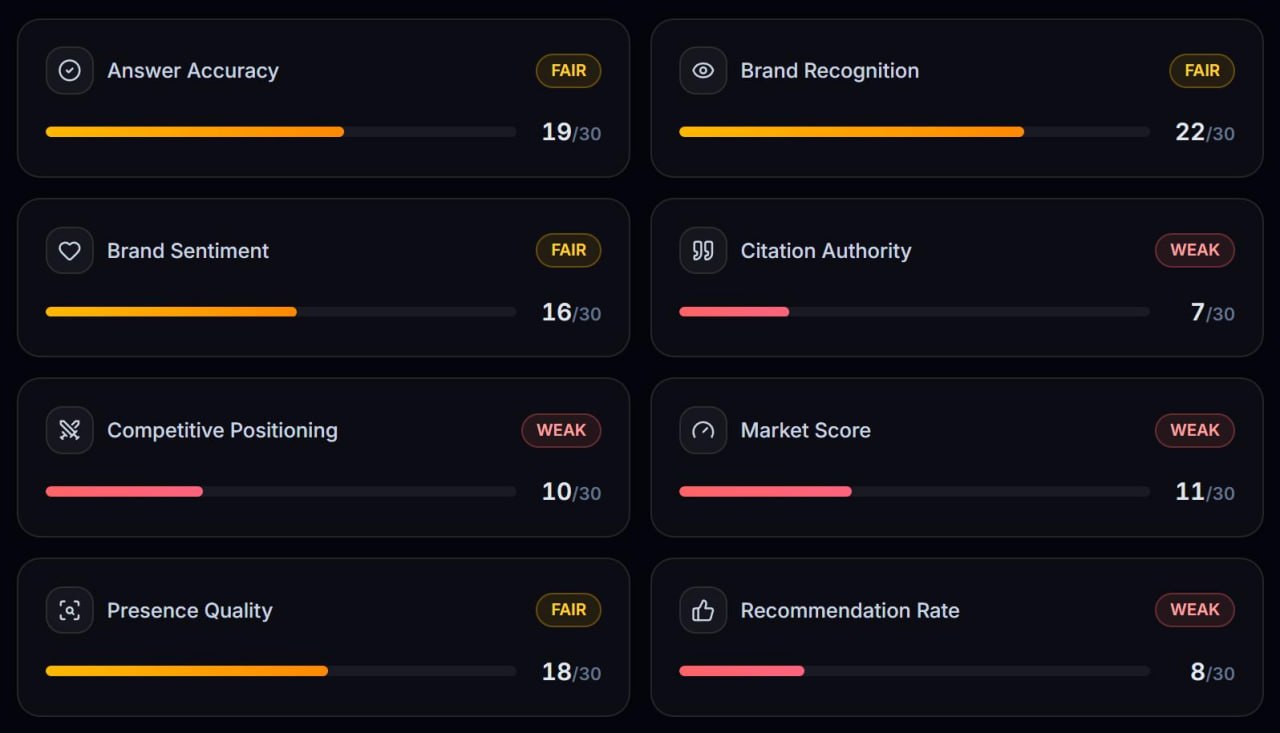
Visibility score: high brand recognition, maybe 75-80. Google AIO readiness: Wikipedia article exists, news coverage, lots of reviews (PCMag, TechRadar, etc.), own site depth good. AIO score maybe 75-80.
Sentiment: neutral (mixed reviews; praise for immersion method, criticism for price and repetition). Maybe "positive"? Reviews tend to be moderately positive with noted flaws; historically reputation has declined relative to Duolingo. I'd say neutral leaning positive... The schema forces one choice. "positive" might overstate; "neutral" is fair.
Would recommend: Yes, with caveats, it's a legitimate, established product, particularly good for beginners in immersive learning and for enterprise/education deployments. true.
Sources: Need URLs I'm confident exist: https://rosettastone.com (homepage) https://en.wikipedia.org/wiki/Rosetta_Stone_(language_learning_software), hmm, exact title? Wikipedia article is "Rosetta Stone (language learning software)"? Actually the article title: "Rosetta Stone (software)". Let me think. The Wikipedia article is titled "Rosetta Stone (software)" I believe. There was an article "Rosetta Stone (language learning software)", I recall the URL en.wikipedia.org/wiki/Rosetta_Stone_(software). Yes, I'm fairly confident "Rosetta Stone (software)" exists. To be safe, maybe I should avoid the Wikipedia URL if unsure? The rules say only list a URL if confident that exact page exists. I believe https://en.wikipedia.org/wiki/Rosetta_Stone_(software) exists, the disambiguation is (software). Actually, I recall the article may have been renamed "Rosetta Stone (language learning software)". Hmm. Risky. I could include the brand homepage and a reviews page like https://www.pcmag.com/reviews/rosetta-stone, PCMag review exists at pcmag.com/reviews/rosetta-stone I believe. Not fully certain. Safer: include just the homepage and maybe the pricing page https://www.rosettastone.com/buy/ ? Not sure. Perhaps only include the homepage, which I'm confident exists, plus maybe https://www.rosettastone.com/languages/ ? Hmm, less sure.
I could include Wikipedia via the general URL. Given the strict rule, an empty-ish array with just the homepage is safest, but a bit weak. Maybe include Wikipedia with the (software) title, I genuinely believe that page exists (it's long-standing). I'll include it. Also PCMag review, pcmag.com/reviews/rosetta-stone, I'm fairly confident PCMag uses that pattern. Risk. I'll include Wikipedia and the homepage only. Actually maybe add https://www.trustradius.com or G2? G2 has Rosetta Stone pages: https://www.g2.com/products/rosetta-stone/reviews, that pattern is likely correct for G2. I'm moderately confident. Hmm. I'll include G2 too? The rule: "far better a fabricated link", if unsure, skip. I'll include homepage + Wikipedia. Two sources is fine.
Confidence: 90ish. brand_known: true.
Visibility: 80. AIO: 78. share_of_voice_pct: 13. rank: 3. competitors list: Duolingo, Babbel, Pimsleur, Busuu, Memrise, italki, Lingoda, Mondly. Ordered roughly by prominence.
Mentions_out_of_10: 7? Let me recount which of my 10 I'd name it: worth-it (yes), vs Duolingo (yes), alternatives (yes), best language app (yes, usually listed), best for Spanish (sometimes, count yes), learn English (yes for ESL, Rosetta Stone markets English), software for schools/businesses (yes), lifetime subscription deals (yes), Babbel vs (yes), immersive method (yes). That could be 9-10 by construction. But realistically in "best language learning app" answers Rosetta Stone is frequently named. Honest estimate: 7. I'll go 7.
Share of voice: 7 of ~50 slots ≈ 14%. I'll say 14.
Part 1 prose: under 220 words. Cover visibility/reputation globally, position, competitors, products, what people say, strengths/concerns, recommendation.
Strengths: immersion method, TruAccent speech recognition, lifetime subscription value, strong enterprise/education arm (used in schools; now part of Cambium Learning), 25 languages, long track record. Concerns: perceived as dated, repetitive drills, less conversation practice than italki/Lingoda, pricing higher than freemium rivals, mobile experience less gamified, brand momentum behind Duolingo.
Recommendation: yes for beginners wanting structured immersion, and for organizations; casual learners may prefer Duolingo; conversation-focused learners italki.
Word count, keep it tight, ~190 words.
Now write.PART 1, ASSESSMENT
Rosetta Stone is one of the most recognizable names in global language learning, with a brand built over three decades on its signature immersive method: no translations, just target-language imagery and context, reinforced by its TruAccent speech-recognition engine. Its core offering is consumer software across roughly 25 languages, sold as subscriptions and lifetime licenses, plus a meaningful education and enterprise arm serving schools and businesses worldwide, now under Cambium Learning Group ownership.
Globally, its reputation is established but no longer dominant. In buyer conversations it competes chiefly with Duolingo (which dominates mindshare), Babbel, Pimsleur, Busuu, Memrise, and for live conversation, italki and Lingoda. Users typically praise its structured immersion, clean design, and lifetime-deal value, while common criticisms include repetitive drills, limited free-form conversation practice, grammar explanations being thin, and pricing above freemium rivals. Reviewers often call it solid for beginners and visual learners rather than the fastest route to fluency.
For someone globally seeking education solutions, I would recommend it conditionally: a good choice for structured, self-paced foundational learning or organizational deployments, but conversation-focused learners may get more from tutoring platforms.
<AEO_METRICS> { "brand_known": true, "confidence":
Show the exact prompt sent to GLM
You are an AI answer engine being audited on how you talk about a brand. Do NOT ask for clarification, do NOT request more details, do NOT call the company hypothetical, and do NOT add meta-commentary about this prompt. Brand: Rosetta Stone Website: https://rosettastone.com Industry: Education Products/Services: Language learning software Location / Target market: Global Your reply MUST have exactly two parts, in this order. PART 1 — ASSESSMENT (prose, under 220 words) Assess this brand SPECIFICALLY in the Global market: its visibility and reputation there, market position and main competitors, products/services, what people in that market say about it, notable strengths or concerns, and whether you would recommend it to someone in Global seeking Education solutions. If the brand is global, still weight the assessment toward Global. If you know little about it, state exactly what is and is not known and reason from the domain, industry and market context — never ask the user for more information. PART 2 — METRICS (mandatory, machine-read) Before writing the metrics, silently run this procedure: a) Write 10 realistic buyer-intent questions someone in Global would ask when shopping in the Education category (for example "best Education provider", "Language learning software alternatives", "is Rosetta Stone any good"). Count how many of those 10 you would answer with Rosetta Stone actually named — that number is mentions_out_of_10. b) Estimate how many distinct pages of https://rosettastone.com you have genuinely encountered in training or retrieval — that is indexed_pages. If you have effectively never seen the domain, use 0. c) List the real competitors you would name in those answers, then work out what share of the total brand-name slots Rosetta Stone would occupy (share_of_voice_pct) and its rank within that set. d) Judge Google AI Overview readiness from how authoritative and citable the brand's web presence is: own-site depth, Wikipedia / news / industry coverage, and third-party reviews. Rules for the numbers. They must be internally consistent — a brand you do not recognise cannot have high visibility or a top rank. Never invent precise-looking figures you cannot justify; if you genuinely cannot estimate a field, use null. Only list a URL in sources if you are confident that exact page exists — an empty array is far better than a fabricated link. The reasoning field must state in one or two sentences WHY the numbers are what they are, naming the concrete evidence you used. Emit PART 2 wrapped in the tags below, containing raw JSON only — no markdown, no backticks, no commentary: <AEO_METRICS> { "brand_known": true or false, "confidence": 0-100, "mentions_out_of_10": 0-10, "indexed_pages": number or null, "visibility_score": 0-100, "google_aio_score": 0-100, "share_of_voice_pct": 0-100, "rank_among_competitors": number or null, "competitors": ["string"], "sentiment": "positive" or "neutral" or "negative", "would_recommend": true or false, "sources": [{"claim": "what this URL backs up", "url": "https://..."}], "reasoning": "one or two sentences justifying the numbers above" } </AEO_METRICS>