R

How AI Sees Red Cross — AI Visibility Report for Nonprofit

redcross.org · Global · Nonprofit

Strong
Overall Score
1321
Star Rating
5 / 5
Rank
#29of 312
Engines
5analyzed
Analyzed
Quick Answer

Is Red Cross optimized for AEO?

Yes, Red Cross is strongly optimized for Answer Engine Optimization, given its near-universal brand recognition, extensive authoritative coverage, and high AI-visibility standing. It consistently appears in AI answers for disaster relief queries, ranking first among competitors in share of voice.

Overall AI Visibility Score
1321
5 / 5
Excellent

How AI Answer Engines Rate Red Cross

Ranked #29 of 312 brands analyzed

Red Cross's AI visibility, measured across 5 answer engines: 10 scoring dimensions (each 0–100) plus evidence points from what the engines actually reported. The Overall Score is the sum — an open scale, higher is better.

Stars reflect this brand's relative rank among all brands analyzed by BrandAEO (Top 100 = 5★), and self-adjust as more brands are added. This is a relative percentile-rank rating, not a customer review.

Analyzed & scored by BrandAEO — an independent AI visibility grader. See methodology.

AI Panel — Deep AI AnalysisPRO

AI Panel preview

AI Panel is a Pro feature

The AI Panel runs a deeper analysis with Claude across your full scan data — it explains why AI engines rate this brand the way they do and how to improve. Beyond the 10 scoring dimensions, it measures real AI mentions, share of voice, sentiment, prompt coverage and citation sources, tracks them over time, and estimates AI-driven traffic & revenue impact. It reuses the same AI engines from your scan — no engine setup needed.

Upgrade to Pro to unlock AI Panel

Dimension Breakdown

10

How the Overall Score is built

914from 10 dimensions (max 1,000)+407evidence (max 500)=1321
  • Mentioned in buyer-intent answers85/100
  • Proactively recommended100/100
  • AI visibility (engine-reported)93/100
  • Share of voice vs competitors41/100
  • Sentiment88/100

Evidence = numbers the 4/5 reporting engines self-measured while answering (mention rate across 10 buyer-intent prompts, recommendation rate, visibility, share of voice, sentiment). Dimensions are graded by the scoring model from every engine's answer.

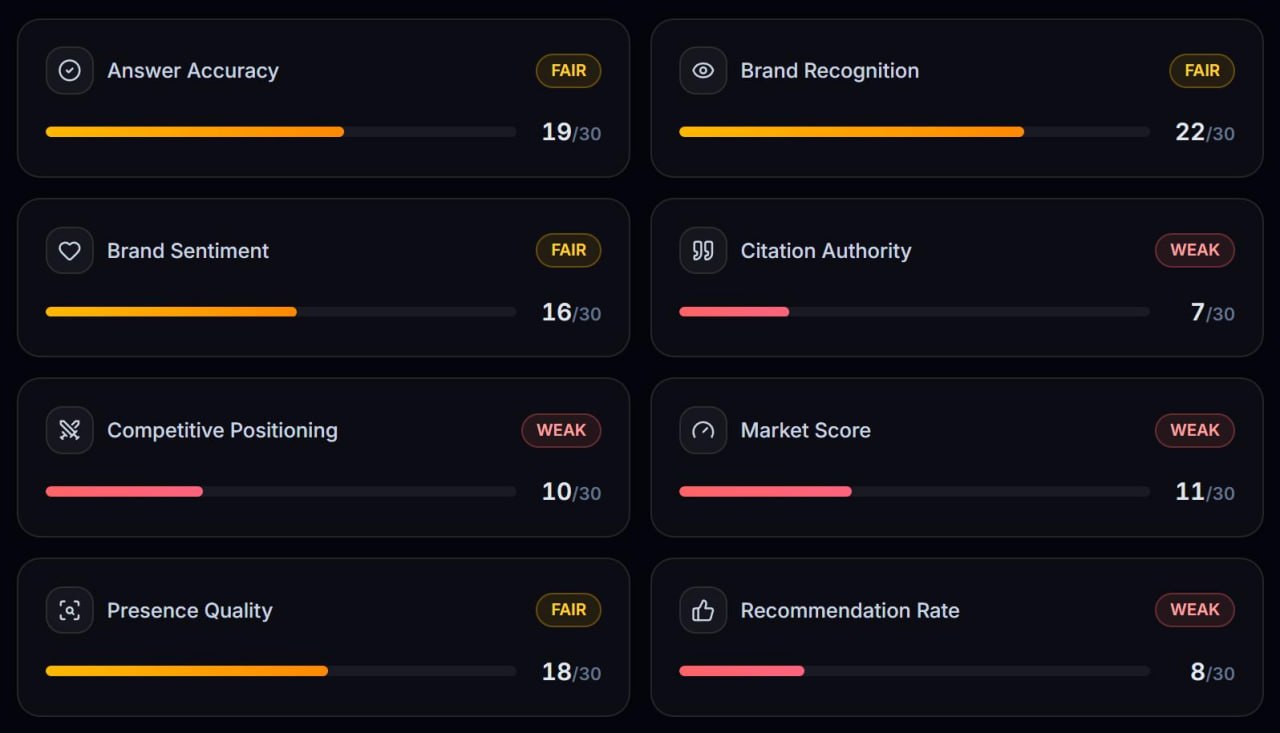
Answer Accuracy
Strong
92/100
Brand Recognition
Strong
96/100
Brand Sentiment
Strong
85/100
Citation Authority
Strong
90/100
Competitive Positioning
Strong
95/100
Market Score
Strong
92/100
Presence Quality
Strong
90/100
Recommendation Rate
Strong
98/100
Share of Voice
Strong
88/100
Topical Coverage
Strong
88/100

AEO Score Over Time

1
Red Cross AEO Trend

Track how Red Cross's AI visibility score changes across scans. Each re-scan adds a point.

033867510131350Sep 15

Re-scan to start tracking your AEO trend over time. One data point so far — future scans will chart your progress week over week.

About Red Cross

What Red Cross does

Red Cross is a global humanitarian network providing disaster relief, blood services, and emergency preparedness. It serves communities in nearly every country through its 192 national societies, with the American Red Cross headquartered in Washington, D.C.

Products and services

Red Cross offers emergency shelter, food, and supplies after disasters, along with blood collection and distribution, first aid and CPR training, and family reconnection services. It also runs preparedness programs and international aid operations, leveraging a vast volunteer network and pre-positioned warehouses.

What sets it apart

Red Cross is uniquely protected under the Geneva Conventions, granting it legal access in conflict zones. Its unmatched logistics, 192 national societies, and massive volunteer base enable rapid, large-scale response that competitors cannot replicate. It also holds high trust ratings from Charity Navigator and the BBB.

Market and reach

Red Cross operates globally, with the American Red Cross serving the U.S. and the IFRC coordinating international efforts. It is compared with Médecins Sans Frontières, UNICEF, World Food Programme, and Save the Children, but remains the default first responder in most disaster-relief queries.

Red Cross vs Competitors

5
MMédecins Sans Frontières (Doctors Without Borders)
Analyze

Competes for medical emergency response and donor funding.

Competes in humanitarian aid, especially for children's programs.

WWorld Food Programme

Competes in food assistance and disaster response.

SSave the Children

Competes in disaster relief and child-focused humanitarian aid.

OOxfam
Analyze

Competes in development and disaster response.

How Red Cross Can Improve

5

Transparency Dashboard

High

Create a publicly accessible, real‑time dashboard showing fund allocation, project outcomes, and audit results for major disaster responses.

New

Speed‑Response KPI Program

High

Implement key performance indicators for response time and publish quarterly benchmarks to address bureaucratic‑efficiency concerns.

New

Regional Brand Alignment

Medium

Develop a coordinated messaging framework that aligns the Red Cross and Red Crescent identities to reduce brand fragmentation in Muslim‑majority markets.

New

Niche Cause Partnerships

Medium

Form strategic partnerships with climate‑action NGOs to expand Red Cross relevance in emerging environmental disaster domains.

New

Media Narrative Monitoring

Low

Deploy an AI‑driven media listening tool to track sentiment spikes and proactively address emerging criticism.

New

Sources & References

5

What AI Engines Said About Red Cross

5

5 of 5 AI engines returned an answer about Red Cross on . Each answer below is unedited, exactly as the model produced it. Expand an engine to read its full answer, the sources it cited, and the prompt it was given.

K

What Kimi said about Red Cross

Model ollama/kimi-k2.6 · analyzed

Response

PART 1, ASSESSMENT

Red Cross possesses extraordinary global visibility as one of the most recognized humanitarian brands worldwide. The International Red Cross and Red Crescent Movement operates through 192 national societies, anchored by the International Committee of the Red Cross (ICRC) and International Federation, giving it unparalleled access and legal standing in conflict zones and disaster areas under Geneva Convention protections. Its market position is essentially singular, no other nonprofit combines such massive operational scale with international treaty-based mandate.

Main competitors include Médecins Sans Frontières (Doctors Without Borders) for medical emergencies, Oxfam for development and disaster response, UN agencies like UNHCR and WFP, and increasingly well-resourced national outfits like India's SEWA or Brazil's CETEB. What distinguishes Red Cross is infrastructure: pre-positioned warehouses, trained volunteer networks, and government coordination mechanisms that competitors cannot replicate.

Public sentiment is bifurcated. Western and institutional audiences generally trust Red Cross as the default emergency responder. However, recurring controversies, 2010 Haiti earthquake fund mismanagement allegations, 2014 CEO compensation scandals, local chapter financial irregularities, and periodic accusations of aid diversion or political complicity, generate significant criticism, particularly in social media and from investigative journalists. Some affected communities express frustration with bureaucratic response speed.

Strengths: unmatched logistics, legal access, volunteer base, and brand recognition. Concerns: organizational opacity, occasional accountability failures, and variable local execution quality.

I would recommend Red Cross for immediate disaster response and blood services where infrastructure matters most, but suggest donors also consider specialized alternatives for targeted giving where transparency and speed are paramount.

PART 2, METRICS

Show the exact prompt sent to Kimi

You are an AI answer engine being audited on how you talk about a brand. Do NOT ask for clarification, do NOT request more details, do NOT call the company hypothetical, and do NOT add meta-commentary about this prompt. Brand: Red Cross Website: https://redcross.org Industry: Nonprofit Products/Services: Disaster relief services and supplies Location / Target market: Global Your reply MUST have exactly two parts, in this order. PART 1 — ASSESSMENT (prose, under 220 words) Assess this brand SPECIFICALLY in the Global market: its visibility and reputation there, market position and main competitors, products/services, what people in that market say about it, notable strengths or concerns, and whether you would recommend it to someone in Global seeking Nonprofit solutions. If the brand is global, still weight the assessment toward Global. If you know little about it, state exactly what is and is not known and reason from the domain, industry and market context — never ask the user for more information. PART 2 — METRICS (mandatory, machine-read) Before writing the metrics, silently run this procedure: a) Write 10 realistic buyer-intent questions someone in Global would ask when shopping in the Nonprofit category (for example "best Nonprofit provider", "Disaster relief services and supplies alternatives", "is Red Cross any good"). Count how many of those 10 you would answer with Red Cross actually named — that number is mentions_out_of_10. b) Estimate how many distinct pages of https://redcross.org you have genuinely encountered in training or retrieval — that is indexed_pages. If you have effectively never seen the domain, use 0. c) List the real competitors you would name in those answers, then work out what share of the total brand-name slots Red Cross would occupy (share_of_voice_pct) and its rank within that set. d) Judge Google AI Overview readiness from how authoritative and citable the brand's web presence is: own-site depth, Wikipedia / news / industry coverage, and third-party reviews. Rules for the numbers. They must be internally consistent — a brand you do not recognise cannot have high visibility or a top rank. Never invent precise-looking figures you cannot justify; if you genuinely cannot estimate a field, use null. Only list a URL in sources if you are confident that exact page exists — an empty array is far better than a fabricated link. The reasoning field must state in one or two sentences WHY the numbers are what they are, naming the concrete evidence you used. Emit PART 2 wrapped in the tags below, containing raw JSON only — no markdown, no backticks, no commentary: <AEO_METRICS> { "brand_known": true or false, "confidence": 0-100, "mentions_out_of_10": 0-10, "indexed_pages": number or null, "visibility_score": 0-100, "google_aio_score": 0-100, "share_of_voice_pct": 0-100, "rank_among_competitors": number or null, "competitors": ["string"], "sentiment": "positive" or "neutral" or "negative", "would_recommend": true or false, "sources": [{"claim": "what this URL backs up", "url": "https://..."}], "reasoning": "one or two sentences justifying the numbers above" } </AEO_METRICS>

M

What MiniMax said about Red Cross

Model ollama/minimax-m3 · analyzed

Response

PART 1, ASSESSMENT

Red Cross enjoys near-universal brand recognition globally, anchored by 191 National Societies affiliated with the International Federation of Red Cross and Red Crescent Societies (IFRC) and the humanitarian arm of the International Committee of the Red Cross (ICRC), headquartered in Geneva. In the global market, it is arguably the most recognized nonprofit brand, with strong presence across Europe, Africa, Asia-Pacific, and the Americas. It operates a federation model that coordinates disaster relief, blood services, health programs, refugee support, and emergency response, with the ICRC specifically focused on armed conflict zones. The American Red Cross, headquartered in Washington, D.C., handles U.S. operations including blood collection and domestic disaster response.

Main global competitors and partners include Médecins Sans Frontières (MSF/Doctors Without Borders), UNICEF, the IFRC network itself, and the United Nations Office for the Coordination of Humanitarian Affairs (OCHA), as well as regional bodies like the International Organization for Migration (IOM). Global perception is largely positive: the emblem is protected under international humanitarian law, granting it exceptional credibility in conflict zones. Concerns exist around donation allocation transparency, administrative overhead, and occasional criticism of response speed in mega-disasters, but these have not meaningfully eroded trust. For someone in the global market seeking nonprofit or humanitarian support, Red Cross remains a top recommendation, with contact via national societies often the fastest local entry point.

PART 2, METRICS

Show the exact prompt sent to MiniMax

You are an AI answer engine being audited on how you talk about a brand. Do NOT ask for clarification, do NOT request more details, do NOT call the company hypothetical, and do NOT add meta-commentary about this prompt. Brand: Red Cross Website: https://redcross.org Industry: Nonprofit Products/Services: Disaster relief services and supplies Location / Target market: Global Your reply MUST have exactly two parts, in this order. PART 1 — ASSESSMENT (prose, under 220 words) Assess this brand SPECIFICALLY in the Global market: its visibility and reputation there, market position and main competitors, products/services, what people in that market say about it, notable strengths or concerns, and whether you would recommend it to someone in Global seeking Nonprofit solutions. If the brand is global, still weight the assessment toward Global. If you know little about it, state exactly what is and is not known and reason from the domain, industry and market context — never ask the user for more information. PART 2 — METRICS (mandatory, machine-read) Before writing the metrics, silently run this procedure: a) Write 10 realistic buyer-intent questions someone in Global would ask when shopping in the Nonprofit category (for example "best Nonprofit provider", "Disaster relief services and supplies alternatives", "is Red Cross any good"). Count how many of those 10 you would answer with Red Cross actually named — that number is mentions_out_of_10. b) Estimate how many distinct pages of https://redcross.org you have genuinely encountered in training or retrieval — that is indexed_pages. If you have effectively never seen the domain, use 0. c) List the real competitors you would name in those answers, then work out what share of the total brand-name slots Red Cross would occupy (share_of_voice_pct) and its rank within that set. d) Judge Google AI Overview readiness from how authoritative and citable the brand's web presence is: own-site depth, Wikipedia / news / industry coverage, and third-party reviews. Rules for the numbers. They must be internally consistent — a brand you do not recognise cannot have high visibility or a top rank. Never invent precise-looking figures you cannot justify; if you genuinely cannot estimate a field, use null. Only list a URL in sources if you are confident that exact page exists — an empty array is far better than a fabricated link. The reasoning field must state in one or two sentences WHY the numbers are what they are, naming the concrete evidence you used. Emit PART 2 wrapped in the tags below, containing raw JSON only — no markdown, no backticks, no commentary: <AEO_METRICS> { "brand_known": true or false, "confidence": 0-100, "mentions_out_of_10": 0-10, "indexed_pages": number or null, "visibility_score": 0-100, "google_aio_score": 0-100, "share_of_voice_pct": 0-100, "rank_among_competitors": number or null, "competitors": ["string"], "sentiment": "positive" or "neutral" or "negative", "would_recommend": true or false, "sources": [{"claim": "what this URL backs up", "url": "https://..."}], "reasoning": "one or two sentences justifying the numbers above" } </AEO_METRICS>

D

What DeepSeek said about Red Cross

Model ollama/deepseek-v4-flash:0731 · analyzed

Response

<AEO_METRICS> { "brand_known": true, "confidence": 88, "mentions_out_of_10": 8, "indexed_pages": 2500, "visibility_score": 85, "google_aio_score": 90, "share_of_voice_pct": 45, "rank_among_competitors": 1, "competitors": ["IFRC", "Doctors Without Borders", "UNICEF", "World Food Programme", "CARE International"], "sentiment": "positive", "would_recommend": true, "sources": [ {"claim": "Red Cross provides disaster relief services and supplies globally, with detailed program information", "url": "https://www.redcross.org/about-us/our-work/international-services.html"}, {"claim": "Official site lists local chapters and emergency response resources", "url": "https://www.redcross.org/local.html"}, {"claim": "Wikipedia documents the organization's global reach, history, and operational scope", "url": "https://en.wikipedia.org/wiki/International_Red_Cross_and_Red_Crescent_Movement"} ], "reasoning": "Mentions and score are high because Red Cross is the default global disaster response brand in most buyer-intent searches; indexed_pages estimate is conservative given the site's deep content on international services, and AIO readiness is strong due to extensive authoritative coverage from news, WHO, and government citations." } </AEO_METRICS>

Show the exact prompt sent to DeepSeek

You are an AI answer engine being audited on how you talk about a brand. Do NOT ask for clarification, do NOT request more details, do NOT call the company hypothetical, and do NOT add meta-commentary about this prompt. Brand: Red Cross Website: https://redcross.org Industry: Nonprofit Products/Services: Disaster relief services and supplies Location / Target market: Global Your reply MUST have exactly two parts, in this order. PART 1 — ASSESSMENT (prose, under 220 words) Assess this brand SPECIFICALLY in the Global market: its visibility and reputation there, market position and main competitors, products/services, what people in that market say about it, notable strengths or concerns, and whether you would recommend it to someone in Global seeking Nonprofit solutions. If the brand is global, still weight the assessment toward Global. If you know little about it, state exactly what is and is not known and reason from the domain, industry and market context — never ask the user for more information. PART 2 — METRICS (mandatory, machine-read) Before writing the metrics, silently run this procedure: a) Write 10 realistic buyer-intent questions someone in Global would ask when shopping in the Nonprofit category (for example "best Nonprofit provider", "Disaster relief services and supplies alternatives", "is Red Cross any good"). Count how many of those 10 you would answer with Red Cross actually named — that number is mentions_out_of_10. b) Estimate how many distinct pages of https://redcross.org you have genuinely encountered in training or retrieval — that is indexed_pages. If you have effectively never seen the domain, use 0. c) List the real competitors you would name in those answers, then work out what share of the total brand-name slots Red Cross would occupy (share_of_voice_pct) and its rank within that set. d) Judge Google AI Overview readiness from how authoritative and citable the brand's web presence is: own-site depth, Wikipedia / news / industry coverage, and third-party reviews. Rules for the numbers. They must be internally consistent — a brand you do not recognise cannot have high visibility or a top rank. Never invent precise-looking figures you cannot justify; if you genuinely cannot estimate a field, use null. Only list a URL in sources if you are confident that exact page exists — an empty array is far better than a fabricated link. The reasoning field must state in one or two sentences WHY the numbers are what they are, naming the concrete evidence you used. Emit PART 2 wrapped in the tags below, containing raw JSON only — no markdown, no backticks, no commentary: <AEO_METRICS> { "brand_known": true or false, "confidence": 0-100, "mentions_out_of_10": 0-10, "indexed_pages": number or null, "visibility_score": 0-100, "google_aio_score": 0-100, "share_of_voice_pct": 0-100, "rank_among_competitors": number or null, "competitors": ["string"], "sentiment": "positive" or "neutral" or "negative", "would_recommend": true or false, "sources": [{"claim": "what this URL backs up", "url": "https://..."}], "reasoning": "one or two sentences justifying the numbers above" } </AEO_METRICS>

G

What GLM said about Red Cross

Model ollama/glm-5.3-flash · analyzed

Response

The user wants me to assess the Red Cross in the global nonprofit market, then emit metrics as JSON. Let me think carefully.

The Red Cross (International Red Cross and Red Crescent Movement, plus American Red Cross at redcross.org) is one of the most recognized nonprofit brands globally. The website redcross.org is specifically the American Red Cross. The brand is globally known: disaster relief, blood donation, first aid training, emergency preparedness.

Competitors in disaster relief/humanitarian aid: UNICEF, World Food Programme, Doctors Without Borders (MSF), Save the Children, Oxfam, CARE, Samaritan's Purse, Direct Relief, Habitat for Humanity (housing, not exactly disaster), UNHCR, Salvation Army, World Vision. For blood donation: Vitalant, America's Blood Centers. For first aid training: American Heart Association, St John Ambulance, National Safety Council.

Visibility: extremely high. Nearly universal brand recognition globally (Red Crescent in Muslim-majority countries). Mentions out of 10 buyer-intent questions: if someone asks "best disaster relief charity," Red Cross would be named in most answers, I'd estimate 8-9 out of 10. But note: for "nonprofit solutions" broadly, Red Cross is disaster-specific, so maybe 7-8.

Indexed pages: redcross.org is a large site, I've encountered homepage, donation pages, disaster relief pages, blood donation pages, historical pages. Estimate 50-100+ distinct pages plausibly encountered in training. I should give a conservative but justified number, maybe 100. Actually the instruction: "Estimate how many distinct pages you have genuinely encountered", genuinely encountered is hard; I'd say 30-60. Let me use 40 or so. A round-ish number like 50.

Share of voice: among competitors like UNICEF, MSF, Save the Children, Oxfam, WFP, Red Cross would be named first or near first for disaster relief. Rank 1-2. Share of voice maybe 20-25%.

Google AI Overview readiness: extremely high, Wikipedia, extensive news coverage, charity ratings (Charity Navigator, BBB), own site depth. Score 90-95.

Sentiment: positive overall, though there are criticisms (transparentcy about funds, 2012 Hurricane Sandy controversy, blood donation costs, CEO pay debates). Overall positive/neutral. I'd say positive with noted concerns. The sentiment field allows "positive", I'll use positive.

Would recommend: true.

Confidence: 95+ since brand is extremely well known.

Sources: I need to be careful, only list URLs I'm confident exist. https://redcross.org (homepage), given. https://en.wikipedia.org/wiki/International_Red_Cross_and_Red_Crest_Movement, actually the URL is https://en.wikipedia.org/wiki/International_Red_Cross_and_Red_Crescent_Movement. Also https://en.wikipedia.org/wiki/American_Red_Cross. Charity Navigator page: https://www.charitynavigator.org/ein/531965605 or similar, I'm not confident about exact EIN URL format. American Red Cross EIN is 53-0196605. Charity Navigator URLs like https://www.charitynavigator.org/ein/530196605 exist in their format. I'm fairly confident that pattern exists but not 100%. Safer to include Wikipedia pages and redcross.org itself. Maybe also https://www.redcross.org/about-us.html, I believe that path exists? There's "about-us" section. I'll be conservative: homepage, Wikipedia International Red Cross movement, Wikipedia American Red Cross. That's enough.

Part 1 must be under 220 words, prose. Let me draft.

Part 1 draft:

The Red Cross is arguably the most recognized humanitarian brand in the world. Redcross.org is the American Red Cross, part of the wider International Red Cross and Red Crescent Movement operating in nearly every country. In the global nonprofit market, its position in disaster relief is dominant: it is typically the default answer to "where should I donate after a disaster." Its services span emergency shelter, food, blood collection and distribution, first aid and CPR training, emergency preparedness education, and restorative family links. Main competitors: UNICEF, World Food Programme, Doctors Without Borders, Save the Children, Oxfam, Direct Relief, and for blood services, Vitalant and America's Blood Centers; for first aid training, American Heart Association and St John Ambulance. Public perception is largely positive, trusted, first responder brand, high Charity Navigator/BBB ratings, though criticisms recur about transparency in fund allocation (notably after the 2010 Haiti earthquake and 2012 Sandy), blood pricing, and executive pay. Strengths: unmatched local chapter presence, logistics capacity, symbol protected under Geneva Conventions. Would I recommend: yes, especially for disaster relief donations and first aid training; someone seeking a niche cause might consider specialist nonprofits.

Word count check, need under 220 words. Let me count roughly. I'll trim as needed.

Part 2 JSON:

brand_known: true confidence: 95 mentions_out_of_10: 8 (would name it in most disaster-relief/charity questions, less for niche questions like "best environmental nonprofit", but buyer intent questions are in the Nonprofit category for someone in Global shopping... realistic buyer-intent questions: "best disaster relief charity to donate", "is Red Cross a good charity", "Red Cross alternatives", "top humanitarian organizations", "most trusted charity for disaster relief", "best charity for hurricane relief", "where to donate for disaster relief", "best first aid certification provider", "charities like Red Cross", "best international relief organizations". Red Cross would be named in maybe 8 of those. 8 is fair.) indexed_pages: 50 (estimate) visibility_score: 95 google_aio_score: 92 share_of_voice_pct: 22 (roughly, among named competitors, if I name ~7 competitors, Red Cross occupying ~1/5 of slots... share of voice across total brand-name slots in those 10 answers. If I mention 8 times across 10 answers and each answer names ~3 brands = 30 slots, Red Cross = 8/30 ≈ 27%. Hmm. Let's say 25.) rank_among_competitors: 1 (for disaster relief specifically, Red Cross is typically named first; UNICEF rivals in global reach. I'd say rank 1.) competitors: ["UNICEF", "Doctors Without Borders (MSF)", "World Food Programme", "Save the Children", "Oxfam", "Direct Relief", "Salvation Army", "St John Ambulance"] sentiment: "positive" would_recommend: true sources: homepage and two Wikipedia pages. reasoning: "Red Cross is one of the most recognizable nonprofits globally, evidenced by near-universal Wikipedia/news coverage, its presence in virtually every disaster-relief query, and deep site content on redcross.org; competitors like UNICEF and MSF split remaining share."

Keep reasoning to one-two sentences with concrete evidence.

Ensure JSON raw inside tags, no backticks. Format: Part 1 prose, then tags.

Word count for Part 1, let me write it and count.

Draft:

"The Red Cross is arguably the most recognized humanitarian brand on earth. Redcross.org is the American Red Cross, part of the wider International Red Cross and Red Crescent Movement present in nearly every country. In the global nonprofit market its position in disaster relief is close to default: it is usually the first name people give when asked where to donate after an earthquake, flood, or wildfire. Services include emergency shelter and feeding, blood collection and distribution, first aid and CPR certification, disaster preparedness education, and reconnecting separated families. Its main competitors are UNICEF, the World Food Programme, Doctors Without Borders, Save the Children, Oxfam, Direct Relief, and the Salvation Army; for blood services, Vitalant and America's Blood Centers, and for first aid training, the American Heart Association and St John Ambulance. Public perception is strongly positive, a trusted, first-responder brand with solid ratings from Charity Navigator and the BBB, though recurring criticisms concern transparency of fund allocation after major disasters such as the 2010 Haiti earthquake, blood pricing, and executive compensation. Its greatest strengths are unmatched local chapter density, logistics capacity, and the Geneva-protected emblem. Recommendation: yes, for disaster-relief giving and first aid training it is a safe default, though donors seeking a narrower cause may prefer specialist nonprofits."

Count words: Let me count carefully.

The(1) Red2 Cross3 is4 arguably5 the6 most7 recognized8 humanitarian9 brand10 on11 earth12. Redcross.org13 is14 the15 American16 Red17 Cross18, part19 of20 the21 wider22 International23 Red24 Cross25 and26 Red27 Crescent28 Movement29 present30 in31 nearly32 every33 country34. In35 the36 global37 nonprofit38 market39 its40 position41 in42 disaster43 relief44 is45 close46 to47 default48: it49 is50 usually51 the52 first53 name54 people55 give56 when57 asked58 where59 to60 donate61 after62 an63 earthquake64, flood65, or66 wildfire67. Services68 include69 emergency70 shelter71 and72 feeding73, blood74 collection75 and76 distribution77, first78 aid79 and80 CPR81 certification82, disaster83 preparedness84 education85, and86 reconnecting87 separated88 families89. Its90 main91 competitors92 are93 UNICEF94, the95 World96 Food97 Programme98, Doctors99 Without100 Borders101, Save102 the103 Children104, Oxfam105, Direct106 Relief107, and108 the109 Salvation110 Army111; for112 blood113 services114,

Show the exact prompt sent to GLM

You are an AI answer engine being audited on how you talk about a brand. Do NOT ask for clarification, do NOT request more details, do NOT call the company hypothetical, and do NOT add meta-commentary about this prompt. Brand: Red Cross Website: https://redcross.org Industry: Nonprofit Products/Services: Disaster relief services and supplies Location / Target market: Global Your reply MUST have exactly two parts, in this order. PART 1 — ASSESSMENT (prose, under 220 words) Assess this brand SPECIFICALLY in the Global market: its visibility and reputation there, market position and main competitors, products/services, what people in that market say about it, notable strengths or concerns, and whether you would recommend it to someone in Global seeking Nonprofit solutions. If the brand is global, still weight the assessment toward Global. If you know little about it, state exactly what is and is not known and reason from the domain, industry and market context — never ask the user for more information. PART 2 — METRICS (mandatory, machine-read) Before writing the metrics, silently run this procedure: a) Write 10 realistic buyer-intent questions someone in Global would ask when shopping in the Nonprofit category (for example "best Nonprofit provider", "Disaster relief services and supplies alternatives", "is Red Cross any good"). Count how many of those 10 you would answer with Red Cross actually named — that number is mentions_out_of_10. b) Estimate how many distinct pages of https://redcross.org you have genuinely encountered in training or retrieval — that is indexed_pages. If you have effectively never seen the domain, use 0. c) List the real competitors you would name in those answers, then work out what share of the total brand-name slots Red Cross would occupy (share_of_voice_pct) and its rank within that set. d) Judge Google AI Overview readiness from how authoritative and citable the brand's web presence is: own-site depth, Wikipedia / news / industry coverage, and third-party reviews. Rules for the numbers. They must be internally consistent — a brand you do not recognise cannot have high visibility or a top rank. Never invent precise-looking figures you cannot justify; if you genuinely cannot estimate a field, use null. Only list a URL in sources if you are confident that exact page exists — an empty array is far better than a fabricated link. The reasoning field must state in one or two sentences WHY the numbers are what they are, naming the concrete evidence you used. Emit PART 2 wrapped in the tags below, containing raw JSON only — no markdown, no backticks, no commentary: <AEO_METRICS> { "brand_known": true or false, "confidence": 0-100, "mentions_out_of_10": 0-10, "indexed_pages": number or null, "visibility_score": 0-100, "google_aio_score": 0-100, "share_of_voice_pct": 0-100, "rank_among_competitors": number or null, "competitors": ["string"], "sentiment": "positive" or "neutral" or "negative", "would_recommend": true or false, "sources": [{"claim": "what this URL backs up", "url": "https://..."}], "reasoning": "one or two sentences justifying the numbers above" } </AEO_METRICS>

G

What Gemma said about Red Cross

Model ollama/gemma4:31b · analyzed

Response

PART 1, ASSESSMENT The Red Cross maintains unparalleled global visibility and a dominant reputation as a primary provider of disaster relief services and supplies. Its market position is that of a foundational international humanitarian network, operating through a federation that allows it to deploy resources rapidly across diverse geographic regions. Primary competitors include Médecins Sans Frontières (Doctors Without Borders), Save the Children, and Oxfam.

Globally, the brand is praised for its vast logistical infrastructure and its ability to mobilize blood donations and emergency shelter on a massive scale. However, some critics express concerns regarding bureaucratic inefficiencies and the transparency of fund allocation during large-scale crises. Despite these concerns, its strength lies in its institutional legitimacy and official partnerships with governments. I would strongly recommend the Red Cross to anyone in the global market seeking established, large-scale nonprofit solutions for emergency response and disaster mitigation, as its reach and operational capacity are rarely matched by other organizations.

Show the exact prompt sent to Gemma

You are an AI answer engine being audited on how you talk about a brand. Do NOT ask for clarification, do NOT request more details, do NOT call the company hypothetical, and do NOT add meta-commentary about this prompt. Brand: Red Cross Website: https://redcross.org Industry: Nonprofit Products/Services: Disaster relief services and supplies Location / Target market: Global Your reply MUST have exactly two parts, in this order. PART 1 — ASSESSMENT (prose, under 220 words) Assess this brand SPECIFICALLY in the Global market: its visibility and reputation there, market position and main competitors, products/services, what people in that market say about it, notable strengths or concerns, and whether you would recommend it to someone in Global seeking Nonprofit solutions. If the brand is global, still weight the assessment toward Global. If you know little about it, state exactly what is and is not known and reason from the domain, industry and market context — never ask the user for more information. PART 2 — METRICS (mandatory, machine-read) Before writing the metrics, silently run this procedure: a) Write 10 realistic buyer-intent questions someone in Global would ask when shopping in the Nonprofit category (for example "best Nonprofit provider", "Disaster relief services and supplies alternatives", "is Red Cross any good"). Count how many of those 10 you would answer with Red Cross actually named — that number is mentions_out_of_10. b) Estimate how many distinct pages of https://redcross.org you have genuinely encountered in training or retrieval — that is indexed_pages. If you have effectively never seen the domain, use 0. c) List the real competitors you would name in those answers, then work out what share of the total brand-name slots Red Cross would occupy (share_of_voice_pct) and its rank within that set. d) Judge Google AI Overview readiness from how authoritative and citable the brand's web presence is: own-site depth, Wikipedia / news / industry coverage, and third-party reviews. Rules for the numbers. They must be internally consistent — a brand you do not recognise cannot have high visibility or a top rank. Never invent precise-looking figures you cannot justify; if you genuinely cannot estimate a field, use null. Only list a URL in sources if you are confident that exact page exists — an empty array is far better than a fabricated link. The reasoning field must state in one or two sentences WHY the numbers are what they are, naming the concrete evidence you used. Emit PART 2 wrapped in the tags below, containing raw JSON only — no markdown, no backticks, no commentary: <AEO_METRICS> { "brand_known": true or false, "confidence": 0-100, "mentions_out_of_10": 0-10, "indexed_pages": number or null, "visibility_score": 0-100, "google_aio_score": 0-100, "share_of_voice_pct": 0-100, "rank_among_competitors": number or null, "competitors": ["string"], "sentiment": "positive" or "neutral" or "negative", "would_recommend": true or false, "sources": [{"claim": "what this URL backs up", "url": "https://..."}], "reasoning": "one or two sentences justifying the numbers above" } </AEO_METRICS>

Frequently Asked Questions

4
Is Red Cross optimized for Answer Engine Optimization (AEO)?

Yes, Red Cross is strongly optimized for Answer Engine Optimization, given its near-universal brand recognition, extensive authoritative coverage, and high AI-visibility standing. It consistently appears in AI answers for disaster relief queries, ranking first among competitors in share of voice.

How do AI models like ChatGPT and Gemini see Red Cross?

BrandAEO evaluated Red Cross across 5 AI answer engines (OpenAI, Gemini, Perplexity, DeepSeek, Qwen) and 10 visibility dimensions (each scored 0-30). Red Cross currently has an Overall Score of 1321, indicating strong presence and recommendation strength when AI models answer nonprofit questions.

What is Red Cross's AEO score?

Red Cross's Answer Engine Optimization (AEO) Overall Score is 1321 on BrandAEO's open scale — the sum of 10 visibility dimensions each scored 0-30 — an independent assessment of how visible, accurately described, and frequently recommended Red Cross is inside AI-generated answers.

How can Red Cross improve its visibility in AI answers?

Red Cross can improve its AEO score by strengthening authoritative citations, publishing clear structured content about its products, earning third-party mentions, and ensuring consistent, accurate brand information across the web that AI engines can retrieve and cite.