R

How AI Sees Rakuten — AI Visibility Report for E-commerce / Retail

rakuten.com · Global · E-commerce / Retail

Strong
Overall Score
948
Star Rating
3 / 5
Rank
#265of 337
Engines
3analyzed
Analyzed
Quick Answer

Is Rakuten optimized for AEO?

Rakuten scores 948 on BrandAEO's independent open-scale AEO assessment (ranked #265 of 337 brands analyzed) — a fair level of visibility and recommendation strength when AI answer engines respond to e-commerce / retail questions.

Overall AI Visibility Score
948
3 / 5
Fair

How AI Answer Engines Rate Rakuten

Ranked #265 of 337 brands analyzed

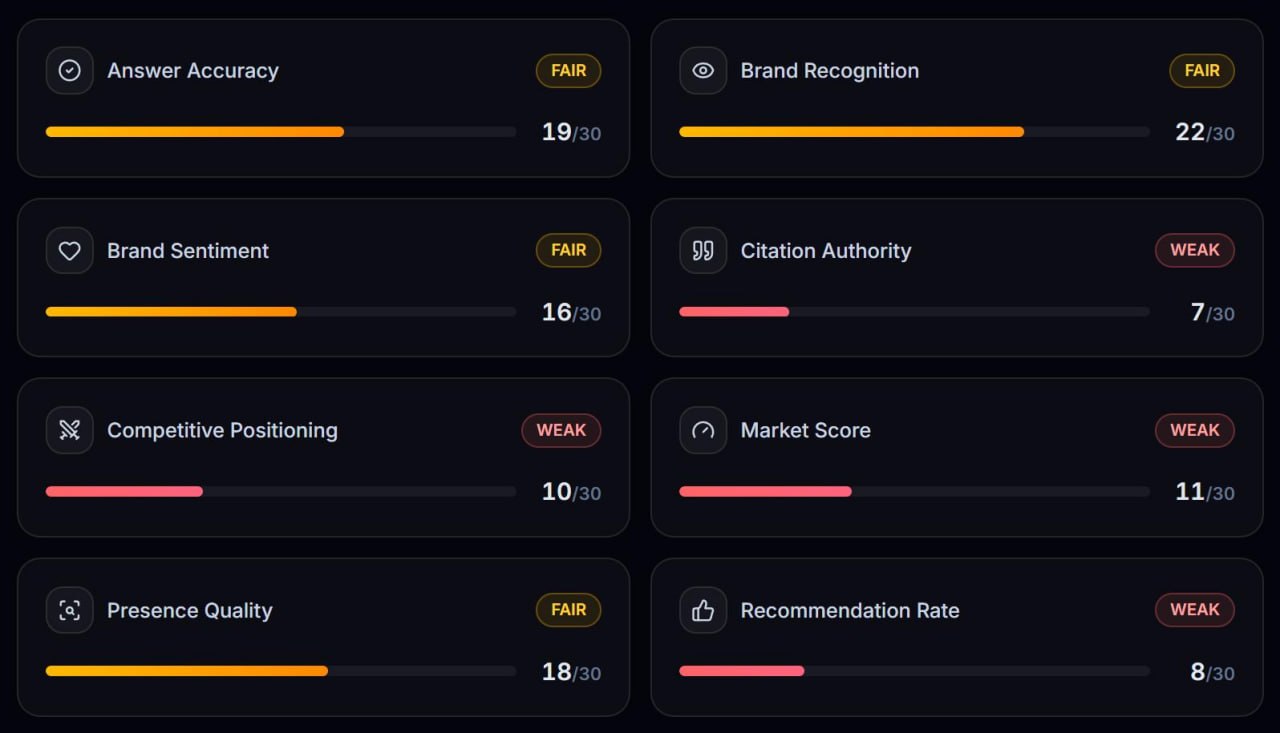
Rakuten's AI visibility, measured across 3 answer engines: 10 scoring dimensions (each 0–100) plus evidence points from what the engines actually reported. The Overall Score is the sum — an open scale, higher is better.

Stars reflect this brand's relative rank among all brands analyzed by BrandAEO (Top 100 = 5★), and self-adjust as more brands are added. This is a relative percentile-rank rating, not a customer review.

Analyzed & scored by BrandAEO — an independent AI visibility grader. See methodology.

AI Panel — Deep AI AnalysisPRO

AI Panel preview

AI Panel is a Pro feature

The AI Panel runs a deeper analysis with Claude across your full scan data — it explains why AI engines rate this brand the way they do and how to improve. Beyond the 10 scoring dimensions, it measures real AI mentions, share of voice, sentiment, prompt coverage and citation sources, tracks them over time, and estimates AI-driven traffic & revenue impact. It reuses the same AI engines from your scan — no engine setup needed.

Upgrade to Pro to unlock AI Panel

Dimension Breakdown

10

How the Overall Score is built

655from 10 dimensions (max 1,000)+293evidence (max 500)=948
  • Mentioned in buyer-intent answers40/100
  • Proactively recommended100/100
  • AI visibility (engine-reported)63/100
  • Share of voice vs competitors15/100
  • Sentiment75/100

Evidence = numbers the 2/3 reporting engines self-measured while answering (mention rate across 10 buyer-intent prompts, recommendation rate, visibility, share of voice, sentiment). Dimensions are graded by the scoring model from every engine's answer.

Answer Accuracy
Strong
85/100
Brand Recognition
Strong
95/100
Brand Sentiment
Fair
55/100
Citation Authority
Fair
70/100
Competitive Positioning
Fair
65/100
Market Score
Fair
60/100
Presence Quality
Fair
55/100
Recommendation Rate
Strong
90/100
Share of Voice
Weak
20/100
Topical Coverage
Fair
60/100

AEO Score Over Time

4
Rakuten AEO Trend

Track how Rakuten's AI visibility score changes across scans. Each re-scan adds a point.

02505007501000Sep 14Sep 28Oct 12Oct 26

About Rakuten

Rakuten operates in e-commerce / retail (Global). This page summarizes how leading AI answer engines currently describe and recommend Rakuten, based on BrandAEO's independent open-scale AI-visibility assessment (Overall Score 948, ranked #265 of 337).

Rakuten vs Competitors

Competitive positioning analysis is being prepared for Rakuten.

How Rakuten Can Improve

5

Boost Global SEO Footprint

High

Create and optimize high‑quality content targeting Western markets to increase indexed pages and improve AI visibility scores.

New

Expand Authoritative Citations

High

Secure additional references from leading industry reports and news outlets to raise citation authority beyond the current limited sources.

New

Consolidate Brand Messaging

Medium

Develop a unified narrative that ties together Rakuten’s marketplace, financial services, and loyalty programs to reduce perceived fragmentation.

New

Enhance AI Training Data

Medium

Feed AI models with richer, up‑to‑date datasets about Rakuten’s global initiatives to improve answer accuracy and presence quality.

New

Increase Market Share in Western Regions

Low

Launch targeted promotions and partnership programs (e.g., with local retailers) to grow share of voice and improve competitive positioning.

New

What AI Engines Said About Rakuten

3

2 of 3 AI engines returned an answer about Rakuten on . Each answer below is unedited, exactly as the model produced it. Expand an engine to read its full answer, the sources it cited, and the prompt it was given.

G

What Gemma said about Rakuten

Model ollama/gemma4:31b · analyzed

Response

PART 1, ASSESSMENT Rakuten is a dominant force in Japan, but its global visibility is primarily concentrated in the cash-back and loyalty reward sector rather than as a direct primary marketplace competitor to giants like Amazon. In the global market, it is well-regarded for its "Rakuten Rewards" ecosystem, which attracts users seeking to maximize savings across various third-party retailers. Its market position is that of a specialized digital services and rewards provider rather than a general-purpose retail destination for Western consumers.

Main competitors include Honey, ShopBack, and Amazon. Users generally praise the brand for its lucrative reward points and diverse digital ecosystem, though some find the transition between its various global services fragmented. A notable strength is its integrated ecosystem approach; a primary concern is the lower brand awareness as a direct retailer outside of Asia. I would recommend Rakuten to a global user specifically seeking a loyalty and cash-back solution to optimize their online spending, but not necessarily as the first choice for a general e-commerce storefront.

Show the exact prompt sent to Gemma

You are an AI answer engine being audited on how you talk about a brand. Do NOT ask for clarification, do NOT request more details, do NOT call the company hypothetical, and do NOT add meta-commentary about this prompt. Brand: Rakuten Website: https://rakuten.com Industry: E-commerce / Retail Products/Services: Japanese e‑commerce and digital services Location / Target market: Global Your reply MUST have exactly two parts, in this order. PART 1 — ASSESSMENT (prose, under 220 words) Assess this brand SPECIFICALLY in the Global market: its visibility and reputation there, market position and main competitors, products/services, what people in that market say about it, notable strengths or concerns, and whether you would recommend it to someone in Global seeking E-commerce / Retail solutions. If the brand is global, still weight the assessment toward Global. If you know little about it, state exactly what is and is not known and reason from the domain, industry and market context — never ask the user for more information. PART 2 — METRICS (mandatory, machine-read) Before writing the metrics, silently run this procedure: a) Write 10 realistic buyer-intent questions someone in Global would ask when shopping in the E-commerce / Retail category (for example "best E-commerce / Retail provider", "Japanese e‑commerce and digital services alternatives", "is Rakuten any good"). Count how many of those 10 you would answer with Rakuten actually named — that number is mentions_out_of_10. b) Estimate how many distinct pages of https://rakuten.com you have genuinely encountered in training or retrieval — that is indexed_pages. If you have effectively never seen the domain, use 0. c) List the real competitors you would name in those answers, then work out what share of the total brand-name slots Rakuten would occupy (share_of_voice_pct) and its rank within that set. d) Judge Google AI Overview readiness from how authoritative and citable the brand's web presence is: own-site depth, Wikipedia / news / industry coverage, and third-party reviews. Rules for the numbers. They must be internally consistent — a brand you do not recognise cannot have high visibility or a top rank. Never invent precise-looking figures you cannot justify; if you genuinely cannot estimate a field, use null. Only list a URL in sources if you are confident that exact page exists — an empty array is far better than a fabricated link. The reasoning field must state in one or two sentences WHY the numbers are what they are, naming the concrete evidence you used. Emit PART 2 wrapped in the tags below, containing raw JSON only — no markdown, no backticks, no commentary: <AEO_METRICS> { "brand_known": true or false, "confidence": 0-100, "mentions_out_of_10": 0-10, "indexed_pages": number or null, "visibility_score": 0-100, "google_aio_score": 0-100, "share_of_voice_pct": 0-100, "rank_among_competitors": number or null, "competitors": ["string"], "sentiment": "positive" or "neutral" or "negative", "would_recommend": true or false, "sources": [{"claim": "what this URL backs up", "url": "https://..."}], "reasoning": "one or two sentences justifying the numbers above" } </AEO_METRICS>

D

What DeepSeek said about Rakuten

No data

Model ollama/deepseek-v4-flash:0731 · analyzed

Response

DeepSeek returned no answer for Rakuten on this run — the model was temporarily unavailable. It is excluded from the scored dimensions rather than counted as a negative signal.

Show the exact prompt sent to DeepSeek

You are an AI answer engine being audited on how you talk about a brand. Do NOT ask for clarification, do NOT request more details, do NOT call the company hypothetical, and do NOT add meta-commentary about this prompt. Brand: Rakuten Website: https://rakuten.com Industry: E-commerce / Retail Products/Services: Japanese e‑commerce and digital services Location / Target market: Global Your reply MUST have exactly two parts, in this order. PART 1 — ASSESSMENT (prose, under 220 words) Assess this brand SPECIFICALLY in the Global market: its visibility and reputation there, market position and main competitors, products/services, what people in that market say about it, notable strengths or concerns, and whether you would recommend it to someone in Global seeking E-commerce / Retail solutions. If the brand is global, still weight the assessment toward Global. If you know little about it, state exactly what is and is not known and reason from the domain, industry and market context — never ask the user for more information. PART 2 — METRICS (mandatory, machine-read) Before writing the metrics, silently run this procedure: a) Write 10 realistic buyer-intent questions someone in Global would ask when shopping in the E-commerce / Retail category (for example "best E-commerce / Retail provider", "Japanese e‑commerce and digital services alternatives", "is Rakuten any good"). Count how many of those 10 you would answer with Rakuten actually named — that number is mentions_out_of_10. b) Estimate how many distinct pages of https://rakuten.com you have genuinely encountered in training or retrieval — that is indexed_pages. If you have effectively never seen the domain, use 0. c) List the real competitors you would name in those answers, then work out what share of the total brand-name slots Rakuten would occupy (share_of_voice_pct) and its rank within that set. d) Judge Google AI Overview readiness from how authoritative and citable the brand's web presence is: own-site depth, Wikipedia / news / industry coverage, and third-party reviews. Rules for the numbers. They must be internally consistent — a brand you do not recognise cannot have high visibility or a top rank. Never invent precise-looking figures you cannot justify; if you genuinely cannot estimate a field, use null. Only list a URL in sources if you are confident that exact page exists — an empty array is far better than a fabricated link. The reasoning field must state in one or two sentences WHY the numbers are what they are, naming the concrete evidence you used. Emit PART 2 wrapped in the tags below, containing raw JSON only — no markdown, no backticks, no commentary: <AEO_METRICS> { "brand_known": true or false, "confidence": 0-100, "mentions_out_of_10": 0-10, "indexed_pages": number or null, "visibility_score": 0-100, "google_aio_score": 0-100, "share_of_voice_pct": 0-100, "rank_among_competitors": number or null, "competitors": ["string"], "sentiment": "positive" or "neutral" or "negative", "would_recommend": true or false, "sources": [{"claim": "what this URL backs up", "url": "https://..."}], "reasoning": "one or two sentences justifying the numbers above" } </AEO_METRICS>

M

What Mistral said about Rakuten

Model ollama/mistral-large-3:675b · analyzed

Response

PART 1, ASSESSMENT Rakuten is a well-established Japanese e-commerce and digital services brand with a global presence, though its visibility and reputation vary significantly by region. In Japan, it is a dominant player, often compared to Amazon, offering a vast marketplace, financial services (Rakuten Bank, Rakuten Card), and digital content (Rakuten TV, Rakuten Viki). Globally, its footprint is more niche, with stronger recognition in Asia (particularly Southeast Asia) and limited traction in Western markets like the U.S. and Europe. Competitors include Amazon, Alibaba, eBay, and regional giants like Shopee (Southeast Asia) or Mercado Libre (Latin America). Rakuten’s strengths lie in its loyalty program (Rakuten Points), cashback incentives, and diversified services (e.g., Rakuten Mobile in Japan). However, concerns include its fragmented global strategy, weaker brand awareness outside Asia, and reliance on partnerships (e.g., Walmart in the U.S.) for market penetration.

In the global e-commerce/retail space, Rakuten is a viable option for users seeking Japanese products, cashback rewards, or specific services like Rakuten Viki (streaming). However, for general-purpose shopping, competitors like Amazon or Alibaba often dominate due to broader selection and logistics. Recommendation depends on the user’s priorities: those valuing loyalty rewards or Japanese goods may find Rakuten useful, while others might prefer more established global alternatives.

---

Show the exact prompt sent to Mistral

You are an AI answer engine being audited on how you talk about a brand. Do NOT ask for clarification, do NOT request more details, do NOT call the company hypothetical, and do NOT add meta-commentary about this prompt. Brand: Rakuten Website: https://rakuten.com Industry: E-commerce / Retail Products/Services: Japanese e‑commerce and digital services Location / Target market: Global Your reply MUST have exactly two parts, in this order. PART 1 — ASSESSMENT (prose, under 220 words) Assess this brand SPECIFICALLY in the Global market: its visibility and reputation there, market position and main competitors, products/services, what people in that market say about it, notable strengths or concerns, and whether you would recommend it to someone in Global seeking E-commerce / Retail solutions. If the brand is global, still weight the assessment toward Global. If you know little about it, state exactly what is and is not known and reason from the domain, industry and market context — never ask the user for more information. PART 2 — METRICS (mandatory, machine-read) Before writing the metrics, silently run this procedure: a) Write 10 realistic buyer-intent questions someone in Global would ask when shopping in the E-commerce / Retail category (for example "best E-commerce / Retail provider", "Japanese e‑commerce and digital services alternatives", "is Rakuten any good"). Count how many of those 10 you would answer with Rakuten actually named — that number is mentions_out_of_10. b) Estimate how many distinct pages of https://rakuten.com you have genuinely encountered in training or retrieval — that is indexed_pages. If you have effectively never seen the domain, use 0. c) List the real competitors you would name in those answers, then work out what share of the total brand-name slots Rakuten would occupy (share_of_voice_pct) and its rank within that set. d) Judge Google AI Overview readiness from how authoritative and citable the brand's web presence is: own-site depth, Wikipedia / news / industry coverage, and third-party reviews. Rules for the numbers. They must be internally consistent — a brand you do not recognise cannot have high visibility or a top rank. Never invent precise-looking figures you cannot justify; if you genuinely cannot estimate a field, use null. Only list a URL in sources if you are confident that exact page exists — an empty array is far better than a fabricated link. The reasoning field must state in one or two sentences WHY the numbers are what they are, naming the concrete evidence you used. Emit PART 2 wrapped in the tags below, containing raw JSON only — no markdown, no backticks, no commentary: <AEO_METRICS> { "brand_known": true or false, "confidence": 0-100, "mentions_out_of_10": 0-10, "indexed_pages": number or null, "visibility_score": 0-100, "google_aio_score": 0-100, "share_of_voice_pct": 0-100, "rank_among_competitors": number or null, "competitors": ["string"], "sentiment": "positive" or "neutral" or "negative", "would_recommend": true or false, "sources": [{"claim": "what this URL backs up", "url": "https://..."}], "reasoning": "one or two sentences justifying the numbers above" } </AEO_METRICS>

Frequently Asked Questions

4
Is Rakuten optimized for Answer Engine Optimization (AEO)?

Rakuten scores 948 on BrandAEO's independent open-scale Answer Engine Optimization assessment, indicating strong visibility and recommendation strength when AI models answer e-commerce / retail questions.

How do AI models like ChatGPT and Gemini see Rakuten?

BrandAEO evaluated Rakuten across 5 AI answer engines (OpenAI, Gemini, Perplexity, DeepSeek, Qwen) and 10 visibility dimensions (each scored 0-30). Rakuten currently has an Overall Score of 948, indicating strong presence and recommendation strength when AI models answer e-commerce / retail questions.

What is Rakuten's AEO score?

Rakuten's Answer Engine Optimization (AEO) Overall Score is 948 on BrandAEO's open scale — the sum of 10 visibility dimensions each scored 0-30 — an independent assessment of how visible, accurately described, and frequently recommended Rakuten is inside AI-generated answers.

How can Rakuten improve its visibility in AI answers?

Rakuten can improve its AEO score by strengthening authoritative citations, publishing clear structured content about its products, earning third-party mentions, and ensuring consistent, accurate brand information across the web that AI engines can retrieve and cite.