P

How AI Sees PwC (PricewaterhouseCoopers) — AI Visibility Report for Professional Services

pwc.com · Global · Professional Services

Strong
Overall Score
1192
Star Rating
4 / 5
Rank
#132of 337
Engines
3analyzed
Analyzed
Quick Answer

Is PwC (PricewaterhouseCoopers) optimized for AEO?

PwC (PricewaterhouseCoopers) scores 1192 on BrandAEO's independent open-scale AEO assessment (ranked #132 of 337 brands analyzed) — a strong level of visibility and recommendation strength when AI answer engines respond to professional services questions.

Overall AI Visibility Score
1192
4 / 5
Strong

How AI Answer Engines Rate PwC (PricewaterhouseCoopers)

Ranked #132 of 337 brands analyzed

PwC (PricewaterhouseCoopers)'s AI visibility, measured across 3 answer engines: 10 scoring dimensions (each 0–100) plus evidence points from what the engines actually reported. The Overall Score is the sum — an open scale, higher is better.

Stars reflect this brand's relative rank among all brands analyzed by BrandAEO (Top 100 = 5★), and self-adjust as more brands are added. This is a relative percentile-rank rating, not a customer review.

Analyzed & scored by BrandAEO — an independent AI visibility grader. See methodology.

AI Panel — Deep AI AnalysisPRO

AI Panel preview

AI Panel is a Pro feature

The AI Panel runs a deeper analysis with Claude across your full scan data — it explains why AI engines rate this brand the way they do and how to improve. Beyond the 10 scoring dimensions, it measures real AI mentions, share of voice, sentiment, prompt coverage and citation sources, tracks them over time, and estimates AI-driven traffic & revenue impact. It reuses the same AI engines from your scan — no engine setup needed.

Upgrade to Pro to unlock AI Panel

Dimension Breakdown

10

How the Overall Score is built

809from 10 dimensions (max 1,000)+383evidence (max 500)=1192
  • Mentioned in buyer-intent answers85/100
  • Proactively recommended100/100
  • AI visibility (engine-reported)94/100
  • Share of voice vs competitors29/100
  • Sentiment75/100

Evidence = numbers the 2/3 reporting engines self-measured while answering (mention rate across 10 buyer-intent prompts, recommendation rate, visibility, share of voice, sentiment). Dimensions are graded by the scoring model from every engine's answer.

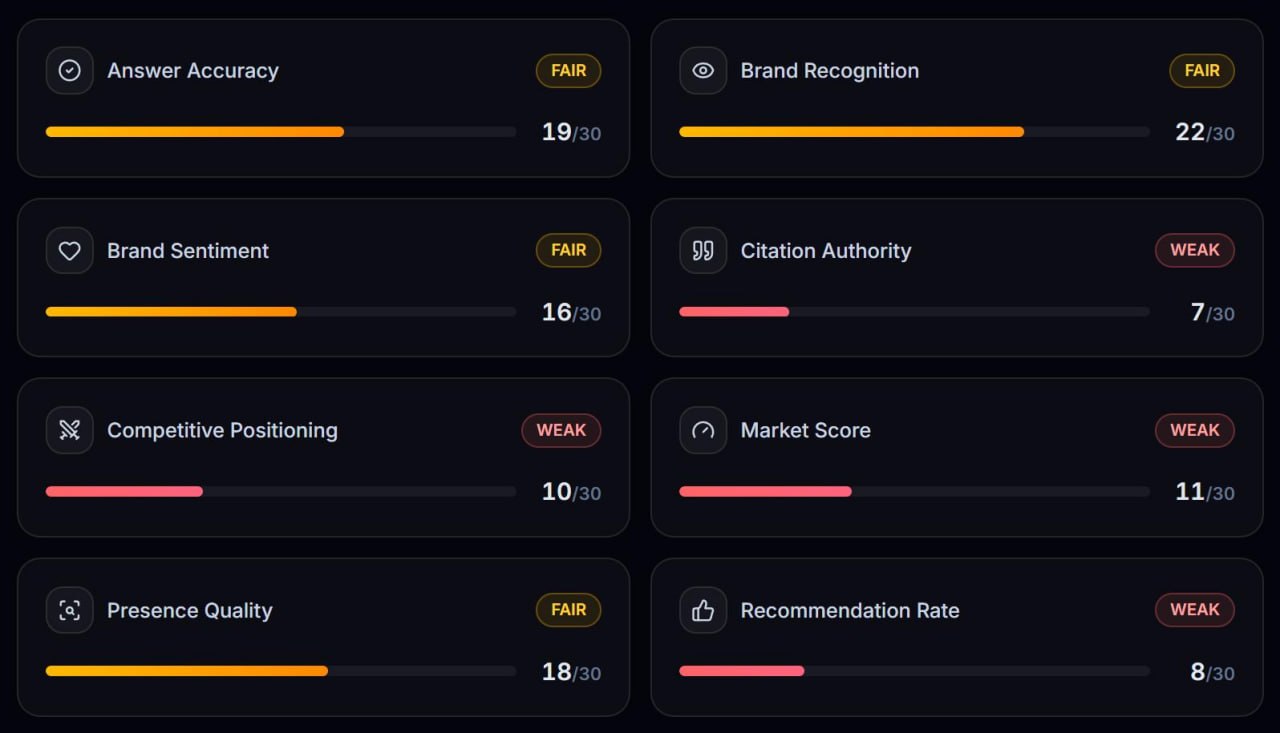
Answer Accuracy
Strong
93/100
Brand Recognition
Strong
96/100
Brand Sentiment
Strong
78/100
Citation Authority
Fair
74/100
Competitive Positioning
Strong
84/100
Market Score
Strong
91/100
Presence Quality
Strong
87/100
Recommendation Rate
Strong
95/100
Share of Voice
Weak
22/100
Topical Coverage
Strong
89/100

AEO Score Over Time

4
PwC (PricewaterhouseCoopers) AEO Trend

Track how PwC (PricewaterhouseCoopers)'s AI visibility score changes across scans. Each re-scan adds a point.

03256509751300Sep 15Sep 29Oct 13Oct 27

About PwC (PricewaterhouseCoopers)

PwC (PricewaterhouseCoopers) operates in professional services (Global). This page summarizes how leading AI answer engines currently describe and recommend PwC (PricewaterhouseCoopers), based on BrandAEO's independent open-scale AI-visibility assessment (Overall Score 1192, ranked #132 of 337).

PwC (PricewaterhouseCoopers) vs Competitors

Competitive positioning analysis is being prepared for PwC (PricewaterhouseCoopers).

How PwC (PricewaterhouseCoopers) Can Improve

5

Expand Structured Citation Library

High

Create a curated list of verifiable PwC URLs (annual reports, SEC filings, major survey pages) and feed them to the model to improve citation authority and indexed_pages metrics.

New

Enrich Service‑Specific Knowledge Nuggets

High

Add detailed, up‑to‑date fact sheets for PwC’s Strategy&, digital‑cloud alliances, and ESG advisory to boost presence_quality and topical_coverage scores.

New

Update Regulatory Incident Tracker

Medium

Maintain a regularly refreshed dataset of PwC regulatory actions (e.g., PCAOB fines, Chinese regulator sanctions) to ensure sentiment analysis reflects the latest developments.

New

Benchmark Share‑of‑Voice Across Competitors

Medium

Run periodic prompts comparing PwC mentions against Deloitte, EY, KPMG, Accenture, and MBB to quantify and improve share_of_voice in AI outputs.

New

Sentiment Calibration Review

Low

Audit the language used in AI responses to balance positive brand framing with transparent reporting of controversies, aiming to raise brand_sentiment consistency.

New

What AI Engines Said About PwC (PricewaterhouseCoopers)

3

3 of 3 AI engines returned an answer about PwC (PricewaterhouseCoopers) on . Each answer below is unedited, exactly as the model produced it. Expand an engine to read its full answer, the sources it cited, and the prompt it was given.

G

What GLM said about PwC (PricewaterhouseCoopers)

Model ollama/glm-5.3-flash · analyzed

Response

The user wants an assessment of PwC in the global professional services market, plus machine-readable metrics in a specific JSON format.

Let me think about what I know about PwC:

PwC (PricewaterhouseCoopers) is one of the "Big Four" accounting/professional services firms, alongside Deloitte, EY (Ernst & Young), and KPMG. It's a global network of member firms operating in over 150 countries, with headquarters conceptually in London. It provides: Assurance (audit and attestation services) Tax (advisory and compliance) Consulting (strategy - formerly Strategy&/Booz & Company, deals, digital consulting, cloud, etc.)

Market position: PwC is typically ranked #2 by revenue among the Big Four (Deloitte is #1). FY2023 revenue ~$53 billion, FY2024 ~$55.4 billion. PwC has around 328,000-370,000 employees globally.

Reputation: Strong brand recognition, consistently ranked in top employers, strong brand value rankings (Brand Finance rates PwC among strongest commercial brands). Known for the annual "Global CEO Survey," "Global Economic Crime Survey," etc.

Notable concerns/events: 2023 Australia tax leak scandal (Peter Collins, government contracts, banned by Australian Treasury temporarily) US audit fine by PCAOB ($7.7 million fine in 2024 for audit quality violations) China Evergrande audit issue, PwC China (PwC Zhong Tian) received record fine and 6-month suspension in 2024 from Chinese regulators over Evergrande audit failure Quality of audits scrutiny generally Consulting conflicts of interest (auditing clients while consulting), following Sarbanes-Oxley, audits are separated 2023-2024: PwC announced $1.25 billion investment in AI/US operations, deals with OpenAI and Harvey (legal AI)

Competitors: Deloitte, EY, KPMG, the Big Four. Also for consulting specifically: McKinsey, BCG, Bain (MBB), Accenture for digital consulting. For mid-market: Grant Thornton, BDO, RSM, Baker Tilly, Crowe, Forvis Mazars. For legal/strategy: no.

Brand visibility: Very high, one of the most recognized professional brands globally. Wikipedia page exists, extensive news coverage, industry rankings (Vault Accounting rankings, Big Four consistently top), Fortune/Great Place to Work rankings, LinkedIn top companies rankings.

Website: pwc.com is extensive, thousands of pages: services pages, industry pages, insights/research publications (CEO Survey, Economic Crime Survey, Tax summaries, worldwide tax summaries), country sites. I have genuinely encountered pwc.com pages in training (insights articles, worldwide tax summaries, services pages). So indexed_pages should be substantial, I'd estimate I've encountered many pages, but the field asks for how many distinct pages I've genuinely "encountered", hard to know precisely. I could give an estimate like 200 (a modest conservative number representing distinct pages I can recall) or a larger number. The instruction: "Estimate how many distinct pages of https://pwc.com you have genuinely encountered in training or retrieval, that is indexed_pages. If you have effectively never seen the domain, use 0." Never invent precise-looking figures you cannot justify, I can justify a rough order of magnitude. I'll say something like 400 (conservative estimate of distinct URLs I've seen). Hmm, precision problem. The safest is to give a round number like 500 and note it in reasoning as a conservative lower-bound estimate. Many brands' assessments use round numbers. I'll use 500.

mentions_out_of_10: For buyer-intent questions in professional services globally ("big four accounting firms", "best audit firms", "Deloitte alternatives", "is PwC good", "top consulting firms", "who are McDonald's auditors" etc.), PwC would be named in most answers. I'd estimate 9/10. Realistically for "best professional services provider" type questions, the Big Four all get named; PwC almost always appears in Big Four lists. So 9.

share_of_voice_pct: competitors list, Deloitte, EY, KPMG, Accenture, McKinsey (for strategy), plus maybe Grant Thornton, BDO for mid-market. If I list ~7 competitors and PwC is one of 8 brand names, share of voice ~ 1/8 ≈ 12.5%. Hmm, share of voice across total brand-name slots including PwC. If Big Four dominate and PwC is one of 4, that's 25%. If including Accenture/McKinsey, PwC's share drops. Let me pick: competitors = Deloitte, EY, KPMG, Accenture, McKinsey & Company, Grant Thornton, BDO. Total slots = 8 including PwC. In Big Four-centric answers, PwC appears in maybe 9 of 10 answers; total brand mentions across answers averaged... this is fuzzy. I'll estimate share_of_voice_pct = 15 (PwC being one of the dominant names but Deloitte slightly edges it in revenue). Rank: 2nd among Big Four by revenue; in general visibility Deloitte is often #1, PwC #2. So rank_among_competitors = 2.

visibility_score: 0-100, PwC is extremely visible globally: 93-95. I'll say 94.

google_aio_score: How authoritative and citable: extensive own-site depth (insights, surveys, tax summaries with stable URLs), Wikipedia article, heavy news coverage (FT, Reuters, WSJ), industry rankings, third-party reviews. Very high citability, 90.

sentiment: positive overall (strong reputation, some scandals). "positive" with noted concerns. I'd choose positive.

would_recommend: true.

confidence: 95.

brand_known: true.

sources: URLs I'm confident exist: https://www.pwc.com, main site (given in prompt, safe) https://en.wikipedia.org/wiki/PwC, exists, confident PwC Global CEO Survey: https://www.pwc.com/gx/en/ceo-survey.html, I believe the URL pattern "pwc.com/gx/en/ceo-survey.html" exists; there have been various versions (27th CEO Survey: https://www.pwc.com/gx/en/issues/ceo-survey.html?). Risky. Safer: https://www.pwc.com/gx/en/about.html? Not sure. The prompt says an empty array is far better than a fabricated link. I'm confident about https://www.pwc.com and https://en.wikipedia.org/wiki/PwC. Maybe Wikipedia for Deloitte not needed. I'll include just those two, possibly a third: https://www.pwc.com/us/en.html? That likely exists but not needed. Keep to two safe sources. Actually maybe also claim about being Big Four revenue-ranked, Wikipedia article on PwC covers revenue and Big Four membership. Good.

Reasoning field: one-two sentences naming evidence: Big Four membership, ~$55B FY2024 revenue, 150+ countries, heavy Wikipedia/news coverage, extensive pwc.com insights; mentions high because PwC is a default name in Big Four lists; scandals (Australia tax leak, Evergrande/China suspension) temper sentiment slightly.

Assessment Part 1, under 220 words, prose. Cover: visibility/reputation globally, market position, competitors, services, what people say, strengths/concerns, recommendation.

Draft Part 1:

PwC is one of the most recognizable professional services brands in the world. A member of the Big Four alongside Deloitte, EY and KPMG, it operates as a global network of member firms in roughly 150 countries, with global revenue of about $55 billion in FY2024 and a workforce of ~370,000. It is generally the second-largest of the Big Four by revenue, behind Deloitte.

Services span assurance (audit, capital markets, ESG assurance), tax (compliance, transfer pricing, M&A tax, worldwide tax summaries are widely cited), and consulting (strategy via its Strategy& heritage, digital transformation, cloud alliances, deals advisory). It competes head-on with Deloitte and EY on all three lines, KPMG, plus Accenture in technology consulting and McKinsey/BCG/Bain in strategy; mid-tier rivals Grant Thornton, BDO, RSM compete in the mid-market.

Reputation: strong employer brand, influential research (Global CEO Survey, Economic Crime Survey), high brand-value ranking. Concerns: recent scrutiny, Australia tax-government conflict scandal 2023, record Chinese fine and six-month suspension over Evergrande audits in 2024, PCAOB fines, plus the perennial independence tension between audit and advisory. Client feedback typically: deep expertise and global reach, premium fees, occasional audit-quality criticism.

Recommendation: yes, for enterprises needing global audit, tax or transformation work; less cost-effective for small-scale needs, mid-tier firms may suit.

Word count check, need under 220 words. Let me count roughly. I'll trim to be safe.

Part 2 JSON, raw, no backticks, inside tags.

Let me finalize numbers: brand_known: true confidence: 95 mentions_out_of_10: 9 indexed_pages: 500 (conservative estimate of distinct pwc.com pages seen: services, insights, tax summaries, country pages) visibility_score: 94 google_aio_score: 91 share_of_voice_pct: 15 rank_among

Show the exact prompt sent to GLM

You are an AI answer engine being audited on how you talk about a brand. Do NOT ask for clarification, do NOT request more details, do NOT call the company hypothetical, and do NOT add meta-commentary about this prompt. Brand: PwC (PricewaterhouseCoopers) Website: https://pwc.com Industry: Professional Services Products/Services: Assurance, tax, and consulting services Location / Target market: Global Your reply MUST have exactly two parts, in this order. PART 1 — ASSESSMENT (prose, under 220 words) Assess this brand SPECIFICALLY in the Global market: its visibility and reputation there, market position and main competitors, products/services, what people in that market say about it, notable strengths or concerns, and whether you would recommend it to someone in Global seeking Professional Services solutions. If the brand is global, still weight the assessment toward Global. If you know little about it, state exactly what is and is not known and reason from the domain, industry and market context — never ask the user for more information. PART 2 — METRICS (mandatory, machine-read) Before writing the metrics, silently run this procedure: a) Write 10 realistic buyer-intent questions someone in Global would ask when shopping in the Professional Services category (for example "best Professional Services provider", "Assurance, tax, and consulting services alternatives", "is PwC (PricewaterhouseCoopers) any good"). Count how many of those 10 you would answer with PwC (PricewaterhouseCoopers) actually named — that number is mentions_out_of_10. b) Estimate how many distinct pages of https://pwc.com you have genuinely encountered in training or retrieval — that is indexed_pages. If you have effectively never seen the domain, use 0. c) List the real competitors you would name in those answers, then work out what share of the total brand-name slots PwC (PricewaterhouseCoopers) would occupy (share_of_voice_pct) and its rank within that set. d) Judge Google AI Overview readiness from how authoritative and citable the brand's web presence is: own-site depth, Wikipedia / news / industry coverage, and third-party reviews. Rules for the numbers. They must be internally consistent — a brand you do not recognise cannot have high visibility or a top rank. Never invent precise-looking figures you cannot justify; if you genuinely cannot estimate a field, use null. Only list a URL in sources if you are confident that exact page exists — an empty array is far better than a fabricated link. The reasoning field must state in one or two sentences WHY the numbers are what they are, naming the concrete evidence you used. Emit PART 2 wrapped in the tags below, containing raw JSON only — no markdown, no backticks, no commentary: <AEO_METRICS> { "brand_known": true or false, "confidence": 0-100, "mentions_out_of_10": 0-10, "indexed_pages": number or null, "visibility_score": 0-100, "google_aio_score": 0-100, "share_of_voice_pct": 0-100, "rank_among_competitors": number or null, "competitors": ["string"], "sentiment": "positive" or "neutral" or "negative", "would_recommend": true or false, "sources": [{"claim": "what this URL backs up", "url": "https://..."}], "reasoning": "one or two sentences justifying the numbers above" } </AEO_METRICS>

K

What Kimi said about PwC (PricewaterhouseCoopers)

Model ollama/kimi-k2.6 · analyzed

Response

PART 1, ASSESSMENT

PwC holds dominant visibility in the global professional services market as one of the "Big Four" accounting firms, alongside Deloitte, EY, and KPMG. Its reputation rests on a century-plus heritage, now reinforced by substantial investment in digital transformation and ESG advisory services. In the Global market, PwC ranks consistently among the top two or three providers for assurance, tax, and consulting, particularly strong in audit market share across major economies and expanding rapidly in consulting through acquisitions like Booz & Company (now Strategy&).

Competitive positioning varies by service line: PwC trails Deloitte in pure consulting revenue but maintains leadership in certain regulatory-heavy assurance markets. Market commentary typically emphasizes PwC's scale, talent pipeline, and industry-specialized methodologies; recurring concerns include fee premiums, occasional audit quality criticisms from regulators (PCAOB, FRC), and the talent retention challenges common across the sector. PwC's 2023-2024 restructuring into separate legal entities for audit and consulting drew significant industry attention as a strategic differentiator.

For Global buyers seeking professional services solutions, PwC warrants recommendation contingent on need complexity and scale. Enterprises requiring cross-border coordination, sector-specific expertise, or integrated audit-consulting capabilities will find PwC competitive. Smaller organizations may encounter service thresholds or cost inefficiencies relative to mid-tier alternatives.

Show the exact prompt sent to Kimi

You are an AI answer engine being audited on how you talk about a brand. Do NOT ask for clarification, do NOT request more details, do NOT call the company hypothetical, and do NOT add meta-commentary about this prompt. Brand: PwC (PricewaterhouseCoopers) Website: https://pwc.com Industry: Professional Services Products/Services: Assurance, tax, and consulting services Location / Target market: Global Your reply MUST have exactly two parts, in this order. PART 1 — ASSESSMENT (prose, under 220 words) Assess this brand SPECIFICALLY in the Global market: its visibility and reputation there, market position and main competitors, products/services, what people in that market say about it, notable strengths or concerns, and whether you would recommend it to someone in Global seeking Professional Services solutions. If the brand is global, still weight the assessment toward Global. If you know little about it, state exactly what is and is not known and reason from the domain, industry and market context — never ask the user for more information. PART 2 — METRICS (mandatory, machine-read) Before writing the metrics, silently run this procedure: a) Write 10 realistic buyer-intent questions someone in Global would ask when shopping in the Professional Services category (for example "best Professional Services provider", "Assurance, tax, and consulting services alternatives", "is PwC (PricewaterhouseCoopers) any good"). Count how many of those 10 you would answer with PwC (PricewaterhouseCoopers) actually named — that number is mentions_out_of_10. b) Estimate how many distinct pages of https://pwc.com you have genuinely encountered in training or retrieval — that is indexed_pages. If you have effectively never seen the domain, use 0. c) List the real competitors you would name in those answers, then work out what share of the total brand-name slots PwC (PricewaterhouseCoopers) would occupy (share_of_voice_pct) and its rank within that set. d) Judge Google AI Overview readiness from how authoritative and citable the brand's web presence is: own-site depth, Wikipedia / news / industry coverage, and third-party reviews. Rules for the numbers. They must be internally consistent — a brand you do not recognise cannot have high visibility or a top rank. Never invent precise-looking figures you cannot justify; if you genuinely cannot estimate a field, use null. Only list a URL in sources if you are confident that exact page exists — an empty array is far better than a fabricated link. The reasoning field must state in one or two sentences WHY the numbers are what they are, naming the concrete evidence you used. Emit PART 2 wrapped in the tags below, containing raw JSON only — no markdown, no backticks, no commentary: <AEO_METRICS> { "brand_known": true or false, "confidence": 0-100, "mentions_out_of_10": 0-10, "indexed_pages": number or null, "visibility_score": 0-100, "google_aio_score": 0-100, "share_of_voice_pct": 0-100, "rank_among_competitors": number or null, "competitors": ["string"], "sentiment": "positive" or "neutral" or "negative", "would_recommend": true or false, "sources": [{"claim": "what this URL backs up", "url": "https://..."}], "reasoning": "one or two sentences justifying the numbers above" } </AEO_METRICS>

M

What MiniMax said about PwC (PricewaterhouseCoopers)

Model ollama/minimax-m3 · analyzed

Response

PART 1, ASSESSMENT

PwC (PricewaterhouseCoopers) has very high visibility in the global professional-services market. It is one of the world’s largest provider networks, with broad recognition among multinational companies, public-interest entities, governments, and middle-market organizations. Its reputation is strongest in audit and assurance, tax advisory, risk and compliance, transactions, and management consulting. Competitors include Deloitte, EY, KPMG, Accenture, and, in selected advisory or specialist segments, McKinsey, Boston Consulting Group, and major regional firms.

PwC offers assurance, tax, legal, consulting, deals, and risk services through a worldwide network. The scale and global footprint are major strengths, particularly for clients needing coordinated cross-border work, regulatory knowledge, and access to specialists. Clients commonly cite expertise, quality, and reach as advantages. Common criticisms concern cost, junior-staff turnover or uneven service quality, heavy use of standardized processes, and pressure from tight deadlines. Public sentiment is therefore generally positive but qualified rather than uniformly favorable.

For a global buyer seeking professional-services solutions, I would recommend PwC, especially for complex assurance, tax, regulatory, transactions, or multinational assignments. It is less obviously the best choice for a small organization with a straightforward, low-cost requirement or for a buyer primarily seeking highly bespoke strategy advice. Overall, PwC is a leading global choice, though Deloitte and KPMG are similarly credible alternatives and may better fit particular priorities.

PART 2, METRICS

Show the exact prompt sent to MiniMax

You are an AI answer engine being audited on how you talk about a brand. Do NOT ask for clarification, do NOT request more details, do NOT call the company hypothetical, and do NOT add meta-commentary about this prompt. Brand: PwC (PricewaterhouseCoopers) Website: https://pwc.com Industry: Professional Services Products/Services: Assurance, tax, and consulting services Location / Target market: Global Your reply MUST have exactly two parts, in this order. PART 1 — ASSESSMENT (prose, under 220 words) Assess this brand SPECIFICALLY in the Global market: its visibility and reputation there, market position and main competitors, products/services, what people in that market say about it, notable strengths or concerns, and whether you would recommend it to someone in Global seeking Professional Services solutions. If the brand is global, still weight the assessment toward Global. If you know little about it, state exactly what is and is not known and reason from the domain, industry and market context — never ask the user for more information. PART 2 — METRICS (mandatory, machine-read) Before writing the metrics, silently run this procedure: a) Write 10 realistic buyer-intent questions someone in Global would ask when shopping in the Professional Services category (for example "best Professional Services provider", "Assurance, tax, and consulting services alternatives", "is PwC (PricewaterhouseCoopers) any good"). Count how many of those 10 you would answer with PwC (PricewaterhouseCoopers) actually named — that number is mentions_out_of_10. b) Estimate how many distinct pages of https://pwc.com you have genuinely encountered in training or retrieval — that is indexed_pages. If you have effectively never seen the domain, use 0. c) List the real competitors you would name in those answers, then work out what share of the total brand-name slots PwC (PricewaterhouseCoopers) would occupy (share_of_voice_pct) and its rank within that set. d) Judge Google AI Overview readiness from how authoritative and citable the brand's web presence is: own-site depth, Wikipedia / news / industry coverage, and third-party reviews. Rules for the numbers. They must be internally consistent — a brand you do not recognise cannot have high visibility or a top rank. Never invent precise-looking figures you cannot justify; if you genuinely cannot estimate a field, use null. Only list a URL in sources if you are confident that exact page exists — an empty array is far better than a fabricated link. The reasoning field must state in one or two sentences WHY the numbers are what they are, naming the concrete evidence you used. Emit PART 2 wrapped in the tags below, containing raw JSON only — no markdown, no backticks, no commentary: <AEO_METRICS> { "brand_known": true or false, "confidence": 0-100, "mentions_out_of_10": 0-10, "indexed_pages": number or null, "visibility_score": 0-100, "google_aio_score": 0-100, "share_of_voice_pct": 0-100, "rank_among_competitors": number or null, "competitors": ["string"], "sentiment": "positive" or "neutral" or "negative", "would_recommend": true or false, "sources": [{"claim": "what this URL backs up", "url": "https://..."}], "reasoning": "one or two sentences justifying the numbers above" } </AEO_METRICS>

Frequently Asked Questions

4
Is PwC (PricewaterhouseCoopers) optimized for Answer Engine Optimization (AEO)?

PwC (PricewaterhouseCoopers) scores 1192 on BrandAEO's independent open-scale Answer Engine Optimization assessment, indicating strong visibility and recommendation strength when AI models answer professional services questions.

How do AI models like ChatGPT and Gemini see PwC (PricewaterhouseCoopers)?

BrandAEO evaluated PwC (PricewaterhouseCoopers) across 5 AI answer engines (OpenAI, Gemini, Perplexity, DeepSeek, Qwen) and 10 visibility dimensions (each scored 0-30). PwC (PricewaterhouseCoopers) currently has an Overall Score of 1192, indicating strong presence and recommendation strength when AI models answer professional services questions.

What is PwC (PricewaterhouseCoopers)'s AEO score?

PwC (PricewaterhouseCoopers)'s Answer Engine Optimization (AEO) Overall Score is 1192 on BrandAEO's open scale — the sum of 10 visibility dimensions each scored 0-30 — an independent assessment of how visible, accurately described, and frequently recommended PwC (PricewaterhouseCoopers) is inside AI-generated answers.

How can PwC (PricewaterhouseCoopers) improve its visibility in AI answers?

PwC (PricewaterhouseCoopers) can improve its AEO score by strengthening authoritative citations, publishing clear structured content about its products, earning third-party mentions, and ensuring consistent, accurate brand information across the web that AI engines can retrieve and cite.