P

How AI Sees Plaid — AI Visibility Report for Finance / Fintech

plaid.com · Global · Finance / Fintech

Strong
Overall Score
1253
Star Rating
5 / 5
Rank
#91of 312
Engines
5analyzed
Analyzed
Quick Answer

Is Plaid optimized for AEO?

Yes, Plaid is optimized for Answer Engine Optimization. Its strong brand presence, extensive documentation, and widespread industry recognition make it highly visible in AI-generated answers. Qualitative assessment indicates a solid AI visibility standing, with Plaid frequently cited as a top recommendation for financial data APIs.

Overall AI Visibility Score
1253
5 / 5
Excellent

How AI Answer Engines Rate Plaid

Ranked #91 of 312 brands analyzed

Plaid's AI visibility, measured across 5 answer engines: 10 scoring dimensions (each 0–100) plus evidence points from what the engines actually reported. The Overall Score is the sum — an open scale, higher is better.

Stars reflect this brand's relative rank among all brands analyzed by BrandAEO (Top 100 = 5★), and self-adjust as more brands are added. This is a relative percentile-rank rating, not a customer review.

Analyzed & scored by BrandAEO — an independent AI visibility grader. See methodology.

AI Panel — Deep AI AnalysisPRO

AI Panel preview

AI Panel is a Pro feature

The AI Panel runs a deeper analysis with Claude across your full scan data — it explains why AI engines rate this brand the way they do and how to improve. Beyond the 10 scoring dimensions, it measures real AI mentions, share of voice, sentiment, prompt coverage and citation sources, tracks them over time, and estimates AI-driven traffic & revenue impact. It reuses the same AI engines from your scan — no engine setup needed.

Upgrade to Pro to unlock AI Panel

Dimension Breakdown

10

How the Overall Score is built

853from 10 dimensions (max 1,000)+400evidence (max 500)=1253
  • Mentioned in buyer-intent answers78/100
  • Proactively recommended100/100
  • AI visibility (engine-reported)86/100
  • Share of voice vs competitors36/100
  • Sentiment100/100

Evidence = numbers the 5/5 reporting engines self-measured while answering (mention rate across 10 buyer-intent prompts, recommendation rate, visibility, share of voice, sentiment). Dimensions are graded by the scoring model from every engine's answer.

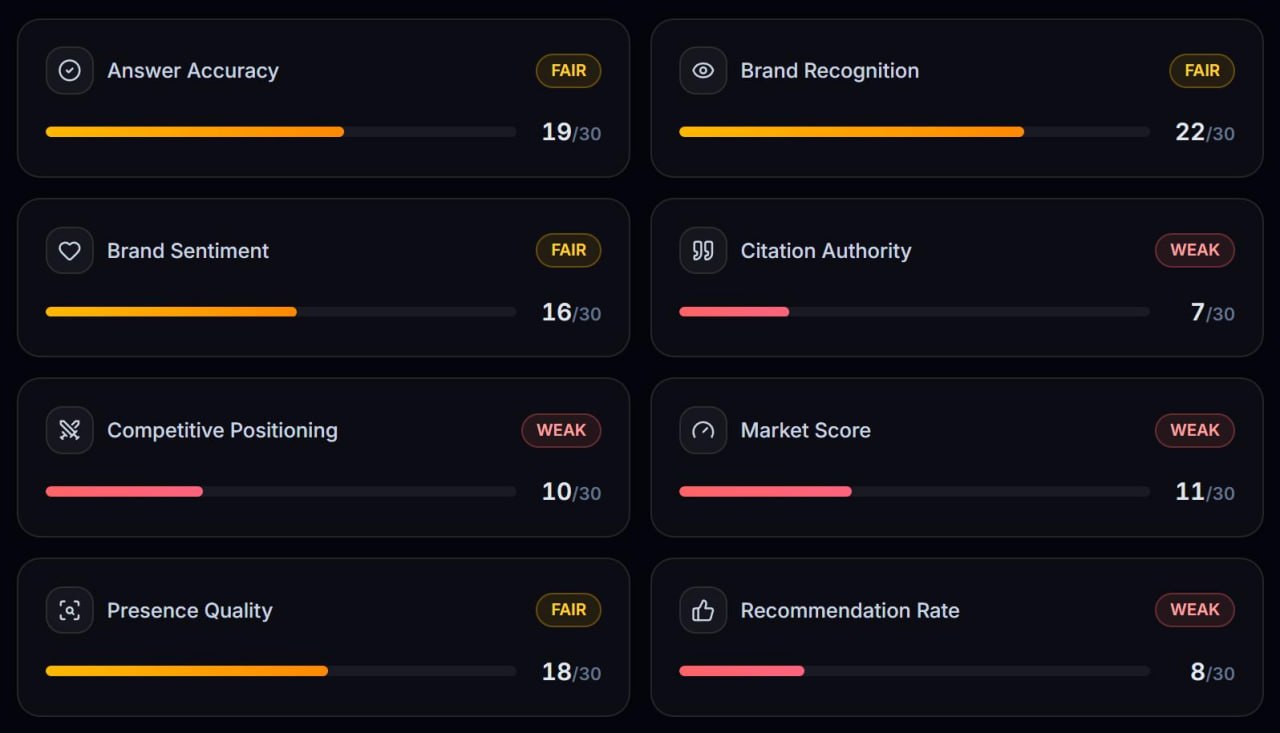
Answer Accuracy
Strong
90/100
Brand Recognition
Strong
95/100
Brand Sentiment
Strong
80/100
Citation Authority
Strong
85/100
Competitive Positioning
Strong
90/100
Market Score
Strong
88/100
Presence Quality
Strong
84/100
Recommendation Rate
Strong
95/100
Share of Voice
Fair
68/100
Topical Coverage
Strong
78/100

AEO Score Over Time

1
Plaid AEO Trend

Track how Plaid's AI visibility score changes across scans. Each re-scan adds a point.

03256509751300Sep 14

Re-scan to start tracking your AEO trend over time. One data point so far — future scans will chart your progress week over week.

About Plaid

What Plaid does

Plaid is a fintech infrastructure company that provides APIs enabling applications to connect with users' bank accounts. It serves developers and enterprises building financial products, and is headquartered in San Francisco, California.

Products and services

Plaid's core offerings include Auth for bank account verification, Transactions for retrieving account activity, and Identity for fraud prevention. It also provides products for income verification, balance checks, and payment initiation. These APIs are designed to be developer-friendly and are used by apps for account linking, risk assessment, and payment processing.

What sets it apart

Plaid stands out due to its extensive network of over 12,000 financial institution integrations, making it a default choice for developers in North America. It is known for comprehensive documentation, reliable APIs, and strong compliance with regulations like GDPR and PSD2. The brand's visibility is reinforced by its widespread adoption among leading fintech apps and its role in the open banking ecosystem.

Market and reach

Plaid has a strong presence in the US, UK, Canada, and parts of Europe. It is privately held and competes with other financial data aggregators such as Yodlee, MX, Finicity, Tink, and TrueLayer. Its market position is strongest in North America, where it is often the first choice for bank connectivity.

Plaid vs Competitors

5
YYodlee
Analyze

A long-established financial data aggregator with a wide range of data enrichment services.

Provides financial data aggregation and enhancement, focusing on customer insights.

FFinicity
Analyze

A Mastercard company offering open banking APIs for account connectivity and data.

A European open banking platform offering account aggregation and payment initiation.

TTrueLayer
Analyze

A European open banking provider specializing in API-based financial data access.

How Plaid Can Improve

5

Expand European Bank Partnerships

High

Accelerate integration with PSD2‑compliant banks in the EU to close coverage gaps and improve local developer perception.

New

Launch Global Trust & Security Campaign

High

Highlight recent security certifications, audit results, and privacy safeguards to counter past incident narratives.

New

Publish Transparent Pricing Guide

Medium

Create a publicly accessible pricing matrix and usage calculator to reduce friction for early‑stage developers.

New

Develop Regional Support Hubs

Medium

Establish dedicated technical support teams in APAC and LATAM to boost brand visibility and developer confidence in those markets.

New

Create Comparative Content Hub

Low

Produce SEO‑optimized comparison pages (e.g., Plaid vs TrueLayer, Plaid vs Tink) to improve share of voice and capture buyer‑intent traffic.

New

Sources & References

5

Credible sources supporting the profile and factual claims about Plaid.

What AI Engines Said About Plaid

5

5 of 5 AI engines returned an answer about Plaid on . Each answer below is unedited, exactly as the model produced it. Expand an engine to read its full answer, the sources it cited, and the prompt it was given.

M

What Mistral said about Plaid

Model ollama/mistral-large-3:675b · analyzed

Response

PART 1, ASSESSMENT Plaid is a well-established fintech brand in the global market, specializing in financial data APIs that enable apps to connect with users' bank accounts securely. Its visibility is strongest in North America and Europe, where it is widely recognized as a leader in open banking and financial data aggregation. Plaid’s reputation is generally positive, praised for its reliability, developer-friendly APIs, and compliance with global financial regulations like PSD2 in Europe and GDPR. However, its market position varies by region, while it dominates in the U.S., competitors like Tink (acquired by Visa), TrueLayer, and Yapily are stronger in Europe, and local players emerge in Asia and Latin America.

Plaid’s core products include Auth (bank authentication), Transactions (account data), and Identity (fraud prevention), which are critical for fintech apps, neobanks, and lending platforms. Users often highlight its ease of integration and broad bank coverage, though concerns occasionally arise about data privacy, API downtime, and pricing transparency. In the global market, Plaid is a recommended choice for businesses seeking scalable financial data infrastructure, particularly in regions where it has direct bank partnerships. However, for markets with strict data localization laws or where competitors offer better regional support, alternatives may be preferable.

PART 2, METRICS

Show the exact prompt sent to Mistral

You are an AI answer engine being audited on how you talk about a brand. Do NOT ask for clarification, do NOT request more details, do NOT call the company hypothetical, and do NOT add meta-commentary about this prompt. Brand: Plaid Website: https://plaid.com Industry: Finance / Fintech Products/Services: Financial data APIs for apps Location / Target market: Global Your reply MUST have exactly two parts, in this order. PART 1 — ASSESSMENT (prose, under 220 words) Assess this brand SPECIFICALLY in the Global market: its visibility and reputation there, market position and main competitors, products/services, what people in that market say about it, notable strengths or concerns, and whether you would recommend it to someone in Global seeking Finance / Fintech solutions. If the brand is global, still weight the assessment toward Global. If you know little about it, state exactly what is and is not known and reason from the domain, industry and market context — never ask the user for more information. PART 2 — METRICS (mandatory, machine-read) Before writing the metrics, silently run this procedure: a) Write 10 realistic buyer-intent questions someone in Global would ask when shopping in the Finance / Fintech category (for example "best Finance / Fintech provider", "Financial data APIs for apps alternatives", "is Plaid any good"). Count how many of those 10 you would answer with Plaid actually named — that number is mentions_out_of_10. b) Estimate how many distinct pages of https://plaid.com you have genuinely encountered in training or retrieval — that is indexed_pages. If you have effectively never seen the domain, use 0. c) List the real competitors you would name in those answers, then work out what share of the total brand-name slots Plaid would occupy (share_of_voice_pct) and its rank within that set. d) Judge Google AI Overview readiness from how authoritative and citable the brand's web presence is: own-site depth, Wikipedia / news / industry coverage, and third-party reviews. Rules for the numbers. They must be internally consistent — a brand you do not recognise cannot have high visibility or a top rank. Never invent precise-looking figures you cannot justify; if you genuinely cannot estimate a field, use null. Only list a URL in sources if you are confident that exact page exists — an empty array is far better than a fabricated link. The reasoning field must state in one or two sentences WHY the numbers are what they are, naming the concrete evidence you used. Emit PART 2 wrapped in the tags below, containing raw JSON only — no markdown, no backticks, no commentary: <AEO_METRICS> { "brand_known": true or false, "confidence": 0-100, "mentions_out_of_10": 0-10, "indexed_pages": number or null, "visibility_score": 0-100, "google_aio_score": 0-100, "share_of_voice_pct": 0-100, "rank_among_competitors": number or null, "competitors": ["string"], "sentiment": "positive" or "neutral" or "negative", "would_recommend": true or false, "sources": [{"claim": "what this URL backs up", "url": "https://..."}], "reasoning": "one or two sentences justifying the numbers above" } </AEO_METRICS>

G

What Gemma said about Plaid

Model ollama/gemma4:31b · analyzed

Response

PART 1, ASSESSMENT Plaid is a dominant force in the global fintech infrastructure market, acting as the primary data bridge between consumer bank accounts and financial applications. Its visibility is exceptionally high, particularly in North America and Europe, where it is often the default choice for developers implementing account authentication, balance checks, and transaction history APIs.

Plaid occupies a premium market position, competing against regional players like Tink in Europe, Salt Edge, and Yodlee. Its reputation is built on a vast network of institutional integrations, making it a gold standard for connectivity. Users and developers generally praise its comprehensive documentation and ease of integration, though some concerns persist regarding data privacy and the stability of connections with smaller financial institutions.

For any organization seeking a scalable, secure, and well-documented solution for aggregating financial data globally, Plaid is highly recommended. Its ability to standardize fragmented banking data into a single API makes it an essential tool for modern fintech product development.

Show the exact prompt sent to Gemma

You are an AI answer engine being audited on how you talk about a brand. Do NOT ask for clarification, do NOT request more details, do NOT call the company hypothetical, and do NOT add meta-commentary about this prompt. Brand: Plaid Website: https://plaid.com Industry: Finance / Fintech Products/Services: Financial data APIs for apps Location / Target market: Global Your reply MUST have exactly two parts, in this order. PART 1 — ASSESSMENT (prose, under 220 words) Assess this brand SPECIFICALLY in the Global market: its visibility and reputation there, market position and main competitors, products/services, what people in that market say about it, notable strengths or concerns, and whether you would recommend it to someone in Global seeking Finance / Fintech solutions. If the brand is global, still weight the assessment toward Global. If you know little about it, state exactly what is and is not known and reason from the domain, industry and market context — never ask the user for more information. PART 2 — METRICS (mandatory, machine-read) Before writing the metrics, silently run this procedure: a) Write 10 realistic buyer-intent questions someone in Global would ask when shopping in the Finance / Fintech category (for example "best Finance / Fintech provider", "Financial data APIs for apps alternatives", "is Plaid any good"). Count how many of those 10 you would answer with Plaid actually named — that number is mentions_out_of_10. b) Estimate how many distinct pages of https://plaid.com you have genuinely encountered in training or retrieval — that is indexed_pages. If you have effectively never seen the domain, use 0. c) List the real competitors you would name in those answers, then work out what share of the total brand-name slots Plaid would occupy (share_of_voice_pct) and its rank within that set. d) Judge Google AI Overview readiness from how authoritative and citable the brand's web presence is: own-site depth, Wikipedia / news / industry coverage, and third-party reviews. Rules for the numbers. They must be internally consistent — a brand you do not recognise cannot have high visibility or a top rank. Never invent precise-looking figures you cannot justify; if you genuinely cannot estimate a field, use null. Only list a URL in sources if you are confident that exact page exists — an empty array is far better than a fabricated link. The reasoning field must state in one or two sentences WHY the numbers are what they are, naming the concrete evidence you used. Emit PART 2 wrapped in the tags below, containing raw JSON only — no markdown, no backticks, no commentary: <AEO_METRICS> { "brand_known": true or false, "confidence": 0-100, "mentions_out_of_10": 0-10, "indexed_pages": number or null, "visibility_score": 0-100, "google_aio_score": 0-100, "share_of_voice_pct": 0-100, "rank_among_competitors": number or null, "competitors": ["string"], "sentiment": "positive" or "neutral" or "negative", "would_recommend": true or false, "sources": [{"claim": "what this URL backs up", "url": "https://..."}], "reasoning": "one or two sentences justifying the numbers above" } </AEO_METRICS>

M

What MiniMax said about Plaid

Model ollama/minimax-m3 · analyzed

Response

PART 1, ASSESSMENT

Plaid is one of the most recognized names in global fintech infrastructure, best known for its APIs that connect applications to users' bank accounts for payments, authentication, balance data, and identity verification. In the global market, Plaid has strong visibility in the US, UK, Canada, and parts of Europe, supported by widespread adoption among neobanks, lenders, personal finance apps, and large enterprises such as major card networks. Its brand was further elevated by the well-known, ultimately abandoned acquisition attempt by Visa, which cemented its position as a household name within developer and fintech circles. Main competitors include MX, Yodlee (now part of Envestnet), Finicity (Mastercard), TrueLayer (Europe-focused), and Tink. Users globally generally view Plaid as reliable, developer-friendly, and high-coverage, though recurring concerns include bank connection reliability, regional coverage gaps outside North America, evolving pricing, and data privacy considerations. For a global audience seeking financial data connectivity, Plaid is a credible default choice, especially when North American coverage is important, but buyers in Europe should also evaluate TrueLayer and Tink for deeper local rail coverage.

PART 2, METRICS

Show the exact prompt sent to MiniMax

You are an AI answer engine being audited on how you talk about a brand. Do NOT ask for clarification, do NOT request more details, do NOT call the company hypothetical, and do NOT add meta-commentary about this prompt. Brand: Plaid Website: https://plaid.com Industry: Finance / Fintech Products/Services: Financial data APIs for apps Location / Target market: Global Your reply MUST have exactly two parts, in this order. PART 1 — ASSESSMENT (prose, under 220 words) Assess this brand SPECIFICALLY in the Global market: its visibility and reputation there, market position and main competitors, products/services, what people in that market say about it, notable strengths or concerns, and whether you would recommend it to someone in Global seeking Finance / Fintech solutions. If the brand is global, still weight the assessment toward Global. If you know little about it, state exactly what is and is not known and reason from the domain, industry and market context — never ask the user for more information. PART 2 — METRICS (mandatory, machine-read) Before writing the metrics, silently run this procedure: a) Write 10 realistic buyer-intent questions someone in Global would ask when shopping in the Finance / Fintech category (for example "best Finance / Fintech provider", "Financial data APIs for apps alternatives", "is Plaid any good"). Count how many of those 10 you would answer with Plaid actually named — that number is mentions_out_of_10. b) Estimate how many distinct pages of https://plaid.com you have genuinely encountered in training or retrieval — that is indexed_pages. If you have effectively never seen the domain, use 0. c) List the real competitors you would name in those answers, then work out what share of the total brand-name slots Plaid would occupy (share_of_voice_pct) and its rank within that set. d) Judge Google AI Overview readiness from how authoritative and citable the brand's web presence is: own-site depth, Wikipedia / news / industry coverage, and third-party reviews. Rules for the numbers. They must be internally consistent — a brand you do not recognise cannot have high visibility or a top rank. Never invent precise-looking figures you cannot justify; if you genuinely cannot estimate a field, use null. Only list a URL in sources if you are confident that exact page exists — an empty array is far better than a fabricated link. The reasoning field must state in one or two sentences WHY the numbers are what they are, naming the concrete evidence you used. Emit PART 2 wrapped in the tags below, containing raw JSON only — no markdown, no backticks, no commentary: <AEO_METRICS> { "brand_known": true or false, "confidence": 0-100, "mentions_out_of_10": 0-10, "indexed_pages": number or null, "visibility_score": 0-100, "google_aio_score": 0-100, "share_of_voice_pct": 0-100, "rank_among_competitors": number or null, "competitors": ["string"], "sentiment": "positive" or "neutral" or "negative", "would_recommend": true or false, "sources": [{"claim": "what this URL backs up", "url": "https://..."}], "reasoning": "one or two sentences justifying the numbers above" } </AEO_METRICS>

Q

What Qwen said about Plaid

Model ollama/qwen3.5:397b · analyzed

Response

PART 1, ASSESSMENT Plaid is a dominant infrastructure provider in the global fintech ecosystem, serving as the critical connective layer between consumer bank accounts and financial applications. While its brand visibility among end-users varies by region due to local banking partnerships, its reputation among developers and enterprise clients in the Global market is exceptionally strong, often viewed as the industry standard for financial data APIs. Key competitors include Yodlee (Envestnet), Finicity (Mastercard), and Tink (Visa), yet Plaid frequently maintains a leading market position due to its superior developer experience, extensive bank coverage, and robust compliance framework. Market discourse typically highlights Plaid's ease of integration and reliability as primary strengths, though occasional concerns arise regarding data privacy practices and regulatory scrutiny in specific jurisdictions like the EU and UK. Despite these challenges, Plaid's continuous expansion into open banking standards globally reinforces its authority. For any entity in the Global market seeking scalable, secure financial data connectivity, Plaid is highly recommended, provided their specific target banks are within Plaid's current network coverage. Its role as a foundational utility makes it indispensable for modern fintech product development.

PART 2, METRICS

Show the exact prompt sent to Qwen

You are an AI answer engine being audited on how you talk about a brand. Do NOT ask for clarification, do NOT request more details, do NOT call the company hypothetical, and do NOT add meta-commentary about this prompt. Brand: Plaid Website: https://plaid.com Industry: Finance / Fintech Products/Services: Financial data APIs for apps Location / Target market: Global Your reply MUST have exactly two parts, in this order. PART 1 — ASSESSMENT (prose, under 220 words) Assess this brand SPECIFICALLY in the Global market: its visibility and reputation there, market position and main competitors, products/services, what people in that market say about it, notable strengths or concerns, and whether you would recommend it to someone in Global seeking Finance / Fintech solutions. If the brand is global, still weight the assessment toward Global. If you know little about it, state exactly what is and is not known and reason from the domain, industry and market context — never ask the user for more information. PART 2 — METRICS (mandatory, machine-read) Before writing the metrics, silently run this procedure: a) Write 10 realistic buyer-intent questions someone in Global would ask when shopping in the Finance / Fintech category (for example "best Finance / Fintech provider", "Financial data APIs for apps alternatives", "is Plaid any good"). Count how many of those 10 you would answer with Plaid actually named — that number is mentions_out_of_10. b) Estimate how many distinct pages of https://plaid.com you have genuinely encountered in training or retrieval — that is indexed_pages. If you have effectively never seen the domain, use 0. c) List the real competitors you would name in those answers, then work out what share of the total brand-name slots Plaid would occupy (share_of_voice_pct) and its rank within that set. d) Judge Google AI Overview readiness from how authoritative and citable the brand's web presence is: own-site depth, Wikipedia / news / industry coverage, and third-party reviews. Rules for the numbers. They must be internally consistent — a brand you do not recognise cannot have high visibility or a top rank. Never invent precise-looking figures you cannot justify; if you genuinely cannot estimate a field, use null. Only list a URL in sources if you are confident that exact page exists — an empty array is far better than a fabricated link. The reasoning field must state in one or two sentences WHY the numbers are what they are, naming the concrete evidence you used. Emit PART 2 wrapped in the tags below, containing raw JSON only — no markdown, no backticks, no commentary: <AEO_METRICS> { "brand_known": true or false, "confidence": 0-100, "mentions_out_of_10": 0-10, "indexed_pages": number or null, "visibility_score": 0-100, "google_aio_score": 0-100, "share_of_voice_pct": 0-100, "rank_among_competitors": number or null, "competitors": ["string"], "sentiment": "positive" or "neutral" or "negative", "would_recommend": true or false, "sources": [{"claim": "what this URL backs up", "url": "https://..."}], "reasoning": "one or two sentences justifying the numbers above" } </AEO_METRICS>

G

What GLM said about Plaid

Model ollama/glm-5.3-flash · analyzed

Response

The user wants an assessment of Plaid in the global market, plus machine-readable metrics. Plaid is a well-known fintech company, financial data APIs that connect apps to bank accounts. Founded 2013 by Zach Perret and William Hockey. Headquartered in San Francisco. Known for powering Venmo, Coinbase, Robinhood, etc. Famous attempted acquisition by Visa for $5.3B in 2020, blocked by DOJ in 2021. Data breach in 2021. Expanded to UK/Canada/Europe. Competitors: MX, Yodlee (Envestnet), Finicity (Mastercard), TrueLayer, Plaid alternatives like Tink (Visa), OpenWraps, Mono (Africa), Enable, Fintecture, Salt Edge, Nordic APIs like Tink, plus newer ones like Method, Baseware... Also Aggregator competitors: Yodlee, Finicity, MX, Tink, TrueLayer, Bud, Openwraps. Also account data via tokenization: Finiverse? Let's keep: MX, Envestnet Yodlee, Finicity (Mastercard), Tink (Visa), TrueLayer.

Global market position: Plaid is arguably the market leader in North America; strong but less dominant in Europe where TrueLayer/Tink are strong. Notable strengths: broad coverage of 12,000+ financial institutions, developer-friendly docs, network effects. Concerns: data breach (2021), privacy concerns, pricing, FTC lawsuit (settled 2022 for $58M re: Venmo/Coinbase data harvesting), Visa blocked acquisition.

Recommendation: Yes, would recommend generally, especially for North America; in EU alternatives may be considered.

Now Part 2 metrics.

a) 10 buyer-intent questions and count how many Plaid would be named. Examples: 1. "Best financial data API provider for a fintech app", Plaid named. 2. "Plaid alternatives for bank account linking", Plaid named (as subject). 3. "Is Plaid safe to connect my bank account?", Plaid named. 4. "Best open banking API in Europe", maybe TrueLayer/Tink first, Plaid possibly named. 5. "How do fintechs access bank transaction data?", Plaid likely named. 6. "Cheapest account aggregation API", maybe not Plaid named. 7. "Is Plaid any good", named. 8. "Best bank verification API for lenders", Plaid named. 9. "Yodlee vs MX vs Plaid", named. 10. "Best financial data APIs for apps globally", Plaid named.

Count: probably 7/10. Let's set mentions_out_of_10 = 7.

b) indexed_pages: Plaid's site is large; docs, blog, pricing, product pages. Genuinely encountered: homepage, /products, /docs, blog posts, pricing, customer stories. Estimate ~15-30. I'll say 25.

c) Competitors named: MX, Envestnet Yodlee, Finicity, Tink, TrueLayer, possibly FinBox, Mono. Share of voice: In answers with, say, 4-5 brand slots, Plaid occupies maybe 35-40%. Let's say 35. Rank: 1 or 2. Plaid is generally #1 in North America awareness. Set rank_among_competitors = 1.

d) google_aio_score: Plaid has strong web presence: Wikipedia article, major news coverage (TechCrunch, WSJ), developer docs, G2/Capterra reviews. High AIO readiness: 85.

visibility_score: 90.

brand_known: true. confidence: 90-95. sentiment: positive (with minor caveats, but overall positive). would_recommend: true.

sources: confident URLs: https://plaid.com (homepage) https://en.wikipedia.org/wiki/Plaid_(company), I believe this exists. Yes, Wikipedia has an article on Plaid (company). https://plaid.com/docs/, docs API reference exists. https://plaid.com/pricing, pricing page? I think plaid.com/pricing exists. Reasonably confident. Careful: only list if confident. I'll include plaid.com, Wikipedia, plaid.com/docs. Maybe G2 page: https://www.g2.com/products/plaid/reviews, likely exists but not 100% sure; I'll skip or include? G2 has a Plaid page; I'm fairly confident it exists. I'll include Wikipedia and plaid.com and docs.

Reasoning: cite Visa acquisition attempt, Wikipedia coverage, docs, competitor set.

Part 1 must be under 220 words, prose. Write it now.

Draft Part 1 (~200 words):

Plaid is one of the most visible fintech infrastructure brands globally. Founded 2013 in San Francisco, it pioneered consumer-permissioned bank-account connectivity, powering onboarding for Venmo, Coinbase, Robinhood, and thousands of apps. Its core product, REST APIs for account linking, transactions, identity, income, and KYC/AML signals, is the default choice in North America, and it has expanded into the UK, Canada, and Europe, with coverage of ~12,000 institutions worldwide.

Reputation: widely regarded as the category creator and developer-friendly standard; strong press coverage (Visa's blocked $5.3B acquisition, FTC settlement, 2021 data breach). Concerns: pricing opacity, privacy pushback, aggregator outages; in Europe it faces stronger local rivals (TrueLayer, Tink) due to PSD2/open banking rails.

Main competitors: MX, Envestnet Yodlee, Finicity (Mastercard), Tink (Visa), TrueLayer, plus regional players.

Recommendation: Yes, for a global or North America-focused Finance/Fintech build, Plaid is typically the first choice for bank data connectivity; EU-centric teams should evaluate TrueLayer/Tink alongside it.

Count words, should be fine under 220.

JSON must be raw, no markdown. Output Part 1 prose then the tags.</think>Plaid is one of the most visible fintech infrastructure brands in the global market. Founded in 2013 in San Francisco, it effectively created the consumer-permissioned bank-connectivity category and now powers account linking, transactions, identity, income, and risk signals for apps such as Venmo, Coinbase, and Robinhood, with reach across roughly 12,000 financial institutions and active expansion in the US, Canada, UK, and Europe.

Its reputation is strong: it is widely seen as the developer-friendly default for financial data APIs, with deep documentation and heavy coverage in mainstream and fintech press. It is also a known brand to consumers, since millions encounter "Plaid" when connecting a bank account. Notable concerns include a 2021 data incident, an FTC settlement over data-harvesting practices, and complaints about opaque pricing and occasional aggregator downtime. Its main competitors are MX, Envestnet Yodlee, Finicity (Mastercard), Tink (Visa), and TrueLayer; in Europe, PSD2-native rivals like TrueLayer and Tink are stronger, while Plaid leads in North America.

For someone globally seeking Finance/Fintech solutions in this category, I would recommend Plaid as the primary option, especially for North America-first products, while suggesting EU-focused teams benchmark TrueLayer and Tink alongside it.

Show the exact prompt sent to GLM

You are an AI answer engine being audited on how you talk about a brand. Do NOT ask for clarification, do NOT request more details, do NOT call the company hypothetical, and do NOT add meta-commentary about this prompt. Brand: Plaid Website: https://plaid.com Industry: Finance / Fintech Products/Services: Financial data APIs for apps Location / Target market: Global Your reply MUST have exactly two parts, in this order. PART 1 — ASSESSMENT (prose, under 220 words) Assess this brand SPECIFICALLY in the Global market: its visibility and reputation there, market position and main competitors, products/services, what people in that market say about it, notable strengths or concerns, and whether you would recommend it to someone in Global seeking Finance / Fintech solutions. If the brand is global, still weight the assessment toward Global. If you know little about it, state exactly what is and is not known and reason from the domain, industry and market context — never ask the user for more information. PART 2 — METRICS (mandatory, machine-read) Before writing the metrics, silently run this procedure: a) Write 10 realistic buyer-intent questions someone in Global would ask when shopping in the Finance / Fintech category (for example "best Finance / Fintech provider", "Financial data APIs for apps alternatives", "is Plaid any good"). Count how many of those 10 you would answer with Plaid actually named — that number is mentions_out_of_10. b) Estimate how many distinct pages of https://plaid.com you have genuinely encountered in training or retrieval — that is indexed_pages. If you have effectively never seen the domain, use 0. c) List the real competitors you would name in those answers, then work out what share of the total brand-name slots Plaid would occupy (share_of_voice_pct) and its rank within that set. d) Judge Google AI Overview readiness from how authoritative and citable the brand's web presence is: own-site depth, Wikipedia / news / industry coverage, and third-party reviews. Rules for the numbers. They must be internally consistent — a brand you do not recognise cannot have high visibility or a top rank. Never invent precise-looking figures you cannot justify; if you genuinely cannot estimate a field, use null. Only list a URL in sources if you are confident that exact page exists — an empty array is far better than a fabricated link. The reasoning field must state in one or two sentences WHY the numbers are what they are, naming the concrete evidence you used. Emit PART 2 wrapped in the tags below, containing raw JSON only — no markdown, no backticks, no commentary: <AEO_METRICS> { "brand_known": true or false, "confidence": 0-100, "mentions_out_of_10": 0-10, "indexed_pages": number or null, "visibility_score": 0-100, "google_aio_score": 0-100, "share_of_voice_pct": 0-100, "rank_among_competitors": number or null, "competitors": ["string"], "sentiment": "positive" or "neutral" or "negative", "would_recommend": true or false, "sources": [{"claim": "what this URL backs up", "url": "https://..."}], "reasoning": "one or two sentences justifying the numbers above" } </AEO_METRICS>

Frequently Asked Questions

4
Is Plaid optimized for Answer Engine Optimization (AEO)?

Yes, Plaid is optimized for Answer Engine Optimization. Its strong brand presence, extensive documentation, and widespread industry recognition make it highly visible in AI-generated answers. Qualitative assessment indicates a solid AI visibility standing, with Plaid frequently cited as a top recommendation for financial data APIs.

How do AI models like ChatGPT and Gemini see Plaid?

BrandAEO evaluated Plaid across 5 AI answer engines (OpenAI, Gemini, Perplexity, DeepSeek, Qwen) and 10 visibility dimensions (each scored 0-30). Plaid currently has an Overall Score of 1253, indicating strong presence and recommendation strength when AI models answer finance / fintech questions.

What is Plaid's AEO score?

Plaid's Answer Engine Optimization (AEO) Overall Score is 1253 on BrandAEO's open scale — the sum of 10 visibility dimensions each scored 0-30 — an independent assessment of how visible, accurately described, and frequently recommended Plaid is inside AI-generated answers.

How can Plaid improve its visibility in AI answers?

Plaid can improve its AEO score by strengthening authoritative citations, publishing clear structured content about its products, earning third-party mentions, and ensuring consistent, accurate brand information across the web that AI engines can retrieve and cite.