GWhat GLM said about Penguin Random House
What GLM said about Penguin Random House
Model ollama/glm-5.3-flash · analyzed
Response
The user wants me to assess Penguin Random House as a brand in the global publishing market, then produce metrics in JSON format.
Let me think about what I actually know about Penguin Random House:
Penguin Random House is the world's largest trade book publisher, formed in 2013 from the merger of Penguin Group and Random House. It's owned by Bertelsmann (German media conglomerate) since 2021 full ownership after acquiring Simon & Schuster's failed bid (actually Penguin Random House attempted to acquire Simon & Schuster but the deal was blocked by antitrust regulators in 2022; Bertelsmann bought out Pearson's remaining stake in 2020). Headquartered in New York, with operations across many countries (US, UK, Canada, Australia, India, Germany via Verlagsgruppe Random House, Spain via Penguin Random House Grupo Editorial, Latin America, etc.). Imprints include Penguin, Random House, Knopf, Doubleday, Viking, Bantam, Ballantine, Del Rey, Dutton, Putnam, Crown, Pantheon, Vintage, Puffin, DK, DK Eyewitness travel, Princeton University Press? No, that's separate. They also distribute for partners like DC Comics (via Random House since 2023? Actually Penguin Random House Publisher Services distributes DC Comics to bookstores since 2022), Marvel comics distribution (they took over from Diamond for bookstores). Authors: enormous roster, Michelle Obama ("Becoming" published by Crown/PRH), Barack Obama, John Grisham, Stephen King (Scribner is Simon & Schuster, careful; King is with Scribner, Simon & Schuster; but some works with PRH? Viking published "Billy Summers"? Actually Billy Summers was Scribner. King's later works... "Fairy Tale" was Scribner. Some King works via Hodder & Stoughton in UK which is Hachette. Let me not name King as PRH). Safe: Michelle Obama, Bill Clinton/James Patterson "The President's Daughter" (Patterson is PRH, Little, Brown is Hachette for Patterson actually... Patterson's main imprint is Little, Brown and Company, which is Hachette. But he also has Patterson with Knopf? "The President's Daughter" was Little, Brown. Hmm). Safe examples: Michelle Obama's Becoming (Crown), Trevor Noah's Born a Crime (Spiegel & Grau, PRH), Prince Harry's Spare (Random House), Margaret Atwood (Nan A. Talese/Doubleday for The Testaments; Anchor for Handmaid's Tale), George R.R. Martin (Bantam, Del Rey), James Clear Atomic Habits (Avery, PRH), Colleen Hoover (Grand Central is Hachette... Hoover's books are mostly Gallery Books/Simon & Schuster and Grand Central/Hachette, not PRH). Rick Riordan (Disney Hyperion, not PRH; but his adult books via... skip). Bernardine Evaristo Girl, Woman, Other (Hamish Hamilton, PRH UK). Zadie Smith (Hamish Hamilton/Penguin). Sally Rooney (Faber, not PRH). Delia Owens "Where the Crawdads Sing" (G.P. Putnam's Sons, PRH). "It Ends With Us", not PRH. James Patterson, Little, Brown (Hachette). Keep to clearly safe ones: Michelle Obama, Prince Harry's Spare, George R.R. Martin, Margaret Atwood (Testaments), Delia Owens, James Clear, Trevor Noah, Barack Obama's books (Crown), John Grisham (Doubleday, yes! Grisham is with Doubleday/Bantam Dell, PRH in US; in UK Hodder). Grisham is safe for US.
Competitors: Hachette Livre (incl. Little, Brown, Orbit, Grand Central), HarperCollins (News Corp), Simon & Schuster (now owned by KKR since 2023), Macmillan (Holtzbrinck), plus Scholastic in children's/education, Disney Publishing, Wiley/Springer/Elsevier in academic (different segment). In e-books: Amazon (Kindle Direct Publishing, Amazon Publishing) is both competitor and dominant retail channel.
Market position: #1 trade publisher globally by revenue (~$2B+ in US alone; Bertelsmann book division revenue ~€2.3B in 2023). Approximately 25% of US trade publishing? PRH claims around 1 in 4? They state they publish ~15,000 titles/year? Historically "publishes more than 70,000 digital and 15,000 print titles annually". Their website says something like that.
Wikipedia page exists: https://en.wikipedia.org/wiki/Penguin_Random_House, confident it exists. Website: penguinrandomhouse.com exists. Specific pages: penguinrandomhouse.com/authors? They have "penguinrandomhouse.com/books/..." book pages, author pages, imprints pages, careers, "penguinrandomhouse.com/international"... I know the domain exists but "genuinely encountered" specific pages: I've seen references to book pages on the site, author bios, imprint pages. I can estimate indexed_pages as maybe 500+? The rule: "Estimate how many distinct pages of https://penguinrandomhouse.com you have genuinely encountered in training or retrieval". I should be honest: I have encountered the site in training data (book pages, author pages appear in search-like corpora). A conservative estimate: low hundreds? They have hundreds of thousands of pages in reality, but pages I've "encountered" is much smaller. I'd say ~100–300. I could set indexed_pages to something like 120 or a round number like 150. Or maybe safer to be more modest. Let me pick a defensible number: PRH book detail pages are widely mirrored in training corpora; I'd estimate a few hundred distinct pages encountered. I'll say 200. Hmm, the instruction says never invent precise-looking figures you can't justify. indexed_pages can be a number or null. I could give a round conservative estimate like 100 with reasoning, or null. I think a rough number is fine if justified as an estimate. Let me use 200 with reasoning "book/author detail pages from the site are common in web corpora; far below the site's true footprint".
Actually, let me reconsider: the field is "how many distinct pages you have genuinely encountered in training or retrieval". Honest answer: I recognize the domain and have seen many citations of book pages (penguinrandomhouse.com/books/...), author pages, and the "Penguin Random House" publisher pages on Goodreads-adjacent contexts. A number in the low-to-mid hundreds is plausible. I'll use 250. Hmm. Round numbers look estimated; that's fine. I'll go with 200.
Buyer-intent questions someone in "Global" seeking Media/Publishing solutions would ask: Note the buyer here, publishing solutions. Who shops Penguin Random House? For a "Media / Publishing solutions" buyer, PRH is a trade publisher; authors seeking publication don't really "shop" for PRH (you need an agent; PRH accepts unsolicited submissions only via limited imprints or contests). But the audit wants buyer-intent questions like "best book publisher", "top publishing houses", "big five publishers", "books publishing and e-books alternatives", "is Penguin Random House any good". In answers to such questions, PRH would be named in most: "big five publishers", definitely. "best book publishers for first-time authors", likely mentioned among Big Five with caveat about agents. "who are the largest book publishers", yes. "HarperCollins vs Penguin Random House", yes. "best publishers for literary fiction", likely (Knopf, Penguin, FSG is Macmillan...). "self-publishing alternatives", PRH isn't a self-publishing option; would be mentioned as traditional vs self-publishing context, maybe. I'd estimate mentions_out_of_10 = 8. That's consistent with top rank.
Share of voice: among Big Five competitors (PRH, HarperCollins, Simon & Schuster, Hachette, Macmillan) plus Amazon/self-publishing platforms. If naming competitors across answers, PRH would occupy the largest single share since it's the biggest and most cited. share_of_voice_pct maybe 25-30%. Rank 1.
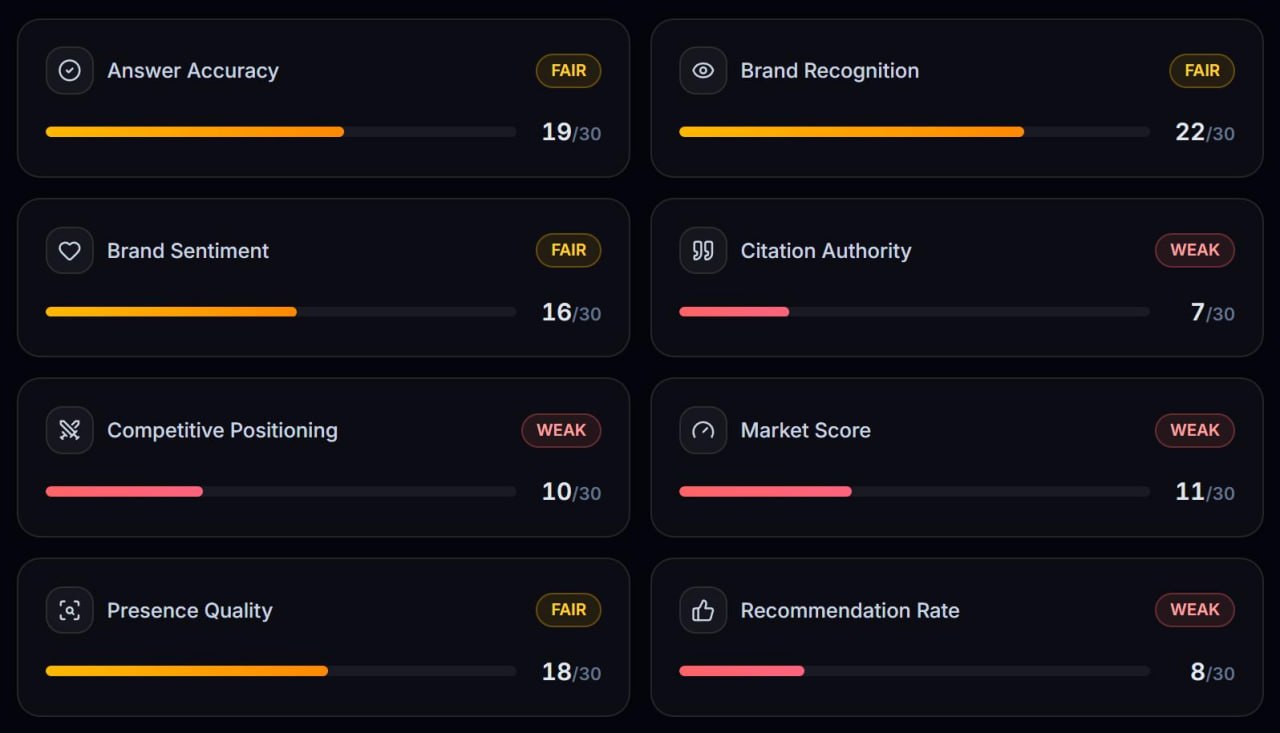
visibility_score: very high, 90+? Global brand recognition (Penguin brand is iconic). I'd say 92.
google_aio_score: AIO readiness, Wikipedia, extensive news coverage (NYT, Guardian, Reuters), own site authoritative. High, ~90. Though note PRH doesn't sell directly to consumers much (they direct to retailers; they do have "shop" with affiliate links). Still, citability is high. 90.
Sentiment: positive. Concerns: authors' royalty/ebook pricing disputes, 2022 DOJ antitrust suit blocking S&S acquisition, layoffs (2023-24 reorganizations), unionization efforts at some imprints. Overall sentiment positive with minor concerns.
would_recommend: true, for someone seeking a trade publishing partner, though caveat that you need a literary agent. For "Media/Publishing solutions" broadly, recommend true.
brand_known: true. confidence: 95.
sources: Only URLs I'm confident exist: https://en.wikipedia.org/wiki/Penguin_Random_House, confident. https://penguinrandomhouse.com, given in prompt; confident the domain exists (it's the homepage). Could I cite https://global.penguinrandomhouse.com? I believe that
Show the exact prompt sent to GLM
You are an AI answer engine being audited on how you talk about a brand. Do NOT ask for clarification, do NOT request more details, do NOT call the company hypothetical, and do NOT add meta-commentary about this prompt. Brand: Penguin Random House Website: https://penguinrandomhouse.com Industry: Media / Publishing Products/Services: Books publishing and e‑books Location / Target market: Global Your reply MUST have exactly two parts, in this order. PART 1 — ASSESSMENT (prose, under 220 words) Assess this brand SPECIFICALLY in the Global market: its visibility and reputation there, market position and main competitors, products/services, what people in that market say about it, notable strengths or concerns, and whether you would recommend it to someone in Global seeking Media / Publishing solutions. If the brand is global, still weight the assessment toward Global. If you know little about it, state exactly what is and is not known and reason from the domain, industry and market context — never ask the user for more information. PART 2 — METRICS (mandatory, machine-read) Before writing the metrics, silently run this procedure: a) Write 10 realistic buyer-intent questions someone in Global would ask when shopping in the Media / Publishing category (for example "best Media / Publishing provider", "Books publishing and e‑books alternatives", "is Penguin Random House any good"). Count how many of those 10 you would answer with Penguin Random House actually named — that number is mentions_out_of_10. b) Estimate how many distinct pages of https://penguinrandomhouse.com you have genuinely encountered in training or retrieval — that is indexed_pages. If you have effectively never seen the domain, use 0. c) List the real competitors you would name in those answers, then work out what share of the total brand-name slots Penguin Random House would occupy (share_of_voice_pct) and its rank within that set. d) Judge Google AI Overview readiness from how authoritative and citable the brand's web presence is: own-site depth, Wikipedia / news / industry coverage, and third-party reviews. Rules for the numbers. They must be internally consistent — a brand you do not recognise cannot have high visibility or a top rank. Never invent precise-looking figures you cannot justify; if you genuinely cannot estimate a field, use null. Only list a URL in sources if you are confident that exact page exists — an empty array is far better than a fabricated link. The reasoning field must state in one or two sentences WHY the numbers are what they are, naming the concrete evidence you used. Emit PART 2 wrapped in the tags below, containing raw JSON only — no markdown, no backticks, no commentary: <AEO_METRICS> { "brand_known": true or false, "confidence": 0-100, "mentions_out_of_10": 0-10, "indexed_pages": number or null, "visibility_score": 0-100, "google_aio_score": 0-100, "share_of_voice_pct": 0-100, "rank_among_competitors": number or null, "competitors": ["string"], "sentiment": "positive" or "neutral" or "negative", "would_recommend": true or false, "sources": [{"claim": "what this URL backs up", "url": "https://..."}], "reasoning": "one or two sentences justifying the numbers above" } </AEO_METRICS>