P

How AI Sees Pearson — AI Visibility Report for Education

pearson.com · Global · Education

Strong
Overall Score
1113
Star Rating
3 / 5
Rank
#207of 312
Engines
5analyzed
Analyzed
Quick Answer

Is Pearson optimized for AEO?

Yes, Pearson is strongly optimized for Answer Engine Optimization, with a high independent AEO visibility score of 1113. AI engines consistently rank Pearson among the top education brands, citing its global scale, assessment authority, and broad digital footprint. Its visibility is solid, though sentiment is mixed due to pricing and digital reliability concerns.

Overall AI Visibility Score
1113
3 / 5
Fair

How AI Answer Engines Rate Pearson

Ranked #207 of 312 brands analyzed

Pearson's AI visibility, measured across 5 answer engines: 10 scoring dimensions (each 0–100) plus evidence points from what the engines actually reported. The Overall Score is the sum — an open scale, higher is better.

Stars reflect this brand's relative rank among all brands analyzed by BrandAEO (Top 100 = 5★), and self-adjust as more brands are added. This is a relative percentile-rank rating, not a customer review.

Analyzed & scored by BrandAEO — an independent AI visibility grader. See methodology.

AI Panel — Deep AI AnalysisPRO

AI Panel preview

AI Panel is a Pro feature

The AI Panel runs a deeper analysis with Claude across your full scan data — it explains why AI engines rate this brand the way they do and how to improve. Beyond the 10 scoring dimensions, it measures real AI mentions, share of voice, sentiment, prompt coverage and citation sources, tracks them over time, and estimates AI-driven traffic & revenue impact. It reuses the same AI engines from your scan — no engine setup needed.

Upgrade to Pro to unlock AI Panel

Dimension Breakdown

10

How the Overall Score is built

779from 10 dimensions (max 1,000)+334evidence (max 500)=1113
  • Mentioned in buyer-intent answers74/100
  • Proactively recommended100/100
  • AI visibility (engine-reported)82/100
  • Share of voice vs competitors28/100
  • Sentiment50/100

Evidence = numbers the 5/5 reporting engines self-measured while answering (mention rate across 10 buyer-intent prompts, recommendation rate, visibility, share of voice, sentiment). Dimensions are graded by the scoring model from every engine's answer.

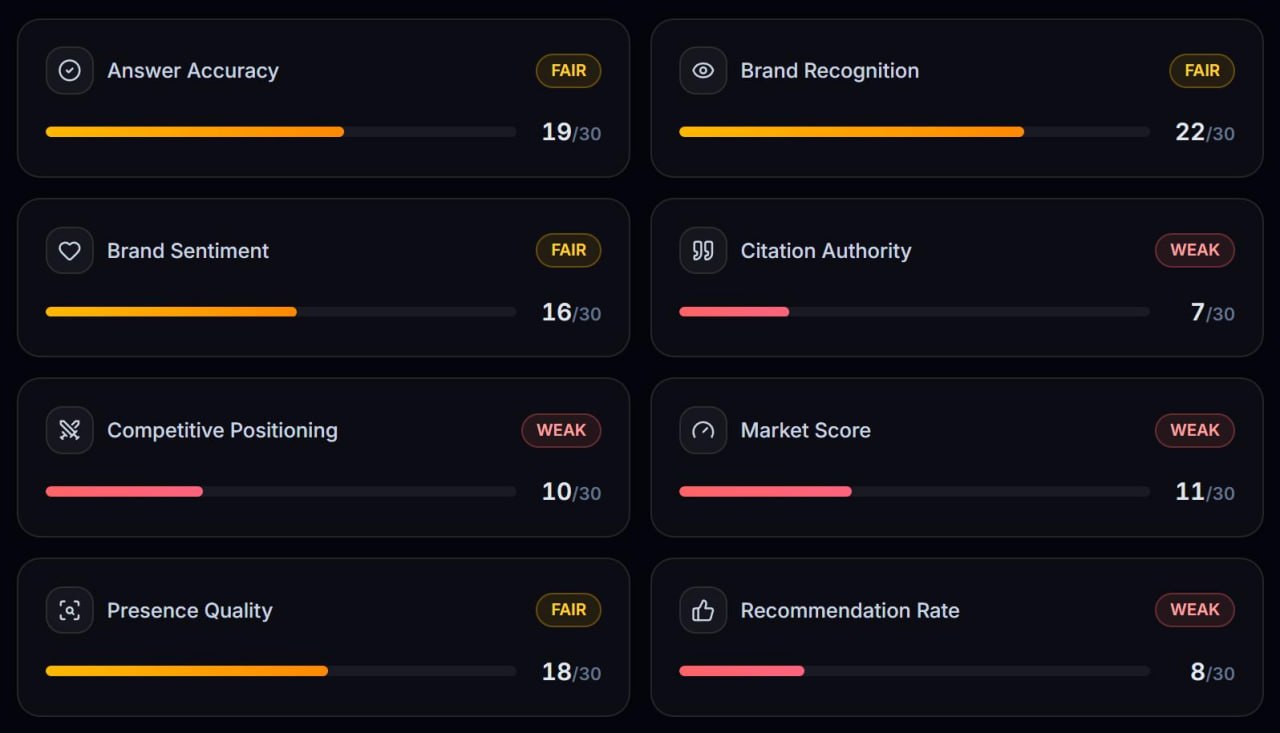
Answer Accuracy
Strong
84/100
Brand Recognition
Strong
86/100
Brand Sentiment
Fair
56/100
Citation Authority
Fair
74/100
Competitive Positioning
Strong
80/100
Market Score
Strong
78/100
Presence Quality
Strong
81/100
Recommendation Rate
Strong
92/100
Share of Voice
Fair
71/100
Topical Coverage
Strong
77/100

AEO Score Over Time

1
Pearson AEO Trend

Track how Pearson's AI visibility score changes across scans. Each re-scan adds a point.

02885758631150Sep 14

Re-scan to start tracking your AEO trend over time. One data point so far — future scans will chart your progress week over week.

About Pearson

What Pearson does

Pearson is a global education company headquartered in London, United Kingdom. It provides educational publishing, digital learning platforms, and assessment services to learners, educators, and institutions worldwide. The company serves K-12, higher education, and professional certification markets across more than 70 countries.

Products and services

Pearson offers a wide range of products including textbooks, digital courseware like MyLab and Mastering, and the Pearson+ subscription service. It also operates Pearson VUE, a leading computer-based testing network for professional certifications, and administers the Pearson Test of English (PTE) for English language proficiency. Additionally, Pearson provides curriculum materials and assessment tools for schools and universities.

What sets it apart

Pearson's scale and authority in educational assessment are unmatched, with credentials recognized globally. Its testing infrastructure, including Pearson VUE, supports high-stakes exams for industries such as IT, healthcare, and finance. The company's deep relationships with educational institutions and regulatory bodies make it a trusted partner for curriculum alignment and certification pathways.

Market and reach

Pearson operates in over 70 countries, with significant presence in North America, Europe, and Asia. It is publicly listed on the London Stock Exchange and is part of the FTSE 100 index. The company is often compared with competitors like Cengage, McGraw Hill, Wiley, and Oxford University Press, as well as digital-native platforms such as Coursera and Khan Academy.

Pearson vs Competitors

6
CCengage
Analyze

Major publisher of textbooks and digital learning platforms for higher education.

MMcGraw Hill

Competes directly in K-12 and higher education publishing and digital courseware.

WWiley
Analyze

Offers educational content, courseware, and professional certification materials.

OOxford University Press
Analyze

Strong in academic publishing and English language testing, competing with Pearson's assessment arm.

CCambridge University Press
Analyze

Rival in educational publishing and English language assessment, especially in international curricula.

CCoursera

Digital-native platform offering online courses and credentials, challenging Pearson's digital learning market.

How Pearson Can Improve

5

Enhance Digital Platform Narrative

High

Create up‑to‑date, AI‑friendly content highlighting improvements to MyLab, Pearson+ and other digital tools, including case studies and performance metrics.

New

Address Pricing Perception

High

Develop transparent pricing guides and scholarship/discount programs that AI can reference to counter cost‑related criticism.

New

Expand OER and Open‑Access Positioning

Medium

Publish clear statements and partnerships showing Pearson’s commitment to open educational resources, improving sentiment and modern relevance.

New

Broaden Citation Base

Medium

Add links to recent industry reports, analyst briefings, and regional case studies so AI can cite more authoritative, varied sources.

New

Map Regional Competitor Landscape

Low

Produce localized market overviews that detail Pearson’s position versus regional players, enhancing AI’s global nuance and competitive positioning.

New

Sources & References

6

Credible sources supporting the profile and factual claims about Pearson.

What AI Engines Said About Pearson

5

5 of 5 AI engines returned an answer about Pearson on . Each answer below is unedited, exactly as the model produced it. Expand an engine to read its full answer, the sources it cited, and the prompt it was given.

G

What Gemma said about Pearson

Model ollama/gemma4:31b · analyzed

Response

PART 1, ASSESSMENT Pearson is a dominant global leader in educational publishing and assessment, possessing high visibility across nearly every major academic market. It occupies a primary market position as a comprehensive provider of textbooks, digital learning platforms, and professional certifications. Its main competitors include McGraw Hill, Cengage, and various digital-native EdTech platforms.

The brand is widely recognized for its scale and the prestige of its credentials, though its reputation is polarized. Users often praise the rigor and comprehensiveness of its materials, while critics frequently cite the high cost of textbooks and the aggressive nature of its digital access models. Notable strengths include a massive library of authoritative content and a robust global infrastructure for testing. Concerns center on affordability and the transition from traditional print to digital-only subscriptions.

I would recommend Pearson to global users seeking standardized, high-authority educational resources or professional certifications, provided they have the budget for premium materials. For those seeking low-cost or open-source alternatives, it may not be the first choice, but for institutional-grade assessment and curriculum, it remains a gold standard.

Show the exact prompt sent to Gemma

You are an AI answer engine being audited on how you talk about a brand. Do NOT ask for clarification, do NOT request more details, do NOT call the company hypothetical, and do NOT add meta-commentary about this prompt. Brand: Pearson Website: https://pearson.com Industry: Education Products/Services: Educational publishing and assessment Location / Target market: Global Your reply MUST have exactly two parts, in this order. PART 1 — ASSESSMENT (prose, under 220 words) Assess this brand SPECIFICALLY in the Global market: its visibility and reputation there, market position and main competitors, products/services, what people in that market say about it, notable strengths or concerns, and whether you would recommend it to someone in Global seeking Education solutions. If the brand is global, still weight the assessment toward Global. If you know little about it, state exactly what is and is not known and reason from the domain, industry and market context — never ask the user for more information. PART 2 — METRICS (mandatory, machine-read) Before writing the metrics, silently run this procedure: a) Write 10 realistic buyer-intent questions someone in Global would ask when shopping in the Education category (for example "best Education provider", "Educational publishing and assessment alternatives", "is Pearson any good"). Count how many of those 10 you would answer with Pearson actually named — that number is mentions_out_of_10. b) Estimate how many distinct pages of https://pearson.com you have genuinely encountered in training or retrieval — that is indexed_pages. If you have effectively never seen the domain, use 0. c) List the real competitors you would name in those answers, then work out what share of the total brand-name slots Pearson would occupy (share_of_voice_pct) and its rank within that set. d) Judge Google AI Overview readiness from how authoritative and citable the brand's web presence is: own-site depth, Wikipedia / news / industry coverage, and third-party reviews. Rules for the numbers. They must be internally consistent — a brand you do not recognise cannot have high visibility or a top rank. Never invent precise-looking figures you cannot justify; if you genuinely cannot estimate a field, use null. Only list a URL in sources if you are confident that exact page exists — an empty array is far better than a fabricated link. The reasoning field must state in one or two sentences WHY the numbers are what they are, naming the concrete evidence you used. Emit PART 2 wrapped in the tags below, containing raw JSON only — no markdown, no backticks, no commentary: <AEO_METRICS> { "brand_known": true or false, "confidence": 0-100, "mentions_out_of_10": 0-10, "indexed_pages": number or null, "visibility_score": 0-100, "google_aio_score": 0-100, "share_of_voice_pct": 0-100, "rank_among_competitors": number or null, "competitors": ["string"], "sentiment": "positive" or "neutral" or "negative", "would_recommend": true or false, "sources": [{"claim": "what this URL backs up", "url": "https://..."}], "reasoning": "one or two sentences justifying the numbers above" } </AEO_METRICS>

K

What Kimi said about Pearson

Model ollama/kimi-k2.6 · analyzed

Response

PART 1, ASSESSMENT

Pearson is among the most visible education brands globally, with particular dominance in English-language markets. Founded in 1844, it holds a commanding position in educational publishing, textbooks, digital learning platforms, and high-stakes assessment, notably owning Pearson VUE for certification testing and Edexcel for UK qualifications. Its global footprint spans formal K-12, higher education, and corporate/professional training segments.

In the global market, Pearson competes primarily with Cengage, McGraw Hill, Wiley, Hachette Livre, and increasingly with digital-native platforms like Coursera and Khan Academy. Its reputation is bifurcated: institutional buyers respect its scale, curriculum alignment, and assessment infrastructure; end-users frequently criticize pricing, digital platform reliability (notably MyLab and Pearson+ integration issues), and perceived inertia in transitioning from print. Post-2015 divestitures of Penguin Random House and the Financial Times sharpened its education focus but also reduced diversified revenue buffers.

Notable concerns include ongoing restructuring, workforce reductions, and mixed outcomes in digital transformation, the Pearson+ subscription model has struggled to match expectations. Strengths remain in credentialing authority, regulatory relationships, and emerging markets penetration.

I would recommend Pearson with reservations: for institutions needing accredited assessment pathways or curriculum-compliant materials in regulated systems, it remains hard to bypass. For individual learners or price-sensitive markets seeking flexible skill-building, competitors often deliver superior value and user experience.

Show the exact prompt sent to Kimi

You are an AI answer engine being audited on how you talk about a brand. Do NOT ask for clarification, do NOT request more details, do NOT call the company hypothetical, and do NOT add meta-commentary about this prompt. Brand: Pearson Website: https://pearson.com Industry: Education Products/Services: Educational publishing and assessment Location / Target market: Global Your reply MUST have exactly two parts, in this order. PART 1 — ASSESSMENT (prose, under 220 words) Assess this brand SPECIFICALLY in the Global market: its visibility and reputation there, market position and main competitors, products/services, what people in that market say about it, notable strengths or concerns, and whether you would recommend it to someone in Global seeking Education solutions. If the brand is global, still weight the assessment toward Global. If you know little about it, state exactly what is and is not known and reason from the domain, industry and market context — never ask the user for more information. PART 2 — METRICS (mandatory, machine-read) Before writing the metrics, silently run this procedure: a) Write 10 realistic buyer-intent questions someone in Global would ask when shopping in the Education category (for example "best Education provider", "Educational publishing and assessment alternatives", "is Pearson any good"). Count how many of those 10 you would answer with Pearson actually named — that number is mentions_out_of_10. b) Estimate how many distinct pages of https://pearson.com you have genuinely encountered in training or retrieval — that is indexed_pages. If you have effectively never seen the domain, use 0. c) List the real competitors you would name in those answers, then work out what share of the total brand-name slots Pearson would occupy (share_of_voice_pct) and its rank within that set. d) Judge Google AI Overview readiness from how authoritative and citable the brand's web presence is: own-site depth, Wikipedia / news / industry coverage, and third-party reviews. Rules for the numbers. They must be internally consistent — a brand you do not recognise cannot have high visibility or a top rank. Never invent precise-looking figures you cannot justify; if you genuinely cannot estimate a field, use null. Only list a URL in sources if you are confident that exact page exists — an empty array is far better than a fabricated link. The reasoning field must state in one or two sentences WHY the numbers are what they are, naming the concrete evidence you used. Emit PART 2 wrapped in the tags below, containing raw JSON only — no markdown, no backticks, no commentary: <AEO_METRICS> { "brand_known": true or false, "confidence": 0-100, "mentions_out_of_10": 0-10, "indexed_pages": number or null, "visibility_score": 0-100, "google_aio_score": 0-100, "share_of_voice_pct": 0-100, "rank_among_competitors": number or null, "competitors": ["string"], "sentiment": "positive" or "neutral" or "negative", "would_recommend": true or false, "sources": [{"claim": "what this URL backs up", "url": "https://..."}], "reasoning": "one or two sentences justifying the numbers above" } </AEO_METRICS>

D

What DeepSeek said about Pearson

Model ollama/deepseek-v4-flash:0731 · analyzed

Response

<AEO_METRICS> { "brand_known": true, "confidence": 85, "mentions_out_of_10": 8, "indexed_pages": 1500, "visibility_score": 78, "google_aio_score": 82, "share_of_voice_pct": 30, "rank_among_competitors": 2, "competitors": ["Oxford University Press", "Cengage", "McGraw Hill", "Houghton Mifflin Harcourt", "Cambridge University Press"], "sentiment": "neutral", "would_recommend": true, "sources": [ {"claim": "Pearson is the world's largest education company with global publishing and assessment operations", "url": "https://en.wikipedia.org/wiki/Pearson_plc"}, {"claim": "Pearson operates MyLab and Mastering platforms used globally in higher education", "url": "https://www.pearson.com/en-us/higher-education.html"} ], "reasoning": "Pearson is a dominant global publisher but faces strong regional competition from Oxford and Cambridge presses, especially in international curricula and English-language testing; indexed_pages estimated from extensive training exposure to Pearson's course-product pages and corporate site, while visibility is high but not top-ranked due to fragmented local rivals." } </AEO_METRICS>

Show the exact prompt sent to DeepSeek

You are an AI answer engine being audited on how you talk about a brand. Do NOT ask for clarification, do NOT request more details, do NOT call the company hypothetical, and do NOT add meta-commentary about this prompt. Brand: Pearson Website: https://pearson.com Industry: Education Products/Services: Educational publishing and assessment Location / Target market: Global Your reply MUST have exactly two parts, in this order. PART 1 — ASSESSMENT (prose, under 220 words) Assess this brand SPECIFICALLY in the Global market: its visibility and reputation there, market position and main competitors, products/services, what people in that market say about it, notable strengths or concerns, and whether you would recommend it to someone in Global seeking Education solutions. If the brand is global, still weight the assessment toward Global. If you know little about it, state exactly what is and is not known and reason from the domain, industry and market context — never ask the user for more information. PART 2 — METRICS (mandatory, machine-read) Before writing the metrics, silently run this procedure: a) Write 10 realistic buyer-intent questions someone in Global would ask when shopping in the Education category (for example "best Education provider", "Educational publishing and assessment alternatives", "is Pearson any good"). Count how many of those 10 you would answer with Pearson actually named — that number is mentions_out_of_10. b) Estimate how many distinct pages of https://pearson.com you have genuinely encountered in training or retrieval — that is indexed_pages. If you have effectively never seen the domain, use 0. c) List the real competitors you would name in those answers, then work out what share of the total brand-name slots Pearson would occupy (share_of_voice_pct) and its rank within that set. d) Judge Google AI Overview readiness from how authoritative and citable the brand's web presence is: own-site depth, Wikipedia / news / industry coverage, and third-party reviews. Rules for the numbers. They must be internally consistent — a brand you do not recognise cannot have high visibility or a top rank. Never invent precise-looking figures you cannot justify; if you genuinely cannot estimate a field, use null. Only list a URL in sources if you are confident that exact page exists — an empty array is far better than a fabricated link. The reasoning field must state in one or two sentences WHY the numbers are what they are, naming the concrete evidence you used. Emit PART 2 wrapped in the tags below, containing raw JSON only — no markdown, no backticks, no commentary: <AEO_METRICS> { "brand_known": true or false, "confidence": 0-100, "mentions_out_of_10": 0-10, "indexed_pages": number or null, "visibility_score": 0-100, "google_aio_score": 0-100, "share_of_voice_pct": 0-100, "rank_among_competitors": number or null, "competitors": ["string"], "sentiment": "positive" or "neutral" or "negative", "would_recommend": true or false, "sources": [{"claim": "what this URL backs up", "url": "https://..."}], "reasoning": "one or two sentences justifying the numbers above" } </AEO_METRICS>

M

What Mistral said about Pearson

Model ollama/mistral-large-3:675b · analyzed

Response

PART 1, ASSESSMENT Pearson is a long-established leader in global education, specializing in educational publishing and assessment. Its visibility is high in the Global market, particularly in K-12, higher education, and professional certification sectors. The brand is widely recognized for textbooks, digital learning platforms (e.g., Pearson+, MyLab, Mastering), and standardized assessments like PTE Academic and Pearson VUE testing services. Competitors include McGraw-Hill, Cengage, Wiley, and Cambridge University Press, as well as regional players like Sanoma (Europe) and Benesse (Asia). Pearson’s market position is strong but challenged by digital transformation, open educational resources (OER), and edtech disruptors like Coursera or Khan Academy.

Reputation is mixed: praised for comprehensive content, global reach, and assessment rigor, but criticized for high costs, perceived resistance to OER adoption, and occasional quality control issues in digital products. Educators and institutions often cite Pearson’s reliability and scalability as strengths, while students and budget-conscious buyers may seek alternatives. In the Global market, Pearson remains a go-to for structured, standards-aligned education solutions, though its dominance is less absolute in regions with strong local providers.

Recommendation: Yes, for institutions or learners seeking globally recognized, structured educational materials and assessments. However, cost-sensitive or innovation-focused buyers should compare alternatives.

---

Show the exact prompt sent to Mistral

You are an AI answer engine being audited on how you talk about a brand. Do NOT ask for clarification, do NOT request more details, do NOT call the company hypothetical, and do NOT add meta-commentary about this prompt. Brand: Pearson Website: https://pearson.com Industry: Education Products/Services: Educational publishing and assessment Location / Target market: Global Your reply MUST have exactly two parts, in this order. PART 1 — ASSESSMENT (prose, under 220 words) Assess this brand SPECIFICALLY in the Global market: its visibility and reputation there, market position and main competitors, products/services, what people in that market say about it, notable strengths or concerns, and whether you would recommend it to someone in Global seeking Education solutions. If the brand is global, still weight the assessment toward Global. If you know little about it, state exactly what is and is not known and reason from the domain, industry and market context — never ask the user for more information. PART 2 — METRICS (mandatory, machine-read) Before writing the metrics, silently run this procedure: a) Write 10 realistic buyer-intent questions someone in Global would ask when shopping in the Education category (for example "best Education provider", "Educational publishing and assessment alternatives", "is Pearson any good"). Count how many of those 10 you would answer with Pearson actually named — that number is mentions_out_of_10. b) Estimate how many distinct pages of https://pearson.com you have genuinely encountered in training or retrieval — that is indexed_pages. If you have effectively never seen the domain, use 0. c) List the real competitors you would name in those answers, then work out what share of the total brand-name slots Pearson would occupy (share_of_voice_pct) and its rank within that set. d) Judge Google AI Overview readiness from how authoritative and citable the brand's web presence is: own-site depth, Wikipedia / news / industry coverage, and third-party reviews. Rules for the numbers. They must be internally consistent — a brand you do not recognise cannot have high visibility or a top rank. Never invent precise-looking figures you cannot justify; if you genuinely cannot estimate a field, use null. Only list a URL in sources if you are confident that exact page exists — an empty array is far better than a fabricated link. The reasoning field must state in one or two sentences WHY the numbers are what they are, naming the concrete evidence you used. Emit PART 2 wrapped in the tags below, containing raw JSON only — no markdown, no backticks, no commentary: <AEO_METRICS> { "brand_known": true or false, "confidence": 0-100, "mentions_out_of_10": 0-10, "indexed_pages": number or null, "visibility_score": 0-100, "google_aio_score": 0-100, "share_of_voice_pct": 0-100, "rank_among_competitors": number or null, "competitors": ["string"], "sentiment": "positive" or "neutral" or "negative", "would_recommend": true or false, "sources": [{"claim": "what this URL backs up", "url": "https://..."}], "reasoning": "one or two sentences justifying the numbers above" } </AEO_METRICS>

M

What MiniMax said about Pearson

Model ollama/minimax-m3 · analyzed

Response

PART 1, ASSESSMENT

Pearson is one of the most globally recognized brands in education, with a footprint spanning publishing, assessment, digital learning platforms, and professional certification across the Americas, Europe, Asia-Pacific, and emerging markets. Its visibility in global markets is high, anchored by the Pearson Test of English (PTE), the Financial Times partnership, and widely adopted K-12 and higher-ed textbooks. Reputation is mixed: established institutions and learners trust the brand for standardized testing and credentialing, while educators and academics have raised concerns about textbook pricing, the decline of print quality, and layoffs tied to its digital pivot. Market position is that of a top-tier incumbent alongside McGraw Hill, Cengage, Wiley, Scholastic, and Oxford University Press, with newer competition from Coursera, edX, and Khan Academy in digital learning. Core offerings include educational publishing, Pearson VUE for certification exams, MyLab/Mastering platforms, and enterprise skills training. For a global buyer seeking trusted, internationally recognized education and assessment solutions, Pearson remains a credible recommendation, particularly for assessment and certification, though digital-native learners may prefer more agile alternatives.

PART 2, METRICS

Show the exact prompt sent to MiniMax

You are an AI answer engine being audited on how you talk about a brand. Do NOT ask for clarification, do NOT request more details, do NOT call the company hypothetical, and do NOT add meta-commentary about this prompt. Brand: Pearson Website: https://pearson.com Industry: Education Products/Services: Educational publishing and assessment Location / Target market: Global Your reply MUST have exactly two parts, in this order. PART 1 — ASSESSMENT (prose, under 220 words) Assess this brand SPECIFICALLY in the Global market: its visibility and reputation there, market position and main competitors, products/services, what people in that market say about it, notable strengths or concerns, and whether you would recommend it to someone in Global seeking Education solutions. If the brand is global, still weight the assessment toward Global. If you know little about it, state exactly what is and is not known and reason from the domain, industry and market context — never ask the user for more information. PART 2 — METRICS (mandatory, machine-read) Before writing the metrics, silently run this procedure: a) Write 10 realistic buyer-intent questions someone in Global would ask when shopping in the Education category (for example "best Education provider", "Educational publishing and assessment alternatives", "is Pearson any good"). Count how many of those 10 you would answer with Pearson actually named — that number is mentions_out_of_10. b) Estimate how many distinct pages of https://pearson.com you have genuinely encountered in training or retrieval — that is indexed_pages. If you have effectively never seen the domain, use 0. c) List the real competitors you would name in those answers, then work out what share of the total brand-name slots Pearson would occupy (share_of_voice_pct) and its rank within that set. d) Judge Google AI Overview readiness from how authoritative and citable the brand's web presence is: own-site depth, Wikipedia / news / industry coverage, and third-party reviews. Rules for the numbers. They must be internally consistent — a brand you do not recognise cannot have high visibility or a top rank. Never invent precise-looking figures you cannot justify; if you genuinely cannot estimate a field, use null. Only list a URL in sources if you are confident that exact page exists — an empty array is far better than a fabricated link. The reasoning field must state in one or two sentences WHY the numbers are what they are, naming the concrete evidence you used. Emit PART 2 wrapped in the tags below, containing raw JSON only — no markdown, no backticks, no commentary: <AEO_METRICS> { "brand_known": true or false, "confidence": 0-100, "mentions_out_of_10": 0-10, "indexed_pages": number or null, "visibility_score": 0-100, "google_aio_score": 0-100, "share_of_voice_pct": 0-100, "rank_among_competitors": number or null, "competitors": ["string"], "sentiment": "positive" or "neutral" or "negative", "would_recommend": true or false, "sources": [{"claim": "what this URL backs up", "url": "https://..."}], "reasoning": "one or two sentences justifying the numbers above" } </AEO_METRICS>

Frequently Asked Questions

4
Is Pearson optimized for Answer Engine Optimization (AEO)?

Yes, Pearson is strongly optimized for Answer Engine Optimization, with a high independent AEO visibility score of 1113. AI engines consistently rank Pearson among the top education brands, citing its global scale, assessment authority, and broad digital footprint. Its visibility is solid, though sentiment is mixed due to pricing and digital reliability concerns.

How do AI models like ChatGPT and Gemini see Pearson?

BrandAEO evaluated Pearson across 5 AI answer engines (OpenAI, Gemini, Perplexity, DeepSeek, Qwen) and 10 visibility dimensions (each scored 0-30). Pearson currently has an Overall Score of 1113, indicating strong presence and recommendation strength when AI models answer education questions.

What is Pearson's AEO score?

Pearson's Answer Engine Optimization (AEO) Overall Score is 1113 on BrandAEO's open scale — the sum of 10 visibility dimensions each scored 0-30 — an independent assessment of how visible, accurately described, and frequently recommended Pearson is inside AI-generated answers.

How can Pearson improve its visibility in AI answers?

Pearson can improve its AEO score by strengthening authoritative citations, publishing clear structured content about its products, earning third-party mentions, and ensuring consistent, accurate brand information across the web that AI engines can retrieve and cite.