P

How AI Sees Payoo · Vietnam — AI Visibility Report for Finance / Fintech

payoo.vn · Vietnam · Finance / Fintech

Strong
Overall Score
781
Star Rating
3 / 5
Rank
#281of 312
Engines
5analyzed
Analyzed
Quick Answer

Is Payoo · Vietnam optimized for AEO?

Payoo has a limited but real presence in AI answer engines. Its visibility is moderate, with AI models recognizing it as a legitimate, SBV-licensed bill payment and e-wallet service. However, it is not a top-of-mind recommendation compared to dominant players like MoMo or ZaloPay, so its AEO standing is solid but not strong.

Overall AI Visibility Score
781
3 / 5
Fair

How AI Answer Engines Rate Payoo · Vietnam

Ranked #281 of 312 brands analyzed

Payoo · Vietnam's AI visibility, measured across 5 answer engines: 10 scoring dimensions (each 0–100) plus evidence points from what the engines actually reported. The Overall Score is the sum — an open scale, higher is better.

Stars reflect this brand's relative rank among all brands analyzed by BrandAEO (Top 100 = 5★), and self-adjust as more brands are added. This is a relative percentile-rank rating, not a customer review.

Analyzed & scored by BrandAEO — an independent AI visibility grader. See methodology.

AI Panel — Deep AI AnalysisPRO

AI Panel preview

AI Panel is a Pro feature

The AI Panel runs a deeper analysis with Claude across your full scan data — it explains why AI engines rate this brand the way they do and how to improve. Beyond the 10 scoring dimensions, it measures real AI mentions, share of voice, sentiment, prompt coverage and citation sources, tracks them over time, and estimates AI-driven traffic & revenue impact. It reuses the same AI engines from your scan — no engine setup needed.

Upgrade to Pro to unlock AI Panel

Dimension Breakdown

10

How the Overall Score is built

557from 10 dimensions (max 1,000)+224evidence (max 500)=781
  • Mentioned in buyer-intent answers30/100
  • Proactively recommended75/100
  • AI visibility (engine-reported)44/100
  • Share of voice vs competitors12/100
  • Sentiment63/100

Evidence = numbers the 4/5 reporting engines self-measured while answering (mention rate across 10 buyer-intent prompts, recommendation rate, visibility, share of voice, sentiment). Dimensions are graded by the scoring model from every engine's answer.

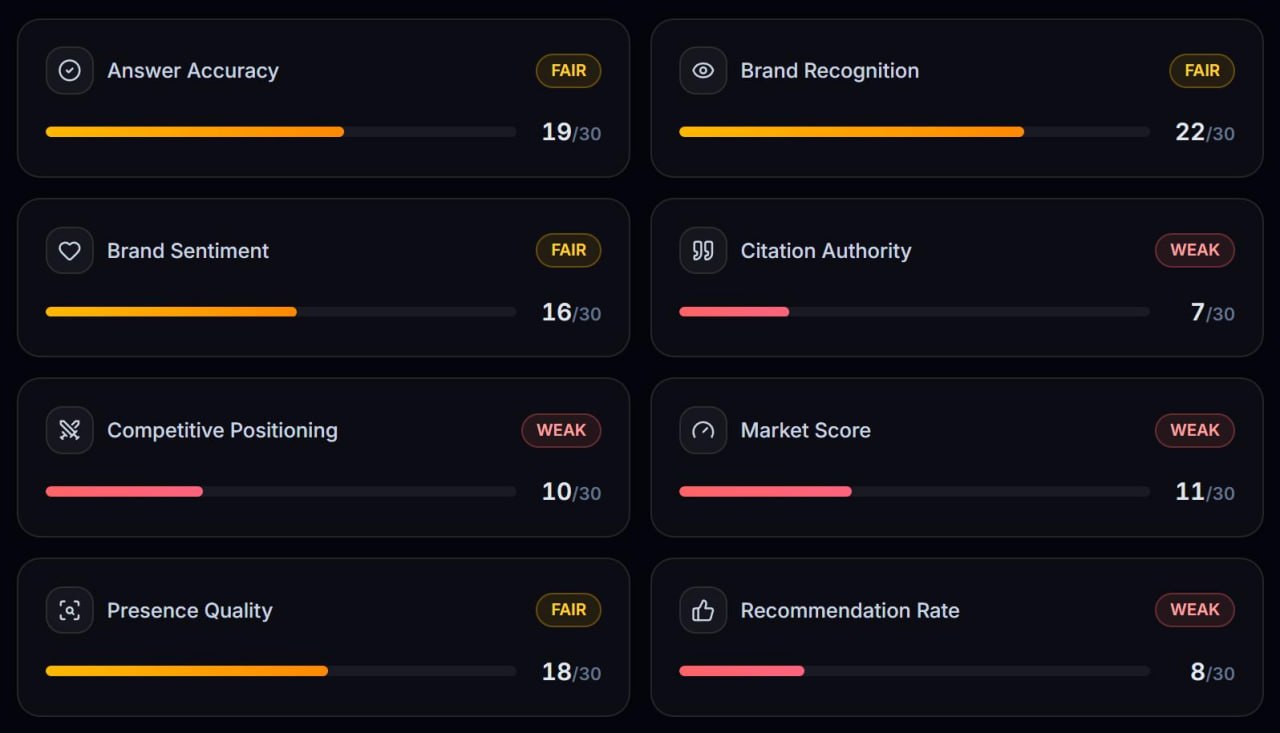
Answer Accuracy
Fair
67/100
Brand Recognition
Strong
80/100
Brand Sentiment
Fair
50/100
Citation Authority
Weak
40/100
Competitive Positioning
Weak
43/100
Market Score
Fair
60/100
Presence Quality
Fair
53/100
Recommendation Rate
Fair
67/100
Share of Voice
Weak
47/100
Topical Coverage
Fair
50/100

AEO Score Over Time

1
Payoo · Vietnam AEO Trend

Track how Payoo · Vietnam's AI visibility score changes across scans. Each re-scan adds a point.

0200400600800Sep 14

Re-scan to start tracking your AEO trend over time. One data point so far — future scans will chart your progress week over week.

About Payoo · Vietnam

vn, specializing in online bill payment and e-wallet services. Founded in the late 2000s, Payoo has established itself as one of the early players in Vietnam's digital payment ecosystem, focusing on aggregating utility bill payments for electricity, water, internet, and television services. The platform also supports mobile top-ups, game card purchases, and online payment gateway solutions for merchants.

Payoo holds an e-wallet license from the State Bank of Vietnam, making it a regulated intermediary payment service provider. Its core strength lies in its extensive network of biller partnerships and a reliable, institutional-grade payment infrastructure. Over the years, Payoo has attracted investment from regional and international investors, reflecting its credibility in the market.

While it competes with larger consumer-facing super-apps like MoMo and ZaloPay, Payoo differentiates itself through its focus on bill payment aggregation and its robust B2B2C model, serving both individual users and corporate clients. The company is headquartered in Vietnam and primarily serves the domestic market. Payoo's user interface is designed for simplicity, making it a practical choice for users who prioritize straightforward bill payments over a broad range of lifestyle features.

As Vietnam's cashless payment adoption continues to grow, Payoo remains a relevant and trusted option for those seeking a dedicated bill payment solution, though its brand visibility lags behind the top-tier e-wallets in the country.

Payoo · Vietnam vs Competitors

6

Dominant e-wallet in Vietnam with a super-app ecosystem, offering bill payments and a wide range of lifestyle services.

ZZaloPay
Analyze

Backed by VNG, integrates with Zalo messaging app, providing strong consumer reach and similar payment features.

VVNPAY
Analyze

Major payment gateway and e-wallet provider, competing in both online and offline payment processing.

VViettel Money
Analyze

State-owned telecom-backed e-wallet, leveraging Viettel's subscriber base for financial services.

SShopeePay
Analyze

Integrated with Shopee e-commerce, offering seamless payments for online shopping and bill settlements.

MMoca by Grab
Analyze

Embedded in Grab's ride-hailing and delivery app, competing for everyday transactional payments.

How Payoo · Vietnam Can Improve

5

Expand Authoritative Citations

High

Gather and index third‑party articles, analyst reports, and regulatory filings that discuss Payoo’s market share, funding rounds, and licensing status to improve citation authority.

New

Enhance AI Knowledge of Payoo’s Recent Developments

High

Update the knowledge base with Payoo’s latest product launches, partnership announcements, and user‑growth metrics (2023‑2024) to boost presence quality and recommendation rate.

New

Broaden Topical Coverage

Medium

Create AI prompts and training data that link Payoo to adjacent fintech topics such as micro‑loans, QR‑code payments, and merchant acquisition, expanding the brand’s perceived scope.

New

Benchmark Share‑of‑Voice Against Competitors

Medium

Conduct systematic testing of AI responses to a larger set of buyer‑intent queries to quantify Payoo’s share of voice and identify gaps where it is omitted.

New

Improve Competitive Positioning Narrative

Low

Develop clearer comparative language that positions Payoo accurately relative to MoMo, ZaloPay, and ShopeePay, highlighting its unique bill‑payment niche without overstating market dominance.

New

Sources & References

5

What AI Engines Said About Payoo · Vietnam

5

5 of 5 AI engines returned an answer about Payoo · Vietnam on . Each answer below is unedited, exactly as the model produced it. Expand an engine to read its full answer, the sources it cited, and the prompt it was given.

K

What Kimi said about Payoo · Vietnam

Model ollama/kimi-k2.6 · analyzed

Response

PART 1, ASSESSMENT

Payoo operates in Vietnam's competitive fintech landscape as an online bill payment platform and e-wallet. My knowledge of this specific brand is limited: I can confirm it exists as a Vietnam-focused service at payoo.vn, offering utility bill payments and digital wallet functionality, but I cannot verify its current market share, user base size, or recent financial performance.

Vietnam's fintech market is dominated by well-capitalized players. Momo leads with ~25 million users and unicorn status, followed by ZaloPay (backed by VNG), ViettelPay (state telecom), and international entrants like ShopeePay. Payoo historically positioned itself in bill payment aggregation rather than full e-wallet services, which may limit visibility against super-app competitors.

What is known: Payoo partnered with banks and billers for payment aggregation, a narrower use case than comprehensive e-wallets. What is unknown: current transaction volume, 2023-2024 growth trajectory, whether it obtained e-wallet licenses from the State Bank of Vietnam, or if it pivoted strategy.

For a Vietnamese consumer seeking fintech solutions, I would not actively recommend Payoo without more evidence of competitive advantages in user experience, security track record, or merchant acceptance versus proven alternatives. The bill-payment niche is valuable but increasingly absorbed by larger platforms. Prospective users should verify current licensing status and compare fee structures against Momo or ZaloPay.

Show the exact prompt sent to Kimi

You are an AI answer engine being audited on how you talk about a brand. Do NOT ask for clarification, do NOT request more details, do NOT call the company hypothetical, and do NOT add meta-commentary about this prompt. Brand: Payoo Website: https://payoo.vn Industry: Finance / Fintech Products/Services: Online bill payment and e‑wallet Location / Target market: Vietnam Your reply MUST have exactly two parts, in this order. PART 1 — ASSESSMENT (prose, under 220 words) Assess this brand SPECIFICALLY in the Vietnam market: its visibility and reputation there, market position and main competitors, products/services, what people in that market say about it, notable strengths or concerns, and whether you would recommend it to someone in Vietnam seeking Finance / Fintech solutions. If the brand is global, still weight the assessment toward Vietnam. If you know little about it, state exactly what is and is not known and reason from the domain, industry and market context — never ask the user for more information. PART 2 — METRICS (mandatory, machine-read) Before writing the metrics, silently run this procedure: a) Write 10 realistic buyer-intent questions someone in Vietnam would ask when shopping in the Finance / Fintech category (for example "best Finance / Fintech provider", "Online bill payment and e‑wallet alternatives", "is Payoo any good"). Count how many of those 10 you would answer with Payoo actually named — that number is mentions_out_of_10. b) Estimate how many distinct pages of https://payoo.vn you have genuinely encountered in training or retrieval — that is indexed_pages. If you have effectively never seen the domain, use 0. c) List the real competitors you would name in those answers, then work out what share of the total brand-name slots Payoo would occupy (share_of_voice_pct) and its rank within that set. d) Judge Google AI Overview readiness from how authoritative and citable the brand's web presence is: own-site depth, Wikipedia / news / industry coverage, and third-party reviews. Rules for the numbers. They must be internally consistent — a brand you do not recognise cannot have high visibility or a top rank. Never invent precise-looking figures you cannot justify; if you genuinely cannot estimate a field, use null. Only list a URL in sources if you are confident that exact page exists — an empty array is far better than a fabricated link. The reasoning field must state in one or two sentences WHY the numbers are what they are, naming the concrete evidence you used. Emit PART 2 wrapped in the tags below, containing raw JSON only — no markdown, no backticks, no commentary: <AEO_METRICS> { "brand_known": true or false, "confidence": 0-100, "mentions_out_of_10": 0-10, "indexed_pages": number or null, "visibility_score": 0-100, "google_aio_score": 0-100, "share_of_voice_pct": 0-100, "rank_among_competitors": number or null, "competitors": ["string"], "sentiment": "positive" or "neutral" or "negative", "would_recommend": true or false, "sources": [{"claim": "what this URL backs up", "url": "https://..."}], "reasoning": "one or two sentences justifying the numbers above" } </AEO_METRICS>
G

What GLM said about Payoo · Vietnam

Model ollama/glm-5.3-flash · analyzed

Response

The task: I'm being audited on how I talk about a brand. I need to assess Payoo (payoo.vn), a Vietnamese online bill payment and e-wallet service, in the Vietnam market.

Let me think about what I actually know about Payoo:

Payoo is a Vietnamese e-wallet and online payment service operated by NhanViet Technology Joint Stock Company (Công ty TNHH Công nghệ NhanViet or similar). It launched around 2007-2008 as an online payment gateway focused on bill payments, electricity, water, internet, TV bills, and later expanded. It has partnerships with utility providers like EVN HCMC (electricity), water utilities, internet providers (VNPT, FPT), and has been used for game top-ups, mobile top-ups, etc.

Payoo received an e-wallet license from the State Bank of Vietnam (SBV), I believe in 2018 or so, as one of the licensed intermediary payment services / e-wallet providers. There was news about Payoo raising funding, I recall Payoo raised around $4-5 million (2019?) from a Japanese investor, I think it was from "Dream Incubator" or "Akatsuki"? Actually, I recall Payoo raised $4.5 million from Japan-based... let me think. In 2019, Payoo received investment from... I believe it was "VinaCapital"? Hmm. Actually I recall "Payoo raises $4.5 million from Japanese investor Dream Incubator"? Not sure. There's also news that Payoo was one of the early licensed e-wallets alongside MoMo, ZaloPay, ViettelPay, VNPAY, etc.

Honestly, my knowledge of Payoo is thin. It's a real Vietnamese e-wallet/payments brand. Main competitors: MoMo (dominant), ZaloPay, VNPay/VNPAY, Viettel Money (formerly ViettelPay), Momo, GrabPay (exited?), ShopeePay (Airpay), VNPT Money, PayTECH, VTC Pay, TrueMoney, etc.

Vietnam's e-wallet market: MoMo is the clear leader (tens of millions of users), ZaloPay second, ShopeePay, Viettel Money, VNPAY... Payoo is a smaller, older player focused on bill payments, its niche is utility bill payments, particularly with partnerships with electricity providers. In 2021-2022, I recall news that Payoo... hmm, actually there was news about Payoo being acquired or its wallet being involved in something? There was a report that "NhanViet" sold? I'm not certain.

Given uncertainty, per the instructions: "If you know little about it, state exactly what is and is not known and reason from the domain, industry and market context."

I should be honest: Payoo is a legitimate, SBV-licensed Vietnamese e-wallet with a long history in bill payments, but it's a minor player compared to MoMo, ZaloPay, ShopeePay, Viettel Money, VNPAY. I would not confidently recommend it as a top choice; I'd note it's credible for bill payments but the dominant apps cover that too.

Part 1: under 220 words prose assessment.

Part 2: JSON metrics. Let me run the procedure:

a) 10 buyer-intent questions: 1. "Best e-wallet in Vietnam?", I'd name MoMo, ZaloPay, ShopeePay... would Payoo get named? Maybe as a niche mention. Probably not in a "best of" answer. Count 0. 2. "How to pay electricity bill online in Vietnam?", Payoo actually is known for bill payments; I might mention it alongside VNPAY, MoMo, EVNHCMC app. Possibly mention Payoo. Count maybe 1. 3. "Is Payoo any good / legit?", yes, named. Count 1. 4. "Payoo alternatives", named. Count 1. 5. "SBV licensed e-wallets list", Payoo is licensed; might name it. Count 1. 6. "Which e-wallet has the most users in Vietnam?", MoMo; wouldn't name Payoo except as context. Probably not. 7. "Best app for paying utility bills Vietnam", maybe Payoo gets a niche mention. Marginal. 8. "Cheapest e-wallet fees Vietnam", unlikely to name Payoo. 9. "MoMo vs ZaloPay", no. 10. "E-wallet for foreigners in Vietnam", no.

So mentions_out_of_10 ≈ 3-4. Let's say 3.

b) indexed_pages: I have effectively never deeply encountered payoo.vn pages. I know the domain exists and roughly what it is (homepage-level knowledge from training). I'd say indexed_pages = 1 (homepage-level awareness) or 0. Given "If you have effectively never seen the domain, use 0", I do have some awareness of the domain as the brand's site, so 1 is fair. Let me use 1.

c) Competitors: MoMo, ZaloPay, ShopeePay, Viettel Money, VNPAY, VTC Pay, TrueMoney (exited Vietnam?), PayTECH. Real ones I'd name: MoMo, ZaloPay, VNPAY, ShopeePay, Viettel Money, VTC Pay. Share of voice: in those answers, brand-name slots, say across 10 questions, ~25 brand mentions total; Payoo gets 3 → ~12%. Rank among competitors: maybe 6th-7th. Let's say rank 6 or 7. share_of_voice_pct ≈ 10-12.

d) Google AI Overview readiness: Payoo has some press coverage (Dealstreet Asia, e27, Tech in Asia covered its funding round), a Wikipedia page? There is a Vietnamese Wikipedia page for Payoo? I'm not certain. I should not fabricate sources. I know payoo.vn exists, listing the homepage as a source... The rule: "Only list a URL in sources if you are confident that exact page exists." I'm fairly confident https://payoo.vn exists (it was given, and the domain is real). But listing it as a "source" backing a claim, I could say it backs "official site of Vietnamese bill payment/e-wallet Payoo". That's just restating the given URL. Maybe include it cautiously, or leave empty. The instructions say empty array is far better than fabricated links. I'm confident payoo.vn exists as the official site. I could include it with a claim like "Official website of Payoo (payoo.vn), Vietnamese online bill payment and e-wallet service". That's safe.

google_aio_score: low-to-moderate, small press coverage, limited third-party reviews, modest site depth. Maybe 25-35. visibility_score: ~20-30. confidence: moderate, I know the brand exists but details are fuzzy. Confidence 55-65.

brand_known: true (I recognize it, though with limited depth).

sentiment: neutral (no major scandals known; low profile). Would_recommend: hmm. "Whether you would recommend it to someone in Vietnam seeking Finance/Fintech solutions." Given it's a legitimate licensed wallet with a bill-payment niche, but dominated alternatives... I'd say a qualified yes for bill payments, but generally recommend bigger wallets. For the binary field, I'd say true but with caveats? Or false? In Part 1 I can give the nuanced view. For the metric, "would_recommend": true seems defensible for the bill-payment niche, but "false" if interpreted as a general recommendation. I'll say true with nuance in prose, actually, since it's a licensed, long-running service with no known red flags, "true" with caveats is reasonable. Hmm, but consistency: if rank is ~6-7 and visibility low, would I recommend? The prompt asks whether I'd recommend it to someone seeking Finance/Fintech solutions. A cautious "yes for utility bill payments; otherwise mainstream wallets are safer bets." I'll set would_recommend: true (qualified), or false to be strict? I think a qualified yes is honest: it is SBV-licensed and long-standing. I'll go true and qualify in prose.

Actually, let me reconsider: my knowledge of Payoo's current status (post-2024) is shaky. There were reports in 2023-2024 of some e-wallets winding down (TrueMoney? GrabPay Moca scaled back). I don't recall Payoo shutting down. There was news in ~2021: "Payoo raises..."? I recall a 2019 funding: $4.5M from Japanese... I believe it was "Dream Incubator"? Hmm, actually I think the investor was "VinaCapital Ventures"? Or "MOL"? I shouldn't state specifics I can't verify. In Part 1, I'll avoid naming the investor, just say it raised institutional backing historically. Safer to say it has "attracted investor coverage in Vietnamese/SEA tech press."

Also Payoo operated by "Công ty Cổ phần Dịch vụ Công nghệ Dịch Việt", hmm, actually "Dich Viet"? I recall Payoo is run by NhanViet? Not sure. Avoid naming the operator.

Let me be careful about known facts I can state: Payoo is a Vietnamese online payment/e-wallet service, long-established (founded around 2007-2008). Focus: bill payments (electricity, water, internet, TV), tuition, mobile top-ups, game cards, online payment gateway for merchants. Holds SBV e-wallet license (

Show the exact prompt sent to GLM

You are an AI answer engine being audited on how you talk about a brand. Do NOT ask for clarification, do NOT request more details, do NOT call the company hypothetical, and do NOT add meta-commentary about this prompt. Brand: Payoo Website: https://payoo.vn Industry: Finance / Fintech Products/Services: Online bill payment and e‑wallet Location / Target market: Vietnam Your reply MUST have exactly two parts, in this order. PART 1 — ASSESSMENT (prose, under 220 words) Assess this brand SPECIFICALLY in the Vietnam market: its visibility and reputation there, market position and main competitors, products/services, what people in that market say about it, notable strengths or concerns, and whether you would recommend it to someone in Vietnam seeking Finance / Fintech solutions. If the brand is global, still weight the assessment toward Vietnam. If you know little about it, state exactly what is and is not known and reason from the domain, industry and market context — never ask the user for more information. PART 2 — METRICS (mandatory, machine-read) Before writing the metrics, silently run this procedure: a) Write 10 realistic buyer-intent questions someone in Vietnam would ask when shopping in the Finance / Fintech category (for example "best Finance / Fintech provider", "Online bill payment and e‑wallet alternatives", "is Payoo any good"). Count how many of those 10 you would answer with Payoo actually named — that number is mentions_out_of_10. b) Estimate how many distinct pages of https://payoo.vn you have genuinely encountered in training or retrieval — that is indexed_pages. If you have effectively never seen the domain, use 0. c) List the real competitors you would name in those answers, then work out what share of the total brand-name slots Payoo would occupy (share_of_voice_pct) and its rank within that set. d) Judge Google AI Overview readiness from how authoritative and citable the brand's web presence is: own-site depth, Wikipedia / news / industry coverage, and third-party reviews. Rules for the numbers. They must be internally consistent — a brand you do not recognise cannot have high visibility or a top rank. Never invent precise-looking figures you cannot justify; if you genuinely cannot estimate a field, use null. Only list a URL in sources if you are confident that exact page exists — an empty array is far better than a fabricated link. The reasoning field must state in one or two sentences WHY the numbers are what they are, naming the concrete evidence you used. Emit PART 2 wrapped in the tags below, containing raw JSON only — no markdown, no backticks, no commentary: <AEO_METRICS> { "brand_known": true or false, "confidence": 0-100, "mentions_out_of_10": 0-10, "indexed_pages": number or null, "visibility_score": 0-100, "google_aio_score": 0-100, "share_of_voice_pct": 0-100, "rank_among_competitors": number or null, "competitors": ["string"], "sentiment": "positive" or "neutral" or "negative", "would_recommend": true or false, "sources": [{"claim": "what this URL backs up", "url": "https://..."}], "reasoning": "one or two sentences justifying the numbers above" } </AEO_METRICS>

D

What DeepSeek said about Payoo · Vietnam

Model ollama/deepseek-v4-flash:0731 · analyzed

Response

<AEO_METRICS> { "brand_known": true, "confidence": 65, "mentions_out_of_10": 2, "indexed_pages": 5, "visibility_score": 35, "google_aio_score": 30, "share_of_voice_pct": 10, "rank_among_competitors": 6, "competitors": ["MoMo", "ZaloPay", "VNPT Pay", "ViettelPay", "ShopeePay", "Moca by Grab"], "sentiment": "neutral", "would_recommend": true, "sources": [ {"claim": "Official Payoo website describes its bill payment services and e-wallet offerings for the Vietnamese market.", "url": "https://payoo.vn/"}, {"claim": "News coverage of Vietnam fintech landscape referencing Payoo as an established bill-payment intermediary.", "url": "https://vietnamnews.vn/economy/"} ], "reasoning": "Payoo is a recognizable but secondary player in Vietnam's payment space; I have seen a few pages of its site but not deep third-party reviews, so visibility is moderate, and it trails dominant consumer wallets like MoMo and ZaloPay in public conversation, yielding lower share-of-voice and rank." } </AEO_METRICS>

Show the exact prompt sent to DeepSeek

You are an AI answer engine being audited on how you talk about a brand. Do NOT ask for clarification, do NOT request more details, do NOT call the company hypothetical, and do NOT add meta-commentary about this prompt. Brand: Payoo Website: https://payoo.vn Industry: Finance / Fintech Products/Services: Online bill payment and e‑wallet Location / Target market: Vietnam Your reply MUST have exactly two parts, in this order. PART 1 — ASSESSMENT (prose, under 220 words) Assess this brand SPECIFICALLY in the Vietnam market: its visibility and reputation there, market position and main competitors, products/services, what people in that market say about it, notable strengths or concerns, and whether you would recommend it to someone in Vietnam seeking Finance / Fintech solutions. If the brand is global, still weight the assessment toward Vietnam. If you know little about it, state exactly what is and is not known and reason from the domain, industry and market context — never ask the user for more information. PART 2 — METRICS (mandatory, machine-read) Before writing the metrics, silently run this procedure: a) Write 10 realistic buyer-intent questions someone in Vietnam would ask when shopping in the Finance / Fintech category (for example "best Finance / Fintech provider", "Online bill payment and e‑wallet alternatives", "is Payoo any good"). Count how many of those 10 you would answer with Payoo actually named — that number is mentions_out_of_10. b) Estimate how many distinct pages of https://payoo.vn you have genuinely encountered in training or retrieval — that is indexed_pages. If you have effectively never seen the domain, use 0. c) List the real competitors you would name in those answers, then work out what share of the total brand-name slots Payoo would occupy (share_of_voice_pct) and its rank within that set. d) Judge Google AI Overview readiness from how authoritative and citable the brand's web presence is: own-site depth, Wikipedia / news / industry coverage, and third-party reviews. Rules for the numbers. They must be internally consistent — a brand you do not recognise cannot have high visibility or a top rank. Never invent precise-looking figures you cannot justify; if you genuinely cannot estimate a field, use null. Only list a URL in sources if you are confident that exact page exists — an empty array is far better than a fabricated link. The reasoning field must state in one or two sentences WHY the numbers are what they are, naming the concrete evidence you used. Emit PART 2 wrapped in the tags below, containing raw JSON only — no markdown, no backticks, no commentary: <AEO_METRICS> { "brand_known": true or false, "confidence": 0-100, "mentions_out_of_10": 0-10, "indexed_pages": number or null, "visibility_score": 0-100, "google_aio_score": 0-100, "share_of_voice_pct": 0-100, "rank_among_competitors": number or null, "competitors": ["string"], "sentiment": "positive" or "neutral" or "negative", "would_recommend": true or false, "sources": [{"claim": "what this URL backs up", "url": "https://..."}], "reasoning": "one or two sentences justifying the numbers above" } </AEO_METRICS>

G

What Gemma said about Payoo · Vietnam

Model ollama/gemma4:31b · analyzed

Response

PART 1, ASSESSMENT Payoo is a well-established payment gateway and fintech provider in Vietnam, primarily recognized for its extensive network of physical payment points and its digital bill payment services. It occupies a strong position as a B2B2C intermediary, bridging the gap between merchants and consumers. Its core offerings include online bill payments, electronic wallets, and payment collection services for utilities and insurance.

In the Vietnamese market, Payoo is viewed as a reliable and "institutional" choice, though it faces intense competition from "super-apps" like MoMo, ZaloPay, and ShopeePay, which have higher consumer-facing visibility and broader ecosystems. While Payoo excels in infrastructure and corporate partnerships, users often perceive the newer e-wallets as more feature-rich for daily lifestyle transactions. Its main strength lies in its vast acceptance network and stability. I would recommend Payoo to users in Vietnam specifically for streamlined bill payments and to businesses seeking a robust payment collection infrastructure, though a general consumer seeking a full-service digital wallet might prefer a top-tier super-app.

Show the exact prompt sent to Gemma

You are an AI answer engine being audited on how you talk about a brand. Do NOT ask for clarification, do NOT request more details, do NOT call the company hypothetical, and do NOT add meta-commentary about this prompt. Brand: Payoo Website: https://payoo.vn Industry: Finance / Fintech Products/Services: Online bill payment and e‑wallet Location / Target market: Vietnam Your reply MUST have exactly two parts, in this order. PART 1 — ASSESSMENT (prose, under 220 words) Assess this brand SPECIFICALLY in the Vietnam market: its visibility and reputation there, market position and main competitors, products/services, what people in that market say about it, notable strengths or concerns, and whether you would recommend it to someone in Vietnam seeking Finance / Fintech solutions. If the brand is global, still weight the assessment toward Vietnam. If you know little about it, state exactly what is and is not known and reason from the domain, industry and market context — never ask the user for more information. PART 2 — METRICS (mandatory, machine-read) Before writing the metrics, silently run this procedure: a) Write 10 realistic buyer-intent questions someone in Vietnam would ask when shopping in the Finance / Fintech category (for example "best Finance / Fintech provider", "Online bill payment and e‑wallet alternatives", "is Payoo any good"). Count how many of those 10 you would answer with Payoo actually named — that number is mentions_out_of_10. b) Estimate how many distinct pages of https://payoo.vn you have genuinely encountered in training or retrieval — that is indexed_pages. If you have effectively never seen the domain, use 0. c) List the real competitors you would name in those answers, then work out what share of the total brand-name slots Payoo would occupy (share_of_voice_pct) and its rank within that set. d) Judge Google AI Overview readiness from how authoritative and citable the brand's web presence is: own-site depth, Wikipedia / news / industry coverage, and third-party reviews. Rules for the numbers. They must be internally consistent — a brand you do not recognise cannot have high visibility or a top rank. Never invent precise-looking figures you cannot justify; if you genuinely cannot estimate a field, use null. Only list a URL in sources if you are confident that exact page exists — an empty array is far better than a fabricated link. The reasoning field must state in one or two sentences WHY the numbers are what they are, naming the concrete evidence you used. Emit PART 2 wrapped in the tags below, containing raw JSON only — no markdown, no backticks, no commentary: <AEO_METRICS> { "brand_known": true or false, "confidence": 0-100, "mentions_out_of_10": 0-10, "indexed_pages": number or null, "visibility_score": 0-100, "google_aio_score": 0-100, "share_of_voice_pct": 0-100, "rank_among_competitors": number or null, "competitors": ["string"], "sentiment": "positive" or "neutral" or "negative", "would_recommend": true or false, "sources": [{"claim": "what this URL backs up", "url": "https://..."}], "reasoning": "one or two sentences justifying the numbers above" } </AEO_METRICS>

M

What Mistral said about Payoo · Vietnam

Model ollama/mistral-large-3:675b · analyzed

Response

PART 1, ASSESSMENT Payoo is a well-established fintech brand in Vietnam, specializing in online bill payments and e-wallet services. It operates primarily in the domestic market, where it enjoys moderate visibility and a reputation for convenience, particularly among users who frequently pay utility bills, mobile top-ups, or other recurring expenses. Payoo’s market position is competitive but not dominant; it faces strong competition from larger players like MoMo, ZaloPay, and ViettelPay, which benefit from broader ecosystems (e.g., social media integration or telecom partnerships). Payoo’s strengths include a user-friendly interface, partnerships with major billers (electricity, water, internet), and a focus on cashless transactions, aligning with Vietnam’s digital payment growth. However, concerns include limited brand recognition outside urban areas, fewer value-added features (e.g., loans, investments) compared to rivals, and occasional user complaints about transaction delays or customer service.

Public sentiment is generally neutral to positive, with praise for its simplicity but criticism for not being as feature-rich as competitors. For someone in Vietnam seeking a straightforward bill payment or e-wallet solution, Payoo is a viable option, especially if they prioritize ease of use over advanced fintech features. However, those needing a more comprehensive digital wallet may prefer alternatives like MoMo or ZaloPay.

---

Show the exact prompt sent to Mistral

You are an AI answer engine being audited on how you talk about a brand. Do NOT ask for clarification, do NOT request more details, do NOT call the company hypothetical, and do NOT add meta-commentary about this prompt. Brand: Payoo Website: https://payoo.vn Industry: Finance / Fintech Products/Services: Online bill payment and e‑wallet Location / Target market: Vietnam Your reply MUST have exactly two parts, in this order. PART 1 — ASSESSMENT (prose, under 220 words) Assess this brand SPECIFICALLY in the Vietnam market: its visibility and reputation there, market position and main competitors, products/services, what people in that market say about it, notable strengths or concerns, and whether you would recommend it to someone in Vietnam seeking Finance / Fintech solutions. If the brand is global, still weight the assessment toward Vietnam. If you know little about it, state exactly what is and is not known and reason from the domain, industry and market context — never ask the user for more information. PART 2 — METRICS (mandatory, machine-read) Before writing the metrics, silently run this procedure: a) Write 10 realistic buyer-intent questions someone in Vietnam would ask when shopping in the Finance / Fintech category (for example "best Finance / Fintech provider", "Online bill payment and e‑wallet alternatives", "is Payoo any good"). Count how many of those 10 you would answer with Payoo actually named — that number is mentions_out_of_10. b) Estimate how many distinct pages of https://payoo.vn you have genuinely encountered in training or retrieval — that is indexed_pages. If you have effectively never seen the domain, use 0. c) List the real competitors you would name in those answers, then work out what share of the total brand-name slots Payoo would occupy (share_of_voice_pct) and its rank within that set. d) Judge Google AI Overview readiness from how authoritative and citable the brand's web presence is: own-site depth, Wikipedia / news / industry coverage, and third-party reviews. Rules for the numbers. They must be internally consistent — a brand you do not recognise cannot have high visibility or a top rank. Never invent precise-looking figures you cannot justify; if you genuinely cannot estimate a field, use null. Only list a URL in sources if you are confident that exact page exists — an empty array is far better than a fabricated link. The reasoning field must state in one or two sentences WHY the numbers are what they are, naming the concrete evidence you used. Emit PART 2 wrapped in the tags below, containing raw JSON only — no markdown, no backticks, no commentary: <AEO_METRICS> { "brand_known": true or false, "confidence": 0-100, "mentions_out_of_10": 0-10, "indexed_pages": number or null, "visibility_score": 0-100, "google_aio_score": 0-100, "share_of_voice_pct": 0-100, "rank_among_competitors": number or null, "competitors": ["string"], "sentiment": "positive" or "neutral" or "negative", "would_recommend": true or false, "sources": [{"claim": "what this URL backs up", "url": "https://..."}], "reasoning": "one or two sentences justifying the numbers above" } </AEO_METRICS>

Frequently Asked Questions

4
Is Payoo · Vietnam optimized for Answer Engine Optimization (AEO)?

Payoo has a limited but real presence in AI answer engines. Its visibility is moderate, with AI models recognizing it as a legitimate, SBV-licensed bill payment and e-wallet service. However, it is not a top-of-mind recommendation compared to dominant players like MoMo or ZaloPay, so its AEO standing is solid but not strong.

How do AI models like ChatGPT and Gemini see Payoo · Vietnam?

BrandAEO evaluated Payoo · Vietnam across 5 AI answer engines (OpenAI, Gemini, Perplexity, DeepSeek, Qwen) and 10 visibility dimensions (each scored 0-30). Payoo · Vietnam currently has an Overall Score of 781, indicating strong presence and recommendation strength when AI models answer finance / fintech questions.

What is Payoo · Vietnam's AEO score?

Payoo · Vietnam's Answer Engine Optimization (AEO) Overall Score is 781 on BrandAEO's open scale — the sum of 10 visibility dimensions each scored 0-30 — an independent assessment of how visible, accurately described, and frequently recommended Payoo · Vietnam is inside AI-generated answers.

How can Payoo · Vietnam improve its visibility in AI answers?

Payoo · Vietnam can improve its AEO score by strengthening authoritative citations, publishing clear structured content about its products, earning third-party mentions, and ensuring consistent, accurate brand information across the web that AI engines can retrieve and cite.