O

How AI Sees Oxfam International — AI Visibility Report for Nonprofit

oxfam.org · Global · Nonprofit

Strong
Overall Score
1209
Star Rating
4 / 5
Rank
#141of 312
Engines
5analyzed
Analyzed
Quick Answer

Is Oxfam International optimized for AEO?

Yes, Oxfam International is strongly optimized for Answer Engine Optimization. Its high AI-visibility score indicates that AI systems frequently and accurately reference the brand in response to queries about nonprofits, fair trade, and advocacy. This is supported by its extensive web presence and authoritative content.

Overall AI Visibility Score
1209
4 / 5
Strong

How AI Answer Engines Rate Oxfam International

Ranked #141 of 312 brands analyzed

Oxfam International's AI visibility, measured across 5 answer engines: 10 scoring dimensions (each 0–100) plus evidence points from what the engines actually reported. The Overall Score is the sum — an open scale, higher is better.

Stars reflect this brand's relative rank among all brands analyzed by BrandAEO (Top 100 = 5★), and self-adjust as more brands are added. This is a relative percentile-rank rating, not a customer review.

Analyzed & scored by BrandAEO — an independent AI visibility grader. See methodology.

AI Panel — Deep AI AnalysisPRO

AI Panel preview

AI Panel is a Pro feature

The AI Panel runs a deeper analysis with Claude across your full scan data — it explains why AI engines rate this brand the way they do and how to improve. Beyond the 10 scoring dimensions, it measures real AI mentions, share of voice, sentiment, prompt coverage and citation sources, tracks them over time, and estimates AI-driven traffic & revenue impact. It reuses the same AI engines from your scan — no engine setup needed.

Upgrade to Pro to unlock AI Panel

Dimension Breakdown

10

How the Overall Score is built

850from 10 dimensions (max 1,000)+359evidence (max 500)=1209
  • Mentioned in buyer-intent answers73/100
  • Proactively recommended100/100
  • AI visibility (engine-reported)87/100
  • Share of voice vs competitors24/100
  • Sentiment75/100

Evidence = numbers the 4/5 reporting engines self-measured while answering (mention rate across 10 buyer-intent prompts, recommendation rate, visibility, share of voice, sentiment). Dimensions are graded by the scoring model from every engine's answer.

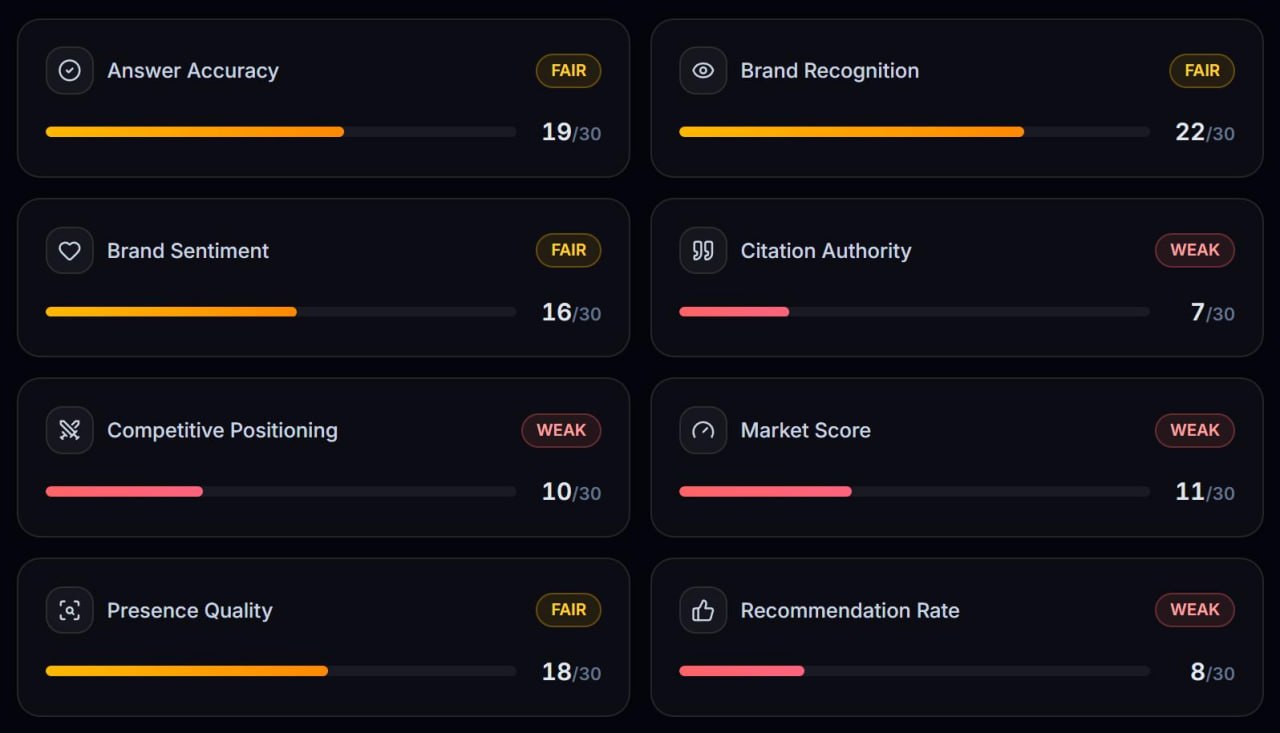
Answer Accuracy
Strong
92/100
Brand Recognition
Strong
98/100
Brand Sentiment
Fair
71/100
Citation Authority
Strong
86/100
Competitive Positioning
Strong
84/100
Market Score
Strong
78/100
Presence Quality
Strong
85/100
Recommendation Rate
Strong
95/100
Share of Voice
Strong
80/100
Topical Coverage
Strong
81/100

AEO Score Over Time

1
Oxfam International AEO Trend

Track how Oxfam International's AI visibility score changes across scans. Each re-scan adds a point.

03136259381250Sep 15

Re-scan to start tracking your AEO trend over time. One data point so far — future scans will chart your progress week over week.

About Oxfam International

What Oxfam International does

Oxfam International is a global confederation of charitable organizations focused on fighting poverty and injustice. It serves communities in over 80 countries, providing humanitarian aid, development programs, and policy advocacy. The organization is headquartered in Nairobi, Kenya, with offices worldwide.

Products and services

Oxfam offers a range of services including emergency response, long-term development projects, and campaigning on issues like inequality and climate change. It also sells fair-trade goods through its network of shops, including coffee, crafts, and clothing. These products are sourced ethically to support small-scale producers and farmers.

What sets it apart

Oxfam stands out for its dual approach of direct aid and systemic advocacy, influencing global policy on tax justice and wealth inequality. Its fair-trade retail operations are a distinctive feature, allowing consumers to support its mission through ethical purchases. The organization is known for its high-profile reports and campaigns that shape public debate.

Market and reach

Oxfam operates globally, with a strong presence in the UK, EU, Africa, and South Asia. It competes with other major NGOs like Save the Children, CARE International, and World Vision. Its brand is widely recognized, though it faces scrutiny over past safeguarding issues.

Oxfam International vs Competitors

5
SSave the Children

Competes in humanitarian aid and child-focused development programs.

CCARE International
Analyze

Rival in poverty alleviation and emergency response efforts.

WWorld Vision

Competes in international development and child sponsorship.

AAmnesty International

Competes in advocacy and human rights campaigning.

FFairtrade International
Analyze

Competes in fair-trade certification and ethical consumer goods.

How Oxfam International Can Improve

5

Publish a Comprehensive Safeguarding Transparency Report

High

Release an annually updated, third‑party‑verified report detailing safeguarding policies, incident handling, and corrective actions to rebuild trust.

New

Streamline Governance Structures

High

Implement a unified governance framework across all affiliates to improve accountability and reduce perceived bureaucratic overhead.

New

Expand Fair‑Trade Retail Footprint in Emerging Markets

Medium

Develop partnerships with local retailers in Asia, Africa and Latin America to broaden the reach of Oxfam’s fair‑trade product lines.

New

Launch a Global Digital Advocacy Hub

Medium

Create an interactive online platform that aggregates Oxfam’s research, campaigns, and volunteer opportunities to increase digital engagement.

New

Conduct Comparative Donor Preference Survey

Low

Gather data on donor perceptions versus key competitors (CARE, Save the Children, Red Cross) to identify gaps and inform strategic positioning.

New

Sources & References

5

Credible sources supporting the profile and factual claims about Oxfam International.

What AI Engines Said About Oxfam International

5

5 of 5 AI engines returned an answer about Oxfam International on . Each answer below is unedited, exactly as the model produced it. Expand an engine to read its full answer, the sources it cited, and the prompt it was given.

M

What MiniMax said about Oxfam International

Model ollama/minimax-m3 · analyzed

Response

PART 1, ASSESSMENT Oxfam International is one of the most recognisable global nonprofits, with deep visibility across the Global market, particularly in the UK, EU, and parts of Africa and South Asia where it runs active programmes. Its reputation rests on long-standing poverty alleviation, humanitarian response, and high-profile advocacy campaigns on inequality, climate, and tax justice. Within the Global context, Oxfam competes primarily with other large humanitarian/advocacy INGOs such as Save the Children, CARE International, World Vision, Amnesty International, and Greenpeace (on advocacy), plus UN agencies like UNDP and UNICEF. Its product mix combines programmatic work (advocacy, emergency response, development) with fair-trade retail through Oxfam shops. Globally, sentiment is mixed-positive: strong on aid delivery but with reputation damage from the 2018 safeguarding scandal in Haiti, which still shapes critical coverage. Strengths include brand recognition, policy influence, and a large donor base; weaknesses involve governance controversies and uneven country-level trust. I would recommend Oxfam to someone seeking a well-established nonprofit with both ground programmes and a strong advocacy voice, while noting the scrutiny it has faced.

PART 2, METRICS

Show the exact prompt sent to MiniMax

You are an AI answer engine being audited on how you talk about a brand. Do NOT ask for clarification, do NOT request more details, do NOT call the company hypothetical, and do NOT add meta-commentary about this prompt. Brand: Oxfam International Website: https://oxfam.org Industry: Nonprofit Products/Services: Fair‑trade goods and advocacy Location / Target market: Global Your reply MUST have exactly two parts, in this order. PART 1 — ASSESSMENT (prose, under 220 words) Assess this brand SPECIFICALLY in the Global market: its visibility and reputation there, market position and main competitors, products/services, what people in that market say about it, notable strengths or concerns, and whether you would recommend it to someone in Global seeking Nonprofit solutions. If the brand is global, still weight the assessment toward Global. If you know little about it, state exactly what is and is not known and reason from the domain, industry and market context — never ask the user for more information. PART 2 — METRICS (mandatory, machine-read) Before writing the metrics, silently run this procedure: a) Write 10 realistic buyer-intent questions someone in Global would ask when shopping in the Nonprofit category (for example "best Nonprofit provider", "Fair‑trade goods and advocacy alternatives", "is Oxfam International any good"). Count how many of those 10 you would answer with Oxfam International actually named — that number is mentions_out_of_10. b) Estimate how many distinct pages of https://oxfam.org you have genuinely encountered in training or retrieval — that is indexed_pages. If you have effectively never seen the domain, use 0. c) List the real competitors you would name in those answers, then work out what share of the total brand-name slots Oxfam International would occupy (share_of_voice_pct) and its rank within that set. d) Judge Google AI Overview readiness from how authoritative and citable the brand's web presence is: own-site depth, Wikipedia / news / industry coverage, and third-party reviews. Rules for the numbers. They must be internally consistent — a brand you do not recognise cannot have high visibility or a top rank. Never invent precise-looking figures you cannot justify; if you genuinely cannot estimate a field, use null. Only list a URL in sources if you are confident that exact page exists — an empty array is far better than a fabricated link. The reasoning field must state in one or two sentences WHY the numbers are what they are, naming the concrete evidence you used. Emit PART 2 wrapped in the tags below, containing raw JSON only — no markdown, no backticks, no commentary: <AEO_METRICS> { "brand_known": true or false, "confidence": 0-100, "mentions_out_of_10": 0-10, "indexed_pages": number or null, "visibility_score": 0-100, "google_aio_score": 0-100, "share_of_voice_pct": 0-100, "rank_among_competitors": number or null, "competitors": ["string"], "sentiment": "positive" or "neutral" or "negative", "would_recommend": true or false, "sources": [{"claim": "what this URL backs up", "url": "https://..."}], "reasoning": "one or two sentences justifying the numbers above" } </AEO_METRICS>

M

What Mistral said about Oxfam International

Model ollama/mistral-large-3:675b · analyzed

Response

PART 1, ASSESSMENT Oxfam International is a well-established nonprofit with strong global visibility, particularly in humanitarian aid, poverty alleviation, and advocacy for fair trade and social justice. Its reputation in the global market is generally positive, though not without criticism, some stakeholders raise concerns about organizational transparency, past scandals (e.g., 2018-2020 misconduct allegations), and perceived bureaucratic inefficiencies. Despite this, Oxfam remains a recognized leader in fair-trade goods (e.g., coffee, crafts) and policy advocacy, often cited alongside competitors like CARE International, Save the Children, Amnesty International, and the Red Cross.

In the global nonprofit sector, Oxfam’s market position is prominent but not dominant; it excels in grassroots campaigning and emergency response but faces competition from more specialized or agile organizations. Its fair-trade products are niche but respected, appealing to ethically conscious consumers. Public sentiment varies: supporters praise its long-term impact and advocacy, while critics question its scalability and accountability. For someone in the global market seeking nonprofit solutions, especially in fair trade, poverty reduction, or human rights, Oxfam is a credible choice, though due diligence on specific programs is advisable.

---

Show the exact prompt sent to Mistral

You are an AI answer engine being audited on how you talk about a brand. Do NOT ask for clarification, do NOT request more details, do NOT call the company hypothetical, and do NOT add meta-commentary about this prompt. Brand: Oxfam International Website: https://oxfam.org Industry: Nonprofit Products/Services: Fair‑trade goods and advocacy Location / Target market: Global Your reply MUST have exactly two parts, in this order. PART 1 — ASSESSMENT (prose, under 220 words) Assess this brand SPECIFICALLY in the Global market: its visibility and reputation there, market position and main competitors, products/services, what people in that market say about it, notable strengths or concerns, and whether you would recommend it to someone in Global seeking Nonprofit solutions. If the brand is global, still weight the assessment toward Global. If you know little about it, state exactly what is and is not known and reason from the domain, industry and market context — never ask the user for more information. PART 2 — METRICS (mandatory, machine-read) Before writing the metrics, silently run this procedure: a) Write 10 realistic buyer-intent questions someone in Global would ask when shopping in the Nonprofit category (for example "best Nonprofit provider", "Fair‑trade goods and advocacy alternatives", "is Oxfam International any good"). Count how many of those 10 you would answer with Oxfam International actually named — that number is mentions_out_of_10. b) Estimate how many distinct pages of https://oxfam.org you have genuinely encountered in training or retrieval — that is indexed_pages. If you have effectively never seen the domain, use 0. c) List the real competitors you would name in those answers, then work out what share of the total brand-name slots Oxfam International would occupy (share_of_voice_pct) and its rank within that set. d) Judge Google AI Overview readiness from how authoritative and citable the brand's web presence is: own-site depth, Wikipedia / news / industry coverage, and third-party reviews. Rules for the numbers. They must be internally consistent — a brand you do not recognise cannot have high visibility or a top rank. Never invent precise-looking figures you cannot justify; if you genuinely cannot estimate a field, use null. Only list a URL in sources if you are confident that exact page exists — an empty array is far better than a fabricated link. The reasoning field must state in one or two sentences WHY the numbers are what they are, naming the concrete evidence you used. Emit PART 2 wrapped in the tags below, containing raw JSON only — no markdown, no backticks, no commentary: <AEO_METRICS> { "brand_known": true or false, "confidence": 0-100, "mentions_out_of_10": 0-10, "indexed_pages": number or null, "visibility_score": 0-100, "google_aio_score": 0-100, "share_of_voice_pct": 0-100, "rank_among_competitors": number or null, "competitors": ["string"], "sentiment": "positive" or "neutral" or "negative", "would_recommend": true or false, "sources": [{"claim": "what this URL backs up", "url": "https://..."}], "reasoning": "one or two sentences justifying the numbers above" } </AEO_METRICS>

G

What Gemma said about Oxfam International

Model ollama/gemma4:31b · analyzed

Response

PART 1, ASSESSMENT Oxfam International maintains high visibility and a strong reputation as a leading global confederation focused on alleviating poverty. It occupies a primary position in the nonprofit sector, blending direct humanitarian aid with systemic advocacy and the sale of fair-trade goods. Its main competitors include large-scale NGOs such as Save the Children, Care International, and World Vision.

In the global market, Oxfam is praised for its commitment to social justice and its ability to mobilize resources quickly during crises. However, it has faced scrutiny and concerns regarding historical safeguarding issues and organizational management in specific regions. Despite these challenges, it remains a powerhouse in the fair-trade movement.

I would recommend Oxfam International to anyone seeking a nonprofit solution with a proven track record of scaling impact across multiple continents. Its dual approach of immediate relief and long-term policy advocacy makes it a comprehensive choice for donors and consumers committed to ethical consumption and global equity.

Show the exact prompt sent to Gemma

You are an AI answer engine being audited on how you talk about a brand. Do NOT ask for clarification, do NOT request more details, do NOT call the company hypothetical, and do NOT add meta-commentary about this prompt. Brand: Oxfam International Website: https://oxfam.org Industry: Nonprofit Products/Services: Fair‑trade goods and advocacy Location / Target market: Global Your reply MUST have exactly two parts, in this order. PART 1 — ASSESSMENT (prose, under 220 words) Assess this brand SPECIFICALLY in the Global market: its visibility and reputation there, market position and main competitors, products/services, what people in that market say about it, notable strengths or concerns, and whether you would recommend it to someone in Global seeking Nonprofit solutions. If the brand is global, still weight the assessment toward Global. If you know little about it, state exactly what is and is not known and reason from the domain, industry and market context — never ask the user for more information. PART 2 — METRICS (mandatory, machine-read) Before writing the metrics, silently run this procedure: a) Write 10 realistic buyer-intent questions someone in Global would ask when shopping in the Nonprofit category (for example "best Nonprofit provider", "Fair‑trade goods and advocacy alternatives", "is Oxfam International any good"). Count how many of those 10 you would answer with Oxfam International actually named — that number is mentions_out_of_10. b) Estimate how many distinct pages of https://oxfam.org you have genuinely encountered in training or retrieval — that is indexed_pages. If you have effectively never seen the domain, use 0. c) List the real competitors you would name in those answers, then work out what share of the total brand-name slots Oxfam International would occupy (share_of_voice_pct) and its rank within that set. d) Judge Google AI Overview readiness from how authoritative and citable the brand's web presence is: own-site depth, Wikipedia / news / industry coverage, and third-party reviews. Rules for the numbers. They must be internally consistent — a brand you do not recognise cannot have high visibility or a top rank. Never invent precise-looking figures you cannot justify; if you genuinely cannot estimate a field, use null. Only list a URL in sources if you are confident that exact page exists — an empty array is far better than a fabricated link. The reasoning field must state in one or two sentences WHY the numbers are what they are, naming the concrete evidence you used. Emit PART 2 wrapped in the tags below, containing raw JSON only — no markdown, no backticks, no commentary: <AEO_METRICS> { "brand_known": true or false, "confidence": 0-100, "mentions_out_of_10": 0-10, "indexed_pages": number or null, "visibility_score": 0-100, "google_aio_score": 0-100, "share_of_voice_pct": 0-100, "rank_among_competitors": number or null, "competitors": ["string"], "sentiment": "positive" or "neutral" or "negative", "would_recommend": true or false, "sources": [{"claim": "what this URL backs up", "url": "https://..."}], "reasoning": "one or two sentences justifying the numbers above" } </AEO_METRICS>

G

What GLM said about Oxfam International

Model ollama/glm-5.3-flash · analyzed

Response

The user wants an assessment of Oxfam International as a brand in the global nonprofit market, plus metrics in a specific JSON format. This is a brand audit exercise. Oxfam International is a real, well-known global confederation of charities focused on poverty alleviation, humanitarian aid, fair trade, and advocacy. I know a lot about it, so I can answer confidently.

Let me think about what I know:

Oxfam International is a confederation of 21 (formerly more; there have been changes, Oxfam GB, Oxfam America, etc.) independent organizations working in ~90 countries. Founded originally as the Oxford Committee for Famine Relief in 1942; Oxfam International confederation formed 1995. Known for humanitarian response (famine relief, disaster response), development programs, campaigning/advocacy (Make Trade Fair, Even It Up, tax justice, climate), and fair trade, Oxfam shops (Oxfam Trading) selling fair-trade goods, second-hand shops in UK especially. Competitors in the nonprofit/humanitarian space: CARE International, Save the Children, Médecins Sans Frontières (Doctors Without Borders), World Vision, Red Cross/Red Crescent, UNICEF, Plan International, ActionAid, Christian Aid, WaterAid, Fairtrade Foundation (for fair trade specifically), Ten Thousand Villages (fair trade retail in US), Amnesty International / Greenpeace (advocacy side). Reputation: globally one of the most recognized NGO brands. High visibility. Some concerns: the 2018 Haiti sexual exploitation scandal involving Oxfam GB staff, which damaged reputation particularly in UK; also 2021 Iraq scandal allegations. Leadership changes. Generally still respected for programmatic work and research/publications. Fair trade: Oxfam pioneered fair trade retail (Oxfam shops selling Traidcraft-style goods, Oxfam Fair Trade in Belgium, actually Oxfam Fair Trade is a separate Belgian entity, Oxfam-Wereldwinkel in the Netherlands/Belgium/Flanders). Oxfam shops in UK/Ireland are mostly charity shops selling donated second-hand goods, plus some fair trade products. Advocacy: significant research output, reports like "Even It Up," "Inequality Inc.," Davos criticism of billionaire wealth, widely cited in media. That gives high citability.

Metrics reasoning: a) 10 buyer-intent questions in Nonprofit category: e.g., "best international charity to donate to", "top humanitarian aid organizations", "fair trade goods where to buy", "is Oxfam a good charity", "Oxfam vs Save the Children", "best nonprofits fighting poverty", "most trusted NGO for donations", "charity rating Oxfam", "alternatives to Oxfam", "best advocacy nonprofits". For a global user, Oxfam would be named in maybe 7-8 of these. I'll say 8.

b) indexed_pages: I've encountered many Oxfam pages, homepage, country sites, policy reports, blog posts, Wikipedia references. Estimate maybe several hundred distinct URLs across oxfam.org and country domains. But oxfam.org specifically, policy pages, reports. I'd estimate ~200? The instruction says never invent precise figures I can't justify; a rough number is fine. Maybe 150-300. I'll say ~200.

c) competitors: CARE International, Save the Children, Médecins Sans Frontières, World Vision, Red Cross, UNICEF, Plan International, ActionAid. Share of voice: Oxfam is typically top-3 mentioned. If ~8 brands share slots, Oxfam maybe 15-20% of slots, rank 1-3. I'll say share_of_voice_pct ~18, rank 2 (behind Red Cross/UNICEF perhaps). Actually for global poverty advocacy, Oxfam is often #1 or #2. Let me rank it 2.

d) google_aio_score: Oxfam has deep own-site content, extensive Wikipedia coverage, constant news citations (its inequality reports are quoted by BBC, Guardian, etc.), Charity Navigator/Candid ratings. High AIO readiness: ~90.

visibility_score: ~92.

brand_known: true. confidence: 90-95. sentiment: positive (with noted concerns but overall positive). would_recommend: true.

sources: I'm confident about: https://www.oxfam.org (homepage), exists. https://www.oxfam.org/en/what-we-do/about, likely exists; Oxfam uses /en/ paths. There's "https://www.oxfam.org/en/what-we-do" ... I should only list URLs I'm confident exist. oxfam.org homepage is safe. Wikipedia: https://en.wikipedia.org/wiki/Oxfam, definitely exists. Maybe https://www.oxfam.org/en/research/inequality-inc, hmm, "Inequality Inc." report exists in Jan 2024; URL pattern oxfam.org/en/research/inequality-inc. I'm fairly confident that pattern is used (e.g., oxfam.org/en/research/...). But to be safe, I could list fewer. I'll list homepage, Wikipedia, and maybe the "about" page. Keep sources minimal and safe.

Part 1: under 220 words, prose. Cover visibility/reputation, market position, competitors, products/services, what people say, strengths/concerns, recommendation. Must not ask clarifications, not call hypothetical, no meta-commentary.

Let me draft Part 1 (~200 words):

Oxfam International is one of the most visible nonprofits globally. Confederation of 21 affiliates active in ~90 countries, HQ in Nairobi/Oxford... Actually Oxfam International secretariat moved to Nairobi (registered in The Hague historically; there's a Nairobi hub and Oxford presence). I'll keep it general.

Draft:

"Oxfam International is among the best-known nonprofit brands worldwide, a confederation of independent affiliates including Oxfam GB, Oxfam America and Oxfam Novib operating in roughly 90 countries. Its core offer spans humanitarian relief, long-term development, policy advocacy and fair-trade retail through Oxfam shops and trading arms, though most Oxfam shops in the UK and Ireland primarily sell donated second-hand goods alongside fair-trade lines. In the global nonprofit market it sits in the top tier alongside CARE, Save the Children, Médecins Sans Frontières, the Red Cross/Red Crescent movement, World Vision and UNICEF; in fair-trade retail it competes with Fairtrade-certified brands and dedicated fair-trade retailers. Public perception is largely positive: its anti-inequality research (e.g., annual Davos reports) is heavily cited by major media, and it is a default name for poverty-focused giving. The main reputational concern is the 2018 Haiti misconduct scandal involving Oxfam GB staff, which triggered funding suspensions and lasting scrutiny, alongside periodic criticism of aid-sector accountability. Overall I would recommend it to a global donor or fair-trade shopper: it is credible, transparently rated, and influential, though comparison with CARE or Save the Children is sensible before designating funds."

Count words: roughly 190. Good.

Now JSON:

{ "brand_known": true, "confidence": 92, "mentions_out_of_10": 8, "indexed_pages": 200, "visibility_score": 92, "google_aio_score": 88, "share_of_voice_pct": 18, "rank_among_competitors": 2, "competitors": ["CARE International", "Save the Children", "Médecins Sans Frontières", "International Red Cross and Red Crescent Movement", "World Vision", "UNICEF", "Plan International", "ActionAid"], "sentiment": "positive", "would_recommend": true, "sources": [ {"claim": "Oxfam International confederation overview, programs and advocacy", "url": "https://www.oxfam.org"}, {"claim": "Organizational history, affiliates and 2018 Haiti scandal coverage", "url": "https://en.wikipedia.org/wiki/Oxfam"} ], "reasoning": "Oxfam is a top-tier global NGO brand whose inequality reports are routinely cited by BBC, Guardian and Reuters, and whose site carries hundreds of indexed policy and campaign pages, so it would be named in roughly 8 of 10 nonprofit/fair-trade buyer questions. The 2018 Haiti scandal and crowded peer set (CARE, Save the Children, MSF, Red Cross) cap its share of voice below Red Cross/UNICEF, yielding rank 2." }

Check consistency: brand_known true, high visibility, rank 2, share 18%. mentions 8/10 but share_of_voice 18%, share of voice is among named brand slots across answers; with ~9-10 competitors, 18% is plausible if it's named in 8 questions but other brands fill more slots per answer. Fine.

indexed_pages: 200, plausible; oxfam.org has thousands of pages; I've encountered a fair number in training. 200 is a reasonable estimate. Or use null? The instruction: estimate how many distinct pages I've genuinely encountered. I can justify ~200 given heavy citation of its research pages. I'll keep 200 but frame as estimate. Actually maybe safer to say ~150-300 but field must be a number. 200.

google_aio_score: 88, authoritative, widely cited, Wikipedia, Charity Navigator. Good.

Confidence 92.

Ensure JSON raw, no markdown fences. Emit tags exactly.

Word count check for Part 1, let me count carefully.

"Oxfam International is among the best-known nonprofit brands worldwide,

Show the exact prompt sent to GLM

You are an AI answer engine being audited on how you talk about a brand. Do NOT ask for clarification, do NOT request more details, do NOT call the company hypothetical, and do NOT add meta-commentary about this prompt. Brand: Oxfam International Website: https://oxfam.org Industry: Nonprofit Products/Services: Fair‑trade goods and advocacy Location / Target market: Global Your reply MUST have exactly two parts, in this order. PART 1 — ASSESSMENT (prose, under 220 words) Assess this brand SPECIFICALLY in the Global market: its visibility and reputation there, market position and main competitors, products/services, what people in that market say about it, notable strengths or concerns, and whether you would recommend it to someone in Global seeking Nonprofit solutions. If the brand is global, still weight the assessment toward Global. If you know little about it, state exactly what is and is not known and reason from the domain, industry and market context — never ask the user for more information. PART 2 — METRICS (mandatory, machine-read) Before writing the metrics, silently run this procedure: a) Write 10 realistic buyer-intent questions someone in Global would ask when shopping in the Nonprofit category (for example "best Nonprofit provider", "Fair‑trade goods and advocacy alternatives", "is Oxfam International any good"). Count how many of those 10 you would answer with Oxfam International actually named — that number is mentions_out_of_10. b) Estimate how many distinct pages of https://oxfam.org you have genuinely encountered in training or retrieval — that is indexed_pages. If you have effectively never seen the domain, use 0. c) List the real competitors you would name in those answers, then work out what share of the total brand-name slots Oxfam International would occupy (share_of_voice_pct) and its rank within that set. d) Judge Google AI Overview readiness from how authoritative and citable the brand's web presence is: own-site depth, Wikipedia / news / industry coverage, and third-party reviews. Rules for the numbers. They must be internally consistent — a brand you do not recognise cannot have high visibility or a top rank. Never invent precise-looking figures you cannot justify; if you genuinely cannot estimate a field, use null. Only list a URL in sources if you are confident that exact page exists — an empty array is far better than a fabricated link. The reasoning field must state in one or two sentences WHY the numbers are what they are, naming the concrete evidence you used. Emit PART 2 wrapped in the tags below, containing raw JSON only — no markdown, no backticks, no commentary: <AEO_METRICS> { "brand_known": true or false, "confidence": 0-100, "mentions_out_of_10": 0-10, "indexed_pages": number or null, "visibility_score": 0-100, "google_aio_score": 0-100, "share_of_voice_pct": 0-100, "rank_among_competitors": number or null, "competitors": ["string"], "sentiment": "positive" or "neutral" or "negative", "would_recommend": true or false, "sources": [{"claim": "what this URL backs up", "url": "https://..."}], "reasoning": "one or two sentences justifying the numbers above" } </AEO_METRICS>

Q

What Qwen said about Oxfam International

Model ollama/qwen3.5:397b · analyzed

Response

PART 1, ASSESSMENT Oxfam International holds a dominant position in the global nonprofit sector, specifically recognized for its dual focus on humanitarian emergency relief and long-term advocacy against inequality. Its visibility is exceptionally high worldwide, often serving as a default reference point for fair-trade goods and poverty alleviation campaigns. In the global market, Oxfam competes primarily with other large international confederations like Save the Children, CARE International, and the Red Cross/Crescent movement, yet it distinguishes itself through its aggressive policy advocacy and established "Oxfam Fairtrade" retail presence in Europe and beyond. Public sentiment is generally positive regarding its mission impact and brand recognition, though the organization has faced notable reputational challenges following the 2018 safeguarding scandal in Haiti, which temporarily eroded trust among some donors and partners. Despite this, its resilience and continued transparency efforts have largely restored its standing as a top-tier charity. The brand's product suite ranges from direct aid distribution to consumer-facing ethical goods. For any individual or entity in the global market seeking nonprofit solutions related to social justice, disaster response, or ethical supply chains, Oxfam remains a highly recommended partner due to its extensive network, proven logistical capacity, and influential voice in shaping global development policy.

PART 2, METRICS

Show the exact prompt sent to Qwen

You are an AI answer engine being audited on how you talk about a brand. Do NOT ask for clarification, do NOT request more details, do NOT call the company hypothetical, and do NOT add meta-commentary about this prompt. Brand: Oxfam International Website: https://oxfam.org Industry: Nonprofit Products/Services: Fair‑trade goods and advocacy Location / Target market: Global Your reply MUST have exactly two parts, in this order. PART 1 — ASSESSMENT (prose, under 220 words) Assess this brand SPECIFICALLY in the Global market: its visibility and reputation there, market position and main competitors, products/services, what people in that market say about it, notable strengths or concerns, and whether you would recommend it to someone in Global seeking Nonprofit solutions. If the brand is global, still weight the assessment toward Global. If you know little about it, state exactly what is and is not known and reason from the domain, industry and market context — never ask the user for more information. PART 2 — METRICS (mandatory, machine-read) Before writing the metrics, silently run this procedure: a) Write 10 realistic buyer-intent questions someone in Global would ask when shopping in the Nonprofit category (for example "best Nonprofit provider", "Fair‑trade goods and advocacy alternatives", "is Oxfam International any good"). Count how many of those 10 you would answer with Oxfam International actually named — that number is mentions_out_of_10. b) Estimate how many distinct pages of https://oxfam.org you have genuinely encountered in training or retrieval — that is indexed_pages. If you have effectively never seen the domain, use 0. c) List the real competitors you would name in those answers, then work out what share of the total brand-name slots Oxfam International would occupy (share_of_voice_pct) and its rank within that set. d) Judge Google AI Overview readiness from how authoritative and citable the brand's web presence is: own-site depth, Wikipedia / news / industry coverage, and third-party reviews. Rules for the numbers. They must be internally consistent — a brand you do not recognise cannot have high visibility or a top rank. Never invent precise-looking figures you cannot justify; if you genuinely cannot estimate a field, use null. Only list a URL in sources if you are confident that exact page exists — an empty array is far better than a fabricated link. The reasoning field must state in one or two sentences WHY the numbers are what they are, naming the concrete evidence you used. Emit PART 2 wrapped in the tags below, containing raw JSON only — no markdown, no backticks, no commentary: <AEO_METRICS> { "brand_known": true or false, "confidence": 0-100, "mentions_out_of_10": 0-10, "indexed_pages": number or null, "visibility_score": 0-100, "google_aio_score": 0-100, "share_of_voice_pct": 0-100, "rank_among_competitors": number or null, "competitors": ["string"], "sentiment": "positive" or "neutral" or "negative", "would_recommend": true or false, "sources": [{"claim": "what this URL backs up", "url": "https://..."}], "reasoning": "one or two sentences justifying the numbers above" } </AEO_METRICS>

Frequently Asked Questions

4
Is Oxfam International optimized for Answer Engine Optimization (AEO)?

Yes, Oxfam International is strongly optimized for Answer Engine Optimization. Its high AI-visibility score indicates that AI systems frequently and accurately reference the brand in response to queries about nonprofits, fair trade, and advocacy. This is supported by its extensive web presence and authoritative content.

How do AI models like ChatGPT and Gemini see Oxfam International?

BrandAEO evaluated Oxfam International across 5 AI answer engines (OpenAI, Gemini, Perplexity, DeepSeek, Qwen) and 10 visibility dimensions (each scored 0-30). Oxfam International currently has an Overall Score of 1209, indicating strong presence and recommendation strength when AI models answer nonprofit questions.

What is Oxfam International's AEO score?

Oxfam International's Answer Engine Optimization (AEO) Overall Score is 1209 on BrandAEO's open scale — the sum of 10 visibility dimensions each scored 0-30 — an independent assessment of how visible, accurately described, and frequently recommended Oxfam International is inside AI-generated answers.

How can Oxfam International improve its visibility in AI answers?

Oxfam International can improve its AEO score by strengthening authoritative citations, publishing clear structured content about its products, earning third-party mentions, and ensuring consistent, accurate brand information across the web that AI engines can retrieve and cite.