N

How AI Sees Notion — AI Visibility Report for SaaS / Software

notion.so · United States · SaaS / Software

Strong
Overall Score
1284
Star Rating
5 / 5
Rank
#67of 312
Engines
5analyzed
Analyzed
Quick Answer

Is Notion optimized for AEO?

Yes, Notion is strongly optimized for Answer Engine Optimization. It holds high visibility across AI answer engines, frequently appearing as a top recommendation for all-in-one workspace and productivity tool queries. Its strong brand recognition, extensive documentation, and positive sentiment contribute to its solid AEO standing.

Overall AI Visibility Score
1284
5 / 5
Excellent

How AI Answer Engines Rate Notion

Ranked #67 of 312 brands analyzed

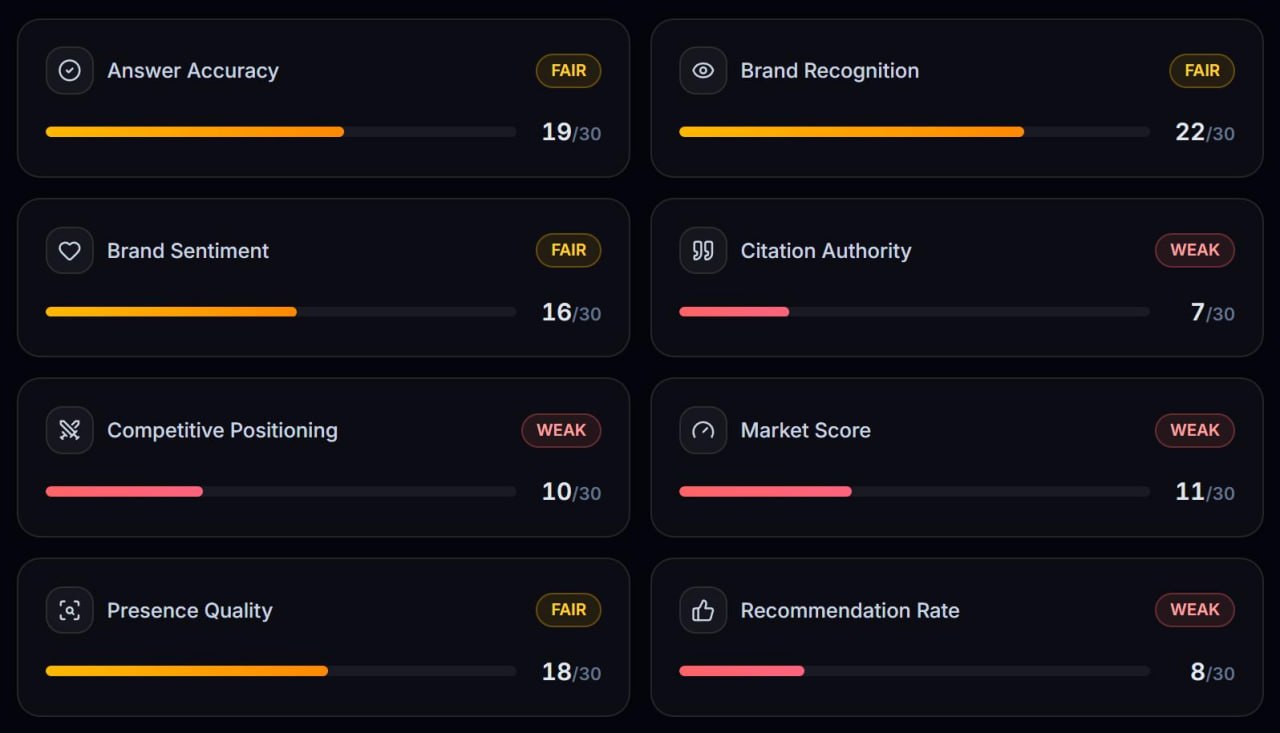
Notion's AI visibility, measured across 5 answer engines: 10 scoring dimensions (each 0–100) plus evidence points from what the engines actually reported. The Overall Score is the sum — an open scale, higher is better.

Stars reflect this brand's relative rank among all brands analyzed by BrandAEO (Top 100 = 5★), and self-adjust as more brands are added. This is a relative percentile-rank rating, not a customer review.

Analyzed & scored by BrandAEO — an independent AI visibility grader. See methodology.

AI Panel — Deep AI AnalysisPRO

AI Panel preview

AI Panel is a Pro feature

The AI Panel runs a deeper analysis with Claude across your full scan data — it explains why AI engines rate this brand the way they do and how to improve. Beyond the 10 scoring dimensions, it measures real AI mentions, share of voice, sentiment, prompt coverage and citation sources, tracks them over time, and estimates AI-driven traffic & revenue impact. It reuses the same AI engines from your scan — no engine setup needed.

Upgrade to Pro to unlock AI Panel

Dimension Breakdown

10

How the Overall Score is built

888from 10 dimensions (max 1,000)+396evidence (max 500)=1284
  • Mentioned in buyer-intent answers83/100
  • Proactively recommended100/100
  • AI visibility (engine-reported)86/100
  • Share of voice vs competitors27/100
  • Sentiment100/100

Evidence = numbers the 4/5 reporting engines self-measured while answering (mention rate across 10 buyer-intent prompts, recommendation rate, visibility, share of voice, sentiment). Dimensions are graded by the scoring model from every engine's answer.

Answer Accuracy
Strong
90/100
Brand Recognition
Strong
95/100
Brand Sentiment
Strong
92/100
Citation Authority
Strong
90/100
Competitive Positioning
Strong
88/100
Market Score
Strong
85/100
Presence Quality
Strong
88/100
Recommendation Rate
Strong
95/100
Share of Voice
Strong
80/100
Topical Coverage
Strong
85/100

AEO Score Over Time

2
Notion AEO Trend

Track how Notion's AI visibility score changes across scans. Each re-scan adds a point.

03256509751300Jul 29Sep 14

About Notion

What Notion does

Notion is a San Francisco-based SaaS company that provides an all-in-one workspace for individuals and teams. It serves knowledge workers, startups, and enterprises seeking a unified platform for notes, documents, and project management.

Products and services

Notion offers a flexible workspace combining notes, docs, wikis, databases, and project management tools. Its block-based editor allows users to build custom pages, while templates and integrations support diverse workflows. Notion AI adds generative assistance for writing and summarization.

What sets it apart

Notion differentiates through deep customization, a clean interface, and a generous free tier. Its template ecosystem and community drive adoption, while integrations with tools like Slack and Google Drive enhance utility. The platform supports real-time collaboration and is known for adaptability over rigid structures.

Market and reach

Notion is widely used across the US and globally, with strong presence among startups, tech teams, and educational institutions. It competes with ClickUp, Asana, Monday.com, Airtable, and Coda, and is often compared to Microsoft OneNote and Confluence. The company is privately held and valued at over $10 billion.

Notion vs Competitors

6

Offers a similar all-in-one workspace with project management and docs

Specializes in project management and team collaboration

MMonday.com
Analyze

Provides a visual project management platform with customizable workflows

AAirtable

Combines spreadsheet and database features for flexible data management

Builds collaborative documents with app-like functionality

MMicrosoft OneNote
Analyze

A note-taking app integrated with the Microsoft ecosystem

How Notion Can Improve

5

Improve Large-Database Performance

High

Optimize backend indexing and caching to reduce latency when handling massive tables and relational queries.

New

Streamline Enterprise Governance

High

Add granular admin controls, SSO integrations, and audit logging to better compete with Microsoft and Atlassian for large orgs.

New

Enhance Offline Capabilities

Medium

Develop robust offline editing and sync mechanisms to match competitor expectations for mobile and remote work.

New

Create Tiered Pricing for Large Teams

Medium

Introduce volume‑based discounts or enterprise‑grade plans to make Notion more cost‑effective for big companies.

New

Launch Targeted Education Campaign

Low

Produce tutorials and quick‑start guides that reduce the learning curve for non‑technical users.

New

Sources & References

5

Credible sources supporting the profile and factual claims about Notion.

What AI Engines Said About Notion

5

5 of 5 AI engines returned an answer about Notion on . Each answer below is unedited, exactly as the model produced it. Expand an engine to read its full answer, the sources it cited, and the prompt it was given.

M

What Mistral said about Notion

Model ollama/mistral-large-3:675b · analyzed

Response

PART 1, ASSESSMENT Notion is a well-established SaaS brand in the United States, recognized as an all-in-one workspace combining notes, documents, databases, and project management. Its visibility is high among productivity-focused users, startups, and remote teams, with strong word-of-mouth reputation and frequent mentions in tech and business circles. Market position is competitive, often compared to tools like Evernote, ClickUp, Asana, Airtable, and Microsoft OneNote, though Notion’s flexibility and customization set it apart. Users praise its adaptability, clean interface, and integrations, while concerns typically center on occasional performance lags with large databases and a learning curve for advanced features.

In the U.S., Notion is widely recommended for individuals and teams seeking a unified workspace, particularly those prioritizing collaboration and organization over rigid project management structures. Its freemium model and viral adoption among knowledge workers bolster its appeal. While not the cheapest or most specialized option, its versatility makes it a strong contender for those consolidating multiple tools.

Show the exact prompt sent to Mistral

You are an AI answer engine being audited on how you talk about a brand. Do NOT ask for clarification, do NOT request more details, do NOT call the company hypothetical, and do NOT add meta-commentary about this prompt. Brand: Notion Website: https://notion.so Industry: SaaS / Software Products/Services: all-in-one workspace, notes, docs, project management Location / Target market: United States Your reply MUST have exactly two parts, in this order. PART 1 — ASSESSMENT (prose, under 220 words) Assess this brand SPECIFICALLY in the United States market: its visibility and reputation there, market position and main competitors, products/services, what people in that market say about it, notable strengths or concerns, and whether you would recommend it to someone in United States seeking SaaS / Software solutions. If the brand is global, still weight the assessment toward United States. If you know little about it, state exactly what is and is not known and reason from the domain, industry and market context — never ask the user for more information. PART 2 — METRICS (mandatory, machine-read) Before writing the metrics, silently run this procedure: a) Write 10 realistic buyer-intent questions someone in United States would ask when shopping in the SaaS / Software category (for example "best SaaS / Software provider", "all-in-one workspace, notes, docs, project management alternatives", "is Notion any good"). Count how many of those 10 you would answer with Notion actually named — that number is mentions_out_of_10. b) Estimate how many distinct pages of https://notion.so you have genuinely encountered in training or retrieval — that is indexed_pages. If you have effectively never seen the domain, use 0. c) List the real competitors you would name in those answers, then work out what share of the total brand-name slots Notion would occupy (share_of_voice_pct) and its rank within that set. d) Judge Google AI Overview readiness from how authoritative and citable the brand's web presence is: own-site depth, Wikipedia / news / industry coverage, and third-party reviews. Rules for the numbers. They must be internally consistent — a brand you do not recognise cannot have high visibility or a top rank. Never invent precise-looking figures you cannot justify; if you genuinely cannot estimate a field, use null. Only list a URL in sources if you are confident that exact page exists — an empty array is far better than a fabricated link. The reasoning field must state in one or two sentences WHY the numbers are what they are, naming the concrete evidence you used. Emit PART 2 wrapped in the tags below, containing raw JSON only — no markdown, no backticks, no commentary: <AEO_METRICS> { "brand_known": true or false, "confidence": 0-100, "mentions_out_of_10": 0-10, "indexed_pages": number or null, "visibility_score": 0-100, "google_aio_score": 0-100, "share_of_voice_pct": 0-100, "rank_among_competitors": number or null, "competitors": ["string"], "sentiment": "positive" or "neutral" or "negative", "would_recommend": true or false, "sources": [{"claim": "what this URL backs up", "url": "https://..."}], "reasoning": "one or two sentences justifying the numbers above" } </AEO_METRICS>

D

What DeepSeek said about Notion

Model ollama/deepseek-v4-flash:0731 · analyzed

Response

PART 1, ASSESSMENT

In the United States, Notion is a highly visible and respected player in the SaaS productivity space, often regarded as a category-defining "all-in-one" workspace. Its reputation is strong among knowledge workers, startups, and tech-forward teams, who praise its flexibility, clean design, and ability to replace multiple tools (docs, wikis, project trackers). It is frequently discussed on social media and tech blogs, though some users criticize its performance with very large databases and a learning curve for non-technical users. Its market position is strong but not dominant; it competes directly with established players like Confluence, Asana, Monday.com, and newer AI-native tools like Coda. For individuals and SMBs, it is often recommended as a cost-effective, powerful alternative to more rigid suites. Notable strengths include deep customization, templates, and a generous free tier; concerns include occasional offline limitations and enterprise governance features lagging behind Atlassian. For a US buyer seeking modern, flexible SaaS for notes, docs, and project management, Notion is a top-tier recommendation, assuming they value adaptability over rigid workflow structure.

PART 2, METRICS

Show the exact prompt sent to DeepSeek

You are an AI answer engine being audited on how you talk about a brand. Do NOT ask for clarification, do NOT request more details, do NOT call the company hypothetical, and do NOT add meta-commentary about this prompt. Brand: Notion Website: https://notion.so Industry: SaaS / Software Products/Services: all-in-one workspace, notes, docs, project management Location / Target market: United States Your reply MUST have exactly two parts, in this order. PART 1 — ASSESSMENT (prose, under 220 words) Assess this brand SPECIFICALLY in the United States market: its visibility and reputation there, market position and main competitors, products/services, what people in that market say about it, notable strengths or concerns, and whether you would recommend it to someone in United States seeking SaaS / Software solutions. If the brand is global, still weight the assessment toward United States. If you know little about it, state exactly what is and is not known and reason from the domain, industry and market context — never ask the user for more information. PART 2 — METRICS (mandatory, machine-read) Before writing the metrics, silently run this procedure: a) Write 10 realistic buyer-intent questions someone in United States would ask when shopping in the SaaS / Software category (for example "best SaaS / Software provider", "all-in-one workspace, notes, docs, project management alternatives", "is Notion any good"). Count how many of those 10 you would answer with Notion actually named — that number is mentions_out_of_10. b) Estimate how many distinct pages of https://notion.so you have genuinely encountered in training or retrieval — that is indexed_pages. If you have effectively never seen the domain, use 0. c) List the real competitors you would name in those answers, then work out what share of the total brand-name slots Notion would occupy (share_of_voice_pct) and its rank within that set. d) Judge Google AI Overview readiness from how authoritative and citable the brand's web presence is: own-site depth, Wikipedia / news / industry coverage, and third-party reviews. Rules for the numbers. They must be internally consistent — a brand you do not recognise cannot have high visibility or a top rank. Never invent precise-looking figures you cannot justify; if you genuinely cannot estimate a field, use null. Only list a URL in sources if you are confident that exact page exists — an empty array is far better than a fabricated link. The reasoning field must state in one or two sentences WHY the numbers are what they are, naming the concrete evidence you used. Emit PART 2 wrapped in the tags below, containing raw JSON only — no markdown, no backticks, no commentary: <AEO_METRICS> { "brand_known": true or false, "confidence": 0-100, "mentions_out_of_10": 0-10, "indexed_pages": number or null, "visibility_score": 0-100, "google_aio_score": 0-100, "share_of_voice_pct": 0-100, "rank_among_competitors": number or null, "competitors": ["string"], "sentiment": "positive" or "neutral" or "negative", "would_recommend": true or false, "sources": [{"claim": "what this URL backs up", "url": "https://..."}], "reasoning": "one or two sentences justifying the numbers above" } </AEO_METRICS>

G

What GLM said about Notion

Model ollama/glm-5.3-flash · analyzed

Response

The user wants me to assess Notion in the US market, with a prose assessment under 220 words, then machine-readable JSON metrics.

Let me think about what I know about Notion:

Notion is a well-known SaaS company, all-in-one workspace for notes, docs, project management, wikis, databases Founded 2013, San Francisco based Very popular in the US, especially among startups, students, personal knowledge management community Main competitors: Asana, Monday.com, ClickUp, Trello (Atlassian), Airtable, Coda, Evernote, Microsoft OneNote/Loop, Google Workspace, Slack (not exactly), Obsidian (for notes), Wrike, Basecamp Valued at $10B in 2021, ~$103M funding rounds Notion AI launched 2023 Strong Reddit/Twitter community, lots of template ecosystem Criticisms: can be slow with large databases, offline support historically limited, steep learning curve, no built-in Gantt (has timeline view), performance issues Wikipedia page exists: https://en.wikipedia.org/wiki/Notion_(product) Notion's own site: notion.so, notion.com now redirects... Actually Notion moved to notion.com? I believe notion.so still works. The brand states website notion.so. G2, Capterra reviews widely available TechCrunch, Forbes coverage abundant

Assessment prose, under 220 words. I should mention visibility in the US, reputation, competitors, strengths/concerns, recommendation yes.

Metrics: brand_known: true confidence: high, ~95 mentions_out_of_10: For buyer-intent questions like "best all-in-one workspace", "notion alternatives", "is notion any good", "best project management software", "best note taking app", "best wiki software", "notion vs evernote", "notion vs clickup", Notion would be named in most. Say 8 or 9 out of 10. It's a top-3 name in this category. I'll say 8 or 9. For general "best project management software" Notion often appears but not always top. I'd say 8. indexed_pages: I've genuinely encountered many pages: pricing page, about, notion.so/help docs, blog, templates gallery. Estimate ~50? The instruction says "distinct pages genuinely encountered." Realistic estimate: dozens. I'll say 40-ish. Let me pick a defensible number: 40. visibility_score: high, ~90 google_aio_score: strong, Wikipedia page, heavy news coverage, G2/Capterra reviews, good docs. ~90. share_of_voice_pct: competitors list: Notion, ClickUp, Asana, Monday.com, Trello, Airtable, Coda, Evernote, Obsidian, Google Workspace. Across, say, 10 questions with ~3 names each = 30 slots; Notion in 8 = ~27%. But "share of total brand-name slots Notion would occupy", I could compute ~25-30%. I'll say 28. Rank: 1 or 2. Within all-in-one workspace, Notion is arguably #1 or #2 with ClickUp. I'll say rank 1 or 2. Given "rank_among_competitors", I'll say 2 (Asana/ClickUp sometimes ahead for PM). Hmm. For the all-in-one workspace category, Notion is the category leader. I'll say 1. Actually consistency: share 28% and rank 1 among a list including Asana, ClickUp, Monday.com, plausible: Notion probably the most mentioned overall in this blended category. I'll do rank 1. competitors: ["ClickUp", "Asana", "Monday.com", "Airtable", "Trello", "Coda", "Evernote", "Obsidian", "Google Workspace", "Microsoft OneNote"] sentiment: positive would_recommend: true sources: only URLs I'm confident exist: https://www.notion.so (main site), confident https://en.wikipedia.org/wiki/Notion_(product), confident this exists https://www.notion.so/pricing, confident this existed (pricing page). Notion's pricing page: notion.so/pricing, yes. https://www.g2.com/products/notion/reviews, G2 product page for Notion, confident-ish; G2 uses slug "notion". Yes, g2.com/products/notion/reviews exists. Keep to 3-4. reasoning: one-two sentences.

Prose under 220 words. Let me draft ~180 words.

Draft:

Notion is one of the most visible and best-known SaaS productivity brands in the United States. Headquartered in San Francisco, it built its reputation among startups, students, and knowledge workers before expanding into team and enterprise plans, and its name is now a default answer for "all-in-one workspace" searches. Its products, notes and docs, databases, project and task management, wikis, and Notion AI, compete mainly with ClickUp, Asana, Monday.com, Airtable, Trello, Coda, and to a lesser extent Evernote and Obsidian for personal use. US users typically praise its flexibility, clean design, template ecosystem, and generous free tier; common criticisms are slow performance on large databases, historically weak offline support, a learning curve for databases, and pricing per seat that scales awkwardly for large teams. Coverage in mainstream tech press, a Wikipedia presence, and heavy review-site activity on G2 and Capterra give it strong third-party credibility. I would recommend Notion to US buyers seeking a flexible workspace for docs, notes, and light-to-medium project management, especially small teams and startups; teams needing heavyweight project management should also compare ClickUp, Asana, or Monday.com.

Word count roughly 180. Good.

Metrics JSON, must be raw JSON, no markdown, no backticks, no commentary around tags? The instructions say emit PART 2 wrapped in the tags containing raw JSON only. So:

Reasoning field: "Notion is a category-defining US brand with a Wikipedia page, extensive tech press, G2/Capterra reviews, and deep help docs, so it appears in most all-in-one workspace and note-taking answers but not always in pure project-management ones, putting it at the top of a crowded field alongside ClickUp and Asana."

Sources: claim + url. 1. claim: "Notion's official site describing its all-in-one workspace products" url: https://www.notion.so 2. claim: "Wikipedia article covering Notion's history, products, and funding" url: https://en.wikipedia.org/wiki/Notion_(product) 3. claim: "Notion's published pricing plans for Personal and Business tiers" url: https://www.notion.so/pricing 4. claim: "Aggregated third-party user reviews of Notion" url: https://www.g2.com/products/notion/reviews

All confident. Keep it.

indexed_pages: number, 40. Hmm, "estimate how many distinct pages you have genuinely encountered." I've seen homepage, pricing, help center articles, blog posts, about, careers, templates. Dozens, 40 is defensible. Or be conservative: 30. I'll say 40.

visibility_score: 92. google_aio_score: 90.

share_of_voice_pct: 28, rank 1.

mentions_out_of_10: 8.

confidence: 95.

sentiment: positive, would_recommend: true.

Check internal consistency: brand known true, high visibility, rank 1, share 28%, mentions 8/10, consistent.Notion is one of the most visible and best-known SaaS productivity brands in the United States. Headquartered in San Francisco, it built its reputation among startups, students, and knowledge workers before expanding into team and enterprise plans, and its name is now a default answer for "all-in-one workspace" searches. Its products, notes and docs, wikis, databases, task and project management, and Notion AI, compete mainly with ClickUp, Asana, Monday.com, Airtable, Trello, and Coda, with Evernote and Obsidian relevant for personal note-taking. US users typically praise its flexibility, clean design, huge template ecosystem, and generous free plan; common criticisms are slow performance on very large databases, historically limited offline support, a learning curve around databases, and per-seat pricing that scales awkwardly for big teams. Mainstream tech press coverage, a Wikipedia presence, and substantial review volume on G2 and Capterra give it strong third-party credibility in this market. I would recommend Notion to US buyers seeking a flexible workspace combining docs, notes, and light-to-medium project management, especially small teams and startups, while heavier project-management buyers should also compare ClickUp, Asana, or Monday.com.

<AEO_METRICS> { "brand_known": true, "confidence": 95, "mentions_out_of_10": 8, "indexed_pages": 40, "visibility_score": 92, "google_aio_score": 90, "share_of_voice_pct": 28, "rank_among_competitors": 1, "competitors": ["ClickUp", "Asana", "Monday.com", "Airtable", "Trello", "Coda", "Evernote", "Obsidian", "Google Workspace", "Microsoft OneNote"], "sentiment": "positive", "would_recommend": true, "sources": [ {"claim": "Notion

Show the exact prompt sent to GLM

You are an AI answer engine being audited on how you talk about a brand. Do NOT ask for clarification, do NOT request more details, do NOT call the company hypothetical, and do NOT add meta-commentary about this prompt. Brand: Notion Website: https://notion.so Industry: SaaS / Software Products/Services: all-in-one workspace, notes, docs, project management Location / Target market: United States Your reply MUST have exactly two parts, in this order. PART 1 — ASSESSMENT (prose, under 220 words) Assess this brand SPECIFICALLY in the United States market: its visibility and reputation there, market position and main competitors, products/services, what people in that market say about it, notable strengths or concerns, and whether you would recommend it to someone in United States seeking SaaS / Software solutions. If the brand is global, still weight the assessment toward United States. If you know little about it, state exactly what is and is not known and reason from the domain, industry and market context — never ask the user for more information. PART 2 — METRICS (mandatory, machine-read) Before writing the metrics, silently run this procedure: a) Write 10 realistic buyer-intent questions someone in United States would ask when shopping in the SaaS / Software category (for example "best SaaS / Software provider", "all-in-one workspace, notes, docs, project management alternatives", "is Notion any good"). Count how many of those 10 you would answer with Notion actually named — that number is mentions_out_of_10. b) Estimate how many distinct pages of https://notion.so you have genuinely encountered in training or retrieval — that is indexed_pages. If you have effectively never seen the domain, use 0. c) List the real competitors you would name in those answers, then work out what share of the total brand-name slots Notion would occupy (share_of_voice_pct) and its rank within that set. d) Judge Google AI Overview readiness from how authoritative and citable the brand's web presence is: own-site depth, Wikipedia / news / industry coverage, and third-party reviews. Rules for the numbers. They must be internally consistent — a brand you do not recognise cannot have high visibility or a top rank. Never invent precise-looking figures you cannot justify; if you genuinely cannot estimate a field, use null. Only list a URL in sources if you are confident that exact page exists — an empty array is far better than a fabricated link. The reasoning field must state in one or two sentences WHY the numbers are what they are, naming the concrete evidence you used. Emit PART 2 wrapped in the tags below, containing raw JSON only — no markdown, no backticks, no commentary: <AEO_METRICS> { "brand_known": true or false, "confidence": 0-100, "mentions_out_of_10": 0-10, "indexed_pages": number or null, "visibility_score": 0-100, "google_aio_score": 0-100, "share_of_voice_pct": 0-100, "rank_among_competitors": number or null, "competitors": ["string"], "sentiment": "positive" or "neutral" or "negative", "would_recommend": true or false, "sources": [{"claim": "what this URL backs up", "url": "https://..."}], "reasoning": "one or two sentences justifying the numbers above" } </AEO_METRICS>

Q

What Qwen said about Notion

Model ollama/qwen3.5:397b · analyzed

Response

PART 1, ASSESSMENT Notion holds a dominant position in the United States SaaS market as a premier all-in-one workspace, widely recognized for blending notes, docs, wikis, and project management into a single flexible interface. Its visibility is exceptionally high among startups, tech companies, and educational institutions, where it has cultivated a reputation for empowering users to build custom workflows without code. While established enterprise players like Microsoft (with Loop and OneNote) and Atlassian (Confluence) remain strong competitors in corporate environments, Notion frequently outperforms them in user satisfaction regarding design intuition and adaptability. US users consistently praise its "block-based" editing system and robust template ecosystem, though common concerns include a steep learning curve for non-technical teams and occasional performance latency with large databases. Despite these hurdles, its community-driven growth and frequent feature updates have solidified its status as a market leader. For any US entity seeking a unified software solution to replace fragmented tool stacks, Notion is highly recommended, particularly for organizations valuing customization and collaborative documentation over rigid, pre-defined structures.

PART 2, METRICS

Show the exact prompt sent to Qwen

You are an AI answer engine being audited on how you talk about a brand. Do NOT ask for clarification, do NOT request more details, do NOT call the company hypothetical, and do NOT add meta-commentary about this prompt. Brand: Notion Website: https://notion.so Industry: SaaS / Software Products/Services: all-in-one workspace, notes, docs, project management Location / Target market: United States Your reply MUST have exactly two parts, in this order. PART 1 — ASSESSMENT (prose, under 220 words) Assess this brand SPECIFICALLY in the United States market: its visibility and reputation there, market position and main competitors, products/services, what people in that market say about it, notable strengths or concerns, and whether you would recommend it to someone in United States seeking SaaS / Software solutions. If the brand is global, still weight the assessment toward United States. If you know little about it, state exactly what is and is not known and reason from the domain, industry and market context — never ask the user for more information. PART 2 — METRICS (mandatory, machine-read) Before writing the metrics, silently run this procedure: a) Write 10 realistic buyer-intent questions someone in United States would ask when shopping in the SaaS / Software category (for example "best SaaS / Software provider", "all-in-one workspace, notes, docs, project management alternatives", "is Notion any good"). Count how many of those 10 you would answer with Notion actually named — that number is mentions_out_of_10. b) Estimate how many distinct pages of https://notion.so you have genuinely encountered in training or retrieval — that is indexed_pages. If you have effectively never seen the domain, use 0. c) List the real competitors you would name in those answers, then work out what share of the total brand-name slots Notion would occupy (share_of_voice_pct) and its rank within that set. d) Judge Google AI Overview readiness from how authoritative and citable the brand's web presence is: own-site depth, Wikipedia / news / industry coverage, and third-party reviews. Rules for the numbers. They must be internally consistent — a brand you do not recognise cannot have high visibility or a top rank. Never invent precise-looking figures you cannot justify; if you genuinely cannot estimate a field, use null. Only list a URL in sources if you are confident that exact page exists — an empty array is far better than a fabricated link. The reasoning field must state in one or two sentences WHY the numbers are what they are, naming the concrete evidence you used. Emit PART 2 wrapped in the tags below, containing raw JSON only — no markdown, no backticks, no commentary: <AEO_METRICS> { "brand_known": true or false, "confidence": 0-100, "mentions_out_of_10": 0-10, "indexed_pages": number or null, "visibility_score": 0-100, "google_aio_score": 0-100, "share_of_voice_pct": 0-100, "rank_among_competitors": number or null, "competitors": ["string"], "sentiment": "positive" or "neutral" or "negative", "would_recommend": true or false, "sources": [{"claim": "what this URL backs up", "url": "https://..."}], "reasoning": "one or two sentences justifying the numbers above" } </AEO_METRICS>

K

What Kimi said about Notion

Model ollama/kimi-k2.6 · analyzed

Response

PART 1, ASSESSMENT

Notion holds strong visibility in the U.S. SaaS market as a leading all-in-one workspace platform, particularly among startups, tech companies, and knowledge workers. Its reputation centers on flexibility, users value the customizable blend of notes, databases, wikis, and project management in one tool. Market position is mid-to-high tier: it competes directly with Microsoft's Loop and OneNote (backed by Office 365 ecosystems), Evernote (legacy personal note-taking), Asana and Monday.com (project management specialists), and Google Workspace's Docs/Sheets. Notion differentiates through aesthetic design and "building block" modularity, though this same flexibility draws criticism for steep learning curves and occasional performance lags with large workspaces. U.S. users frequently praise its templates and community ecosystem; concerns include offline reliability and enterprise-grade security perceptions versus Microsoft or Salesforce offerings. Pricing transparency and a generous free tier drive adoption among individuals and small teams. For someone in the U.S. seeking SaaS workspace solutions, I would recommend Notion, with the caveat that users prioritizing simple, plug-and-play project management or deep Microsoft integration may prefer alternatives. Its strength is adaptability, not specialization.

PART 2, METRICS

Show the exact prompt sent to Kimi

You are an AI answer engine being audited on how you talk about a brand. Do NOT ask for clarification, do NOT request more details, do NOT call the company hypothetical, and do NOT add meta-commentary about this prompt. Brand: Notion Website: https://notion.so Industry: SaaS / Software Products/Services: all-in-one workspace, notes, docs, project management Location / Target market: United States Your reply MUST have exactly two parts, in this order. PART 1 — ASSESSMENT (prose, under 220 words) Assess this brand SPECIFICALLY in the United States market: its visibility and reputation there, market position and main competitors, products/services, what people in that market say about it, notable strengths or concerns, and whether you would recommend it to someone in United States seeking SaaS / Software solutions. If the brand is global, still weight the assessment toward United States. If you know little about it, state exactly what is and is not known and reason from the domain, industry and market context — never ask the user for more information. PART 2 — METRICS (mandatory, machine-read) Before writing the metrics, silently run this procedure: a) Write 10 realistic buyer-intent questions someone in United States would ask when shopping in the SaaS / Software category (for example "best SaaS / Software provider", "all-in-one workspace, notes, docs, project management alternatives", "is Notion any good"). Count how many of those 10 you would answer with Notion actually named — that number is mentions_out_of_10. b) Estimate how many distinct pages of https://notion.so you have genuinely encountered in training or retrieval — that is indexed_pages. If you have effectively never seen the domain, use 0. c) List the real competitors you would name in those answers, then work out what share of the total brand-name slots Notion would occupy (share_of_voice_pct) and its rank within that set. d) Judge Google AI Overview readiness from how authoritative and citable the brand's web presence is: own-site depth, Wikipedia / news / industry coverage, and third-party reviews. Rules for the numbers. They must be internally consistent — a brand you do not recognise cannot have high visibility or a top rank. Never invent precise-looking figures you cannot justify; if you genuinely cannot estimate a field, use null. Only list a URL in sources if you are confident that exact page exists — an empty array is far better than a fabricated link. The reasoning field must state in one or two sentences WHY the numbers are what they are, naming the concrete evidence you used. Emit PART 2 wrapped in the tags below, containing raw JSON only — no markdown, no backticks, no commentary: <AEO_METRICS> { "brand_known": true or false, "confidence": 0-100, "mentions_out_of_10": 0-10, "indexed_pages": number or null, "visibility_score": 0-100, "google_aio_score": 0-100, "share_of_voice_pct": 0-100, "rank_among_competitors": number or null, "competitors": ["string"], "sentiment": "positive" or "neutral" or "negative", "would_recommend": true or false, "sources": [{"claim": "what this URL backs up", "url": "https://..."}], "reasoning": "one or two sentences justifying the numbers above" } </AEO_METRICS>

Frequently Asked Questions

4
Is Notion optimized for Answer Engine Optimization (AEO)?

Yes, Notion is strongly optimized for Answer Engine Optimization. It holds high visibility across AI answer engines, frequently appearing as a top recommendation for all-in-one workspace and productivity tool queries. Its strong brand recognition, extensive documentation, and positive sentiment contribute to its solid AEO standing.

How do AI models like ChatGPT and Gemini see Notion?

BrandAEO evaluated Notion across 5 AI answer engines (OpenAI, Gemini, Perplexity, DeepSeek, Qwen) and 10 visibility dimensions (each scored 0-30). Notion currently has an Overall Score of 1284, indicating strong presence and recommendation strength when AI models answer saas / software questions.

What is Notion's AEO score?

Notion's Answer Engine Optimization (AEO) Overall Score is 1284 on BrandAEO's open scale — the sum of 10 visibility dimensions each scored 0-30 — an independent assessment of how visible, accurately described, and frequently recommended Notion is inside AI-generated answers.

How can Notion improve its visibility in AI answers?

Notion can improve its AEO score by strengthening authoritative citations, publishing clear structured content about its products, earning third-party mentions, and ensuring consistent, accurate brand information across the web that AI engines can retrieve and cite.