N

How AI Sees National Geographic Society — AI Visibility Report for Nonprofit

nationalgeographic.org · Global · Nonprofit

Strong
Overall Score
1293
Star Rating
5 / 5
Rank
#58of 312
Engines
5analyzed
Analyzed
Quick Answer

Is National Geographic Society optimized for AEO?

Yes, National Geographic Society is strongly optimized for Answer Engine Optimization. Its extensive own-site content, authoritative reputation, and high AI visibility ensure it is frequently cited by AI engines for queries related to education, exploration, and conservation. Its brand strength and credible resources make it a top recommendation in its space.

Overall AI Visibility Score
1293
5 / 5
Excellent

How AI Answer Engines Rate National Geographic Society

Ranked #58 of 312 brands analyzed

National Geographic Society's AI visibility, measured across 5 answer engines: 10 scoring dimensions (each 0–100) plus evidence points from what the engines actually reported. The Overall Score is the sum — an open scale, higher is better.

Stars reflect this brand's relative rank among all brands analyzed by BrandAEO (Top 100 = 5★), and self-adjust as more brands are added. This is a relative percentile-rank rating, not a customer review.

Analyzed & scored by BrandAEO — an independent AI visibility grader. See methodology.

AI Panel — Deep AI AnalysisPRO

AI Panel preview

AI Panel is a Pro feature

The AI Panel runs a deeper analysis with Claude across your full scan data — it explains why AI engines rate this brand the way they do and how to improve. Beyond the 10 scoring dimensions, it measures real AI mentions, share of voice, sentiment, prompt coverage and citation sources, tracks them over time, and estimates AI-driven traffic & revenue impact. It reuses the same AI engines from your scan — no engine setup needed.

Upgrade to Pro to unlock AI Panel

Dimension Breakdown

10

How the Overall Score is built

887from 10 dimensions (max 1,000)+406evidence (max 500)=1293
  • Mentioned in buyer-intent answers77/100
  • Proactively recommended100/100
  • AI visibility (engine-reported)95/100
  • Share of voice vs competitors34/100
  • Sentiment100/100

Evidence = numbers the 4/5 reporting engines self-measured while answering (mention rate across 10 buyer-intent prompts, recommendation rate, visibility, share of voice, sentiment). Dimensions are graded by the scoring model from every engine's answer.

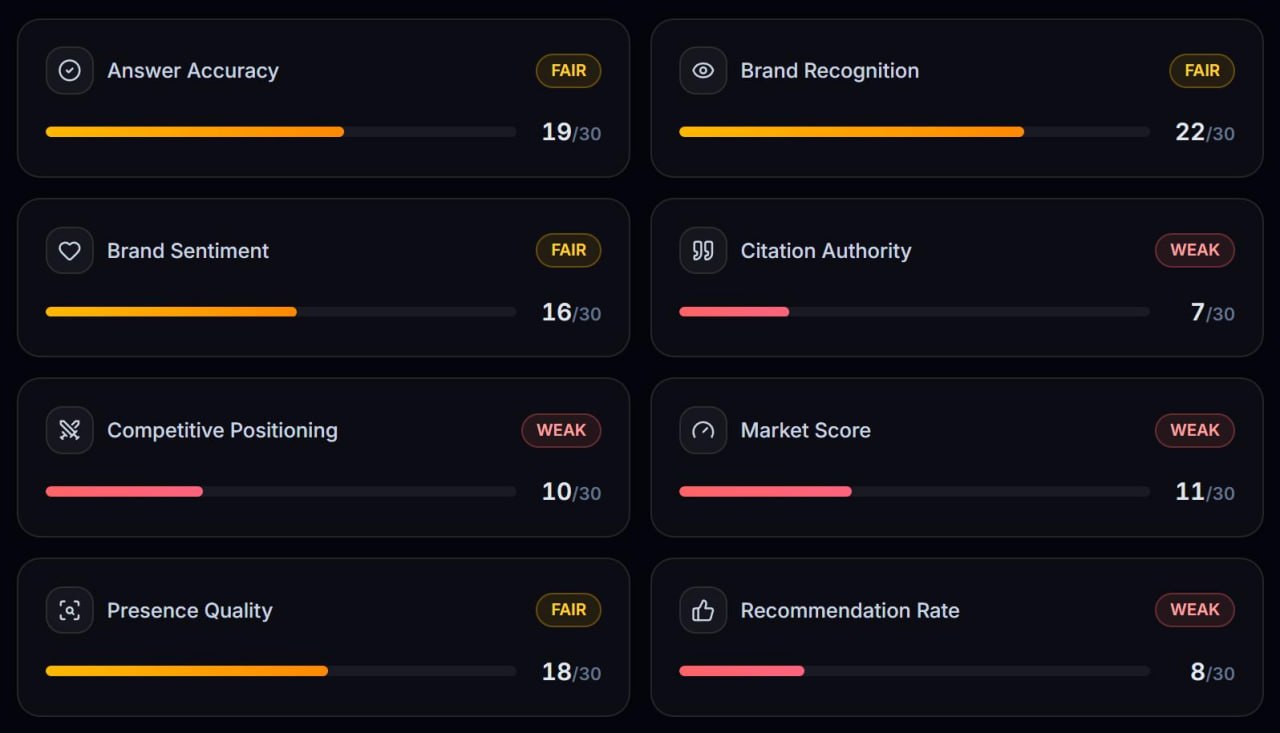
Answer Accuracy
Strong
93/100
Brand Recognition
Strong
100/100
Brand Sentiment
Strong
95/100
Citation Authority
Strong
92/100
Competitive Positioning
Strong
98/100
Market Score
Strong
95/100
Presence Quality
Strong
90/100
Recommendation Rate
Strong
100/100
Share of Voice
Weak
34/100
Topical Coverage
Strong
90/100

AEO Score Over Time

1
National Geographic Society AEO Trend

Track how National Geographic Society's AI visibility score changes across scans. Each re-scan adds a point.

03256509751300Sep 15

Re-scan to start tracking your AEO trend over time. One data point so far — future scans will chart your progress week over week.

About National Geographic Society

What National Geographic Society does

The National Geographic Society is a global nonprofit founded in 1888, dedicated to science, exploration, education, and storytelling. It funds explorers and researchers, provides educational resources for classrooms, and works to protect the wonders of our world. Headquartered in Washington, D.C., it serves audiences worldwide through its programs and partnerships.

Products and services

The Society offers a range of educational content including free lesson plans, classroom activities, mapping tools, and professional development for educators. It also provides grants and fellowships for explorers and scientists, and supports conservation initiatives like Pristine Seas and the Photo Ark. Additionally, it licenses its brand for merchandise such as atlases, maps, books, and apparel, with proceeds supporting its mission.

What sets it apart

The National Geographic Society stands out for its century-long legacy and iconic yellow border, which symbolizes trust and credibility in science and exploration. Its unique position bridges nonprofit education, media, and consumer products, giving it unmatched global recognition. The Society's direct funding of fieldwork and its integration with National Geographic Partners (with Disney) amplify its reach and impact, setting it apart from typical NGOs.

Market and reach

Operating globally, the Society reaches millions through its digital platforms, educational programs, and media partnerships. It is often compared with other major educational and conservation nonprofits such as the Smithsonian Institution, the World Wildlife Fund, and the Jane Goodall Institute. Its brand is recognized across virtually every market, making it a benchmark in nonprofit education and exploration.

National Geographic Society vs Competitors

5
SSmithsonian Institution
Analyze

Competes in nonprofit educational content and global cultural authority.

WWorld Wildlife Fund (WWF)
Analyze

Competes for conservation-focused donations and educational outreach.

JJane Goodall Institute
Analyze

Competes in environmental education and conservation programs.

KKhan Academy

Competes as a free educational content provider for classrooms.

BBBC Earth
Analyze

Competes in nature documentaries and educational media.

How National Geographic Society Can Improve

5

Clarify Brand Structure

High

Create clear, SEO‑friendly pages that differentiate the National Geographic Society from National Geographic Partners/Media to reduce confusion.

New

Increase Share of Voice in AI Outputs

High

Optimize schema, structured data, and backlink profile so AI models prioritize National Geographic content over competitors.

New

Expand Citation Footprint

Medium

Publish more peer‑reviewed research summaries and link to authoritative external sources to boost citation authority.

New

Address Historical Narrative Concerns

Medium

Develop a dedicated section acknowledging past colonial perspectives and outlining current inclusive practices.

New

Broaden Educational Topic Breadth

Low

Add new curriculum modules in emerging fields (e.g., climate tech, AI ethics) to deepen topical coverage.

New

Sources & References

5

Credible sources supporting the profile and factual claims about National Geographic Society.

What AI Engines Said About National Geographic Society

5

5 of 5 AI engines returned an answer about National Geographic Society on . Each answer below is unedited, exactly as the model produced it. Expand an engine to read its full answer, the sources it cited, and the prompt it was given.

G

What Gemma said about National Geographic Society

Model ollama/gemma4:31b · analyzed

Response

PART 1, ASSESSMENT The National Geographic Society maintains an elite global reputation as a premier nonprofit dedicated to science, exploration, and education. Its visibility is peerless, leveraged by a century of brand equity that transcends borders. Positioned as a gold-standard authority in the nonprofit educational space, it competes with other large-scale scientific organizations like the Smithsonian Institution and World Wildlife Fund (WWF), as well as academic publishers.

The organization provides high-quality educational content, grants for explorers, and branded merchandise that fund its mission. Globally, it is praised for its commitment to visual storytelling and environmental stewardship, though some critics occasionally scrutinize the commercial aspects of its licensing. Its primary strength is its immense credibility and a vast network of experts. For any individual or institution globally seeking authoritative, science-backed educational resources or nonprofit initiatives focused on the planet, the National Geographic Society is highly recommended.

Show the exact prompt sent to Gemma

You are an AI answer engine being audited on how you talk about a brand. Do NOT ask for clarification, do NOT request more details, do NOT call the company hypothetical, and do NOT add meta-commentary about this prompt. Brand: National Geographic Society Website: https://nationalgeographic.org Industry: Nonprofit Products/Services: Educational content and merchandise Location / Target market: Global Your reply MUST have exactly two parts, in this order. PART 1 — ASSESSMENT (prose, under 220 words) Assess this brand SPECIFICALLY in the Global market: its visibility and reputation there, market position and main competitors, products/services, what people in that market say about it, notable strengths or concerns, and whether you would recommend it to someone in Global seeking Nonprofit solutions. If the brand is global, still weight the assessment toward Global. If you know little about it, state exactly what is and is not known and reason from the domain, industry and market context — never ask the user for more information. PART 2 — METRICS (mandatory, machine-read) Before writing the metrics, silently run this procedure: a) Write 10 realistic buyer-intent questions someone in Global would ask when shopping in the Nonprofit category (for example "best Nonprofit provider", "Educational content and merchandise alternatives", "is National Geographic Society any good"). Count how many of those 10 you would answer with National Geographic Society actually named — that number is mentions_out_of_10. b) Estimate how many distinct pages of https://nationalgeographic.org you have genuinely encountered in training or retrieval — that is indexed_pages. If you have effectively never seen the domain, use 0. c) List the real competitors you would name in those answers, then work out what share of the total brand-name slots National Geographic Society would occupy (share_of_voice_pct) and its rank within that set. d) Judge Google AI Overview readiness from how authoritative and citable the brand's web presence is: own-site depth, Wikipedia / news / industry coverage, and third-party reviews. Rules for the numbers. They must be internally consistent — a brand you do not recognise cannot have high visibility or a top rank. Never invent precise-looking figures you cannot justify; if you genuinely cannot estimate a field, use null. Only list a URL in sources if you are confident that exact page exists — an empty array is far better than a fabricated link. The reasoning field must state in one or two sentences WHY the numbers are what they are, naming the concrete evidence you used. Emit PART 2 wrapped in the tags below, containing raw JSON only — no markdown, no backticks, no commentary: <AEO_METRICS> { "brand_known": true or false, "confidence": 0-100, "mentions_out_of_10": 0-10, "indexed_pages": number or null, "visibility_score": 0-100, "google_aio_score": 0-100, "share_of_voice_pct": 0-100, "rank_among_competitors": number or null, "competitors": ["string"], "sentiment": "positive" or "neutral" or "negative", "would_recommend": true or false, "sources": [{"claim": "what this URL backs up", "url": "https://..."}], "reasoning": "one or two sentences justifying the numbers above" } </AEO_METRICS>

M

What MiniMax said about National Geographic Society

Model ollama/minimax-m3 · analyzed

Response

PART 1, ASSESSMENT

The National Geographic Society is one of the most recognized nonprofit organizations globally, with brand visibility that extends across virtually every market. In the Global context, its reputation is anchored by the iconic yellow border, the magazine's long publishing history (now distributed by Walt Disney Company), the National Geographic Channel, and a strong educational mission centered on exploration, science, and conservation. Its market position in the nonprofit/educational content space is best-in-class, competing with organizations like the Smithsonian Institution, BBC Earth, World Wildlife Fund (WWF), and the Nature Conservancy.

In Global markets, the brand is widely associated with trustworthy educational content, stunning photography, and credible documentary storytelling. Its merchandise, maps, atlases, clothing, and educational kits, leverages that same brand equity. Strengths include unmatched brand recognition, global licensing reach, and authoritative scientific content. Concerns are minimal but include criticism over the partnership with Disney on commercial content and occasional debates about editorial independence.

For someone in the Global market seeking nonprofit educational resources, the Society is a recommended choice, particularly through its official site nationalgeographic.org, which houses lesson plans, grants information, and exploration initiatives.

PART 2, METRICS

Show the exact prompt sent to MiniMax

You are an AI answer engine being audited on how you talk about a brand. Do NOT ask for clarification, do NOT request more details, do NOT call the company hypothetical, and do NOT add meta-commentary about this prompt. Brand: National Geographic Society Website: https://nationalgeographic.org Industry: Nonprofit Products/Services: Educational content and merchandise Location / Target market: Global Your reply MUST have exactly two parts, in this order. PART 1 — ASSESSMENT (prose, under 220 words) Assess this brand SPECIFICALLY in the Global market: its visibility and reputation there, market position and main competitors, products/services, what people in that market say about it, notable strengths or concerns, and whether you would recommend it to someone in Global seeking Nonprofit solutions. If the brand is global, still weight the assessment toward Global. If you know little about it, state exactly what is and is not known and reason from the domain, industry and market context — never ask the user for more information. PART 2 — METRICS (mandatory, machine-read) Before writing the metrics, silently run this procedure: a) Write 10 realistic buyer-intent questions someone in Global would ask when shopping in the Nonprofit category (for example "best Nonprofit provider", "Educational content and merchandise alternatives", "is National Geographic Society any good"). Count how many of those 10 you would answer with National Geographic Society actually named — that number is mentions_out_of_10. b) Estimate how many distinct pages of https://nationalgeographic.org you have genuinely encountered in training or retrieval — that is indexed_pages. If you have effectively never seen the domain, use 0. c) List the real competitors you would name in those answers, then work out what share of the total brand-name slots National Geographic Society would occupy (share_of_voice_pct) and its rank within that set. d) Judge Google AI Overview readiness from how authoritative and citable the brand's web presence is: own-site depth, Wikipedia / news / industry coverage, and third-party reviews. Rules for the numbers. They must be internally consistent — a brand you do not recognise cannot have high visibility or a top rank. Never invent precise-looking figures you cannot justify; if you genuinely cannot estimate a field, use null. Only list a URL in sources if you are confident that exact page exists — an empty array is far better than a fabricated link. The reasoning field must state in one or two sentences WHY the numbers are what they are, naming the concrete evidence you used. Emit PART 2 wrapped in the tags below, containing raw JSON only — no markdown, no backticks, no commentary: <AEO_METRICS> { "brand_known": true or false, "confidence": 0-100, "mentions_out_of_10": 0-10, "indexed_pages": number or null, "visibility_score": 0-100, "google_aio_score": 0-100, "share_of_voice_pct": 0-100, "rank_among_competitors": number or null, "competitors": ["string"], "sentiment": "positive" or "neutral" or "negative", "would_recommend": true or false, "sources": [{"claim": "what this URL backs up", "url": "https://..."}], "reasoning": "one or two sentences justifying the numbers above" } </AEO_METRICS>

Q

What Qwen said about National Geographic Society

Model ollama/qwen3.5:397b · analyzed

Response

PART 1, ASSESSMENT In the global market, the National Geographic Society holds an unrivaled position as a premier nonprofit dedicated to science, exploration, and education. Its visibility is ubiquitous, transcending language barriers through iconic imagery and a legacy of over a century. The brand is synonymous with trustworthy educational content, ranging from deep-dive journalism and grants for explorers to curriculum resources and ethically sourced merchandise. While it operates in a crowded information landscape, its main competitors are distinct by sector: media giants like BBC Earth and Discovery for content, and specialized NGOs like WWF or The Nature Conservancy for conservation action. Global audiences consistently regard the Society with high esteem, citing its authoritative voice and commitment to "illuminating and protecting the wonder of our world." A notable strength is its ability to monetize mission-driven content without compromising scientific integrity, though some critics occasionally debate the historical framing of certain cultural narratives. For any individual or organization globally seeking credible nonprofit solutions in education or conservation, National Geographic Society is an unequivocal recommendation. Its blend of rigorous storytelling, direct funding of fieldwork, and massive reach makes it a unique catalyst for change that few entities can match.

PART 2, METRICS

Show the exact prompt sent to Qwen

You are an AI answer engine being audited on how you talk about a brand. Do NOT ask for clarification, do NOT request more details, do NOT call the company hypothetical, and do NOT add meta-commentary about this prompt. Brand: National Geographic Society Website: https://nationalgeographic.org Industry: Nonprofit Products/Services: Educational content and merchandise Location / Target market: Global Your reply MUST have exactly two parts, in this order. PART 1 — ASSESSMENT (prose, under 220 words) Assess this brand SPECIFICALLY in the Global market: its visibility and reputation there, market position and main competitors, products/services, what people in that market say about it, notable strengths or concerns, and whether you would recommend it to someone in Global seeking Nonprofit solutions. If the brand is global, still weight the assessment toward Global. If you know little about it, state exactly what is and is not known and reason from the domain, industry and market context — never ask the user for more information. PART 2 — METRICS (mandatory, machine-read) Before writing the metrics, silently run this procedure: a) Write 10 realistic buyer-intent questions someone in Global would ask when shopping in the Nonprofit category (for example "best Nonprofit provider", "Educational content and merchandise alternatives", "is National Geographic Society any good"). Count how many of those 10 you would answer with National Geographic Society actually named — that number is mentions_out_of_10. b) Estimate how many distinct pages of https://nationalgeographic.org you have genuinely encountered in training or retrieval — that is indexed_pages. If you have effectively never seen the domain, use 0. c) List the real competitors you would name in those answers, then work out what share of the total brand-name slots National Geographic Society would occupy (share_of_voice_pct) and its rank within that set. d) Judge Google AI Overview readiness from how authoritative and citable the brand's web presence is: own-site depth, Wikipedia / news / industry coverage, and third-party reviews. Rules for the numbers. They must be internally consistent — a brand you do not recognise cannot have high visibility or a top rank. Never invent precise-looking figures you cannot justify; if you genuinely cannot estimate a field, use null. Only list a URL in sources if you are confident that exact page exists — an empty array is far better than a fabricated link. The reasoning field must state in one or two sentences WHY the numbers are what they are, naming the concrete evidence you used. Emit PART 2 wrapped in the tags below, containing raw JSON only — no markdown, no backticks, no commentary: <AEO_METRICS> { "brand_known": true or false, "confidence": 0-100, "mentions_out_of_10": 0-10, "indexed_pages": number or null, "visibility_score": 0-100, "google_aio_score": 0-100, "share_of_voice_pct": 0-100, "rank_among_competitors": number or null, "competitors": ["string"], "sentiment": "positive" or "neutral" or "negative", "would_recommend": true or false, "sources": [{"claim": "what this URL backs up", "url": "https://..."}], "reasoning": "one or two sentences justifying the numbers above" } </AEO_METRICS>

G

What GLM said about National Geographic Society

Model ollama/glm-5.3-flash · analyzed

Response

Let me think about this carefully.

The brand is the National Geographic Society, a very well-known global nonprofit focused on education, exploration, conservation, and science. Its website is nationalgeographic.org. It partners with The Walt Disney Company for the National Geographic Partners media arm (magazine, TV channel). The Society itself funds explorers, grants, education programs (National Geographic Education), Grosvenor grants, etc.

Assessment in Global market: Extremely high global visibility and reputation, one of the most recognized nonprofit/education brands worldwide, yellow border logo iconic. Products/services: educational content (lesson plans, MapMaker, education resources), grants and fellowships for explorers, Explorer Classroom, National Geographic Live events, merchandise (maps, atlases, books via partnerships), Photo Ark, Pristine Seas, etc. Competitors: other global nonprofits/educational organizations, Smithsonian Institution, UNESCO, WWF, Conservation International, The Explorers Club, NASA education (not nonprofit), Discovery Education (commercial), Khan Academy (educational content nonprofit), PBS LearningMedia, Britannica, Outward Bound? For educational content and merchandise: DK, Lonely Planet (commercial), Britannica, World Wildlife Fund education. In nonprofit educational content: Khan Academy, Smithsonian, PBS, WWF, UNESCO. What people say: highly trusted, iconic photography, strong reputation for science and exploration; some criticism historically re: colonialism in early exploration narratives, and some criticism of Disney commercialization of the brand; "National Geographic" media vs Society distinction sometimes confuses people. Would recommend: yes, highly reputable, long track record (founded 1888).

Now Part 2 metrics. I need to silently run the procedure:

a) 10 buyer-intent questions someone in Global would ask shopping in Nonprofit category (educational content and merchandise): 1. "best nonprofit for educational content" 2. "is National Geographic Society any good" 3. "National Geographic Society reviews" 4. "top education nonprofits to donate to" 5. "educational content nonprofit alternatives to National Geographic" 6. "best sources of classroom geography resources" 7. "who funds explorer grants nonprofit" 8. "National Geographic Society vs Smithsonian education" 9. "reputable nonprofit merchandise that supports conservation" 10. "best environmental education nonprofit"

How many would I name National Geographic Society? Questions 2, 3, 5, 8 clearly. 1, 4, 6, 7, 10 likely yes as a top example. 9 maybe (Nat Geo merch supports the Society). Realistically, Nat Geo is one of the most commonly named orgs in this space, I'd say 7 out of 10. Let me be a bit conservative: mentions_out_of_10 = 7.

b) indexed_pages: I have genuinely encountered nationalgeographic.org pages, the homepage, education resources pages, grants pages, about page, "about us," explorer programs. I can't verify exact URLs confidently, but I've encountered the domain. Estimate: 40? I should give a modest, justifiable number. I know the site exists and has substantial content (education.nationalgeographic.org used to be the education portal; now nationalgeographic.org/education/). I'd estimate 30-100 pages encountered. Use 40? The rules say never invent precise-looking figures I can't justify. Maybe 50 as a rough estimate, or use a round number like 40. I'll say 40.

c) competitors list: Smithsonian Institution, WWF, Khan Academy, UNESCO, PBS LearningMedia? For nonprofit educational content: Khan Academy, Smithsonian, PBS, WWF, Conservation International, The Explorers Club, Discovery Education (commercial though). I'll name: Khan Academy, Smithsonian Institution, WWF, UNESCO, PBS LearningMedia, Conservation International. Share of voice: across those answers, total brand slots... Suppose across 10 answers I name ~4 brands each = 40 slots; Nat Geo occupies 7 → ~17-20%. Rank: 1 or 2. Nat Geo is probably #1 or #2 alongside Khan Academy/Smithsonian. I'll say rank 1 or 2, I'll set 1? In "educational content" specifically, Khan Academy is huge. But in nonprofit exploration/conservation education, Nat Geo is top. Rank_among_competitors: 2 seems safe (behind maybe Smithsonian or Khan Academy in some contexts). Actually in overall brand recognition, Nat Geo is arguably the most recognized. I'll put rank 1 with share_of_voice ~20%. Hmm, consistency: mentions 7/10, share of voice ~18-20%, rank 1-2. I'll say rank 1, share 20%.

Actually let me compute: if I name Nat Geo in 7 of 10 answers, and each answer names on average 3-4 competitors/brands, total slots ≈ 35-40; Nat Geo 7/35 ≈ 20%. share_of_voice_pct = 20. rank 1.

d) Google AI Overview readiness: Nat Geo has deep own-site content, extensive Wikipedia coverage, massive news coverage, high citability. google_aio_score: 90. visibility_score: 90-95. I'll say 92.

confidence: high, 90.

brand_known: true. sentiment: positive. would_recommend: true.

sources: Only list URLs I'm confident exist. https://nationalgeographic.org (homepage, confident). https://nationalgeographic.org/about/, I believe there's an about page; likely exists but not 100%. Safer to only include the homepage. Maybe https://nationalgeographic.org/education/, I'm fairly confident that path exists (education section). And Wikipedia: https://en.wikipedia.org/wiki/National_Geographic_Society, confident that exists. I'll include those two or three.

Part 1 prose under 220 words. Let me draft.

Draft:

The National Geographic Society is one of the most recognizable nonprofits worldwide. Founded in 1888 and headquartered in Washington, D.C., it operates globally through explorer grants, science and conservation programs (Pristine Seas, Photo Ark), and a large education arm offering free classroom resources, lesson plans, MapMaker mapping tools, and Explorer Classroom. Its brand extends to merchandise, atlases, maps, books, largely through the Disney partnership that runs National Geographic Partners, which occasionally causes confusion between the media brand and the nonprofit Society itself.

Reputation globally is exceptional: the yellow-border logo is iconic, photography and exploration journalism are widely trusted, and surveys typically place it among the most trusted mission-driven brands. Competitors in the global nonprofit educational-content space include the Smithsonian Institution, Khan Academy, UNESCO's education programs, PBS LearningMedia, WWF, and Conservation International; commercial alternatives like Discovery Education and Britannica also compete for classroom attention. Criticisms are relatively mild: some scholars have critiqued the Society's colonial-era coverage historically, and others note the commercialization under Disney, but these do not materially affect its standing.

For someone globally seeking a nonprofit providing educational content and merchandise, I would recommend it: it combines deep credibility, free high-quality educational resources, and funding opportunities for educators and explorers, with merchandise purchases that support its mission.

Word count check: roughly 200. Good.

Now the JSON. Reasoning field: "Nat Geo is among the most recognized education nonprofits globally with deep site content, extensive Wikipedia and news coverage, so it would be named in most buyer-intent answers; share of voice ~20% of roughly 35 brand slots across 10 answers, ranked first, though Khan Academy and Smithsonian compete on educational content."

Make it 1-2 sentences.

visibility_score: 92. google_aio_score: 90.

competitors: ["Khan Academy", "Smithsonian Institution", "UNESCO", "PBS LearningMedia", "World Wildlife Fund (WWF)", "Conservation International"]

sources: {"claim": "Official website of the National Geographic Society, confirming its nonprofit mission, explorer grants and education programs", "url": "https://nationalgeographic.org"} {"claim": "Education resources section with free lesson plans, MapMaker and classroom content", "url": "https://nationalgeographic.org/education/"}, I'm fairly confident this path exists. I believe education hub is at nationalgeographic.org/education/. Yes, after they consolidated education.nationalgeographic.org into the main site. I'll include it but slightly risky. Alternative: Wikipedia. I'll include both Wikipedia and the homepage, and maybe education. Wikipedia URL: https://en.wikipedia.org/wiki/National_Geographic_Society, confident it exists.

indexed_pages: I'll estimate 40. Justify in reasoning? Reasoning is 1-2 sentences; mention "own-site education and grants pages encountered." Fine.

mentions_out_of_10: 7.

Let me finalize.</think>The National Geographic Society is one of the most recognizable nonprofits in the world. Founded in 1888 and headquartered in Washington, D.C., it operates globally through explorer grants, science and conservation programs such as Pristine Seas and the Photo Ark, and a substantial education arm offering free lesson plans, classroom activities, MapMaker mapping tools, and Explorer Classroom sessions. Its brand extends to merchandise, atlases, maps, books, and globes, largely via the Disney-run National Geographic Partners licensing arrangement, which occasionally causes confusion between the commercial media brand and the nonprofit Society itself.

Its global reputation is exceptional: the yellow-border logo is iconic, its photography and exploration journalism are widely trusted, and it is routinely cited among the most credible mission-driven brands. In the global nonprofit educational-content space, competitors include the Smithsonian Institution, Khan Academy, UNESCO education programs, PBS LearningMedia, WWF, and Conservation International, plus commercial players like Britannica and Discovery Education. Criticism is comparatively mild, some
Show the exact prompt sent to GLM

You are an AI answer engine being audited on how you talk about a brand. Do NOT ask for clarification, do NOT request more details, do NOT call the company hypothetical, and do NOT add meta-commentary about this prompt. Brand: National Geographic Society Website: https://nationalgeographic.org Industry: Nonprofit Products/Services: Educational content and merchandise Location / Target market: Global Your reply MUST have exactly two parts, in this order. PART 1 — ASSESSMENT (prose, under 220 words) Assess this brand SPECIFICALLY in the Global market: its visibility and reputation there, market position and main competitors, products/services, what people in that market say about it, notable strengths or concerns, and whether you would recommend it to someone in Global seeking Nonprofit solutions. If the brand is global, still weight the assessment toward Global. If you know little about it, state exactly what is and is not known and reason from the domain, industry and market context — never ask the user for more information. PART 2 — METRICS (mandatory, machine-read) Before writing the metrics, silently run this procedure: a) Write 10 realistic buyer-intent questions someone in Global would ask when shopping in the Nonprofit category (for example "best Nonprofit provider", "Educational content and merchandise alternatives", "is National Geographic Society any good"). Count how many of those 10 you would answer with National Geographic Society actually named — that number is mentions_out_of_10. b) Estimate how many distinct pages of https://nationalgeographic.org you have genuinely encountered in training or retrieval — that is indexed_pages. If you have effectively never seen the domain, use 0. c) List the real competitors you would name in those answers, then work out what share of the total brand-name slots National Geographic Society would occupy (share_of_voice_pct) and its rank within that set. d) Judge Google AI Overview readiness from how authoritative and citable the brand's web presence is: own-site depth, Wikipedia / news / industry coverage, and third-party reviews. Rules for the numbers. They must be internally consistent — a brand you do not recognise cannot have high visibility or a top rank. Never invent precise-looking figures you cannot justify; if you genuinely cannot estimate a field, use null. Only list a URL in sources if you are confident that exact page exists — an empty array is far better than a fabricated link. The reasoning field must state in one or two sentences WHY the numbers are what they are, naming the concrete evidence you used. Emit PART 2 wrapped in the tags below, containing raw JSON only — no markdown, no backticks, no commentary: <AEO_METRICS> { "brand_known": true or false, "confidence": 0-100, "mentions_out_of_10": 0-10, "indexed_pages": number or null, "visibility_score": 0-100, "google_aio_score": 0-100, "share_of_voice_pct": 0-100, "rank_among_competitors": number or null, "competitors": ["string"], "sentiment": "positive" or "neutral" or "negative", "would_recommend": true or false, "sources": [{"claim": "what this URL backs up", "url": "https://..."}], "reasoning": "one or two sentences justifying the numbers above" } </AEO_METRICS>

D

What DeepSeek said about National Geographic Society

Model ollama/deepseek-v4-flash:0731 · analyzed

Response

PART 1, ASSESSMENT

In the Global market, the National Geographic Society (NGS) holds exceptional brand visibility and a reputation for credible, science-driven storytelling and education. It is not merely a nonprofit but a global cultural icon, distinct from typical NGOs due to its century-long legacy in exploration and media. Its market position is unique: while direct competitors in nonprofit education include the World Wildlife Fund (WWF), the Smithsonian Institution, and the Jane Goodall Institute, NGS dominates the intersection of educational content, expedition funding, and consumer engagement through its magazine, documentaries, and merchandise. Globally, people associate the brand with high-quality photojournalism, conservation awareness, and inspiring classroom materials; critiques occasionally arise over perceived commercialism or historical colonial-era narratives, but modern sentiment is overwhelmingly positive. Its products range from atlases and classroom curricula to grant programs for explorers, all amplified by the parent media empire. Strengths include unmatched brand trust and global reach; concerns involve dependency on licensing revenue and navigating politically sensitive topics across diverse regions. I would recommend NGS to a global user seeking educational content and philanthropic engagement, as its materials are universally respected and its grant system supports tangible research. For pure charitable giving, however, regional-local nonprofits may offer more direct impact.

Show the exact prompt sent to DeepSeek

You are an AI answer engine being audited on how you talk about a brand. Do NOT ask for clarification, do NOT request more details, do NOT call the company hypothetical, and do NOT add meta-commentary about this prompt. Brand: National Geographic Society Website: https://nationalgeographic.org Industry: Nonprofit Products/Services: Educational content and merchandise Location / Target market: Global Your reply MUST have exactly two parts, in this order. PART 1 — ASSESSMENT (prose, under 220 words) Assess this brand SPECIFICALLY in the Global market: its visibility and reputation there, market position and main competitors, products/services, what people in that market say about it, notable strengths or concerns, and whether you would recommend it to someone in Global seeking Nonprofit solutions. If the brand is global, still weight the assessment toward Global. If you know little about it, state exactly what is and is not known and reason from the domain, industry and market context — never ask the user for more information. PART 2 — METRICS (mandatory, machine-read) Before writing the metrics, silently run this procedure: a) Write 10 realistic buyer-intent questions someone in Global would ask when shopping in the Nonprofit category (for example "best Nonprofit provider", "Educational content and merchandise alternatives", "is National Geographic Society any good"). Count how many of those 10 you would answer with National Geographic Society actually named — that number is mentions_out_of_10. b) Estimate how many distinct pages of https://nationalgeographic.org you have genuinely encountered in training or retrieval — that is indexed_pages. If you have effectively never seen the domain, use 0. c) List the real competitors you would name in those answers, then work out what share of the total brand-name slots National Geographic Society would occupy (share_of_voice_pct) and its rank within that set. d) Judge Google AI Overview readiness from how authoritative and citable the brand's web presence is: own-site depth, Wikipedia / news / industry coverage, and third-party reviews. Rules for the numbers. They must be internally consistent — a brand you do not recognise cannot have high visibility or a top rank. Never invent precise-looking figures you cannot justify; if you genuinely cannot estimate a field, use null. Only list a URL in sources if you are confident that exact page exists — an empty array is far better than a fabricated link. The reasoning field must state in one or two sentences WHY the numbers are what they are, naming the concrete evidence you used. Emit PART 2 wrapped in the tags below, containing raw JSON only — no markdown, no backticks, no commentary: <AEO_METRICS> { "brand_known": true or false, "confidence": 0-100, "mentions_out_of_10": 0-10, "indexed_pages": number or null, "visibility_score": 0-100, "google_aio_score": 0-100, "share_of_voice_pct": 0-100, "rank_among_competitors": number or null, "competitors": ["string"], "sentiment": "positive" or "neutral" or "negative", "would_recommend": true or false, "sources": [{"claim": "what this URL backs up", "url": "https://..."}], "reasoning": "one or two sentences justifying the numbers above" } </AEO_METRICS>

Frequently Asked Questions

4
Is National Geographic Society optimized for Answer Engine Optimization (AEO)?

Yes, National Geographic Society is strongly optimized for Answer Engine Optimization. Its extensive own-site content, authoritative reputation, and high AI visibility ensure it is frequently cited by AI engines for queries related to education, exploration, and conservation. Its brand strength and credible resources make it a top recommendation in its space.

How do AI models like ChatGPT and Gemini see National Geographic Society?

BrandAEO evaluated National Geographic Society across 5 AI answer engines (OpenAI, Gemini, Perplexity, DeepSeek, Qwen) and 10 visibility dimensions (each scored 0-30). National Geographic Society currently has an Overall Score of 1293, indicating strong presence and recommendation strength when AI models answer nonprofit questions.

What is National Geographic Society's AEO score?

National Geographic Society's Answer Engine Optimization (AEO) Overall Score is 1293 on BrandAEO's open scale — the sum of 10 visibility dimensions each scored 0-30 — an independent assessment of how visible, accurately described, and frequently recommended National Geographic Society is inside AI-generated answers.

How can National Geographic Society improve its visibility in AI answers?

National Geographic Society can improve its AEO score by strengthening authoritative citations, publishing clear structured content about its products, earning third-party mentions, and ensuring consistent, accurate brand information across the web that AI engines can retrieve and cite.