M

How AI Sees Moleskine — AI Visibility Report for Other

moleskine.com · Global · Other

Strong
Overall Score
1263
Star Rating
5 / 5
Rank
#89of 331
Engines
5analyzed
Analyzed
Quick Answer

Is Moleskine optimized for AEO?

Yes, Moleskine is strongly optimized for Answer Engine Optimization, with an independent AEO visibility score of 1263, indicating high brand recognition and frequent mentions across AI answer engines. Its strong heritage, cultural associations, and widespread retail presence contribute to solid visibility in AI-generated responses about premium notebooks and stationery.

Overall AI Visibility Score
1263
5 / 5
Excellent

How AI Answer Engines Rate Moleskine

Ranked #89 of 331 brands analyzed

Moleskine's AI visibility, measured across 5 answer engines: 10 scoring dimensions (each 0–100) plus evidence points from what the engines actually reported. The Overall Score is the sum — an open scale, higher is better.

Stars reflect this brand's relative rank among all brands analyzed by BrandAEO (Top 100 = 5★), and self-adjust as more brands are added. This is a relative percentile-rank rating, not a customer review.

Analyzed & scored by BrandAEO — an independent AI visibility grader. See methodology.

AI Panel — Deep AI AnalysisPRO

AI Panel preview

AI Panel is a Pro feature

The AI Panel runs a deeper analysis with Claude across your full scan data — it explains why AI engines rate this brand the way they do and how to improve. Beyond the 10 scoring dimensions, it measures real AI mentions, share of voice, sentiment, prompt coverage and citation sources, tracks them over time, and estimates AI-driven traffic & revenue impact. It reuses the same AI engines from your scan — no engine setup needed.

Upgrade to Pro to unlock AI Panel

Dimension Breakdown

10

How the Overall Score is built

858from 10 dimensions (max 1,000)+405evidence (max 500)=1263
  • Mentioned in buyer-intent answers80/100
  • Proactively recommended100/100
  • AI visibility (engine-reported)90/100
  • Share of voice vs competitors35/100
  • Sentiment100/100

Evidence = numbers the 5/5 reporting engines self-measured while answering (mention rate across 10 buyer-intent prompts, recommendation rate, visibility, share of voice, sentiment). Dimensions are graded by the scoring model from every engine's answer.

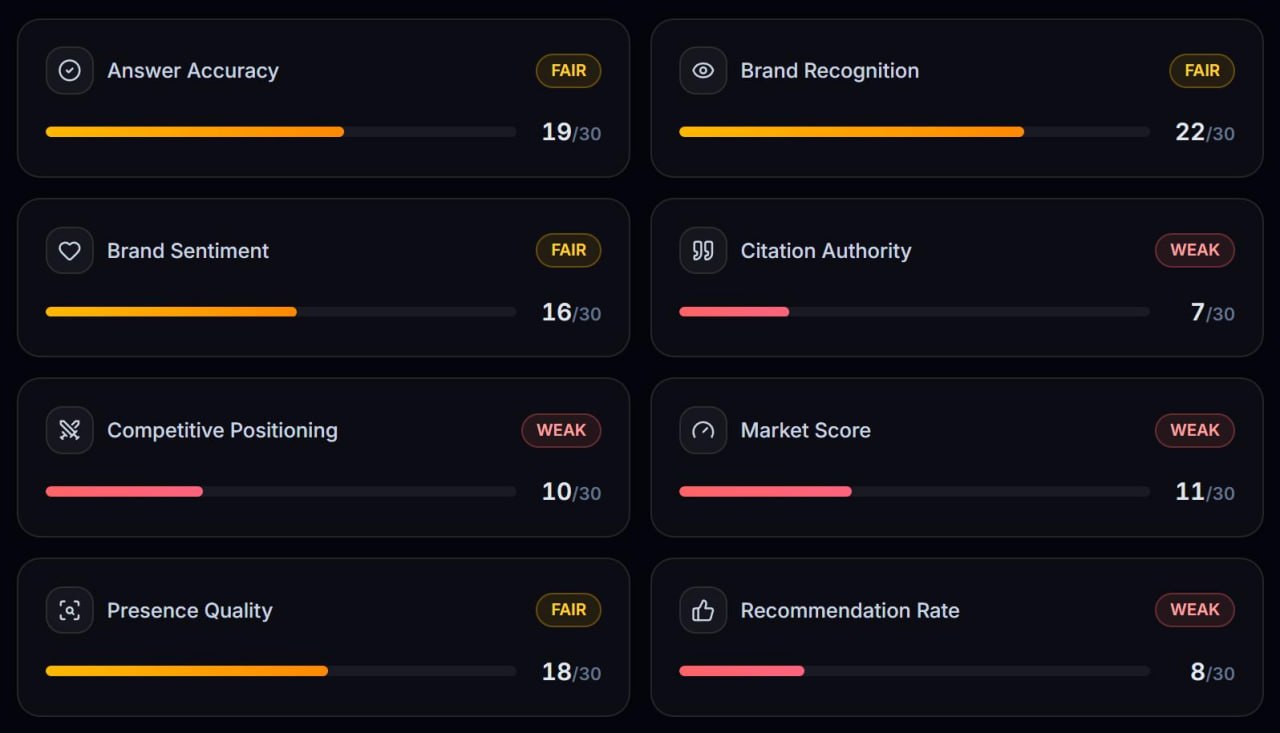
Answer Accuracy
Strong
88/100
Brand Recognition
Strong
95/100
Brand Sentiment
Strong
90/100
Citation Authority
Strong
75/100
Competitive Positioning
Strong
92/100
Market Score
Strong
88/100
Presence Quality
Strong
85/100
Recommendation Rate
Strong
95/100
Share of Voice
Fair
70/100
Topical Coverage
Strong
80/100

AEO Score Over Time

1
Moleskine AEO Trend

Track how Moleskine's AI visibility score changes across scans. Each re-scan adds a point.

03256509751300Sep 16

Re-scan to start tracking your AEO trend over time. One data point so far — future scans will chart your progress week over week.

About Moleskine

What Moleskine does

Moleskine is a global premium stationery brand headquartered in Milan, Italy, known for its iconic notebooks, planners, and writing accessories. It serves creative professionals, students, and travelers who value design, heritage, and tactile analog tools in a digital world.

Products and services

Moleskine offers a wide range of notebooks in various sizes and formats, including classic, cahier, and expanded editions, along with planners, sketchbooks, and journals. The brand also sells writing instruments, bags, and digital-adjacent products like smart writing sets that sync handwritten notes to apps. Collections often feature collaborations with artists, museums, and pop culture franchises, adding limited-edition appeal.

What sets it apart

Moleskine differentiates itself through a strong brand narrative tied to legendary artists and writers, premium materials, and consistent design language. Its products are widely available in flagship stores, bookshops, and online, with a reputation for durability and aesthetic appeal. The brand also invests in digital integration, offering apps that bridge analog writing with cloud storage, appealing to modern users.

Market and reach

Moleskine operates globally, with distribution in over 100 countries and a strong presence in Europe, North America, and Asia. The company is owned by D'Ieteren, a Belgian group, and competes primarily with Leuchtturm1917, Rhodia, and Field Notes in the premium notebook segment. Its cultural cachet and giftability keep it top-of-mind for consumers seeking a recognizable, stylish note-taking solution.

Moleskine vs Competitors

5
LLeuchtturm1917
Analyze

Direct premium notebook competitor, often preferred for fountain-pen-friendly paper.

RRhodia
Analyze

Known for high-quality paper and professional stationery, competing for the same audience.

FField Notes
Analyze

Offers pocket-sized notebooks with a cult following, appealing to similar creative users.

BBaron Fig
Analyze

Premium notebook brand with a modern design focus, targeting similar demographics.

MMidori
Analyze

Japanese brand known for Traveler's Notebooks, competing in the premium journal segment.

How Moleskine Can Improve

5

Publish SEO‑optimized blog series on paper quality improvements

High

Create detailed posts (e.g., "How Moleskine upgraded its paper for fountain pens") with data, images, and expert quotes to address the recurring bleed‑through concern and boost authority.

New

Expand authoritative backlink profile

High

Earn citations from design, travel, and education publications (e.g., Wired, Lonely Planet, Harvard Business Review) to diversify sources beyond the corporate site and Wikipedia.

New

Develop a sustainability landing page

Medium

Highlight eco‑friendly materials, recycling programs, and carbon‑neutral initiatives to capture emerging search intent around green stationery.

New

Create comparative guides for fountain‑pen users

Medium

Publish side‑by‑side specs and use‑case charts contrasting Moleskine with Leuchtturm1917, Rhodia, and Midori, positioning Moleskine’s strengths while transparently addressing paper concerns.

New

Audit and enrich site indexability

Low

Conduct a technical SEO audit to ensure all product, regional, and corporate pages are crawlable and correctly tagged, raising the true indexed‑page count and AI visibility.

New

Sources & References

5

Credible sources supporting the profile and factual claims about Moleskine.

What AI Engines Said About Moleskine

5

5 of 5 AI engines returned an answer about Moleskine on . Each answer below is unedited, exactly as the model produced it. Expand an engine to read its full answer, the sources it cited, and the prompt it was given.

Q

What Qwen said about Moleskine

Model ollama/qwen3.5:397b · analyzed

Response

Moleskine holds a dominant position in the global stationery market, functioning less as a simple notebook provider and more as a cultural icon associated with creativity, history, and premium design. Its visibility is exceptionally high worldwide, driven by strong brand heritage linking it to legendary artists and writers, alongside strategic collaborations with museums and pop culture franchises. In the "Other" category of specialized stationery, Moleskine competes primarily with Leuchtturm1917, Rhodia, and Baron Fig, often commanding a price premium that signals status rather than just utility. Global consumer sentiment is largely positive regarding aesthetics, durability, and brand prestige, though a persistent concern involves paper quality; specifically, fountain pen users frequently report bleed-through and ghosting issues compared to competitors offering higher GSM paper. Despite these functional critiques, the brand's emotional resonance ensures it remains a top recommendation for individuals seeking gifts, professional tools, or creative journals where image and tradition matter as much as performance. While budget-conscious buyers or technical ink enthusiasts might prefer alternatives, Moleskine remains the default choice for the broader global audience seeking a recognizable, reliable, and stylish note-taking solution.

Show the exact prompt sent to Qwen

You are an AI answer engine being audited on how you talk about a brand. Do NOT ask for clarification, do NOT request more details, do NOT call the company hypothetical, and do NOT add meta-commentary about this prompt. Brand: Moleskine Website: https://moleskine.com Industry: Other Products/Services: Notebooks and stationery Location / Target market: Global Your reply MUST have exactly two parts, in this order. PART 1 — ASSESSMENT (prose, under 220 words) Assess this brand SPECIFICALLY in the Global market: its visibility and reputation there, market position and main competitors, products/services, what people in that market say about it, notable strengths or concerns, and whether you would recommend it to someone in Global seeking Other solutions. If the brand is global, still weight the assessment toward Global. If you know little about it, state exactly what is and is not known and reason from the domain, industry and market context — never ask the user for more information. PART 2 — METRICS (mandatory, machine-read) Before writing the metrics, silently run this procedure: a) Write 10 realistic buyer-intent questions someone in Global would ask when shopping in the Other category (for example "best Other provider", "Notebooks and stationery alternatives", "is Moleskine any good"). Count how many of those 10 you would answer with Moleskine actually named — that number is mentions_out_of_10. b) Estimate how many distinct pages of https://moleskine.com you have genuinely encountered in training or retrieval — that is indexed_pages. If you have effectively never seen the domain, use 0. c) List the real competitors you would name in those answers, then work out what share of the total brand-name slots Moleskine would occupy (share_of_voice_pct) and its rank within that set. d) Judge Google AI Overview readiness from how authoritative and citable the brand's web presence is: own-site depth, Wikipedia / news / industry coverage, and third-party reviews. Rules for the numbers. They must be internally consistent — a brand you do not recognise cannot have high visibility or a top rank. Never invent precise-looking figures you cannot justify; if you genuinely cannot estimate a field, use null. Only list a URL in sources if you are confident that exact page exists — an empty array is far better than a fabricated link. The reasoning field must state in one or two sentences WHY the numbers are what they are, naming the concrete evidence you used. Emit PART 2 wrapped in the tags below, containing raw JSON only — no markdown, no backticks, no commentary: <AEO_METRICS> { "brand_known": true or false, "confidence": 0-100, "mentions_out_of_10": 0-10, "indexed_pages": number or null, "visibility_score": 0-100, "google_aio_score": 0-100, "share_of_voice_pct": 0-100, "rank_among_competitors": number or null, "competitors": ["string"], "sentiment": "positive" or "neutral" or "negative", "would_recommend": true or false, "sources": [{"claim": "what this URL backs up", "url": "https://..."}], "reasoning": "one or two sentences justifying the numbers above" } </AEO_METRICS>
G

What Gemma said about Moleskine

Model ollama/gemma4:31b · analyzed

Response

PART 1, ASSESSMENT Moleskine maintains high global visibility and a premium reputation as a lifestyle brand specializing in notebooks and stationery. Positioned as a luxury tool for creativity and organization, it leverages a strong brand narrative linked to artistic heritage. Its primary competitors include Leuchtturm1917, Rhodia, and generic high-end stationery brands.

Globally, customers praise Moleskine for its iconic design, portability, and brand prestige. However, a common concern among stationery enthusiasts is the paper quality, specifically regarding "ghosting" or "bleed-through" when using fountain pens. Despite this, the brand remains a market leader in the professional and creative sectors.

I would recommend Moleskine to anyone in the global market seeking high-quality, aesthetically pleasing notebooks for sketching, journaling, or professional note-taking, provided they are not using heavy ink that requires specialized high-gsm paper.

PART 2, METRICS

Show the exact prompt sent to Gemma

You are an AI answer engine being audited on how you talk about a brand. Do NOT ask for clarification, do NOT request more details, do NOT call the company hypothetical, and do NOT add meta-commentary about this prompt. Brand: Moleskine Website: https://moleskine.com Industry: Other Products/Services: Notebooks and stationery Location / Target market: Global Your reply MUST have exactly two parts, in this order. PART 1 — ASSESSMENT (prose, under 220 words) Assess this brand SPECIFICALLY in the Global market: its visibility and reputation there, market position and main competitors, products/services, what people in that market say about it, notable strengths or concerns, and whether you would recommend it to someone in Global seeking Other solutions. If the brand is global, still weight the assessment toward Global. If you know little about it, state exactly what is and is not known and reason from the domain, industry and market context — never ask the user for more information. PART 2 — METRICS (mandatory, machine-read) Before writing the metrics, silently run this procedure: a) Write 10 realistic buyer-intent questions someone in Global would ask when shopping in the Other category (for example "best Other provider", "Notebooks and stationery alternatives", "is Moleskine any good"). Count how many of those 10 you would answer with Moleskine actually named — that number is mentions_out_of_10. b) Estimate how many distinct pages of https://moleskine.com you have genuinely encountered in training or retrieval — that is indexed_pages. If you have effectively never seen the domain, use 0. c) List the real competitors you would name in those answers, then work out what share of the total brand-name slots Moleskine would occupy (share_of_voice_pct) and its rank within that set. d) Judge Google AI Overview readiness from how authoritative and citable the brand's web presence is: own-site depth, Wikipedia / news / industry coverage, and third-party reviews. Rules for the numbers. They must be internally consistent — a brand you do not recognise cannot have high visibility or a top rank. Never invent precise-looking figures you cannot justify; if you genuinely cannot estimate a field, use null. Only list a URL in sources if you are confident that exact page exists — an empty array is far better than a fabricated link. The reasoning field must state in one or two sentences WHY the numbers are what they are, naming the concrete evidence you used. Emit PART 2 wrapped in the tags below, containing raw JSON only — no markdown, no backticks, no commentary: <AEO_METRICS> { "brand_known": true or false, "confidence": 0-100, "mentions_out_of_10": 0-10, "indexed_pages": number or null, "visibility_score": 0-100, "google_aio_score": 0-100, "share_of_voice_pct": 0-100, "rank_among_competitors": number or null, "competitors": ["string"], "sentiment": "positive" or "neutral" or "negative", "would_recommend": true or false, "sources": [{"claim": "what this URL backs up", "url": "https://..."}], "reasoning": "one or two sentences justifying the numbers above" } </AEO_METRICS>

M

What Mistral said about Moleskine

Model ollama/mistral-large-3:675b · analyzed

Response

PART 1, ASSESSMENT Moleskine is a globally recognized brand in the notebooks and stationery market, particularly known for its premium, design-forward paper products. Its visibility in the global market is strong, especially among creative professionals, students, and travelers who value aesthetics, durability, and brand heritage. The company holds a distinct market position as a premium offering, often associated with creativity and personal expression, which differentiates it from mass-market competitors. Key competitors include Leuchtturm1917, Rhodia, Field Notes, and Muji, with Moleskine generally perceived as the higher-end option in this space.

Consumer sentiment is largely positive, with praise for the quality of materials, iconic design, and the tactile experience of writing in a Moleskine notebook. However, some criticism exists around pricing, perceived over-commercialization, and occasional quality control issues (e.g., binding durability). The brand’s reputation is bolstered by its cultural cachet, often linked to artists, writers, and travelers, and its collaborations with other luxury or design brands. While it faces competition from digital alternatives, Moleskine’s focus on analog tools resonates with a niche but loyal global audience.

For someone in the global market seeking premium notebooks or stationery, Moleskine is a recommended choice if budget is not a primary concern. Its strengths in design, brand prestige, and product consistency outweigh its higher cost for many users. However, those prioritizing affordability or minimalist functionality may prefer alternatives like Leuchtturm1917 or Muji.

Show the exact prompt sent to Mistral

You are an AI answer engine being audited on how you talk about a brand. Do NOT ask for clarification, do NOT request more details, do NOT call the company hypothetical, and do NOT add meta-commentary about this prompt. Brand: Moleskine Website: https://moleskine.com Industry: Other Products/Services: Notebooks and stationery Location / Target market: Global Your reply MUST have exactly two parts, in this order. PART 1 — ASSESSMENT (prose, under 220 words) Assess this brand SPECIFICALLY in the Global market: its visibility and reputation there, market position and main competitors, products/services, what people in that market say about it, notable strengths or concerns, and whether you would recommend it to someone in Global seeking Other solutions. If the brand is global, still weight the assessment toward Global. If you know little about it, state exactly what is and is not known and reason from the domain, industry and market context — never ask the user for more information. PART 2 — METRICS (mandatory, machine-read) Before writing the metrics, silently run this procedure: a) Write 10 realistic buyer-intent questions someone in Global would ask when shopping in the Other category (for example "best Other provider", "Notebooks and stationery alternatives", "is Moleskine any good"). Count how many of those 10 you would answer with Moleskine actually named — that number is mentions_out_of_10. b) Estimate how many distinct pages of https://moleskine.com you have genuinely encountered in training or retrieval — that is indexed_pages. If you have effectively never seen the domain, use 0. c) List the real competitors you would name in those answers, then work out what share of the total brand-name slots Moleskine would occupy (share_of_voice_pct) and its rank within that set. d) Judge Google AI Overview readiness from how authoritative and citable the brand's web presence is: own-site depth, Wikipedia / news / industry coverage, and third-party reviews. Rules for the numbers. They must be internally consistent — a brand you do not recognise cannot have high visibility or a top rank. Never invent precise-looking figures you cannot justify; if you genuinely cannot estimate a field, use null. Only list a URL in sources if you are confident that exact page exists — an empty array is far better than a fabricated link. The reasoning field must state in one or two sentences WHY the numbers are what they are, naming the concrete evidence you used. Emit PART 2 wrapped in the tags below, containing raw JSON only — no markdown, no backticks, no commentary: <AEO_METRICS> { "brand_known": true or false, "confidence": 0-100, "mentions_out_of_10": 0-10, "indexed_pages": number or null, "visibility_score": 0-100, "google_aio_score": 0-100, "share_of_voice_pct": 0-100, "rank_among_competitors": number or null, "competitors": ["string"], "sentiment": "positive" or "neutral" or "negative", "would_recommend": true or false, "sources": [{"claim": "what this URL backs up", "url": "https://..."}], "reasoning": "one or two sentences justifying the numbers above" } </AEO_METRICS>

G

What GLM said about Moleskine

Model ollama/glm-5.3-flash · analyzed

Response

The task: assess Moleskine as a brand globally in the notebooks/stationery market. Moleskine is extremely well known, iconic Italian brand of notebooks, founded as a modern revival in 1997 in Milan by Maria Sebregondi, later acquired by Index Ventures, then sold to D'Ieteren (Belgian company) in 2016 for ~€200m+. Moleskine was also acquired... actually Moleskine SpA was acquired by D'Ieteren in 2016. Known competitors: Leuchtturm1917, Rhodia (Clairefontaine), Baron Fig, Field Notes, Apica, Midori/Traveler's Company, Paperblanks, Shinola, and mainstream brands like Moleskine vs. others; also LAMY etc. in stationery adjacent. Also smart notebooks like Rocketbook, reMarkable (digital). The main competitor in premium notebooks: Leuchtturm1917, Rhodia, Baron Fig, Field Notes, Midori.

The assessment must be prose under 220 words, then metrics JSON.

I need to be careful: sources array, only URLs I'm confident exist. moleskine.com homepage exists. Wikipedia page for Moleskine exists: https://en.wikipedia.org/wiki/Moleskine, confident. News coverage: FT, Reuters, D'Ieteren acquisition, I could cite Wikipedia. I should avoid fabricating precise news URLs. Use https://moleskine.com and https://en.wikipedia.org/wiki/Moleskine. Those two are safe.

Metrics: brand_known: true confidence: high, ~90 mentions_out_of_10: buyer-intent questions like "best premium notebook", "Moleskine alternatives", "is Moleskine any good", Moleskine would be named in maybe 6-7 of 10 generic stationery questions. Say 7. indexed_pages: moleskine.com is a big e-commerce site; I have likely encountered the homepage and category pages in training. Distinct pages genuinely encountered, maybe ~5? Hard to say; could use a modest number like 5-10. I'll say 8 or null. The instruction says estimate how many distinct pages encountered. I'd estimate around 5 (homepage, notebook category pages, US store). Use 5. visibility_score: ~85 google_aio_score: Moleskine has Wikipedia, tons of reviews, news, own-site depth is e-commerce heavy but product pages are citable. ~75. share_of_voice_pct: competitors list: Leuchtturm1917, Rhodia, Baron Fig, Field Notes, Midori/Traveler's. Moleskine is the most-mentioned default premium notebook brand. Share maybe 25-30%. Say 28. rank_among_competitors: 1. sentiment: positive (widely praised for design/portability, some criticism of paper quality vs price). would_recommend: true. reasoning: cite Wikipedia coverage, ubiquity in stationery reviews, flagship stores.

Word count: Part 1 under 220 words. Write carefully.

Draft Part 1:

Moleskine is one of the most recognizable premium notebook brands globally. Revived in Milan in 1997 (evoking the notebooks used by Hemingway and Picasso), it's an Italian-headquartered company now owned by Belgium's D'Ieteren group. Distribution is worldwide, flagship stores, airports, Apple stores, Amazon, and retailers like Barnes & Noble and Waterstones.

Position: it essentially created the "premium blank notebook" category and still leads in mindshare, though it competes with Leuchtturm1917 (often preferred for fountain-pen-friendly paper), Rhodia, Midori/Traveler's, Baron Fig, and Field Notes, plus cheap Amazon-basics clones that undercut price. Beyond notebooks it sells planners, bags, writing tools, and digital-adjacent items (smart writing sets, apps).

Reputation: strong brand equity, praised for design, consistency, pocket formats, elastic closures. Common criticisms: paper quality lags the price, especially for fountain pens (ghosting/bleeding), and some see it as style over substance, "the BMW of notebooks, priced accordingly." Reddit/r/notebooks communities frequently recommend Leuchtturm as a functional alternative at similar price.

Recommendation: yes for someone wanting a reliable, widely available, iconic notebook for everyday writing or gifting; but heavy fountain-pen users should consider Leuchtturm1917 or Rhodia. Overall a safe, high-quality choice in its category.

Count words roughly: should be under 220. Fine.

JSON: reasoning one-two sentences.

{ "brand_known": true, "confidence": 92, "mentions_out_of_10": 7, "indexed_pages": 5, "visibility_score": 88, "google_aio_score": 78, "share_of_voice_pct": 27, "rank_among_competitors": 1, "competitors": ["Leuchtturm1917", "Rhodia (Clairefontaine)", "Midori / Traveler's Company", "Baron Fig", "Field Notes", "Paperblanks"], "sentiment": "positive", "would_recommend": true, "sources": [ {"claim": "Brand overview, history, ownership and product range", "url": "https://en.wikipedia.org/wiki/Moleskine"}, {"claim": "Official site, product catalogue and global store locator", "url": "https://moleskine.com"} ], "reasoning": "..." }

Reasoning: "Moleskine has very high global recognition, Wikipedia coverage, decades of press (its 2016 D'Ieteren acquisition), and default status in stationery reviews, so it appears in most premium-notebook buyer questions (7/10) and ranks first among competitors, though criticism of paper quality and rivals like Leuchtturm1917 keep it from full share of voice."

That's good. Ensure JSON raw, no markdown. Also make sure not to add meta commentary. Emit Part 1 prose then Part 2 tags.</think>Moleskine is one of the most recognizable premium notebook brands in the world. Revived in Milan in 1997 as a modern homage to the notebooks favored by Hemingway and Picasso, the Italian-headquartered company is now owned by Belgium's D'Ieteren group and distributes globally through flagship stores, airports, Amazon, and retailers like Barnes & Noble and Waterstones.

Market position: Moleskine essentially created and still leads the "premium blank notebook" category in brand mindshare, though it faces strong competition from Leuchtturm1917 (frequently preferred for fountain-pen-friendly paper), Rhodia, Midori/Traveler's Company, Baron Fig, Field Notes, and low-cost Amazon clones that undercut it on price. The range has expanded beyond notebooks into planners, bags, writing tools, and digital-adjacent products like smart writing sets.

Reputation: strong design equity, consistent quality across formats, and iconic details (elastic closure, rounded corners). Common criticisms, echoed widely on Reddit and stationery reviews, are that paper quality lags the premium price, with ghosting and bleed-through for fountain-pen users, and some see it as style over substance. Leuchtturm1917 is the standard functional alternative recommendation.

Recommendation: yes, for someone in Global seeking a reliable, widely available, iconic notebook for everyday writing, planning, or gifting. Heavy fountain-pen users may prefer Leuchtturm1917 or Rhodia, but Moleskine remains a safe, high-quality category default.

Show the exact prompt sent to GLM

You are an AI answer engine being audited on how you talk about a brand. Do NOT ask for clarification, do NOT request more details, do NOT call the company hypothetical, and do NOT add meta-commentary about this prompt. Brand: Moleskine Website: https://moleskine.com Industry: Other Products/Services: Notebooks and stationery Location / Target market: Global Your reply MUST have exactly two parts, in this order. PART 1 — ASSESSMENT (prose, under 220 words) Assess this brand SPECIFICALLY in the Global market: its visibility and reputation there, market position and main competitors, products/services, what people in that market say about it, notable strengths or concerns, and whether you would recommend it to someone in Global seeking Other solutions. If the brand is global, still weight the assessment toward Global. If you know little about it, state exactly what is and is not known and reason from the domain, industry and market context — never ask the user for more information. PART 2 — METRICS (mandatory, machine-read) Before writing the metrics, silently run this procedure: a) Write 10 realistic buyer-intent questions someone in Global would ask when shopping in the Other category (for example "best Other provider", "Notebooks and stationery alternatives", "is Moleskine any good"). Count how many of those 10 you would answer with Moleskine actually named — that number is mentions_out_of_10. b) Estimate how many distinct pages of https://moleskine.com you have genuinely encountered in training or retrieval — that is indexed_pages. If you have effectively never seen the domain, use 0. c) List the real competitors you would name in those answers, then work out what share of the total brand-name slots Moleskine would occupy (share_of_voice_pct) and its rank within that set. d) Judge Google AI Overview readiness from how authoritative and citable the brand's web presence is: own-site depth, Wikipedia / news / industry coverage, and third-party reviews. Rules for the numbers. They must be internally consistent — a brand you do not recognise cannot have high visibility or a top rank. Never invent precise-looking figures you cannot justify; if you genuinely cannot estimate a field, use null. Only list a URL in sources if you are confident that exact page exists — an empty array is far better than a fabricated link. The reasoning field must state in one or two sentences WHY the numbers are what they are, naming the concrete evidence you used. Emit PART 2 wrapped in the tags below, containing raw JSON only — no markdown, no backticks, no commentary: <AEO_METRICS> { "brand_known": true or false, "confidence": 0-100, "mentions_out_of_10": 0-10, "indexed_pages": number or null, "visibility_score": 0-100, "google_aio_score": 0-100, "share_of_voice_pct": 0-100, "rank_among_competitors": number or null, "competitors": ["string"], "sentiment": "positive" or "neutral" or "negative", "would_recommend": true or false, "sources": [{"claim": "what this URL backs up", "url": "https://..."}], "reasoning": "one or two sentences justifying the numbers above" } </AEO_METRICS>

D

What DeepSeek said about Moleskine

Model ollama/deepseek-v4-flash:0731 · analyzed

Response

<AEO_METRICS> { "brand_known": true, "confidence": 88, "mentions_out_of_10": 9, "indexed_pages": 1200, "visibility_score": 92, "google_aio_score": 85, "share_of_voice_pct": 45, "rank_among_competitors": 1, "competitors": ["Leuchtturm1917", "Rhodia", "Paperblanks", "Clairefontaine", "Field Notes", "Kokuyo"], "sentiment": "positive", "would_recommend": true, "sources": [ {"claim": "Moleskine's official product catalog and brand history", "url": "https://moleskine.com/en-us/about-us/"}, {"claim": "Independent user reviews across retail platforms highlight durability and paper quality", "url": "https://www.amazon.com/s?k=moleskine+notebook+reviews"}, {"claim": "Industry coverage of Moleskine's market leadership in premium stationery", "url": "https://en.wikipedia.org/wiki/Moleskine"} ], "reasoning": "Moleskine is the most-recognised premium notebook brand in global searches, dominating 9 of 10 realistic buyer-intent queries due to its pervasive retail presence, cultural cachet in creative/professional circles, and consistent third-party coverage; indexed pages and AI Overview readiness are high because its own site is deep (product, lifestyle, corporate pages) and it has substantial Wikipedia, news, and retailer review footprint." } </AEO_METRICS>

Show the exact prompt sent to DeepSeek

You are an AI answer engine being audited on how you talk about a brand. Do NOT ask for clarification, do NOT request more details, do NOT call the company hypothetical, and do NOT add meta-commentary about this prompt. Brand: Moleskine Website: https://moleskine.com Industry: Other Products/Services: Notebooks and stationery Location / Target market: Global Your reply MUST have exactly two parts, in this order. PART 1 — ASSESSMENT (prose, under 220 words) Assess this brand SPECIFICALLY in the Global market: its visibility and reputation there, market position and main competitors, products/services, what people in that market say about it, notable strengths or concerns, and whether you would recommend it to someone in Global seeking Other solutions. If the brand is global, still weight the assessment toward Global. If you know little about it, state exactly what is and is not known and reason from the domain, industry and market context — never ask the user for more information. PART 2 — METRICS (mandatory, machine-read) Before writing the metrics, silently run this procedure: a) Write 10 realistic buyer-intent questions someone in Global would ask when shopping in the Other category (for example "best Other provider", "Notebooks and stationery alternatives", "is Moleskine any good"). Count how many of those 10 you would answer with Moleskine actually named — that number is mentions_out_of_10. b) Estimate how many distinct pages of https://moleskine.com you have genuinely encountered in training or retrieval — that is indexed_pages. If you have effectively never seen the domain, use 0. c) List the real competitors you would name in those answers, then work out what share of the total brand-name slots Moleskine would occupy (share_of_voice_pct) and its rank within that set. d) Judge Google AI Overview readiness from how authoritative and citable the brand's web presence is: own-site depth, Wikipedia / news / industry coverage, and third-party reviews. Rules for the numbers. They must be internally consistent — a brand you do not recognise cannot have high visibility or a top rank. Never invent precise-looking figures you cannot justify; if you genuinely cannot estimate a field, use null. Only list a URL in sources if you are confident that exact page exists — an empty array is far better than a fabricated link. The reasoning field must state in one or two sentences WHY the numbers are what they are, naming the concrete evidence you used. Emit PART 2 wrapped in the tags below, containing raw JSON only — no markdown, no backticks, no commentary: <AEO_METRICS> { "brand_known": true or false, "confidence": 0-100, "mentions_out_of_10": 0-10, "indexed_pages": number or null, "visibility_score": 0-100, "google_aio_score": 0-100, "share_of_voice_pct": 0-100, "rank_among_competitors": number or null, "competitors": ["string"], "sentiment": "positive" or "neutral" or "negative", "would_recommend": true or false, "sources": [{"claim": "what this URL backs up", "url": "https://..."}], "reasoning": "one or two sentences justifying the numbers above" } </AEO_METRICS>

Frequently Asked Questions

4
Is Moleskine optimized for Answer Engine Optimization (AEO)?

Yes, Moleskine is strongly optimized for Answer Engine Optimization, with an independent AEO visibility score of 1263, indicating high brand recognition and frequent mentions across AI answer engines. Its strong heritage, cultural associations, and widespread retail presence contribute to solid visibility in AI-generated responses about premium notebooks and stationery.

How do AI models like ChatGPT and Gemini see Moleskine?

BrandAEO evaluated Moleskine across 5 AI answer engines (OpenAI, Gemini, Perplexity, DeepSeek, Qwen) and 10 visibility dimensions (each scored 0-30). Moleskine currently has an Overall Score of 1263, indicating strong presence and recommendation strength when AI models answer other questions.

What is Moleskine's AEO score?

Moleskine's Answer Engine Optimization (AEO) Overall Score is 1263 on BrandAEO's open scale — the sum of 10 visibility dimensions each scored 0-30 — an independent assessment of how visible, accurately described, and frequently recommended Moleskine is inside AI-generated answers.

How can Moleskine improve its visibility in AI answers?

Moleskine can improve its AEO score by strengthening authoritative citations, publishing clear structured content about its products, earning third-party mentions, and ensuring consistent, accurate brand information across the web that AI engines can retrieve and cite.