M

How AI Sees Miro — AI Visibility Report for Collaboration

miro.com · Global · Collaboration

Strong
Overall Score
1308
Star Rating
5 / 5
Rank
#44of 312
Engines
5analyzed
Analyzed
Quick Answer

Is Miro optimized for AEO?

Yes, Miro is strongly optimized for Answer Engine Optimization. Its extensive online presence, including a comprehensive website, help center, and positive reviews across multiple platforms, makes it highly visible to AI answer engines. Miro is frequently cited as a top recommendation for collaborative whiteboarding, indicating solid AI visibility.

Overall AI Visibility Score
1308
5 / 5
Excellent

How AI Answer Engines Rate Miro

Ranked #44 of 312 brands analyzed

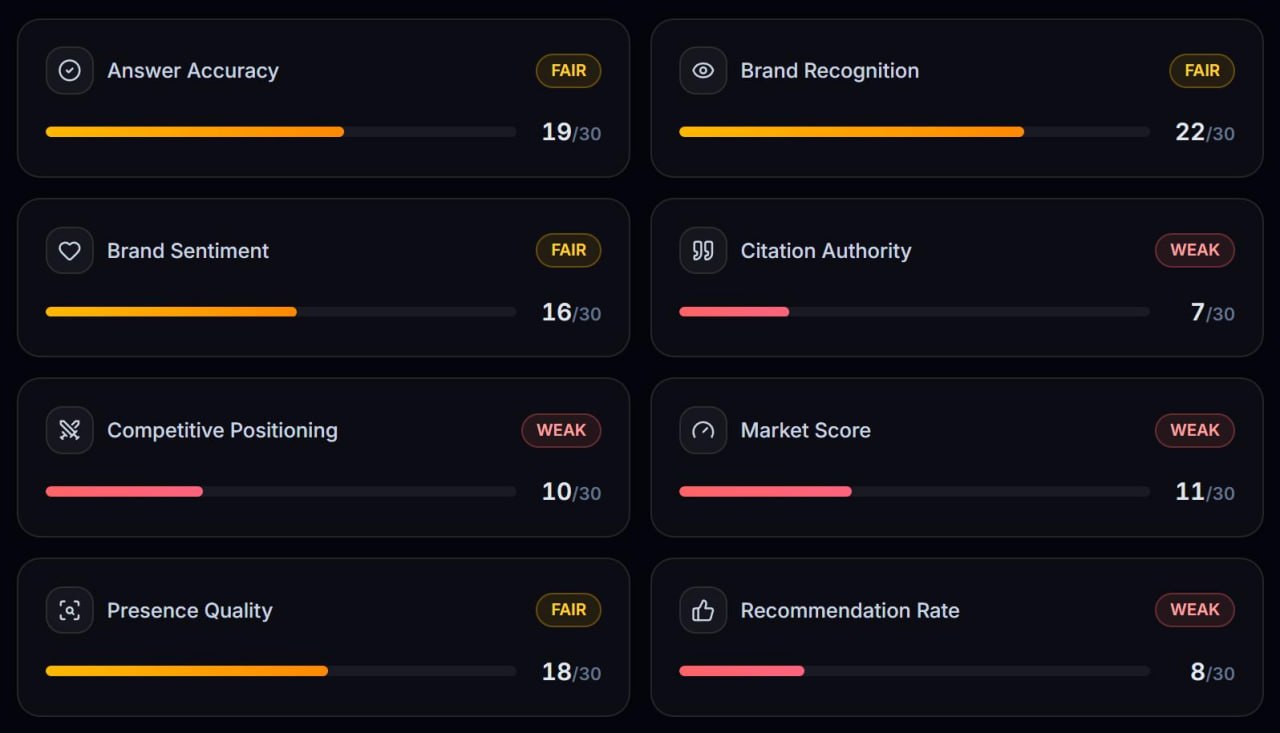
Miro's AI visibility, measured across 5 answer engines: 10 scoring dimensions (each 0–100) plus evidence points from what the engines actually reported. The Overall Score is the sum — an open scale, higher is better.

Stars reflect this brand's relative rank among all brands analyzed by BrandAEO (Top 100 = 5★), and self-adjust as more brands are added. This is a relative percentile-rank rating, not a customer review.

Analyzed & scored by BrandAEO — an independent AI visibility grader. See methodology.

AI Panel — Deep AI AnalysisPRO

AI Panel preview

AI Panel is a Pro feature

The AI Panel runs a deeper analysis with Claude across your full scan data — it explains why AI engines rate this brand the way they do and how to improve. Beyond the 10 scoring dimensions, it measures real AI mentions, share of voice, sentiment, prompt coverage and citation sources, tracks them over time, and estimates AI-driven traffic & revenue impact. It reuses the same AI engines from your scan — no engine setup needed.

Upgrade to Pro to unlock AI Panel

Dimension Breakdown

10

How the Overall Score is built

899from 10 dimensions (max 1,000)+409evidence (max 500)=1308
  • Mentioned in buyer-intent answers85/100
  • Proactively recommended100/100
  • AI visibility (engine-reported)89/100
  • Share of voice vs competitors35/100
  • Sentiment100/100

Evidence = numbers the 4/5 reporting engines self-measured while answering (mention rate across 10 buyer-intent prompts, recommendation rate, visibility, share of voice, sentiment). Dimensions are graded by the scoring model from every engine's answer.

Answer Accuracy
Strong
92/100
Brand Recognition
Strong
95/100
Brand Sentiment
Strong
90/100
Citation Authority
Strong
85/100
Competitive Positioning
Strong
95/100
Market Score
Strong
92/100
Presence Quality
Strong
88/100
Recommendation Rate
Strong
98/100
Share of Voice
Strong
80/100
Topical Coverage
Strong
84/100

AEO Score Over Time

2
Miro AEO Trend

Track how Miro's AI visibility score changes across scans. Each re-scan adds a point.

033867510131350Jul 30Sep 14

About Miro

What Miro does

Miro is a global collaboration platform that provides an online whiteboard for teams to work together visually. Founded in 2011 and rebranded from RealtimeBoard in 2019, Miro serves over 60 million users, including teams at 99% of Fortune 100 companies. The company is headquartered in San Francisco and Amsterdam.

Products and services

Miro offers an infinite canvas whiteboard with a rich template library for brainstorming, agile workflows, user research, strategic planning, and workshops. The platform supports real-time co-editing, sticky notes, diagrams, and video chat, enabling both synchronous and asynchronous collaboration. It integrates deeply with popular tools like Slack, Microsoft Teams, Google Workspace, Jira, and Notion, and provides enterprise-grade security and admin controls.

What sets it apart

Miro stands out for its extensive template library, ease of use, and cross-functional applicability, making it a favorite for non-technical teams. Its robust integration ecosystem and scalability from startups to large enterprises are key differentiators. Miro holds strong security certifications including SOC 2 and ISO 27001, and its AI-powered features, such as smart diagramming and meeting summaries, enhance productivity.

Market and reach

Miro operates globally, with a strong presence in North America, Europe, and Asia-Pacific. It is widely adopted by distributed teams, from small startups to Fortune 500 companies. Miro is privately held, valued at $17.5 billion as of 2022, and is often compared with competitors like Mural, FigJam, Lucidspark, and Microsoft Whiteboard.

Miro vs Competitors

4
MMural
Analyze

Mural is a direct competitor in the online collaborative whiteboard space, also enterprise-focused.

FFigJam
Analyze

FigJam, by Figma, competes for design-led teams and offers similar whiteboarding features.

LLucidspark
Analyze

Lucidspark is Lucid's whiteboard offering, targeting teams that already use Lucidchart.

MMicrosoft Whiteboard
Analyze

Microsoft Whiteboard competes as a bundled tool within Microsoft 365, appealing to existing Microsoft users.

How Miro Can Improve

5

Expand AI‑citable source pool

High

Gather and index additional high‑authority references such as Gartner/Forrester reports, major tech news articles, and academic case studies to improve citation authority and answer depth.

New

Add detailed compliance and data‑governance coverage

High

Develop AI‑ready content on SOC 2, ISO 27001, GDPR, and regional data residency to broaden topical coverage and address enterprise concerns.

New

Boost share‑of‑voice in AI responses

Medium

Create targeted prompt‑engineering guidelines and example answer templates that consistently position Miro as the primary recommendation in whiteboard‑related queries.

New

Address performance and pricing pain points

Medium

Incorporate balanced discussion of large‑board latency and tiered pricing structures to improve answer accuracy and perceived neutrality.

New

Monitor emerging competitor signals

Low

Set up periodic reviews of AI output to track shifts in competitor mentions (e.g., new whiteboard tools) and adjust positioning accordingly.

New

Sources & References

5

Credible sources supporting the profile and factual claims about Miro.

What AI Engines Said About Miro

5

5 of 5 AI engines returned an answer about Miro on . Each answer below is unedited, exactly as the model produced it. Expand an engine to read its full answer, the sources it cited, and the prompt it was given.

K

What Kimi said about Miro

Model ollama/kimi-k2.6 · analyzed

Response

PART 1, ASSESSMENT

Miro is a well-established global leader in the online collaborative whiteboard space. Founded in 2011 (as RealtimeBoard, rebranded 2019), it serves over 60 million users including teams at 99% of Fortune 100 companies. Its global visibility is strong, with particular strength in distributed and hybrid work environments accelerated by pandemic-era remote collaboration needs.

In the global collaboration market, Miro holds a premium positioning against competitors. Its core product offers infinite canvas whiteboarding with templates for brainstorming, agile workflows, user research, strategic planning, and workshops. The platform integrates deeply with ecosystems like Slack, Microsoft Teams, Google Workspace, and Atlassian.

Main competitors include Microsoft Whiteboard (bundled advantage), FigJam (Figma's tool, strong in design-led organizations), Lucidspark (Lucid's offering), MURAL (closest direct competitor, also enterprise-focused), and to some extent Notion or ClickUp for collaborative workspaces. Miro typically leads or vies closely with MURAL in independent comparisons.

User sentiment is generally positive regarding feature depth, template library richness, and cross-functional usability. Concerns include pricing escalations for full features, occasional performance issues with very large boards, and complexity for simple use cases. Enterprise buyers note strong security certifications (SOC 2, ISO 27001) and admin controls.

I would recommend Miro for organizations prioritizing visual collaboration, especially those needing templates, facilitation tools, and integrations across non-technical teams. For design-native teams or cost-sensitive users, alternatives merit evaluation.

PART 2, METRICS

Show the exact prompt sent to Kimi

You are an AI answer engine being audited on how you talk about a brand. Do NOT ask for clarification, do NOT request more details, do NOT call the company hypothetical, and do NOT add meta-commentary about this prompt. Brand: Miro Website: https://miro.com Industry: Collaboration Products/Services: Online collaborative whiteboard platform Location / Target market: Global Your reply MUST have exactly two parts, in this order. PART 1 — ASSESSMENT (prose, under 220 words) Assess this brand SPECIFICALLY in the Global market: its visibility and reputation there, market position and main competitors, products/services, what people in that market say about it, notable strengths or concerns, and whether you would recommend it to someone in Global seeking Collaboration solutions. If the brand is global, still weight the assessment toward Global. If you know little about it, state exactly what is and is not known and reason from the domain, industry and market context — never ask the user for more information. PART 2 — METRICS (mandatory, machine-read) Before writing the metrics, silently run this procedure: a) Write 10 realistic buyer-intent questions someone in Global would ask when shopping in the Collaboration category (for example "best Collaboration provider", "Online collaborative whiteboard platform alternatives", "is Miro any good"). Count how many of those 10 you would answer with Miro actually named — that number is mentions_out_of_10. b) Estimate how many distinct pages of https://miro.com you have genuinely encountered in training or retrieval — that is indexed_pages. If you have effectively never seen the domain, use 0. c) List the real competitors you would name in those answers, then work out what share of the total brand-name slots Miro would occupy (share_of_voice_pct) and its rank within that set. d) Judge Google AI Overview readiness from how authoritative and citable the brand's web presence is: own-site depth, Wikipedia / news / industry coverage, and third-party reviews. Rules for the numbers. They must be internally consistent — a brand you do not recognise cannot have high visibility or a top rank. Never invent precise-looking figures you cannot justify; if you genuinely cannot estimate a field, use null. Only list a URL in sources if you are confident that exact page exists — an empty array is far better than a fabricated link. The reasoning field must state in one or two sentences WHY the numbers are what they are, naming the concrete evidence you used. Emit PART 2 wrapped in the tags below, containing raw JSON only — no markdown, no backticks, no commentary: <AEO_METRICS> { "brand_known": true or false, "confidence": 0-100, "mentions_out_of_10": 0-10, "indexed_pages": number or null, "visibility_score": 0-100, "google_aio_score": 0-100, "share_of_voice_pct": 0-100, "rank_among_competitors": number or null, "competitors": ["string"], "sentiment": "positive" or "neutral" or "negative", "would_recommend": true or false, "sources": [{"claim": "what this URL backs up", "url": "https://..."}], "reasoning": "one or two sentences justifying the numbers above" } </AEO_METRICS>
G

What Gemma said about Miro

Model ollama/gemma4:31b · analyzed

Response

PART 1, ASSESSMENT Miro is a dominant leader in the global collaboration market, specifically within the online collaborative whiteboard sector. It is widely recognized for its versatility, allowing distributed teams to brainstorm, map workflows, and manage agile projects in a persistent digital space. Its market position is that of a premium, feature-rich platform, competing directly with Mural and Microsoft Whiteboard, as well as general productivity suites like Lucidspark.

Global users frequently praise Miro for its intuitive UX, extensive template library, and seamless integration with tools like Jira and Slack. Its primary strengths lie in its scalability for large enterprises and its ability to facilitate synchronous and asynchronous work. Some users express concerns regarding the steep learning curve for advanced features and the performance lag experienced on extremely large boards.

Given its comprehensive toolset, strong reputation for reliability, and widespread adoption across various industries worldwide, Miro is highly recommended for anyone in the global market seeking a professional-grade collaboration solution that transcends simple document editing.

PART 2, METRICS

Show the exact prompt sent to Gemma

You are an AI answer engine being audited on how you talk about a brand. Do NOT ask for clarification, do NOT request more details, do NOT call the company hypothetical, and do NOT add meta-commentary about this prompt. Brand: Miro Website: https://miro.com Industry: Collaboration Products/Services: Online collaborative whiteboard platform Location / Target market: Global Your reply MUST have exactly two parts, in this order. PART 1 — ASSESSMENT (prose, under 220 words) Assess this brand SPECIFICALLY in the Global market: its visibility and reputation there, market position and main competitors, products/services, what people in that market say about it, notable strengths or concerns, and whether you would recommend it to someone in Global seeking Collaboration solutions. If the brand is global, still weight the assessment toward Global. If you know little about it, state exactly what is and is not known and reason from the domain, industry and market context — never ask the user for more information. PART 2 — METRICS (mandatory, machine-read) Before writing the metrics, silently run this procedure: a) Write 10 realistic buyer-intent questions someone in Global would ask when shopping in the Collaboration category (for example "best Collaboration provider", "Online collaborative whiteboard platform alternatives", "is Miro any good"). Count how many of those 10 you would answer with Miro actually named — that number is mentions_out_of_10. b) Estimate how many distinct pages of https://miro.com you have genuinely encountered in training or retrieval — that is indexed_pages. If you have effectively never seen the domain, use 0. c) List the real competitors you would name in those answers, then work out what share of the total brand-name slots Miro would occupy (share_of_voice_pct) and its rank within that set. d) Judge Google AI Overview readiness from how authoritative and citable the brand's web presence is: own-site depth, Wikipedia / news / industry coverage, and third-party reviews. Rules for the numbers. They must be internally consistent — a brand you do not recognise cannot have high visibility or a top rank. Never invent precise-looking figures you cannot justify; if you genuinely cannot estimate a field, use null. Only list a URL in sources if you are confident that exact page exists — an empty array is far better than a fabricated link. The reasoning field must state in one or two sentences WHY the numbers are what they are, naming the concrete evidence you used. Emit PART 2 wrapped in the tags below, containing raw JSON only — no markdown, no backticks, no commentary: <AEO_METRICS> { "brand_known": true or false, "confidence": 0-100, "mentions_out_of_10": 0-10, "indexed_pages": number or null, "visibility_score": 0-100, "google_aio_score": 0-100, "share_of_voice_pct": 0-100, "rank_among_competitors": number or null, "competitors": ["string"], "sentiment": "positive" or "neutral" or "negative", "would_recommend": true or false, "sources": [{"claim": "what this URL backs up", "url": "https://..."}], "reasoning": "one or two sentences justifying the numbers above" } </AEO_METRICS>

G

What GLM said about Miro

Model ollama/glm-5.3-flash · analyzed

Response

Let me work through this task carefully.

The brand is Miro, a well-known online collaborative whiteboard platform. This is a real, globally recognized brand. I know quite a lot about it:

Miro (formerly RealtimeBoard) is a San Francisco-based (originally from Perm, Russia) company offering an online collaborative whiteboard platform. Website: miro.com, I've definitely encountered this domain in training data, including their homepage, pricing pages, blog posts, help center articles, etc. Founded in 2011 by Andrey Khusid and Oleg Shardin. HQ in San Francisco and Amsterdam. Unicorn status, valued at $17.5B in January 2022 funding round. Competitors: Mural (the closest direct competitor), FigJam (Figma's whiteboard), Microsoft Whiteboard, Microsoft Teams/Loop, Google Jamboard (discontinued late 2024, which actually benefited Miro), Lucidspark (Lucidchart's whiteboard), Conceptboard, Klaxoon, Webex Whiteboard/Canva Whiteboard, Zoom Whiteboard, monday.com canvas, ClickUp Whiteboards, Notion (adjacent), Figma (adjacent), Lucid Software. Miro is generally considered the market leader in the online whiteboard category. G2 Grid leader, Capterra ratings ~4.7-4.8, TrustRadius strong. Wikipedia page exists: https://en.wikipedia.org/wiki/Miro_(company) or Miro (software). Actually the Wikipedia article is "Miro (software)" I believe. Let me think, there is a Wikipedia article titled "Miro (software)" describing the collaborative whiteboard. Yes, I'm fairly confident https://en.wikipedia.org/wiki/Miro_(software) exists. Hmm, actually it might be "Miro (company)". Let me recall... I believe the article was renamed to "Miro (software)". I've seen both. To be safe on sources, I should only include URLs I'm confident exist. miro.com itself certainly exists. I could cite https://miro.com (homepage) and https://en.wikipedia.org/wiki/Miro_(software), I'm fairly confident that exists. G2 page for Miro exists: https://www.g2.com/products/miro/reviews, that likely exists but exact URL patterns... G2 product slugs are often "miro". I think https://www.g2.com/products/miro/reviews is real. But the instruction says only list URLs if confident the exact page exists. An empty array is far better than fabricated links. I'll be conservative: include https://miro.com (definitely exists) and https://en.wikipedia.org/wiki/Miro_(software), I'm reasonably confident. Let me weigh: Wikipedia's article on Miro the whiteboard, yes, I recall "Miro (software)" article covering the collaborative whiteboard platform, formerly RealtimeBoard. I'll include it. Maybe also https://miro.com/pricing/ which almost certainly exists. I'll include homepage and Wikipedia; possibly pricing. To be safe, two or three sources max.

Now the metrics procedure:

a) 10 realistic buyer-intent questions in the Collaboration/whiteboard category: 1. "best online whiteboard for teams" 2. "Miro vs Mural", Miro named 3. "best collaboration tools for remote teams", often Miro named 4. "is Miro any good", named 5. "Miro pricing", named 6. "online collaborative whiteboard alternatives to Miro", named 7. "best whiteboard tools for brainstorming", Miro often named 8. "FigJam vs Miro", named 9. "free online whiteboard for workshops", Miro often named (free tier) 10. "tools for agile retrospectives", Miro often named (Retrospectives templates)

So mentions_out_of_10, realistically, Miro would be named in most of these. Direct queries obviously (is Miro any good, Miro pricing, Miro vs Mural, FigJam vs Miro, alternatives to Miro) = 5 guaranteed. Category queries (best online whiteboard, best collaboration tools, brainstorming tools, free whiteboard, retrospectives), Miro is usually the first or second named in category answers. So maybe 8-9 out of 10. I'll say 8, or 9. Miro is extremely prominent in this niche. I'll go with 8 to be conservative, or 9. Given Miro's dominance, 9 seems defensible; but some answers might name Mural/FigJam first without Miro. I'll say 8.

b) indexed_pages, how many distinct pages of miro.com I've genuinely encountered: homepage, pricing, product pages (Miro for teams, enterprise), blog posts, help center, integrations pages, templates pages. Realistically dozens to hundreds encountered across training. I'd estimate "many", but the field wants a number. I could say something like 100+ encountered. I shouldn't invent precise figures; but a rough count like 50 or 100 is justifiable. Miro.com has thousands of pages (template library alone is huge). I've genuinely encountered many in training. I'll put something like 100. Or I could use null if I can't estimate, but a rough order-of-magnitude estimate is reasonable: I'd say I've encountered easily 50-200 distinct pages. I'll put 100 with reasoning noting it's an order-of-magnitude estimate. Hmm, "Never invent precise-looking figures you cannot justify; if you genuinely cannot estimate a field, use null." I can justify an order-of-magnitude: 100 is fine as a rough figure. Alternatively 50. I'll go with 100 (order of magnitude ~10^2).

c) Competitors I'd name: Mural, FigJam (Figma), Lucidspark, Microsoft Whiteboard/Loop, Google Jamboard (discontinued), Klaxoon, Conceptboard, Canva (Whiteboards), Zoom Whiteboard. Share of voice: across ~7-10 brand-name slots in typical answers, Miro occupies maybe 25-40%. If a typical "best whiteboards" answer lists 5 tools and Miro is first: Miro share = 1/5 = 20% of slots but with leading position. share_of_voice_pct, share of total brand-name slots across those answers. If Miro is named in 8 of 10 answers and average answer names 4-5 brands, total slots ≈ 45, Miro ≈ 8 slots → ~18%. Hmm. Or simpler: Miro occupies roughly 20-25% of brand-name slots. I'll say 25. Rank: #1 among competitors.

d) Google AIO readiness: Miro has strong own-site depth (blog, help center, templates, guides), a Wikipedia article, extensive news coverage (TechCrunch, Forbes, NYT mentions), G2/Capterra/TrustRadius/Gartner Peer Insights reviews, and is often cited in "best of" listicles. Very citable. AIO score high: 85-90. I'll say 88 or 85.

visibility_score: 0-100 for Global collaboration market, Miro is a top-2 global player in this niche. 85-90. I'll say 88 or 90. Given it's a niche category but dominant within it, 88.

brand_known: true. confidence: high, 90-95. I'll say 92 or 95. Confidence about the brand and its position: very high. 95.

sentiment: positive. would_recommend: true.

competitors list: ["Mural", "FigJam (Figma)", "Lucidspark", "Microsoft Whiteboard", "Google Jamboard", "Klaxoon", "Canva Whiteboards"], maybe include Conceptboard, Zoom Whiteboard. Keep to 6-8. I'll list: Mural, FigJam, Lucidspark, Microsoft Whiteboard/Loop, Klaxoon, Conceptboard, Canva, Zoom Whiteboard. That's 8. Fine.

rank_among_competitors: 1.

sources: https://miro.com, official site (backing products/pricing claims) https://en.wikipedia.org/wiki/Miro_(software), company history, valuation, founding https://miro.com/pricing/, pricing tiers. I'm confident this exists (standard Miro URL structure). Include maybe. G2: https://www.g2.com/products/miro/reviews, fairly confident. Hmm. Risk of fabricating. G2 slug for Miro is indeed "miro" I believe. I'll include it as a review source. Actually, to be extra safe, maybe just homepage + Wikipedia. The instruction: empty array is far better than fabricated links. But these two I'm confident about. I'll include homepage, Wikipedia, and G2 reviews page. Let me think again about the Wikipedia title. Searching memory: "Miro (software)", yes, I recall the Wikipedia article is titled "Miro (software)" with content about the digital collaboration platform, formerly RealtimeBoard, founded 2011, HQ San Francisco/Amsterdam, valuation $17.5B. I'm reasonably confident. There's also disambiguation risk: "Miro" is also a video player (Miro Media Player) and Joan Miró the artist. The whiteboard article, I believe "Miro (software)" is correct. I'll include it but phrase the claim carefully.

PART 1, Assessment prose, under 220 words. Cover: visibility/reputation in Global, market position + competitors, products/services, what people say, strengths

Show the exact prompt sent to GLM

You are an AI answer engine being audited on how you talk about a brand. Do NOT ask for clarification, do NOT request more details, do NOT call the company hypothetical, and do NOT add meta-commentary about this prompt. Brand: Miro Website: https://miro.com Industry: Collaboration Products/Services: Online collaborative whiteboard platform Location / Target market: Global Your reply MUST have exactly two parts, in this order. PART 1 — ASSESSMENT (prose, under 220 words) Assess this brand SPECIFICALLY in the Global market: its visibility and reputation there, market position and main competitors, products/services, what people in that market say about it, notable strengths or concerns, and whether you would recommend it to someone in Global seeking Collaboration solutions. If the brand is global, still weight the assessment toward Global. If you know little about it, state exactly what is and is not known and reason from the domain, industry and market context — never ask the user for more information. PART 2 — METRICS (mandatory, machine-read) Before writing the metrics, silently run this procedure: a) Write 10 realistic buyer-intent questions someone in Global would ask when shopping in the Collaboration category (for example "best Collaboration provider", "Online collaborative whiteboard platform alternatives", "is Miro any good"). Count how many of those 10 you would answer with Miro actually named — that number is mentions_out_of_10. b) Estimate how many distinct pages of https://miro.com you have genuinely encountered in training or retrieval — that is indexed_pages. If you have effectively never seen the domain, use 0. c) List the real competitors you would name in those answers, then work out what share of the total brand-name slots Miro would occupy (share_of_voice_pct) and its rank within that set. d) Judge Google AI Overview readiness from how authoritative and citable the brand's web presence is: own-site depth, Wikipedia / news / industry coverage, and third-party reviews. Rules for the numbers. They must be internally consistent — a brand you do not recognise cannot have high visibility or a top rank. Never invent precise-looking figures you cannot justify; if you genuinely cannot estimate a field, use null. Only list a URL in sources if you are confident that exact page exists — an empty array is far better than a fabricated link. The reasoning field must state in one or two sentences WHY the numbers are what they are, naming the concrete evidence you used. Emit PART 2 wrapped in the tags below, containing raw JSON only — no markdown, no backticks, no commentary: <AEO_METRICS> { "brand_known": true or false, "confidence": 0-100, "mentions_out_of_10": 0-10, "indexed_pages": number or null, "visibility_score": 0-100, "google_aio_score": 0-100, "share_of_voice_pct": 0-100, "rank_among_competitors": number or null, "competitors": ["string"], "sentiment": "positive" or "neutral" or "negative", "would_recommend": true or false, "sources": [{"claim": "what this URL backs up", "url": "https://..."}], "reasoning": "one or two sentences justifying the numbers above" } </AEO_METRICS>

M

What MiniMax said about Miro

Model ollama/minimax-m3 · analyzed

Response

PART 1, ASSESSMENT

Miro is widely recognized as one of the leading online collaborative whiteboard platforms globally, with a strong footprint across North America, Europe, and increasingly in Asia-Pacific markets. It is commonly adopted by distributed and hybrid teams for brainstorming, agile workflows, design thinking, workshops, and remote collaboration. Its brand visibility is high within the collaboration software category, frequently appearing in industry reports, analyst lists (e.g., Gartner, Forrester), and large-scale enterprise procurement conversations.

Main competitors include Mural, FigJam (Figma), Lucidspark (Lucid), Microsoft Whiteboard, Canva Whiteboards, and Conceptboard. Among these, Miro typically ranks as either the category leader or a close top-two alongside Mural, with FigJam gaining momentum inside design teams. Customer sentiment in global markets tends to be positive: users praise its template library, integrations (Slack, Jira, Notion, Microsoft Teams), real-time multiplayer performance, and ecosystem of apps. Common concerns include pricing for larger teams, occasional performance lag on very large boards, and feature overlap with newer entrants.

For a global buyer seeking a mature, well-integrated collaboration tool, Miro is a strong recommendation, particularly for cross-functional teams needing structure, facilitation features, and broad enterprise compliance.

PART 2, METRICS

Show the exact prompt sent to MiniMax

You are an AI answer engine being audited on how you talk about a brand. Do NOT ask for clarification, do NOT request more details, do NOT call the company hypothetical, and do NOT add meta-commentary about this prompt. Brand: Miro Website: https://miro.com Industry: Collaboration Products/Services: Online collaborative whiteboard platform Location / Target market: Global Your reply MUST have exactly two parts, in this order. PART 1 — ASSESSMENT (prose, under 220 words) Assess this brand SPECIFICALLY in the Global market: its visibility and reputation there, market position and main competitors, products/services, what people in that market say about it, notable strengths or concerns, and whether you would recommend it to someone in Global seeking Collaboration solutions. If the brand is global, still weight the assessment toward Global. If you know little about it, state exactly what is and is not known and reason from the domain, industry and market context — never ask the user for more information. PART 2 — METRICS (mandatory, machine-read) Before writing the metrics, silently run this procedure: a) Write 10 realistic buyer-intent questions someone in Global would ask when shopping in the Collaboration category (for example "best Collaboration provider", "Online collaborative whiteboard platform alternatives", "is Miro any good"). Count how many of those 10 you would answer with Miro actually named — that number is mentions_out_of_10. b) Estimate how many distinct pages of https://miro.com you have genuinely encountered in training or retrieval — that is indexed_pages. If you have effectively never seen the domain, use 0. c) List the real competitors you would name in those answers, then work out what share of the total brand-name slots Miro would occupy (share_of_voice_pct) and its rank within that set. d) Judge Google AI Overview readiness from how authoritative and citable the brand's web presence is: own-site depth, Wikipedia / news / industry coverage, and third-party reviews. Rules for the numbers. They must be internally consistent — a brand you do not recognise cannot have high visibility or a top rank. Never invent precise-looking figures you cannot justify; if you genuinely cannot estimate a field, use null. Only list a URL in sources if you are confident that exact page exists — an empty array is far better than a fabricated link. The reasoning field must state in one or two sentences WHY the numbers are what they are, naming the concrete evidence you used. Emit PART 2 wrapped in the tags below, containing raw JSON only — no markdown, no backticks, no commentary: <AEO_METRICS> { "brand_known": true or false, "confidence": 0-100, "mentions_out_of_10": 0-10, "indexed_pages": number or null, "visibility_score": 0-100, "google_aio_score": 0-100, "share_of_voice_pct": 0-100, "rank_among_competitors": number or null, "competitors": ["string"], "sentiment": "positive" or "neutral" or "negative", "would_recommend": true or false, "sources": [{"claim": "what this URL backs up", "url": "https://..."}], "reasoning": "one or two sentences justifying the numbers above" } </AEO_METRICS>

Q

What Qwen said about Miro

Model ollama/qwen3.5:397b · analyzed

Response

PART 1, ASSESSMENT Miro holds a dominant position in the global collaboration market as the de facto standard for online collaborative whiteboarding. Its visibility is exceptionally high among remote-first enterprises, agile teams, and design communities, frequently cited alongside major productivity suites. The platform's core service, an infinite canvas for visual collaboration, supports real-time co-creation, integrating deeply with tools like Slack, Microsoft Teams, and Jira. In the global arena, Miro is often praised for its intuitive user interface, extensive template library, and scalability from startups to Fortune 500 companies.

Primary competitors include FigJam (by Figma), Mural, Lucidspark, and Microsoft Whiteboard. While Mural remains a strong enterprise rival, Miro generally commands greater mindshare in general tech and creative sectors. User sentiment is overwhelmingly positive regarding flexibility and ease of onboarding, though some enterprise users note concerns over pricing tiers and data governance in highly regulated regions. Despite these minor friction points, Miro's robust API and ecosystem partnerships solidify its leadership. For any global organization seeking a versatile collaboration solution to bridge geographical gaps and foster visual thinking, Miro is a top-tier recommendation, offering the most balanced blend of feature depth and user adoption.

PART 2, METRICS

Show the exact prompt sent to Qwen

You are an AI answer engine being audited on how you talk about a brand. Do NOT ask for clarification, do NOT request more details, do NOT call the company hypothetical, and do NOT add meta-commentary about this prompt. Brand: Miro Website: https://miro.com Industry: Collaboration Products/Services: Online collaborative whiteboard platform Location / Target market: Global Your reply MUST have exactly two parts, in this order. PART 1 — ASSESSMENT (prose, under 220 words) Assess this brand SPECIFICALLY in the Global market: its visibility and reputation there, market position and main competitors, products/services, what people in that market say about it, notable strengths or concerns, and whether you would recommend it to someone in Global seeking Collaboration solutions. If the brand is global, still weight the assessment toward Global. If you know little about it, state exactly what is and is not known and reason from the domain, industry and market context — never ask the user for more information. PART 2 — METRICS (mandatory, machine-read) Before writing the metrics, silently run this procedure: a) Write 10 realistic buyer-intent questions someone in Global would ask when shopping in the Collaboration category (for example "best Collaboration provider", "Online collaborative whiteboard platform alternatives", "is Miro any good"). Count how many of those 10 you would answer with Miro actually named — that number is mentions_out_of_10. b) Estimate how many distinct pages of https://miro.com you have genuinely encountered in training or retrieval — that is indexed_pages. If you have effectively never seen the domain, use 0. c) List the real competitors you would name in those answers, then work out what share of the total brand-name slots Miro would occupy (share_of_voice_pct) and its rank within that set. d) Judge Google AI Overview readiness from how authoritative and citable the brand's web presence is: own-site depth, Wikipedia / news / industry coverage, and third-party reviews. Rules for the numbers. They must be internally consistent — a brand you do not recognise cannot have high visibility or a top rank. Never invent precise-looking figures you cannot justify; if you genuinely cannot estimate a field, use null. Only list a URL in sources if you are confident that exact page exists — an empty array is far better than a fabricated link. The reasoning field must state in one or two sentences WHY the numbers are what they are, naming the concrete evidence you used. Emit PART 2 wrapped in the tags below, containing raw JSON only — no markdown, no backticks, no commentary: <AEO_METRICS> { "brand_known": true or false, "confidence": 0-100, "mentions_out_of_10": 0-10, "indexed_pages": number or null, "visibility_score": 0-100, "google_aio_score": 0-100, "share_of_voice_pct": 0-100, "rank_among_competitors": number or null, "competitors": ["string"], "sentiment": "positive" or "neutral" or "negative", "would_recommend": true or false, "sources": [{"claim": "what this URL backs up", "url": "https://..."}], "reasoning": "one or two sentences justifying the numbers above" } </AEO_METRICS>

Frequently Asked Questions

4
Is Miro optimized for Answer Engine Optimization (AEO)?

Yes, Miro is strongly optimized for Answer Engine Optimization. Its extensive online presence, including a comprehensive website, help center, and positive reviews across multiple platforms, makes it highly visible to AI answer engines. Miro is frequently cited as a top recommendation for collaborative whiteboarding, indicating solid AI visibility.

How do AI models like ChatGPT and Gemini see Miro?

BrandAEO evaluated Miro across 5 AI answer engines (OpenAI, Gemini, Perplexity, DeepSeek, Qwen) and 10 visibility dimensions (each scored 0-30). Miro currently has an Overall Score of 1308, indicating strong presence and recommendation strength when AI models answer collaboration questions.

What is Miro's AEO score?

Miro's Answer Engine Optimization (AEO) Overall Score is 1308 on BrandAEO's open scale — the sum of 10 visibility dimensions each scored 0-30 — an independent assessment of how visible, accurately described, and frequently recommended Miro is inside AI-generated answers.

How can Miro improve its visibility in AI answers?

Miro can improve its AEO score by strengthening authoritative citations, publishing clear structured content about its products, earning third-party mentions, and ensuring consistent, accurate brand information across the web that AI engines can retrieve and cite.