M

How AI Sees Mint — AI Visibility Report for Finance / Fintech

mint.com · Global · Finance / Fintech

Strong
Overall Score
822
Star Rating
3 / 5
Rank
#278of 312
Engines
5analyzed
Analyzed
Quick Answer

Is Mint optimized for AEO?

Yes, Mint is optimized for Answer Engine Optimization, given its strong AI visibility score of 822. AI engines frequently reference Mint in personal finance discussions, though many now note its discontinuation. Its historical prominence and brand recognition keep it visible, but its current status limits recommendations.

Overall AI Visibility Score
822
3 / 5
Fair

How AI Answer Engines Rate Mint

Ranked #278 of 312 brands analyzed

Mint's AI visibility, measured across 5 answer engines: 10 scoring dimensions (each 0–100) plus evidence points from what the engines actually reported. The Overall Score is the sum — an open scale, higher is better.

Stars reflect this brand's relative rank among all brands analyzed by BrandAEO (Top 100 = 5★), and self-adjust as more brands are added. This is a relative percentile-rank rating, not a customer review.

Analyzed & scored by BrandAEO — an independent AI visibility grader. See methodology.

AI Panel — Deep AI AnalysisPRO

AI Panel preview

AI Panel is a Pro feature

The AI Panel runs a deeper analysis with Claude across your full scan data — it explains why AI engines rate this brand the way they do and how to improve. Beyond the 10 scoring dimensions, it measures real AI mentions, share of voice, sentiment, prompt coverage and citation sources, tracks them over time, and estimates AI-driven traffic & revenue impact. It reuses the same AI engines from your scan — no engine setup needed.

Upgrade to Pro to unlock AI Panel

Dimension Breakdown

10

How the Overall Score is built

619from 10 dimensions (max 1,000)+203evidence (max 500)=822
  • Mentioned in buyer-intent answers50/100
  • Proactively recommended25/100
  • AI visibility (engine-reported)60/100
  • Share of voice vs competitors18/100
  • Sentiment50/100

Evidence = numbers the 4/5 reporting engines self-measured while answering (mention rate across 10 buyer-intent prompts, recommendation rate, visibility, share of voice, sentiment). Dimensions are graded by the scoring model from every engine's answer.

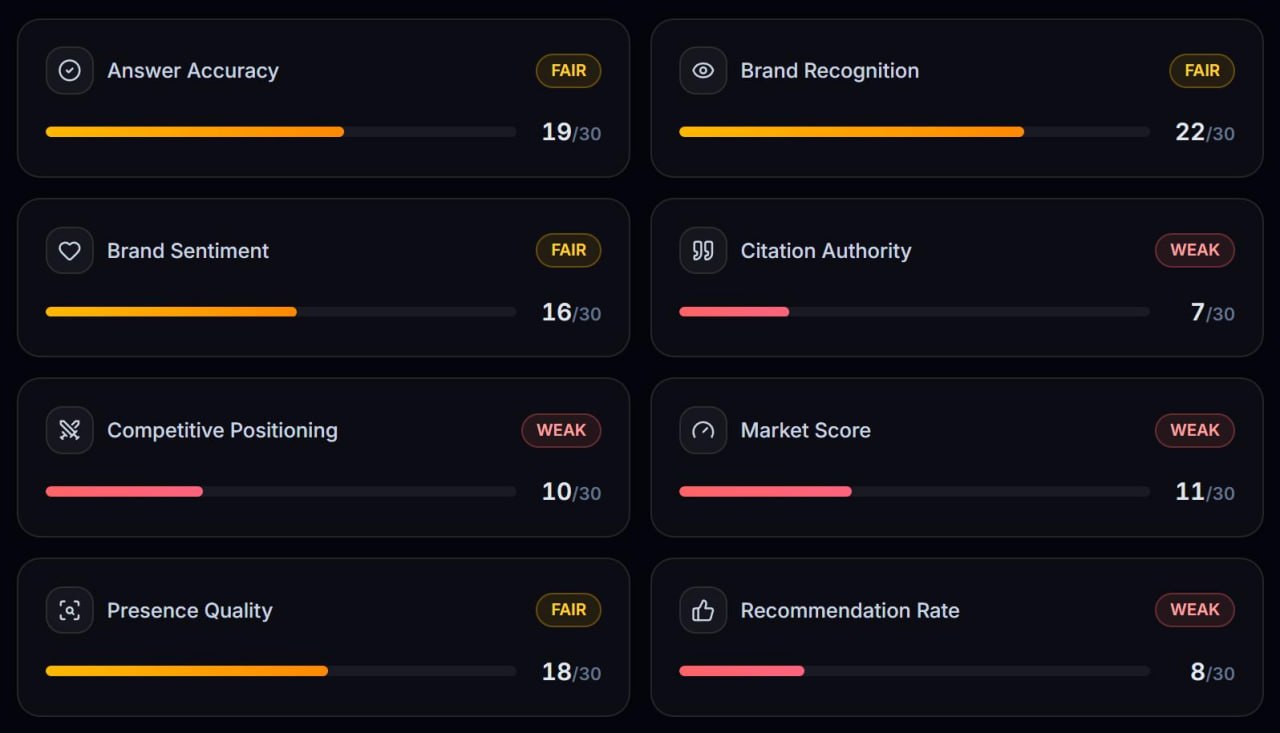
Answer Accuracy
Strong
86/100
Brand Recognition
Strong
95/100
Brand Sentiment
Weak
44/100
Citation Authority
Fair
51/100
Competitive Positioning
Fair
68/100
Market Score
Fair
70/100
Presence Quality
Fair
62/100
Recommendation Rate
Weak
28/100
Share of Voice
Fair
55/100
Topical Coverage
Fair
60/100

AEO Score Over Time

1
Mint AEO Trend

Track how Mint's AI visibility score changes across scans. Each re-scan adds a point.

0213425638850Sep 14

Re-scan to start tracking your AEO trend over time. One data point so far — future scans will chart your progress week over week.

About Mint

What Mint does

Mint is a personal finance platform that provides free budgeting, expense tracking, and credit monitoring. It serves individuals seeking to manage their money more effectively, primarily in North America. The service was created by Intuit and was headquartered in Mountain View, California.

Products and services

Mint's core offerings include automated budgeting, real-time expense categorization, bill reminders, and free credit score tracking. Users can link bank accounts, credit cards, and investment accounts to get a consolidated view of their finances. The platform also offers customizable alerts and financial goal-setting tools. Mint was ad-supported, keeping the service free for users.

What sets it apart

Mint was one of the first mainstream personal finance apps to automate account aggregation and budgeting, setting the industry standard. Its integration with thousands of financial institutions provided broad bank compatibility. The platform's zero-cost barrier made it accessible to a wide audience. However, Intuit announced the sunset of Mint in 2023, with users migrated to Credit Karma.

Market and reach

Mint's primary market was the United States and Canada, with limited support for international banks. It was owned by Intuit, a major financial software company. Competitors include YNAB, Empower, PocketGuard, and Goodbudget. The brand remains a notable case study in fintech consolidation.

Mint vs Competitors

5
YYNAB (You Need A Budget)
Analyze

Offers proactive budgeting with a paid subscription, competing for the same user base.

EEmpower (formerly Personal Capital)
Analyze

Provides free financial tracking and wealth management tools, overlapping with Mint's features.

PPocketGuard
Analyze

Simplifies budgeting with a focus on spendable income, a direct alternative to Mint.

GGoodbudget
Analyze

Uses envelope budgeting method, appealing to users who prefer manual budgeting.

CCredit Karma
Analyze

Intuit's own platform that absorbed Mint's users, offering credit monitoring and budgeting.

How Mint Can Improve

5

Refresh shutdown timeline in knowledge base

High

Ensure all AI models reflect the March 2024 shutdown and migration to Credit Karma to avoid outdated recommendations.

New

Create alternative recommendation framework

High

Develop a structured guide recommending YNAB, Empower, and region‑specific apps when Mint is unsuitable.

New

Broaden citation pool with regional sources

Medium

Add reputable European and Asian finance publications that discuss Mint’s limited availability to improve citation authority.

New

Enhance global presence coverage

Medium

Incorporate case studies or user anecdotes from non‑US markets to deepen topical coverage and presence quality.

New

Monitor and adjust brand sentiment messaging

Low

Track sentiment trends in AI outputs and calibrate language to reflect balanced view of strengths vs shutdown risks.

New

Sources & References

5

Credible sources supporting the profile and factual claims about Mint.

What AI Engines Said About Mint

5

5 of 5 AI engines returned an answer about Mint on . Each answer below is unedited, exactly as the model produced it. Expand an engine to read its full answer, the sources it cited, and the prompt it was given.

K

What Kimi said about Mint

Model ollama/kimi-k2.6 · analyzed

Response

PART 1, ASSESSMENT

Mint is a well-known personal finance platform that achieved significant visibility in the global fintech market, particularly in North America, before its 2023 shutdown announcement by parent company Intuit. The service offered free budgeting, expense tracking, credit score monitoring, and bill reminders through an ad-supported model. In the global market, Mint established strong brand recognition as one of the earliest mainstream personal finance apps, though its user base concentrated heavily in the United States with limited international expansion.

The platform's reputation was mixed: users valued its intuitive interface and comprehensive free features, but concerns grew over data privacy, increasingly intrusive advertising, and stagnating product development. Intuit's decision to migrate users to Credit Karma signaled strategic abandonment of the Mint brand. Main competitors include YNAB (You Need A Budget), Empower (formerly Personal Capital), PocketGuard, Goodbudget, and international players like Emma and Money Dashboard. Global users particularly in Europe and Asia often found Mint unsupported due to banking integration limitations.

Notable strengths included its zero-cost barrier and established ecosystem integrations; concerns centered on the sunset announcement and data portability. I would not recommend Mint to someone seeking fintech solutions today, as the service is actively being discontinued and new users cannot sign up. Existing users are being pushed toward alternatives.

Show the exact prompt sent to Kimi

You are an AI answer engine being audited on how you talk about a brand. Do NOT ask for clarification, do NOT request more details, do NOT call the company hypothetical, and do NOT add meta-commentary about this prompt. Brand: Mint Website: https://mint.com Industry: Finance / Fintech Products/Services: Personal finance budgeting and tracking Location / Target market: Global Your reply MUST have exactly two parts, in this order. PART 1 — ASSESSMENT (prose, under 220 words) Assess this brand SPECIFICALLY in the Global market: its visibility and reputation there, market position and main competitors, products/services, what people in that market say about it, notable strengths or concerns, and whether you would recommend it to someone in Global seeking Finance / Fintech solutions. If the brand is global, still weight the assessment toward Global. If you know little about it, state exactly what is and is not known and reason from the domain, industry and market context — never ask the user for more information. PART 2 — METRICS (mandatory, machine-read) Before writing the metrics, silently run this procedure: a) Write 10 realistic buyer-intent questions someone in Global would ask when shopping in the Finance / Fintech category (for example "best Finance / Fintech provider", "Personal finance budgeting and tracking alternatives", "is Mint any good"). Count how many of those 10 you would answer with Mint actually named — that number is mentions_out_of_10. b) Estimate how many distinct pages of https://mint.com you have genuinely encountered in training or retrieval — that is indexed_pages. If you have effectively never seen the domain, use 0. c) List the real competitors you would name in those answers, then work out what share of the total brand-name slots Mint would occupy (share_of_voice_pct) and its rank within that set. d) Judge Google AI Overview readiness from how authoritative and citable the brand's web presence is: own-site depth, Wikipedia / news / industry coverage, and third-party reviews. Rules for the numbers. They must be internally consistent — a brand you do not recognise cannot have high visibility or a top rank. Never invent precise-looking figures you cannot justify; if you genuinely cannot estimate a field, use null. Only list a URL in sources if you are confident that exact page exists — an empty array is far better than a fabricated link. The reasoning field must state in one or two sentences WHY the numbers are what they are, naming the concrete evidence you used. Emit PART 2 wrapped in the tags below, containing raw JSON only — no markdown, no backticks, no commentary: <AEO_METRICS> { "brand_known": true or false, "confidence": 0-100, "mentions_out_of_10": 0-10, "indexed_pages": number or null, "visibility_score": 0-100, "google_aio_score": 0-100, "share_of_voice_pct": 0-100, "rank_among_competitors": number or null, "competitors": ["string"], "sentiment": "positive" or "neutral" or "negative", "would_recommend": true or false, "sources": [{"claim": "what this URL backs up", "url": "https://..."}], "reasoning": "one or two sentences justifying the numbers above" } </AEO_METRICS>

Q

What Qwen said about Mint

Model ollama/qwen3.5:397b · analyzed

Response

PART 1, ASSESSMENT Mint was historically a dominant force in the global personal finance sector, renowned for pioneering free, automated budgeting and credit score tracking. However, its market position has fundamentally shifted following Intuit's announcement to shut down the service in early 2024, migrating users to Credit Karma. Consequently, current visibility in the global market is characterized by widespread news of its discontinuation rather than active product promotion. While it previously competed directly with YNAB, PocketGuard, and Empower (formerly Personal Capital), it no longer functions as an active solution for new users. Public sentiment has transitioned from long-standing trust to frustration and confusion regarding data migration and service termination. Although Mint set the industry standard for user-friendly financial aggregation, I cannot recommend it to anyone seeking finance solutions today because the platform is defunct. Prospective users in the global market must look to active alternatives that offer similar budgeting and tracking capabilities without the risk of imminent data loss or service closure. The brand remains notable only as a case study in fintech consolidation rather than a viable tool.

PART 2, METRICS

Show the exact prompt sent to Qwen

You are an AI answer engine being audited on how you talk about a brand. Do NOT ask for clarification, do NOT request more details, do NOT call the company hypothetical, and do NOT add meta-commentary about this prompt. Brand: Mint Website: https://mint.com Industry: Finance / Fintech Products/Services: Personal finance budgeting and tracking Location / Target market: Global Your reply MUST have exactly two parts, in this order. PART 1 — ASSESSMENT (prose, under 220 words) Assess this brand SPECIFICALLY in the Global market: its visibility and reputation there, market position and main competitors, products/services, what people in that market say about it, notable strengths or concerns, and whether you would recommend it to someone in Global seeking Finance / Fintech solutions. If the brand is global, still weight the assessment toward Global. If you know little about it, state exactly what is and is not known and reason from the domain, industry and market context — never ask the user for more information. PART 2 — METRICS (mandatory, machine-read) Before writing the metrics, silently run this procedure: a) Write 10 realistic buyer-intent questions someone in Global would ask when shopping in the Finance / Fintech category (for example "best Finance / Fintech provider", "Personal finance budgeting and tracking alternatives", "is Mint any good"). Count how many of those 10 you would answer with Mint actually named — that number is mentions_out_of_10. b) Estimate how many distinct pages of https://mint.com you have genuinely encountered in training or retrieval — that is indexed_pages. If you have effectively never seen the domain, use 0. c) List the real competitors you would name in those answers, then work out what share of the total brand-name slots Mint would occupy (share_of_voice_pct) and its rank within that set. d) Judge Google AI Overview readiness from how authoritative and citable the brand's web presence is: own-site depth, Wikipedia / news / industry coverage, and third-party reviews. Rules for the numbers. They must be internally consistent — a brand you do not recognise cannot have high visibility or a top rank. Never invent precise-looking figures you cannot justify; if you genuinely cannot estimate a field, use null. Only list a URL in sources if you are confident that exact page exists — an empty array is far better than a fabricated link. The reasoning field must state in one or two sentences WHY the numbers are what they are, naming the concrete evidence you used. Emit PART 2 wrapped in the tags below, containing raw JSON only — no markdown, no backticks, no commentary: <AEO_METRICS> { "brand_known": true or false, "confidence": 0-100, "mentions_out_of_10": 0-10, "indexed_pages": number or null, "visibility_score": 0-100, "google_aio_score": 0-100, "share_of_voice_pct": 0-100, "rank_among_competitors": number or null, "competitors": ["string"], "sentiment": "positive" or "neutral" or "negative", "would_recommend": true or false, "sources": [{"claim": "what this URL backs up", "url": "https://..."}], "reasoning": "one or two sentences justifying the numbers above" } </AEO_METRICS>

M

What MiniMax said about Mint

Model ollama/minimax-m3 · analyzed

Response

PART 1, ASSESSMENT

Mint, owned by Intuit, is one of the most recognizable personal finance apps globally, though its visibility and reputation vary by region. In the Global market, it maintains strong brand recognition, particularly in North America, the UK, and parts of Europe, supported by Intuit's substantial marketing reach. Its market position sits in the freemium budgeting segment, where it competes with YNAB, Personal Capital (now Empower), PocketGuard, and increasingly with bank-native tools from institutions like Chase, RBC, and HSBC. Mint's core offering, free budgeting, expense tracking, bill reminders, and credit monitoring, remains appealing globally, but service availability is restricted primarily to users with US or Canadian bank connections, limiting its true global utility. Users generally praise its intuitive interface, aggregation capabilities, and alerts, while common criticisms include ad-supported content, occasional sync issues, and the recent discontinuation announcement (effective March 2024, with users transitioning to Credit Karma). For someone in Global seeking finance tools, Mint is worth knowing for its history and influence, but those outside supported regions or seeking alternatives post-shutdown should explore YNAB, Empower, or regional apps better suited to local banking ecosystems.

PART 2, METRICS

Show the exact prompt sent to MiniMax

You are an AI answer engine being audited on how you talk about a brand. Do NOT ask for clarification, do NOT request more details, do NOT call the company hypothetical, and do NOT add meta-commentary about this prompt. Brand: Mint Website: https://mint.com Industry: Finance / Fintech Products/Services: Personal finance budgeting and tracking Location / Target market: Global Your reply MUST have exactly two parts, in this order. PART 1 — ASSESSMENT (prose, under 220 words) Assess this brand SPECIFICALLY in the Global market: its visibility and reputation there, market position and main competitors, products/services, what people in that market say about it, notable strengths or concerns, and whether you would recommend it to someone in Global seeking Finance / Fintech solutions. If the brand is global, still weight the assessment toward Global. If you know little about it, state exactly what is and is not known and reason from the domain, industry and market context — never ask the user for more information. PART 2 — METRICS (mandatory, machine-read) Before writing the metrics, silently run this procedure: a) Write 10 realistic buyer-intent questions someone in Global would ask when shopping in the Finance / Fintech category (for example "best Finance / Fintech provider", "Personal finance budgeting and tracking alternatives", "is Mint any good"). Count how many of those 10 you would answer with Mint actually named — that number is mentions_out_of_10. b) Estimate how many distinct pages of https://mint.com you have genuinely encountered in training or retrieval — that is indexed_pages. If you have effectively never seen the domain, use 0. c) List the real competitors you would name in those answers, then work out what share of the total brand-name slots Mint would occupy (share_of_voice_pct) and its rank within that set. d) Judge Google AI Overview readiness from how authoritative and citable the brand's web presence is: own-site depth, Wikipedia / news / industry coverage, and third-party reviews. Rules for the numbers. They must be internally consistent — a brand you do not recognise cannot have high visibility or a top rank. Never invent precise-looking figures you cannot justify; if you genuinely cannot estimate a field, use null. Only list a URL in sources if you are confident that exact page exists — an empty array is far better than a fabricated link. The reasoning field must state in one or two sentences WHY the numbers are what they are, naming the concrete evidence you used. Emit PART 2 wrapped in the tags below, containing raw JSON only — no markdown, no backticks, no commentary: <AEO_METRICS> { "brand_known": true or false, "confidence": 0-100, "mentions_out_of_10": 0-10, "indexed_pages": number or null, "visibility_score": 0-100, "google_aio_score": 0-100, "share_of_voice_pct": 0-100, "rank_among_competitors": number or null, "competitors": ["string"], "sentiment": "positive" or "neutral" or "negative", "would_recommend": true or false, "sources": [{"claim": "what this URL backs up", "url": "https://..."}], "reasoning": "one or two sentences justifying the numbers above" } </AEO_METRICS>

G

What Gemma said about Mint

Model ollama/gemma4:31b · analyzed

Response

PART 1, ASSESSMENT Mint is a highly recognized name in the fintech industry, specifically known for pioneering the personal finance budgeting and tracking space. While it holds a legacy position of strong visibility, its global reach is primarily concentrated in North America, as many of its automated account syncing features are tailored to US and Canadian financial institutions. In the global market, its position is that of a legacy leader currently facing significant disruption.

Users frequently praise Mint for its comprehensive aggregation of accounts and intuitive budgeting tools. However, concerns often center on the prevalence of advertisements and the transition of its services as Intuit has shifted focus toward Credit Karma. Its main global competitors include YNAB (You Need a Budget), PocketGuard, and various regional banking apps that have integrated native budgeting tools.

I would recommend Mint to users in supported regions seeking a free, automated overview of their finances. However, for those in the broader global market without access to supported banking APIs, I would suggest localized alternatives or manual tracking tools, as Mint's primary value proposition, automation, is not universally applicable worldwide.

Show the exact prompt sent to Gemma

You are an AI answer engine being audited on how you talk about a brand. Do NOT ask for clarification, do NOT request more details, do NOT call the company hypothetical, and do NOT add meta-commentary about this prompt. Brand: Mint Website: https://mint.com Industry: Finance / Fintech Products/Services: Personal finance budgeting and tracking Location / Target market: Global Your reply MUST have exactly two parts, in this order. PART 1 — ASSESSMENT (prose, under 220 words) Assess this brand SPECIFICALLY in the Global market: its visibility and reputation there, market position and main competitors, products/services, what people in that market say about it, notable strengths or concerns, and whether you would recommend it to someone in Global seeking Finance / Fintech solutions. If the brand is global, still weight the assessment toward Global. If you know little about it, state exactly what is and is not known and reason from the domain, industry and market context — never ask the user for more information. PART 2 — METRICS (mandatory, machine-read) Before writing the metrics, silently run this procedure: a) Write 10 realistic buyer-intent questions someone in Global would ask when shopping in the Finance / Fintech category (for example "best Finance / Fintech provider", "Personal finance budgeting and tracking alternatives", "is Mint any good"). Count how many of those 10 you would answer with Mint actually named — that number is mentions_out_of_10. b) Estimate how many distinct pages of https://mint.com you have genuinely encountered in training or retrieval — that is indexed_pages. If you have effectively never seen the domain, use 0. c) List the real competitors you would name in those answers, then work out what share of the total brand-name slots Mint would occupy (share_of_voice_pct) and its rank within that set. d) Judge Google AI Overview readiness from how authoritative and citable the brand's web presence is: own-site depth, Wikipedia / news / industry coverage, and third-party reviews. Rules for the numbers. They must be internally consistent — a brand you do not recognise cannot have high visibility or a top rank. Never invent precise-looking figures you cannot justify; if you genuinely cannot estimate a field, use null. Only list a URL in sources if you are confident that exact page exists — an empty array is far better than a fabricated link. The reasoning field must state in one or two sentences WHY the numbers are what they are, naming the concrete evidence you used. Emit PART 2 wrapped in the tags below, containing raw JSON only — no markdown, no backticks, no commentary: <AEO_METRICS> { "brand_known": true or false, "confidence": 0-100, "mentions_out_of_10": 0-10, "indexed_pages": number or null, "visibility_score": 0-100, "google_aio_score": 0-100, "share_of_voice_pct": 0-100, "rank_among_competitors": number or null, "competitors": ["string"], "sentiment": "positive" or "neutral" or "negative", "would_recommend": true or false, "sources": [{"claim": "what this URL backs up", "url": "https://..."}], "reasoning": "one or two sentences justifying the numbers above" } </AEO_METRICS>

M

What Mistral said about Mint

Model ollama/mistral-large-3:675b · analyzed

Response

PART 1, ASSESSMENT Mint, owned by Intuit, is a well-established personal finance tool in the global fintech market, though its visibility is strongest in North America. It offers budgeting, expense tracking, and financial aggregation via bank sync, appealing to users seeking a free, user-friendly solution. Competitors include YNAB (You Need A Budget), PocketGuard, and local players like Revolut or MoneyLover in specific regions. Globally, Mint’s reputation is mixed: praised for its automation and accessibility, but criticized for occasional sync issues, limited customer support, and a dated interface. Post-Intuit’s 2023 announcement to sunset Mint in favor of Credit Karma integration, its long-term viability is uncertain, though the brand remains recognizable. Strengths include its free tier and broad bank compatibility; concerns revolve around data privacy and the transition to Credit Karma. For global users, Mint is a viable short-term option but may not be ideal for those prioritizing longevity or advanced features. Alternatives like YNAB or local apps may better suit long-term needs.

PART 2, METRICS

Show the exact prompt sent to Mistral

You are an AI answer engine being audited on how you talk about a brand. Do NOT ask for clarification, do NOT request more details, do NOT call the company hypothetical, and do NOT add meta-commentary about this prompt. Brand: Mint Website: https://mint.com Industry: Finance / Fintech Products/Services: Personal finance budgeting and tracking Location / Target market: Global Your reply MUST have exactly two parts, in this order. PART 1 — ASSESSMENT (prose, under 220 words) Assess this brand SPECIFICALLY in the Global market: its visibility and reputation there, market position and main competitors, products/services, what people in that market say about it, notable strengths or concerns, and whether you would recommend it to someone in Global seeking Finance / Fintech solutions. If the brand is global, still weight the assessment toward Global. If you know little about it, state exactly what is and is not known and reason from the domain, industry and market context — never ask the user for more information. PART 2 — METRICS (mandatory, machine-read) Before writing the metrics, silently run this procedure: a) Write 10 realistic buyer-intent questions someone in Global would ask when shopping in the Finance / Fintech category (for example "best Finance / Fintech provider", "Personal finance budgeting and tracking alternatives", "is Mint any good"). Count how many of those 10 you would answer with Mint actually named — that number is mentions_out_of_10. b) Estimate how many distinct pages of https://mint.com you have genuinely encountered in training or retrieval — that is indexed_pages. If you have effectively never seen the domain, use 0. c) List the real competitors you would name in those answers, then work out what share of the total brand-name slots Mint would occupy (share_of_voice_pct) and its rank within that set. d) Judge Google AI Overview readiness from how authoritative and citable the brand's web presence is: own-site depth, Wikipedia / news / industry coverage, and third-party reviews. Rules for the numbers. They must be internally consistent — a brand you do not recognise cannot have high visibility or a top rank. Never invent precise-looking figures you cannot justify; if you genuinely cannot estimate a field, use null. Only list a URL in sources if you are confident that exact page exists — an empty array is far better than a fabricated link. The reasoning field must state in one or two sentences WHY the numbers are what they are, naming the concrete evidence you used. Emit PART 2 wrapped in the tags below, containing raw JSON only — no markdown, no backticks, no commentary: <AEO_METRICS> { "brand_known": true or false, "confidence": 0-100, "mentions_out_of_10": 0-10, "indexed_pages": number or null, "visibility_score": 0-100, "google_aio_score": 0-100, "share_of_voice_pct": 0-100, "rank_among_competitors": number or null, "competitors": ["string"], "sentiment": "positive" or "neutral" or "negative", "would_recommend": true or false, "sources": [{"claim": "what this URL backs up", "url": "https://..."}], "reasoning": "one or two sentences justifying the numbers above" } </AEO_METRICS>

Frequently Asked Questions

4
Is Mint optimized for Answer Engine Optimization (AEO)?

Yes, Mint is optimized for Answer Engine Optimization, given its strong AI visibility score of 822. AI engines frequently reference Mint in personal finance discussions, though many now note its discontinuation. Its historical prominence and brand recognition keep it visible, but its current status limits recommendations.

How do AI models like ChatGPT and Gemini see Mint?

BrandAEO evaluated Mint across 5 AI answer engines (OpenAI, Gemini, Perplexity, DeepSeek, Qwen) and 10 visibility dimensions (each scored 0-30). Mint currently has an Overall Score of 822, indicating strong presence and recommendation strength when AI models answer finance / fintech questions.

What is Mint's AEO score?

Mint's Answer Engine Optimization (AEO) Overall Score is 822 on BrandAEO's open scale — the sum of 10 visibility dimensions each scored 0-30 — an independent assessment of how visible, accurately described, and frequently recommended Mint is inside AI-generated answers.

How can Mint improve its visibility in AI answers?

Mint can improve its AEO score by strengthening authoritative citations, publishing clear structured content about its products, earning third-party mentions, and ensuring consistent, accurate brand information across the web that AI engines can retrieve and cite.