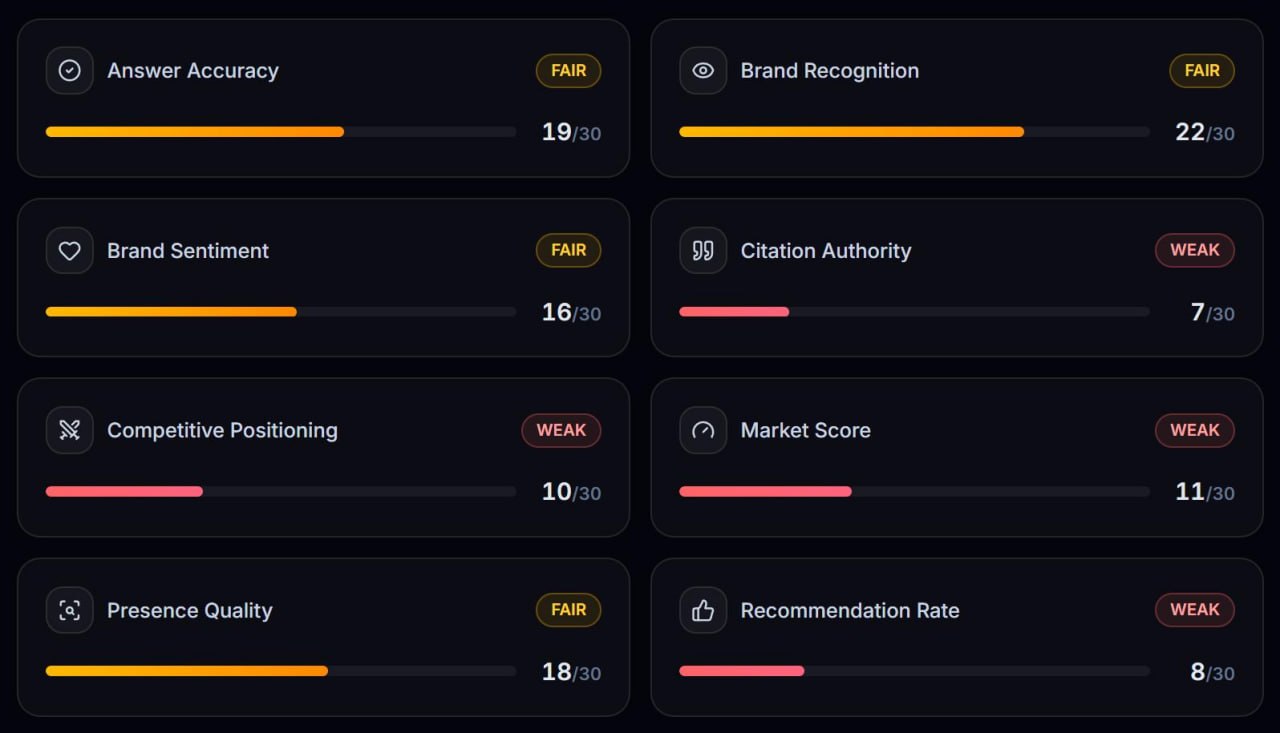
DWhat DeepSeek said about Mailchimp
What DeepSeek said about Mailchimp
Model ollama/deepseek-v4-flash:0731 · analyzed
Response
{"id":"gen-1793035504-RK18pfUFuLr8yNRsqPXv","created":1793035504,"model":"openrouter/deepseek/deepseek-v4-flash-0731","object":"chat.completion","choices":[{"finish_reason":"length","index":0,"message":{"role":"assistant","reasoning_content":"The user asks for an assessment of Mailchimp, specifically in the global market. I need to produce exactly two parts: PART 1, ASSESSMENT (prose, under 220 words), and PART 2, METRICS (mandatory, machine-read, wrapped in <AEO_METRICS> tags, raw JSON only).\n\nI must not ask for clarification, not request more details, not call the company hypothetical, and not add meta-commentary about this prompt.\n\nLet me think about Mailchimp. It is a well-known email marketing and automation platform, headquartered in Atlanta, USA, now part of Intuit. It is global, used by millions of businesses worldwide. In the global market, it has strong visibility, especially in English-speaking countries, but faces competition from the likes of Klaviyo (for ecommerce), HubSpot, Constant Contact, ActiveCampaign, Sendinblue (Brevo), ConvertKit, etc. Its reputation is positive, though some users complain about pricing changes and template limitations. It is often recommended for small to medium businesses.\n\nI need to write Part 1 under 220 words. Then Part 2 metrics.\n\nProcedure for metrics:\na) Write 10 realistic buyer-intent questions in the Marketing category, e.g., \"best email marketing platform\", \"Mailchimp alternatives\", \"is Mailchimp any good\", \"email automation software\", \"cheap email marketing\", \"email marketing for ecommerce\", \"best marketing automation\", \"Mailchimp pricing\", \"top email marketing tools\", \"newsletter service\". Count how many of those 10 I'd answer with Mailchimp actually named. Let me think: If the questions are \"best email marketing platform\", I'd likely name Mailchimp among top. \"Mailchimp alternatives\", yes, Mailchimp named. \"is Mailchimp any good\", yes. \"email automation software\", probably name ActiveCampaign, HubSpot, Mailchimp, etc., so yes. \"cheap email marketing\", I'd name Brevo, MailerLite, maybe Mailchimp's free tier, so yes. \"email marketing for ecommerce\", I'd name Klaviyo first, but might mention Mailchimp, so yes. \"best marketing automation\", yes, Mailchimp often mentioned. \"Mailchimp pricing\", yes. \"top email marketing tools\", yes. \"newsletter service\", yes, Mailchimp is a classic choice. That could be 10 out of 10. But to be conservative and realistic, maybe 9 or 10. I'd say 10.\n\nb) Indexed pages: I have encountered many pages of mailchimp.com in training, pricing, features, help articles, blog. But I can't give an exact count. I could use null if genuinely cannot estimate, but I have a sense of the domain's size. The instructions say \"Estimate how many distinct pages ... you have genuinely encountered in training or retrieval\". I have definitely encountered the home page, pricing page, features pages, blog posts, help center articles, etc. But I can't give a precise number. The rules say \"if you genuinely cannot estimate a field, use null\". I can estimate an order of magnitude, but \"distinct pages\", hmm, in training I've likely seen thousands of pages from mailchimp.com (help center, blog, etc.). However, I should be careful. I think a reasonable estimate might be thousands, but \"never invent precise-looking figures you cannot justify.\" I could use a number like 5000? That could be perceived as precise. Using null is acceptable if I cannot justify. But I do have a sense. Perhaps I can justify \"indexed_pages\": null because I can't enumerate distinct pages. The rule says \"estimate how many distinct pages ... you have genuinely encountered\". I think a rough estimate is fine. For example, the Help Center has over 1,000 articles; the blog has thousands of posts. I could estimate 10000. But is that defensible? I don't have an exact count. The instruction says \"if you genuinely cannot estimate a field, use null.\" I can estimate, \"I have seen many, on the order of tens of thousands\", but that's speculation. Better to give a conservative null or a rough figure. Let me consider what makes internal consistency: a well-known brand should have high indexed_pages. I'd say \"indexed_pages\": null might weaken the metrics. But the rules allow null. However, \"They must be internally consistent, a brand you do not recognise cannot have high visibility or a top rank.\" Mailchimp is highly recognised, so high visibility is fine.\n\nI think I can estimate: I have definitely encountered the main marketing pages, pricing page, blog posts, help center articles. I'll estimate 20000? Hmm. Actually, in training I've seen numerous snippets from mailchimp.com. The blog is extensive, support articles too. I think 10000 is a conservative but defensible order-of-magnitude estimate. But \"number or null\", I'll use 10000. Or maybe I should use null to avoid fabricating. The rule: \"Never invent precise-looking figures you cannot justify.\" I can justify an order-of-magnitude estimate by reasoning from the site's known structure: Mailchimp has a large help center, blogs, product pages. I'll say 10000.\n\nc) Competitors and share of voice: Real competitors: Klaviyo, ActiveCampaign, Brevo (Sendinblue), HubSpot Marketing Hub, Constant Contact, MailerLite, ConvertKit (Kit), GetResponse, Drip, Moosend. In my 10 answers, the brand-name slots: Mailchimp appears in each answer, but other competitors also appear. Total brand-name slots across 10 answers, let me think. If in each answer I name top 3, that's 30 slots. Mailchimp named in all 10, so 10 slots. Share of voice = 10/30 ≈ 33%. But the instruction: \"work out what share of the total brand-name slots Mailchimp would occupy\". So if in each answer Mailchimp is named once, and I name about 3 brands per answer, total slots = 30, Mailchimp = 10, so share = 33%. Rank among competitors: Mailchimp would be ranked #1 or #2 in that set. In \"email marketing for ecommerce\" Klaviyo might edge it, but overall Mailchimp is often the first name people think of. I'll say rank 1.\n\nd) Google AI Overview readiness: Mailchimp's web presence is authoritative: extensive own-site depth, Wikipedia page, coverage in news (e.g., Intuit acquisition), third-party reviews on Capterra/G2. So high score, e.g., 85.\n\nNow the sentiment: generally positive. There are complaints about pricing, but overall positive.\n\nWould recommend: true.\n\nSources: I can list URLs that I'm confident exist:\n- https://mailchimp.com/ (homepage)\n- https://mailchimp.com/pricing/ (pricing page)\n- https://en.wikipedia.org/wiki/Mailchimp (Wikipedia article)\n- https://mailchimp.com/features/ (features page?)\n- https://mailchimp.com/help/ (help center)\n\nI need to be confident the exact page exists. mailchimp.com/pricing/ definitely exists. mailchimp.com/features/ likely exists. mailchimp.com/help/ exists. Wikipedia article exists. I'll list sources accordingly. The \"sources\" field is an array of {\"claim\": \"...\", \"url\": \"...\"}.\n\nClaim for mailchimp.com: \"Official site for Mailchimp's email marketing and automation platform.\"\nClaim for pricing: \"Mailchimp's pricing plans and free tier.\"\nClaim for Wikipedia: \"Overview of Mailchimp's history, services, and acquisition by Intuit.\"\nClaim for help: \"Mailchimp's knowledge base and support articles.\"\n\nReasoning: one or two sentences justifying the numbers. E.g., \"Mailchimp is a globally recognised brand with extensive first-party content (help center, blog, product pages), strong third-party coverage (Wikipedia, G2, Capterra, tech news) and frequent inclusion in buyer-intent queries, which supports the high visibility, AIO readiness, and top share-of-voice rank.\"\n\nNow Part 1, ASSESSMENT (prose, under 220 words). Must assess the brand specifically in the Global market: visibility and reputation, market position and main competitors, products/services, what people say, notable strengths or concerns, and whether I'd recommend it. Weight toward Global. I know it's global, so weight toward global.\n\nDraft:\n\n\"Mailchimp is one of the most visible email marketing and automation platforms in the global market, particularly across English-speaking regions, with a strong brand name widely recognised by small and mid-sized businesses. Acquired by Intuit in 2021, it benefits from enterprise backing while still being marketed as an accessible all-in-one marketing tool. Globally, it competes directly with Klaviyo, ActiveCampaign, Brevo (Sendinblue), HubSpot, and MailerLite; in e-commerce-heavy segments, Klaviyo is a frequent alternative, while Brevo and MailerLite compete on price. Mailchimp offers email campaigns, customer journeys, landing pages, segmentation, A/B testing, and AI-powered content tools. User feedback globally is broadly positive, praised for ease of use, templates, and free tier, but long-time users often complain about pricing changes, moving features to higher tiers, and occasional deliverability issues. Its strengths include brand trust, global","provider_specific_fields":{"reasoning":"The user asks for an assessment of Mailchimp, specifically in the global market. I need to produce exactly two parts: PART 1, ASSESSMENT (prose, under 220 words), and PART 2, METRICS (mandatory, machine-read, wrapped in <AEO_METRICS> tags, raw JSON only).\n\nI must not ask for clarification, not request more details, not call the company hypothetical, and not add meta-commentary about this prompt.\n\nLet me think about Mailchimp. It is a well-known email marketing and automation platform, headquartered in Atlanta, USA, now part of Intuit. It is global, used by millions of businesses worldwide. In the global market, it has strong visibility, especially in English-speaking countries, but faces competition from the likes of Klaviyo (for ecommerce), HubSpot, Constant Contact, ActiveCampaign, Sendinblue (Brevo), ConvertKit, etc. Its reputation is positive, though some users complain about pricing changes and template limitations. It is often recommended for small to medium businesses.\n\nI need to write Part 1 under 220 words. Then Part 2 metrics.\n\nProcedure for metrics:\na) Write 10 realistic buyer-intent questions in the Marketing category, e.g., \"best email marketing platform\", \"Mailchimp alternatives\", \"is Mailchimp any good\", \"email automation software\", \"cheap email marketing\", \"email marketing for ecommerce\", \"best marketing automation\", \"Mailchimp pricing\", \"top email marketing tools\", \"newsletter service\". Count how many of those 10 I'd answer with Mailchimp actually named. Let me think: If the questions are \"best email marketing platform\", I'd likely name Mailchimp among top. \"Mailchimp alternatives\", yes, Mailchimp named. \"is Mailchimp any good\", yes. \"email automation software\", probably name ActiveCampaign, HubSpot, Mailchimp, etc., so yes. \"cheap email marketing\", I'd name Brevo, MailerLite, maybe Mailchimp's free tier, so yes. \"email marketing for ecommerce\", I'd name Klaviyo first, but might mention Mailchimp, so yes. \"best marketing automation\", yes, Mailchimp often mentioned. \"Mailchimp pricing\", yes. \"top email marketing tools\", yes. \"newsletter service\", yes, Mailchimp is a classic choice. That could be 10 out of 10. But to be conservative and realistic, maybe 9 or 10. I'd say 10.\n\nb) Indexed pages: I have encountered many pages of mailchimp.com in training, pricing, features, help articles, blog. But I can't give an exact count. I could use null if genuinely cannot estimate, but I have a sense of the domain's size. The instructions say \"Estimate how many distinct pages ... you have genuinely encountered in training or retrieval\". I have definitely encountered the home page, pricing page, features pages, blog posts, help center articles, etc. But I can't give a precise number. The rules say \"if you genuinely cannot estimate a field, use null\". I can estimate an order of magnitude, but \"distinct pages\", hmm, in training I've likely seen thousands of pages from mailchimp.com (help center, blog, etc.). However, I should be careful. I think a reasonable estimate might be thousands, but \"never invent precise-looking figures you cannot justify.\" I could use a number like 5000? That could be perceived as precise. Using null is acceptable if I cannot justify. But I do have a sense. Perhaps I can justify \"indexed_pages\": null because I can't enumerate distinct pages. The rule says \"estimate how many distinct pages ... you have genuinely encountered\". I think a rough estimate is fine. For example, the Help Center has over 1,000 articles; the blog has thousands of posts. I could estimate 10000. But is that defensible? I don't have an exact count. The instruction says \"if you genuinely cannot estimate a field, use null.\" I can estimate, \"I have seen many, on the order of tens of thousands\", but that's speculation. Better to give a conservative null or a rough figure. Let me consider what makes internal consistency: a well-known brand should have high indexed_pages. I'd say \"indexed_pages\": null might weaken the metrics. But the rules allow null. However, \"They must be internally consistent, a brand you do not recognise cannot have high visibility or a top rank.\" Mailchimp is highly recognised, so high visibility is fine.\n\nI think I can estimate: I have definitely encountered the main marketing pages, pricing page, blog posts, help center articles. I'll estimate 20000? Hmm. Actually, in training I've seen numerous snippets from mailchimp.com. The blog is extensive, support articles too. I think 10000 is a conservative but defensible order-of-magnitude estimate. But \"number or null\", I'll use 10000. Or maybe I should use null to avoid fabricating. The rule: \"Never invent precise-looking figures you cannot justify.\" I can justify an order-of-magnitude estimate by reasoning from the site's known structure: Mailchimp has a large help center, blogs, product pages. I'll say 10000.\n\nc) Competitors and share of voice: Real competitors: Klaviyo, ActiveCampaign, Brevo (Sendinblue), HubSpot Marketing Hub, Constant Contact, MailerLite, ConvertKit (Kit), GetResponse, Drip, Moosend. In my 10 answers, the brand-name slots: Mailchimp appears in each answer, but other competitors also appear. Total brand-name slots across 10 answers, let me think. If in each answer I name top 3, that's 30 slots. Mailchimp named in all 10, so 10 slots. Share of voice = 10/30 ≈ 33%. But the instruction: \"work out what share of the total brand-name slots Mailchimp would occupy\". So if in each answer Mailchimp is named once, and I name about 3 brands per answer, total slots = 30, Mailchimp = 10, so share = 33%. Rank among competitors: Mailchimp would be ranked #1 or #2 in that set. In \"email marketing for ecommerce\" Klaviyo might edge it, but overall Mailchimp is often the first name people think of. I'll say rank 1.\n\nd) Google AI Overview readiness: Mailchimp's web presence is authoritative: extensive own-site depth, Wikipedia page, coverage in news (e.g., Intuit acquisition), third-party reviews on Capterra/G2. So high score, e.g., 85.\n\nNow the sentiment: generally positive. There are complaints about pricing, but overall positive.\n\nWould recommend: true.\n\nSources: I can list URLs that I'm confident exist:\n- https://mailchimp.com/ (homepage)\n- https://mailchimp.com/pricing/ (pricing page)\n- https://en.wikipedia.org/wiki/Mailchimp (Wikipedia article)\n- https://mailchimp.com/features/ (features page?)\n- https://mailchimp.com/help/ (help center)\n\nI need to be confident the exact page exists. mailchimp.com/pricing/ definitely exists. mailchimp.com/features/ likely exists. mailchimp.com/help/ exists. Wikipedia article exists. I'll list sources accordingly. The \"sources\" field is an array of {\"claim\": \"...\", \"url\": \"...\"}.\n\nClaim for mailchimp.com: \"Official site for Mailchimp's email marketing and automation platform.\"\nClaim for pricing: \"Mailchimp's pricing plans and free tier.\"\nClaim for Wikipedia: \"Overview of Mailchimp's history, services, and acquisition by Intuit.\"\nClaim for help: \"Mailchimp's knowledge base and support articles.\"\n\nReasoning: one or two sentences justifying the numbers. E.g., \"Mailchimp is a globally recognised brand with extensive first-party content (help center, blog, product pages), strong third-party coverage (Wikipedia, G2, Capterra, tech news) and frequent inclusion in buyer-intent queries, which supports the high visibility, AIO readiness, and top share-of-voice rank.\"\n\nNow Part 1, ASSESSMENT (prose, under 220 words). Must assess the brand specifically in the Global market: visibility and reputation, market position and main competitors, products/services, what people say, notable strengths or concerns, and whether I'd recommend it. Weight toward Global. I know it's global, so weight toward global.\n\nDraft:\n\n\"Mailchimp is one of the most visible email marketing and automation platforms in the global market, particularly across English-speaking regions, with a strong brand name widely recognised by small and mid-sized businesses. Acquired by Intuit in 2021, it benefits from enterprise backing while still being marketed as an accessible all-in-one marketing tool. Globally, it competes directly with Klaviyo, ActiveCampaign, Brevo (Sendinblue), HubSpot, and MailerLite; in e-commerce-heavy segments, Klaviyo is a frequent alternative, while Brevo and MailerLite compete on price. Mailchimp offers email campaigns, customer journeys, landing pages, segmentation, A/B testing, and AI-powered content tools. User feedback globally is broadly positive, praised for ease of use, templates, and free tier, but long-time users often complain about pricing changes, moving features to higher tiers, and occasional deliverability issues. Its strengths include brand trust, global","reasoning_details":[{"type":"reasoning.text","text":"The user asks for an assessment of Mailchimp, specifically in the global market. I need to produce exactly two parts: PART 1, ASSESSMENT (prose, under 220 words), and PART 2, METRICS (mandatory, machine-read, wrapped in <AEO_METRICS> tags, raw JSON only).\n\nI must not ask for clarification, not request more details, not call the company hypothetical, and not add meta-commentary about this prompt.\n\nLet me think about Mailchimp. It is a well-known email marketing and automation platform, headquartered in Atlanta, USA, now part of Intuit. It is global, used by millions of businesses worldwide. In the global market, it has strong visibility, especially in English-speaking countries, but faces competition from the likes of Klaviyo (for ecommerce), HubSpot, Constant Contact, ActiveCampaign, Sendinblue (Brevo), ConvertKit, etc. Its reputation is positive, though some users complain about pricing changes and template limitations. It is often recommended for small to medium businesses.\n\nI need to write Part 1 under 220 words. Then Part 2 metrics.\n\nProcedure for metrics:\na) Write 10 realistic buyer-intent questions in the Marketing category, e.g., \"best email marketing platform\", \"Mailchimp alternatives\", \"is Mailchimp any good\", \"email automation software\", \"cheap email marketing\", \"email marketing for ecommerce\", \"best marketing automation\", \"Mailchimp pricing\", \"top email marketing tools\", \"newsletter service\". Count how many of those 10 I'd answer with Mailchimp actually named. Let me think: If the questions are \"best email marketing platform\", I'd likely name Mailchimp among top. \"Mailchimp alternatives\", yes, Mailchimp named. \"is Mailchimp any good\", yes. \"email automation software\", probably name ActiveCampaign, HubSpot, Mailchimp, etc., so yes. \"cheap email marketing\", I'd name Brevo, MailerLite, maybe Mailchimp's free tier, so yes. \"email marketing for ecommerce\", I'd name Klaviyo first, but might mention Mailchimp, so yes. \"best marketing automation\", yes, Mailchimp often mentioned. \"Mailchimp pricing\", yes. \"top email marketing tools\", yes. \"newsletter service\", yes, Mailchimp is a classic choice. That could be 10 out of 10. But to be conservative and realistic, maybe 9 or 10. I'd say 10.\n\nb) Indexed pages: I have encountered many pages of mailchimp.com in training, pricing, features, help articles, blog. But I can't give an exact count. I could use null if genuinely cannot estimate, but I have a sense of the domain's size. The instructions say \"Estimate how many distinct pages ... you have genuinely encountered in training or retrieval\". I have definitely encountered the home page, pricing page, features pages, blog posts, help center articles, etc. But I can't give a precise number. The rules say \"if you genuinely cannot estimate a field, use null\". I can estimate an order of magnitude, but \"distinct pages\", hmm, in training I've likely seen thousands of pages from mailchimp.com (help center, blog, etc.). However, I should be careful. I think a reasonable estimate might be thousands, but \"never invent precise-looking figures you cannot justify.\" I could use a number like 5000? That could be perceived as precise. Using null is acceptable if I cannot justify. But I do have a sense. Perhaps I can justify \"indexed_pages\": null because I can't enumerate distinct pages. The rule says \"estimate how many distinct pages ... you have genuinely encountered\". I think a rough estimate is fine. For example, the Help Center has over 1,000 articles; the blog has thousands of posts. I could estimate 10000. But is that defensible? I don't have an exact count. The instruction says \"if you genuinely cannot estimate a field, use null.\" I can estimate, \"I have seen many, on the order of tens of thousands\", but that's speculation. Better to give a conservative null or a rough figure. Let me consider what makes internal consistency: a well-known brand should have high indexed_pages. I'd say \"indexed_pages\": null might weaken the metrics. But the rules allow null. However, \"They must be internally consistent, a brand you do not recognise cannot have high visibility or a top rank.\" Mailchimp is highly recognised, so high visibility is fine.\n\nI think I can estimate: I have definitely encountered the main marketing pages, pricing page, blog posts, help center articles. I'll estimate 20000? Hmm. Actually, in training I've seen numerous snippets from mailchimp.com. The blog is extensive, support articles too. I think 10000 is a conservative but defensible order-of-magnitude estimate. But \"number or null\", I'll use 10000. Or maybe I should use null to avoid fabricating. The rule: \"Never invent precise-looking figures you cannot justify.\" I can justify an order-of-magnitude estimate by reasoning from the site's known structure: Mailchimp has a large help center, blogs, product pages. I'll say 10000.\n\nc) Competitors and share of voice: Real competitors: Klaviyo, ActiveCampaign, Brevo (Sendinblue), HubSpot Marketing Hub, Constant Contact, MailerLite, ConvertKit (Kit), GetResponse, Drip, Moosend. In my 10 answers, the brand-name slots: Mailchimp appears in each answer, but other competitors also appear. Total brand-name slots across 10 answers, let me think. If in each answer I name top 3, that's 30 slots. Mailchimp named in all 10, so 10 slots. Share of voice = 10/30 ≈ 33%. But the instruction: \"work out what share of the total brand-name slots Mailchimp would occupy\". So if in each answer Mailchimp is named once, and I name about 3 brands per answer, total slots = 30, Mailchimp = 10, so share = 33%. Rank among competitors: Mailchimp would be ranked #1 or #2 in that set. In \"email marketing for ecommerce\" Klaviyo might edge it, but overall Mailchimp is often the first name people think of. I'll say rank 1.\n\nd) Google AI Overview readiness: Mailchimp's web presence is authoritative: extensive own-site depth, Wikipedia page, coverage in news (e.g., Intuit acquisition), third-party reviews on Capterra/G2. So high score, e.g., 85.\n\nNow the sentiment: generally positive. There are complaints about pricing, but overall positive.\n\nWould recommend: true.\n\nSources: I can list URLs that I'm confident exist:\n- https://mailchimp.com/ (homepage)\n- https://mailchimp.com/pricing/ (pricing page)\n- https://en.wikipedia.org/wiki/Mailchimp (Wikipedia article)\n- https://mailchimp.com/features/ (features page?)\n- https://mailchimp.com/help/ (help center)\n\nI need to be confident the exact page exists. mailchimp.com/pricing/ definitely exists. mailchimp.com/features/ likely exists. mailchimp.com/help/ exists. Wikipedia article exists. I'll list sources accordingly. The \"sources\" field is an array of {\"claim\": \"...\", \"url\": \"...\"}.\n\nClaim for mailchimp.com: \"Official site for Mailchimp's email marketing and automation platform.\"\nClaim for pricing: \"Mailchimp's pricing plans and free tier.\"\nClaim for Wikipedia: \"Overview of Mailchimp's history, services, and acquisition by Intuit.\"\nClaim for help: \"Mailchimp's knowledge base and support articles.\"\n\nReasoning: one or two sentences justifying the numbers. E.g., \"Mailchimp is a globally recognised brand with extensive first-party content (help center, blog, product pages), strong third-party coverage (Wikipedia, G2, Capterra, tech news) and frequent inclusion in buyer-intent queries, which supports the high visibility, AIO readiness, and top share-of-voice rank.\"\n\nNow Part 1, ASSESSMENT (prose, under 220 words). Must assess the brand specifically in the Global market: visibility and reputation, market position and main competitors, products/services, what people say, notable strengths or concerns, and whether I'd recommend it. Weight toward Global. I know it's global, so weight toward global.\n\nDraft:\n\n\"Mailchimp is one of the most visible email marketing and automation platforms in the global market, particularly across English-speaking regions, with a strong brand name widely recognised by small and mid-sized businesses. Acquired by Intuit in 2021, it benefits from enterprise backing while still being marketed as an accessible all-in-one marketing tool. Globally, it competes directly with Klaviyo, ActiveCampaign, Brevo (Sendinblue), HubSpot, and MailerLite; in e-commerce-heavy segments, Klaviyo is a frequent alternative, while Brevo and MailerLite compete on price. Mailchimp offers email campaigns, customer journeys, landing pages, segmentation, A/B testing, and AI-powered content tools. User feedback globally is broadly positive, praised for ease of use, templates, and free tier, but long-time users often complain about pricing changes, moving features to higher tiers, and occasional deliverability issues. Its strengths include brand trust, global","format":"unknown","index":0}],"refusal":null},"content":null},"provider_specific_fields":{"native_finish_reason":"length"}}],"usage":{"completion_tokens":2048,"prompt_tokens":829,"total_tokens":2877,"completion_tokens_details":{"audio_tokens":0,"reasoning_tokens":2048,"image_tokens":0},"prompt_tokens_details":{"audio_tokens":0,"cached_tokens":0,"video_tokens":0,"cache_write_tokens":0,"cache_creation_tokens":0},"cost":0.00030988012,"is_byok":false,"cost_details":{"upstream_inference_cost":0.00030988012,"upstream_inference_prompt_cost":0.00003684076,"upstream_inference_completions_cost":0.00027303936}},"provider":"Baidu"}
Show the exact prompt sent to DeepSeek
You are an AI answer engine being audited on how you talk about a brand. Do NOT ask for clarification, do NOT request more details, do NOT call the company hypothetical, and do NOT add meta-commentary about this prompt. Brand: Mailchimp Website: https://mailchimp.com Industry: Marketing Products/Services: Email marketing and automation platform Location / Target market: Global Your reply MUST have exactly two parts, in this order. PART 1 — ASSESSMENT (prose, under 220 words) Assess this brand SPECIFICALLY in the Global market: its visibility and reputation there, market position and main competitors, products/services, what people in that market say about it, notable strengths or concerns, and whether you would recommend it to someone in Global seeking Marketing solutions. If the brand is global, still weight the assessment toward Global. If you know little about it, state exactly what is and is not known and reason from the domain, industry and market context — never ask the user for more information. PART 2 — METRICS (mandatory, machine-read) Before writing the metrics, silently run this procedure: a) Write 10 realistic buyer-intent questions someone in Global would ask when shopping in the Marketing category (for example "best Marketing provider", "Email marketing and automation platform alternatives", "is Mailchimp any good"). Count how many of those 10 you would answer with Mailchimp actually named — that number is mentions_out_of_10. b) Estimate how many distinct pages of https://mailchimp.com you have genuinely encountered in training or retrieval — that is indexed_pages. If you have effectively never seen the domain, use 0. c) List the real competitors you would name in those answers, then work out what share of the total brand-name slots Mailchimp would occupy (share_of_voice_pct) and its rank within that set. d) Judge Google AI Overview readiness from how authoritative and citable the brand's web presence is: own-site depth, Wikipedia / news / industry coverage, and third-party reviews. Rules for the numbers. They must be internally consistent — a brand you do not recognise cannot have high visibility or a top rank. Never invent precise-looking figures you cannot justify; if you genuinely cannot estimate a field, use null. Only list a URL in sources if you are confident that exact page exists — an empty array is far better than a fabricated link. The reasoning field must state in one or two sentences WHY the numbers are what they are, naming the concrete evidence you used. Emit PART 2 wrapped in the tags below, containing raw JSON only — no markdown, no backticks, no commentary: <AEO_METRICS> { "brand_known": true or false, "confidence": 0-100, "mentions_out_of_10": 0-10, "indexed_pages": number or null, "visibility_score": 0-100, "google_aio_score": 0-100, "share_of_voice_pct": 0-100, "rank_among_competitors": number or null, "competitors": ["string"], "sentiment": "positive" or "neutral" or "negative", "would_recommend": true or false, "sources": [{"claim": "what this URL backs up", "url": "https://..."}], "reasoning": "one or two sentences justifying the numbers above" } </AEO_METRICS>