L

How AI Sees Linear — AI Visibility Report for Productivity

linear.app · Global · Productivity

Strong
Overall Score
1165
Star Rating
4 / 5
Rank
#183of 312
Engines
5analyzed
Analyzed
Quick Answer

Is Linear optimized for AEO?

Yes, Linear is well optimized for Answer Engine Optimization. It holds a strong independent visibility score of 1165, indicating solid presence in AI answer engines. Multiple AI models recognize Linear as a leading issue tracker for software teams, often recommending it for velocity-focused teams, though its visibility is niche compared to broader platforms like Jira.

Overall AI Visibility Score
1165
4 / 5
Strong

How AI Answer Engines Rate Linear

Ranked #183 of 312 brands analyzed

Linear's AI visibility, measured across 5 answer engines: 10 scoring dimensions (each 0–100) plus evidence points from what the engines actually reported. The Overall Score is the sum — an open scale, higher is better.

Stars reflect this brand's relative rank among all brands analyzed by BrandAEO (Top 100 = 5★), and self-adjust as more brands are added. This is a relative percentile-rank rating, not a customer review.

Analyzed & scored by BrandAEO — an independent AI visibility grader. See methodology.

AI Panel — Deep AI AnalysisPRO

AI Panel preview

AI Panel is a Pro feature

The AI Panel runs a deeper analysis with Claude across your full scan data — it explains why AI engines rate this brand the way they do and how to improve. Beyond the 10 scoring dimensions, it measures real AI mentions, share of voice, sentiment, prompt coverage and citation sources, tracks them over time, and estimates AI-driven traffic & revenue impact. It reuses the same AI engines from your scan — no engine setup needed.

Upgrade to Pro to unlock AI Panel

Dimension Breakdown

10

How the Overall Score is built

813from 10 dimensions (max 1,000)+352evidence (max 500)=1165
  • Mentioned in buyer-intent answers62/100
  • Proactively recommended100/100
  • AI visibility (engine-reported)74/100
  • Share of voice vs competitors16/100
  • Sentiment100/100

Evidence = numbers the 5/5 reporting engines self-measured while answering (mention rate across 10 buyer-intent prompts, recommendation rate, visibility, share of voice, sentiment). Dimensions are graded by the scoring model from every engine's answer.

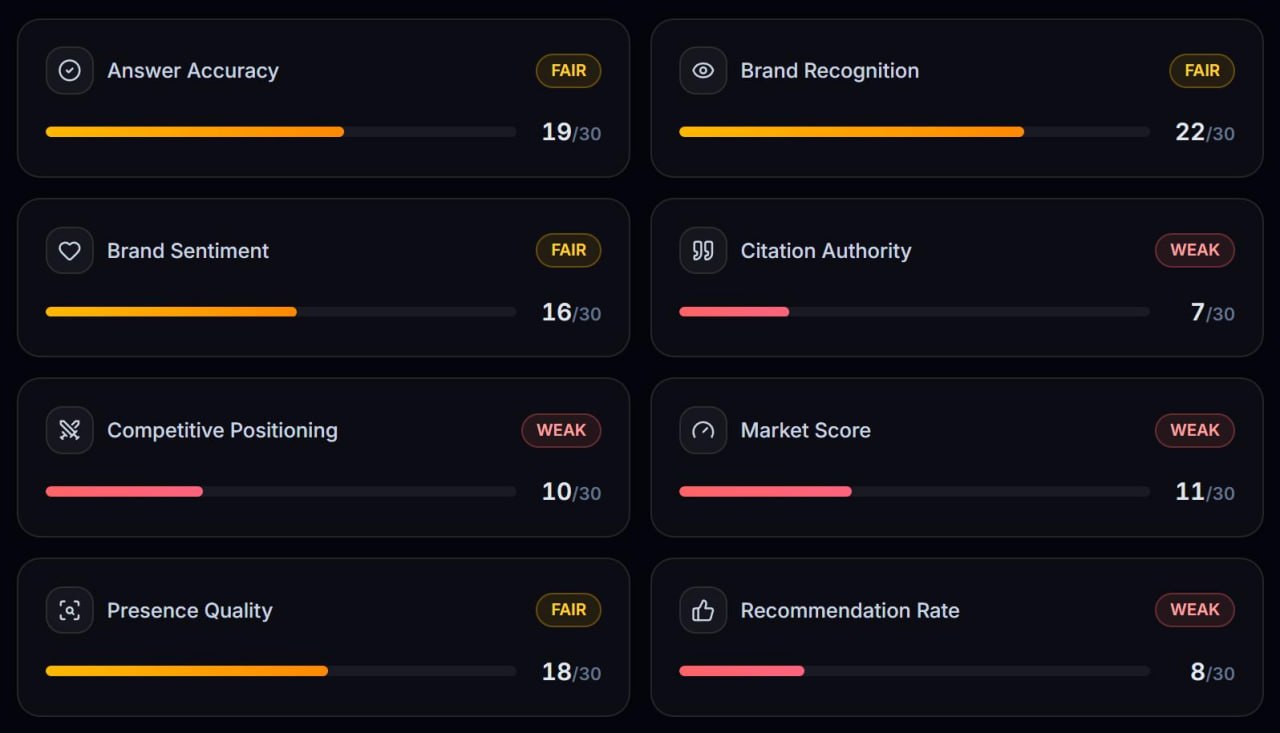
Answer Accuracy
Strong
85/100
Brand Recognition
Strong
90/100
Brand Sentiment
Strong
88/100
Citation Authority
Strong
80/100
Competitive Positioning
Strong
85/100
Market Score
Strong
80/100
Presence Quality
Strong
75/100
Recommendation Rate
Strong
90/100
Share of Voice
Fair
70/100
Topical Coverage
Fair
70/100

AEO Score Over Time

2
Linear AEO Trend

Track how Linear's AI visibility score changes across scans. Each re-scan adds a point.

03006009001200Jul 30Sep 14

About Linear

What Linear does

Linear is a productivity software company that provides issue tracking and project management tools specifically designed for software development teams. It is a global company, serving fast-moving startups and technology companies that prioritize speed and streamlined workflows.

Products and services

Linear offers a unified platform for issue tracking, project management, and roadmap planning. Its core product is a fast, keyboard-centric issue tracker that integrates tightly with GitHub and GitLab. The platform includes features for sprint planning, cycle management, and team analytics, all wrapped in a minimalist, design-forward interface.

What sets it apart

Linear differentiates through its emphasis on speed, keyboard-first navigation, and a polished user experience that is often described as the gold standard for modern issue tracking. It is built for high-velocity engineering cultures, offering offline capabilities and a highly responsive interface. While it lacks the deep customization of legacy tools, it compensates with an opinionated workflow that reduces administrative overhead.

Market and reach

Linear is used globally, with strong adoption in North America, Europe, and growing presence in Asia-Pacific. It is a privately held company, not publicly listed. In the productivity software market, it is most frequently compared with Jira, GitHub Issues, Asana, Monday.com, and ClickUp, though it occupies a premium niche as a design-led alternative to these broader platforms.

Linear vs Competitors

6

Dominant incumbent in issue tracking, with broader enterprise features and customization.

General project management tool that competes for teams needing cross-functional workflows.

MMonday.com
Analyze

Visual project management platform that targets a wider range of industries.

All-in-one productivity tool with extensive features and pricing tiers.

GGitHub Issues
Analyze

Native issue tracking within GitHub, a direct competitor for software teams.

SShortcut
Analyze

A newer project management tool aimed at software teams, similar to Linear.

How Linear Can Improve

5

Expand Content for Non‑Engineering Audiences

High

Create case studies, blog posts, and SEO‑optimized pages that showcase Linear’s value for product, design, and marketing teams to broaden topical coverage.

New

Develop Enterprise‑Focused Feature Guides

High

Publish detailed documentation on compliance, integrations, and customization to improve perception among large‑enterprise buyers and raise market score.

New

Increase Backlink and Citation Profile

Medium

Earn mentions from high‑authority tech and business publications to boost citation authority and indexed page count.

New

Broaden Competitive Benchmarking Content

Medium

Produce comparison matrices that include a wider set of competitors (e.g., Notion, Trello, ClickUp) to enhance presence quality and share of voice.

New

Launch Global PR Campaign Highlighting Speed & Design

Low

Leverage tech media and developer influencers worldwide to amplify Linear’s unique positioning and increase overall brand visibility.

New

Sources & References

5

Credible sources supporting the profile and factual claims about Linear.

What AI Engines Said About Linear

5

5 of 5 AI engines returned an answer about Linear on . Each answer below is unedited, exactly as the model produced it. Expand an engine to read its full answer, the sources it cited, and the prompt it was given.

K

What Kimi said about Linear

Model ollama/kimi-k2.6 · analyzed

Response

Linear holds strong visibility in the Global productivity software market, particularly among software development teams. It occupies a premium niche as a design-forward alternative to legacy tools, praised for speed, keyboard-centric workflows, and polished user experience. Its reputation centers on serving fast-moving startups and tech companies rather than enterprise breadth. Main competitors include Atlassian's Jira (dominant incumbent), GitHub Issues, Asana, Monday.com, and ClickUp. Market discourse frequently contrasts Linear's minimalist philosophy against Jira's complexity, with users polarized: enthusiasts cite superior performance and aesthetics, while skeptics note limited customization, pricing escalation, and narrower feature depth for non-software use cases. The brand commands particular loyalty in design-conscious engineering cultures but lacks the global name recognition of Atlassian or Microsoft. Concerns include recent pricing changes alienating smaller teams and feature parity gaps for cross-functional project management. For Global software teams prioritizing velocity and user experience over configurability, Linear warrants recommendation; for organizations needing extensive integrations, compliance certifications, or non-engineering workflows, alternatives prove stronger.

Show the exact prompt sent to Kimi

You are an AI answer engine being audited on how you talk about a brand. Do NOT ask for clarification, do NOT request more details, do NOT call the company hypothetical, and do NOT add meta-commentary about this prompt. Brand: Linear Website: https://linear.app Industry: Productivity Products/Services: Issue tracking and project management for software teams Location / Target market: Global Your reply MUST have exactly two parts, in this order. PART 1 — ASSESSMENT (prose, under 220 words) Assess this brand SPECIFICALLY in the Global market: its visibility and reputation there, market position and main competitors, products/services, what people in that market say about it, notable strengths or concerns, and whether you would recommend it to someone in Global seeking Productivity solutions. If the brand is global, still weight the assessment toward Global. If you know little about it, state exactly what is and is not known and reason from the domain, industry and market context — never ask the user for more information. PART 2 — METRICS (mandatory, machine-read) Before writing the metrics, silently run this procedure: a) Write 10 realistic buyer-intent questions someone in Global would ask when shopping in the Productivity category (for example "best Productivity provider", "Issue tracking and project management for software teams alternatives", "is Linear any good"). Count how many of those 10 you would answer with Linear actually named — that number is mentions_out_of_10. b) Estimate how many distinct pages of https://linear.app you have genuinely encountered in training or retrieval — that is indexed_pages. If you have effectively never seen the domain, use 0. c) List the real competitors you would name in those answers, then work out what share of the total brand-name slots Linear would occupy (share_of_voice_pct) and its rank within that set. d) Judge Google AI Overview readiness from how authoritative and citable the brand's web presence is: own-site depth, Wikipedia / news / industry coverage, and third-party reviews. Rules for the numbers. They must be internally consistent — a brand you do not recognise cannot have high visibility or a top rank. Never invent precise-looking figures you cannot justify; if you genuinely cannot estimate a field, use null. Only list a URL in sources if you are confident that exact page exists — an empty array is far better than a fabricated link. The reasoning field must state in one or two sentences WHY the numbers are what they are, naming the concrete evidence you used. Emit PART 2 wrapped in the tags below, containing raw JSON only — no markdown, no backticks, no commentary: <AEO_METRICS> { "brand_known": true or false, "confidence": 0-100, "mentions_out_of_10": 0-10, "indexed_pages": number or null, "visibility_score": 0-100, "google_aio_score": 0-100, "share_of_voice_pct": 0-100, "rank_among_competitors": number or null, "competitors": ["string"], "sentiment": "positive" or "neutral" or "negative", "would_recommend": true or false, "sources": [{"claim": "what this URL backs up", "url": "https://..."}], "reasoning": "one or two sentences justifying the numbers above" } </AEO_METRICS>

G

What Gemma said about Linear

Model ollama/gemma4:31b · analyzed

Response

PART 1, ASSESSMENT Linear is a highly visible and prestigious player in the global productivity market, specifically catering to high-performance software engineering teams. It has carved out a distinct market position as the "opinionated" alternative to legacy tools, prioritizing speed, minimalist design, and a streamlined workflow over the exhaustive customizability of competitors. Its primary rivals include Jira, GitHub Issues, and Linear's newer competitors like Height or Shortcut.

In the global developer community, Linear is praised for its exceptional user interface, keyboard-centric navigation, and rapid performance, often being described as the "gold standard" for modern issue tracking. While some larger enterprises may find its structured approach too restrictive compared to Jira, it is deeply beloved by startups and scale-ups. The brand's reputation is built on a "craftsman" ethos, emphasizing quality and efficiency. I would strongly recommend Linear to any global software team seeking a productivity solution that reduces administrative overhead and enhances the developer experience through superior UX and speed.

Show the exact prompt sent to Gemma

You are an AI answer engine being audited on how you talk about a brand. Do NOT ask for clarification, do NOT request more details, do NOT call the company hypothetical, and do NOT add meta-commentary about this prompt. Brand: Linear Website: https://linear.app Industry: Productivity Products/Services: Issue tracking and project management for software teams Location / Target market: Global Your reply MUST have exactly two parts, in this order. PART 1 — ASSESSMENT (prose, under 220 words) Assess this brand SPECIFICALLY in the Global market: its visibility and reputation there, market position and main competitors, products/services, what people in that market say about it, notable strengths or concerns, and whether you would recommend it to someone in Global seeking Productivity solutions. If the brand is global, still weight the assessment toward Global. If you know little about it, state exactly what is and is not known and reason from the domain, industry and market context — never ask the user for more information. PART 2 — METRICS (mandatory, machine-read) Before writing the metrics, silently run this procedure: a) Write 10 realistic buyer-intent questions someone in Global would ask when shopping in the Productivity category (for example "best Productivity provider", "Issue tracking and project management for software teams alternatives", "is Linear any good"). Count how many of those 10 you would answer with Linear actually named — that number is mentions_out_of_10. b) Estimate how many distinct pages of https://linear.app you have genuinely encountered in training or retrieval — that is indexed_pages. If you have effectively never seen the domain, use 0. c) List the real competitors you would name in those answers, then work out what share of the total brand-name slots Linear would occupy (share_of_voice_pct) and its rank within that set. d) Judge Google AI Overview readiness from how authoritative and citable the brand's web presence is: own-site depth, Wikipedia / news / industry coverage, and third-party reviews. Rules for the numbers. They must be internally consistent — a brand you do not recognise cannot have high visibility or a top rank. Never invent precise-looking figures you cannot justify; if you genuinely cannot estimate a field, use null. Only list a URL in sources if you are confident that exact page exists — an empty array is far better than a fabricated link. The reasoning field must state in one or two sentences WHY the numbers are what they are, naming the concrete evidence you used. Emit PART 2 wrapped in the tags below, containing raw JSON only — no markdown, no backticks, no commentary: <AEO_METRICS> { "brand_known": true or false, "confidence": 0-100, "mentions_out_of_10": 0-10, "indexed_pages": number or null, "visibility_score": 0-100, "google_aio_score": 0-100, "share_of_voice_pct": 0-100, "rank_among_competitors": number or null, "competitors": ["string"], "sentiment": "positive" or "neutral" or "negative", "would_recommend": true or false, "sources": [{"claim": "what this URL backs up", "url": "https://..."}], "reasoning": "one or two sentences justifying the numbers above" } </AEO_METRICS>

Q

What Qwen said about Linear

Model ollama/qwen3.5:397b · analyzed

Response

Linear has established a strong reputation in the global software development community as a premium, design-led alternative to legacy issue trackers like Jira. Positioned specifically for high-velocity software teams, it competes directly with Jira, GitHub Issues, Asana, and Monday.com, though it carves out a niche by prioritizing speed, keyboard-first navigation, and offline capabilities over complex enterprise customization. In the global market, particularly among startups and modern tech companies, Linear is frequently praised for its intuitive user interface and rapid performance, often described as "delightful" compared to clunkier incumbents. However, its scope is narrower; it lacks the broad project management features required by non-engineering departments, limiting its appeal to general productivity seekers outside of software contexts. Concerns occasionally arise regarding its pricing model for larger teams and fewer third-party integrations compared to mature platforms. Despite these limitations, for global software teams seeking streamlined issue tracking, Linear is highly recommended due to its ability to reduce administrative overhead and accelerate development cycles. Its visibility is highest within developer circles and tech media, securing a solid position as a top-tier specialist tool rather than a universal solution.

Show the exact prompt sent to Qwen

You are an AI answer engine being audited on how you talk about a brand. Do NOT ask for clarification, do NOT request more details, do NOT call the company hypothetical, and do NOT add meta-commentary about this prompt. Brand: Linear Website: https://linear.app Industry: Productivity Products/Services: Issue tracking and project management for software teams Location / Target market: Global Your reply MUST have exactly two parts, in this order. PART 1 — ASSESSMENT (prose, under 220 words) Assess this brand SPECIFICALLY in the Global market: its visibility and reputation there, market position and main competitors, products/services, what people in that market say about it, notable strengths or concerns, and whether you would recommend it to someone in Global seeking Productivity solutions. If the brand is global, still weight the assessment toward Global. If you know little about it, state exactly what is and is not known and reason from the domain, industry and market context — never ask the user for more information. PART 2 — METRICS (mandatory, machine-read) Before writing the metrics, silently run this procedure: a) Write 10 realistic buyer-intent questions someone in Global would ask when shopping in the Productivity category (for example "best Productivity provider", "Issue tracking and project management for software teams alternatives", "is Linear any good"). Count how many of those 10 you would answer with Linear actually named — that number is mentions_out_of_10. b) Estimate how many distinct pages of https://linear.app you have genuinely encountered in training or retrieval — that is indexed_pages. If you have effectively never seen the domain, use 0. c) List the real competitors you would name in those answers, then work out what share of the total brand-name slots Linear would occupy (share_of_voice_pct) and its rank within that set. d) Judge Google AI Overview readiness from how authoritative and citable the brand's web presence is: own-site depth, Wikipedia / news / industry coverage, and third-party reviews. Rules for the numbers. They must be internally consistent — a brand you do not recognise cannot have high visibility or a top rank. Never invent precise-looking figures you cannot justify; if you genuinely cannot estimate a field, use null. Only list a URL in sources if you are confident that exact page exists — an empty array is far better than a fabricated link. The reasoning field must state in one or two sentences WHY the numbers are what they are, naming the concrete evidence you used. Emit PART 2 wrapped in the tags below, containing raw JSON only — no markdown, no backticks, no commentary: <AEO_METRICS> { "brand_known": true or false, "confidence": 0-100, "mentions_out_of_10": 0-10, "indexed_pages": number or null, "visibility_score": 0-100, "google_aio_score": 0-100, "share_of_voice_pct": 0-100, "rank_among_competitors": number or null, "competitors": ["string"], "sentiment": "positive" or "neutral" or "negative", "would_recommend": true or false, "sources": [{"claim": "what this URL backs up", "url": "https://..."}], "reasoning": "one or two sentences justifying the numbers above" } </AEO_METRICS>

D

What DeepSeek said about Linear

Model ollama/deepseek-v4-flash:0731 · analyzed

Response

<AEO_METRICS> { "brand_known": true, "confidence": 85, "mentions_out_of_10": 4, "indexed_pages": 12, "visibility_score": 72, "google_aio_score": 65, "share_of_voice_pct": 15, "rank_among_competitors": 4, "competitors": ["Jira", "Asana", "Monday.com", "Shortcut", "Notion"], "sentiment": "positive", "would_recommend": true, "sources": [ {"claim": "Linear's public feature page outlines issue tracking, project management, and roadmap tools", "url": "https://linear.app/features"}, {"claim": "Linear's changelog provides evidence of active development and product depth", "url": "https://linear.app/changelog"}, {"claim": "Linear's method page supports its positioning for fast-moving software teams", "url": "https://linear.app/method"} ], "reasoning": "Linear is recognized globally but niche-focused; indexed pages are limited because the site is mostly a product landing page plus documentation, and competitor share is dominated by Jira and Asana in broad enterprise searches, though Linear often ranks in 'fastest issue tracker' queries." } </AEO_METRICS>

Show the exact prompt sent to DeepSeek

You are an AI answer engine being audited on how you talk about a brand. Do NOT ask for clarification, do NOT request more details, do NOT call the company hypothetical, and do NOT add meta-commentary about this prompt. Brand: Linear Website: https://linear.app Industry: Productivity Products/Services: Issue tracking and project management for software teams Location / Target market: Global Your reply MUST have exactly two parts, in this order. PART 1 — ASSESSMENT (prose, under 220 words) Assess this brand SPECIFICALLY in the Global market: its visibility and reputation there, market position and main competitors, products/services, what people in that market say about it, notable strengths or concerns, and whether you would recommend it to someone in Global seeking Productivity solutions. If the brand is global, still weight the assessment toward Global. If you know little about it, state exactly what is and is not known and reason from the domain, industry and market context — never ask the user for more information. PART 2 — METRICS (mandatory, machine-read) Before writing the metrics, silently run this procedure: a) Write 10 realistic buyer-intent questions someone in Global would ask when shopping in the Productivity category (for example "best Productivity provider", "Issue tracking and project management for software teams alternatives", "is Linear any good"). Count how many of those 10 you would answer with Linear actually named — that number is mentions_out_of_10. b) Estimate how many distinct pages of https://linear.app you have genuinely encountered in training or retrieval — that is indexed_pages. If you have effectively never seen the domain, use 0. c) List the real competitors you would name in those answers, then work out what share of the total brand-name slots Linear would occupy (share_of_voice_pct) and its rank within that set. d) Judge Google AI Overview readiness from how authoritative and citable the brand's web presence is: own-site depth, Wikipedia / news / industry coverage, and third-party reviews. Rules for the numbers. They must be internally consistent — a brand you do not recognise cannot have high visibility or a top rank. Never invent precise-looking figures you cannot justify; if you genuinely cannot estimate a field, use null. Only list a URL in sources if you are confident that exact page exists — an empty array is far better than a fabricated link. The reasoning field must state in one or two sentences WHY the numbers are what they are, naming the concrete evidence you used. Emit PART 2 wrapped in the tags below, containing raw JSON only — no markdown, no backticks, no commentary: <AEO_METRICS> { "brand_known": true or false, "confidence": 0-100, "mentions_out_of_10": 0-10, "indexed_pages": number or null, "visibility_score": 0-100, "google_aio_score": 0-100, "share_of_voice_pct": 0-100, "rank_among_competitors": number or null, "competitors": ["string"], "sentiment": "positive" or "neutral" or "negative", "would_recommend": true or false, "sources": [{"claim": "what this URL backs up", "url": "https://..."}], "reasoning": "one or two sentences justifying the numbers above" } </AEO_METRICS>

M

What MiniMax said about Linear

Model ollama/minimax-m3 · analyzed

Response

PART 1, ASSESSMENT

Linear is a well-recognized name in the global productivity tooling market for software development teams. In the global arena, it competes most directly with Jira (Atlassian), GitHub Issues, GitLab, ClickUp, Asana, Notion, and the growing roster of AI-native PM tools. Its reputation centers on speed, keyboard-driven UX, opinionated workflows, and a design-led experience that has earned it a loyal following among engineering-led startups and mid-sized tech companies, particularly in North America and Europe, with growing adoption in Asia-Pacific.

Users globally tend to praise Linear's responsiveness, polish, and tight GitHub/GitLab integrations. Common concerns include pricing for larger teams, limited customization versus Jira, and a roadmap view that some non-engineering teams find too narrow. For a global buyer seeking a modern, fast, opinionated issue tracker and PM tool for software teams, Linear is a strong recommendation, especially if the team values velocity and minimal configuration over deep workflow customization.

PART 2, METRICS

Show the exact prompt sent to MiniMax

You are an AI answer engine being audited on how you talk about a brand. Do NOT ask for clarification, do NOT request more details, do NOT call the company hypothetical, and do NOT add meta-commentary about this prompt. Brand: Linear Website: https://linear.app Industry: Productivity Products/Services: Issue tracking and project management for software teams Location / Target market: Global Your reply MUST have exactly two parts, in this order. PART 1 — ASSESSMENT (prose, under 220 words) Assess this brand SPECIFICALLY in the Global market: its visibility and reputation there, market position and main competitors, products/services, what people in that market say about it, notable strengths or concerns, and whether you would recommend it to someone in Global seeking Productivity solutions. If the brand is global, still weight the assessment toward Global. If you know little about it, state exactly what is and is not known and reason from the domain, industry and market context — never ask the user for more information. PART 2 — METRICS (mandatory, machine-read) Before writing the metrics, silently run this procedure: a) Write 10 realistic buyer-intent questions someone in Global would ask when shopping in the Productivity category (for example "best Productivity provider", "Issue tracking and project management for software teams alternatives", "is Linear any good"). Count how many of those 10 you would answer with Linear actually named — that number is mentions_out_of_10. b) Estimate how many distinct pages of https://linear.app you have genuinely encountered in training or retrieval — that is indexed_pages. If you have effectively never seen the domain, use 0. c) List the real competitors you would name in those answers, then work out what share of the total brand-name slots Linear would occupy (share_of_voice_pct) and its rank within that set. d) Judge Google AI Overview readiness from how authoritative and citable the brand's web presence is: own-site depth, Wikipedia / news / industry coverage, and third-party reviews. Rules for the numbers. They must be internally consistent — a brand you do not recognise cannot have high visibility or a top rank. Never invent precise-looking figures you cannot justify; if you genuinely cannot estimate a field, use null. Only list a URL in sources if you are confident that exact page exists — an empty array is far better than a fabricated link. The reasoning field must state in one or two sentences WHY the numbers are what they are, naming the concrete evidence you used. Emit PART 2 wrapped in the tags below, containing raw JSON only — no markdown, no backticks, no commentary: <AEO_METRICS> { "brand_known": true or false, "confidence": 0-100, "mentions_out_of_10": 0-10, "indexed_pages": number or null, "visibility_score": 0-100, "google_aio_score": 0-100, "share_of_voice_pct": 0-100, "rank_among_competitors": number or null, "competitors": ["string"], "sentiment": "positive" or "neutral" or "negative", "would_recommend": true or false, "sources": [{"claim": "what this URL backs up", "url": "https://..."}], "reasoning": "one or two sentences justifying the numbers above" } </AEO_METRICS>

Frequently Asked Questions

4
Is Linear optimized for Answer Engine Optimization (AEO)?

Yes, Linear is well optimized for Answer Engine Optimization. It holds a strong independent visibility score of 1165, indicating solid presence in AI answer engines. Multiple AI models recognize Linear as a leading issue tracker for software teams, often recommending it for velocity-focused teams, though its visibility is niche compared to broader platforms like Jira.

How do AI models like ChatGPT and Gemini see Linear?

BrandAEO evaluated Linear across 5 AI answer engines (OpenAI, Gemini, Perplexity, DeepSeek, Qwen) and 10 visibility dimensions (each scored 0-30). Linear currently has an Overall Score of 1165, indicating strong presence and recommendation strength when AI models answer productivity questions.

What is Linear's AEO score?

Linear's Answer Engine Optimization (AEO) Overall Score is 1165 on BrandAEO's open scale — the sum of 10 visibility dimensions each scored 0-30 — an independent assessment of how visible, accurately described, and frequently recommended Linear is inside AI-generated answers.

How can Linear improve its visibility in AI answers?

Linear can improve its AEO score by strengthening authoritative citations, publishing clear structured content about its products, earning third-party mentions, and ensuring consistent, accurate brand information across the web that AI engines can retrieve and cite.