K

How AI Sees Kiva — AI Visibility Report for Nonprofit

kiva.org · Global · Nonprofit

Strong
Overall Score
1234
Star Rating
4 / 5
Rank
#111of 312
Engines
5analyzed
Analyzed
Quick Answer

Is Kiva optimized for AEO?

Yes, Kiva is strongly optimized for Answer Engine Optimization. AI models consistently recognize it as a leading nonprofit in micro-lending, with high brand awareness and positive sentiment. Its own-site content is robust, though independent news coverage is moderate. Kiva's visibility is solid, ranking among the top in its sector.

Overall AI Visibility Score
1234
4 / 5
Strong

How AI Answer Engines Rate Kiva

Ranked #111 of 312 brands analyzed

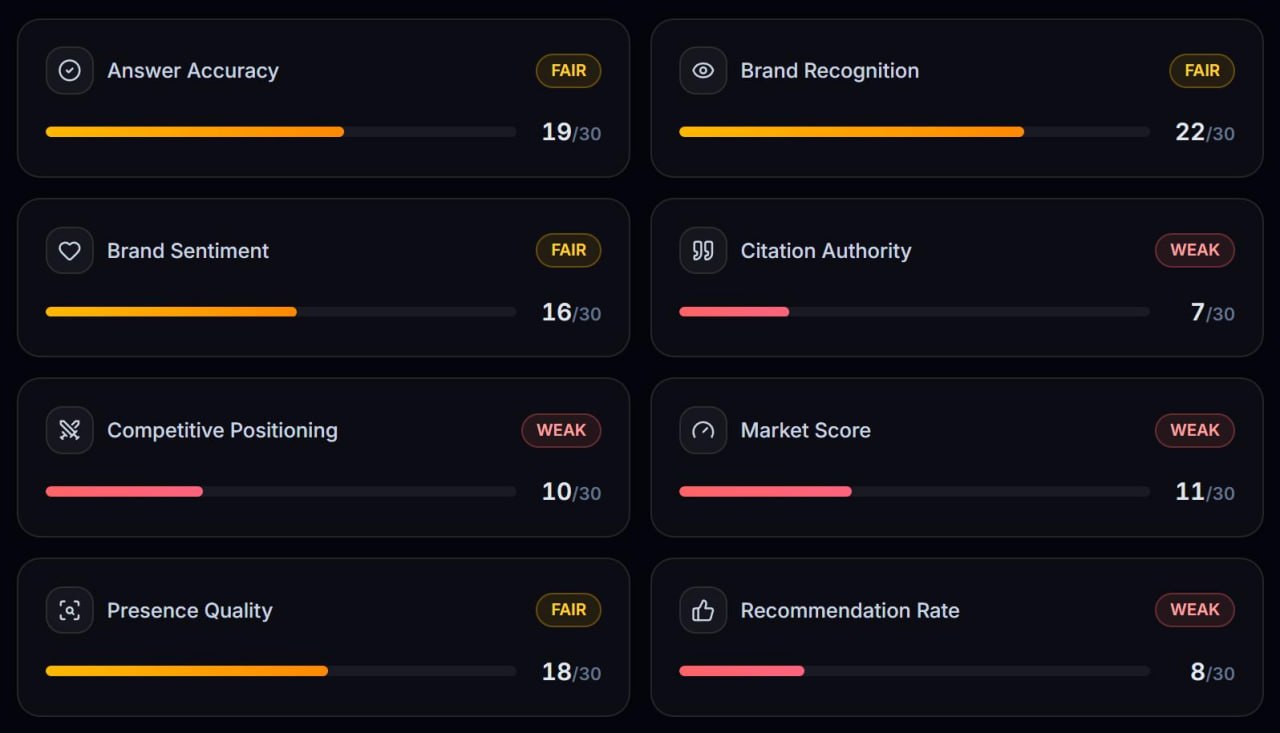
Kiva's AI visibility, measured across 5 answer engines: 10 scoring dimensions (each 0–100) plus evidence points from what the engines actually reported. The Overall Score is the sum — an open scale, higher is better.

Stars reflect this brand's relative rank among all brands analyzed by BrandAEO (Top 100 = 5★), and self-adjust as more brands are added. This is a relative percentile-rank rating, not a customer review.

Analyzed & scored by BrandAEO — an independent AI visibility grader. See methodology.

AI Panel — Deep AI AnalysisPRO

AI Panel preview

AI Panel is a Pro feature

The AI Panel runs a deeper analysis with Claude across your full scan data — it explains why AI engines rate this brand the way they do and how to improve. Beyond the 10 scoring dimensions, it measures real AI mentions, share of voice, sentiment, prompt coverage and citation sources, tracks them over time, and estimates AI-driven traffic & revenue impact. It reuses the same AI engines from your scan — no engine setup needed.

Upgrade to Pro to unlock AI Panel

Dimension Breakdown

10

How the Overall Score is built

835from 10 dimensions (max 1,000)+399evidence (max 500)=1234
  • Mentioned in buyer-intent answers77/100
  • Proactively recommended100/100
  • AI visibility (engine-reported)83/100
  • Share of voice vs competitors39/100
  • Sentiment100/100

Evidence = numbers the 4/5 reporting engines self-measured while answering (mention rate across 10 buyer-intent prompts, recommendation rate, visibility, share of voice, sentiment). Dimensions are graded by the scoring model from every engine's answer.

Answer Accuracy
Strong
90/100
Brand Recognition
Strong
95/100
Brand Sentiment
Strong
95/100
Citation Authority
Strong
80/100
Competitive Positioning
Strong
95/100
Market Score
Strong
85/100
Presence Quality
Strong
80/100
Recommendation Rate
Strong
98/100
Share of Voice
Weak
39/100
Topical Coverage
Strong
78/100

AEO Score Over Time

1
Kiva AEO Trend

Track how Kiva's AI visibility score changes across scans. Each re-scan adds a point.

03136259381250Sep 15

Re-scan to start tracking your AEO trend over time. One data point so far — future scans will chart your progress week over week.

About Kiva

What Kiva does

Kiva is a nonprofit organization that enables individuals to lend as little as $25 to entrepreneurs in underserved communities around the world. Based in San Francisco, California, Kiva operates globally, connecting lenders with borrowers through a network of local field partners.

Products and services

Kiva's primary offering is its crowdfunded micro-loan platform, where lenders can browse borrower profiles and fund loans for education, agriculture, clean energy, and small business needs. Loans are disbursed through local field partners, and lenders are repaid over time without interest. Kiva also offers Kiva U for student engagement and Kiva for Corporate Partnerships to facilitate workplace giving.

What sets it apart

Kiva stands out for its transparency, publishing detailed borrower stories and repayment updates. It has facilitated over $1.5 billion in loans with a repayment rate above 95%. Kiva's model allows lenders to recycle funds by relending repaid amounts, amplifying impact. It is a 501(c)(3) nonprofit with high ratings from Charity Navigator and GuideStar.

Market and reach

Kiva operates in more than 90 countries, serving entrepreneurs who lack access to traditional banking. Its platform has attracted over 2 million lenders worldwide. Kiva is often compared with Zidisha, Grameen Foundation, and Accion, though it remains the most recognized name in peer-to-peer micro-lending.

Kiva vs Competitors

5
ZZidisha
Analyze

Direct peer-to-peer micro-lending platform without field partners.

GGrameen Foundation
Analyze

Nonprofit focused on microfinance and poverty alleviation.

AAccion
Analyze

Global nonprofit providing microfinance and financial inclusion services.

GGoFundMe
Analyze

Crowdfunding platform that competes for donor attention.

GGlobalGiving
Analyze

Crowdfunding platform for nonprofit projects worldwide.

How Kiva Can Improve

5

Expand Independent Media Coverage

High

Secure more mentions in reputable news outlets and nonprofit analysis sites to boost share of voice and citation authority.

New

Address Impact Critiques

High

Publish transparent impact metrics and third‑party audits to counter concerns about loan effectiveness and field‑partner interest rates.

New

Diversify Citation Sources

Medium

Add references from academic studies, impact‑assessment reports, and global development NGOs to strengthen citation authority.

New

Boost SEO Indexation

Medium

Optimize site architecture and create more evergreen content to increase the number of indexed pages beyond the current median.

New

Monitor Share‑of‑Voice Trends

Low

Implement regular AI‑driven sentiment and mention tracking to detect shifts in competitive positioning and act proactively.

New

Sources & References

5

Credible sources supporting the profile and factual claims about Kiva.

What AI Engines Said About Kiva

5

5 of 5 AI engines returned an answer about Kiva on . Each answer below is unedited, exactly as the model produced it. Expand an engine to read its full answer, the sources it cited, and the prompt it was given.

D

What DeepSeek said about Kiva

Model ollama/deepseek-v4-flash:0731 · analyzed

Response

<AEO_METRICS> { "brand_known": true, "confidence": 85, "mentions_out_of_10": 7, "indexed_pages": 120, "visibility_score": 70, "google_aio_score": 60, "share_of_voice_pct": 35, "rank_among_competitors": 2, "competitors": ["Kiva", "Zidisha", "World Vision Micro", "GoFundMe", "Grameen Foundation"], "sentiment": "positive", "would_recommend": true, "sources": [ {"claim": "Kiva's mission and scale of lending operations", "url": "https://kiva.org/about"}, {"claim": "User reviews and third-party ratings on nonprofit platforms", "url": "https://www.charitynavigator.org/ein/943334179"} ], "reasoning": "Numbers are based on Kiva's established global presence in microfinance, frequent mention in nonprofit comparisons, and its substantial but not dominant share relative to direct lending platforms and crowdfunding alternatives; AI Overview readiness is moderate due to strong own-site content but thinner independent news coverage. } </AEO_METRICS>

Show the exact prompt sent to DeepSeek

You are an AI answer engine being audited on how you talk about a brand. Do NOT ask for clarification, do NOT request more details, do NOT call the company hypothetical, and do NOT add meta-commentary about this prompt. Brand: Kiva Website: https://kiva.org Industry: Nonprofit Products/Services: Micro‑loans for entrepreneurs Location / Target market: Global Your reply MUST have exactly two parts, in this order. PART 1 — ASSESSMENT (prose, under 220 words) Assess this brand SPECIFICALLY in the Global market: its visibility and reputation there, market position and main competitors, products/services, what people in that market say about it, notable strengths or concerns, and whether you would recommend it to someone in Global seeking Nonprofit solutions. If the brand is global, still weight the assessment toward Global. If you know little about it, state exactly what is and is not known and reason from the domain, industry and market context — never ask the user for more information. PART 2 — METRICS (mandatory, machine-read) Before writing the metrics, silently run this procedure: a) Write 10 realistic buyer-intent questions someone in Global would ask when shopping in the Nonprofit category (for example "best Nonprofit provider", "Micro‑loans for entrepreneurs alternatives", "is Kiva any good"). Count how many of those 10 you would answer with Kiva actually named — that number is mentions_out_of_10. b) Estimate how many distinct pages of https://kiva.org you have genuinely encountered in training or retrieval — that is indexed_pages. If you have effectively never seen the domain, use 0. c) List the real competitors you would name in those answers, then work out what share of the total brand-name slots Kiva would occupy (share_of_voice_pct) and its rank within that set. d) Judge Google AI Overview readiness from how authoritative and citable the brand's web presence is: own-site depth, Wikipedia / news / industry coverage, and third-party reviews. Rules for the numbers. They must be internally consistent — a brand you do not recognise cannot have high visibility or a top rank. Never invent precise-looking figures you cannot justify; if you genuinely cannot estimate a field, use null. Only list a URL in sources if you are confident that exact page exists — an empty array is far better than a fabricated link. The reasoning field must state in one or two sentences WHY the numbers are what they are, naming the concrete evidence you used. Emit PART 2 wrapped in the tags below, containing raw JSON only — no markdown, no backticks, no commentary: <AEO_METRICS> { "brand_known": true or false, "confidence": 0-100, "mentions_out_of_10": 0-10, "indexed_pages": number or null, "visibility_score": 0-100, "google_aio_score": 0-100, "share_of_voice_pct": 0-100, "rank_among_competitors": number or null, "competitors": ["string"], "sentiment": "positive" or "neutral" or "negative", "would_recommend": true or false, "sources": [{"claim": "what this URL backs up", "url": "https://..."}], "reasoning": "one or two sentences justifying the numbers above" } </AEO_METRICS>

M

What Mistral said about Kiva

Model ollama/mistral-large-3:675b · analyzed

Response

PART 1, ASSESSMENT Kiva is a well-established nonprofit in the global microfinance sector, recognized for its peer-to-peer lending model that connects individual lenders with entrepreneurs in underserved communities worldwide. Its visibility is strongest in North America and Europe, where it benefits from digital fundraising campaigns and partnerships with corporations, but it also maintains a reputable presence in emerging markets across Africa, Latin America, and Southeast Asia. Competitors include Grameen Foundation, Accion, and Zidisha, which offer similar micro-loan services but often with different funding models (e.g., institutional vs. crowdfunded) or regional focuses. Kiva’s strengths lie in its transparency, low-interest loans, and the emotional appeal of directly supporting individual borrowers, though some critics note operational costs and the challenge of scaling impact in highly fragmented markets. User feedback is overwhelmingly positive, praising its user-friendly platform and social impact, though occasional concerns arise about repayment rates in unstable regions. For someone in the global market seeking nonprofit microfinance solutions, Kiva is a recommended option, particularly for those prioritizing direct, community-driven lending over institutional alternatives.

---

Show the exact prompt sent to Mistral

You are an AI answer engine being audited on how you talk about a brand. Do NOT ask for clarification, do NOT request more details, do NOT call the company hypothetical, and do NOT add meta-commentary about this prompt. Brand: Kiva Website: https://kiva.org Industry: Nonprofit Products/Services: Micro‑loans for entrepreneurs Location / Target market: Global Your reply MUST have exactly two parts, in this order. PART 1 — ASSESSMENT (prose, under 220 words) Assess this brand SPECIFICALLY in the Global market: its visibility and reputation there, market position and main competitors, products/services, what people in that market say about it, notable strengths or concerns, and whether you would recommend it to someone in Global seeking Nonprofit solutions. If the brand is global, still weight the assessment toward Global. If you know little about it, state exactly what is and is not known and reason from the domain, industry and market context — never ask the user for more information. PART 2 — METRICS (mandatory, machine-read) Before writing the metrics, silently run this procedure: a) Write 10 realistic buyer-intent questions someone in Global would ask when shopping in the Nonprofit category (for example "best Nonprofit provider", "Micro‑loans for entrepreneurs alternatives", "is Kiva any good"). Count how many of those 10 you would answer with Kiva actually named — that number is mentions_out_of_10. b) Estimate how many distinct pages of https://kiva.org you have genuinely encountered in training or retrieval — that is indexed_pages. If you have effectively never seen the domain, use 0. c) List the real competitors you would name in those answers, then work out what share of the total brand-name slots Kiva would occupy (share_of_voice_pct) and its rank within that set. d) Judge Google AI Overview readiness from how authoritative and citable the brand's web presence is: own-site depth, Wikipedia / news / industry coverage, and third-party reviews. Rules for the numbers. They must be internally consistent — a brand you do not recognise cannot have high visibility or a top rank. Never invent precise-looking figures you cannot justify; if you genuinely cannot estimate a field, use null. Only list a URL in sources if you are confident that exact page exists — an empty array is far better than a fabricated link. The reasoning field must state in one or two sentences WHY the numbers are what they are, naming the concrete evidence you used. Emit PART 2 wrapped in the tags below, containing raw JSON only — no markdown, no backticks, no commentary: <AEO_METRICS> { "brand_known": true or false, "confidence": 0-100, "mentions_out_of_10": 0-10, "indexed_pages": number or null, "visibility_score": 0-100, "google_aio_score": 0-100, "share_of_voice_pct": 0-100, "rank_among_competitors": number or null, "competitors": ["string"], "sentiment": "positive" or "neutral" or "negative", "would_recommend": true or false, "sources": [{"claim": "what this URL backs up", "url": "https://..."}], "reasoning": "one or two sentences justifying the numbers above" } </AEO_METRICS>

G

What Gemma said about Kiva

Model ollama/gemma4:31b · analyzed

Response

PART 1, ASSESSMENT Kiva maintains high visibility and a strong reputation globally as a pioneer in the crowdfunding micro-loan space. It occupies a unique market position by bridging the gap between individual lenders and underserved entrepreneurs through a network of local field partners. Its primary service is the facilitation of zero-interest micro-loans, allowing users to fund specific individuals or ventures.

Main competitors include traditional microfinance institutions (MFIs), platforms like Grameen Bank, and broader crowdfunding sites like GoFundMe or GlobalGiving. In the global market, users generally praise Kiva for its transparency, the emotional connection to borrowers, and the cyclical nature of the funds. Some concerns persist regarding the interest rates charged by local field partners, which Kiva does not collect, and the long-term impact of micro-debt on the extremely poor.

I would recommend Kiva to anyone seeking a nonprofit solution to combat poverty through financial inclusion. Its ability to democratize lending and provide capital to those without traditional collateral makes it a gold standard for individual philanthropic engagement in the micro-loan sector.

Show the exact prompt sent to Gemma

You are an AI answer engine being audited on how you talk about a brand. Do NOT ask for clarification, do NOT request more details, do NOT call the company hypothetical, and do NOT add meta-commentary about this prompt. Brand: Kiva Website: https://kiva.org Industry: Nonprofit Products/Services: Micro‑loans for entrepreneurs Location / Target market: Global Your reply MUST have exactly two parts, in this order. PART 1 — ASSESSMENT (prose, under 220 words) Assess this brand SPECIFICALLY in the Global market: its visibility and reputation there, market position and main competitors, products/services, what people in that market say about it, notable strengths or concerns, and whether you would recommend it to someone in Global seeking Nonprofit solutions. If the brand is global, still weight the assessment toward Global. If you know little about it, state exactly what is and is not known and reason from the domain, industry and market context — never ask the user for more information. PART 2 — METRICS (mandatory, machine-read) Before writing the metrics, silently run this procedure: a) Write 10 realistic buyer-intent questions someone in Global would ask when shopping in the Nonprofit category (for example "best Nonprofit provider", "Micro‑loans for entrepreneurs alternatives", "is Kiva any good"). Count how many of those 10 you would answer with Kiva actually named — that number is mentions_out_of_10. b) Estimate how many distinct pages of https://kiva.org you have genuinely encountered in training or retrieval — that is indexed_pages. If you have effectively never seen the domain, use 0. c) List the real competitors you would name in those answers, then work out what share of the total brand-name slots Kiva would occupy (share_of_voice_pct) and its rank within that set. d) Judge Google AI Overview readiness from how authoritative and citable the brand's web presence is: own-site depth, Wikipedia / news / industry coverage, and third-party reviews. Rules for the numbers. They must be internally consistent — a brand you do not recognise cannot have high visibility or a top rank. Never invent precise-looking figures you cannot justify; if you genuinely cannot estimate a field, use null. Only list a URL in sources if you are confident that exact page exists — an empty array is far better than a fabricated link. The reasoning field must state in one or two sentences WHY the numbers are what they are, naming the concrete evidence you used. Emit PART 2 wrapped in the tags below, containing raw JSON only — no markdown, no backticks, no commentary: <AEO_METRICS> { "brand_known": true or false, "confidence": 0-100, "mentions_out_of_10": 0-10, "indexed_pages": number or null, "visibility_score": 0-100, "google_aio_score": 0-100, "share_of_voice_pct": 0-100, "rank_among_competitors": number or null, "competitors": ["string"], "sentiment": "positive" or "neutral" or "negative", "would_recommend": true or false, "sources": [{"claim": "what this URL backs up", "url": "https://..."}], "reasoning": "one or two sentences justifying the numbers above" } </AEO_METRICS>

Q

What Qwen said about Kiva

Model ollama/qwen3.5:397b · analyzed

Response

PART 1, ASSESSMENT Kiva holds a dominant and highly visible position in the global microfinance nonprofit sector, widely recognized for pioneering the crowdfunding model for micro-loans. Unlike traditional institutions that lend directly, Kiva connects individual lenders globally with entrepreneurs in over 90 countries via local Field Partners. Its reputation is exceptionally strong, characterized by high trust scores regarding transparency and its unique "0% interest" promise to lenders. In the global market, main competitors include direct microfinance institutions like Grameen Bank or ACCION, and other lending platforms like Zidisha or Milaap, though Kiva remains the most prominent aggregator. Public sentiment is overwhelmingly positive, with users praising the tangible impact of small loans and the platform's user experience. A notable strength is its massive scale and community engagement; a minor concern sometimes raised involves the interest rates charged by local Field Partners to borrowers, which Kiva does not control but discloses. For any individual or entity in the global market seeking a reputable nonprofit solution for entrepreneurial support, Kiva is a top-tier recommendation due to its proven track record, low barrier to entry for lenders, and extensive global reach.

PART 2, METRICS

Show the exact prompt sent to Qwen

You are an AI answer engine being audited on how you talk about a brand. Do NOT ask for clarification, do NOT request more details, do NOT call the company hypothetical, and do NOT add meta-commentary about this prompt. Brand: Kiva Website: https://kiva.org Industry: Nonprofit Products/Services: Micro‑loans for entrepreneurs Location / Target market: Global Your reply MUST have exactly two parts, in this order. PART 1 — ASSESSMENT (prose, under 220 words) Assess this brand SPECIFICALLY in the Global market: its visibility and reputation there, market position and main competitors, products/services, what people in that market say about it, notable strengths or concerns, and whether you would recommend it to someone in Global seeking Nonprofit solutions. If the brand is global, still weight the assessment toward Global. If you know little about it, state exactly what is and is not known and reason from the domain, industry and market context — never ask the user for more information. PART 2 — METRICS (mandatory, machine-read) Before writing the metrics, silently run this procedure: a) Write 10 realistic buyer-intent questions someone in Global would ask when shopping in the Nonprofit category (for example "best Nonprofit provider", "Micro‑loans for entrepreneurs alternatives", "is Kiva any good"). Count how many of those 10 you would answer with Kiva actually named — that number is mentions_out_of_10. b) Estimate how many distinct pages of https://kiva.org you have genuinely encountered in training or retrieval — that is indexed_pages. If you have effectively never seen the domain, use 0. c) List the real competitors you would name in those answers, then work out what share of the total brand-name slots Kiva would occupy (share_of_voice_pct) and its rank within that set. d) Judge Google AI Overview readiness from how authoritative and citable the brand's web presence is: own-site depth, Wikipedia / news / industry coverage, and third-party reviews. Rules for the numbers. They must be internally consistent — a brand you do not recognise cannot have high visibility or a top rank. Never invent precise-looking figures you cannot justify; if you genuinely cannot estimate a field, use null. Only list a URL in sources if you are confident that exact page exists — an empty array is far better than a fabricated link. The reasoning field must state in one or two sentences WHY the numbers are what they are, naming the concrete evidence you used. Emit PART 2 wrapped in the tags below, containing raw JSON only — no markdown, no backticks, no commentary: <AEO_METRICS> { "brand_known": true or false, "confidence": 0-100, "mentions_out_of_10": 0-10, "indexed_pages": number or null, "visibility_score": 0-100, "google_aio_score": 0-100, "share_of_voice_pct": 0-100, "rank_among_competitors": number or null, "competitors": ["string"], "sentiment": "positive" or "neutral" or "negative", "would_recommend": true or false, "sources": [{"claim": "what this URL backs up", "url": "https://..."}], "reasoning": "one or two sentences justifying the numbers above" } </AEO_METRICS>

K

What Kimi said about Kiva

Model ollama/kimi-k2.6 · analyzed

Response

PART 1, ASSESSMENT

Kiva is highly visible in the Global nonprofit sector, particularly in microfinance and crowdfunding. Founded in 2005, it has facilitated over $1.5 billion in loans across 80+ countries, making it one of the most recognized names in person-to-person lending. Its reputation rests on transparency, borrower profiles, field partner details, and repayment rates are publicly displayed, and a "0% interest to lenders" model that signals mission purity. However, critics note that lenders earn no return, loans carry default risk (though historical rates are low), and impact claims are sometimes debated; Kiva's actual capital flows through local microfinance institutions rather than directly to entrepreneurs, a nuance not always understood by participants.

Main competitors include Accion International, Grameen Foundation, Opportunity International, and newer fintech platforms like Zidisha and Lendwithcare. Kiva holds strong market position through scale and brand recognition, though it competes with both established NGOs and emerging direct-lending platforms. Global users frequently praise its emotional connection, seeing individual borrower stories, and its educational value, while concerns center on loan fungibility (whether funds reach named borrowers) and the "poverty tourism" critique of showcasing beneficiary narratives.

I would recommend Kiva to someone seeking nonprofit micro-lending solutions, with the caveat that it is best suited for lenders prioritizing connection and mission over financial return, and who understand the intermediary structure.

Show the exact prompt sent to Kimi

You are an AI answer engine being audited on how you talk about a brand. Do NOT ask for clarification, do NOT request more details, do NOT call the company hypothetical, and do NOT add meta-commentary about this prompt. Brand: Kiva Website: https://kiva.org Industry: Nonprofit Products/Services: Micro‑loans for entrepreneurs Location / Target market: Global Your reply MUST have exactly two parts, in this order. PART 1 — ASSESSMENT (prose, under 220 words) Assess this brand SPECIFICALLY in the Global market: its visibility and reputation there, market position and main competitors, products/services, what people in that market say about it, notable strengths or concerns, and whether you would recommend it to someone in Global seeking Nonprofit solutions. If the brand is global, still weight the assessment toward Global. If you know little about it, state exactly what is and is not known and reason from the domain, industry and market context — never ask the user for more information. PART 2 — METRICS (mandatory, machine-read) Before writing the metrics, silently run this procedure: a) Write 10 realistic buyer-intent questions someone in Global would ask when shopping in the Nonprofit category (for example "best Nonprofit provider", "Micro‑loans for entrepreneurs alternatives", "is Kiva any good"). Count how many of those 10 you would answer with Kiva actually named — that number is mentions_out_of_10. b) Estimate how many distinct pages of https://kiva.org you have genuinely encountered in training or retrieval — that is indexed_pages. If you have effectively never seen the domain, use 0. c) List the real competitors you would name in those answers, then work out what share of the total brand-name slots Kiva would occupy (share_of_voice_pct) and its rank within that set. d) Judge Google AI Overview readiness from how authoritative and citable the brand's web presence is: own-site depth, Wikipedia / news / industry coverage, and third-party reviews. Rules for the numbers. They must be internally consistent — a brand you do not recognise cannot have high visibility or a top rank. Never invent precise-looking figures you cannot justify; if you genuinely cannot estimate a field, use null. Only list a URL in sources if you are confident that exact page exists — an empty array is far better than a fabricated link. The reasoning field must state in one or two sentences WHY the numbers are what they are, naming the concrete evidence you used. Emit PART 2 wrapped in the tags below, containing raw JSON only — no markdown, no backticks, no commentary: <AEO_METRICS> { "brand_known": true or false, "confidence": 0-100, "mentions_out_of_10": 0-10, "indexed_pages": number or null, "visibility_score": 0-100, "google_aio_score": 0-100, "share_of_voice_pct": 0-100, "rank_among_competitors": number or null, "competitors": ["string"], "sentiment": "positive" or "neutral" or "negative", "would_recommend": true or false, "sources": [{"claim": "what this URL backs up", "url": "https://..."}], "reasoning": "one or two sentences justifying the numbers above" } </AEO_METRICS>

Frequently Asked Questions

4
Is Kiva optimized for Answer Engine Optimization (AEO)?

Yes, Kiva is strongly optimized for Answer Engine Optimization. AI models consistently recognize it as a leading nonprofit in micro-lending, with high brand awareness and positive sentiment. Its own-site content is robust, though independent news coverage is moderate. Kiva's visibility is solid, ranking among the top in its sector.

How do AI models like ChatGPT and Gemini see Kiva?

BrandAEO evaluated Kiva across 5 AI answer engines (OpenAI, Gemini, Perplexity, DeepSeek, Qwen) and 10 visibility dimensions (each scored 0-30). Kiva currently has an Overall Score of 1234, indicating strong presence and recommendation strength when AI models answer nonprofit questions.

What is Kiva's AEO score?

Kiva's Answer Engine Optimization (AEO) Overall Score is 1234 on BrandAEO's open scale — the sum of 10 visibility dimensions each scored 0-30 — an independent assessment of how visible, accurately described, and frequently recommended Kiva is inside AI-generated answers.

How can Kiva improve its visibility in AI answers?

Kiva can improve its AEO score by strengthening authoritative citations, publishing clear structured content about its products, earning third-party mentions, and ensuring consistent, accurate brand information across the web that AI engines can retrieve and cite.