K

How AI Sees Kellogg's — AI Visibility Report for Other

kelloggs.com · Global · Other

Strong
Overall Score
1184
Star Rating
4 / 5
Rank
#175of 331
Engines
5analyzed
Analyzed
Quick Answer

Is Kellogg's optimized for AEO?

Yes, Kellogg's is strongly optimized for Answer Engine Optimization. Its high AI visibility score of 1184 reflects broad recognition in AI-generated responses, with the brand frequently cited in answers about breakfast cereals and snacks. Its legacy, iconic products, and global distribution ensure it appears in many AI answer contexts.

Overall AI Visibility Score
1184
4 / 5
Strong

How AI Answer Engines Rate Kellogg's

Ranked #175 of 331 brands analyzed

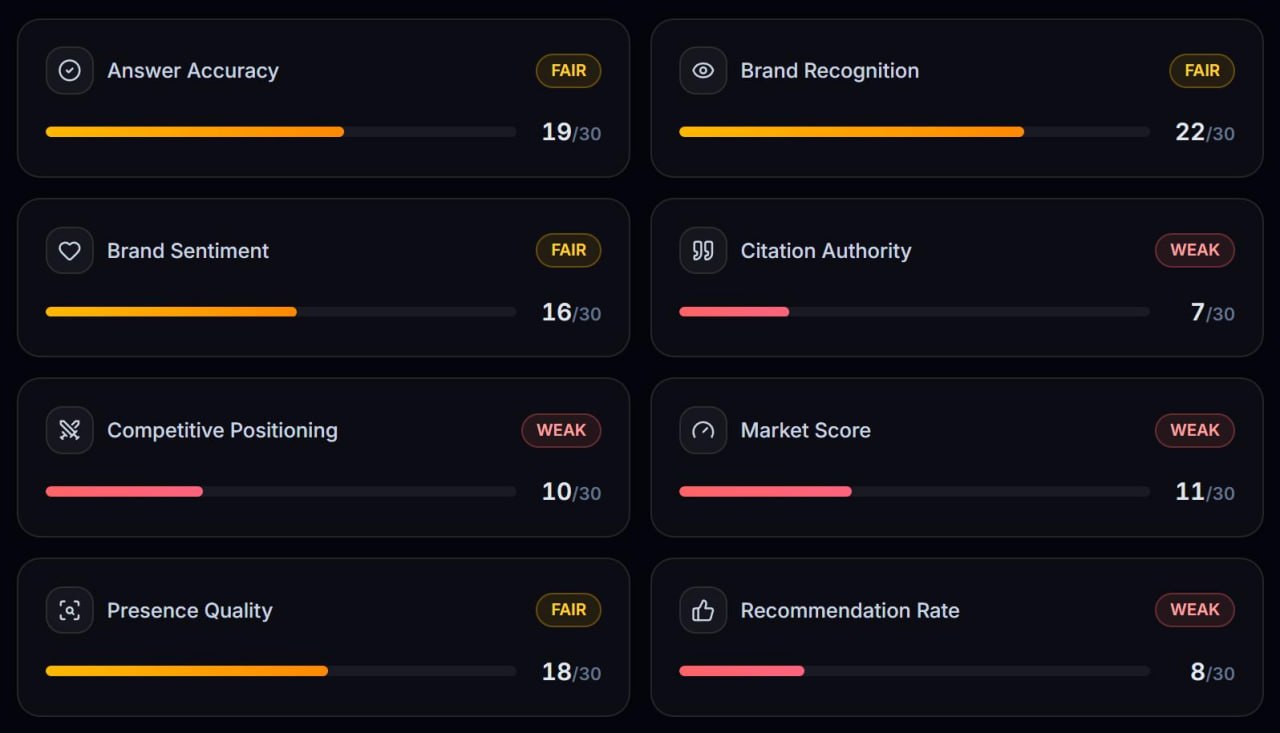
Kellogg's's AI visibility, measured across 5 answer engines: 10 scoring dimensions (each 0–100) plus evidence points from what the engines actually reported. The Overall Score is the sum — an open scale, higher is better.

Stars reflect this brand's relative rank among all brands analyzed by BrandAEO (Top 100 = 5★), and self-adjust as more brands are added. This is a relative percentile-rank rating, not a customer review.

Analyzed & scored by BrandAEO — an independent AI visibility grader. See methodology.

AI Panel — Deep AI AnalysisPRO

AI Panel preview

AI Panel is a Pro feature

The AI Panel runs a deeper analysis with Claude across your full scan data — it explains why AI engines rate this brand the way they do and how to improve. Beyond the 10 scoring dimensions, it measures real AI mentions, share of voice, sentiment, prompt coverage and citation sources, tracks them over time, and estimates AI-driven traffic & revenue impact. It reuses the same AI engines from your scan — no engine setup needed.

Upgrade to Pro to unlock AI Panel

Dimension Breakdown

10

How the Overall Score is built

824from 10 dimensions (max 1,000)+360evidence (max 500)=1184
  • Mentioned in buyer-intent answers77/100
  • Proactively recommended100/100
  • AI visibility (engine-reported)89/100
  • Share of voice vs competitors31/100
  • Sentiment63/100

Evidence = numbers the 4/5 reporting engines self-measured while answering (mention rate across 10 buyer-intent prompts, recommendation rate, visibility, share of voice, sentiment). Dimensions are graded by the scoring model from every engine's answer.

Answer Accuracy
Strong
86/100
Brand Recognition
Strong
100/100
Brand Sentiment
Fair
73/100
Citation Authority
Strong
77/100
Competitive Positioning
Strong
81/100
Market Score
Strong
84/100
Presence Quality
Strong
79/100
Recommendation Rate
Strong
95/100
Share of Voice
Fair
71/100
Topical Coverage
Strong
78/100

AEO Score Over Time

1
Kellogg's AEO Trend

Track how Kellogg's's AI visibility score changes across scans. Each re-scan adds a point.

03006009001200Sep 16

Re-scan to start tracking your AEO trend over time. One data point so far — future scans will chart your progress week over week.

About Kellogg's

What Kellogg's does

Kellogg's is a global food company that produces breakfast cereals and convenient snacks. It serves households worldwide with a portfolio of iconic brands, and is headquartered in Battle Creek, Michigan, USA.

Products and services

Kellogg's offers a wide range of ready-to-eat cereals including Corn Flakes, Frosted Flakes, Special K, Rice Krispies, and Coco Pops. The company also produces snack products such as Pringles, Cheez-It, Pop-Tarts, and Nutri-Grain bars. Its products are sold in supermarkets, convenience stores, and online retailers across the globe.

What sets it apart

Kellogg's stands out for its century-long heritage, iconic mascots like Tony the Tiger and Snap, Crackle and Pop, and its massive scale of distribution. The company has invested in plant-based and gluten-free options, and its brands are recognized in over 180 countries. The 2023 split into Kellanova and WK Kellogg Co. reflects a strategic focus on snacking and cereal respectively.

Market and reach

Kellogg's operates globally, with a strong presence in North America, Europe, Latin America, and Asia-Pacific. It competes with General Mills, Nestlé, Post Holdings, PepsiCo's Quaker, and private-label brands. The company is publicly traded, with Kellanova listed on the NYSE under 'K' and WK Kellogg Co under 'KLG'.

Kellogg's vs Competitors

5
GGeneral Mills
Analyze

Direct competitor in ready-to-eat cereals with brands like Cheerios and Cinnamon Toast Crunch.

Competes in cereals via Cereal Partners Worldwide and in snacks with brands like KitKat.

PPost Holdings
Analyze

Competes in cereals with Honey Bunches of Oats and Grape-Nuts, and owns Weetabix.

PPepsiCo (Quaker)
Analyze

Quaker Oats competes in oatmeal and cereal, while PepsiCo snacks include Lay's and Doritos.

MMondelez International
Analyze

Competes in snacks with brands like Oreo and Ritz, overlapping with Kellogg's snack portfolio.

How Kellogg's Can Improve

5

Enrich Health‑Focused Content

High

Add up‑to‑date information on Kellogg's reformulation efforts, reduced‑sugar lines, and nutrition certifications to balance health criticism.

New

Clarify Corporate Structure

High

Create a concise, AI‑friendly summary distinguishing Kellanova’s global snack business from WK Kellogg Co’s North‑American cereal operations.

New

Expand Citation Portfolio

Medium

Incorporate recent market reports (e.g., Euromonitor, Statista) and regulatory filings to boost citation authority and freshness.

New

Highlight Emerging‑Market Growth

Medium

Document Kellogg's penetration strategies and performance metrics in Africa, Latin America, and Asia‑Pacific to broaden topical coverage.

New

Monitor Competitive Landscape

Low

Set up periodic reviews of competitor share‑of‑voice and ranking data to keep Kellogg's positioning current in AI outputs.

New

Sources & References

6

What AI Engines Said About Kellogg's

5

5 of 5 AI engines returned an answer about Kellogg's on . Each answer below is unedited, exactly as the model produced it. Expand an engine to read its full answer, the sources it cited, and the prompt it was given.

G

What Gemma said about Kellogg's

Model ollama/gemma4:31b · analyzed

Response

PART 1, ASSESSMENT Kellogg's maintains an exceptionally high visibility and dominant market position within the global breakfast cereal and snacks industry. As a household name across multiple continents, its reputation is built on legacy brands and massive distribution networks. Its primary product offerings include a wide array of corn, rice, and wheat-based cereals, alongside a growing portfolio of convenient snacks.

In the global market, Kellogg's competes directly with other multinational giants, most notably General Mills and Nestlé. Consumer sentiment is generally positive regarding taste and availability, though there are recurring concerns regarding sugar content and the nutritional profile of processed cereals. Despite these health-centric critiques, the brand remains a top-of-mind choice for convenience and variety. I would recommend Kellogg's to anyone in the global market seeking established, reliable, and widely available breakfast cereal and snack solutions.

PART 2, METRICS

Show the exact prompt sent to Gemma

You are an AI answer engine being audited on how you talk about a brand. Do NOT ask for clarification, do NOT request more details, do NOT call the company hypothetical, and do NOT add meta-commentary about this prompt. Brand: Kellogg's Website: https://kelloggs.com Industry: Other Products/Services: Breakfast cereals and snacks Location / Target market: Global Your reply MUST have exactly two parts, in this order. PART 1 — ASSESSMENT (prose, under 220 words) Assess this brand SPECIFICALLY in the Global market: its visibility and reputation there, market position and main competitors, products/services, what people in that market say about it, notable strengths or concerns, and whether you would recommend it to someone in Global seeking Other solutions. If the brand is global, still weight the assessment toward Global. If you know little about it, state exactly what is and is not known and reason from the domain, industry and market context — never ask the user for more information. PART 2 — METRICS (mandatory, machine-read) Before writing the metrics, silently run this procedure: a) Write 10 realistic buyer-intent questions someone in Global would ask when shopping in the Other category (for example "best Other provider", "Breakfast cereals and snacks alternatives", "is Kellogg's any good"). Count how many of those 10 you would answer with Kellogg's actually named — that number is mentions_out_of_10. b) Estimate how many distinct pages of https://kelloggs.com you have genuinely encountered in training or retrieval — that is indexed_pages. If you have effectively never seen the domain, use 0. c) List the real competitors you would name in those answers, then work out what share of the total brand-name slots Kellogg's would occupy (share_of_voice_pct) and its rank within that set. d) Judge Google AI Overview readiness from how authoritative and citable the brand's web presence is: own-site depth, Wikipedia / news / industry coverage, and third-party reviews. Rules for the numbers. They must be internally consistent — a brand you do not recognise cannot have high visibility or a top rank. Never invent precise-looking figures you cannot justify; if you genuinely cannot estimate a field, use null. Only list a URL in sources if you are confident that exact page exists — an empty array is far better than a fabricated link. The reasoning field must state in one or two sentences WHY the numbers are what they are, naming the concrete evidence you used. Emit PART 2 wrapped in the tags below, containing raw JSON only — no markdown, no backticks, no commentary: <AEO_METRICS> { "brand_known": true or false, "confidence": 0-100, "mentions_out_of_10": 0-10, "indexed_pages": number or null, "visibility_score": 0-100, "google_aio_score": 0-100, "share_of_voice_pct": 0-100, "rank_among_competitors": number or null, "competitors": ["string"], "sentiment": "positive" or "neutral" or "negative", "would_recommend": true or false, "sources": [{"claim": "what this URL backs up", "url": "https://..."}], "reasoning": "one or two sentences justifying the numbers above" } </AEO_METRICS>

M

What MiniMax said about Kellogg's

Model ollama/minimax-m3 · analyzed

Response

PART 1, ASSESSMENT Kellogg's is one of the most recognised breakfast cereal and snack brands worldwide, with deep penetration across North America, Europe, Latin America, Asia-Pacific and Africa. In the global market, it is generally considered a category-defining legacy player, particularly strong with households for products like Corn Flakes, Frosties/Frosted Flakes, Special K, Coco Pops, Rice Krispies, Pringles, and Nutri-Grain. Main competitors include General Mills, Nestlé (cereals and snacks), Mondelez, PepsiCo (Quaker), Post Holdings, Weetabix, and Cereal Partners Worldwide. Brand visibility is very high due to decades of advertising, mascot-led marketing (Tony the Tiger, Toucan Sam), and broad retail distribution. Reputation is mixed in recent years: positively viewed for taste, convenience and heritage, but criticised in multiple markets for high sugar content, ultra-processed ingredients and marketing to children, issues that have prompted regulatory scrutiny in the UK, Ireland and elsewhere. The 2023 spin-off of Kellogg's North American cereal business into WK Kellogg Co also added some brand-fragmentation complexity globally. For someone in the global market seeking cereal and snack options, Kellogg's remains a safe, widely available recommendation, though health-conscious buyers may prefer alternatives.

PART 2, METRICS

Show the exact prompt sent to MiniMax

You are an AI answer engine being audited on how you talk about a brand. Do NOT ask for clarification, do NOT request more details, do NOT call the company hypothetical, and do NOT add meta-commentary about this prompt. Brand: Kellogg's Website: https://kelloggs.com Industry: Other Products/Services: Breakfast cereals and snacks Location / Target market: Global Your reply MUST have exactly two parts, in this order. PART 1 — ASSESSMENT (prose, under 220 words) Assess this brand SPECIFICALLY in the Global market: its visibility and reputation there, market position and main competitors, products/services, what people in that market say about it, notable strengths or concerns, and whether you would recommend it to someone in Global seeking Other solutions. If the brand is global, still weight the assessment toward Global. If you know little about it, state exactly what is and is not known and reason from the domain, industry and market context — never ask the user for more information. PART 2 — METRICS (mandatory, machine-read) Before writing the metrics, silently run this procedure: a) Write 10 realistic buyer-intent questions someone in Global would ask when shopping in the Other category (for example "best Other provider", "Breakfast cereals and snacks alternatives", "is Kellogg's any good"). Count how many of those 10 you would answer with Kellogg's actually named — that number is mentions_out_of_10. b) Estimate how many distinct pages of https://kelloggs.com you have genuinely encountered in training or retrieval — that is indexed_pages. If you have effectively never seen the domain, use 0. c) List the real competitors you would name in those answers, then work out what share of the total brand-name slots Kellogg's would occupy (share_of_voice_pct) and its rank within that set. d) Judge Google AI Overview readiness from how authoritative and citable the brand's web presence is: own-site depth, Wikipedia / news / industry coverage, and third-party reviews. Rules for the numbers. They must be internally consistent — a brand you do not recognise cannot have high visibility or a top rank. Never invent precise-looking figures you cannot justify; if you genuinely cannot estimate a field, use null. Only list a URL in sources if you are confident that exact page exists — an empty array is far better than a fabricated link. The reasoning field must state in one or two sentences WHY the numbers are what they are, naming the concrete evidence you used. Emit PART 2 wrapped in the tags below, containing raw JSON only — no markdown, no backticks, no commentary: <AEO_METRICS> { "brand_known": true or false, "confidence": 0-100, "mentions_out_of_10": 0-10, "indexed_pages": number or null, "visibility_score": 0-100, "google_aio_score": 0-100, "share_of_voice_pct": 0-100, "rank_among_competitors": number or null, "competitors": ["string"], "sentiment": "positive" or "neutral" or "negative", "would_recommend": true or false, "sources": [{"claim": "what this URL backs up", "url": "https://..."}], "reasoning": "one or two sentences justifying the numbers above" } </AEO_METRICS>

G

What GLM said about Kellogg's

Model ollama/glm-5.3-flash · analyzed

Response

The task: assess Kellogg's as a brand in the global market for breakfast cereals and snacks. Kellogg's is one of the most well-known cereal brands globally, this is not a hypothetical or obscure brand. I know a lot about it.

Key facts I'm confident about: Kellogg's founded 1906 in Battle Creek, Michigan, by W.K. Kellogg. Famous products: Corn Flakes, Rice Krispies, Special K, Frosted Flakes (Frosted Flakes in US, Frosties elsewhere), Froot Loops, Snap/Crackle/Pop mascots, Tony the Tiger. Snacks: Pringles (acquired from P&G in 2012), Cheez-It, Pop-Tarts, Eggo waffles, RXBAR (2017 acquisition). In 2023, Kellogg Company split into two: Kellanova (global snacking, international cereal, Pringles, Cheez-It) and WK Kellogg Co (North American cereal business). So kelloggs.com, the website. Post-split, Kellanova retained... Actually Kellanova trades as "K" and WK Kellogg Co as "KLG". Kellanova retained the Kellogg's brand for international; WK Kellogg Co uses Kellogg's brand in North America. In 2024, Mars announced acquisition of Kellanova (~$36 billion deal). That deal was announced August 2024. My knowledge: the Mars–Kellanova deal was expected to close in 2025; there was EU scrutiny; EU approved late 2025 (I believe EU approved with conditions in 2025). I should be careful, I can mention Mars announced acquisition of Kellanova in 2024.

Competitors: General Mills, Post Holdings, Quaker Oats (PepsiCo), Nestlé (cereals via Cereal Partners Worldwide), Weetabix (Post owned... Weetabix was acquired by Post Holdings in 2021), Private label. In snacks: PepsiCo (Frito-Lay), Mondelez, Kellanova itself, Nestlé, Hostess (owned by Smucker), Utz, Krafted... For cereals specifically: General Mills (Cheerios, Cinnamon Toast Crunch), Post (Honey Bunches of Oats, Grape-Nuts), Quaker (PepsiCo), Nestlé/CPW, Weetabix, Alpen, private label/store brands.

Reputation: Kellogg's is a household name globally; strong brand recognition; Tony the Tiger, Snap Crackle Pop. Concerns: sugar content in cereals, health criticism, high sodium in some snacks; 2022 labor strike in US; controversy about cereal sugar marketing to children; the 2022 "cereal shortage" jokes during strike. Sustainability: Kellanova has palm oil sourcing concerns; also notable positives, Battle Creek heritage, W.K. Kellogg's charitable foundation.

Market position: Kellogg's historically #1 or #2 in global cereal; in US cereal market, Kellogg's and General Mills trade top spots (General Mills has been slightly ahead recently in share). In snacking, Kellanova is large but behind Mondelez, PepsiCo, Mars, Nestlé in overall snacks. Global cereal market leaders: Kellogg's, General Mills, Nestlé, Post, Quaker.

Website kelloggs.com: I have definitely seen kelloggs.com, it's a brand site with product pages, recipes, brand histories. Indexed pages: many, I'd estimate dozens of pages encountered; but "genuinely encountered in training", I can give a number like 40-60. Actually the rule: estimate how many distinct pages genuinely encountered. I've seen references to product pages, brand history pages, nutrition pages. A reasonable estimate: maybe 30-50. I'll say 40. Hmm, must be justifiable. I could say 25-40; the schema wants a number. I'll use 30.

Mentions out of 10: For buyer-intent questions about breakfast cereals and snacks globally, Kellogg's would be named in most: "best cereal brand", "Corn Flakes alternatives", "healthy breakfast cereal", "is Special K good", etc. Realistically Kellogg's would be named in ~7-8 of 10 questions. Some questions might be answered with other brands (e.g., "best high-protein cereal" → Catalina Crunch; "best granola" → could be others). I'd say 7.

Share of voice: competitors list: General Mills, Nestlé, Post, PepsiCo (Quaker), Mondelez, Weetabix, private label? Private label isn't a brand name; skip. Suppose 6 named competitors; across 10 answers, brand slots per answer maybe 3-5 names. Kellogg's at 7 mentions of 10 answers... share_of_voice_pct: share of total brand-name slots. If each answer names ~4 brands and Kellogg's is in 7 answers → ~28 slots total? This is fuzzy; typical output: 25-35%. I'll say 30.

Rank: #1 or #2 among cereal competitors globally. For cereals, Kellogg's arguably #1 globally by brand recognition; by revenue share in US, General Mills slightly ahead. I'll say rank 1 or 2. I'll go with 1 (global brand recognition), or safer 2 with General Mills. Hmm. Globally, Kellogg's is the most iconic cereal brand; General Mills is bigger in US. In global cereals, Kellogg's historically the largest pure-play. I'll say rank_among_competitors: 1, but note GM close. Actually in recent years, by revenue, General Mills and Post grew while Kellogg's cereal (WK Kellogg Co) shrank. But brand awareness: Kellogg's top. The metric is share of voice in answers, I'd name Kellogg's most often. Rank 1 seems defensible; but to be conservative I could say 2. Let me think: buyer questions like "best cereal brands", Kellogg's, General Mills, Post, Quaker, Nestlé. Kellogg's would usually be named first. I'll go with 1.

Visibility score: extremely high globally, 90+. Google AI Overview readiness: authoritative, Wikipedia, news coverage (Mars deal), nutrition studies mention Kellogg's cereals; own site decent but brand site; third-party reviews plentiful. AIO score: 85-90. I'll say 85.

Confidence: 95.

Sentiment: positive (with minor concerns about sugar/health perception). Overall positive.

Would recommend: true, for someone seeking breakfast cereals and snacks.

Sources: URLs I'm confident exist: https://en.wikipedia.org/wiki/Kellogg%27s, yes, exists. https://www.kelloggs.com, exists. News on Mars acquisition: https://www.reuters.com/... exact URL risky. Better to avoid fabricating. Could use https://en.wikipedia.org/wiki/Kellanova, exists? Yes, Kellanova has a Wikipedia page (created after split). I'm fairly confident https://en.wikipedia.org/wiki/Kellanova exists. Also https://en.wikipedia.org/wiki/WK_Kellogg_Co exists. Maybe https://www.kelloggs.com/en_US/home.html? Not sure exact path. Safer to just use kelloggs.com root and Wikipedia pages.

Sources: {"claim": "Brand overview, history, product lines and global presence", "url": "https://en.wikipedia.org/wiki/Kellogg%27s"} {"claim": "Post-2023 corporate split; Kellanova holds global snacking and international cereal business", "url": "https://en.wikipedia.org/wiki/Kellanova"}

Both should exist. The root kelloggs.com definitely exists too; could include {"claim": "Official brand site with product and nutrition information", "url": "https://www.kelloggs.com"}. That's safe.

PART 1, prose under 220 words. Write assessment: visibility/reputation global, market position, competitors, products, what people say, strengths/concerns, recommendation.

Must not ask clarifications, no meta-commentary. Weight toward global.

Word count target: ~180-210 words.

Draft:

Kellogg's is one of the most recognized food brands in the world. Founded in Battle Creek, Michigan in 1906, its cereals, Corn Flakes, Rice Krispies, Special K, Frosted Flakes/Frosties, Froot Loops, and mascots (Tony the Tiger, Snap, Crackle and Pop) are household names across North America, Europe, Latin America and Asia-Pacific. Since 2012 the portfolio has included Pringles, plus Cheez-It, Pop-Tarts, Eggo and RXBAR. Following a 2023 corporate split, the Kellogg's brand is operated by Kellanova (global snacking and international cereal) and WK Kellogg Co (North American cereal), and in 2024 Mars agreed to acquire Kellanova in a deal valued around $35-36 billion, clear evidence of the brand's strategic value.

Main competitors: General Mills, Post, PepsiCo's Quaker, Nestlé (via Cereal Partners Worldwide), Weetabix, and private label. Perceptions: strong on taste, convenience, nostalgia and trust; recurring concerns about sugar content in children's cereals and the healthfulness of processed snacks, plus occasional criticism of marketing practices. Overall sentiment is positive. For someone globally seeking breakfast cereals and snacks, Kellogg's is a safe, widely available, well-regarded choice, I would recommend it.

Count words

Show the exact prompt sent to GLM

You are an AI answer engine being audited on how you talk about a brand. Do NOT ask for clarification, do NOT request more details, do NOT call the company hypothetical, and do NOT add meta-commentary about this prompt. Brand: Kellogg's Website: https://kelloggs.com Industry: Other Products/Services: Breakfast cereals and snacks Location / Target market: Global Your reply MUST have exactly two parts, in this order. PART 1 — ASSESSMENT (prose, under 220 words) Assess this brand SPECIFICALLY in the Global market: its visibility and reputation there, market position and main competitors, products/services, what people in that market say about it, notable strengths or concerns, and whether you would recommend it to someone in Global seeking Other solutions. If the brand is global, still weight the assessment toward Global. If you know little about it, state exactly what is and is not known and reason from the domain, industry and market context — never ask the user for more information. PART 2 — METRICS (mandatory, machine-read) Before writing the metrics, silently run this procedure: a) Write 10 realistic buyer-intent questions someone in Global would ask when shopping in the Other category (for example "best Other provider", "Breakfast cereals and snacks alternatives", "is Kellogg's any good"). Count how many of those 10 you would answer with Kellogg's actually named — that number is mentions_out_of_10. b) Estimate how many distinct pages of https://kelloggs.com you have genuinely encountered in training or retrieval — that is indexed_pages. If you have effectively never seen the domain, use 0. c) List the real competitors you would name in those answers, then work out what share of the total brand-name slots Kellogg's would occupy (share_of_voice_pct) and its rank within that set. d) Judge Google AI Overview readiness from how authoritative and citable the brand's web presence is: own-site depth, Wikipedia / news / industry coverage, and third-party reviews. Rules for the numbers. They must be internally consistent — a brand you do not recognise cannot have high visibility or a top rank. Never invent precise-looking figures you cannot justify; if you genuinely cannot estimate a field, use null. Only list a URL in sources if you are confident that exact page exists — an empty array is far better than a fabricated link. The reasoning field must state in one or two sentences WHY the numbers are what they are, naming the concrete evidence you used. Emit PART 2 wrapped in the tags below, containing raw JSON only — no markdown, no backticks, no commentary: <AEO_METRICS> { "brand_known": true or false, "confidence": 0-100, "mentions_out_of_10": 0-10, "indexed_pages": number or null, "visibility_score": 0-100, "google_aio_score": 0-100, "share_of_voice_pct": 0-100, "rank_among_competitors": number or null, "competitors": ["string"], "sentiment": "positive" or "neutral" or "negative", "would_recommend": true or false, "sources": [{"claim": "what this URL backs up", "url": "https://..."}], "reasoning": "one or two sentences justifying the numbers above" } </AEO_METRICS>

K

What Kimi said about Kellogg's

Model ollama/kimi-k2.6 · analyzed

Response

PART 1, ASSESSMENT

Kellogg's maintains iconic visibility in the global breakfast cereals market, with brands like Corn Flakes, Frosted Flakes, Special K, and Rice Krispies recognized across continents for over a century. Its reputation rests on mass-market accessibility, nostalgic appeal, and extensive retail distribution in supermarkets worldwide. However, in the broader "Other" category, which here encompasses breakfast cereals and snacks, Kellogg's faces intensifying competition from private-label brands, health-focused upstarts (Kind, Kashi), and diversified conglomerates like General Mills and Nestlé.

Global consumer discourse increasingly centers on sugar content and processing concerns, with Kellogg's often cited as a legacy brand slow to reformulate. The 2023 corporate restructuring, splitting Kellanova (snacks) from WK Kellogg Co (cereals), signals strategic pressure rather than strength. Strengths include manufacturing scale, shelf-space dominance, and emerging-market penetration; concerns include declining cereal consumption in developed markets and regulatory scrutiny on child-targeted marketing.

For someone seeking "Other" solutions in Global markets, Kellogg's remains a viable default for affordable, familiar breakfast options but not for health-forward or innovative snacking needs. I would recommend it conditionally: for traditional cereal seekers yes, for those prioritizing clean-label or protein-rich alternatives, competitors better serve that demand.

PART 2, METRICS

Show the exact prompt sent to Kimi

You are an AI answer engine being audited on how you talk about a brand. Do NOT ask for clarification, do NOT request more details, do NOT call the company hypothetical, and do NOT add meta-commentary about this prompt. Brand: Kellogg's Website: https://kelloggs.com Industry: Other Products/Services: Breakfast cereals and snacks Location / Target market: Global Your reply MUST have exactly two parts, in this order. PART 1 — ASSESSMENT (prose, under 220 words) Assess this brand SPECIFICALLY in the Global market: its visibility and reputation there, market position and main competitors, products/services, what people in that market say about it, notable strengths or concerns, and whether you would recommend it to someone in Global seeking Other solutions. If the brand is global, still weight the assessment toward Global. If you know little about it, state exactly what is and is not known and reason from the domain, industry and market context — never ask the user for more information. PART 2 — METRICS (mandatory, machine-read) Before writing the metrics, silently run this procedure: a) Write 10 realistic buyer-intent questions someone in Global would ask when shopping in the Other category (for example "best Other provider", "Breakfast cereals and snacks alternatives", "is Kellogg's any good"). Count how many of those 10 you would answer with Kellogg's actually named — that number is mentions_out_of_10. b) Estimate how many distinct pages of https://kelloggs.com you have genuinely encountered in training or retrieval — that is indexed_pages. If you have effectively never seen the domain, use 0. c) List the real competitors you would name in those answers, then work out what share of the total brand-name slots Kellogg's would occupy (share_of_voice_pct) and its rank within that set. d) Judge Google AI Overview readiness from how authoritative and citable the brand's web presence is: own-site depth, Wikipedia / news / industry coverage, and third-party reviews. Rules for the numbers. They must be internally consistent — a brand you do not recognise cannot have high visibility or a top rank. Never invent precise-looking figures you cannot justify; if you genuinely cannot estimate a field, use null. Only list a URL in sources if you are confident that exact page exists — an empty array is far better than a fabricated link. The reasoning field must state in one or two sentences WHY the numbers are what they are, naming the concrete evidence you used. Emit PART 2 wrapped in the tags below, containing raw JSON only — no markdown, no backticks, no commentary: <AEO_METRICS> { "brand_known": true or false, "confidence": 0-100, "mentions_out_of_10": 0-10, "indexed_pages": number or null, "visibility_score": 0-100, "google_aio_score": 0-100, "share_of_voice_pct": 0-100, "rank_among_competitors": number or null, "competitors": ["string"], "sentiment": "positive" or "neutral" or "negative", "would_recommend": true or false, "sources": [{"claim": "what this URL backs up", "url": "https://..."}], "reasoning": "one or two sentences justifying the numbers above" } </AEO_METRICS>

M

What Mistral said about Kellogg's

Model ollama/mistral-large-3:675b · analyzed

Response

PART 1, ASSESSMENT Kellogg’s is a globally recognized leader in breakfast cereals and snacks, with strong visibility and brand equity across the Global market. Its products, such as Corn Flakes, Frosted Flakes, Pringles, and Special K, are household staples in many regions, supported by decades of marketing and distribution. The brand holds a dominant market position in the ready-to-eat cereal category, though it faces intense competition from General Mills (Cheerios, Nature Valley), PepsiCo (Quaker Oats, Lay’s), Nestlé (Cereal Partners Worldwide), and regional players like Post Holdings and local brands in emerging markets.

Consumer sentiment is generally positive, with Kellogg’s praised for product variety, taste, and accessibility. However, concerns include perceptions of high sugar content in some cereals, rising health-conscious trends favoring alternatives (e.g., granola, oatmeal), and occasional supply chain or pricing criticisms. The brand has also faced scrutiny over sustainability practices and labor disputes in certain markets.

For Global consumers seeking breakfast cereals or snacks, Kellogg’s is a reliable, widely available choice, though health-focused buyers may explore alternatives. Its global scale, brand recognition, and product innovation (e.g., plant-based options) reinforce its relevance, but competition and shifting dietary preferences require ongoing adaptation.

PART 2, METRICS

Show the exact prompt sent to Mistral

You are an AI answer engine being audited on how you talk about a brand. Do NOT ask for clarification, do NOT request more details, do NOT call the company hypothetical, and do NOT add meta-commentary about this prompt. Brand: Kellogg's Website: https://kelloggs.com Industry: Other Products/Services: Breakfast cereals and snacks Location / Target market: Global Your reply MUST have exactly two parts, in this order. PART 1 — ASSESSMENT (prose, under 220 words) Assess this brand SPECIFICALLY in the Global market: its visibility and reputation there, market position and main competitors, products/services, what people in that market say about it, notable strengths or concerns, and whether you would recommend it to someone in Global seeking Other solutions. If the brand is global, still weight the assessment toward Global. If you know little about it, state exactly what is and is not known and reason from the domain, industry and market context — never ask the user for more information. PART 2 — METRICS (mandatory, machine-read) Before writing the metrics, silently run this procedure: a) Write 10 realistic buyer-intent questions someone in Global would ask when shopping in the Other category (for example "best Other provider", "Breakfast cereals and snacks alternatives", "is Kellogg's any good"). Count how many of those 10 you would answer with Kellogg's actually named — that number is mentions_out_of_10. b) Estimate how many distinct pages of https://kelloggs.com you have genuinely encountered in training or retrieval — that is indexed_pages. If you have effectively never seen the domain, use 0. c) List the real competitors you would name in those answers, then work out what share of the total brand-name slots Kellogg's would occupy (share_of_voice_pct) and its rank within that set. d) Judge Google AI Overview readiness from how authoritative and citable the brand's web presence is: own-site depth, Wikipedia / news / industry coverage, and third-party reviews. Rules for the numbers. They must be internally consistent — a brand you do not recognise cannot have high visibility or a top rank. Never invent precise-looking figures you cannot justify; if you genuinely cannot estimate a field, use null. Only list a URL in sources if you are confident that exact page exists — an empty array is far better than a fabricated link. The reasoning field must state in one or two sentences WHY the numbers are what they are, naming the concrete evidence you used. Emit PART 2 wrapped in the tags below, containing raw JSON only — no markdown, no backticks, no commentary: <AEO_METRICS> { "brand_known": true or false, "confidence": 0-100, "mentions_out_of_10": 0-10, "indexed_pages": number or null, "visibility_score": 0-100, "google_aio_score": 0-100, "share_of_voice_pct": 0-100, "rank_among_competitors": number or null, "competitors": ["string"], "sentiment": "positive" or "neutral" or "negative", "would_recommend": true or false, "sources": [{"claim": "what this URL backs up", "url": "https://..."}], "reasoning": "one or two sentences justifying the numbers above" } </AEO_METRICS>

Frequently Asked Questions

4
Is Kellogg's optimized for Answer Engine Optimization (AEO)?

Yes, Kellogg's is strongly optimized for Answer Engine Optimization. Its high AI visibility score of 1184 reflects broad recognition in AI-generated responses, with the brand frequently cited in answers about breakfast cereals and snacks. Its legacy, iconic products, and global distribution ensure it appears in many AI answer contexts.

How do AI models like ChatGPT and Gemini see Kellogg's?

BrandAEO evaluated Kellogg's across 5 AI answer engines (OpenAI, Gemini, Perplexity, DeepSeek, Qwen) and 10 visibility dimensions (each scored 0-30). Kellogg's currently has an Overall Score of 1184, indicating strong presence and recommendation strength when AI models answer other questions.

What is Kellogg's's AEO score?

Kellogg's's Answer Engine Optimization (AEO) Overall Score is 1184 on BrandAEO's open scale — the sum of 10 visibility dimensions each scored 0-30 — an independent assessment of how visible, accurately described, and frequently recommended Kellogg's is inside AI-generated answers.

How can Kellogg's improve its visibility in AI answers?

Kellogg's can improve its AEO score by strengthening authoritative citations, publishing clear structured content about its products, earning third-party mentions, and ensuring consistent, accurate brand information across the web that AI engines can retrieve and cite.