K

How AI Sees Kayak — AI Visibility Report for Travel / Hospitality

kayak.com · Global · Travel / Hospitality

Strong
Overall Score
1225
Star Rating
4 / 5
Rank
#124of 312
Engines
5analyzed
Analyzed
Quick Answer

Is Kayak optimized for AEO?

Yes, Kayak is strongly optimized for Answer Engine Optimization. AI engines consistently recognize it as a leading travel metasearch brand, frequently citing it in responses about flight and hotel comparison. Its high visibility score of 1225 reflects robust AI answer engine presence, though it faces competition from Google Flights and Skyscanner in AI-generated recommendations.

Overall AI Visibility Score
1225
4 / 5
Strong

How AI Answer Engines Rate Kayak

Ranked #124 of 312 brands analyzed

Kayak's AI visibility, measured across 5 answer engines: 10 scoring dimensions (each 0–100) plus evidence points from what the engines actually reported. The Overall Score is the sum — an open scale, higher is better.

Stars reflect this brand's relative rank among all brands analyzed by BrandAEO (Top 100 = 5★), and self-adjust as more brands are added. This is a relative percentile-rank rating, not a customer review.

Analyzed & scored by BrandAEO — an independent AI visibility grader. See methodology.

AI Panel — Deep AI AnalysisPRO

AI Panel preview

AI Panel is a Pro feature

The AI Panel runs a deeper analysis with Claude across your full scan data — it explains why AI engines rate this brand the way they do and how to improve. Beyond the 10 scoring dimensions, it measures real AI mentions, share of voice, sentiment, prompt coverage and citation sources, tracks them over time, and estimates AI-driven traffic & revenue impact. It reuses the same AI engines from your scan — no engine setup needed.

Upgrade to Pro to unlock AI Panel

Dimension Breakdown

10

How the Overall Score is built

839from 10 dimensions (max 1,000)+386evidence (max 500)=1225
  • Mentioned in buyer-intent answers76/100
  • Proactively recommended100/100
  • AI visibility (engine-reported)86/100
  • Share of voice vs competitors24/100
  • Sentiment100/100

Evidence = numbers the 5/5 reporting engines self-measured while answering (mention rate across 10 buyer-intent prompts, recommendation rate, visibility, share of voice, sentiment). Dimensions are graded by the scoring model from every engine's answer.

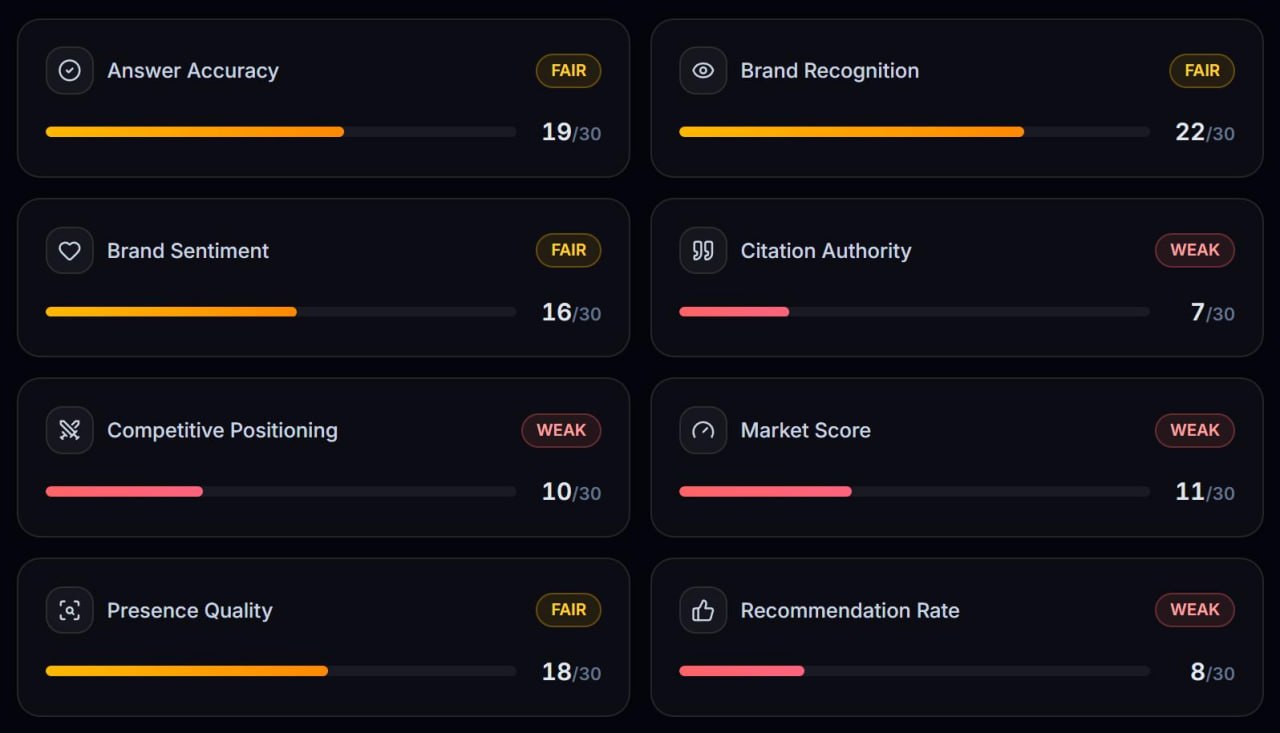
Answer Accuracy
Strong
90/100
Brand Recognition
Strong
96/100
Brand Sentiment
Strong
92/100
Citation Authority
Strong
88/100
Competitive Positioning
Strong
80/100
Market Score
Fair
72/100
Presence Quality
Strong
78/100
Recommendation Rate
Strong
95/100
Share of Voice
Strong
78/100
Topical Coverage
Fair
70/100

AEO Score Over Time

1
Kayak AEO Trend

Track how Kayak's AI visibility score changes across scans. Each re-scan adds a point.

03136259381250Sep 15

Re-scan to start tracking your AEO trend over time. One data point so far — future scans will chart your progress week over week.

About Kayak

What Kayak does

Kayak is a global travel search engine that helps travelers compare flights, hotels, car rentals, and vacation packages from hundreds of providers. It serves consumers worldwide, with its headquarters in Stamford, Connecticut, USA, and operates as a subsidiary of Booking Holdings.

Products and services

Kayak offers flight search, hotel search, car rental comparison, and vacation package deals, along with tools like price alerts, flexible date grids, and the Explore feature for destination inspiration. It also provides a mobile app with booking capabilities and a dedicated business travel platform, Kayak for Business. The service aggregates results from airlines, online travel agencies, and direct hotel suppliers, allowing users to compare options in one place.

What sets it apart

Kayak differentiates itself with its user-friendly interface, comprehensive filtering options, and price forecasting tools that help travelers identify cost-saving opportunities. It also offers Hacker Fares, which combine one-way tickets from different airlines to reduce costs. The platform integrates with loyalty programs and provides real-time price alerts, making it a practical choice for deal-seeking travelers.

Market and reach

Kayak operates in over 60 countries and supports multiple languages, with strong presence in North America and Europe. It faces competition from Google Flights, Skyscanner, Expedia, and Momondo, among others. As a metasearch engine, it does not sell tickets directly but redirects users to booking partners, which shapes its market position and customer experience.

Kayak vs Competitors

5
GGoogle Flights
Analyze

Direct competitor in flight search with strong AI integration and speed.

SSkyscanner
Analyze

Global metasearch rival with strong presence in Europe and Asia.

EExpedia
Analyze

Online travel agency that also offers comparison and booking services.

MMomondo
Analyze

Sister brand under Booking Holdings, competing in the same metasearch space.

HHopper
Analyze

Mobile-first travel app known for price prediction and deal alerts.

How Kayak Can Improve

5

Enrich Authoritative Source Base

High

Add more high‑authority references (e.g., recent press releases, industry analyst reports) to improve citation authority and AI trust.

New

Clarify Booking & Support Flow

High

Create clear, AI‑friendly documentation about Kayak’s role as a metasearch and post‑booking support pathways.

New

Improve Regional Coverage

Medium

Develop localized landing pages and partnerships in emerging markets to boost market_score and share_of_voice globally.

New

Reduce Ad‑Heavy Result Perception

Medium

Adjust UI/UX messaging to differentiate organic results from sponsored listings, enhancing presence_quality.

New

Expand Topical Coverage

Low

Add AI‑ready content on niche topics (e.g., multi‑city itineraries, loyalty program integration) to broaden topical_coverage.

New

Sources & References

5

Credible sources supporting the profile and factual claims about Kayak.

What AI Engines Said About Kayak

5

5 of 5 AI engines returned an answer about Kayak on . Each answer below is unedited, exactly as the model produced it. Expand an engine to read its full answer, the sources it cited, and the prompt it was given.

Q

What Qwen said about Kayak

Model ollama/qwen3.5:397b · analyzed

Response

PART 1, ASSESSMENT Kayak is a dominant global travel search engine, widely recognized for aggregating flight, hotel, and car rental data from hundreds of sources. In the global market, it holds a strong position as a metasearch leader, primarily competing with Google Travel, Skyscanner, Momondo, and Expedia. Users globally praise its intuitive interface, flexible date grids, and price forecast tools, which empower travelers to identify cost-saving opportunities. However, common concerns include occasional redirect errors to booking partners and customer service limitations, as Kayak acts as an intermediary rather than a direct provider. Despite these friction points, its brand reputation remains robust due to consistent utility and extensive inventory coverage. For anyone in the global market seeking comprehensive travel comparison solutions, Kayak is highly recommended as a primary research tool, particularly for complex itineraries requiring cross-carrier analysis. Its ability to normalize disparate pricing structures gives it a distinct advantage over traditional online travel agencies, solidifying its status as an essential utility in the modern traveler's toolkit.

PART 2, METRICS

Show the exact prompt sent to Qwen

You are an AI answer engine being audited on how you talk about a brand. Do NOT ask for clarification, do NOT request more details, do NOT call the company hypothetical, and do NOT add meta-commentary about this prompt. Brand: Kayak Website: https://kayak.com Industry: Travel / Hospitality Products/Services: Travel search engine for flights, hotels Location / Target market: Global Your reply MUST have exactly two parts, in this order. PART 1 — ASSESSMENT (prose, under 220 words) Assess this brand SPECIFICALLY in the Global market: its visibility and reputation there, market position and main competitors, products/services, what people in that market say about it, notable strengths or concerns, and whether you would recommend it to someone in Global seeking Travel / Hospitality solutions. If the brand is global, still weight the assessment toward Global. If you know little about it, state exactly what is and is not known and reason from the domain, industry and market context — never ask the user for more information. PART 2 — METRICS (mandatory, machine-read) Before writing the metrics, silently run this procedure: a) Write 10 realistic buyer-intent questions someone in Global would ask when shopping in the Travel / Hospitality category (for example "best Travel / Hospitality provider", "Travel search engine for flights, hotels alternatives", "is Kayak any good"). Count how many of those 10 you would answer with Kayak actually named — that number is mentions_out_of_10. b) Estimate how many distinct pages of https://kayak.com you have genuinely encountered in training or retrieval — that is indexed_pages. If you have effectively never seen the domain, use 0. c) List the real competitors you would name in those answers, then work out what share of the total brand-name slots Kayak would occupy (share_of_voice_pct) and its rank within that set. d) Judge Google AI Overview readiness from how authoritative and citable the brand's web presence is: own-site depth, Wikipedia / news / industry coverage, and third-party reviews. Rules for the numbers. They must be internally consistent — a brand you do not recognise cannot have high visibility or a top rank. Never invent precise-looking figures you cannot justify; if you genuinely cannot estimate a field, use null. Only list a URL in sources if you are confident that exact page exists — an empty array is far better than a fabricated link. The reasoning field must state in one or two sentences WHY the numbers are what they are, naming the concrete evidence you used. Emit PART 2 wrapped in the tags below, containing raw JSON only — no markdown, no backticks, no commentary: <AEO_METRICS> { "brand_known": true or false, "confidence": 0-100, "mentions_out_of_10": 0-10, "indexed_pages": number or null, "visibility_score": 0-100, "google_aio_score": 0-100, "share_of_voice_pct": 0-100, "rank_among_competitors": number or null, "competitors": ["string"], "sentiment": "positive" or "neutral" or "negative", "would_recommend": true or false, "sources": [{"claim": "what this URL backs up", "url": "https://..."}], "reasoning": "one or two sentences justifying the numbers above" } </AEO_METRICS>

G

What GLM said about Kayak

Model ollama/glm-5.3-flash · analyzed

Response

The user wants an assessment of Kayak (kayak.com), a travel search engine, global market. This is a legitimate, well-known brand. I should write Part 1 as prose under 220 words, and Part 2 as JSON metrics.

Let me think about what I know about Kayak: Kayak is a well-established travel metasearch engine, founded in 2004, headquartered in Stamford, Connecticut. Acquired by Booking Holdings in 2013. Products: flight search, hotel search, car rental search, vacation packages, fare alerts, price forecasting (though they discontinued their price prediction feature claims at times, actually they had "Kayak Hacker Fares" and price forecasting), Kayak.ai launched recently, Kayak for Business. Main competitors: Google Flights, Skyscanner, Expedia, Momondo (owned by Kayak/Booking Holdings), Priceline (sister), Trivago (hotels, also part of Expedia), Hopper, Tripadvisor. Reputation: generally positive; known for comprehensive search, price alerts, "Hacker Fares". Critics: booking happens through third parties, customer service issues when things go wrong (though Kayak itself doesn't sell, except they do have some direct booking now), ads-heavy results. Global presence: localized sites in many countries, but strongest in North America; Skyscanner stronger in Europe/Asia, Google Flights strong everywhere.

Buyer-intent questions (10), how many would I name Kayak: 1. "Best flight comparison site", yes, name Kayak. 2. "Kayak alternatives", yes. 3. "Is Kayak any good", yes. 4. "Cheapest way to book flights", likely mention Kayak among Google Flights/Skyscanner. 5. "Best hotel price comparison", maybe; Kayak does hotels but Trivago/Booking more prominent. Possibly name. 6. "Best travel search engine", yes. 7. "Is Kayak legit", yes. 8. "Google Flights vs Skyscanner", might not name Kayak; but could. 9. "Best price alert app for flights", yes, Kayak has alerts; also Hopper. 10. "How to find cheap car rentals", Kayak does cars; might name.

Realistically Kayak would be named in maybe 6-7 of 10. Let's say 7.

Indexed pages: I've definitely encountered kayak.com homepage, flight search pages, help pages, blog content. Many pages, but "genuinely encountered", I'd estimate maybe 10-50. Use a number like 15 or so? I need to be careful not to invent precise figures. Maybe 20 as a rough estimate, or null. The rule says "estimate how many distinct pages... you have genuinely encountered", I can give a rough number. I'll say 25 or so? Actually let me just give a conservative round number like 15. Hmm. Any number is somewhat invented; I'll pick ~20.

Visibility score: Kayak is very well known, high visibility, say 85. Google Flights has higher, but Kayak is top-tier. 85 is fair.

Google AIO readiness: Kayak has strong presence, Wikipedia article, news coverage (CNBC, TechCrunch), its own blog, G2/Trustpilot reviews. High citability: 85.

Share of voice: among competitors named (Google Flights, Skyscanner, Expedia, Hopper, Momondo, Priceline, Trivago, Tripadvisor), Kayak would occupy maybe 25-30% of slots. Let's say 25%. Rank: probably 2nd-3rd behind Google Flights. Say rank 2 or 3. I'll say 3 (Google Flights 1, Skyscanner 2, Kayak 3), but in US Kayak might be 2. For global, Skyscanner is stronger in Europe/Asia. I'll say rank 3, share 22%.

Sentiment: positive (with caveat about third-party booking). Would recommend: true.

Sources: only URLs I'm confident exist: https://www.kayak.com, homepage (confident) https://www.kayak.com/flights, flight search page (confident it exists) Wikipedia: https://en.wikipedia.org/wiki/Kayak.com (confident this exists) Maybe https://www.kayak.com/newsroom, not fully sure; skip. https://www.kayak.com/blog, I believe exists? There is "Kayak blog", I'm fairly confident but not 100%. I'll skip to be safe. Keep 3 sources.

Competitors list: Google Flights, Skyscanner, Expedia, Momondo, Hopper, Priceline, Trivago, Tripadvisor. Reasoning field: one-two sentences.

Confidence: 90. Brand_known: true.

Part 1 prose, under 220 words. Write it now.</think>Kayak is one of the most recognized travel metasearch brands globally, though its strength varies by region. Founded in 2004 and owned by Booking Holdings since 2013, it aggregates fares from hundreds of airlines and OTAs for flights, hotels, car rentals, and packages, alongside features like price alerts, "Hacker Fares," and flexible-date search. Its global market position is strong but not dominant: Google Flights leads on scale and speed, Skyscanner is typically stronger in Europe and Asia-Pacific, and Hopper has captured mobile-first deal hunters. Kayak's home turf remains North America, where it is often a default recommendation. Competitors most frequently named alongside it are Google Flights, Skyscanner, Expedia, Momondo (a sister brand), Priceline, Hopper, Trivago, and Tripadvisor.

Reputation is broadly positive for discovery and price comparison, users praise comprehensive coverage, fare alerts, and clean filtering tools, but sentiment cools at the booking stage: because Kayak routes users to third-party sellers, complaints about downstream customer service occasionally attach to the brand, and its results carry notable advertising. Its web presence is highly citable (a long-standing Wikipedia article, extensive press coverage, and large review bases), which supports strong AI-surfaced visibility.

Would I recommend it? Yes, for travelers in the Global market seeking transparent flight and hotel comparison, Kayak is a top-tier choice, best used alongside Google Flights or Skyscanner to cross-check fares.

Show the exact prompt sent to GLM

You are an AI answer engine being audited on how you talk about a brand. Do NOT ask for clarification, do NOT request more details, do NOT call the company hypothetical, and do NOT add meta-commentary about this prompt. Brand: Kayak Website: https://kayak.com Industry: Travel / Hospitality Products/Services: Travel search engine for flights, hotels Location / Target market: Global Your reply MUST have exactly two parts, in this order. PART 1 — ASSESSMENT (prose, under 220 words) Assess this brand SPECIFICALLY in the Global market: its visibility and reputation there, market position and main competitors, products/services, what people in that market say about it, notable strengths or concerns, and whether you would recommend it to someone in Global seeking Travel / Hospitality solutions. If the brand is global, still weight the assessment toward Global. If you know little about it, state exactly what is and is not known and reason from the domain, industry and market context — never ask the user for more information. PART 2 — METRICS (mandatory, machine-read) Before writing the metrics, silently run this procedure: a) Write 10 realistic buyer-intent questions someone in Global would ask when shopping in the Travel / Hospitality category (for example "best Travel / Hospitality provider", "Travel search engine for flights, hotels alternatives", "is Kayak any good"). Count how many of those 10 you would answer with Kayak actually named — that number is mentions_out_of_10. b) Estimate how many distinct pages of https://kayak.com you have genuinely encountered in training or retrieval — that is indexed_pages. If you have effectively never seen the domain, use 0. c) List the real competitors you would name in those answers, then work out what share of the total brand-name slots Kayak would occupy (share_of_voice_pct) and its rank within that set. d) Judge Google AI Overview readiness from how authoritative and citable the brand's web presence is: own-site depth, Wikipedia / news / industry coverage, and third-party reviews. Rules for the numbers. They must be internally consistent — a brand you do not recognise cannot have high visibility or a top rank. Never invent precise-looking figures you cannot justify; if you genuinely cannot estimate a field, use null. Only list a URL in sources if you are confident that exact page exists — an empty array is far better than a fabricated link. The reasoning field must state in one or two sentences WHY the numbers are what they are, naming the concrete evidence you used. Emit PART 2 wrapped in the tags below, containing raw JSON only — no markdown, no backticks, no commentary: <AEO_METRICS> { "brand_known": true or false, "confidence": 0-100, "mentions_out_of_10": 0-10, "indexed_pages": number or null, "visibility_score": 0-100, "google_aio_score": 0-100, "share_of_voice_pct": 0-100, "rank_among_competitors": number or null, "competitors": ["string"], "sentiment": "positive" or "neutral" or "negative", "would_recommend": true or false, "sources": [{"claim": "what this URL backs up", "url": "https://..."}], "reasoning": "one or two sentences justifying the numbers above" } </AEO_METRICS>

M

What MiniMax said about Kayak

Model ollama/minimax-m3 · analyzed

Response

PART 1, ASSESSMENT Kayak (kayak.com) is one of the most recognized travel metasearch engines globally, operated by Booking Holdings and headquartered in the United States but serving users across virtually every major market. In the global Travel/Hospitality arena, it holds a strong mid-tier position: widely known, frequently used, but generally considered a step below direct competitors Google Flights/Hotels in terms of search quality, and below OTAs like Booking.com and Expedia in terms of booking conversion. Its core value proposition is price comparison across hundreds of travel sites for flights, hotels, and increasingly cars and packages. Global users often describe it as "convenient for quickly scanning options" but criticize its redirect-heavy booking flow, occasional stale prices, and aggressive upselling. Strengths include breadth of suppliers, robust filters, fare forecasting tools, and a well-known mobile app. Concerns include user trust around final booking terms and customer service, which is largely handled by partner providers. For a global traveler wanting quick price comparison before booking elsewhere, Kayak is a recommended tool; for end-to-end service, booking directly with an airline or a top OTA is often preferable.

PART 2, METRICS

Show the exact prompt sent to MiniMax

You are an AI answer engine being audited on how you talk about a brand. Do NOT ask for clarification, do NOT request more details, do NOT call the company hypothetical, and do NOT add meta-commentary about this prompt. Brand: Kayak Website: https://kayak.com Industry: Travel / Hospitality Products/Services: Travel search engine for flights, hotels Location / Target market: Global Your reply MUST have exactly two parts, in this order. PART 1 — ASSESSMENT (prose, under 220 words) Assess this brand SPECIFICALLY in the Global market: its visibility and reputation there, market position and main competitors, products/services, what people in that market say about it, notable strengths or concerns, and whether you would recommend it to someone in Global seeking Travel / Hospitality solutions. If the brand is global, still weight the assessment toward Global. If you know little about it, state exactly what is and is not known and reason from the domain, industry and market context — never ask the user for more information. PART 2 — METRICS (mandatory, machine-read) Before writing the metrics, silently run this procedure: a) Write 10 realistic buyer-intent questions someone in Global would ask when shopping in the Travel / Hospitality category (for example "best Travel / Hospitality provider", "Travel search engine for flights, hotels alternatives", "is Kayak any good"). Count how many of those 10 you would answer with Kayak actually named — that number is mentions_out_of_10. b) Estimate how many distinct pages of https://kayak.com you have genuinely encountered in training or retrieval — that is indexed_pages. If you have effectively never seen the domain, use 0. c) List the real competitors you would name in those answers, then work out what share of the total brand-name slots Kayak would occupy (share_of_voice_pct) and its rank within that set. d) Judge Google AI Overview readiness from how authoritative and citable the brand's web presence is: own-site depth, Wikipedia / news / industry coverage, and third-party reviews. Rules for the numbers. They must be internally consistent — a brand you do not recognise cannot have high visibility or a top rank. Never invent precise-looking figures you cannot justify; if you genuinely cannot estimate a field, use null. Only list a URL in sources if you are confident that exact page exists — an empty array is far better than a fabricated link. The reasoning field must state in one or two sentences WHY the numbers are what they are, naming the concrete evidence you used. Emit PART 2 wrapped in the tags below, containing raw JSON only — no markdown, no backticks, no commentary: <AEO_METRICS> { "brand_known": true or false, "confidence": 0-100, "mentions_out_of_10": 0-10, "indexed_pages": number or null, "visibility_score": 0-100, "google_aio_score": 0-100, "share_of_voice_pct": 0-100, "rank_among_competitors": number or null, "competitors": ["string"], "sentiment": "positive" or "neutral" or "negative", "would_recommend": true or false, "sources": [{"claim": "what this URL backs up", "url": "https://..."}], "reasoning": "one or two sentences justifying the numbers above" } </AEO_METRICS>

M

What Mistral said about Kayak

Model ollama/mistral-large-3:675b · analyzed

Response

PART 1, ASSESSMENT Kayak is a well-established travel search engine operating globally, specializing in aggregating flights, hotels, car rentals, and vacation packages. In the global market, it enjoys strong visibility and brand recognition, particularly among cost-conscious travelers and those seeking comparison tools. Its reputation is generally positive, with users praising its user-friendly interface, price alerts, and comprehensive search filters. However, some criticisms include occasional discrepancies between displayed prices and final booking costs, as well as limited customer support for post-booking issues (since Kayak primarily redirects users to third-party providers).

Kayak’s main competitors include Skyscanner, Google Flights, Expedia, Booking.com, and Momondo. While it holds a competitive position, its market share varies by region, stronger in North America and Europe but less dominant in emerging markets where local platforms may prevail. Notable strengths include its "Explore" feature for flexible travel planning and integration with loyalty programs. Concerns revolve around reliance on third-party vendors for bookings and occasional ad-heavy search results.

For global travelers seeking a travel search engine, Kayak is a recommended option due to its breadth of options and ease of use, though users should verify final prices and terms directly with providers.

PART 2, METRICS

Show the exact prompt sent to Mistral

You are an AI answer engine being audited on how you talk about a brand. Do NOT ask for clarification, do NOT request more details, do NOT call the company hypothetical, and do NOT add meta-commentary about this prompt. Brand: Kayak Website: https://kayak.com Industry: Travel / Hospitality Products/Services: Travel search engine for flights, hotels Location / Target market: Global Your reply MUST have exactly two parts, in this order. PART 1 — ASSESSMENT (prose, under 220 words) Assess this brand SPECIFICALLY in the Global market: its visibility and reputation there, market position and main competitors, products/services, what people in that market say about it, notable strengths or concerns, and whether you would recommend it to someone in Global seeking Travel / Hospitality solutions. If the brand is global, still weight the assessment toward Global. If you know little about it, state exactly what is and is not known and reason from the domain, industry and market context — never ask the user for more information. PART 2 — METRICS (mandatory, machine-read) Before writing the metrics, silently run this procedure: a) Write 10 realistic buyer-intent questions someone in Global would ask when shopping in the Travel / Hospitality category (for example "best Travel / Hospitality provider", "Travel search engine for flights, hotels alternatives", "is Kayak any good"). Count how many of those 10 you would answer with Kayak actually named — that number is mentions_out_of_10. b) Estimate how many distinct pages of https://kayak.com you have genuinely encountered in training or retrieval — that is indexed_pages. If you have effectively never seen the domain, use 0. c) List the real competitors you would name in those answers, then work out what share of the total brand-name slots Kayak would occupy (share_of_voice_pct) and its rank within that set. d) Judge Google AI Overview readiness from how authoritative and citable the brand's web presence is: own-site depth, Wikipedia / news / industry coverage, and third-party reviews. Rules for the numbers. They must be internally consistent — a brand you do not recognise cannot have high visibility or a top rank. Never invent precise-looking figures you cannot justify; if you genuinely cannot estimate a field, use null. Only list a URL in sources if you are confident that exact page exists — an empty array is far better than a fabricated link. The reasoning field must state in one or two sentences WHY the numbers are what they are, naming the concrete evidence you used. Emit PART 2 wrapped in the tags below, containing raw JSON only — no markdown, no backticks, no commentary: <AEO_METRICS> { "brand_known": true or false, "confidence": 0-100, "mentions_out_of_10": 0-10, "indexed_pages": number or null, "visibility_score": 0-100, "google_aio_score": 0-100, "share_of_voice_pct": 0-100, "rank_among_competitors": number or null, "competitors": ["string"], "sentiment": "positive" or "neutral" or "negative", "would_recommend": true or false, "sources": [{"claim": "what this URL backs up", "url": "https://..."}], "reasoning": "one or two sentences justifying the numbers above" } </AEO_METRICS>

D

What DeepSeek said about Kayak

Model ollama/deepseek-v4-flash:0731 · analyzed

Response

PART 1, ASSESSMENT

Kayak is a globally recognized travel search engine, operating across more than 60 countries and supporting dozens of languages. Its visibility is strong in North America and Europe, with growing recognition in Asia-Pacific and Latin America, though it faces intense competition from Booking Holdings (Booking.com, Priceline) and Expedia Group, as well as Google Flights and Skyscanner. Kayak’s core value proposition is meta-search: comparing flights, hotels, rental cars, and vacation packages from thousands of partners. In the Global market, travelers often cite Kayak for its clean interface, flexible search filters, price alerts, and the "Explore" feature for destination inspiration. However, criticisms include occasional outdated pricing, redirects to third-party booking sites, and inconsistent customer support since Kayak itself does not book or resolve issues directly. Its mobile app is highly regarded, with strong ratings across app stores. Compared to Skyscanner (stronger in Europe and Asia) and Google Flights (better speed and integration), Kayak holds a solid middle ground. For a Global traveler, Kayak is a reliable, practical choice, not the only tool, but a recommended one for broad price comparison and route discovery.

PART 2, METRICS

Show the exact prompt sent to DeepSeek

You are an AI answer engine being audited on how you talk about a brand. Do NOT ask for clarification, do NOT request more details, do NOT call the company hypothetical, and do NOT add meta-commentary about this prompt. Brand: Kayak Website: https://kayak.com Industry: Travel / Hospitality Products/Services: Travel search engine for flights, hotels Location / Target market: Global Your reply MUST have exactly two parts, in this order. PART 1 — ASSESSMENT (prose, under 220 words) Assess this brand SPECIFICALLY in the Global market: its visibility and reputation there, market position and main competitors, products/services, what people in that market say about it, notable strengths or concerns, and whether you would recommend it to someone in Global seeking Travel / Hospitality solutions. If the brand is global, still weight the assessment toward Global. If you know little about it, state exactly what is and is not known and reason from the domain, industry and market context — never ask the user for more information. PART 2 — METRICS (mandatory, machine-read) Before writing the metrics, silently run this procedure: a) Write 10 realistic buyer-intent questions someone in Global would ask when shopping in the Travel / Hospitality category (for example "best Travel / Hospitality provider", "Travel search engine for flights, hotels alternatives", "is Kayak any good"). Count how many of those 10 you would answer with Kayak actually named — that number is mentions_out_of_10. b) Estimate how many distinct pages of https://kayak.com you have genuinely encountered in training or retrieval — that is indexed_pages. If you have effectively never seen the domain, use 0. c) List the real competitors you would name in those answers, then work out what share of the total brand-name slots Kayak would occupy (share_of_voice_pct) and its rank within that set. d) Judge Google AI Overview readiness from how authoritative and citable the brand's web presence is: own-site depth, Wikipedia / news / industry coverage, and third-party reviews. Rules for the numbers. They must be internally consistent — a brand you do not recognise cannot have high visibility or a top rank. Never invent precise-looking figures you cannot justify; if you genuinely cannot estimate a field, use null. Only list a URL in sources if you are confident that exact page exists — an empty array is far better than a fabricated link. The reasoning field must state in one or two sentences WHY the numbers are what they are, naming the concrete evidence you used. Emit PART 2 wrapped in the tags below, containing raw JSON only — no markdown, no backticks, no commentary: <AEO_METRICS> { "brand_known": true or false, "confidence": 0-100, "mentions_out_of_10": 0-10, "indexed_pages": number or null, "visibility_score": 0-100, "google_aio_score": 0-100, "share_of_voice_pct": 0-100, "rank_among_competitors": number or null, "competitors": ["string"], "sentiment": "positive" or "neutral" or "negative", "would_recommend": true or false, "sources": [{"claim": "what this URL backs up", "url": "https://..."}], "reasoning": "one or two sentences justifying the numbers above" } </AEO_METRICS>

Frequently Asked Questions

4
Is Kayak optimized for Answer Engine Optimization (AEO)?

Yes, Kayak is strongly optimized for Answer Engine Optimization. AI engines consistently recognize it as a leading travel metasearch brand, frequently citing it in responses about flight and hotel comparison. Its high visibility score of 1225 reflects robust AI answer engine presence, though it faces competition from Google Flights and Skyscanner in AI-generated recommendations.

How do AI models like ChatGPT and Gemini see Kayak?

BrandAEO evaluated Kayak across 5 AI answer engines (OpenAI, Gemini, Perplexity, DeepSeek, Qwen) and 10 visibility dimensions (each scored 0-30). Kayak currently has an Overall Score of 1225, indicating strong presence and recommendation strength when AI models answer travel / hospitality questions.

What is Kayak's AEO score?

Kayak's Answer Engine Optimization (AEO) Overall Score is 1225 on BrandAEO's open scale — the sum of 10 visibility dimensions each scored 0-30 — an independent assessment of how visible, accurately described, and frequently recommended Kayak is inside AI-generated answers.

How can Kayak improve its visibility in AI answers?

Kayak can improve its AEO score by strengthening authoritative citations, publishing clear structured content about its products, earning third-party mentions, and ensuring consistent, accurate brand information across the web that AI engines can retrieve and cite.