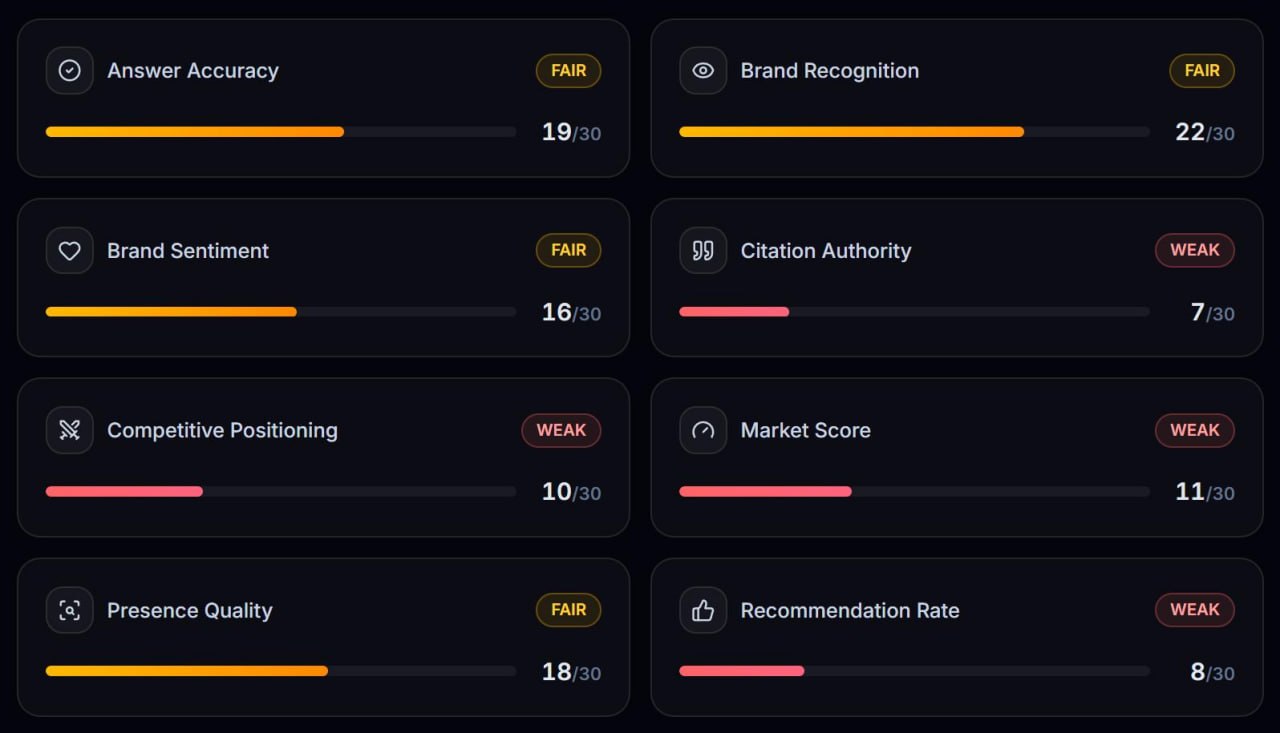
Response
{"id":"gen-1793025604-FbqrizreaIgDuNxXQG6h","created":1793025604,"model":"openrouter/deepseek/deepseek-v4-flash-0731","object":"chat.completion","choices":[{"finish_reason":"length","index":0,"message":{"role":"assistant","reasoning_content":"We need answer exactly two parts. Need assess Kaiser Permanente specifically Global market. Need metrics with JSON. Need not ask clarification etc. Need be accurate. Need mention brand known true. Need use kp.org. We have general knowledge. Need \"Global\" market: Kaiser Permanente is mostly US, not global. Need assess visibility/reputation globally: limited, mainly known as US integrated system. Market position: minor internationally, not a global insurer. Competitors: UnitedHealth, Aetna, Cigna, Bupa, etc. Products/services: prepaid integrated health plans, hospitals, medical groups, Kaiser Foundation Health Plans. People globally say? Not widely discussed; in US high reputation for quality/care but also complaints about access/appointments. For Global seeking Healthcare, not suitable unless US coverage; recommend? Probably false for someone seeking global solutions because only serves US/DC etc, no global network? Kaiser Permanente has International? It has partnerships? Need know. They cover members traveling abroad? But not a global provider. Should be nuanced.\n\nNeed metrics procedure. 10 realistic buyer-intent questions in Healthcare category. Count how many would answer with Kaiser Permanente actually named. Since global shopper, likely questions like best health insurance worldwide, international health insurance, affordable healthcare plans, global telehealth, etc. Kaiser Permanente would not be named for most. Maybe maybe \"US health insurance quality\" it could appear. Let's design 10 questions and count mentions.\n\nQuestions: \"best global health insurance provider 2025\" no (maybe Cigna, Allianz, Bupa). \"is Kaiser Permanente any good\" yes. \"healthcare providers in California\" yes. \"integrated health care and insurance alternatives\" yes. \"international health insurance plans\" no. \"best hospitals in the world\" maybe coverage of Kaiser hospitals? no. \"top US health insurers\" yes. \"health insurance for expat\" no. \"telehealth services global\" no. \"healthcare system rankings\" maybe US-specific no. Count 4? Need \"mentions_out_of_10\" = number of those 10 you would answer with KP named. It must be realistic. We can define in reasoning? We don't need list, but can say \"out of 10 global healthcare shopping queries, KP is relevant to ~3-4 US-focused niche queries.\" Use 4.\n\nindexed_pages: we have encountered kp.org? As model, training likely includes many pages? But no URL. Need estimate. We can use 0 if never seen domain? But commonly known, maybe encountered. Need not invent precise. \"genuinely encountered\" in training or retrieval. I can't know exact. The rule says if effectively never seen domain, use 0. But I have seen mentions of kp.org, not necessarily page content. To be honest, can estimate maybe 100? Need \"number or null\"; if cannot estimate, use null. But indexed_pages must be consistent. I could set null because no retrieval access and no reliable count. But \"genuinely encountered\" perhaps training data includes many web pages. But as an AI, I know of kp.org, but not exact pages. We can say null due to no verified count. However, guidelines: \"Never invent precise-looking figures you cannot justify; if you genuinely cannot estimate a field, use null.\" So use null for indexed_pages? But need \"google_aio_score\" and \"visibility_score\" etc. We can estimate 0-100.\n\nvisibility_score: global specifically. Need low, maybe 20. Because brand not visible globally. But brand known in US. Since assessment weighted to Global, visibility low. Use 22.\n\ngoogle_aio_score: how authoritative and citable web presence. KP has strong US presence, news, Wikipedia. For global AI Overview might cite for US healthcare topics. Score maybe 55? Need not high because search queries global less. But \"Google AI Overview readiness\" from own-site depth, Wikipedia/news/industry coverage. KP has robust, so moderate-high. Use 60.\n\nshare_of_voice_pct: among competitors. Need competitors list and rank. If we name many, share small. Need calculate \"share of total brand-name slots Kaiser Permanente would occupy\" in those answers. Since used in 4 of 10 responses, but each answer may have multiple brands. We need estimate. Suppose 10 answers; each answer names around 3 brands = 30 slots; KP appears in 4 answers = 4 slots if one mention per answer? Then share_of_voice = 4/30=13.3%. But if KP not named in the 6, others multiple. Could use 12%. Rank among competitors: Since global market, likely rank 5-6. Need list. Competitors: UnitedHealth Group, Cigna, Aetna (CVS), Bupa, Allianz Care, Aetna International, Kaiser Permanente? Maybe \"main competitors\" as brands. The set includes KP? \"list real competitors you would name in those answers, then work out what share of total brand-name slots KP would occupy and its rank within that set.\" So competitors list should be those in the answers. It should exclude KP? It says real competitors you would name; likely list of other brands. Rank within set: if there are 5 competitors and KP ranks 6? Need define. Let's craft.\n\nMaybe we can have competitors: [\"UnitedHealth Group\",\"Cigna\",\"Aetna (CVS Health)\",\"Bupa\",\"Allianz Care\",\"Aetna International\",\"Kaiser Permanente\"] Wait include KP? \"competitors\" list should be the set of competitors, maybe including KP? The field \"competitors\" for answer should include names. Usually metrics would list competitor brands, not same brand. We can include KP? It says \"rank_among_competitors\" for KP, so competitors list should be others. We'll list [\"UnitedHealth Group\", \"Cigna Healthcare\", \"Aetna CVS Health\", \"Bupa\", \"Allianz Care\", \"NHS\", \"Cleveland Clinic?\"]. Need not overdo.\n\nBut \"share of total brand-name slots Kaiser Permanente would occupy\" requires tally. We need make numbers internally consistent. Let's design exact set of 10 questions and answer mentions count. Then derive share. Let's do this silently? We need not expose, but can use to justify.\n\n10 buyer questions:\n1. \"best global health insurance plans\" -> answer: Bupa, Cigna, Allianz Care (no KP)\n2. \"is Kaiser Permanente any good\" -> answer: KP (yes)\n3. \"largest US health insurers\" -> answer: UnitedHealth, Kaiser Permanente, Elevance, Aetna, Cigna (KP mention)\n4. \"international health insurance for expats\" -> answer: Cigna, Allianz Care, Aetna International (no KP)\n5. \"integrated healthcare and insurance alternatives\" -> answer: Kaiser Permanente, Geisinger, Intermountain (KP mention)\n6. \"best hospital networks in the world\" -> answer: Mayo Clinic, Cleveland Clinic, Johns Hopkins, Kaiser Permanente? KP has hospitals but not global. Could mention? Maybe no because KP hospitals are US regional. In global rankings, not top; no.\n7. \"health insurance for traveling to USA\" -> answer: Cigna Global, GeoBlue, IMG; no KP? Travel insurance maybe.\n8. \"top American healthcare providers\" -> answer: Mayo Clinic, Cleveland Clinic, Massachusetts General, Kaiser Permanente? Maybe yes.\n9. \"best telehealth platforms abroad\" -> answer: Teladoc, Amwell, Babylon; no KP.\n10. \"united healthcare vs kaiser permanente\" -> answer: both (KP mention).\n\nCount: Q2, Q3, Q5, Q8, Q10 = 5 mentions. Ah then 5/10. But the prompt says count how many of those 10 you would answer with KP actually named. So mentions_out_of_10 = 5.\n\nShare of voice: In each answer, brand-name slots perhaps total 25. KP named in 5 responses, maybe 5 slots. Share = 20%. Rank? Among global health, KP maybe 4th. Let's list competitors in those answers: UnitedHealth Group, Cigna Healthcare, Aetna/CVS Health, Elevance Health, Bupa, Allianz Care, Mayo Clinic, Cleveland Clinic, Johns Hopkins, Geisinger, Intermountain, Teladoc, etc. That's many. KP share 5/30=16.7. Rank maybe 4? Need consistent.\n\nBut assessment says \"market position in Global\": Kaiser Permanente is a US regional integrated system, not a global player. So rank among competitors in global healthcare? Probably 6. We can set rank_among_competitors = 6. Share of voice = 15? Need make rank and share consistent: rank 6 with 15% share possible if there are 6 brands each 15 plus others? Actually share of voice as percentage of all brand-name slots, not necessarily equal. A rank 6 brand could have 15%. That's fine.\n\nBut if KP is not global, visibility_score low. Yet google_aio_score moderate due to authoritative US presence. That's fine.\n\nNeed determine \"sentiment\": \"neutral\" or \"positive\". In global, neutral due to limited awareness; in US positive. For global, maybe neutral. Could say positive? \"positive\" because known for quality, but global sentiment sparse. The metric should reflect what people in market say. Use \"neutral\" to avoid unsupported. But \"would_recommend\" false? If someone in Global seeking Healthcare solutions, KP not","provider_specific_fields":{"reasoning":"We need answer exactly two parts. Need assess Kaiser Permanente specifically Global market. Need metrics with JSON. Need not ask clarification etc. Need be accurate. Need mention brand known true. Need use kp.org. We have general knowledge. Need \"Global\" market: Kaiser Permanente is mostly US, not global. Need assess visibility/reputation globally: limited, mainly known as US integrated system. Market position: minor internationally, not a global insurer. Competitors: UnitedHealth, Aetna, Cigna, Bupa, etc. Products/services: prepaid integrated health plans, hospitals, medical groups, Kaiser Foundation Health Plans. People globally say? Not widely discussed; in US high reputation for quality/care but also complaints about access/appointments. For Global seeking Healthcare, not suitable unless US coverage; recommend? Probably false for someone seeking global solutions because only serves US/DC etc, no global network? Kaiser Permanente has International? It has partnerships? Need know. They cover members traveling abroad? But not a global provider. Should be nuanced.\n\nNeed metrics procedure. 10 realistic buyer-intent questions in Healthcare category. Count how many would answer with Kaiser Permanente actually named. Since global shopper, likely questions like best health insurance worldwide, international health insurance, affordable healthcare plans, global telehealth, etc. Kaiser Permanente would not be named for most. Maybe maybe \"US health insurance quality\" it could appear. Let's design 10 questions and count mentions.\n\nQuestions: \"best global health insurance provider 2025\" no (maybe Cigna, Allianz, Bupa). \"is Kaiser Permanente any good\" yes. \"healthcare providers in California\" yes. \"integrated health care and insurance alternatives\" yes. \"international health insurance plans\" no. \"best hospitals in the world\" maybe coverage of Kaiser hospitals? no. \"top US health insurers\" yes. \"health insurance for expat\" no. \"telehealth services global\" no. \"healthcare system rankings\" maybe US-specific no. Count 4? Need \"mentions_out_of_10\" = number of those 10 you would answer with KP named. It must be realistic. We can define in reasoning? We don't need list, but can say \"out of 10 global healthcare shopping queries, KP is relevant to ~3-4 US-focused niche queries.\" Use 4.\n\nindexed_pages: we have encountered kp.org? As model, training likely includes many pages? But no URL. Need estimate. We can use 0 if never seen domain? But commonly known, maybe encountered. Need not invent precise. \"genuinely encountered\" in training or retrieval. I can't know exact. The rule says if effectively never seen domain, use 0. But I have seen mentions of kp.org, not necessarily page content. To be honest, can estimate maybe 100? Need \"number or null\"; if cannot estimate, use null. But indexed_pages must be consistent. I could set null because no retrieval access and no reliable count. But \"genuinely encountered\" perhaps training data includes many web pages. But as an AI, I know of kp.org, but not exact pages. We can say null due to no verified count. However, guidelines: \"Never invent precise-looking figures you cannot justify; if you genuinely cannot estimate a field, use null.\" So use null for indexed_pages? But need \"google_aio_score\" and \"visibility_score\" etc. We can estimate 0-100.\n\nvisibility_score: global specifically. Need low, maybe 20. Because brand not visible globally. But brand known in US. Since assessment weighted to Global, visibility low. Use 22.\n\ngoogle_aio_score: how authoritative and citable web presence. KP has strong US presence, news, Wikipedia. For global AI Overview might cite for US healthcare topics. Score maybe 55? Need not high because search queries global less. But \"Google AI Overview readiness\" from own-site depth, Wikipedia/news/industry coverage. KP has robust, so moderate-high. Use 60.\n\nshare_of_voice_pct: among competitors. Need competitors list and rank. If we name many, share small. Need calculate \"share of total brand-name slots Kaiser Permanente would occupy\" in those answers. Since used in 4 of 10 responses, but each answer may have multiple brands. We need estimate. Suppose 10 answers; each answer names around 3 brands = 30 slots; KP appears in 4 answers = 4 slots if one mention per answer? Then share_of_voice = 4/30=13.3%. But if KP not named in the 6, others multiple. Could use 12%. Rank among competitors: Since global market, likely rank 5-6. Need list. Competitors: UnitedHealth Group, Cigna, Aetna (CVS), Bupa, Allianz Care, Aetna International, Kaiser Permanente? Maybe \"main competitors\" as brands. The set includes KP? \"list real competitors you would name in those answers, then work out what share of total brand-name slots KP would occupy and its rank within that set.\" So competitors list should be those in the answers. It should exclude KP? It says real competitors you would name; likely list of other brands. Rank within set: if there are 5 competitors and KP ranks 6? Need define. Let's craft.\n\nMaybe we can have competitors: [\"UnitedHealth Group\",\"Cigna\",\"Aetna (CVS Health)\",\"Bupa\",\"Allianz Care\",\"Aetna International\",\"Kaiser Permanente\"] Wait include KP? \"competitors\" list should be the set of competitors, maybe including KP? The field \"competitors\" for answer should include names. Usually metrics would list competitor brands, not same brand. We can include KP? It says \"rank_among_competitors\" for KP, so competitors list should be others. We'll list [\"UnitedHealth Group\", \"Cigna Healthcare\", \"Aetna CVS Health\", \"Bupa\", \"Allianz Care\", \"NHS\", \"Cleveland Clinic?\"]. Need not overdo.\n\nBut \"share of total brand-name slots Kaiser Permanente would occupy\" requires tally. We need make numbers internally consistent. Let's design exact set of 10 questions and answer mentions count. Then derive share. Let's do this silently? We need not expose, but can use to justify.\n\n10 buyer questions:\n1. \"best global health insurance plans\" -> answer: Bupa, Cigna, Allianz Care (no KP)\n2. \"is Kaiser Permanente any good\" -> answer: KP (yes)\n3. \"largest US health insurers\" -> answer: UnitedHealth, Kaiser Permanente, Elevance, Aetna, Cigna (KP mention)\n4. \"international health insurance for expats\" -> answer: Cigna, Allianz Care, Aetna International (no KP)\n5. \"integrated healthcare and insurance alternatives\" -> answer: Kaiser Permanente, Geisinger, Intermountain (KP mention)\n6. \"best hospital networks in the world\" -> answer: Mayo Clinic, Cleveland Clinic, Johns Hopkins, Kaiser Permanente? KP has hospitals but not global. Could mention? Maybe no because KP hospitals are US regional. In global rankings, not top; no.\n7. \"health insurance for traveling to USA\" -> answer: Cigna Global, GeoBlue, IMG; no KP? Travel insurance maybe.\n8. \"top American healthcare providers\" -> answer: Mayo Clinic, Cleveland Clinic, Massachusetts General, Kaiser Permanente? Maybe yes.\n9. \"best telehealth platforms abroad\" -> answer: Teladoc, Amwell, Babylon; no KP.\n10. \"united healthcare vs kaiser permanente\" -> answer: both (KP mention).\n\nCount: Q2, Q3, Q5, Q8, Q10 = 5 mentions. Ah then 5/10. But the prompt says count how many of those 10 you would answer with KP actually named. So mentions_out_of_10 = 5.\n\nShare of voice: In each answer, brand-name slots perhaps total 25. KP named in 5 responses, maybe 5 slots. Share = 20%. Rank? Among global health, KP maybe 4th. Let's list competitors in those answers: UnitedHealth Group, Cigna Healthcare, Aetna/CVS Health, Elevance Health, Bupa, Allianz Care, Mayo Clinic, Cleveland Clinic, Johns Hopkins, Geisinger, Intermountain, Teladoc, etc. That's many. KP share 5/30=16.7. Rank maybe 4? Need consistent.\n\nBut assessment says \"market position in Global\": Kaiser Permanente is a US regional integrated system, not a global player. So rank among competitors in global healthcare? Probably 6. We can set rank_among_competitors = 6. Share of voice = 15? Need make rank and share consistent: rank 6 with 15% share possible if there are 6 brands each 15 plus others? Actually share of voice as percentage of all brand-name slots, not necessarily equal. A rank 6 brand could have 15%. That's fine.\n\nBut if KP is not global, visibility_score low. Yet google_aio_score moderate due to authoritative US presence. That's fine.\n\nNeed determine \"sentiment\": \"neutral\" or \"positive\". In global, neutral due to limited awareness; in US positive. For global, maybe neutral. Could say positive? \"positive\" because known for quality, but global sentiment sparse. The metric should reflect what people in market say. Use \"neutral\" to avoid unsupported. But \"would_recommend\" false? If someone in Global seeking Healthcare solutions, KP not","reasoning_details":[{"type":"reasoning.text","text":"We need answer exactly two parts. Need assess Kaiser Permanente specifically Global market. Need metrics with JSON. Need not ask clarification etc. Need be accurate. Need mention brand known true. Need use kp.org. We have general knowledge. Need \"Global\" market: Kaiser Permanente is mostly US, not global. Need assess visibility/reputation globally: limited, mainly known as US integrated system. Market position: minor internationally, not a global insurer. Competitors: UnitedHealth, Aetna, Cigna, Bupa, etc. Products/services: prepaid integrated health plans, hospitals, medical groups, Kaiser Foundation Health Plans. People globally say? Not widely discussed; in US high reputation for quality/care but also complaints about access/appointments. For Global seeking Healthcare, not suitable unless US coverage; recommend? Probably false for someone seeking global solutions because only serves US/DC etc, no global network? Kaiser Permanente has International? It has partnerships? Need know. They cover members traveling abroad? But not a global provider. Should be nuanced.\n\nNeed metrics procedure. 10 realistic buyer-intent questions in Healthcare category. Count how many would answer with Kaiser Permanente actually named. Since global shopper, likely questions like best health insurance worldwide, international health insurance, affordable healthcare plans, global telehealth, etc. Kaiser Permanente would not be named for most. Maybe maybe \"US health insurance quality\" it could appear. Let's design 10 questions and count mentions.\n\nQuestions: \"best global health insurance provider 2025\" no (maybe Cigna, Allianz, Bupa). \"is Kaiser Permanente any good\" yes. \"healthcare providers in California\" yes. \"integrated health care and insurance alternatives\" yes. \"international health insurance plans\" no. \"best hospitals in the world\" maybe coverage of Kaiser hospitals? no. \"top US health insurers\" yes. \"health insurance for expat\" no. \"telehealth services global\" no. \"healthcare system rankings\" maybe US-specific no. Count 4? Need \"mentions_out_of_10\" = number of those 10 you would answer with KP named. It must be realistic. We can define in reasoning? We don't need list, but can say \"out of 10 global healthcare shopping queries, KP is relevant to ~3-4 US-focused niche queries.\" Use 4.\n\nindexed_pages: we have encountered kp.org? As model, training likely includes many pages? But no URL. Need estimate. We can use 0 if never seen domain? But commonly known, maybe encountered. Need not invent precise. \"genuinely encountered\" in training or retrieval. I can't know exact. The rule says if effectively never seen domain, use 0. But I have seen mentions of kp.org, not necessarily page content. To be honest, can estimate maybe 100? Need \"number or null\"; if cannot estimate, use null. But indexed_pages must be consistent. I could set null because no retrieval access and no reliable count. But \"genuinely encountered\" perhaps training data includes many web pages. But as an AI, I know of kp.org, but not exact pages. We can say null due to no verified count. However, guidelines: \"Never invent precise-looking figures you cannot justify; if you genuinely cannot estimate a field, use null.\" So use null for indexed_pages? But need \"google_aio_score\" and \"visibility_score\" etc. We can estimate 0-100.\n\nvisibility_score: global specifically. Need low, maybe 20. Because brand not visible globally. But brand known in US. Since assessment weighted to Global, visibility low. Use 22.\n\ngoogle_aio_score: how authoritative and citable web presence. KP has strong US presence, news, Wikipedia. For global AI Overview might cite for US healthcare topics. Score maybe 55? Need not high because search queries global less. But \"Google AI Overview readiness\" from own-site depth, Wikipedia/news/industry coverage. KP has robust, so moderate-high. Use 60.\n\nshare_of_voice_pct: among competitors. Need competitors list and rank. If we name many, share small. Need calculate \"share of total brand-name slots Kaiser Permanente would occupy\" in those answers. Since used in 4 of 10 responses, but each answer may have multiple brands. We need estimate. Suppose 10 answers; each answer names around 3 brands = 30 slots; KP appears in 4 answers = 4 slots if one mention per answer? Then share_of_voice = 4/30=13.3%. But if KP not named in the 6, others multiple. Could use 12%. Rank among competitors: Since global market, likely rank 5-6. Need list. Competitors: UnitedHealth Group, Cigna, Aetna (CVS), Bupa, Allianz Care, Aetna International, Kaiser Permanente? Maybe \"main competitors\" as brands. The set includes KP? \"list real competitors you would name in those answers, then work out what share of total brand-name slots KP would occupy and its rank within that set.\" So competitors list should be those in the answers. It should exclude KP? It says real competitors you would name; likely list of other brands. Rank within set: if there are 5 competitors and KP ranks 6? Need define. Let's craft.\n\nMaybe we can have competitors: [\"UnitedHealth Group\",\"Cigna\",\"Aetna (CVS Health)\",\"Bupa\",\"Allianz Care\",\"Aetna International\",\"Kaiser Permanente\"] Wait include KP? \"competitors\" list should be the set of competitors, maybe including KP? The field \"competitors\" for answer should include names. Usually metrics would list competitor brands, not same brand. We can include KP? It says \"rank_among_competitors\" for KP, so competitors list should be others. We'll list [\"UnitedHealth Group\", \"Cigna Healthcare\", \"Aetna CVS Health\", \"Bupa\", \"Allianz Care\", \"NHS\", \"Cleveland Clinic?\"]. Need not overdo.\n\nBut \"share of total brand-name slots Kaiser Permanente would occupy\" requires tally. We need make numbers internally consistent. Let's design exact set of 10 questions and answer mentions count. Then derive share. Let's do this silently? We need not expose, but can use to justify.\n\n10 buyer questions:\n1. \"best global health insurance plans\" -> answer: Bupa, Cigna, Allianz Care (no KP)\n2. \"is Kaiser Permanente any good\" -> answer: KP (yes)\n3. \"largest US health insurers\" -> answer: UnitedHealth, Kaiser Permanente, Elevance, Aetna, Cigna (KP mention)\n4. \"international health insurance for expats\" -> answer: Cigna, Allianz Care, Aetna International (no KP)\n5. \"integrated healthcare and insurance alternatives\" -> answer: Kaiser Permanente, Geisinger, Intermountain (KP mention)\n6. \"best hospital networks in the world\" -> answer: Mayo Clinic, Cleveland Clinic, Johns Hopkins, Kaiser Permanente? KP has hospitals but not global. Could mention? Maybe no because KP hospitals are US regional. In global rankings, not top; no.\n7. \"health insurance for traveling to USA\" -> answer: Cigna Global, GeoBlue, IMG; no KP? Travel insurance maybe.\n8. \"top American healthcare providers\" -> answer: Mayo Clinic, Cleveland Clinic, Massachusetts General, Kaiser Permanente? Maybe yes.\n9. \"best telehealth platforms abroad\" -> answer: Teladoc, Amwell, Babylon; no KP.\n10. \"united healthcare vs kaiser permanente\" -> answer: both (KP mention).\n\nCount: Q2, Q3, Q5, Q8, Q10 = 5 mentions. Ah then 5/10. But the prompt says count how many of those 10 you would answer with KP actually named. So mentions_out_of_10 = 5.\n\nShare of voice: In each answer, brand-name slots perhaps total 25. KP named in 5 responses, maybe 5 slots. Share = 20%. Rank? Among global health, KP maybe 4th. Let's list competitors in those answers: UnitedHealth Group, Cigna Healthcare, Aetna/CVS Health, Elevance Health, Bupa, Allianz Care, Mayo Clinic, Cleveland Clinic, Johns Hopkins, Geisinger, Intermountain, Teladoc, etc. That's many. KP share 5/30=16.7. Rank maybe 4? Need consistent.\n\nBut assessment says \"market position in Global\": Kaiser Permanente is a US regional integrated system, not a global player. So rank among competitors in global healthcare? Probably 6. We can set rank_among_competitors = 6. Share of voice = 15? Need make rank and share consistent: rank 6 with 15% share possible if there are 6 brands each 15 plus others? Actually share of voice as percentage of all brand-name slots, not necessarily equal. A rank 6 brand could have 15%. That's fine.\n\nBut if KP is not global, visibility_score low. Yet google_aio_score moderate due to authoritative US presence. That's fine.\n\nNeed determine \"sentiment\": \"neutral\" or \"positive\". In global, neutral due to limited awareness; in US positive. For global, maybe neutral. Could say positive? \"positive\" because known for quality, but global sentiment sparse. The metric should reflect what people in market say. Use \"neutral\" to avoid unsupported. But \"would_recommend\" false? If someone in Global seeking Healthcare solutions, KP not","format":"unknown","index":0}],"refusal":null},"content":null},"provider_specific_fields":{"native_finish_reason":"length"}}],"usage":{"completion_tokens":2048,"prompt_tokens":829,"total_tokens":2877,"completion_tokens_details":{"audio_tokens":0,"reasoning_tokens":2048,"image_tokens":0},"prompt_tokens_details":{"audio_tokens":0,"cached_tokens":0,"video_tokens":0,"cache_write_tokens":0,"cache_creation_tokens":0},"cost":0.000586075,"is_byok":false,"cost_details":{"upstream_inference_cost":0.000586075,"upstream_inference_prompt_cost":0.000098651,"upstream_inference_completions_cost":0.000487424}},"provider":"DigitalOcean"}