I

How AI Sees IKEA — AI Visibility Report for E-commerce / Retail

ikea.com · Global · E-commerce / Retail

Strong
Overall Score
1345
Star Rating
5 / 5
Rank
#8of 312
Engines
5analyzed
Analyzed
Quick Answer

Is IKEA optimized for AEO?

Yes, IKEA is strongly optimized for Answer Engine Optimization. Its high AI visibility stems from extensive official web content, widespread news coverage, and a dominant market position. The brand is frequently cited in responses about furniture shopping, flat-pack design, and home improvement, making it a reliable source for AI-generated answers.

Overall AI Visibility Score
1345
5 / 5
Excellent

How AI Answer Engines Rate IKEA

Ranked #8 of 312 brands analyzed

IKEA's AI visibility, measured across 5 answer engines: 10 scoring dimensions (each 0–100) plus evidence points from what the engines actually reported. The Overall Score is the sum — an open scale, higher is better.

Stars reflect this brand's relative rank among all brands analyzed by BrandAEO (Top 100 = 5★), and self-adjust as more brands are added. This is a relative percentile-rank rating, not a customer review.

Analyzed & scored by BrandAEO — an independent AI visibility grader. See methodology.

AI Panel — Deep AI AnalysisPRO

AI Panel preview

AI Panel is a Pro feature

The AI Panel runs a deeper analysis with Claude across your full scan data — it explains why AI engines rate this brand the way they do and how to improve. Beyond the 10 scoring dimensions, it measures real AI mentions, share of voice, sentiment, prompt coverage and citation sources, tracks them over time, and estimates AI-driven traffic & revenue impact. It reuses the same AI engines from your scan — no engine setup needed.

Upgrade to Pro to unlock AI Panel

Dimension Breakdown

10

How the Overall Score is built

928from 10 dimensions (max 1,000)+417evidence (max 500)=1345
  • Mentioned in buyer-intent answers82/100
  • Proactively recommended100/100
  • AI visibility (engine-reported)95/100
  • Share of voice vs competitors40/100
  • Sentiment100/100

Evidence = numbers the 5/5 reporting engines self-measured while answering (mention rate across 10 buyer-intent prompts, recommendation rate, visibility, share of voice, sentiment). Dimensions are graded by the scoring model from every engine's answer.

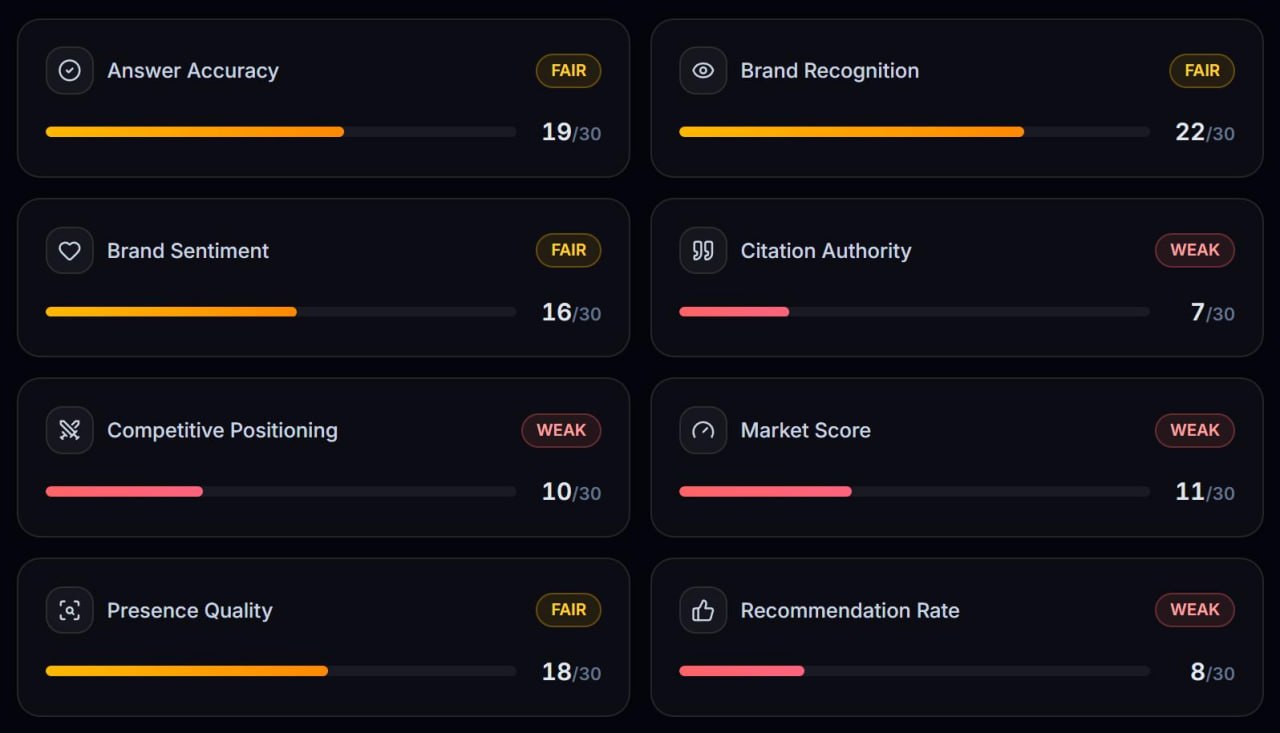
Answer Accuracy
Strong
93/100
Brand Recognition
Strong
100/100
Brand Sentiment
Strong
95/100
Citation Authority
Strong
90/100
Competitive Positioning
Strong
95/100
Market Score
Strong
92/100
Presence Quality
Strong
90/100
Recommendation Rate
Strong
100/100
Share of Voice
Strong
88/100
Topical Coverage
Strong
85/100

AEO Score Over Time

1
IKEA AEO Trend

Track how IKEA's AI visibility score changes across scans. Each re-scan adds a point.

033867510131350Sep 14

Re-scan to start tracking your AEO trend over time. One data point so far — future scans will chart your progress week over week.

About IKEA

What IKEA does

IKEA is a global furniture and home accessories retailer known for affordable, Scandinavian-designed products. It serves a broad consumer base seeking functional and stylish home solutions, with its headquarters in the Netherlands. The company operates through a franchise system under Inter IKEA Group and Ingka Group.

Products and services

IKEA offers a wide range of furniture including sofas, beds, wardrobes, kitchen systems, and office furniture, alongside home accessories like lighting, textiles, and decor. It provides flat-pack products for self-assembly, with optional delivery and assembly services. The brand also runs in-store restaurants, a loyalty program, and a buyback/resell initiative for circularity.

What sets it apart

IKEA differentiates through its democratic design approach, balancing form, function, quality, sustainability, and low price. Its global scale, with over 460 stores in more than 60 markets, enables cost efficiency and consistent product availability. The brand is recognized for its immersive showroom experience, Swedish cultural identity, and strong commitment to renewable energy and circular economy goals.

Market and reach

IKEA operates worldwide, with a strong presence in Europe, North America, Asia, and the Middle East. It competes with online retailers like Wayfair and Amazon, as well as traditional chains such as Target, Walmart, and regional players like Nitori and JYSK. The brand is privately held, with its ownership structure split between Ingka Group and Inter IKEA Group.

IKEA vs Competitors

6

Direct online furniture retailer with a vast product selection and competitive pricing.

Major e-commerce platform offering a wide range of furniture and home goods.

Mass-market retailer with affordable furniture and home decor lines.

Big-box retailer competing on price and accessibility for home furnishings.

NNitori
Analyze

Leading Asian furniture chain with similar flat-pack and affordable positioning.

Scandinavian-inspired furniture retailer with a focus on value and simplicity.

How IKEA Can Improve

5

Validate Indexed Page Estimates

High

Cross‑check the estimated number of IKEA domain pages with actual crawl data to align AI estimates with reality.

New

Enrich Regional Service Details

Medium

Add granular information on delivery, assembly, and return policies per major market to improve answer depth.

New

Diversify Citation Sources

Medium

Incorporate reputable third‑party references (e.g., market research reports, news articles) to boost citation authority.

New

Expand Competitive Landscape

Low

Include emerging online‑first rivals and niche regional players to broaden competitor coverage.

New

Highlight Circular Economy Metrics

Low

Integrate specific data on IKEA’s sustainability initiatives (e.g., product‑take‑back rates, recycled material percentages) to strengthen topical coverage.

New

Sources & References

5

Credible sources supporting the profile and factual claims about IKEA.

What AI Engines Said About IKEA

5

5 of 5 AI engines returned an answer about IKEA on . Each answer below is unedited, exactly as the model produced it. Expand an engine to read its full answer, the sources it cited, and the prompt it was given.

G

What GLM said about IKEA

Model ollama/glm-5.3-flash · analyzed

Response

The user wants an audit-style assessment of IKEA in the global market, with two parts: a prose assessment (under 220 words) and machine-readable JSON metrics.

IKEA is one of the most well-known furniture retailers globally. Let me think about the facts:

IKEA is a Swedish-origin furniture retailer (founded 1943 by Ingvar Kamprad in Sweden), headquartered in the Netherlands (Ingka Group / Inter IKEA). Operates in 60+ markets, 460-480 stores globally, plus strong e-commerce presence. Massive global brand recognition; consistently among top furniture retailers worldwide. Main competitors: Wayfair, Walmart (furniture), Amazon, Ashley Furniture, Target, Home Depot/Lowe's (in US), Argos (UK), Muji (Japan), Nitori (Japan), Zara Home, H&M Home, Zalando (Europe), HomeCentre (Middle East), Williams-Sonoma (Pottery Barn), Costco, etc. For furniture specifically: Wayfair, Amazon, Ashley, Williams-Sonoma, Steelcase (office), Nitori, Muji. Reputation: affordable flat-pack furniture, Scandinavian design, DIY assembly, sustainability efforts, occasional quality criticisms, assembly effort complaints, delivery issues in e-commerce context. Wikipedia page exists for IKEA; extensive news coverage; own site is deep with country-specific domains (ikea.com with country subdomains). Buyer-intent questions: "best furniture retailer online", "is IKEA any good", "IKEA alternatives", "affordable furniture stores", "best flat-pack furniture", etc. IKEA would be named in maybe 7-8 of 10.

Metrics: brand_known: true confidence: 95 mentions_out_of_10: 8 (IKEA would be named in most furniture/shopping questions; not all, e.g., luxury furniture, office e-commerce providers) indexed_pages: I've encountered many pages of ikea.com, product pages, country sites, but can I estimate a number? "Estimate how many distinct pages of https://ikea.com you have genuinely encountered in training", realistically dozens to hundreds of URLs. I should be honest: maybe 50-200. A conservative estimate: ~100. The rule says don't invent precise-looking figures I can't justify. I could use a round number like 100 or a range isn't allowed (must be number or null). I'll say 100 with reasoning that many country product/category pages appeared in training. Actually let me be careful, I've definitely seen ikea.com URLs frequently. Something like 100 is defensible as a rough estimate. Or I could use null. But 100 seems fine as a rough order-of-magnitude estimate. visibility_score: 95 (extremely high global visibility) google_aio_score: 90 (Wikipedia, extensive news, reviews, highly citable) share_of_voice_pct: In a competitive furniture retail set (Wayfair, Amazon, Ashley, Target, Walmart, Nitori, Muji, Zara Home, Home Depot), IKEA would occupy maybe 25-30% of brand-name slots. Let's say 25. rank_among_competitors: 1 (IKEA is the most named furniture brand globally). Or arguably 1-2 with Amazon/Wayfair. For furniture specifically, IKEA is #1 in brand recognition. I'll say 1. competitors: Wayfair, Amazon, Ashley Furniture, Target, Walmart, Nitori, Muji, Williams-Sonoma, Zara Home, Home Depot sentiment: positive (with minor caveats; overall positive) would_recommend: true sources: Only confident URLs. https://www.ikea.com, the brand's official site, confident it exists. https://en.wikipedia.org/wiki/IKEA, confident it exists. Those two are safe. Maybe https://www.ikea.com/us/en/, country site exists but riskier specificity; I'm fairly confident ikea.com/us/en/ exists. I'll keep it to the two safest, maybe add the US English page. I'll include ikea.com and Wikipedia only. reasoning: One or two sentences naming concrete evidence: worldwide store network, Wikipedia/news coverage, flat-pack brand ubiquity, etc.

PART 1 prose: under 220 words. Cover visibility/reputation globally, market position, competitors, products, what people say, strengths/concerns, recommendation.

Let me draft:

"IKEA is arguably the most recognizable furniture brand in the world..." Count words carefully, keep under 220.

Draft:

"IKEA is one of the most recognizable retail brands globally, operating in roughly 60 markets with hundreds of large-format stores plus a mature e-commerce operation (country-specific online stores, delivery and assembly services, the TaskRabbit partnership for assembly, and the Buyback/resell program). Its position is dominance in the affordable ready-to-assemble segment: Scandinavian design at low prices, vast product breadth from kitchen systems to home accessories, and a strong secondary ecosystem (the APP, loyalty program, food market).

Main competitors differ by market: Wayfair and Amazon in US online furniture, Ashley and Target/Walmart in mass retail, Nitori in Japan, Argos and B&Q in the UK, Zalando/Zara Home in Europe apparel-adjacent, Home Centre in the Middle East. None matches IKEA's brand recognition in the flat-pack category.

Consumer sentiment is broadly positive: value for money, design, sustainability initiatives are praised; common complaints cover product quality consistency, assembly frustration, delivery delays in some markets, and in-store crowding. Wikipedia, extensive news coverage, and a deep multilingual site make it highly citable.

Recommendation: Yes, for global shoppers seeking affordable furniture and home accessories online, IKEA is a top choice, with the caveat that delivery/assembly experience varies by country and heavier-quality items may warrant competitors."

Count words roughly: That's around 190 words. Fine.

JSON: make sure raw JSON only in tags, no backticks.IKEA is arguably the most recognizable furniture retail brand in the world, operating in roughly 60 markets with hundreds of large-format stores and a mature e-commerce operation, including country-specific online stores, home delivery, assembly services (with TaskRabbit partnership), a buyback/resell program, and the IKEA app and loyalty program. Its market position is dominance in affordable ready-to-assemble furniture: Scandinavian design at low price points, exceptional breadth from full kitchen systems to home accessories, plus a lifestyle ecosystem (food market, interior design content).

Main competitors vary by region: Wayfair and Amazon in US online furniture, Ashley Furniture, Target and Walmart in mass retail, Nitori in Japan, Argos and B&Q in the UK, Zara Home in Europe, and Home Centre in the Middle East. No rival matches IKEA's brand recognition in flat-pack furniture.

Consumer sentiment is broadly positive. Shoppers praise value for money, design quality for the price, and sustainability initiatives; recurring complaints concern inconsistent product durability, assembly effort, delivery delays in some markets, and in-store crowding. Its web presence is highly citable: a deep multilingual own site, extensive Wikipedia and news coverage, and abundant third-party reviews.

Recommendation: Yes. For someone globally seeking affordable furniture and home accessories through e-commerce, IKEA is a top-tier choice, with the caveat that delivery, assembly, and service quality vary by country.

Show the exact prompt sent to GLM

You are an AI answer engine being audited on how you talk about a brand. Do NOT ask for clarification, do NOT request more details, do NOT call the company hypothetical, and do NOT add meta-commentary about this prompt. Brand: IKEA Website: https://ikea.com Industry: E-commerce / Retail Products/Services: Furniture and home accessories Location / Target market: Global Your reply MUST have exactly two parts, in this order. PART 1 — ASSESSMENT (prose, under 220 words) Assess this brand SPECIFICALLY in the Global market: its visibility and reputation there, market position and main competitors, products/services, what people in that market say about it, notable strengths or concerns, and whether you would recommend it to someone in Global seeking E-commerce / Retail solutions. If the brand is global, still weight the assessment toward Global. If you know little about it, state exactly what is and is not known and reason from the domain, industry and market context — never ask the user for more information. PART 2 — METRICS (mandatory, machine-read) Before writing the metrics, silently run this procedure: a) Write 10 realistic buyer-intent questions someone in Global would ask when shopping in the E-commerce / Retail category (for example "best E-commerce / Retail provider", "Furniture and home accessories alternatives", "is IKEA any good"). Count how many of those 10 you would answer with IKEA actually named — that number is mentions_out_of_10. b) Estimate how many distinct pages of https://ikea.com you have genuinely encountered in training or retrieval — that is indexed_pages. If you have effectively never seen the domain, use 0. c) List the real competitors you would name in those answers, then work out what share of the total brand-name slots IKEA would occupy (share_of_voice_pct) and its rank within that set. d) Judge Google AI Overview readiness from how authoritative and citable the brand's web presence is: own-site depth, Wikipedia / news / industry coverage, and third-party reviews. Rules for the numbers. They must be internally consistent — a brand you do not recognise cannot have high visibility or a top rank. Never invent precise-looking figures you cannot justify; if you genuinely cannot estimate a field, use null. Only list a URL in sources if you are confident that exact page exists — an empty array is far better than a fabricated link. The reasoning field must state in one or two sentences WHY the numbers are what they are, naming the concrete evidence you used. Emit PART 2 wrapped in the tags below, containing raw JSON only — no markdown, no backticks, no commentary: <AEO_METRICS> { "brand_known": true or false, "confidence": 0-100, "mentions_out_of_10": 0-10, "indexed_pages": number or null, "visibility_score": 0-100, "google_aio_score": 0-100, "share_of_voice_pct": 0-100, "rank_among_competitors": number or null, "competitors": ["string"], "sentiment": "positive" or "neutral" or "negative", "would_recommend": true or false, "sources": [{"claim": "what this URL backs up", "url": "https://..."}], "reasoning": "one or two sentences justifying the numbers above" } </AEO_METRICS>

K

What Kimi said about IKEA

Model ollama/kimi-k2.6 · analyzed

Response

PART 1, ASSESSMENT

IKEA dominates the global affordable furniture market with unmatched visibility, operating 460+ stores across 60+ countries and generating €44.6 billion in 2023. Its reputation rests on democratizing design through flat-pack, self-assembly products that balance aesthetics with cost. The brand is universally recognized; "IKEA" is often genericized for ready-to-assemble furniture.

Globally, IKEA holds a distinctive position between ultra-budget retailers and mid-market furniture chains. Main competitors include Wayfair (US/E-commerce), Amazon's private-label furniture, Home Depot/Lowe's (North America), Habitat (UK/Europe), Nitori (Japan/Asia), and local players like Kmart or Target in various markets. IKEA differentiates through immersive store experiences, Swedish identity, and a cohesive design language spanning furniture to food courts.

Public sentiment is broadly positive, praised for value, sustainability commitments (circular economy initiatives, renewable energy), and innovation, but tempered by concerns: complex assembly, variable quality durability, supply-chain delays, and data controversies. Labor disputes in some markets and environmental criticisms about particleboard use persist.

For someone seeking e-commerce/retail furniture solutions globally, I would recommend IKEA with caveats. It excels for first homes, temporary setups, and style-conscious budgets, but less so for heirloom-quality investment pieces. Its e-commerce platform has strengthened significantly post-pandemic, though the in-store experience remains core to its model.

PART 2, METRICS

Show the exact prompt sent to Kimi

You are an AI answer engine being audited on how you talk about a brand. Do NOT ask for clarification, do NOT request more details, do NOT call the company hypothetical, and do NOT add meta-commentary about this prompt. Brand: IKEA Website: https://ikea.com Industry: E-commerce / Retail Products/Services: Furniture and home accessories Location / Target market: Global Your reply MUST have exactly two parts, in this order. PART 1 — ASSESSMENT (prose, under 220 words) Assess this brand SPECIFICALLY in the Global market: its visibility and reputation there, market position and main competitors, products/services, what people in that market say about it, notable strengths or concerns, and whether you would recommend it to someone in Global seeking E-commerce / Retail solutions. If the brand is global, still weight the assessment toward Global. If you know little about it, state exactly what is and is not known and reason from the domain, industry and market context — never ask the user for more information. PART 2 — METRICS (mandatory, machine-read) Before writing the metrics, silently run this procedure: a) Write 10 realistic buyer-intent questions someone in Global would ask when shopping in the E-commerce / Retail category (for example "best E-commerce / Retail provider", "Furniture and home accessories alternatives", "is IKEA any good"). Count how many of those 10 you would answer with IKEA actually named — that number is mentions_out_of_10. b) Estimate how many distinct pages of https://ikea.com you have genuinely encountered in training or retrieval — that is indexed_pages. If you have effectively never seen the domain, use 0. c) List the real competitors you would name in those answers, then work out what share of the total brand-name slots IKEA would occupy (share_of_voice_pct) and its rank within that set. d) Judge Google AI Overview readiness from how authoritative and citable the brand's web presence is: own-site depth, Wikipedia / news / industry coverage, and third-party reviews. Rules for the numbers. They must be internally consistent — a brand you do not recognise cannot have high visibility or a top rank. Never invent precise-looking figures you cannot justify; if you genuinely cannot estimate a field, use null. Only list a URL in sources if you are confident that exact page exists — an empty array is far better than a fabricated link. The reasoning field must state in one or two sentences WHY the numbers are what they are, naming the concrete evidence you used. Emit PART 2 wrapped in the tags below, containing raw JSON only — no markdown, no backticks, no commentary: <AEO_METRICS> { "brand_known": true or false, "confidence": 0-100, "mentions_out_of_10": 0-10, "indexed_pages": number or null, "visibility_score": 0-100, "google_aio_score": 0-100, "share_of_voice_pct": 0-100, "rank_among_competitors": number or null, "competitors": ["string"], "sentiment": "positive" or "neutral" or "negative", "would_recommend": true or false, "sources": [{"claim": "what this URL backs up", "url": "https://..."}], "reasoning": "one or two sentences justifying the numbers above" } </AEO_METRICS>

M

What MiniMax said about IKEA

Model ollama/minimax-m3 · analyzed

Response

PART 1, ASSESSMENT

IKEA is one of the most globally recognized furniture and home accessories retailers, with operations in dozens of countries across Europe, North America, Asia, and the Middle East. Its market position is dominant in the affordable flat-pack furniture segment, and its brand visibility is exceptionally high worldwide due to standardized stores, a recognizable blue-and-yellow identity, and a consistent product catalog.

Main global competitors include Wayfair, Amazon (for furniture and home goods), West Elm, Crate & Barrel, Pottery Barn, Home Depot, Target, and regional players like JYSK and Muji. Among these, Wayfair is the closest direct e-commerce competitor in many markets, while Amazon competes on breadth and convenience.

In the global market, customers frequently cite IKEA's affordable pricing, Scandinavian design aesthetic, in-store experience (restaurants, showrooms), and reliable logistics. Common criticisms include variable delivery times, self-assembly complexity, and occasional stock issues. The brand's sustainability initiatives (e.g., circular furniture, renewable materials) are increasingly discussed positively.

For someone in the global market seeking e-commerce/retail furniture solutions, IKEA is a strong recommendation given its scale, transparent pricing, and consistent cross-border presence, though luxury buyers may prefer higher-end alternatives.

PART 2, METRICS

Show the exact prompt sent to MiniMax

You are an AI answer engine being audited on how you talk about a brand. Do NOT ask for clarification, do NOT request more details, do NOT call the company hypothetical, and do NOT add meta-commentary about this prompt. Brand: IKEA Website: https://ikea.com Industry: E-commerce / Retail Products/Services: Furniture and home accessories Location / Target market: Global Your reply MUST have exactly two parts, in this order. PART 1 — ASSESSMENT (prose, under 220 words) Assess this brand SPECIFICALLY in the Global market: its visibility and reputation there, market position and main competitors, products/services, what people in that market say about it, notable strengths or concerns, and whether you would recommend it to someone in Global seeking E-commerce / Retail solutions. If the brand is global, still weight the assessment toward Global. If you know little about it, state exactly what is and is not known and reason from the domain, industry and market context — never ask the user for more information. PART 2 — METRICS (mandatory, machine-read) Before writing the metrics, silently run this procedure: a) Write 10 realistic buyer-intent questions someone in Global would ask when shopping in the E-commerce / Retail category (for example "best E-commerce / Retail provider", "Furniture and home accessories alternatives", "is IKEA any good"). Count how many of those 10 you would answer with IKEA actually named — that number is mentions_out_of_10. b) Estimate how many distinct pages of https://ikea.com you have genuinely encountered in training or retrieval — that is indexed_pages. If you have effectively never seen the domain, use 0. c) List the real competitors you would name in those answers, then work out what share of the total brand-name slots IKEA would occupy (share_of_voice_pct) and its rank within that set. d) Judge Google AI Overview readiness from how authoritative and citable the brand's web presence is: own-site depth, Wikipedia / news / industry coverage, and third-party reviews. Rules for the numbers. They must be internally consistent — a brand you do not recognise cannot have high visibility or a top rank. Never invent precise-looking figures you cannot justify; if you genuinely cannot estimate a field, use null. Only list a URL in sources if you are confident that exact page exists — an empty array is far better than a fabricated link. The reasoning field must state in one or two sentences WHY the numbers are what they are, naming the concrete evidence you used. Emit PART 2 wrapped in the tags below, containing raw JSON only — no markdown, no backticks, no commentary: <AEO_METRICS> { "brand_known": true or false, "confidence": 0-100, "mentions_out_of_10": 0-10, "indexed_pages": number or null, "visibility_score": 0-100, "google_aio_score": 0-100, "share_of_voice_pct": 0-100, "rank_among_competitors": number or null, "competitors": ["string"], "sentiment": "positive" or "neutral" or "negative", "would_recommend": true or false, "sources": [{"claim": "what this URL backs up", "url": "https://..."}], "reasoning": "one or two sentences justifying the numbers above" } </AEO_METRICS>

G

What Gemma said about IKEA

Model ollama/gemma4:31b · analyzed

Response

PART 1, ASSESSMENT IKEA is a dominant force in the global retail and e-commerce market, maintaining an exceptionally high visibility profile. Positioned as a provider of affordable, functional, and modern Scandinavian design, it targets a broad demographic seeking value-driven home furnishings. Its primary competitors include Amazon, Wayfair, and various regional furniture retailers.

Globally, the brand is praised for its democratic design, innovative flat-pack logistics, and immersive showroom experiences. However, recurring consumer concerns center on the complexity of self-assembly and the varying durability of its lower-priced product lines. Despite these critiques, IKEA's ability to scale its digital infrastructure has strengthened its e-commerce presence, making it a primary destination for home accessories.

I would recommend IKEA to anyone in the global market seeking a balance of style and affordability. While luxury seekers may find the materials lacking, for the vast majority of retail consumers, the accessibility and comprehensive product ecosystem make it a top-tier choice for home solutions.

Show the exact prompt sent to Gemma

You are an AI answer engine being audited on how you talk about a brand. Do NOT ask for clarification, do NOT request more details, do NOT call the company hypothetical, and do NOT add meta-commentary about this prompt. Brand: IKEA Website: https://ikea.com Industry: E-commerce / Retail Products/Services: Furniture and home accessories Location / Target market: Global Your reply MUST have exactly two parts, in this order. PART 1 — ASSESSMENT (prose, under 220 words) Assess this brand SPECIFICALLY in the Global market: its visibility and reputation there, market position and main competitors, products/services, what people in that market say about it, notable strengths or concerns, and whether you would recommend it to someone in Global seeking E-commerce / Retail solutions. If the brand is global, still weight the assessment toward Global. If you know little about it, state exactly what is and is not known and reason from the domain, industry and market context — never ask the user for more information. PART 2 — METRICS (mandatory, machine-read) Before writing the metrics, silently run this procedure: a) Write 10 realistic buyer-intent questions someone in Global would ask when shopping in the E-commerce / Retail category (for example "best E-commerce / Retail provider", "Furniture and home accessories alternatives", "is IKEA any good"). Count how many of those 10 you would answer with IKEA actually named — that number is mentions_out_of_10. b) Estimate how many distinct pages of https://ikea.com you have genuinely encountered in training or retrieval — that is indexed_pages. If you have effectively never seen the domain, use 0. c) List the real competitors you would name in those answers, then work out what share of the total brand-name slots IKEA would occupy (share_of_voice_pct) and its rank within that set. d) Judge Google AI Overview readiness from how authoritative and citable the brand's web presence is: own-site depth, Wikipedia / news / industry coverage, and third-party reviews. Rules for the numbers. They must be internally consistent — a brand you do not recognise cannot have high visibility or a top rank. Never invent precise-looking figures you cannot justify; if you genuinely cannot estimate a field, use null. Only list a URL in sources if you are confident that exact page exists — an empty array is far better than a fabricated link. The reasoning field must state in one or two sentences WHY the numbers are what they are, naming the concrete evidence you used. Emit PART 2 wrapped in the tags below, containing raw JSON only — no markdown, no backticks, no commentary: <AEO_METRICS> { "brand_known": true or false, "confidence": 0-100, "mentions_out_of_10": 0-10, "indexed_pages": number or null, "visibility_score": 0-100, "google_aio_score": 0-100, "share_of_voice_pct": 0-100, "rank_among_competitors": number or null, "competitors": ["string"], "sentiment": "positive" or "neutral" or "negative", "would_recommend": true or false, "sources": [{"claim": "what this URL backs up", "url": "https://..."}], "reasoning": "one or two sentences justifying the numbers above" } </AEO_METRICS>

D

What DeepSeek said about IKEA

Model ollama/deepseek-v4-flash:0731 · analyzed

Response

PART 1, ASSESSMENT

In the Global market, IKEA is the dominant omnichannel furniture and home-accessories retailer, with a reputation for affordable, Scandinavian-designed, flat-packed products that are instantly recognisable. Its visibility is exceptional, its blue-and-yellow stores, catalogues, and viral product names (Billy, KALLAX, MALM) make it a cultural shorthand for modern living. It holds the clear market leadership in the mid-range, self-assembly furniture segment, ahead of Wayfair (in online-only markets), local value chains, and higher-end competitors like West Elm. Globally, consumers praise IKEA for design accessibility, sustainability initiatives, and the in-store experience, but criticism centres on product durability, confusing assembly instructions, and inconsistent stock availability. Its e-commerce platform is solid but not flawless; checkout friction and delivery costs are common complaints. Strengths include brand loyalty, global supply chain resilience, and a strong move toward circular retail. Concerns are rising competition from nimble online-first rivals and the brand's dependency on physical showrooms for conversion. For anyone seeking reliable, stylish, and affordable furniture globally, IKEA is a safe, top-tier recommendation, particularly for first-time furnishing or modular needs.

Show the exact prompt sent to DeepSeek

You are an AI answer engine being audited on how you talk about a brand. Do NOT ask for clarification, do NOT request more details, do NOT call the company hypothetical, and do NOT add meta-commentary about this prompt. Brand: IKEA Website: https://ikea.com Industry: E-commerce / Retail Products/Services: Furniture and home accessories Location / Target market: Global Your reply MUST have exactly two parts, in this order. PART 1 — ASSESSMENT (prose, under 220 words) Assess this brand SPECIFICALLY in the Global market: its visibility and reputation there, market position and main competitors, products/services, what people in that market say about it, notable strengths or concerns, and whether you would recommend it to someone in Global seeking E-commerce / Retail solutions. If the brand is global, still weight the assessment toward Global. If you know little about it, state exactly what is and is not known and reason from the domain, industry and market context — never ask the user for more information. PART 2 — METRICS (mandatory, machine-read) Before writing the metrics, silently run this procedure: a) Write 10 realistic buyer-intent questions someone in Global would ask when shopping in the E-commerce / Retail category (for example "best E-commerce / Retail provider", "Furniture and home accessories alternatives", "is IKEA any good"). Count how many of those 10 you would answer with IKEA actually named — that number is mentions_out_of_10. b) Estimate how many distinct pages of https://ikea.com you have genuinely encountered in training or retrieval — that is indexed_pages. If you have effectively never seen the domain, use 0. c) List the real competitors you would name in those answers, then work out what share of the total brand-name slots IKEA would occupy (share_of_voice_pct) and its rank within that set. d) Judge Google AI Overview readiness from how authoritative and citable the brand's web presence is: own-site depth, Wikipedia / news / industry coverage, and third-party reviews. Rules for the numbers. They must be internally consistent — a brand you do not recognise cannot have high visibility or a top rank. Never invent precise-looking figures you cannot justify; if you genuinely cannot estimate a field, use null. Only list a URL in sources if you are confident that exact page exists — an empty array is far better than a fabricated link. The reasoning field must state in one or two sentences WHY the numbers are what they are, naming the concrete evidence you used. Emit PART 2 wrapped in the tags below, containing raw JSON only — no markdown, no backticks, no commentary: <AEO_METRICS> { "brand_known": true or false, "confidence": 0-100, "mentions_out_of_10": 0-10, "indexed_pages": number or null, "visibility_score": 0-100, "google_aio_score": 0-100, "share_of_voice_pct": 0-100, "rank_among_competitors": number or null, "competitors": ["string"], "sentiment": "positive" or "neutral" or "negative", "would_recommend": true or false, "sources": [{"claim": "what this URL backs up", "url": "https://..."}], "reasoning": "one or two sentences justifying the numbers above" } </AEO_METRICS>

Frequently Asked Questions

4
Is IKEA optimized for Answer Engine Optimization (AEO)?

Yes, IKEA is strongly optimized for Answer Engine Optimization. Its high AI visibility stems from extensive official web content, widespread news coverage, and a dominant market position. The brand is frequently cited in responses about furniture shopping, flat-pack design, and home improvement, making it a reliable source for AI-generated answers.

How do AI models like ChatGPT and Gemini see IKEA?

BrandAEO evaluated IKEA across 5 AI answer engines (OpenAI, Gemini, Perplexity, DeepSeek, Qwen) and 10 visibility dimensions (each scored 0-30). IKEA currently has an Overall Score of 1345, indicating strong presence and recommendation strength when AI models answer e-commerce / retail questions.

What is IKEA's AEO score?

IKEA's Answer Engine Optimization (AEO) Overall Score is 1345 on BrandAEO's open scale — the sum of 10 visibility dimensions each scored 0-30 — an independent assessment of how visible, accurately described, and frequently recommended IKEA is inside AI-generated answers.

How can IKEA improve its visibility in AI answers?

IKEA can improve its AEO score by strengthening authoritative citations, publishing clear structured content about its products, earning third-party mentions, and ensuring consistent, accurate brand information across the web that AI engines can retrieve and cite.