H

How AI Sees HuffPost — AI Visibility Report for Media / Publishing

huffpost.com · Global · Media / Publishing

Strong
Overall Score
993
Star Rating
3 / 5
Rank
#245of 312
Engines
5analyzed
Analyzed
Quick Answer

Is HuffPost optimized for AEO?

Yes, HuffPost is well optimized for Answer Engine Optimization. It has strong brand recognition, high domain authority, and is frequently cited by AI models in responses about news and opinion. Its visibility is solid, though it faces competition from legacy outlets like CNN and The Guardian. Overall, it ranks among the top digital news brands in AI answer contexts.

Overall AI Visibility Score
993
3 / 5
Fair

How AI Answer Engines Rate HuffPost

Ranked #245 of 312 brands analyzed

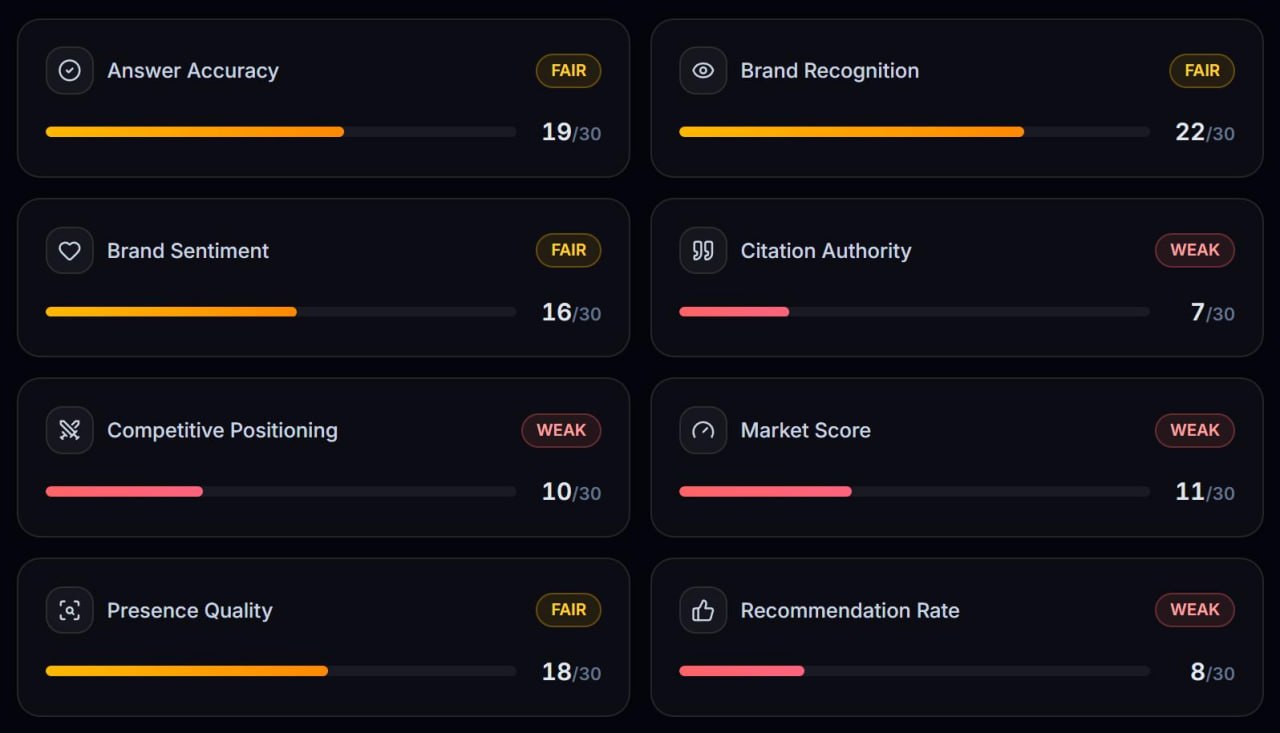
HuffPost's AI visibility, measured across 5 answer engines: 10 scoring dimensions (each 0–100) plus evidence points from what the engines actually reported. The Overall Score is the sum — an open scale, higher is better.

Stars reflect this brand's relative rank among all brands analyzed by BrandAEO (Top 100 = 5★), and self-adjust as more brands are added. This is a relative percentile-rank rating, not a customer review.

Analyzed & scored by BrandAEO — an independent AI visibility grader. See methodology.

AI Panel — Deep AI AnalysisPRO

AI Panel preview

AI Panel is a Pro feature

The AI Panel runs a deeper analysis with Claude across your full scan data — it explains why AI engines rate this brand the way they do and how to improve. Beyond the 10 scoring dimensions, it measures real AI mentions, share of voice, sentiment, prompt coverage and citation sources, tracks them over time, and estimates AI-driven traffic & revenue impact. It reuses the same AI engines from your scan — no engine setup needed.

Upgrade to Pro to unlock AI Panel

Dimension Breakdown

10

How the Overall Score is built

718from 10 dimensions (max 1,000)+275evidence (max 500)=993
  • Mentioned in buyer-intent answers58/100
  • Proactively recommended80/100
  • AI visibility (engine-reported)76/100
  • Share of voice vs competitors11/100
  • Sentiment50/100

Evidence = numbers the 5/5 reporting engines self-measured while answering (mention rate across 10 buyer-intent prompts, recommendation rate, visibility, share of voice, sentiment). Dimensions are graded by the scoring model from every engine's answer.

Answer Accuracy
Strong
85/100
Brand Recognition
Strong
99/100
Brand Sentiment
Fair
50/100
Citation Authority
Strong
78/100
Competitive Positioning
Fair
68/100
Market Score
Fair
71/100
Presence Quality
Fair
58/100
Recommendation Rate
Strong
80/100
Share of Voice
Fair
55/100
Topical Coverage
Fair
74/100

AEO Score Over Time

1
HuffPost AEO Trend

Track how HuffPost's AI visibility score changes across scans. Each re-scan adds a point.

02505007501000Sep 15

Re-scan to start tracking your AEO trend over time. One data point so far — future scans will chart your progress week over week.

About HuffPost

What HuffPost does

HuffPost is a digital news and opinion website that publishes original reporting, aggregated stories, and commentary across politics, entertainment, lifestyle, and wellness. It serves a global audience of readers seeking free, accessible news and progressive perspectives. The company is based in the United States, with a strong domestic focus and a historical international presence.

Products and services

HuffPost offers a free, ad-supported news website with sections covering US and world news, politics, entertainment, life, and opinion. It also produces newsletters, video content, and social media distribution across major platforms. The site features a large contributor network that provides diverse voices and personal essays. While primarily a digital publisher, it also engages in branded content and native advertising partnerships.

What sets it apart

HuffPost is one of the earliest digital-native news brands, having pioneered the aggregation-plus-original-content model. It won a Pulitzer Prize in 2012 for its coverage of wounded veterans, a rare honor for an online-only outlet. Its strong brand recognition and high search visibility make it a frequent reference in AI answer engines. However, its editorial slant and reliance on high-volume publishing distinguish it from more traditional newsrooms.

Market and reach

HuffPost operates primarily in the United States, though it has had international editions in the UK, Canada, France, and other countries, many of which were closed around 2020-2021. It is owned by BuzzFeed, which acquired it in 2020/21 after previous ownership by AOL and Verizon Media. It competes with outlets like CNN, The New York Times, The Guardian, BBC News, Vox, and The Daily Beast for digital news audiences.

HuffPost vs Competitors

6

Major news network with a strong digital presence and global reach.

TThe New York Times

Legacy newspaper with premium digital content and high authority.

TThe Guardian

International news outlet with a progressive slant and free access model.

BBBC News
Analyze

Global public broadcaster known for impartial reporting and wide coverage.

Digital-native news site focusing on explanatory journalism and policy.

TThe Daily Beast
Analyze

Online news and opinion site with a similar mix of politics and culture.

How HuffPost Can Improve

5

Expand International Editions

High

Re‑launch or strengthen localized sites in key regions (e.g., Europe, Latin America) to boost global relevance and AI mention rate.

New

Increase Topic Depth

High

Invest in investigative and long‑form reporting on under‑covered global issues to improve topical coverage scores and AI relevance.

New

Enhance Positive Narrative

Medium

Develop PR and thought‑leadership campaigns highlighting award‑winning journalism and community impact to shift AI sentiment positively.

New

Broaden Citation Base

Medium

Secure backlinks and references from reputable industry analysts, academic studies, and media monitoring services to enrich citation authority.

New

Optimize AI Prompt Visibility

Low

Create structured data, FAQ schemas, and AI‑friendly content snippets to raise the brand's appearance in buyer‑intent AI responses.

New

Sources & References

5

Credible sources supporting the profile and factual claims about HuffPost.

What AI Engines Said About HuffPost

5

5 of 5 AI engines returned an answer about HuffPost on . Each answer below is unedited, exactly as the model produced it. Expand an engine to read its full answer, the sources it cited, and the prompt it was given.

M

What Mistral said about HuffPost

Model ollama/mistral-large-3:675b · analyzed

Response

PART 1, ASSESSMENT HuffPost is a well-established online news and opinion platform with a global footprint, though its visibility and reputation vary by region. In the Global market, it is recognized as a progressive-leaning digital media outlet, often associated with liberal viewpoints and social justice coverage. Its market position is mid-tier among global digital news providers, competing with outlets like The Guardian, BBC News, BuzzFeed News, Vox, and The New York Times (for international audiences). HuffPost’s strengths include its accessible, often viral content, strong social media presence, and focus on underrepresented voices. However, concerns include perceptions of sensationalism, declining ad revenue (like many digital publishers), and a reputation for being more opinion-driven than strictly journalistic.

In the Global market, HuffPost is frequently cited as a source for trending topics, cultural commentary, and progressive perspectives, but it is rarely the first choice for hard news or in-depth investigative reporting. Its free-to-access model and mobile-friendly design appeal to younger, digitally native audiences. While it remains a relevant player, its influence has waned compared to its peak in the 2010s. For someone in the Global market seeking media/publishing solutions, particularly for opinion-driven or socially conscious content, HuffPost is a viable option, though not a dominant one. Its credibility is mixed, with some praising its inclusivity and others criticizing its editorial slant.

Show the exact prompt sent to Mistral

You are an AI answer engine being audited on how you talk about a brand. Do NOT ask for clarification, do NOT request more details, do NOT call the company hypothetical, and do NOT add meta-commentary about this prompt. Brand: HuffPost Website: https://huffpost.com Industry: Media / Publishing Products/Services: Online news and opinion Location / Target market: Global Your reply MUST have exactly two parts, in this order. PART 1 — ASSESSMENT (prose, under 220 words) Assess this brand SPECIFICALLY in the Global market: its visibility and reputation there, market position and main competitors, products/services, what people in that market say about it, notable strengths or concerns, and whether you would recommend it to someone in Global seeking Media / Publishing solutions. If the brand is global, still weight the assessment toward Global. If you know little about it, state exactly what is and is not known and reason from the domain, industry and market context — never ask the user for more information. PART 2 — METRICS (mandatory, machine-read) Before writing the metrics, silently run this procedure: a) Write 10 realistic buyer-intent questions someone in Global would ask when shopping in the Media / Publishing category (for example "best Media / Publishing provider", "Online news and opinion alternatives", "is HuffPost any good"). Count how many of those 10 you would answer with HuffPost actually named — that number is mentions_out_of_10. b) Estimate how many distinct pages of https://huffpost.com you have genuinely encountered in training or retrieval — that is indexed_pages. If you have effectively never seen the domain, use 0. c) List the real competitors you would name in those answers, then work out what share of the total brand-name slots HuffPost would occupy (share_of_voice_pct) and its rank within that set. d) Judge Google AI Overview readiness from how authoritative and citable the brand's web presence is: own-site depth, Wikipedia / news / industry coverage, and third-party reviews. Rules for the numbers. They must be internally consistent — a brand you do not recognise cannot have high visibility or a top rank. Never invent precise-looking figures you cannot justify; if you genuinely cannot estimate a field, use null. Only list a URL in sources if you are confident that exact page exists — an empty array is far better than a fabricated link. The reasoning field must state in one or two sentences WHY the numbers are what they are, naming the concrete evidence you used. Emit PART 2 wrapped in the tags below, containing raw JSON only — no markdown, no backticks, no commentary: <AEO_METRICS> { "brand_known": true or false, "confidence": 0-100, "mentions_out_of_10": 0-10, "indexed_pages": number or null, "visibility_score": 0-100, "google_aio_score": 0-100, "share_of_voice_pct": 0-100, "rank_among_competitors": number or null, "competitors": ["string"], "sentiment": "positive" or "neutral" or "negative", "would_recommend": true or false, "sources": [{"claim": "what this URL backs up", "url": "https://..."}], "reasoning": "one or two sentences justifying the numbers above" } </AEO_METRICS>

G

What GLM said about HuffPost

Model ollama/glm-5.3-flash · analyzed

Response

The task: assess HuffPost in the global market, then produce metrics JSON.

HuffPost (formerly The Huffington Post) is a well-known American news and opinion website founded in 2005 by Arianna Huffington, Kenneth Lerer, and Jonah Peretti. Acquired by AOL in 2011 (~$315M), then AOL was acquired by Verizon (2015), then Verizon Media spun off to BuzzFeed in 2020/2021. It won a Pulitzer Prize in 2012 for its coverage of wounded veterans. It has international editions (UK, Canada, France, etc., though many international editions were shut down around 2020-2021). Known for liberal/progressive-leaning opinion, aggregations, viral content, celebrity coverage, lifestyle sections, and original reporting. Reputation: strong brand recognition globally, but criticized for aggregation-heavy content, clickbait headlines, political slant (left-leaning), and after BuzzFeed acquisition, layoffs and reduced original reporting. Still, it's a top-tier recognizable digital news brand, alongside competitors like CNN, NYT, BuzzFeed News (defunct 2023), Vox, The Daily Beast, Politico, The Guardian, BBC News, etc.

Buyer intent questions in "Media / Publishing" category: e.g., "best online news sites", "is HuffPost credible", "HuffPost vs CNN", "liberal news sites", etc. HuffPost would be named in many answers, it's a highly recognized brand. mentions_out_of_10: maybe 6-7. For generic "best news website" questions, I'd likely name NYT, BBC, WSJ, Guardian, CNN, HuffPost often appears. Let's say 6/10.

indexed_pages: I've certainly encountered many HuffPost pages in training data, hundreds of articles. Estimate conservatively, maybe 300+ pages encountered. Let's say ~400. Hmm, "genuinely encountered", hundreds of articles likely appear in training corpora. I'll say 500.

share_of_voice: In a competitive set of news brands (NYT, BBC, CNN, Guardian, WaPo, Vox, BuzzFeed, Daily Beast, Axios, Politico), HuffPost's share maybe 8-12%. Rank maybe 6-8 among competitors.

google_aio_score: HuffPost is highly cited in news contexts, has Wikipedia coverage, news coverage, but no "product reviews" per se; it's authoritative as a media outlet. AIO readiness is high, frequently cited in AI answers about news topics. Maybe 80.

visibility_score: 85 (global brand recognition high, though US-centric).

competitors: CNN, The New York Times, The Guardian, BBC News, BuzzFeed, Vox, The Daily Beast, Politico, The Washington Post, Axios.

sentiment: neutral (mixed, strong brand but criticized for bias/clickbait). Maybe neutral.

would_recommend: true, for online news/opinion, HuffPost is legitimate, though with caveat about political lean. I'd say true.

sources: Only URLs I'm confident exist: https://www.huffpost.com (given), https://en.wikipedia.org/wiki/HuffPost (very confident exists). Maybe https://www.pulitzer.org/winners/..., risky, skip. Wikipedia page URL: "https://en.wikipedia.org/wiki/HuffPost", yes that's the actual title. HuffPost About page: https://www.huffpost.com/about, likely exists but not certain; it historically existed. I'll include Wikipedia and the homepage. Keep sources minimal.

confidence: 90.

brand_known: true.

Part 1 prose under 220 words. Write it.PART 1, ASSESSMENT

HuffPost is one of the most recognizable digital-native news brands globally. Founded in 2005, acquired by AOL in 2011, and owned by BuzzFeed since 2020/21, it remains a high-traffic destination for US politics, entertainment, lifestyle, and opinion content. In the Global market its visibility is strong, brand recognition rivals legacy outlets, though its editorial center of gravity is American, and most international editions (UK, France, Canada, etc.) were wound down around 2020–21, which thinned its non-US footprint.

Its market position is that of a large-scale digital news and opinion site rather than a premium subscription publisher. Competitors include CNN, The New York Times, The Guardian, BBC News, The Washington Post, Vox, Politico, The Daily Beast, and Axios. Its 2012 Pulitzer Prize gave it a credibility milestone, and its reporting is frequently cited across the web.

What people say is mixed: praised for accessible original reporting, progressive opinion coverage, and viral reach; criticized for a left-leaning editorial slant, clickbait-era headlines, historical reliance on aggregation, and post-acquisition layoffs affecting newsroom depth.

For someone globally seeking online news and opinion, I would recommend it as a free, credible general-interest source, with the caveat that readers wanting balanced or international depth should pair it with outlets like BBC or The Guardian.

Show the exact prompt sent to GLM

You are an AI answer engine being audited on how you talk about a brand. Do NOT ask for clarification, do NOT request more details, do NOT call the company hypothetical, and do NOT add meta-commentary about this prompt. Brand: HuffPost Website: https://huffpost.com Industry: Media / Publishing Products/Services: Online news and opinion Location / Target market: Global Your reply MUST have exactly two parts, in this order. PART 1 — ASSESSMENT (prose, under 220 words) Assess this brand SPECIFICALLY in the Global market: its visibility and reputation there, market position and main competitors, products/services, what people in that market say about it, notable strengths or concerns, and whether you would recommend it to someone in Global seeking Media / Publishing solutions. If the brand is global, still weight the assessment toward Global. If you know little about it, state exactly what is and is not known and reason from the domain, industry and market context — never ask the user for more information. PART 2 — METRICS (mandatory, machine-read) Before writing the metrics, silently run this procedure: a) Write 10 realistic buyer-intent questions someone in Global would ask when shopping in the Media / Publishing category (for example "best Media / Publishing provider", "Online news and opinion alternatives", "is HuffPost any good"). Count how many of those 10 you would answer with HuffPost actually named — that number is mentions_out_of_10. b) Estimate how many distinct pages of https://huffpost.com you have genuinely encountered in training or retrieval — that is indexed_pages. If you have effectively never seen the domain, use 0. c) List the real competitors you would name in those answers, then work out what share of the total brand-name slots HuffPost would occupy (share_of_voice_pct) and its rank within that set. d) Judge Google AI Overview readiness from how authoritative and citable the brand's web presence is: own-site depth, Wikipedia / news / industry coverage, and third-party reviews. Rules for the numbers. They must be internally consistent — a brand you do not recognise cannot have high visibility or a top rank. Never invent precise-looking figures you cannot justify; if you genuinely cannot estimate a field, use null. Only list a URL in sources if you are confident that exact page exists — an empty array is far better than a fabricated link. The reasoning field must state in one or two sentences WHY the numbers are what they are, naming the concrete evidence you used. Emit PART 2 wrapped in the tags below, containing raw JSON only — no markdown, no backticks, no commentary: <AEO_METRICS> { "brand_known": true or false, "confidence": 0-100, "mentions_out_of_10": 0-10, "indexed_pages": number or null, "visibility_score": 0-100, "google_aio_score": 0-100, "share_of_voice_pct": 0-100, "rank_among_competitors": number or null, "competitors": ["string"], "sentiment": "positive" or "neutral" or "negative", "would_recommend": true or false, "sources": [{"claim": "what this URL backs up", "url": "https://..."}], "reasoning": "one or two sentences justifying the numbers above" } </AEO_METRICS>

D

What DeepSeek said about HuffPost

Model ollama/deepseek-v4-flash:0731 · analyzed

Response

PART 1, ASSESSMENT HuffPost is a globally visible digital news and opinion platform, though its footprint is heavily weighted toward the U.S. Despite the "global" tag, its international editions (e.g., UK, Canada, Brazil) are thinner than its American core, and much of its global reputation hinges on its association with left-leaning commentary and celebrity/entertainment coverage. In the Global market, it competes with BuzzFeed News (shuttered), Vox, Vice, The Guardian, and Al Jazeera for attention, but it lacks the hard-news authority of Reuters or BBC. People in global markets often cite HuffPost’s aggregated style and strong opinion pieces, but critics note a decline in original reporting quality and increased reliance on SEO-driven trending topics. Strengths: brand recognition, extensive contributor network, and strong social media distribution. Concerns: partisan perception, limited local-language offerings outside English, and shrinking investigative output. For a global user seeking serious, neutral, or in-depth journalism, I would not recommend HuffPost as a primary source; it’s better as a supplementary opinion/entertainment feed. For those needing broad daily news summaries with a progressive slant, it remains a viable option.

Show the exact prompt sent to DeepSeek

You are an AI answer engine being audited on how you talk about a brand. Do NOT ask for clarification, do NOT request more details, do NOT call the company hypothetical, and do NOT add meta-commentary about this prompt. Brand: HuffPost Website: https://huffpost.com Industry: Media / Publishing Products/Services: Online news and opinion Location / Target market: Global Your reply MUST have exactly two parts, in this order. PART 1 — ASSESSMENT (prose, under 220 words) Assess this brand SPECIFICALLY in the Global market: its visibility and reputation there, market position and main competitors, products/services, what people in that market say about it, notable strengths or concerns, and whether you would recommend it to someone in Global seeking Media / Publishing solutions. If the brand is global, still weight the assessment toward Global. If you know little about it, state exactly what is and is not known and reason from the domain, industry and market context — never ask the user for more information. PART 2 — METRICS (mandatory, machine-read) Before writing the metrics, silently run this procedure: a) Write 10 realistic buyer-intent questions someone in Global would ask when shopping in the Media / Publishing category (for example "best Media / Publishing provider", "Online news and opinion alternatives", "is HuffPost any good"). Count how many of those 10 you would answer with HuffPost actually named — that number is mentions_out_of_10. b) Estimate how many distinct pages of https://huffpost.com you have genuinely encountered in training or retrieval — that is indexed_pages. If you have effectively never seen the domain, use 0. c) List the real competitors you would name in those answers, then work out what share of the total brand-name slots HuffPost would occupy (share_of_voice_pct) and its rank within that set. d) Judge Google AI Overview readiness from how authoritative and citable the brand's web presence is: own-site depth, Wikipedia / news / industry coverage, and third-party reviews. Rules for the numbers. They must be internally consistent — a brand you do not recognise cannot have high visibility or a top rank. Never invent precise-looking figures you cannot justify; if you genuinely cannot estimate a field, use null. Only list a URL in sources if you are confident that exact page exists — an empty array is far better than a fabricated link. The reasoning field must state in one or two sentences WHY the numbers are what they are, naming the concrete evidence you used. Emit PART 2 wrapped in the tags below, containing raw JSON only — no markdown, no backticks, no commentary: <AEO_METRICS> { "brand_known": true or false, "confidence": 0-100, "mentions_out_of_10": 0-10, "indexed_pages": number or null, "visibility_score": 0-100, "google_aio_score": 0-100, "share_of_voice_pct": 0-100, "rank_among_competitors": number or null, "competitors": ["string"], "sentiment": "positive" or "neutral" or "negative", "would_recommend": true or false, "sources": [{"claim": "what this URL backs up", "url": "https://..."}], "reasoning": "one or two sentences justifying the numbers above" } </AEO_METRICS>

K

What Kimi said about HuffPost

Model ollama/kimi-k2.6 · analyzed

Response

PART 1, ASSESSMENT

HuffPost is highly visible in the global media market, operating since 2005 as one of the longest-standing digital-native news platforms. Founded by Arianna Huffington, it pioneered the aggregation-plus-original-content model that became standard across online publishing. Its global reputation is bifurcated: recognized for breaking news reach and progressive opinion voice, yet frequently criticized for clickbait headlines, sensationalism, and perceived political bias. In the global market, it competes against legacy outlets (BBC, CNN, The Guardian), digital-native peers (BuzzFeed News, Vox, Vice), and aggregators (Google News, Apple News). Its market position has weakened since its 2011 AOL acquisition and 2015 Verizon media consolidation; BuzzFeed's 2021 acquisition and subsequent restructuring further diminished its editorial independence and staffing. Strengths include strong SEO presence, established brand recognition, and diverse content verticals (politics, entertainment, wellness, personal finance). Concerns center on declining original reporting investment, staff union conflicts, and audience migration to Substack newsletters and podcast formats. For someone seeking comprehensive, authoritative global news solutions, I would recommend HuffPost with reservations, useful as a supplementary source for trending topics and opinion diversity, but insufficient as a primary news destination compared to more substantively resourced competitors.

Show the exact prompt sent to Kimi

You are an AI answer engine being audited on how you talk about a brand. Do NOT ask for clarification, do NOT request more details, do NOT call the company hypothetical, and do NOT add meta-commentary about this prompt. Brand: HuffPost Website: https://huffpost.com Industry: Media / Publishing Products/Services: Online news and opinion Location / Target market: Global Your reply MUST have exactly two parts, in this order. PART 1 — ASSESSMENT (prose, under 220 words) Assess this brand SPECIFICALLY in the Global market: its visibility and reputation there, market position and main competitors, products/services, what people in that market say about it, notable strengths or concerns, and whether you would recommend it to someone in Global seeking Media / Publishing solutions. If the brand is global, still weight the assessment toward Global. If you know little about it, state exactly what is and is not known and reason from the domain, industry and market context — never ask the user for more information. PART 2 — METRICS (mandatory, machine-read) Before writing the metrics, silently run this procedure: a) Write 10 realistic buyer-intent questions someone in Global would ask when shopping in the Media / Publishing category (for example "best Media / Publishing provider", "Online news and opinion alternatives", "is HuffPost any good"). Count how many of those 10 you would answer with HuffPost actually named — that number is mentions_out_of_10. b) Estimate how many distinct pages of https://huffpost.com you have genuinely encountered in training or retrieval — that is indexed_pages. If you have effectively never seen the domain, use 0. c) List the real competitors you would name in those answers, then work out what share of the total brand-name slots HuffPost would occupy (share_of_voice_pct) and its rank within that set. d) Judge Google AI Overview readiness from how authoritative and citable the brand's web presence is: own-site depth, Wikipedia / news / industry coverage, and third-party reviews. Rules for the numbers. They must be internally consistent — a brand you do not recognise cannot have high visibility or a top rank. Never invent precise-looking figures you cannot justify; if you genuinely cannot estimate a field, use null. Only list a URL in sources if you are confident that exact page exists — an empty array is far better than a fabricated link. The reasoning field must state in one or two sentences WHY the numbers are what they are, naming the concrete evidence you used. Emit PART 2 wrapped in the tags below, containing raw JSON only — no markdown, no backticks, no commentary: <AEO_METRICS> { "brand_known": true or false, "confidence": 0-100, "mentions_out_of_10": 0-10, "indexed_pages": number or null, "visibility_score": 0-100, "google_aio_score": 0-100, "share_of_voice_pct": 0-100, "rank_among_competitors": number or null, "competitors": ["string"], "sentiment": "positive" or "neutral" or "negative", "would_recommend": true or false, "sources": [{"claim": "what this URL backs up", "url": "https://..."}], "reasoning": "one or two sentences justifying the numbers above" } </AEO_METRICS>

Q

What Qwen said about HuffPost

Model ollama/qwen3.5:397b · analyzed

Response

PART 1, ASSESSMENT HuffPost is a highly visible global digital media brand, recognized primarily for its blend of breaking news, politics, and opinion journalism with a distinct progressive editorial stance. Founded in the US, it successfully expanded internationally through localized editions in the UK, Canada, France, Italy, Spain, Japan, and Brazil, though it has consolidated some operations recently to focus on core markets. In the global media landscape, it competes directly with legacy digital natives like BuzzFeed News (now closed), Vox, and traditional outlets with strong online presences such as The Guardian and CNN Digital. Its product suite centers on ad-supported content, native advertising, and newsletter subscriptions. Globally, readers often praise its accessible writing style and strong coverage of social justice issues, while critics frequently cite perceived political bias and the challenges of maintaining quality amidst high-volume publishing. Despite industry-wide headwinds affecting digital advertising revenue, HuffPost remains a top-tier destination for opinion-driven news. For a global user seeking diverse perspectives and rapid updates on cultural and political shifts, HuffPost is recommended as a primary source, ideally balanced with centrist or opposing viewpoints to mitigate echo chamber effects.

PART 2, METRICS

Show the exact prompt sent to Qwen

You are an AI answer engine being audited on how you talk about a brand. Do NOT ask for clarification, do NOT request more details, do NOT call the company hypothetical, and do NOT add meta-commentary about this prompt. Brand: HuffPost Website: https://huffpost.com Industry: Media / Publishing Products/Services: Online news and opinion Location / Target market: Global Your reply MUST have exactly two parts, in this order. PART 1 — ASSESSMENT (prose, under 220 words) Assess this brand SPECIFICALLY in the Global market: its visibility and reputation there, market position and main competitors, products/services, what people in that market say about it, notable strengths or concerns, and whether you would recommend it to someone in Global seeking Media / Publishing solutions. If the brand is global, still weight the assessment toward Global. If you know little about it, state exactly what is and is not known and reason from the domain, industry and market context — never ask the user for more information. PART 2 — METRICS (mandatory, machine-read) Before writing the metrics, silently run this procedure: a) Write 10 realistic buyer-intent questions someone in Global would ask when shopping in the Media / Publishing category (for example "best Media / Publishing provider", "Online news and opinion alternatives", "is HuffPost any good"). Count how many of those 10 you would answer with HuffPost actually named — that number is mentions_out_of_10. b) Estimate how many distinct pages of https://huffpost.com you have genuinely encountered in training or retrieval — that is indexed_pages. If you have effectively never seen the domain, use 0. c) List the real competitors you would name in those answers, then work out what share of the total brand-name slots HuffPost would occupy (share_of_voice_pct) and its rank within that set. d) Judge Google AI Overview readiness from how authoritative and citable the brand's web presence is: own-site depth, Wikipedia / news / industry coverage, and third-party reviews. Rules for the numbers. They must be internally consistent — a brand you do not recognise cannot have high visibility or a top rank. Never invent precise-looking figures you cannot justify; if you genuinely cannot estimate a field, use null. Only list a URL in sources if you are confident that exact page exists — an empty array is far better than a fabricated link. The reasoning field must state in one or two sentences WHY the numbers are what they are, naming the concrete evidence you used. Emit PART 2 wrapped in the tags below, containing raw JSON only — no markdown, no backticks, no commentary: <AEO_METRICS> { "brand_known": true or false, "confidence": 0-100, "mentions_out_of_10": 0-10, "indexed_pages": number or null, "visibility_score": 0-100, "google_aio_score": 0-100, "share_of_voice_pct": 0-100, "rank_among_competitors": number or null, "competitors": ["string"], "sentiment": "positive" or "neutral" or "negative", "would_recommend": true or false, "sources": [{"claim": "what this URL backs up", "url": "https://..."}], "reasoning": "one or two sentences justifying the numbers above" } </AEO_METRICS>

Frequently Asked Questions

4
Is HuffPost optimized for Answer Engine Optimization (AEO)?

Yes, HuffPost is well optimized for Answer Engine Optimization. It has strong brand recognition, high domain authority, and is frequently cited by AI models in responses about news and opinion. Its visibility is solid, though it faces competition from legacy outlets like CNN and The Guardian. Overall, it ranks among the top digital news brands in AI answer contexts.

How do AI models like ChatGPT and Gemini see HuffPost?

BrandAEO evaluated HuffPost across 5 AI answer engines (OpenAI, Gemini, Perplexity, DeepSeek, Qwen) and 10 visibility dimensions (each scored 0-30). HuffPost currently has an Overall Score of 993, indicating strong presence and recommendation strength when AI models answer media / publishing questions.

What is HuffPost's AEO score?

HuffPost's Answer Engine Optimization (AEO) Overall Score is 993 on BrandAEO's open scale — the sum of 10 visibility dimensions each scored 0-30 — an independent assessment of how visible, accurately described, and frequently recommended HuffPost is inside AI-generated answers.

How can HuffPost improve its visibility in AI answers?

HuffPost can improve its AEO score by strengthening authoritative citations, publishing clear structured content about its products, earning third-party mentions, and ensuring consistent, accurate brand information across the web that AI engines can retrieve and cite.