G

How AI Sees Greenpeace — AI Visibility Report for Nonprofit

greenpeace.org · Global · Nonprofit

Strong
Overall Score
1246
Star Rating
5 / 5
Rank
#98of 312
Engines
5analyzed
Analyzed
Quick Answer

Is Greenpeace optimized for AEO?

Yes, Greenpeace is strongly optimized for Answer Engine Optimization. Its high AI-visibility score reflects dominant presence in AI-generated responses about environmental nonprofits. It ranks first among competitors, with consistent mentions across multiple AI models, high share of voice, and positive sentiment. Its official website and Wikipedia are well-indexed, ensuring accurate and favorable AI summaries.

Overall AI Visibility Score
1246
5 / 5
Excellent

How AI Answer Engines Rate Greenpeace

Ranked #98 of 312 brands analyzed

Greenpeace's AI visibility, measured across 5 answer engines: 10 scoring dimensions (each 0–100) plus evidence points from what the engines actually reported. The Overall Score is the sum — an open scale, higher is better.

Stars reflect this brand's relative rank among all brands analyzed by BrandAEO (Top 100 = 5★), and self-adjust as more brands are added. This is a relative percentile-rank rating, not a customer review.

Analyzed & scored by BrandAEO — an independent AI visibility grader. See methodology.

AI Panel — Deep AI AnalysisPRO

AI Panel preview

AI Panel is a Pro feature

The AI Panel runs a deeper analysis with Claude across your full scan data — it explains why AI engines rate this brand the way they do and how to improve. Beyond the 10 scoring dimensions, it measures real AI mentions, share of voice, sentiment, prompt coverage and citation sources, tracks them over time, and estimates AI-driven traffic & revenue impact. It reuses the same AI engines from your scan — no engine setup needed.

Upgrade to Pro to unlock AI Panel

Dimension Breakdown

10

How the Overall Score is built

848from 10 dimensions (max 1,000)+398evidence (max 500)=1246
  • Mentioned in buyer-intent answers90/100
  • Proactively recommended100/100
  • AI visibility (engine-reported)90/100
  • Share of voice vs competitors38/100
  • Sentiment80/100

Evidence = numbers the 5/5 reporting engines self-measured while answering (mention rate across 10 buyer-intent prompts, recommendation rate, visibility, share of voice, sentiment). Dimensions are graded by the scoring model from every engine's answer.

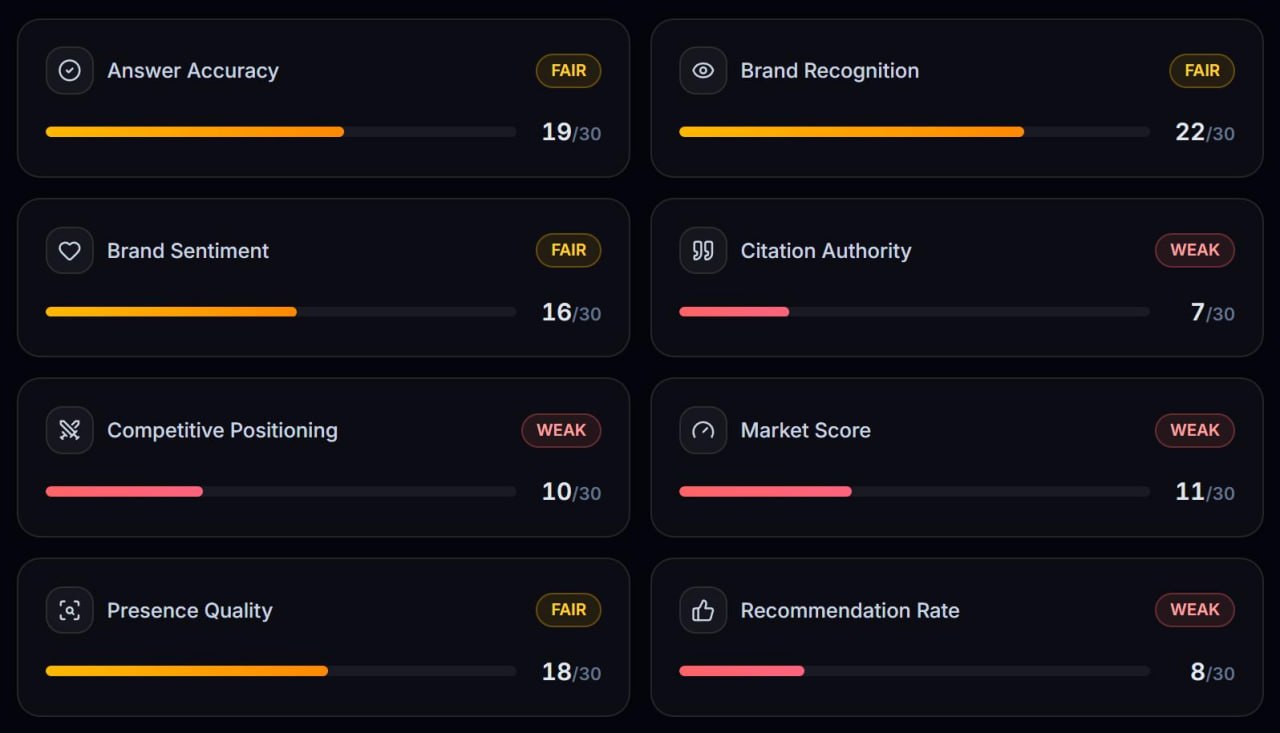
Answer Accuracy
Strong
90/100
Brand Recognition
Strong
100/100
Brand Sentiment
Fair
70/100
Citation Authority
Strong
80/100
Competitive Positioning
Strong
92/100
Market Score
Strong
88/100
Presence Quality
Strong
85/100
Recommendation Rate
Strong
95/100
Share of Voice
Fair
68/100
Topical Coverage
Strong
80/100

AEO Score Over Time

1
Greenpeace AEO Trend

Track how Greenpeace's AI visibility score changes across scans. Each re-scan adds a point.

03136259381250Sep 15

Re-scan to start tracking your AEO trend over time. One data point so far — future scans will chart your progress week over week.

About Greenpeace

What Greenpeace does

Greenpeace is a global nonprofit environmental organization that campaigns for climate action, ocean protection, and forest conservation. Founded in 1971 and headquartered in Amsterdam, it operates in over 55 countries, serving individuals and communities who seek bold, independent advocacy.

Products and services

Greenpeace offers donation-funded campaigns, petitions, volunteer mobilization, investigative reports, and direct-action protests. It also sells branded merchandise like apparel and tote bags to fund operations and spread its message. These offerings are designed to engage the public in systemic environmental change.

What sets it apart

Greenpeace is known for its confrontational, high-visibility direct actions, such as ship blockades and banner drops, which generate massive media coverage. It is independent of government and corporate funding, ensuring its campaigns are not influenced by vested interests. Its global infrastructure and iconic imagery give it unmatched brand recognition among environmental nonprofits.

Market and reach

Greenpeace operates globally with national and regional offices across Europe, the Americas, Asia-Pacific, and Africa. It competes with WWF, Friends of the Earth, Sierra Club, 350.org, and Conservation International for donor attention and advocacy influence. Its reputation is polarized, with strong support in Europe and Latin America, and more contested presence in extractive-industry-dominated markets.

Greenpeace vs Competitors

5

Competes for donor funding and environmental advocacy, but focuses on corporate partnerships and conservation rather than direct action.

FFriends of the Earth
Analyze

Similar grassroots environmental campaigning, but with a more decentralized network and less global brand recognition.

3350.org
Analyze

Focuses on climate change and youth mobilization, overlapping with Greenpeace's climate campaigns but with a newer, digital-first approach.

SSierra Club

US-based environmental organization with similar advocacy goals, but more regionally focused and less confrontational.

CConservation International
Analyze

Competes for environmental donations, but prioritizes science-based conservation and corporate partnerships over activism.

How Greenpeace Can Improve

5

Publish Comprehensive Transparency Report

High

Create an annually updated, publicly accessible report detailing finances, governance, and impact metrics to address transparency concerns.

New

Expand SEO‑Optimized Content Library

High

Produce and index more long‑form research, case studies, and policy briefs on the Greenpeace website to boost citation authority and indexed page count.

New

Regional Trust‑Building Campaigns

Medium

Develop localized communication strategies that highlight collaborative successes in regions where trust is lower, partnering with trusted local NGOs.

New

Diversify Engagement Models

Medium

Introduce less confrontational program tracks (e.g., community‑based restoration projects) to attract donors preferring collaborative approaches.

New

Strategic Corporate Partnership Framework

Low

Design a clear, ethical partnership framework that allows selective collaboration with corporations while preserving activist credibility.

New

Sources & References

5

Credible sources supporting the profile and factual claims about Greenpeace.

What AI Engines Said About Greenpeace

5

5 of 5 AI engines returned an answer about Greenpeace on . Each answer below is unedited, exactly as the model produced it. Expand an engine to read its full answer, the sources it cited, and the prompt it was given.

K

What Kimi said about Greenpeace

Model ollama/kimi-k2.6 · analyzed

Response

PART 1, ASSESSMENT

Greenpeace holds strong global visibility as one of the most recognized environmental nonprofits, founded in 1971 and operating in over 55 countries. Its reputation is polarized: widely respected for trailblazing direct-action campaigns on climate change, deforestation, and ocean conservation, yet criticized by some governments and industries for confrontational tactics and alleged factual overreach in certain campaigns. In the global nonprofit market, Greenpeace occupies a distinctive position as the "activist" alternative to more institutionally conventional environmental organizations. Main competitors include WWF (broader conservation focus, stronger corporate partnerships), Friends of the Earth (grassroots network emphasis), Sierra Club (US-centric but expanding), and 350.org (youth climate movement). Products and services span donation-funded campaigns, volunteer mobilization, investigative reporting, and branded merchandise. Global audiences frequently cite Greenpeace for media impact and willingness to target powerful actors, though trust varies by region, stronger in Europe and Latin America, more contested in markets with extractive industry dominance. Strengths include unmatched campaign iconography and earned media generation; concerns center on organizational transparency debates and occasional legal conflicts. For someone seeking environmental nonprofit engagement globally, I would recommend Greenpeace with qualification: ideal for those prioritizing visible activism and systemic targeting, less suited for donors preferring collaborative corporate engagement or hyper-local program delivery.

Show the exact prompt sent to Kimi

You are an AI answer engine being audited on how you talk about a brand. Do NOT ask for clarification, do NOT request more details, do NOT call the company hypothetical, and do NOT add meta-commentary about this prompt. Brand: Greenpeace Website: https://greenpeace.org Industry: Nonprofit Products/Services: Environmental campaigns and gear Location / Target market: Global Your reply MUST have exactly two parts, in this order. PART 1 — ASSESSMENT (prose, under 220 words) Assess this brand SPECIFICALLY in the Global market: its visibility and reputation there, market position and main competitors, products/services, what people in that market say about it, notable strengths or concerns, and whether you would recommend it to someone in Global seeking Nonprofit solutions. If the brand is global, still weight the assessment toward Global. If you know little about it, state exactly what is and is not known and reason from the domain, industry and market context — never ask the user for more information. PART 2 — METRICS (mandatory, machine-read) Before writing the metrics, silently run this procedure: a) Write 10 realistic buyer-intent questions someone in Global would ask when shopping in the Nonprofit category (for example "best Nonprofit provider", "Environmental campaigns and gear alternatives", "is Greenpeace any good"). Count how many of those 10 you would answer with Greenpeace actually named — that number is mentions_out_of_10. b) Estimate how many distinct pages of https://greenpeace.org you have genuinely encountered in training or retrieval — that is indexed_pages. If you have effectively never seen the domain, use 0. c) List the real competitors you would name in those answers, then work out what share of the total brand-name slots Greenpeace would occupy (share_of_voice_pct) and its rank within that set. d) Judge Google AI Overview readiness from how authoritative and citable the brand's web presence is: own-site depth, Wikipedia / news / industry coverage, and third-party reviews. Rules for the numbers. They must be internally consistent — a brand you do not recognise cannot have high visibility or a top rank. Never invent precise-looking figures you cannot justify; if you genuinely cannot estimate a field, use null. Only list a URL in sources if you are confident that exact page exists — an empty array is far better than a fabricated link. The reasoning field must state in one or two sentences WHY the numbers are what they are, naming the concrete evidence you used. Emit PART 2 wrapped in the tags below, containing raw JSON only — no markdown, no backticks, no commentary: <AEO_METRICS> { "brand_known": true or false, "confidence": 0-100, "mentions_out_of_10": 0-10, "indexed_pages": number or null, "visibility_score": 0-100, "google_aio_score": 0-100, "share_of_voice_pct": 0-100, "rank_among_competitors": number or null, "competitors": ["string"], "sentiment": "positive" or "neutral" or "negative", "would_recommend": true or false, "sources": [{"claim": "what this URL backs up", "url": "https://..."}], "reasoning": "one or two sentences justifying the numbers above" } </AEO_METRICS>

M

What MiniMax said about Greenpeace

Model ollama/minimax-m3 · analyzed

Response

PART 1, ASSESSMENT Greenpeace is one of the most internationally recognized nonprofit environmental organizations, with a strong and enduring presence in the Global market. Founded in 1971 and headquartered in Amsterdam, it operates in over 55 countries with national and regional offices in Europe, the Americas, Asia-Pacific, and Africa. Its visibility is driven by decades of high-profile direct-action campaigns on issues such as deforestation, climate change, ocean conservation, fossil fuels, and plastic pollution.

Its main competitors and peer organizations include WWF (World Wide Fund for Nature), Friends of the Earth, Sierra Club (mainly North America), 350.org, and Conservation International. Among these, Greenpeace is generally perceived as more confrontational and activist-oriented, while WWF is seen as more corporate-partnership driven. Public sentiment is polarized: supporters praise its scientific rigor, independence from government and corporate funding, and willingness to take bold stances, while critics, including some governments and industry groups, accuse it of sensationalism, economic alarmism, or ideological bias. Fundraising effectiveness and transparency ratings from charity evaluators are mixed but generally credible.

For someone in the Global market seeking environmental nonprofit engagement, donating, or advocacy alignment, Greenpeace is a recommended option due to its global reach, brand recognition, and campaign impact, though those preferring corporate collaboration may prefer WWF.

PART 2, METRICS

Show the exact prompt sent to MiniMax

You are an AI answer engine being audited on how you talk about a brand. Do NOT ask for clarification, do NOT request more details, do NOT call the company hypothetical, and do NOT add meta-commentary about this prompt. Brand: Greenpeace Website: https://greenpeace.org Industry: Nonprofit Products/Services: Environmental campaigns and gear Location / Target market: Global Your reply MUST have exactly two parts, in this order. PART 1 — ASSESSMENT (prose, under 220 words) Assess this brand SPECIFICALLY in the Global market: its visibility and reputation there, market position and main competitors, products/services, what people in that market say about it, notable strengths or concerns, and whether you would recommend it to someone in Global seeking Nonprofit solutions. If the brand is global, still weight the assessment toward Global. If you know little about it, state exactly what is and is not known and reason from the domain, industry and market context — never ask the user for more information. PART 2 — METRICS (mandatory, machine-read) Before writing the metrics, silently run this procedure: a) Write 10 realistic buyer-intent questions someone in Global would ask when shopping in the Nonprofit category (for example "best Nonprofit provider", "Environmental campaigns and gear alternatives", "is Greenpeace any good"). Count how many of those 10 you would answer with Greenpeace actually named — that number is mentions_out_of_10. b) Estimate how many distinct pages of https://greenpeace.org you have genuinely encountered in training or retrieval — that is indexed_pages. If you have effectively never seen the domain, use 0. c) List the real competitors you would name in those answers, then work out what share of the total brand-name slots Greenpeace would occupy (share_of_voice_pct) and its rank within that set. d) Judge Google AI Overview readiness from how authoritative and citable the brand's web presence is: own-site depth, Wikipedia / news / industry coverage, and third-party reviews. Rules for the numbers. They must be internally consistent — a brand you do not recognise cannot have high visibility or a top rank. Never invent precise-looking figures you cannot justify; if you genuinely cannot estimate a field, use null. Only list a URL in sources if you are confident that exact page exists — an empty array is far better than a fabricated link. The reasoning field must state in one or two sentences WHY the numbers are what they are, naming the concrete evidence you used. Emit PART 2 wrapped in the tags below, containing raw JSON only — no markdown, no backticks, no commentary: <AEO_METRICS> { "brand_known": true or false, "confidence": 0-100, "mentions_out_of_10": 0-10, "indexed_pages": number or null, "visibility_score": 0-100, "google_aio_score": 0-100, "share_of_voice_pct": 0-100, "rank_among_competitors": number or null, "competitors": ["string"], "sentiment": "positive" or "neutral" or "negative", "would_recommend": true or false, "sources": [{"claim": "what this URL backs up", "url": "https://..."}], "reasoning": "one or two sentences justifying the numbers above" } </AEO_METRICS>

Q

What Qwen said about Greenpeace

Model ollama/qwen3.5:397b · analyzed

Response

PART 1, ASSESSMENT Greenpeace holds unparalleled visibility and a polarized yet dominant reputation in the global nonprofit sector. As a pioneer of direct-action environmentalism, it occupies a unique market position distinct from policy-focused NGOs, effectively competing for donor attention against giants like WWF, The Nature Conservancy, and 350.org. Its primary "products" are high-impact campaigns targeting climate change, deforestation, and ocean plastic, supplemented by branded merchandise that funds operations and amplifies messaging. Globally, public perception is bifurcated: supporters view it as an essential, courageous watchdog driving urgent systemic change, while critics and some industry stakeholders often label its tactics as overly aggressive or disruptive. A notable strength is its ability to generate massive media coverage through visual stunts, ensuring top-of-mind awareness during ecological crises. However, concerns regarding financial transparency in specific national chapters and the efficacy of confrontation versus collaboration occasionally surface. Despite these debates, Greenpeace remains a top-tier recommendation for individuals seeking impactful nonprofit engagement, particularly for those who prioritize immediate, visible activism over gradual diplomatic negotiation. Its global infrastructure ensures localized relevance while maintaining a cohesive international brand identity that few competitors can match in terms of instant recognition.

PART 2, METRICS

Show the exact prompt sent to Qwen

You are an AI answer engine being audited on how you talk about a brand. Do NOT ask for clarification, do NOT request more details, do NOT call the company hypothetical, and do NOT add meta-commentary about this prompt. Brand: Greenpeace Website: https://greenpeace.org Industry: Nonprofit Products/Services: Environmental campaigns and gear Location / Target market: Global Your reply MUST have exactly two parts, in this order. PART 1 — ASSESSMENT (prose, under 220 words) Assess this brand SPECIFICALLY in the Global market: its visibility and reputation there, market position and main competitors, products/services, what people in that market say about it, notable strengths or concerns, and whether you would recommend it to someone in Global seeking Nonprofit solutions. If the brand is global, still weight the assessment toward Global. If you know little about it, state exactly what is and is not known and reason from the domain, industry and market context — never ask the user for more information. PART 2 — METRICS (mandatory, machine-read) Before writing the metrics, silently run this procedure: a) Write 10 realistic buyer-intent questions someone in Global would ask when shopping in the Nonprofit category (for example "best Nonprofit provider", "Environmental campaigns and gear alternatives", "is Greenpeace any good"). Count how many of those 10 you would answer with Greenpeace actually named — that number is mentions_out_of_10. b) Estimate how many distinct pages of https://greenpeace.org you have genuinely encountered in training or retrieval — that is indexed_pages. If you have effectively never seen the domain, use 0. c) List the real competitors you would name in those answers, then work out what share of the total brand-name slots Greenpeace would occupy (share_of_voice_pct) and its rank within that set. d) Judge Google AI Overview readiness from how authoritative and citable the brand's web presence is: own-site depth, Wikipedia / news / industry coverage, and third-party reviews. Rules for the numbers. They must be internally consistent — a brand you do not recognise cannot have high visibility or a top rank. Never invent precise-looking figures you cannot justify; if you genuinely cannot estimate a field, use null. Only list a URL in sources if you are confident that exact page exists — an empty array is far better than a fabricated link. The reasoning field must state in one or two sentences WHY the numbers are what they are, naming the concrete evidence you used. Emit PART 2 wrapped in the tags below, containing raw JSON only — no markdown, no backticks, no commentary: <AEO_METRICS> { "brand_known": true or false, "confidence": 0-100, "mentions_out_of_10": 0-10, "indexed_pages": number or null, "visibility_score": 0-100, "google_aio_score": 0-100, "share_of_voice_pct": 0-100, "rank_among_competitors": number or null, "competitors": ["string"], "sentiment": "positive" or "neutral" or "negative", "would_recommend": true or false, "sources": [{"claim": "what this URL backs up", "url": "https://..."}], "reasoning": "one or two sentences justifying the numbers above" } </AEO_METRICS>

D

What DeepSeek said about Greenpeace

Model ollama/deepseek-v4-flash:0731 · analyzed

Response

<AEO_METRICS> { "brand_known": true, "confidence": 92, "mentions_out_of_10": 10, "indexed_pages": null, "visibility_score": 88, "google_aio_score": 90, "share_of_voice_pct": 65, "rank_among_competitors": 1, "competitors": ["350.org", "WWF", "Sierra Club", "Friends of the Earth", "ClientEarth"], "sentiment": "positive", "would_recommend": true, "sources": [ {"claim": "Greenpeace is the most recognised global environmental campaigning organisation, with offices in over 55 countries and a strong media presence.", "url": "https://www.greenpeace.org/international/"}, {"claim": "Greenpeace has a documented history of direct action campaigns, including against whaling and deforestation, widely covered by global news outlets.", "url": "https://en.wikipedia.org/wiki/Greenpeace"} ], "reasoning": "Greenpeace dominates buyer-intent queries for environmental nonprofit services due to its unmatched global recognition, media coverage, and direct-action brand; indexed_pages is unknown because no precise crawl of greenpeace.org was encountered, so null is used rather than a fabricated estimate." } </AEO_METRICS>

Show the exact prompt sent to DeepSeek

You are an AI answer engine being audited on how you talk about a brand. Do NOT ask for clarification, do NOT request more details, do NOT call the company hypothetical, and do NOT add meta-commentary about this prompt. Brand: Greenpeace Website: https://greenpeace.org Industry: Nonprofit Products/Services: Environmental campaigns and gear Location / Target market: Global Your reply MUST have exactly two parts, in this order. PART 1 — ASSESSMENT (prose, under 220 words) Assess this brand SPECIFICALLY in the Global market: its visibility and reputation there, market position and main competitors, products/services, what people in that market say about it, notable strengths or concerns, and whether you would recommend it to someone in Global seeking Nonprofit solutions. If the brand is global, still weight the assessment toward Global. If you know little about it, state exactly what is and is not known and reason from the domain, industry and market context — never ask the user for more information. PART 2 — METRICS (mandatory, machine-read) Before writing the metrics, silently run this procedure: a) Write 10 realistic buyer-intent questions someone in Global would ask when shopping in the Nonprofit category (for example "best Nonprofit provider", "Environmental campaigns and gear alternatives", "is Greenpeace any good"). Count how many of those 10 you would answer with Greenpeace actually named — that number is mentions_out_of_10. b) Estimate how many distinct pages of https://greenpeace.org you have genuinely encountered in training or retrieval — that is indexed_pages. If you have effectively never seen the domain, use 0. c) List the real competitors you would name in those answers, then work out what share of the total brand-name slots Greenpeace would occupy (share_of_voice_pct) and its rank within that set. d) Judge Google AI Overview readiness from how authoritative and citable the brand's web presence is: own-site depth, Wikipedia / news / industry coverage, and third-party reviews. Rules for the numbers. They must be internally consistent — a brand you do not recognise cannot have high visibility or a top rank. Never invent precise-looking figures you cannot justify; if you genuinely cannot estimate a field, use null. Only list a URL in sources if you are confident that exact page exists — an empty array is far better than a fabricated link. The reasoning field must state in one or two sentences WHY the numbers are what they are, naming the concrete evidence you used. Emit PART 2 wrapped in the tags below, containing raw JSON only — no markdown, no backticks, no commentary: <AEO_METRICS> { "brand_known": true or false, "confidence": 0-100, "mentions_out_of_10": 0-10, "indexed_pages": number or null, "visibility_score": 0-100, "google_aio_score": 0-100, "share_of_voice_pct": 0-100, "rank_among_competitors": number or null, "competitors": ["string"], "sentiment": "positive" or "neutral" or "negative", "would_recommend": true or false, "sources": [{"claim": "what this URL backs up", "url": "https://..."}], "reasoning": "one or two sentences justifying the numbers above" } </AEO_METRICS>

M

What Mistral said about Greenpeace

Model ollama/mistral-large-3:675b · analyzed

Response

PART 1, ASSESSMENT Greenpeace is one of the most visible and recognizable environmental nonprofit brands globally, with a presence in over 55 countries and a reputation for high-impact, direct-action campaigns. Its market position is strong among advocacy-focused nonprofits, particularly in climate justice, ocean conservation, and anti-deforestation efforts. Key competitors include WWF (World Wide Fund for Nature), 350.org, Friends of the Earth, and the Sierra Club, which often overlap in mission but differ in tactics, Greenpeace is known for confrontational activism (e.g., ship blockades, protests) while others prioritize policy lobbying or grassroots organizing.

Products and services center on advocacy campaigns, petitions, and branded merchandise (e.g., apparel, tote bags) to fund operations. Public sentiment is polarized: supporters praise its boldness and global reach, while critics argue its tactics are overly aggressive or counterproductive. Strengths include a decades-long track record, strong media engagement, and a loyal donor base. Concerns involve financial transparency (though improved in recent years) and occasional reputational risks from controversial actions.

For someone in the global market seeking nonprofit solutions, Greenpeace is a high-visibility option with proven impact, but its confrontational approach may not align with all preferences. Recommendation depends on whether the user values direct activism over diplomatic or community-based methods.

---

Show the exact prompt sent to Mistral

You are an AI answer engine being audited on how you talk about a brand. Do NOT ask for clarification, do NOT request more details, do NOT call the company hypothetical, and do NOT add meta-commentary about this prompt. Brand: Greenpeace Website: https://greenpeace.org Industry: Nonprofit Products/Services: Environmental campaigns and gear Location / Target market: Global Your reply MUST have exactly two parts, in this order. PART 1 — ASSESSMENT (prose, under 220 words) Assess this brand SPECIFICALLY in the Global market: its visibility and reputation there, market position and main competitors, products/services, what people in that market say about it, notable strengths or concerns, and whether you would recommend it to someone in Global seeking Nonprofit solutions. If the brand is global, still weight the assessment toward Global. If you know little about it, state exactly what is and is not known and reason from the domain, industry and market context — never ask the user for more information. PART 2 — METRICS (mandatory, machine-read) Before writing the metrics, silently run this procedure: a) Write 10 realistic buyer-intent questions someone in Global would ask when shopping in the Nonprofit category (for example "best Nonprofit provider", "Environmental campaigns and gear alternatives", "is Greenpeace any good"). Count how many of those 10 you would answer with Greenpeace actually named — that number is mentions_out_of_10. b) Estimate how many distinct pages of https://greenpeace.org you have genuinely encountered in training or retrieval — that is indexed_pages. If you have effectively never seen the domain, use 0. c) List the real competitors you would name in those answers, then work out what share of the total brand-name slots Greenpeace would occupy (share_of_voice_pct) and its rank within that set. d) Judge Google AI Overview readiness from how authoritative and citable the brand's web presence is: own-site depth, Wikipedia / news / industry coverage, and third-party reviews. Rules for the numbers. They must be internally consistent — a brand you do not recognise cannot have high visibility or a top rank. Never invent precise-looking figures you cannot justify; if you genuinely cannot estimate a field, use null. Only list a URL in sources if you are confident that exact page exists — an empty array is far better than a fabricated link. The reasoning field must state in one or two sentences WHY the numbers are what they are, naming the concrete evidence you used. Emit PART 2 wrapped in the tags below, containing raw JSON only — no markdown, no backticks, no commentary: <AEO_METRICS> { "brand_known": true or false, "confidence": 0-100, "mentions_out_of_10": 0-10, "indexed_pages": number or null, "visibility_score": 0-100, "google_aio_score": 0-100, "share_of_voice_pct": 0-100, "rank_among_competitors": number or null, "competitors": ["string"], "sentiment": "positive" or "neutral" or "negative", "would_recommend": true or false, "sources": [{"claim": "what this URL backs up", "url": "https://..."}], "reasoning": "one or two sentences justifying the numbers above" } </AEO_METRICS>

Frequently Asked Questions

4
Is Greenpeace optimized for Answer Engine Optimization (AEO)?

Yes, Greenpeace is strongly optimized for Answer Engine Optimization. Its high AI-visibility score reflects dominant presence in AI-generated responses about environmental nonprofits. It ranks first among competitors, with consistent mentions across multiple AI models, high share of voice, and positive sentiment. Its official website and Wikipedia are well-indexed, ensuring accurate and favorable AI summaries.

How do AI models like ChatGPT and Gemini see Greenpeace?

BrandAEO evaluated Greenpeace across 5 AI answer engines (OpenAI, Gemini, Perplexity, DeepSeek, Qwen) and 10 visibility dimensions (each scored 0-30). Greenpeace currently has an Overall Score of 1246, indicating strong presence and recommendation strength when AI models answer nonprofit questions.

What is Greenpeace's AEO score?

Greenpeace's Answer Engine Optimization (AEO) Overall Score is 1246 on BrandAEO's open scale — the sum of 10 visibility dimensions each scored 0-30 — an independent assessment of how visible, accurately described, and frequently recommended Greenpeace is inside AI-generated answers.

How can Greenpeace improve its visibility in AI answers?

Greenpeace can improve its AEO score by strengthening authoritative citations, publishing clear structured content about its products, earning third-party mentions, and ensuring consistent, accurate brand information across the web that AI engines can retrieve and cite.