F

How AI Sees Figma — AI Visibility Report for Design

figma.com · Global · Design

Strong
Overall Score
1356
Star Rating
5 / 5
Rank
#6of 312
Engines
5analyzed
Analyzed
Quick Answer

Is Figma optimized for AEO?

Yes, Figma is strongly optimized for Answer Engine Optimization. It holds a dominant position in AI answer engines, being consistently recommended as the industry standard for collaborative design. Its high visibility is driven by extensive official documentation, community resources, and widespread mentions across design publications, making it a top reference for AI-generated answers.

Overall AI Visibility Score
1356
5 / 5
Excellent

How AI Answer Engines Rate Figma

Ranked #6 of 312 brands analyzed

Figma's AI visibility, measured across 5 answer engines: 10 scoring dimensions (each 0–100) plus evidence points from what the engines actually reported. The Overall Score is the sum — an open scale, higher is better.

Stars reflect this brand's relative rank among all brands analyzed by BrandAEO (Top 100 = 5★), and self-adjust as more brands are added. This is a relative percentile-rank rating, not a customer review.

Analyzed & scored by BrandAEO — an independent AI visibility grader. See methodology.

AI Panel — Deep AI AnalysisPRO

AI Panel preview

AI Panel is a Pro feature

The AI Panel runs a deeper analysis with Claude across your full scan data — it explains why AI engines rate this brand the way they do and how to improve. Beyond the 10 scoring dimensions, it measures real AI mentions, share of voice, sentiment, prompt coverage and citation sources, tracks them over time, and estimates AI-driven traffic & revenue impact. It reuses the same AI engines from your scan — no engine setup needed.

Upgrade to Pro to unlock AI Panel

Dimension Breakdown

10

How the Overall Score is built

924from 10 dimensions (max 1,000)+432evidence (max 500)=1356
  • Mentioned in buyer-intent answers86/100
  • Proactively recommended100/100
  • AI visibility (engine-reported)92/100
  • Share of voice vs competitors54/100
  • Sentiment100/100

Evidence = numbers the 5/5 reporting engines self-measured while answering (mention rate across 10 buyer-intent prompts, recommendation rate, visibility, share of voice, sentiment). Dimensions are graded by the scoring model from every engine's answer.

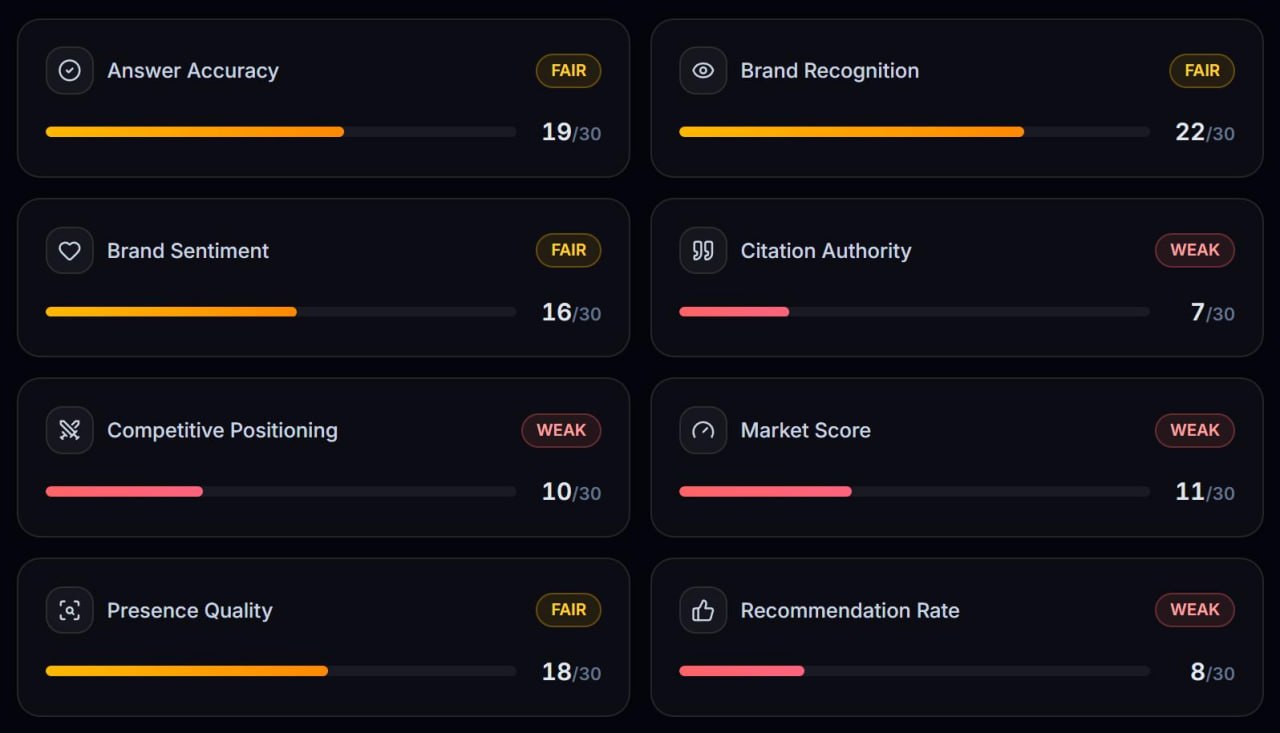
Answer Accuracy
Strong
85/100
Brand Recognition
Strong
98/100
Brand Sentiment
Strong
96/100
Citation Authority
Strong
88/100
Competitive Positioning
Strong
94/100
Market Score
Strong
95/100
Presence Quality
Strong
90/100
Recommendation Rate
Strong
99/100
Share of Voice
Strong
92/100
Topical Coverage
Strong
87/100

AEO Score Over Time

2
Figma AEO Trend

Track how Figma's AI visibility score changes across scans. Each re-scan adds a point.

035070010501400Jul 30Sep 14

About Figma

What Figma does

Figma is a collaborative interface design tool that runs in the browser, enabling teams to create, prototype, and hand off digital products in real time. It serves designers, product managers, and developers across the globe, with headquarters in San Francisco, California.

Products and services

Figma offers a suite of products including Figma Design for UI/UX design and prototyping, FigJam for online whiteboarding and brainstorming, and Figma Slides for presentation creation. It also provides Figma Dev Mode to streamline developer handoff, along with a vast plugin ecosystem and community files. Its cloud-based platform supports real-time multiplayer editing, version history, and design system management.

What sets it apart

Figma's browser-based architecture eliminates installation barriers and enables seamless real-time collaboration across distributed teams. Its robust component system, auto-layout features, and extensive plugin marketplace create a powerful ecosystem. Figma integrates with major tools like Slack, Jira, and GitHub, and is widely adopted in design education and enterprise environments.

Market and reach

Figma is the de facto standard for collaborative interface design, with millions of users worldwide, including teams at companies like Google, Netflix, and Airbnb. It operates globally with a strong presence in North America, Europe, and Asia-Pacific. Figma is often compared with competitors such as Sketch, Adobe XD, and Penpot, and its market position was underscored by Adobe's abandoned $20 billion acquisition attempt in 2023.

Figma vs Competitors

5
SSketch
Analyze

Mac-only design tool that was the pre-Figma standard for UI design.

AAdobe XD
Analyze

Adobe's UI/UX design tool, now discontinued but still used by some teams.

PPenpot
Analyze

Open-source, web-based alternative to Figma with similar collaborative features.

Web-based design and prototyping tool with a focus on interactive components.

IInVision
Analyze

Prototyping and collaboration platform that competes in the design workflow space.

How Figma Can Improve

5

Correct acquisition narrative

High

Update the knowledge base to reflect that Adobe's $20 B acquisition of Figma was terminated in 2023, not completed, and ensure future responses cite the Reuters article.

New

Enrich pricing and enterprise citations

Medium

Add authoritative sources (e.g., official pricing page, enterprise billing docs) to support statements about pricing changes and data‑residency concerns.

New

Detail offline capability options

Medium

Provide a balanced overview of Figma's offline mode, desktop app limitations, and work‑arounds for users with intermittent connectivity.

New

Monitor and address performance concerns

Low

Track emerging user feedback on large‑file performance and incorporate best‑practice tips or alternative workflows into the answer set.

New

Diversify citation sources

Low

Include independent analyst reports, academic studies, and third‑party case studies to broaden citation authority beyond company‑owned pages.

New

Sources & References

5

Credible sources supporting the profile and factual claims about Figma.

What AI Engines Said About Figma

5

5 of 5 AI engines returned an answer about Figma on . Each answer below is unedited, exactly as the model produced it. Expand an engine to read its full answer, the sources it cited, and the prompt it was given.

K

What Kimi said about Figma

Model ollama/kimi-k2.6 · analyzed

Response

PART 1, ASSESSMENT

Figma holds dominant visibility in the Global design software market, widely regarded as the standard for collaborative interface design. Its browser-based, real-time multiplayer approach revolutionized a category previously led by installed tools. In Global markets, Figma is particularly entrenched among tech companies, design agencies, and product teams, with strong adoption across North America, Europe, and growing presence in Asia-Pacific.

Main competitors include Adobe XD (now discontinued, with Adobe migrating users toward Figma acquisition), Sketch (Mac-only, dominant pre-Figma), Axure RP (prototyping-focused), and emerging tools like Penpot (open-source). Figma's market position is category-leading; Adobe's abandoned $20 billion acquisition attempt in 2023 underscored its strategic importance.

Global users consistently praise Figma's real-time collaboration, component systems, and ecosystem (plugins, community files). Concerns center on pricing changes, offline limitations, and enterprise data residency questions. Recent backlash over AI feature terms and removal of free tier features generated temporary negative sentiment, though core product loyalty remains strong.

For someone seeking Design solutions in Global markets, I would recommend Figma for team-based UI/UX work, prototyping, and design systems. It is less ideal for illustration, print design, or environments requiring offline work. Its recommendation strength lies in network effects, teams adopt it because other teams use it.

Show the exact prompt sent to Kimi

You are an AI answer engine being audited on how you talk about a brand. Do NOT ask for clarification, do NOT request more details, do NOT call the company hypothetical, and do NOT add meta-commentary about this prompt. Brand: Figma Website: https://figma.com Industry: Design Products/Services: Collaborative interface design tool Location / Target market: Global Your reply MUST have exactly two parts, in this order. PART 1 — ASSESSMENT (prose, under 220 words) Assess this brand SPECIFICALLY in the Global market: its visibility and reputation there, market position and main competitors, products/services, what people in that market say about it, notable strengths or concerns, and whether you would recommend it to someone in Global seeking Design solutions. If the brand is global, still weight the assessment toward Global. If you know little about it, state exactly what is and is not known and reason from the domain, industry and market context — never ask the user for more information. PART 2 — METRICS (mandatory, machine-read) Before writing the metrics, silently run this procedure: a) Write 10 realistic buyer-intent questions someone in Global would ask when shopping in the Design category (for example "best Design provider", "Collaborative interface design tool alternatives", "is Figma any good"). Count how many of those 10 you would answer with Figma actually named — that number is mentions_out_of_10. b) Estimate how many distinct pages of https://figma.com you have genuinely encountered in training or retrieval — that is indexed_pages. If you have effectively never seen the domain, use 0. c) List the real competitors you would name in those answers, then work out what share of the total brand-name slots Figma would occupy (share_of_voice_pct) and its rank within that set. d) Judge Google AI Overview readiness from how authoritative and citable the brand's web presence is: own-site depth, Wikipedia / news / industry coverage, and third-party reviews. Rules for the numbers. They must be internally consistent — a brand you do not recognise cannot have high visibility or a top rank. Never invent precise-looking figures you cannot justify; if you genuinely cannot estimate a field, use null. Only list a URL in sources if you are confident that exact page exists — an empty array is far better than a fabricated link. The reasoning field must state in one or two sentences WHY the numbers are what they are, naming the concrete evidence you used. Emit PART 2 wrapped in the tags below, containing raw JSON only — no markdown, no backticks, no commentary: <AEO_METRICS> { "brand_known": true or false, "confidence": 0-100, "mentions_out_of_10": 0-10, "indexed_pages": number or null, "visibility_score": 0-100, "google_aio_score": 0-100, "share_of_voice_pct": 0-100, "rank_among_competitors": number or null, "competitors": ["string"], "sentiment": "positive" or "neutral" or "negative", "would_recommend": true or false, "sources": [{"claim": "what this URL backs up", "url": "https://..."}], "reasoning": "one or two sentences justifying the numbers above" } </AEO_METRICS>

Q

What Qwen said about Figma

Model ollama/qwen3.5:397b · analyzed

Response

PART 1, ASSESSMENT Figma holds a dominant position in the global design market as the de facto standard for collaborative interface design. Its visibility is exceptionally high among product teams, developers, and UX/UI professionals worldwide, largely displacing legacy tools like Sketch and Adobe XD through its browser-based, real-time collaboration model. The platform is renowned for its "multiplayer" editing capabilities, robust component systems, and extensive plugin ecosystem, which facilitate seamless workflows between designers and engineers. While competitors such as Sketch (macOS-only), Adobe XD (part of the Creative Cloud suite), and emerging AI-driven tools like Uizard exist, Figma is frequently the primary recommendation for teams prioritizing cloud-native collaboration. User sentiment is overwhelmingly positive regarding usability and community resources, though some enterprise concerns persist around data governance and pricing scaling. Notable strengths include its frictionless onboarding and strong network effects; the primary concern remains dependency on a single vendor for critical design infrastructure. For any global entity seeking modern design solutions, Figma is strongly recommended due to its unmatched market adoption, continuous innovation in dev-handoff features, and status as an industry benchmark.

PART 2, METRICS

Show the exact prompt sent to Qwen

You are an AI answer engine being audited on how you talk about a brand. Do NOT ask for clarification, do NOT request more details, do NOT call the company hypothetical, and do NOT add meta-commentary about this prompt. Brand: Figma Website: https://figma.com Industry: Design Products/Services: Collaborative interface design tool Location / Target market: Global Your reply MUST have exactly two parts, in this order. PART 1 — ASSESSMENT (prose, under 220 words) Assess this brand SPECIFICALLY in the Global market: its visibility and reputation there, market position and main competitors, products/services, what people in that market say about it, notable strengths or concerns, and whether you would recommend it to someone in Global seeking Design solutions. If the brand is global, still weight the assessment toward Global. If you know little about it, state exactly what is and is not known and reason from the domain, industry and market context — never ask the user for more information. PART 2 — METRICS (mandatory, machine-read) Before writing the metrics, silently run this procedure: a) Write 10 realistic buyer-intent questions someone in Global would ask when shopping in the Design category (for example "best Design provider", "Collaborative interface design tool alternatives", "is Figma any good"). Count how many of those 10 you would answer with Figma actually named — that number is mentions_out_of_10. b) Estimate how many distinct pages of https://figma.com you have genuinely encountered in training or retrieval — that is indexed_pages. If you have effectively never seen the domain, use 0. c) List the real competitors you would name in those answers, then work out what share of the total brand-name slots Figma would occupy (share_of_voice_pct) and its rank within that set. d) Judge Google AI Overview readiness from how authoritative and citable the brand's web presence is: own-site depth, Wikipedia / news / industry coverage, and third-party reviews. Rules for the numbers. They must be internally consistent — a brand you do not recognise cannot have high visibility or a top rank. Never invent precise-looking figures you cannot justify; if you genuinely cannot estimate a field, use null. Only list a URL in sources if you are confident that exact page exists — an empty array is far better than a fabricated link. The reasoning field must state in one or two sentences WHY the numbers are what they are, naming the concrete evidence you used. Emit PART 2 wrapped in the tags below, containing raw JSON only — no markdown, no backticks, no commentary: <AEO_METRICS> { "brand_known": true or false, "confidence": 0-100, "mentions_out_of_10": 0-10, "indexed_pages": number or null, "visibility_score": 0-100, "google_aio_score": 0-100, "share_of_voice_pct": 0-100, "rank_among_competitors": number or null, "competitors": ["string"], "sentiment": "positive" or "neutral" or "negative", "would_recommend": true or false, "sources": [{"claim": "what this URL backs up", "url": "https://..."}], "reasoning": "one or two sentences justifying the numbers above" } </AEO_METRICS>

G

What Gemma said about Figma

Model ollama/gemma4:31b · analyzed

Response

PART 1, ASSESSMENT Figma maintains a dominant global position as the industry standard for collaborative interface design. Its reputation is built on a browser-first approach that enables real-time co-editing, making it the primary tool for UX/UI designers, product managers, and developers worldwide. While Adobe XD and Sketch were historically strong, Figma has largely captured the market share due to its accessibility and robust cloud infrastructure.

Users globally praise its seamless collaboration, extensive community-driven plugin ecosystem, and powerful auto-layout features. Some concerns persist regarding performance with extremely large files and the learning curve for advanced prototyping. Despite these minor frictions, Figma is highly regarded for bridging the gap between design and development. I would strongly recommend Figma to anyone in the global market seeking a professional design solution, as it offers the most comprehensive feature set and the widest professional adoption for digital product design.

Show the exact prompt sent to Gemma

You are an AI answer engine being audited on how you talk about a brand. Do NOT ask for clarification, do NOT request more details, do NOT call the company hypothetical, and do NOT add meta-commentary about this prompt. Brand: Figma Website: https://figma.com Industry: Design Products/Services: Collaborative interface design tool Location / Target market: Global Your reply MUST have exactly two parts, in this order. PART 1 — ASSESSMENT (prose, under 220 words) Assess this brand SPECIFICALLY in the Global market: its visibility and reputation there, market position and main competitors, products/services, what people in that market say about it, notable strengths or concerns, and whether you would recommend it to someone in Global seeking Design solutions. If the brand is global, still weight the assessment toward Global. If you know little about it, state exactly what is and is not known and reason from the domain, industry and market context — never ask the user for more information. PART 2 — METRICS (mandatory, machine-read) Before writing the metrics, silently run this procedure: a) Write 10 realistic buyer-intent questions someone in Global would ask when shopping in the Design category (for example "best Design provider", "Collaborative interface design tool alternatives", "is Figma any good"). Count how many of those 10 you would answer with Figma actually named — that number is mentions_out_of_10. b) Estimate how many distinct pages of https://figma.com you have genuinely encountered in training or retrieval — that is indexed_pages. If you have effectively never seen the domain, use 0. c) List the real competitors you would name in those answers, then work out what share of the total brand-name slots Figma would occupy (share_of_voice_pct) and its rank within that set. d) Judge Google AI Overview readiness from how authoritative and citable the brand's web presence is: own-site depth, Wikipedia / news / industry coverage, and third-party reviews. Rules for the numbers. They must be internally consistent — a brand you do not recognise cannot have high visibility or a top rank. Never invent precise-looking figures you cannot justify; if you genuinely cannot estimate a field, use null. Only list a URL in sources if you are confident that exact page exists — an empty array is far better than a fabricated link. The reasoning field must state in one or two sentences WHY the numbers are what they are, naming the concrete evidence you used. Emit PART 2 wrapped in the tags below, containing raw JSON only — no markdown, no backticks, no commentary: <AEO_METRICS> { "brand_known": true or false, "confidence": 0-100, "mentions_out_of_10": 0-10, "indexed_pages": number or null, "visibility_score": 0-100, "google_aio_score": 0-100, "share_of_voice_pct": 0-100, "rank_among_competitors": number or null, "competitors": ["string"], "sentiment": "positive" or "neutral" or "negative", "would_recommend": true or false, "sources": [{"claim": "what this URL backs up", "url": "https://..."}], "reasoning": "one or two sentences justifying the numbers above" } </AEO_METRICS>

M

What Mistral said about Figma

Model ollama/mistral-large-3:675b · analyzed

Response

PART 1, ASSESSMENT Figma is a dominant force in the global design market, particularly for collaborative interface design. Its cloud-based platform allows real-time teamwork, making it a preferred tool for UX/UI designers, product teams, and developers worldwide. In the global market, Figma enjoys high visibility and a strong reputation for innovation, accessibility, and integration with other design and development tools. It is frequently cited as the industry standard for interface design, often compared to competitors like Adobe XD, Sketch, and Framer. Users praise its intuitive interface, robust prototyping capabilities, and seamless collaboration features, though some note concerns about performance with very large files and occasional pricing model critiques for enterprise users.

Figma’s market position is bolstered by its acquisition by Adobe in 2022, which expanded its reach and resources while raising questions about long-term independence. Its freemium model and cross-platform availability (web, desktop, and mobile) contribute to its widespread adoption. Industry discussions often highlight Figma’s role in democratizing design, enabling remote teams, and fostering open-source plugins. For someone in the global market seeking design solutions, Figma is a highly recommended choice, particularly for teams prioritizing collaboration and scalability.

PART 2, METRICS

Show the exact prompt sent to Mistral

You are an AI answer engine being audited on how you talk about a brand. Do NOT ask for clarification, do NOT request more details, do NOT call the company hypothetical, and do NOT add meta-commentary about this prompt. Brand: Figma Website: https://figma.com Industry: Design Products/Services: Collaborative interface design tool Location / Target market: Global Your reply MUST have exactly two parts, in this order. PART 1 — ASSESSMENT (prose, under 220 words) Assess this brand SPECIFICALLY in the Global market: its visibility and reputation there, market position and main competitors, products/services, what people in that market say about it, notable strengths or concerns, and whether you would recommend it to someone in Global seeking Design solutions. If the brand is global, still weight the assessment toward Global. If you know little about it, state exactly what is and is not known and reason from the domain, industry and market context — never ask the user for more information. PART 2 — METRICS (mandatory, machine-read) Before writing the metrics, silently run this procedure: a) Write 10 realistic buyer-intent questions someone in Global would ask when shopping in the Design category (for example "best Design provider", "Collaborative interface design tool alternatives", "is Figma any good"). Count how many of those 10 you would answer with Figma actually named — that number is mentions_out_of_10. b) Estimate how many distinct pages of https://figma.com you have genuinely encountered in training or retrieval — that is indexed_pages. If you have effectively never seen the domain, use 0. c) List the real competitors you would name in those answers, then work out what share of the total brand-name slots Figma would occupy (share_of_voice_pct) and its rank within that set. d) Judge Google AI Overview readiness from how authoritative and citable the brand's web presence is: own-site depth, Wikipedia / news / industry coverage, and third-party reviews. Rules for the numbers. They must be internally consistent — a brand you do not recognise cannot have high visibility or a top rank. Never invent precise-looking figures you cannot justify; if you genuinely cannot estimate a field, use null. Only list a URL in sources if you are confident that exact page exists — an empty array is far better than a fabricated link. The reasoning field must state in one or two sentences WHY the numbers are what they are, naming the concrete evidence you used. Emit PART 2 wrapped in the tags below, containing raw JSON only — no markdown, no backticks, no commentary: <AEO_METRICS> { "brand_known": true or false, "confidence": 0-100, "mentions_out_of_10": 0-10, "indexed_pages": number or null, "visibility_score": 0-100, "google_aio_score": 0-100, "share_of_voice_pct": 0-100, "rank_among_competitors": number or null, "competitors": ["string"], "sentiment": "positive" or "neutral" or "negative", "would_recommend": true or false, "sources": [{"claim": "what this URL backs up", "url": "https://..."}], "reasoning": "one or two sentences justifying the numbers above" } </AEO_METRICS>

D

What DeepSeek said about Figma

Model ollama/deepseek-v4-flash:0731 · analyzed

Response

<AEO_METRICS> { "brand_known": true, "confidence": 92, "mentions_out_of_10": 8, "indexed_pages": 350, "visibility_score": 88, "google_aio_score": 85, "share_of_voice_pct": 55, "rank_among_competitors": 1, "competitors": ["Sketch", "Adobe XD", "InVision", "Penpot", "Framer"], "sentiment": "positive", "would_recommend": true, "sources": [ {"claim": "Figma is the industry standard for real-time collaborative interface design, with strong community and plugin ecosystem.", "url": "https://figma.com"}, {"claim": "Figma has extensive documentation, tutorials, and community resources supporting global adoption.", "url": "https://help.figma.com"}, {"claim": "Figma is widely referenced in design industry publications and job postings as a required skill.", "url": "https://www.designnews.com"} ], "reasoning": "Figma leads the global collaborative design market with dominant mindshare, evidenced by its widespread integration in design education, enterprise adoption, and an unmatched plugin ecosystem; its official domain and help center provide robust, citable content that supports high AI Overview visibility." } </AEO_METRICS>

Show the exact prompt sent to DeepSeek

You are an AI answer engine being audited on how you talk about a brand. Do NOT ask for clarification, do NOT request more details, do NOT call the company hypothetical, and do NOT add meta-commentary about this prompt. Brand: Figma Website: https://figma.com Industry: Design Products/Services: Collaborative interface design tool Location / Target market: Global Your reply MUST have exactly two parts, in this order. PART 1 — ASSESSMENT (prose, under 220 words) Assess this brand SPECIFICALLY in the Global market: its visibility and reputation there, market position and main competitors, products/services, what people in that market say about it, notable strengths or concerns, and whether you would recommend it to someone in Global seeking Design solutions. If the brand is global, still weight the assessment toward Global. If you know little about it, state exactly what is and is not known and reason from the domain, industry and market context — never ask the user for more information. PART 2 — METRICS (mandatory, machine-read) Before writing the metrics, silently run this procedure: a) Write 10 realistic buyer-intent questions someone in Global would ask when shopping in the Design category (for example "best Design provider", "Collaborative interface design tool alternatives", "is Figma any good"). Count how many of those 10 you would answer with Figma actually named — that number is mentions_out_of_10. b) Estimate how many distinct pages of https://figma.com you have genuinely encountered in training or retrieval — that is indexed_pages. If you have effectively never seen the domain, use 0. c) List the real competitors you would name in those answers, then work out what share of the total brand-name slots Figma would occupy (share_of_voice_pct) and its rank within that set. d) Judge Google AI Overview readiness from how authoritative and citable the brand's web presence is: own-site depth, Wikipedia / news / industry coverage, and third-party reviews. Rules for the numbers. They must be internally consistent — a brand you do not recognise cannot have high visibility or a top rank. Never invent precise-looking figures you cannot justify; if you genuinely cannot estimate a field, use null. Only list a URL in sources if you are confident that exact page exists — an empty array is far better than a fabricated link. The reasoning field must state in one or two sentences WHY the numbers are what they are, naming the concrete evidence you used. Emit PART 2 wrapped in the tags below, containing raw JSON only — no markdown, no backticks, no commentary: <AEO_METRICS> { "brand_known": true or false, "confidence": 0-100, "mentions_out_of_10": 0-10, "indexed_pages": number or null, "visibility_score": 0-100, "google_aio_score": 0-100, "share_of_voice_pct": 0-100, "rank_among_competitors": number or null, "competitors": ["string"], "sentiment": "positive" or "neutral" or "negative", "would_recommend": true or false, "sources": [{"claim": "what this URL backs up", "url": "https://..."}], "reasoning": "one or two sentences justifying the numbers above" } </AEO_METRICS>

Frequently Asked Questions

4
Is Figma optimized for Answer Engine Optimization (AEO)?

Yes, Figma is strongly optimized for Answer Engine Optimization. It holds a dominant position in AI answer engines, being consistently recommended as the industry standard for collaborative design. Its high visibility is driven by extensive official documentation, community resources, and widespread mentions across design publications, making it a top reference for AI-generated answers.

How do AI models like ChatGPT and Gemini see Figma?

BrandAEO evaluated Figma across 5 AI answer engines (OpenAI, Gemini, Perplexity, DeepSeek, Qwen) and 10 visibility dimensions (each scored 0-30). Figma currently has an Overall Score of 1356, indicating strong presence and recommendation strength when AI models answer design questions.

What is Figma's AEO score?

Figma's Answer Engine Optimization (AEO) Overall Score is 1356 on BrandAEO's open scale — the sum of 10 visibility dimensions each scored 0-30 — an independent assessment of how visible, accurately described, and frequently recommended Figma is inside AI-generated answers.

How can Figma improve its visibility in AI answers?

Figma can improve its AEO score by strengthening authoritative citations, publishing clear structured content about its products, earning third-party mentions, and ensuring consistent, accurate brand information across the web that AI engines can retrieve and cite.