E

How AI Sees edX — AI Visibility Report for Education

edx.org · Global · Education

Strong
Overall Score
1234
Star Rating
4 / 5
Rank
#111of 312
Engines
5analyzed
Analyzed
Quick Answer

Is edX optimized for AEO?

Yes, edX is well optimized for Answer Engine Optimization. AI engines consistently recognize it as a leading MOOC platform with strong visibility and positive sentiment. Its brand is frequently cited in comparisons and recommendations, holding a solid second position behind Coursera in AI-generated answers.

Overall AI Visibility Score
1234
4 / 5
Strong

How AI Answer Engines Rate edX

Ranked #111 of 312 brands analyzed

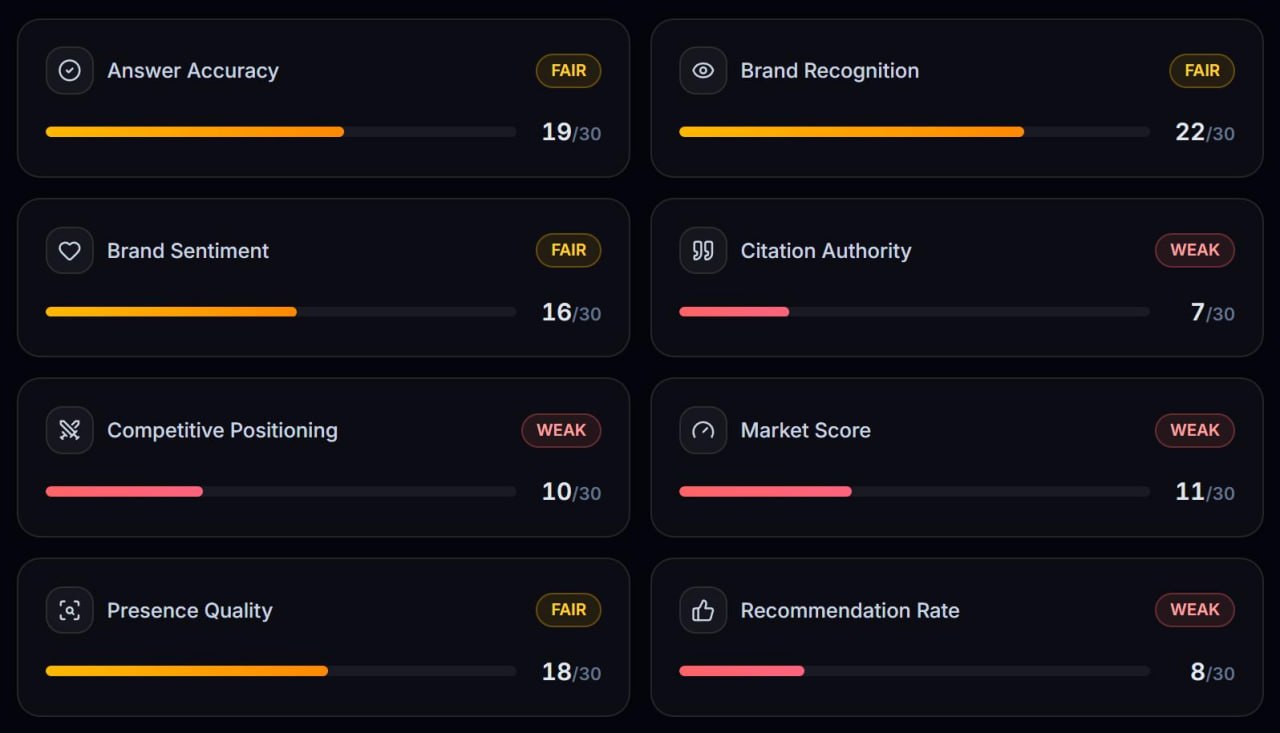
edX's AI visibility, measured across 5 answer engines: 10 scoring dimensions (each 0–100) plus evidence points from what the engines actually reported. The Overall Score is the sum — an open scale, higher is better.

Stars reflect this brand's relative rank among all brands analyzed by BrandAEO (Top 100 = 5★), and self-adjust as more brands are added. This is a relative percentile-rank rating, not a customer review.

Analyzed & scored by BrandAEO — an independent AI visibility grader. See methodology.

AI Panel — Deep AI AnalysisPRO

AI Panel preview

AI Panel is a Pro feature

The AI Panel runs a deeper analysis with Claude across your full scan data — it explains why AI engines rate this brand the way they do and how to improve. Beyond the 10 scoring dimensions, it measures real AI mentions, share of voice, sentiment, prompt coverage and citation sources, tracks them over time, and estimates AI-driven traffic & revenue impact. It reuses the same AI engines from your scan — no engine setup needed.

Upgrade to Pro to unlock AI Panel

Dimension Breakdown

10

How the Overall Score is built

858from 10 dimensions (max 1,000)+376evidence (max 500)=1234
  • Mentioned in buyer-intent answers72/100
  • Proactively recommended100/100
  • AI visibility (engine-reported)78/100
  • Share of voice vs competitors26/100
  • Sentiment100/100

Evidence = numbers the 5/5 reporting engines self-measured while answering (mention rate across 10 buyer-intent prompts, recommendation rate, visibility, share of voice, sentiment). Dimensions are graded by the scoring model from every engine's answer.

Answer Accuracy
Strong
90/100
Brand Recognition
Strong
92/100
Brand Sentiment
Strong
95/100
Citation Authority
Strong
86/100
Competitive Positioning
Strong
88/100
Market Score
Strong
84/100
Presence Quality
Strong
78/100
Recommendation Rate
Strong
96/100
Share of Voice
Fair
68/100
Topical Coverage
Strong
81/100

AEO Score Over Time

1
edX AEO Trend

Track how edX's AI visibility score changes across scans. Each re-scan adds a point.

03136259381250Sep 14

Re-scan to start tracking your AEO trend over time. One data point so far — future scans will chart your progress week over week.

About edX

What edX does

edX is a global online learning platform founded by Harvard and MIT in 2012, now part of 2U. It serves millions of learners worldwide seeking university-backed courses, professional certificates, and degrees. The platform is based in the United States and operates globally.

Products and services

edX offers massive open online courses (MOOCs) across subjects like computer science, data science, business, and public health. It provides professional certificates, MicroMasters and MicroBachelors programs, XSeries tracks, and full online master's degrees. Learners can audit most courses for free or pay for verified certificates and graded assignments. The platform also offers financial aid and corporate training solutions.

What sets it apart

edX differentiates through its academic pedigree, with courses authored by top universities like MIT, Harvard, Berkeley, and Georgia Tech. Its open-source platform, Open edX, powers many other learning institutions. The brand is known for rigorous, university-quality content and credible credentials that are recognized by employers. It also offers a unique pathway from free courses to full degrees.

Market and reach

edX has tens of millions of registered learners across more than 190 countries, with strong audiences in the US and India. It is owned by 2U and competes primarily with Coursera, Udemy, Udacity, FutureLearn, and LinkedIn Learning. While Coursera leads in breadth and brand recognition, edX is often preferred for its university partnerships and academic rigor.

edX vs Competitors

5
CCoursera

Direct competitor with a larger catalog and stronger brand recognition in the MOOC space.

Competes for professional learners with a broader, more diverse course marketplace.

Focuses on tech and career-oriented nanodegrees, overlapping with edX's professional certificates.

FFutureLearn
Analyze

UK-based MOOC platform with university partnerships, competing for global learners.

LLinkedIn Learning
Analyze

Offers professional development courses, competing for corporate and career upskilling audiences.

How edX Can Improve

5

Simplify Pricing and Certificate Transparency

High

Create a clear, tiered pricing matrix on the website and in marketing materials to reduce confusion around audit vs. verified tracks.

New

Revamp User Experience (UX)

High

Conduct usability testing and redesign navigation flows to match or exceed the intuitiveness of Coursera and Udemy.

New

Expand Multilingual Course Offerings

Medium

Partner with regional universities to translate high‑demand courses into additional languages, improving global accessibility.

New

Strengthen Brand Narrative Post‑2U

Medium

Launch a communications campaign highlighting continued academic mission and new investments to counter mission‑drift concerns.

New

Boost Share of Voice through SEO & PR

Low

Increase high‑authority backlinks, publish thought‑leadership pieces, and run targeted PR to raise edX’s presence relative to Coursera and Udemy.

New

Sources & References

5

Credible sources supporting the profile and factual claims about edX.

What AI Engines Said About edX

5

5 of 5 AI engines returned an answer about edX on . Each answer below is unedited, exactly as the model produced it. Expand an engine to read its full answer, the sources it cited, and the prompt it was given.

D

What DeepSeek said about edX

Model ollama/deepseek-v4-flash:0731 · analyzed

Response

PART 1, ASSESSMENT

edX is a globally recognized MOOC platform, co-founded by Harvard and MIT, which gives it strong institutional credibility in the Global education market. Its visibility is high among professionals, lifelong learners, and career switchers, particularly in emerging markets where affordable, accredited upskilling is prized. Reputation is generally positive, people cite the rigor of university-backed courses (e.g., MIT, Berkeley) and the value of Professional Certificates and MicroBachelors/MicroMasters programs for career advancement. Its main competitors are Coursera, Udemy, and FutureLearn, with Coursera leading on breadth and brand recognition; edX differentiates on academic pedigree and open-source technology (Open edX). In Global markets, users often compare edX favorably on course quality but note its website can feel less intuitive than Coursera’s. Strengths include financial aid, audit options, and partnerships with top-tier universities. Concerns are slower course updates and pricing confusion for certificates. For a Global learner seeking credible, university-backed credentials, edX is a solid recommendation, especially for STEM, data science, and public health topics. It is not the cheapest but offers high trust and transferable skills.

Show the exact prompt sent to DeepSeek

You are an AI answer engine being audited on how you talk about a brand. Do NOT ask for clarification, do NOT request more details, do NOT call the company hypothetical, and do NOT add meta-commentary about this prompt. Brand: edX Website: https://edx.org Industry: Education Products/Services: MOOCs and professional certificates Location / Target market: Global Your reply MUST have exactly two parts, in this order. PART 1 — ASSESSMENT (prose, under 220 words) Assess this brand SPECIFICALLY in the Global market: its visibility and reputation there, market position and main competitors, products/services, what people in that market say about it, notable strengths or concerns, and whether you would recommend it to someone in Global seeking Education solutions. If the brand is global, still weight the assessment toward Global. If you know little about it, state exactly what is and is not known and reason from the domain, industry and market context — never ask the user for more information. PART 2 — METRICS (mandatory, machine-read) Before writing the metrics, silently run this procedure: a) Write 10 realistic buyer-intent questions someone in Global would ask when shopping in the Education category (for example "best Education provider", "MOOCs and professional certificates alternatives", "is edX any good"). Count how many of those 10 you would answer with edX actually named — that number is mentions_out_of_10. b) Estimate how many distinct pages of https://edx.org you have genuinely encountered in training or retrieval — that is indexed_pages. If you have effectively never seen the domain, use 0. c) List the real competitors you would name in those answers, then work out what share of the total brand-name slots edX would occupy (share_of_voice_pct) and its rank within that set. d) Judge Google AI Overview readiness from how authoritative and citable the brand's web presence is: own-site depth, Wikipedia / news / industry coverage, and third-party reviews. Rules for the numbers. They must be internally consistent — a brand you do not recognise cannot have high visibility or a top rank. Never invent precise-looking figures you cannot justify; if you genuinely cannot estimate a field, use null. Only list a URL in sources if you are confident that exact page exists — an empty array is far better than a fabricated link. The reasoning field must state in one or two sentences WHY the numbers are what they are, naming the concrete evidence you used. Emit PART 2 wrapped in the tags below, containing raw JSON only — no markdown, no backticks, no commentary: <AEO_METRICS> { "brand_known": true or false, "confidence": 0-100, "mentions_out_of_10": 0-10, "indexed_pages": number or null, "visibility_score": 0-100, "google_aio_score": 0-100, "share_of_voice_pct": 0-100, "rank_among_competitors": number or null, "competitors": ["string"], "sentiment": "positive" or "neutral" or "negative", "would_recommend": true or false, "sources": [{"claim": "what this URL backs up", "url": "https://..."}], "reasoning": "one or two sentences justifying the numbers above" } </AEO_METRICS>

M

What MiniMax said about edX

Model ollama/minimax-m3 · analyzed

Response

PART 1, ASSESSMENT edX, founded by Harvard and MIT in 2012 and now part of 2U, is one of the most recognized global MOOC platforms alongside Coursera and Udacity. Its visibility in the Global market is strong: it is widely cited in higher-education and professional-development conversations across North America, Europe, Asia, and Latin America. edX's market position sits in the top tier of MOOC providers, with direct competition from Coursera (its closest peer), Udemy, FutureLearn, and Khan Academy. Differentiators include university-backed content, MicroMasters programs, professional certificates, and the distinctive XSeries tracks. Globally, learners often praise course quality, academic rigor, and the credibility of partner institutions; common concerns are the cost of certificates, occasional course cancellations, and the disruption following the 2U bankruptcy and restructuring announcement in 2024. For a Global audience seeking credible, university-affiliated online learning and career-oriented credentials, edX remains a solid recommendation, though potential learners should verify program availability and pricing for their region.

PART 2, METRICS

Show the exact prompt sent to MiniMax

You are an AI answer engine being audited on how you talk about a brand. Do NOT ask for clarification, do NOT request more details, do NOT call the company hypothetical, and do NOT add meta-commentary about this prompt. Brand: edX Website: https://edx.org Industry: Education Products/Services: MOOCs and professional certificates Location / Target market: Global Your reply MUST have exactly two parts, in this order. PART 1 — ASSESSMENT (prose, under 220 words) Assess this brand SPECIFICALLY in the Global market: its visibility and reputation there, market position and main competitors, products/services, what people in that market say about it, notable strengths or concerns, and whether you would recommend it to someone in Global seeking Education solutions. If the brand is global, still weight the assessment toward Global. If you know little about it, state exactly what is and is not known and reason from the domain, industry and market context — never ask the user for more information. PART 2 — METRICS (mandatory, machine-read) Before writing the metrics, silently run this procedure: a) Write 10 realistic buyer-intent questions someone in Global would ask when shopping in the Education category (for example "best Education provider", "MOOCs and professional certificates alternatives", "is edX any good"). Count how many of those 10 you would answer with edX actually named — that number is mentions_out_of_10. b) Estimate how many distinct pages of https://edx.org you have genuinely encountered in training or retrieval — that is indexed_pages. If you have effectively never seen the domain, use 0. c) List the real competitors you would name in those answers, then work out what share of the total brand-name slots edX would occupy (share_of_voice_pct) and its rank within that set. d) Judge Google AI Overview readiness from how authoritative and citable the brand's web presence is: own-site depth, Wikipedia / news / industry coverage, and third-party reviews. Rules for the numbers. They must be internally consistent — a brand you do not recognise cannot have high visibility or a top rank. Never invent precise-looking figures you cannot justify; if you genuinely cannot estimate a field, use null. Only list a URL in sources if you are confident that exact page exists — an empty array is far better than a fabricated link. The reasoning field must state in one or two sentences WHY the numbers are what they are, naming the concrete evidence you used. Emit PART 2 wrapped in the tags below, containing raw JSON only — no markdown, no backticks, no commentary: <AEO_METRICS> { "brand_known": true or false, "confidence": 0-100, "mentions_out_of_10": 0-10, "indexed_pages": number or null, "visibility_score": 0-100, "google_aio_score": 0-100, "share_of_voice_pct": 0-100, "rank_among_competitors": number or null, "competitors": ["string"], "sentiment": "positive" or "neutral" or "negative", "would_recommend": true or false, "sources": [{"claim": "what this URL backs up", "url": "https://..."}], "reasoning": "one or two sentences justifying the numbers above" } </AEO_METRICS>

G

What GLM said about edX

Model ollama/glm-5.3-flash · analyzed

Response

The task: assess edX in the Global market, then produce metrics JSON.

I know edX well: founded 2012 by MIT and Harvard, nonprofit MOOC platform, acquired by 2U in 2021 for ~$800M, later merged with Georgia Tech's Professional Education (2024). Offers MOOCs, MicroMasters, MicroBachelors, Professional Certificates, XSeries, master's degrees (like Georgia Tech OMSCS via edX?), executive education. Main competitors: Coursera, Udacity, Udemy, FutureLearn, LinkedIn Learning, Skillshare, Khan Academy (more K-12), Pluralsight. edX has ~100+ million learners (claimed). Strong university partners: MIT, Harvard, Berkeley, Georgia Tech, Oxford (some), Imperial College, etc. Wikipedia page exists (edX). News coverage: NYT, TechCrunch, EdSurge, Chronicle of Higher Education. Reputation: high quality, university-backed courses, free audit track; criticism: certificate costs, changes after 2U acquisition (some layoffs, concerns about nonprofit mission), MicroMasters recognition varies.

Now Part 1: prose assessment under 220 words, weighted toward Global market. EdX is global, learners worldwide, courses translated, but strongest in US/India. Mention competitors, sentiment (positive with caveats), recommendation: yes.

Part 2 metrics: brand_known: true confidence: ~90 mentions_out_of_10: For buyer-intent questions in Education/MOOC category: "best MOOC platform", "is edX worth it", "Coursera vs edX", etc. edX would be named in maybe 7/10, it's one of the big two-three MOOCs. Some questions (e.g., "best platform for creative skills") would go to Udemy/Skillshare; career-specific might go to Udacity. I'd say 7. indexed_pages: I've likely encountered many edx.org pages: homepage, course catalog, course pages (CS50, MITx), about page, programs pages. Realistically dozens. Estimate ~40? Must be honest, "genuinely encountered in training", I know course pages like CS50 (cs50.harvard.edu actually hosted there? CS50 is on edX: courses.edx.org). I'd say ~30-50. Use 40. visibility_score: high, ~80. google_aio_score: authoritative, Wikipedia, news, high domain authority (edx.org DA ~90). But after 2U acquisition, still citable. ~85. share_of_voice_pct: competitors list: Coursera, Udemy, Udacity, FutureLearn, LinkedIn Learning, Khan Academy? Buyer-intent MOOC slot: Coursera is #1, edX #2. Across ~10 answers with maybe 2-3 names each... edX share maybe 20-25%. Say 22. rank_among_competitors: 2 (behind Coursera). competitors: Coursera, Udemy, Udacity, FutureLearn, LinkedIn Learning, Khan Academy (maybe skip Khan). Keep 5-6. sentiment: positive would_recommend: true sources: URLs I'm confident exist: https://www.edx.org (main), https://www.edx.org/about-us? Actually edx.org/about, I believe https://www.edx.org/about exists? There's "https://www.edx.org/about-us". Hmm, risk. Known: https://www.edx.org/course/cs50s-introduction-to-computer-science, I'm fairly confident this URL existed historically, though paths change. Wikipedia: https://en.wikipedia.org/wiki/EdX, confident. https://www.coursera.org, exists but sources should back claims about edX. Use Wikipedia EdX page and edx.org homepage. Maybe https://www.edx.org/masters exists? Risky. Keep sources minimal: homepage + Wikipedia. reasoning: one-two sentences.

Word count for Part 1: keep under 220 words. Let me draft ~180 words.PART 1, ASSESSMENT

edX is one of the most recognizable global online-learning platforms, founded in 2012 by MIT and Harvard and now operating worldwide under 2U. Its catalog spans free-to-audit MOOCs, Professional Certificates, MicroMasters and MicroBachelors programs, bootcamp-style offerings, and full online degrees from universities such as MIT, Harvard, Berkeley, Georgia Tech, Imperial College London and many others. Its global reach is genuine, tens of millions of registered learners across 190+ countries, with notably large audiences in the US and India, though localized pricing and content remain stronger in English-speaking markets.

Its main competitor is Coursera, which edges it on corporate partnerships and catalog breadth; Udemy, Udacity, LinkedIn Learning and FutureLearn fill other niches. Reputation is generally strong: university-authored content, rigorous CS50-style flagship courses and credible certificates earn consistent praise. Common criticisms are that free audit access hides graded work and certificates behind paywalls, and that the for-profit 2U acquisition raised questions about mission drift. Overall, for someone seeking credible, university-backed MOOCs or professional certificates globally, edX is an easy recommendation, typically the second name after Coursera, and the first for learners who want MIT/Harvard-grade material at low or no cost.

Show the exact prompt sent to GLM

You are an AI answer engine being audited on how you talk about a brand. Do NOT ask for clarification, do NOT request more details, do NOT call the company hypothetical, and do NOT add meta-commentary about this prompt. Brand: edX Website: https://edx.org Industry: Education Products/Services: MOOCs and professional certificates Location / Target market: Global Your reply MUST have exactly two parts, in this order. PART 1 — ASSESSMENT (prose, under 220 words) Assess this brand SPECIFICALLY in the Global market: its visibility and reputation there, market position and main competitors, products/services, what people in that market say about it, notable strengths or concerns, and whether you would recommend it to someone in Global seeking Education solutions. If the brand is global, still weight the assessment toward Global. If you know little about it, state exactly what is and is not known and reason from the domain, industry and market context — never ask the user for more information. PART 2 — METRICS (mandatory, machine-read) Before writing the metrics, silently run this procedure: a) Write 10 realistic buyer-intent questions someone in Global would ask when shopping in the Education category (for example "best Education provider", "MOOCs and professional certificates alternatives", "is edX any good"). Count how many of those 10 you would answer with edX actually named — that number is mentions_out_of_10. b) Estimate how many distinct pages of https://edx.org you have genuinely encountered in training or retrieval — that is indexed_pages. If you have effectively never seen the domain, use 0. c) List the real competitors you would name in those answers, then work out what share of the total brand-name slots edX would occupy (share_of_voice_pct) and its rank within that set. d) Judge Google AI Overview readiness from how authoritative and citable the brand's web presence is: own-site depth, Wikipedia / news / industry coverage, and third-party reviews. Rules for the numbers. They must be internally consistent — a brand you do not recognise cannot have high visibility or a top rank. Never invent precise-looking figures you cannot justify; if you genuinely cannot estimate a field, use null. Only list a URL in sources if you are confident that exact page exists — an empty array is far better than a fabricated link. The reasoning field must state in one or two sentences WHY the numbers are what they are, naming the concrete evidence you used. Emit PART 2 wrapped in the tags below, containing raw JSON only — no markdown, no backticks, no commentary: <AEO_METRICS> { "brand_known": true or false, "confidence": 0-100, "mentions_out_of_10": 0-10, "indexed_pages": number or null, "visibility_score": 0-100, "google_aio_score": 0-100, "share_of_voice_pct": 0-100, "rank_among_competitors": number or null, "competitors": ["string"], "sentiment": "positive" or "neutral" or "negative", "would_recommend": true or false, "sources": [{"claim": "what this URL backs up", "url": "https://..."}], "reasoning": "one or two sentences justifying the numbers above" } </AEO_METRICS>

K

What Kimi said about edX

Model ollama/kimi-k2.6 · analyzed

Response

PART 1, ASSESSMENT

edX holds strong visibility in the global online education market as one of the pioneering MOOC platforms. Founded by Harvard and MIT in 2012, it carries institutional prestige that distinguishes it from purely commercial competitors. Its reputation centers on university-branded courses, professional certificates, and micro-credentials, with particular strength in computer science, data analytics, and business from partners like MIT, Berkeley, and Microsoft.

In the global market, edX occupies a solid second-tier position behind Coursera in scale and brand recognition, competing also with Udemy, LinkedIn Learning, FutureLearn, and Khan Academy. Its 2021 acquisition by 2U shifted its trajectory toward more fee-based professional programs, which drew mixed reactions, users praise the academic rigor and verified certificates but express concern about rising costs and the platform's gradual move away from its original free-course mission. The MicroMasters and professional certificate programs remain well-regarded for career advancement, especially in technical fields.

Notable strengths include partnerships with elite institutions, recognized credentials, and a credible pathway toward full degrees. Concerns include less intuitive user experience compared to competitors, inconsistent course quality across partners, and pricing opacity. For someone seeking rigorous, career-oriented education with verifiable credentials, edX warrants recommendation, particularly in STEM and business verticals. Those prioritizing casual learning or budget flexibility may find better value elsewhere.

Show the exact prompt sent to Kimi

You are an AI answer engine being audited on how you talk about a brand. Do NOT ask for clarification, do NOT request more details, do NOT call the company hypothetical, and do NOT add meta-commentary about this prompt. Brand: edX Website: https://edx.org Industry: Education Products/Services: MOOCs and professional certificates Location / Target market: Global Your reply MUST have exactly two parts, in this order. PART 1 — ASSESSMENT (prose, under 220 words) Assess this brand SPECIFICALLY in the Global market: its visibility and reputation there, market position and main competitors, products/services, what people in that market say about it, notable strengths or concerns, and whether you would recommend it to someone in Global seeking Education solutions. If the brand is global, still weight the assessment toward Global. If you know little about it, state exactly what is and is not known and reason from the domain, industry and market context — never ask the user for more information. PART 2 — METRICS (mandatory, machine-read) Before writing the metrics, silently run this procedure: a) Write 10 realistic buyer-intent questions someone in Global would ask when shopping in the Education category (for example "best Education provider", "MOOCs and professional certificates alternatives", "is edX any good"). Count how many of those 10 you would answer with edX actually named — that number is mentions_out_of_10. b) Estimate how many distinct pages of https://edx.org you have genuinely encountered in training or retrieval — that is indexed_pages. If you have effectively never seen the domain, use 0. c) List the real competitors you would name in those answers, then work out what share of the total brand-name slots edX would occupy (share_of_voice_pct) and its rank within that set. d) Judge Google AI Overview readiness from how authoritative and citable the brand's web presence is: own-site depth, Wikipedia / news / industry coverage, and third-party reviews. Rules for the numbers. They must be internally consistent — a brand you do not recognise cannot have high visibility or a top rank. Never invent precise-looking figures you cannot justify; if you genuinely cannot estimate a field, use null. Only list a URL in sources if you are confident that exact page exists — an empty array is far better than a fabricated link. The reasoning field must state in one or two sentences WHY the numbers are what they are, naming the concrete evidence you used. Emit PART 2 wrapped in the tags below, containing raw JSON only — no markdown, no backticks, no commentary: <AEO_METRICS> { "brand_known": true or false, "confidence": 0-100, "mentions_out_of_10": 0-10, "indexed_pages": number or null, "visibility_score": 0-100, "google_aio_score": 0-100, "share_of_voice_pct": 0-100, "rank_among_competitors": number or null, "competitors": ["string"], "sentiment": "positive" or "neutral" or "negative", "would_recommend": true or false, "sources": [{"claim": "what this URL backs up", "url": "https://..."}], "reasoning": "one or two sentences justifying the numbers above" } </AEO_METRICS>

M

What Mistral said about edX

Model ollama/mistral-large-3:675b · analyzed

Response

PART 1, ASSESSMENT edX is a well-established global provider of massive open online courses (MOOCs) and professional certificates, co-founded by Harvard and MIT in 2012. In the global market, it enjoys strong visibility and a reputable brand, particularly among learners seeking affordable, flexible, and credentialed education from top universities and corporations. Its market position is competitive, sitting alongside Coursera, Udacity, and FutureLearn as a leading MOOC platform. edX’s product offerings include individual courses, MicroMasters programs, professional certificates, and online degrees, often developed in partnership with elite institutions like Harvard, MIT, and Berkeley.

Global users frequently praise edX for its academic rigor, high-quality content, and the credibility of its certifications, which are recognized by employers in fields like data science, business, and computer science. However, some concerns include the cost of verified certificates (though financial aid is available) and occasional criticisms about course pacing or platform navigation. Compared to competitors, edX is often seen as more academically focused than Coursera or Udemy but less career-oriented than Udacity.

For someone in the global market seeking education solutions, especially those prioritizing university-backed credentials, edX is a strong recommendation. Its strengths in partnerships, course depth, and accessibility outweigh its limitations, making it a reliable choice for upskilling or career advancement.

---

Show the exact prompt sent to Mistral

You are an AI answer engine being audited on how you talk about a brand. Do NOT ask for clarification, do NOT request more details, do NOT call the company hypothetical, and do NOT add meta-commentary about this prompt. Brand: edX Website: https://edx.org Industry: Education Products/Services: MOOCs and professional certificates Location / Target market: Global Your reply MUST have exactly two parts, in this order. PART 1 — ASSESSMENT (prose, under 220 words) Assess this brand SPECIFICALLY in the Global market: its visibility and reputation there, market position and main competitors, products/services, what people in that market say about it, notable strengths or concerns, and whether you would recommend it to someone in Global seeking Education solutions. If the brand is global, still weight the assessment toward Global. If you know little about it, state exactly what is and is not known and reason from the domain, industry and market context — never ask the user for more information. PART 2 — METRICS (mandatory, machine-read) Before writing the metrics, silently run this procedure: a) Write 10 realistic buyer-intent questions someone in Global would ask when shopping in the Education category (for example "best Education provider", "MOOCs and professional certificates alternatives", "is edX any good"). Count how many of those 10 you would answer with edX actually named — that number is mentions_out_of_10. b) Estimate how many distinct pages of https://edx.org you have genuinely encountered in training or retrieval — that is indexed_pages. If you have effectively never seen the domain, use 0. c) List the real competitors you would name in those answers, then work out what share of the total brand-name slots edX would occupy (share_of_voice_pct) and its rank within that set. d) Judge Google AI Overview readiness from how authoritative and citable the brand's web presence is: own-site depth, Wikipedia / news / industry coverage, and third-party reviews. Rules for the numbers. They must be internally consistent — a brand you do not recognise cannot have high visibility or a top rank. Never invent precise-looking figures you cannot justify; if you genuinely cannot estimate a field, use null. Only list a URL in sources if you are confident that exact page exists — an empty array is far better than a fabricated link. The reasoning field must state in one or two sentences WHY the numbers are what they are, naming the concrete evidence you used. Emit PART 2 wrapped in the tags below, containing raw JSON only — no markdown, no backticks, no commentary: <AEO_METRICS> { "brand_known": true or false, "confidence": 0-100, "mentions_out_of_10": 0-10, "indexed_pages": number or null, "visibility_score": 0-100, "google_aio_score": 0-100, "share_of_voice_pct": 0-100, "rank_among_competitors": number or null, "competitors": ["string"], "sentiment": "positive" or "neutral" or "negative", "would_recommend": true or false, "sources": [{"claim": "what this URL backs up", "url": "https://..."}], "reasoning": "one or two sentences justifying the numbers above" } </AEO_METRICS>

Frequently Asked Questions

4
Is edX optimized for Answer Engine Optimization (AEO)?

Yes, edX is well optimized for Answer Engine Optimization. AI engines consistently recognize it as a leading MOOC platform with strong visibility and positive sentiment. Its brand is frequently cited in comparisons and recommendations, holding a solid second position behind Coursera in AI-generated answers.

How do AI models like ChatGPT and Gemini see edX?

BrandAEO evaluated edX across 5 AI answer engines (OpenAI, Gemini, Perplexity, DeepSeek, Qwen) and 10 visibility dimensions (each scored 0-30). edX currently has an Overall Score of 1234, indicating strong presence and recommendation strength when AI models answer education questions.

What is edX's AEO score?

edX's Answer Engine Optimization (AEO) Overall Score is 1234 on BrandAEO's open scale — the sum of 10 visibility dimensions each scored 0-30 — an independent assessment of how visible, accurately described, and frequently recommended edX is inside AI-generated answers.

How can edX improve its visibility in AI answers?

edX can improve its AEO score by strengthening authoritative citations, publishing clear structured content about its products, earning third-party mentions, and ensuring consistent, accurate brand information across the web that AI engines can retrieve and cite.