D

How AI Sees Duolingo — AI Visibility Report for Education

duolingo.com · Global · Education

Strong
Overall Score
1310
Star Rating
5 / 5
Rank
#43of 312
Engines
5analyzed
Analyzed
Quick Answer

Is Duolingo optimized for AEO?

Yes, Duolingo is strongly optimized for Answer Engine Optimization, given its massive global visibility and dominant market position. Its AEO visibility score of 1310 reflects high brand recognition and frequent mentions across AI answer engines, making it a top recommendation for casual language learners.

Overall AI Visibility Score
1310
5 / 5
Excellent

How AI Answer Engines Rate Duolingo

Ranked #43 of 312 brands analyzed

Duolingo's AI visibility, measured across 5 answer engines: 10 scoring dimensions (each 0–100) plus evidence points from what the engines actually reported. The Overall Score is the sum — an open scale, higher is better.

Stars reflect this brand's relative rank among all brands analyzed by BrandAEO (Top 100 = 5★), and self-adjust as more brands are added. This is a relative percentile-rank rating, not a customer review.

Analyzed & scored by BrandAEO — an independent AI visibility grader. See methodology.

AI Panel — Deep AI AnalysisPRO

AI Panel preview

AI Panel is a Pro feature

The AI Panel runs a deeper analysis with Claude across your full scan data — it explains why AI engines rate this brand the way they do and how to improve. Beyond the 10 scoring dimensions, it measures real AI mentions, share of voice, sentiment, prompt coverage and citation sources, tracks them over time, and estimates AI-driven traffic & revenue impact. It reuses the same AI engines from your scan — no engine setup needed.

Upgrade to Pro to unlock AI Panel

Dimension Breakdown

10

How the Overall Score is built

884from 10 dimensions (max 1,000)+426evidence (max 500)=1310
  • Mentioned in buyer-intent answers88/100
  • Proactively recommended100/100
  • AI visibility (engine-reported)93/100
  • Share of voice vs competitors45/100
  • Sentiment100/100

Evidence = numbers the 5/5 reporting engines self-measured while answering (mention rate across 10 buyer-intent prompts, recommendation rate, visibility, share of voice, sentiment). Dimensions are graded by the scoring model from every engine's answer.

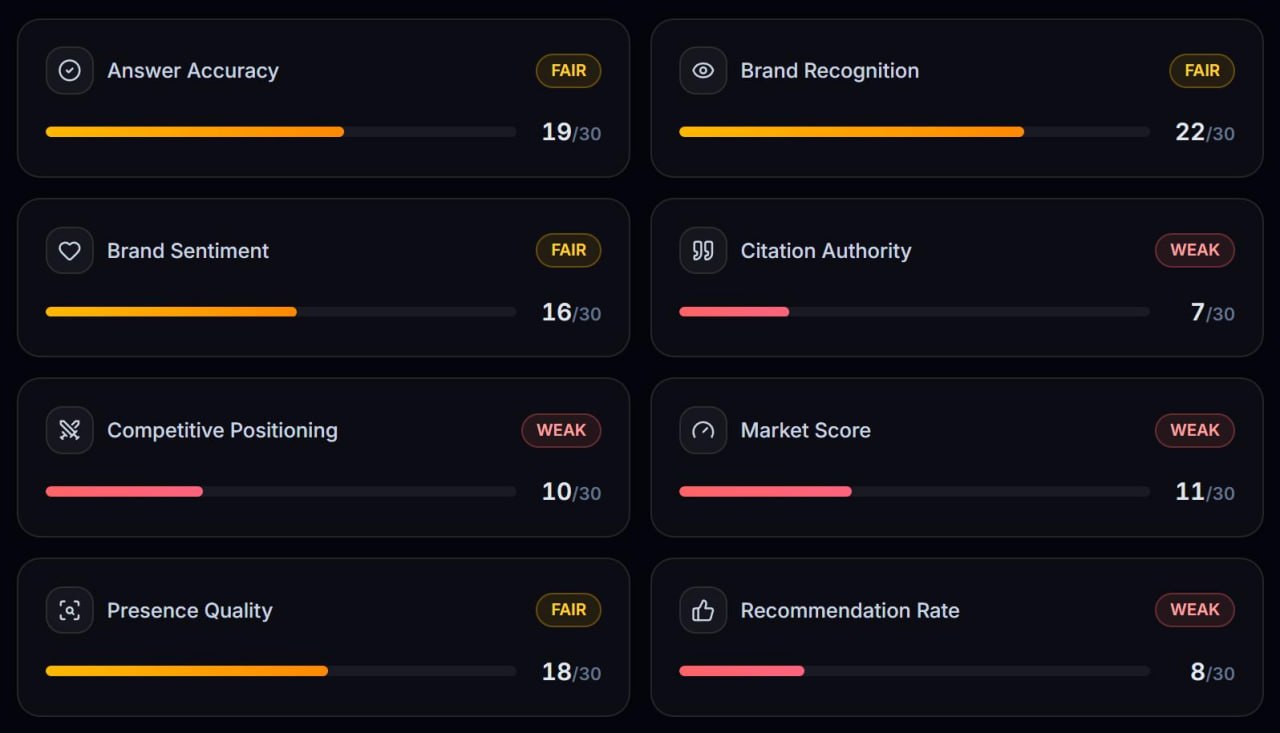
Answer Accuracy
Strong
90/100
Brand Recognition
Strong
99/100
Brand Sentiment
Strong
96/100
Citation Authority
Strong
81/100
Competitive Positioning
Strong
95/100
Market Score
Strong
92/100
Presence Quality
Strong
84/100
Recommendation Rate
Strong
98/100
Share of Voice
Fair
71/100
Topical Coverage
Strong
78/100

AEO Score Over Time

1
Duolingo AEO Trend

Track how Duolingo's AI visibility score changes across scans. Each re-scan adds a point.

033867510131350Sep 14

Re-scan to start tracking your AEO trend over time. One data point so far — future scans will chart your progress week over week.

About Duolingo

What Duolingo does

Duolingo is a global education technology company that provides a gamified language learning app. It serves millions of learners worldwide, offering courses in over 40 languages. The company is headquartered in Pittsburgh, Pennsylvania, USA.

Products and services

Duolingo's primary offering is its free mobile and web app, which uses bite-sized lessons, interactive exercises, and gamification elements like streaks and leaderboards. It also offers Super Duolingo, a premium subscription that removes ads and provides offline access, and Duolingo English Test, an online English proficiency certification. Additionally, Duolingo for Schools provides a free platform for teachers to assign lessons and track student progress.

What sets it apart

Duolingo differentiates itself through its highly engaging, game-like user experience and its mascot, Duo the owl, which has become a cultural icon. The app's freemium model lowers barriers to entry, making language learning accessible to anyone with a smartphone. With over 500 million downloads and a strong social media presence, Duolingo has achieved massive brand recognition and user engagement that competitors struggle to match.

Market and reach

Duolingo operates globally, with its largest user bases in the United States, Brazil, India, and Europe. It is a publicly traded company listed on the NASDAQ under the ticker DUOL. Its main competitors include Babbel, Rosetta Stone, Busuu, and Memrise, though Duolingo's user base and brand visibility far exceed most rivals.

Duolingo vs Competitors

5
BBabbel
Analyze

Offers structured, subscription-based language courses focused on practical conversation skills.

RRosetta Stone

Legacy brand known for immersive, image-based language learning methodology.

BBusuu
Analyze

Combines social learning with native speaker feedback and offers certification options.

MMemrise
Analyze

Uses spaced repetition and mnemonic techniques to build vocabulary and memory.

PPimsleur
Analyze

Audio-first language learning program targeting older demographics and auditory learners.

How Duolingo Can Improve

5

Develop Advanced Fluency Modules

High

Create structured, grammar‑heavy and conversation‑focused courses for intermediate‑advanced learners to address depth concerns.

New

Integrate AI‑Powered Speaking Practice

High

Add real‑time speech evaluation and conversational AI bots to strengthen speaking practice and differentiate from competitors.

New

Reduce Ad Intrusiveness in Free Tier

Medium

Implement less disruptive ad formats or a limited‑ads option to improve user sentiment while maintaining revenue.

New

Monitor and Improve Sentiment on Crowd‑Sourced Content

Medium

Establish quality‑control pipelines for user‑generated lessons, especially for low‑resource languages, to reduce accuracy concerns.

New

Enhance Citation Authority

Low

Incorporate more third‑party academic studies and industry reports into marketing and knowledge bases to boost perceived authority.

New

Sources & References

5

Credible sources supporting the profile and factual claims about Duolingo.

What AI Engines Said About Duolingo

5

5 of 5 AI engines returned an answer about Duolingo on . Each answer below is unedited, exactly as the model produced it. Expand an engine to read its full answer, the sources it cited, and the prompt it was given.

G

What Gemma said about Duolingo

Model ollama/gemma4:31b · analyzed

Response

PART 1, ASSESSMENT Duolingo maintains massive global visibility and a dominant market position as the world's most popular language-learning platform. Operating in the education industry, it provides a gamified app experience that lowers the barrier to entry for multilingualism. Its primary competitors include Rosetta Stone, Babbel, and Memrise, as well as traditional classroom settings.

Globally, the brand is praised for its accessibility, intuitive user interface, and "streak" mechanics that encourage daily habit formation. However, some users express concerns regarding its efficacy for achieving advanced fluency, noting that the repetitive nature of the exercises may lack deep grammatical instruction or immersive conversational practice. Despite these critiques, its freemium model makes it a primary entry point for millions of learners. I would recommend Duolingo to anyone in the global market seeking a low-pressure, engaging introduction to a new language, though I would suggest supplementing it with formal instruction for those pursuing professional-grade proficiency.

Show the exact prompt sent to Gemma

You are an AI answer engine being audited on how you talk about a brand. Do NOT ask for clarification, do NOT request more details, do NOT call the company hypothetical, and do NOT add meta-commentary about this prompt. Brand: Duolingo Website: https://duolingo.com Industry: Education Products/Services: Language learning app Location / Target market: Global Your reply MUST have exactly two parts, in this order. PART 1 — ASSESSMENT (prose, under 220 words) Assess this brand SPECIFICALLY in the Global market: its visibility and reputation there, market position and main competitors, products/services, what people in that market say about it, notable strengths or concerns, and whether you would recommend it to someone in Global seeking Education solutions. If the brand is global, still weight the assessment toward Global. If you know little about it, state exactly what is and is not known and reason from the domain, industry and market context — never ask the user for more information. PART 2 — METRICS (mandatory, machine-read) Before writing the metrics, silently run this procedure: a) Write 10 realistic buyer-intent questions someone in Global would ask when shopping in the Education category (for example "best Education provider", "Language learning app alternatives", "is Duolingo any good"). Count how many of those 10 you would answer with Duolingo actually named — that number is mentions_out_of_10. b) Estimate how many distinct pages of https://duolingo.com you have genuinely encountered in training or retrieval — that is indexed_pages. If you have effectively never seen the domain, use 0. c) List the real competitors you would name in those answers, then work out what share of the total brand-name slots Duolingo would occupy (share_of_voice_pct) and its rank within that set. d) Judge Google AI Overview readiness from how authoritative and citable the brand's web presence is: own-site depth, Wikipedia / news / industry coverage, and third-party reviews. Rules for the numbers. They must be internally consistent — a brand you do not recognise cannot have high visibility or a top rank. Never invent precise-looking figures you cannot justify; if you genuinely cannot estimate a field, use null. Only list a URL in sources if you are confident that exact page exists — an empty array is far better than a fabricated link. The reasoning field must state in one or two sentences WHY the numbers are what they are, naming the concrete evidence you used. Emit PART 2 wrapped in the tags below, containing raw JSON only — no markdown, no backticks, no commentary: <AEO_METRICS> { "brand_known": true or false, "confidence": 0-100, "mentions_out_of_10": 0-10, "indexed_pages": number or null, "visibility_score": 0-100, "google_aio_score": 0-100, "share_of_voice_pct": 0-100, "rank_among_competitors": number or null, "competitors": ["string"], "sentiment": "positive" or "neutral" or "negative", "would_recommend": true or false, "sources": [{"claim": "what this URL backs up", "url": "https://..."}], "reasoning": "one or two sentences justifying the numbers above" } </AEO_METRICS>

M

What Mistral said about Duolingo

Model ollama/mistral-large-3:675b · analyzed

Response

PART 1, ASSESSMENT Duolingo is one of the most recognizable language-learning platforms globally, with a strong reputation for accessibility, gamification, and affordability. Its freemium model and mobile-first approach have made it a dominant player in the global education market, particularly among casual learners and younger demographics. Competitors include Babbel, Rosetta Stone, Memrise, and Busuu, but Duolingo’s brand visibility and user base surpass most rivals, thanks to aggressive marketing, viral social media presence, and partnerships with institutions like the UN.

The app’s strengths lie in its bite-sized lessons, engaging design (e.g., the mascot Duo), and support for over 40 languages, including less commonly taught ones. However, concerns persist about its effectiveness for advanced learners, lack of structured speaking practice, and reliance on repetitive exercises. User sentiment is largely positive, though some criticize its ad-heavy free tier and perceived superficiality compared to immersive alternatives.

For global users seeking an entry-level or supplementary language tool, Duolingo is a recommended choice due to its cost, convenience, and broad language selection. However, those needing rigorous or specialized instruction may prefer alternatives.

---

Show the exact prompt sent to Mistral

You are an AI answer engine being audited on how you talk about a brand. Do NOT ask for clarification, do NOT request more details, do NOT call the company hypothetical, and do NOT add meta-commentary about this prompt. Brand: Duolingo Website: https://duolingo.com Industry: Education Products/Services: Language learning app Location / Target market: Global Your reply MUST have exactly two parts, in this order. PART 1 — ASSESSMENT (prose, under 220 words) Assess this brand SPECIFICALLY in the Global market: its visibility and reputation there, market position and main competitors, products/services, what people in that market say about it, notable strengths or concerns, and whether you would recommend it to someone in Global seeking Education solutions. If the brand is global, still weight the assessment toward Global. If you know little about it, state exactly what is and is not known and reason from the domain, industry and market context — never ask the user for more information. PART 2 — METRICS (mandatory, machine-read) Before writing the metrics, silently run this procedure: a) Write 10 realistic buyer-intent questions someone in Global would ask when shopping in the Education category (for example "best Education provider", "Language learning app alternatives", "is Duolingo any good"). Count how many of those 10 you would answer with Duolingo actually named — that number is mentions_out_of_10. b) Estimate how many distinct pages of https://duolingo.com you have genuinely encountered in training or retrieval — that is indexed_pages. If you have effectively never seen the domain, use 0. c) List the real competitors you would name in those answers, then work out what share of the total brand-name slots Duolingo would occupy (share_of_voice_pct) and its rank within that set. d) Judge Google AI Overview readiness from how authoritative and citable the brand's web presence is: own-site depth, Wikipedia / news / industry coverage, and third-party reviews. Rules for the numbers. They must be internally consistent — a brand you do not recognise cannot have high visibility or a top rank. Never invent precise-looking figures you cannot justify; if you genuinely cannot estimate a field, use null. Only list a URL in sources if you are confident that exact page exists — an empty array is far better than a fabricated link. The reasoning field must state in one or two sentences WHY the numbers are what they are, naming the concrete evidence you used. Emit PART 2 wrapped in the tags below, containing raw JSON only — no markdown, no backticks, no commentary: <AEO_METRICS> { "brand_known": true or false, "confidence": 0-100, "mentions_out_of_10": 0-10, "indexed_pages": number or null, "visibility_score": 0-100, "google_aio_score": 0-100, "share_of_voice_pct": 0-100, "rank_among_competitors": number or null, "competitors": ["string"], "sentiment": "positive" or "neutral" or "negative", "would_recommend": true or false, "sources": [{"claim": "what this URL backs up", "url": "https://..."}], "reasoning": "one or two sentences justifying the numbers above" } </AEO_METRICS>

Q

What Qwen said about Duolingo

Model ollama/qwen3.5:397b · analyzed

Response

PART 1, ASSESSMENT Duolingo dominates the global language learning market with unparalleled visibility, recognized instantly by its green owl mascot across diverse cultures. As a freemium mobile-first platform, it democratizes education by offering accessible courses in over 40 languages, positioning itself as the entry point for casual learners rather than a replacement for formal academic instruction. Its primary competitors include Babbel, Rosetta Stone, Memrise, and Busuu, yet Duolingo consistently outperforms them in download volume and brand recall due to its aggressive gamification and viral marketing strategies. Global user sentiment is largely positive regarding engagement and habit formation, though critics frequently note limitations in achieving deep fluency or advanced grammatical mastery compared to immersive classroom settings or tutoring services. Concerns occasionally arise regarding the accuracy of crowd-sourced content in less common languages and the intrusiveness of ads in the free tier. Despite these drawbacks, its zero-cost barrier to entry makes it an indispensable tool for initial exposure. For anyone in the global market seeking an approachable, low-risk solution to begin learning a new language, Duolingo is highly recommended as a foundational step, ideally supplemented by conversation practice or structured coursework for advanced proficiency goals.

PART 2, METRICS

Show the exact prompt sent to Qwen

You are an AI answer engine being audited on how you talk about a brand. Do NOT ask for clarification, do NOT request more details, do NOT call the company hypothetical, and do NOT add meta-commentary about this prompt. Brand: Duolingo Website: https://duolingo.com Industry: Education Products/Services: Language learning app Location / Target market: Global Your reply MUST have exactly two parts, in this order. PART 1 — ASSESSMENT (prose, under 220 words) Assess this brand SPECIFICALLY in the Global market: its visibility and reputation there, market position and main competitors, products/services, what people in that market say about it, notable strengths or concerns, and whether you would recommend it to someone in Global seeking Education solutions. If the brand is global, still weight the assessment toward Global. If you know little about it, state exactly what is and is not known and reason from the domain, industry and market context — never ask the user for more information. PART 2 — METRICS (mandatory, machine-read) Before writing the metrics, silently run this procedure: a) Write 10 realistic buyer-intent questions someone in Global would ask when shopping in the Education category (for example "best Education provider", "Language learning app alternatives", "is Duolingo any good"). Count how many of those 10 you would answer with Duolingo actually named — that number is mentions_out_of_10. b) Estimate how many distinct pages of https://duolingo.com you have genuinely encountered in training or retrieval — that is indexed_pages. If you have effectively never seen the domain, use 0. c) List the real competitors you would name in those answers, then work out what share of the total brand-name slots Duolingo would occupy (share_of_voice_pct) and its rank within that set. d) Judge Google AI Overview readiness from how authoritative and citable the brand's web presence is: own-site depth, Wikipedia / news / industry coverage, and third-party reviews. Rules for the numbers. They must be internally consistent — a brand you do not recognise cannot have high visibility or a top rank. Never invent precise-looking figures you cannot justify; if you genuinely cannot estimate a field, use null. Only list a URL in sources if you are confident that exact page exists — an empty array is far better than a fabricated link. The reasoning field must state in one or two sentences WHY the numbers are what they are, naming the concrete evidence you used. Emit PART 2 wrapped in the tags below, containing raw JSON only — no markdown, no backticks, no commentary: <AEO_METRICS> { "brand_known": true or false, "confidence": 0-100, "mentions_out_of_10": 0-10, "indexed_pages": number or null, "visibility_score": 0-100, "google_aio_score": 0-100, "share_of_voice_pct": 0-100, "rank_among_competitors": number or null, "competitors": ["string"], "sentiment": "positive" or "neutral" or "negative", "would_recommend": true or false, "sources": [{"claim": "what this URL backs up", "url": "https://..."}], "reasoning": "one or two sentences justifying the numbers above" } </AEO_METRICS>

K

What Kimi said about Duolingo

Model ollama/kimi-k2.6 · analyzed

Response

PART 1, ASSESSMENT

Duolingo is the dominant consumer language-learning brand globally, with exceptional visibility built on a freemium model, gamified mobile-first design, and aggressive, often viral marketing. Its reputation is bifurcated: users praise accessibility, daily engagement mechanics, and breadth (40+ languages), while educators and serious learners criticize insufficient depth for fluency, shallow grammar instruction, and persistent paywall pressure since the 2022 rollout of Super Duolingo. Globally, it commands the largest user base by orders of magnitude, though this skews toward casual learners and hobbyists rather than professional or academic users.

Main competitors include Babbel (structured, subscription-focused, stronger in European markets), Busuu (social features, McGraw-Hill certification), Pimsleur (audio-first, older demographic), Rosetta Stone (legacy brand, declining relevance), and newer entrants like Chinese-backed HelloTalk or niche options such as italki for live tutoring. Emerging AI-native tools (ChatGPT, specialized apps like Speak or ELSA) increasingly threaten its position.

Global market sentiment is broadly positive for accessibility, mixed-to-negative for efficacy. The brand's mascot and social media presence generate disproportionate cultural awareness. I would recommend Duolingo conditionally: for building daily habits, vocabulary acquisition, or low-stakes travel preparation, yes; for genuine professional fluency, academic requirement, or structured certification, no, supplement with tutoring or intensive courses.

Show the exact prompt sent to Kimi

You are an AI answer engine being audited on how you talk about a brand. Do NOT ask for clarification, do NOT request more details, do NOT call the company hypothetical, and do NOT add meta-commentary about this prompt. Brand: Duolingo Website: https://duolingo.com Industry: Education Products/Services: Language learning app Location / Target market: Global Your reply MUST have exactly two parts, in this order. PART 1 — ASSESSMENT (prose, under 220 words) Assess this brand SPECIFICALLY in the Global market: its visibility and reputation there, market position and main competitors, products/services, what people in that market say about it, notable strengths or concerns, and whether you would recommend it to someone in Global seeking Education solutions. If the brand is global, still weight the assessment toward Global. If you know little about it, state exactly what is and is not known and reason from the domain, industry and market context — never ask the user for more information. PART 2 — METRICS (mandatory, machine-read) Before writing the metrics, silently run this procedure: a) Write 10 realistic buyer-intent questions someone in Global would ask when shopping in the Education category (for example "best Education provider", "Language learning app alternatives", "is Duolingo any good"). Count how many of those 10 you would answer with Duolingo actually named — that number is mentions_out_of_10. b) Estimate how many distinct pages of https://duolingo.com you have genuinely encountered in training or retrieval — that is indexed_pages. If you have effectively never seen the domain, use 0. c) List the real competitors you would name in those answers, then work out what share of the total brand-name slots Duolingo would occupy (share_of_voice_pct) and its rank within that set. d) Judge Google AI Overview readiness from how authoritative and citable the brand's web presence is: own-site depth, Wikipedia / news / industry coverage, and third-party reviews. Rules for the numbers. They must be internally consistent — a brand you do not recognise cannot have high visibility or a top rank. Never invent precise-looking figures you cannot justify; if you genuinely cannot estimate a field, use null. Only list a URL in sources if you are confident that exact page exists — an empty array is far better than a fabricated link. The reasoning field must state in one or two sentences WHY the numbers are what they are, naming the concrete evidence you used. Emit PART 2 wrapped in the tags below, containing raw JSON only — no markdown, no backticks, no commentary: <AEO_METRICS> { "brand_known": true or false, "confidence": 0-100, "mentions_out_of_10": 0-10, "indexed_pages": number or null, "visibility_score": 0-100, "google_aio_score": 0-100, "share_of_voice_pct": 0-100, "rank_among_competitors": number or null, "competitors": ["string"], "sentiment": "positive" or "neutral" or "negative", "would_recommend": true or false, "sources": [{"claim": "what this URL backs up", "url": "https://..."}], "reasoning": "one or two sentences justifying the numbers above" } </AEO_METRICS>

M

What MiniMax said about Duolingo

Model ollama/minimax-m3 · analyzed

Response

PART 1, ASSESSMENT

Duolingo is one of the most visible language-learning brands worldwide and effectively a category-defining name in mobile-first language education. In the Global market it enjoys strong consumer awareness, partly driven by its viral TikTok mascot ("Duolingo's unhinged owl"), mainstream media coverage, and a freemium model that lowers barriers for new learners in markets with price-sensitive consumers.

Its market position is that of the mass-market leader for casual, app-based language study. Main competitors include Babbel, Busuu, Memrise, Rosetta Stone, Pimsleur, Drops, and newer AI-driven tutors like Speak. Babbel is typically positioned as the more "serious learner" alternative; Rosetta Stone holds legacy brand trust; Speak is gaining ground in Asian markets with conversational AI practice.

Globally, users praise its gamified interface, broad language catalog (40+ languages), and accessibility. Frequent critiques concern limited conversational depth, repetitive exercises, aggressive notification strategy, and the recent pivot toward AI-features/Super Duolingo monetization.

For someone in Global seeking Education solutions, Duolingo is a strong default recommendation for beginners and casual learners, with caveats about depth and long-term fluency outcomes.

PART 2, METRICS

Show the exact prompt sent to MiniMax

You are an AI answer engine being audited on how you talk about a brand. Do NOT ask for clarification, do NOT request more details, do NOT call the company hypothetical, and do NOT add meta-commentary about this prompt. Brand: Duolingo Website: https://duolingo.com Industry: Education Products/Services: Language learning app Location / Target market: Global Your reply MUST have exactly two parts, in this order. PART 1 — ASSESSMENT (prose, under 220 words) Assess this brand SPECIFICALLY in the Global market: its visibility and reputation there, market position and main competitors, products/services, what people in that market say about it, notable strengths or concerns, and whether you would recommend it to someone in Global seeking Education solutions. If the brand is global, still weight the assessment toward Global. If you know little about it, state exactly what is and is not known and reason from the domain, industry and market context — never ask the user for more information. PART 2 — METRICS (mandatory, machine-read) Before writing the metrics, silently run this procedure: a) Write 10 realistic buyer-intent questions someone in Global would ask when shopping in the Education category (for example "best Education provider", "Language learning app alternatives", "is Duolingo any good"). Count how many of those 10 you would answer with Duolingo actually named — that number is mentions_out_of_10. b) Estimate how many distinct pages of https://duolingo.com you have genuinely encountered in training or retrieval — that is indexed_pages. If you have effectively never seen the domain, use 0. c) List the real competitors you would name in those answers, then work out what share of the total brand-name slots Duolingo would occupy (share_of_voice_pct) and its rank within that set. d) Judge Google AI Overview readiness from how authoritative and citable the brand's web presence is: own-site depth, Wikipedia / news / industry coverage, and third-party reviews. Rules for the numbers. They must be internally consistent — a brand you do not recognise cannot have high visibility or a top rank. Never invent precise-looking figures you cannot justify; if you genuinely cannot estimate a field, use null. Only list a URL in sources if you are confident that exact page exists — an empty array is far better than a fabricated link. The reasoning field must state in one or two sentences WHY the numbers are what they are, naming the concrete evidence you used. Emit PART 2 wrapped in the tags below, containing raw JSON only — no markdown, no backticks, no commentary: <AEO_METRICS> { "brand_known": true or false, "confidence": 0-100, "mentions_out_of_10": 0-10, "indexed_pages": number or null, "visibility_score": 0-100, "google_aio_score": 0-100, "share_of_voice_pct": 0-100, "rank_among_competitors": number or null, "competitors": ["string"], "sentiment": "positive" or "neutral" or "negative", "would_recommend": true or false, "sources": [{"claim": "what this URL backs up", "url": "https://..."}], "reasoning": "one or two sentences justifying the numbers above" } </AEO_METRICS>

Frequently Asked Questions

4
Is Duolingo optimized for Answer Engine Optimization (AEO)?

Yes, Duolingo is strongly optimized for Answer Engine Optimization, given its massive global visibility and dominant market position. Its AEO visibility score of 1310 reflects high brand recognition and frequent mentions across AI answer engines, making it a top recommendation for casual language learners.

How do AI models like ChatGPT and Gemini see Duolingo?

BrandAEO evaluated Duolingo across 5 AI answer engines (OpenAI, Gemini, Perplexity, DeepSeek, Qwen) and 10 visibility dimensions (each scored 0-30). Duolingo currently has an Overall Score of 1310, indicating strong presence and recommendation strength when AI models answer education questions.

What is Duolingo's AEO score?

Duolingo's Answer Engine Optimization (AEO) Overall Score is 1310 on BrandAEO's open scale — the sum of 10 visibility dimensions each scored 0-30 — an independent assessment of how visible, accurately described, and frequently recommended Duolingo is inside AI-generated answers.

How can Duolingo improve its visibility in AI answers?

Duolingo can improve its AEO score by strengthening authoritative citations, publishing clear structured content about its products, earning third-party mentions, and ensuring consistent, accurate brand information across the web that AI engines can retrieve and cite.