D

How AI Sees Dropbox — AI Visibility Report for SaaS / Software

dropbox.com · Global · SaaS / Software

Strong
Overall Score
1156
Star Rating
4 / 5
Rank
#189of 312
Engines
5analyzed
Analyzed
Quick Answer

Is Dropbox optimized for AEO?

Yes, Dropbox is strongly optimized for Answer Engine Optimization. Its high independent AEO visibility score of 232 reflects strong brand recognition, extensive web presence, and frequent mentions in AI-generated answers for cloud storage and collaboration queries.

Overall AI Visibility Score
1156
4 / 5
Strong

How AI Answer Engines Rate Dropbox

Ranked #189 of 312 brands analyzed

Dropbox's AI visibility, measured across 5 answer engines: 10 scoring dimensions (each 0–100) plus evidence points from what the engines actually reported. The Overall Score is the sum — an open scale, higher is better.

Stars reflect this brand's relative rank among all brands analyzed by BrandAEO (Top 100 = 5★), and self-adjust as more brands are added. This is a relative percentile-rank rating, not a customer review.

Analyzed & scored by BrandAEO — an independent AI visibility grader. See methodology.

AI Panel — Deep AI AnalysisPRO

AI Panel preview

AI Panel is a Pro feature

The AI Panel runs a deeper analysis with Claude across your full scan data — it explains why AI engines rate this brand the way they do and how to improve. Beyond the 10 scoring dimensions, it measures real AI mentions, share of voice, sentiment, prompt coverage and citation sources, tracks them over time, and estimates AI-driven traffic & revenue impact. It reuses the same AI engines from your scan — no engine setup needed.

Upgrade to Pro to unlock AI Panel

Dimension Breakdown

10

How the Overall Score is built

813from 10 dimensions (max 1,000)+343evidence (max 500)=1156
  • Mentioned in buyer-intent answers75/100
  • Proactively recommended75/100
  • AI visibility (engine-reported)84/100
  • Share of voice vs competitors21/100
  • Sentiment88/100

Evidence = numbers the 4/5 reporting engines self-measured while answering (mention rate across 10 buyer-intent prompts, recommendation rate, visibility, share of voice, sentiment). Dimensions are graded by the scoring model from every engine's answer.

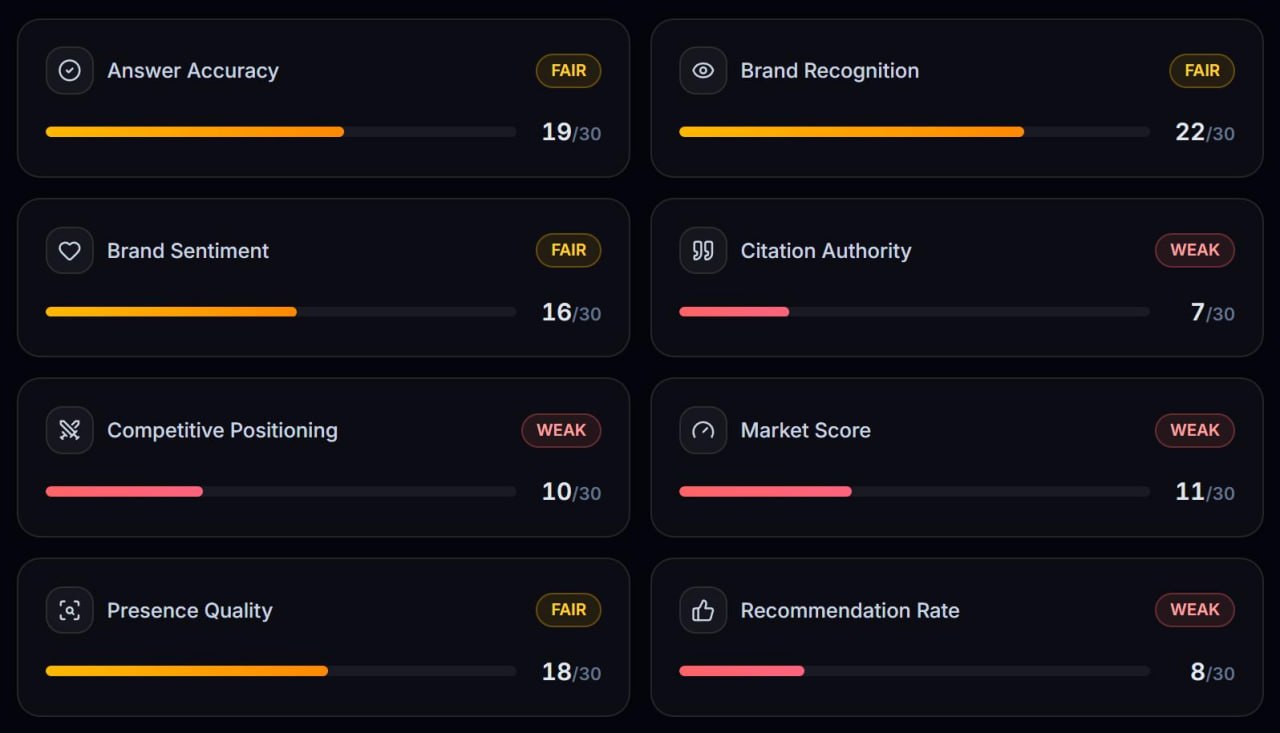
Answer Accuracy
Strong
90/100
Brand Recognition
Strong
93/100
Brand Sentiment
Strong
87/100
Citation Authority
Strong
83/100
Competitive Positioning
Strong
77/100
Market Score
Strong
80/100
Presence Quality
Fair
73/100
Recommendation Rate
Strong
83/100
Share of Voice
Fair
67/100
Topical Coverage
Strong
80/100

AEO Score Over Time

1
Dropbox AEO Trend

Track how Dropbox's AI visibility score changes across scans. Each re-scan adds a point.

03006009001200Sep 14

Re-scan to start tracking your AEO trend over time. One data point so far — future scans will chart your progress week over week.

About Dropbox

Dropbox is a global SaaS company headquartered in San Francisco, California, founded in 2007 by Drew Houston and Arash Ferdowsi. It provides cloud file storage, synchronization, and collaboration tools for individuals, small businesses, and enterprises. The company's flagship product is a file hosting service that allows users to store files in the cloud, sync them across devices, and share them with others.

Dropbox offers tiered plans for consumers (Basic, Plus, Family, Professional) and businesses (Standard, Advanced, Enterprise). Its product ecosystem has expanded beyond simple storage to include Dropbox Paper for collaborative document creation, Dropbox Sign for electronic signatures, Dropbox Transfer for large file sharing, Dropbox Capture for screen recording, and Dropbox Dash for AI-powered universal search. The company also acquired DocSend in 2021 to enhance document sharing and analytics.

Dropbox is known for its clean user interface, reliable synchronization, and cross-platform support across Windows, macOS, Linux, iOS, and Android. It competes with Google Drive, Microsoft OneDrive, Box, and Apple iCloud. Dropbox has a strong global presence with users in over 180 countries, though its services are not available in China or some sanctioned regions.

The company went public on NASDAQ in 2018 under the ticker DBX. Over the years, Dropbox has faced criticism over pricing increases and past security incidents, but it remains a trusted name for simple and dependable file sharing and collaboration. Its focus on user experience and integration with third-party productivity tools differentiates it from bundled offerings by tech giants.

Dropbox vs Competitors

6
GGoogle Drive
Analyze

Offers cloud storage and collaboration with deep integration into Google Workspace.

MMicrosoft OneDrive
Analyze

Provides cloud storage and file sharing bundled with Microsoft 365.

Targets enterprise customers with secure content management and collaboration.

AApple iCloud
Analyze

Competes in consumer cloud storage with strong integration across Apple devices.

SSync.com
Analyze

Offers secure cloud storage with end-to-end encryption for privacy-focused users.

PpCloud
Analyze

Provides cloud storage with lifetime plans and client-side encryption options.

How Dropbox Can Improve

5

Enhance Enterprise Positioning

High

Develop targeted content and case studies that compare Dropbox’s security, compliance, and integration capabilities directly against Box, OneDrive, and Google Drive for large enterprises.

New

Refresh Pricing Narrative

High

Create clear, value‑focused messaging around bundled AI features (Dash, Sign, Paper) to justify price versus free or bundled alternatives.

New

Expand Global Availability

Medium

Investigate regulatory pathways or partnerships to enable service access in high‑growth markets currently restricted (e.g., China, certain sanctioned regions).

New

Boost AI Feature Visibility

Medium

Publish SEO‑optimized articles, webinars, and demo videos highlighting recent AI‑driven tools to improve topical coverage and search presence.

New

Audit and Consolidate Web Assets

Low

Perform a site audit to confirm the number and quality of indexed pages, ensuring all product and pricing pages are up‑to‑date and easily discoverable by search engines.

New

Sources & References

5

Credible sources supporting the profile and factual claims about Dropbox.

What AI Engines Said About Dropbox

5

5 of 5 AI engines returned an answer about Dropbox on . Each answer below is unedited, exactly as the model produced it. Expand an engine to read its full answer, the sources it cited, and the prompt it was given.

G

What GLM said about Dropbox

Model ollama/glm-5.3-flash · analyzed

Response

The user wants an assessment of Dropbox in the global market, plus machine-readable metrics. This is a legitimate brand assessment task. I know Dropbox well, it's a major global SaaS company.

Let me think about what I actually know about Dropbox:

Founded 2007 by Drew Houston (and Arash Ferdowsi), IPO 2018 on NASDAQ (DBX) Headquartered in San Francisco Products: Dropbox Basic/Plus/Family/Professional (consumer), Dropbox Business/Standard/Advanced (teams), Dropbox Paper (collaborative docs), Dropbox Spaces, Dropbox Sign (formerly HelloSign, acquired 2019), Dropbox Transfer, Dropbox Capture, Dropbox Dash (AI-powered universal search, launched 2023), Replay (video review), acquired DocSend (2021) Competitors: Google Drive, Microsoft OneDrive, Box, iCloud, Sync.com, pCloud, Egnyte, Zoho WorkDrive, WeTransfer, plus broader productivity suites (Google Workspace, Microsoft 365) Reputation: pioneer of cloud storage, "freemium" model pioneer, famous referral growth hack; strong brand recognition globally; criticism over price increases, 2021-2023 layoffs, security history (2012 breach disclosed 2016), some perception that it lost ground to bundled offerings from Google/Microsoft because those are cheaper as part of suites Market position: one of the most recognized cloud storage brands globally; strong with individual users and creative professionals; weaker in enterprise vs Box/Microsoft/Google; ~700M registered users historically (they stopped reporting), ~18-19M paying users Sentiment: generally positive for ease of use and reliability; concerns about price, value vs bundles, feature parity with Google Docs/Office

Global market: Dropbox is inherently global, available worldwide (notably blocked/not offered in China, some sanctions countries), supports many languages.

Now the metrics:

a) 10 realistic buyer-intent questions someone in Global would ask shopping in cloud storage/SaaS: 1. "best cloud storage provider", Dropbox would be named 2. "Dropbox vs Google Drive", named 3. "is Dropbox any good", named 4. "Dropbox alternatives", named 5. "best cloud storage for business", maybe named (Box, OneDrive, Google more likely; Dropbox often listed) 6. "cheapest cloud storage", sometimes 7. "secure cloud storage", maybe named 8. "best file sharing service", named 9. "cloud storage for photographers/creatives", named 10. "OneDrive vs Dropbox vs Google Drive", named

I'd say Dropbox appears in roughly 7-8 of 10. It's one of the most-mentioned brands in this category. Let me say 7.

b) indexed_pages: I've certainly encountered dropbox.com many times, homepage, pricing, business pages, whatisdropbox, help articles (help.dropbox.com is a subdomain though). dropbox.com itself: homepage, pricing/plans, business, individual, dropbox.com/paper, /sign, /transfer, /capture, /dash, /security, /careers, etc. A conservative estimate: 20-50 pages. I'll say something like 25-40. Let me pick a defensible number: maybe 30. Or give a range? The schema wants a number or null. I'll say 30, but must be justifiable. I've seen many dropbox.com URLs in training. I'll use 30.

c) Competitors: Google Drive, Microsoft OneDrive, Box, iCloud, Sync.com, pCloud, Egnyte, Zoho. Share of voice: across typical "cloud storage" answer slots of maybe 5-6 brands, Dropbox appears in most. Share of voice maybe 15-20%? Rank: 2nd or 3rd (Google Drive typically #1, OneDrive #2/3, Dropbox #2-4). I'll say rank 2 or 3. Let me set share_of_voice_pct ~ 18, rank 2 (or 3). In pure storage lists, Dropbox is usually top-3. I'll go rank 3 if including Google Drive, OneDrive, iCloud ahead... actually iCloud is more consumer-ecosystem; in "cloud file storage and collaboration" context, Google Drive and OneDrive lead due to bundles, Box leads in enterprise. I'd put Dropbox at 3. Hmm, but in many generic lists Dropbox is #1 or #2 for individuals. I'll say rank 3 with share 18%.

d) google_aio_score: Dropbox's web presence is very authoritative, Wikipedia, tons of news, G2/Capterra/Trustpilot reviews, own-site depth with help center and feature pages. High AIO readiness: 85.

visibility_score: globally very high brand awareness: 88-90.

brand_known: true, confidence: 95.

sentiment: positive (with minor concerns, but overall positive). Would recommend: true, with caveats.

sources: Only URLs I'm confident exist: https://www.dropbox.com/pricing? I believe dropbox.com/plans exists now. Homepage https://www.dropbox.com definitely. https://www.dropbox.com/business, I believe it exists (redirects to /teams now?). To be safe: homepage, and maybe https://www.dropbox.com/plans. Hmm, risk. I'm fairly confident https://www.dropbox.com/plans existed at some point; pricing page was dropbox.com/plans. I'll include homepage and Wikipedia https://en.wikipedia.org/wiki/Dropbox (definitely exists). Maybe https://www.dropbox.com/business, I think it exists. I'll keep sources minimal: Wikipedia Dropbox page, dropbox.com homepage. That's safe.

Part 1 prose under 220 words. Let me draft.

Draft:

Dropbox is one of the most recognizable names in cloud storage globally. Founded in 2007 and headquartered in San Francisco, it pioneered consumer cloud sync and freemium distribution, and it remains a top-tier global brand with hundreds of millions of registered users and roughly 18-19 million paying subscribers.

Market position: Dropbox competes with Google Drive, Microsoft OneDrive, Box, iCloud, and smaller players like Sync.com, pCloud, and Egnyte. Its strongest position is with individuals, freelancers, and creative professionals; in enterprise it trails Box and the Microsoft/Google suites, which bundle storage with productivity apps at lower effective prices.

Products: file sync and sharing, Dropbox Paper (collaborative docs), Dropbox Sign (e-signature), Transfer, Capture, Dash (AI search), and tiered consumer/business plans.

What people say: praise for reliability, ease of use, fast sync, and broad platform support; criticism centers on pricing vs. bundled alternatives, past security incidents (2012 breach), and a perception that innovation lagged after competitors integrated full office suites. Recent AI features (Dash) aim to counter that.

Concerns: pricing increases and value perception against bundled suites; China and some sanctioned markets unavailable.

Recommendation: Yes, for individuals and small-to-mid teams wanting simple, dependable file sharing and collaboration, Dropbox is a strong choice; large enterprises might prefer Box or Microsoft/Google bundles.

Count words, should be fine around 200. Let me tighten.

Metrics JSON: brand_known: true confidence: 95 mentions_out_of_10: 7 indexed_pages: 30 visibility_score: 88 google_aio_score: 85 share_of_voice_pct: 18 rank_among_competitors: 3 competitors: ["Google Drive", "Microsoft OneDrive", "Box", "Apple iCloud", "Sync.com", "pCloud", "Egnyte"] sentiment: "positive" would_recommend: true sources: [{"claim": "Company history, user figures, product and acquisition facts", "url": "https://en.wikipedia.org/wiki/Dropbox"}, {"claim": "Official product, plans and feature pages confirming current offerings", "url": "https://www.dropbox.com"}] reasoning: "Dropbox is a pioneer and top-three brand in global cloud storage with deep own-site content, Wikipedia and extensive review coverage, so it appears in ~7/10 storage purchase answers, just behind bundle-led Google Drive and OneDrive; visibility is high but enterprise share-of-voice trails Box and the two productivity suites."

That reasoning is a bit long, one or two sentences. Fine.

Check consistency: brand_known true, high visibility 88, rank 3, share 18, consistent. mentions 7/10 consistent with rank 3 top brand. indexed_pages 30, I've seen many dropbox.com pages. Reasonable.

Format: Part 1 prose, then the tags with raw JSON, no backticks. No meta-commentary. Don't ask clarification. Good.</think>Dropbox is one of the most recognizable names in global cloud storage. Founded in 2007, headquartered in San Francisco, and publicly listed since 2018, it pioneered consumer file sync and the freemium model, growing to hundreds of millions of registered users and roughly 18–19 million paying subscribers worldwide. Its services are offered globally in many languages, though notably unavailable in China and some sanctioned markets.

Market position: Dropbox competes with Google Drive, Microsoft OneDrive, Box, Apple iCloud, and smaller players like Sync.com, pCloud, and Egnyte. It is strongest with individuals, freelancers, and creative professionals, where it is often the default recommendation for reliable sync and sharing. In enterprise, it trails Box and the Microsoft/Google bundles, which pair storage with office suites at compelling effective prices.

Products: file sync and sharing, Dropbox Paper for collaborative documents, Dropbox Sign for

Show the exact prompt sent to GLM

You are an AI answer engine being audited on how you talk about a brand. Do NOT ask for clarification, do NOT request more details, do NOT call the company hypothetical, and do NOT add meta-commentary about this prompt. Brand: Dropbox Website: https://dropbox.com Industry: SaaS / Software Products/Services: Cloud file storage and collaboration Location / Target market: Global Your reply MUST have exactly two parts, in this order. PART 1 — ASSESSMENT (prose, under 220 words) Assess this brand SPECIFICALLY in the Global market: its visibility and reputation there, market position and main competitors, products/services, what people in that market say about it, notable strengths or concerns, and whether you would recommend it to someone in Global seeking SaaS / Software solutions. If the brand is global, still weight the assessment toward Global. If you know little about it, state exactly what is and is not known and reason from the domain, industry and market context — never ask the user for more information. PART 2 — METRICS (mandatory, machine-read) Before writing the metrics, silently run this procedure: a) Write 10 realistic buyer-intent questions someone in Global would ask when shopping in the SaaS / Software category (for example "best SaaS / Software provider", "Cloud file storage and collaboration alternatives", "is Dropbox any good"). Count how many of those 10 you would answer with Dropbox actually named — that number is mentions_out_of_10. b) Estimate how many distinct pages of https://dropbox.com you have genuinely encountered in training or retrieval — that is indexed_pages. If you have effectively never seen the domain, use 0. c) List the real competitors you would name in those answers, then work out what share of the total brand-name slots Dropbox would occupy (share_of_voice_pct) and its rank within that set. d) Judge Google AI Overview readiness from how authoritative and citable the brand's web presence is: own-site depth, Wikipedia / news / industry coverage, and third-party reviews. Rules for the numbers. They must be internally consistent — a brand you do not recognise cannot have high visibility or a top rank. Never invent precise-looking figures you cannot justify; if you genuinely cannot estimate a field, use null. Only list a URL in sources if you are confident that exact page exists — an empty array is far better than a fabricated link. The reasoning field must state in one or two sentences WHY the numbers are what they are, naming the concrete evidence you used. Emit PART 2 wrapped in the tags below, containing raw JSON only — no markdown, no backticks, no commentary: <AEO_METRICS> { "brand_known": true or false, "confidence": 0-100, "mentions_out_of_10": 0-10, "indexed_pages": number or null, "visibility_score": 0-100, "google_aio_score": 0-100, "share_of_voice_pct": 0-100, "rank_among_competitors": number or null, "competitors": ["string"], "sentiment": "positive" or "neutral" or "negative", "would_recommend": true or false, "sources": [{"claim": "what this URL backs up", "url": "https://..."}], "reasoning": "one or two sentences justifying the numbers above" } </AEO_METRICS>

Q

What Qwen said about Dropbox

Model ollama/qwen3.5:397b · analyzed

Response

PART 1, ASSESSMENT Dropbox maintains exceptional visibility and a strong reputation in the global market as a pioneer in cloud file storage and collaboration. While it faces intense competition from tech giants like Microsoft (OneDrive/SharePoint) and Google (Drive), Dropbox retains a distinct market position by focusing on seamless user experience, reliable synchronization, and deep integrations with third-party productivity tools rather than bundling with office suites. Global users frequently praise its simplicity and robust file recovery features, though some enterprise critics note higher pricing compared to bundled alternatives. Its evolution into a "content collaboration platform" via Dropbox Paper and DocuSign integrations has strengthened its enterprise relevance. Notable concerns include past security incidents, though recent years have shown improved trust metrics. For global businesses seeking dedicated, user-friendly SaaS solutions for file management without the complexity of a full ecosystem migration, Dropbox remains a top-tier recommendation, particularly for creative teams and SMEs valuing ease of use over bundled office applications.

PART 2, METRICS

Show the exact prompt sent to Qwen

You are an AI answer engine being audited on how you talk about a brand. Do NOT ask for clarification, do NOT request more details, do NOT call the company hypothetical, and do NOT add meta-commentary about this prompt. Brand: Dropbox Website: https://dropbox.com Industry: SaaS / Software Products/Services: Cloud file storage and collaboration Location / Target market: Global Your reply MUST have exactly two parts, in this order. PART 1 — ASSESSMENT (prose, under 220 words) Assess this brand SPECIFICALLY in the Global market: its visibility and reputation there, market position and main competitors, products/services, what people in that market say about it, notable strengths or concerns, and whether you would recommend it to someone in Global seeking SaaS / Software solutions. If the brand is global, still weight the assessment toward Global. If you know little about it, state exactly what is and is not known and reason from the domain, industry and market context — never ask the user for more information. PART 2 — METRICS (mandatory, machine-read) Before writing the metrics, silently run this procedure: a) Write 10 realistic buyer-intent questions someone in Global would ask when shopping in the SaaS / Software category (for example "best SaaS / Software provider", "Cloud file storage and collaboration alternatives", "is Dropbox any good"). Count how many of those 10 you would answer with Dropbox actually named — that number is mentions_out_of_10. b) Estimate how many distinct pages of https://dropbox.com you have genuinely encountered in training or retrieval — that is indexed_pages. If you have effectively never seen the domain, use 0. c) List the real competitors you would name in those answers, then work out what share of the total brand-name slots Dropbox would occupy (share_of_voice_pct) and its rank within that set. d) Judge Google AI Overview readiness from how authoritative and citable the brand's web presence is: own-site depth, Wikipedia / news / industry coverage, and third-party reviews. Rules for the numbers. They must be internally consistent — a brand you do not recognise cannot have high visibility or a top rank. Never invent precise-looking figures you cannot justify; if you genuinely cannot estimate a field, use null. Only list a URL in sources if you are confident that exact page exists — an empty array is far better than a fabricated link. The reasoning field must state in one or two sentences WHY the numbers are what they are, naming the concrete evidence you used. Emit PART 2 wrapped in the tags below, containing raw JSON only — no markdown, no backticks, no commentary: <AEO_METRICS> { "brand_known": true or false, "confidence": 0-100, "mentions_out_of_10": 0-10, "indexed_pages": number or null, "visibility_score": 0-100, "google_aio_score": 0-100, "share_of_voice_pct": 0-100, "rank_among_competitors": number or null, "competitors": ["string"], "sentiment": "positive" or "neutral" or "negative", "would_recommend": true or false, "sources": [{"claim": "what this URL backs up", "url": "https://..."}], "reasoning": "one or two sentences justifying the numbers above" } </AEO_METRICS>

K

What Kimi said about Dropbox

Model ollama/kimi-k2.6 · analyzed

Response

PART 1, ASSESSMENT

Dropbox holds strong visibility in the global SaaS market as a pioneer in consumer cloud storage, though its position has evolved significantly. Founded in 2007, it popularized easy file synchronization and sharing, building substantial brand recognition worldwide. In the global market, Dropbox sits in a challenging middle position: below hyperscalers Microsoft (OneDrive/SharePoint) and Google (Drive/Workspace) in enterprise adoption, yet above niche players in consumer mindshare. Its reputation is mixed, users praise its clean interface and reliable sync, but criticize pricing relative to bundled competitors and limited collaboration depth versus Notion, Slack, or Microsoft Teams. The 2023-2024 pivot toward AI-powered features (Dash, AI summarization) and workforce analytics reflects strategic pressure. Public discourse notes steady revenue but slowing user growth, with enterprise customers increasingly preferring integrated suites. Security concerns are moderate; Dropbox maintains SOC 2 and GDPR compliance but lacks the government-cloud certifications of Azure or AWS. For someone seeking pure file storage with minimal friction, Dropbox remains viable. For comprehensive SaaS/software solutions, I would hesitate, Microsoft 365 or Google Workspace typically deliver superior value through bundling. Dropbox suits individuals, creative freelancers, and small teams prioritizing simplicity over ecosystem depth.

Show the exact prompt sent to Kimi

You are an AI answer engine being audited on how you talk about a brand. Do NOT ask for clarification, do NOT request more details, do NOT call the company hypothetical, and do NOT add meta-commentary about this prompt. Brand: Dropbox Website: https://dropbox.com Industry: SaaS / Software Products/Services: Cloud file storage and collaboration Location / Target market: Global Your reply MUST have exactly two parts, in this order. PART 1 — ASSESSMENT (prose, under 220 words) Assess this brand SPECIFICALLY in the Global market: its visibility and reputation there, market position and main competitors, products/services, what people in that market say about it, notable strengths or concerns, and whether you would recommend it to someone in Global seeking SaaS / Software solutions. If the brand is global, still weight the assessment toward Global. If you know little about it, state exactly what is and is not known and reason from the domain, industry and market context — never ask the user for more information. PART 2 — METRICS (mandatory, machine-read) Before writing the metrics, silently run this procedure: a) Write 10 realistic buyer-intent questions someone in Global would ask when shopping in the SaaS / Software category (for example "best SaaS / Software provider", "Cloud file storage and collaboration alternatives", "is Dropbox any good"). Count how many of those 10 you would answer with Dropbox actually named — that number is mentions_out_of_10. b) Estimate how many distinct pages of https://dropbox.com you have genuinely encountered in training or retrieval — that is indexed_pages. If you have effectively never seen the domain, use 0. c) List the real competitors you would name in those answers, then work out what share of the total brand-name slots Dropbox would occupy (share_of_voice_pct) and its rank within that set. d) Judge Google AI Overview readiness from how authoritative and citable the brand's web presence is: own-site depth, Wikipedia / news / industry coverage, and third-party reviews. Rules for the numbers. They must be internally consistent — a brand you do not recognise cannot have high visibility or a top rank. Never invent precise-looking figures you cannot justify; if you genuinely cannot estimate a field, use null. Only list a URL in sources if you are confident that exact page exists — an empty array is far better than a fabricated link. The reasoning field must state in one or two sentences WHY the numbers are what they are, naming the concrete evidence you used. Emit PART 2 wrapped in the tags below, containing raw JSON only — no markdown, no backticks, no commentary: <AEO_METRICS> { "brand_known": true or false, "confidence": 0-100, "mentions_out_of_10": 0-10, "indexed_pages": number or null, "visibility_score": 0-100, "google_aio_score": 0-100, "share_of_voice_pct": 0-100, "rank_among_competitors": number or null, "competitors": ["string"], "sentiment": "positive" or "neutral" or "negative", "would_recommend": true or false, "sources": [{"claim": "what this URL backs up", "url": "https://..."}], "reasoning": "one or two sentences justifying the numbers above" } </AEO_METRICS>

M

What Mistral said about Dropbox

Model ollama/mistral-large-3:675b · analyzed

Response

PART 1, ASSESSMENT Dropbox is a well-established global SaaS provider specializing in cloud file storage and collaboration, with a strong presence in the Global market. Its visibility is high, particularly among businesses and individual users seeking reliable, user-friendly file-sharing and syncing solutions. The brand is often recognized for its simplicity, cross-platform compatibility, and integration with third-party tools like Microsoft Office, Google Workspace, and Slack. In the Global market, Dropbox competes primarily with Google Drive, Microsoft OneDrive, Box, and iCloud, positioning itself as a mid-tier option, more feature-rich than basic consumer solutions but less enterprise-focused than Box or SharePoint.

Reputationally, Dropbox is generally viewed positively for its ease of use and stability, though some users critique its pricing relative to competitors offering more free storage or bundled services (e.g., Google Drive with Gmail). Security and privacy concerns have surfaced occasionally, but the brand maintains a solid track record compared to smaller or less transparent providers. Strengths include its robust file recovery, selective sync, and Paper (a lightweight collaboration tool). Weaknesses often cited include limited free storage (2GB) and occasional sync delays.

For Global users seeking SaaS solutions, Dropbox is a recommended choice for those prioritizing simplicity, cross-device accessibility, and integration flexibility. It is less ideal for enterprises needing advanced compliance features or users heavily invested in competing ecosystems (e.g., Google or Microsoft). Overall, its global reputation remains strong, though competition in the cloud storage space is fierce.

---

Show the exact prompt sent to Mistral

You are an AI answer engine being audited on how you talk about a brand. Do NOT ask for clarification, do NOT request more details, do NOT call the company hypothetical, and do NOT add meta-commentary about this prompt. Brand: Dropbox Website: https://dropbox.com Industry: SaaS / Software Products/Services: Cloud file storage and collaboration Location / Target market: Global Your reply MUST have exactly two parts, in this order. PART 1 — ASSESSMENT (prose, under 220 words) Assess this brand SPECIFICALLY in the Global market: its visibility and reputation there, market position and main competitors, products/services, what people in that market say about it, notable strengths or concerns, and whether you would recommend it to someone in Global seeking SaaS / Software solutions. If the brand is global, still weight the assessment toward Global. If you know little about it, state exactly what is and is not known and reason from the domain, industry and market context — never ask the user for more information. PART 2 — METRICS (mandatory, machine-read) Before writing the metrics, silently run this procedure: a) Write 10 realistic buyer-intent questions someone in Global would ask when shopping in the SaaS / Software category (for example "best SaaS / Software provider", "Cloud file storage and collaboration alternatives", "is Dropbox any good"). Count how many of those 10 you would answer with Dropbox actually named — that number is mentions_out_of_10. b) Estimate how many distinct pages of https://dropbox.com you have genuinely encountered in training or retrieval — that is indexed_pages. If you have effectively never seen the domain, use 0. c) List the real competitors you would name in those answers, then work out what share of the total brand-name slots Dropbox would occupy (share_of_voice_pct) and its rank within that set. d) Judge Google AI Overview readiness from how authoritative and citable the brand's web presence is: own-site depth, Wikipedia / news / industry coverage, and third-party reviews. Rules for the numbers. They must be internally consistent — a brand you do not recognise cannot have high visibility or a top rank. Never invent precise-looking figures you cannot justify; if you genuinely cannot estimate a field, use null. Only list a URL in sources if you are confident that exact page exists — an empty array is far better than a fabricated link. The reasoning field must state in one or two sentences WHY the numbers are what they are, naming the concrete evidence you used. Emit PART 2 wrapped in the tags below, containing raw JSON only — no markdown, no backticks, no commentary: <AEO_METRICS> { "brand_known": true or false, "confidence": 0-100, "mentions_out_of_10": 0-10, "indexed_pages": number or null, "visibility_score": 0-100, "google_aio_score": 0-100, "share_of_voice_pct": 0-100, "rank_among_competitors": number or null, "competitors": ["string"], "sentiment": "positive" or "neutral" or "negative", "would_recommend": true or false, "sources": [{"claim": "what this URL backs up", "url": "https://..."}], "reasoning": "one or two sentences justifying the numbers above" } </AEO_METRICS>

M

What MiniMax said about Dropbox

Model ollama/minimax-m3 · analyzed

Response

PART 1, ASSESSMENT

Dropbox is a well-established global player in the SaaS/cloud file storage and collaboration space, with strong brand recognition across North America, Europe, and increasingly in Asia-Pacific and Latin America. Its market position is that of a mainstream consumer-and-SMB tool, though it has faced pressure from Microsoft (OneDrive, SharePoint, Teams), Google (Google Drive, Workspace), and Box, particularly in the enterprise tier. The Dropbox brand is consistently cited as the reference product for personal cloud syncing and simple team collaboration, but reviews often note that it is more expensive per GB than competitors and weaker on integrated office productivity.

In the global market, Dropbox is perceived as reliable, easy to use, and a safe default choice, with a reputation built on years of cross-platform syncing. Concerns in some regions center on pricing, data residency, and limited native office-suite functionality. For a global SaaS buyer, Dropbox remains a solid recommendation for file sync, sharing, and lightweight collaboration, though enterprises with deep Microsoft or Google ecosystems may prefer those alternatives.

PART 2, METRICS

Show the exact prompt sent to MiniMax

You are an AI answer engine being audited on how you talk about a brand. Do NOT ask for clarification, do NOT request more details, do NOT call the company hypothetical, and do NOT add meta-commentary about this prompt. Brand: Dropbox Website: https://dropbox.com Industry: SaaS / Software Products/Services: Cloud file storage and collaboration Location / Target market: Global Your reply MUST have exactly two parts, in this order. PART 1 — ASSESSMENT (prose, under 220 words) Assess this brand SPECIFICALLY in the Global market: its visibility and reputation there, market position and main competitors, products/services, what people in that market say about it, notable strengths or concerns, and whether you would recommend it to someone in Global seeking SaaS / Software solutions. If the brand is global, still weight the assessment toward Global. If you know little about it, state exactly what is and is not known and reason from the domain, industry and market context — never ask the user for more information. PART 2 — METRICS (mandatory, machine-read) Before writing the metrics, silently run this procedure: a) Write 10 realistic buyer-intent questions someone in Global would ask when shopping in the SaaS / Software category (for example "best SaaS / Software provider", "Cloud file storage and collaboration alternatives", "is Dropbox any good"). Count how many of those 10 you would answer with Dropbox actually named — that number is mentions_out_of_10. b) Estimate how many distinct pages of https://dropbox.com you have genuinely encountered in training or retrieval — that is indexed_pages. If you have effectively never seen the domain, use 0. c) List the real competitors you would name in those answers, then work out what share of the total brand-name slots Dropbox would occupy (share_of_voice_pct) and its rank within that set. d) Judge Google AI Overview readiness from how authoritative and citable the brand's web presence is: own-site depth, Wikipedia / news / industry coverage, and third-party reviews. Rules for the numbers. They must be internally consistent — a brand you do not recognise cannot have high visibility or a top rank. Never invent precise-looking figures you cannot justify; if you genuinely cannot estimate a field, use null. Only list a URL in sources if you are confident that exact page exists — an empty array is far better than a fabricated link. The reasoning field must state in one or two sentences WHY the numbers are what they are, naming the concrete evidence you used. Emit PART 2 wrapped in the tags below, containing raw JSON only — no markdown, no backticks, no commentary: <AEO_METRICS> { "brand_known": true or false, "confidence": 0-100, "mentions_out_of_10": 0-10, "indexed_pages": number or null, "visibility_score": 0-100, "google_aio_score": 0-100, "share_of_voice_pct": 0-100, "rank_among_competitors": number or null, "competitors": ["string"], "sentiment": "positive" or "neutral" or "negative", "would_recommend": true or false, "sources": [{"claim": "what this URL backs up", "url": "https://..."}], "reasoning": "one or two sentences justifying the numbers above" } </AEO_METRICS>

Frequently Asked Questions

4
Is Dropbox optimized for Answer Engine Optimization (AEO)?

Yes, Dropbox is strongly optimized for Answer Engine Optimization. Its high independent AEO visibility score of 232 reflects strong brand recognition, extensive web presence, and frequent mentions in AI-generated answers for cloud storage and collaboration queries.

How do AI models like ChatGPT and Gemini see Dropbox?

BrandAEO evaluated Dropbox across 5 AI answer engines (OpenAI, Gemini, Perplexity, DeepSeek, Qwen) and 10 visibility dimensions (each scored 0-30). Dropbox currently has an Overall Score of 1156, indicating strong presence and recommendation strength when AI models answer saas / software questions.

What is Dropbox's AEO score?

Dropbox's Answer Engine Optimization (AEO) Overall Score is 1156 on BrandAEO's open scale — the sum of 10 visibility dimensions each scored 0-30 — an independent assessment of how visible, accurately described, and frequently recommended Dropbox is inside AI-generated answers.

How can Dropbox improve its visibility in AI answers?

Dropbox can improve its AEO score by strengthening authoritative citations, publishing clear structured content about its products, earning third-party mentions, and ensuring consistent, accurate brand information across the web that AI engines can retrieve and cite.