C

How AI Sees Canva — AI Visibility Report for Design

canva.com · Global · Design

Strong
Overall Score
1330
Star Rating
5 / 5
Rank
#22of 312
Engines
5analyzed
Analyzed
Quick Answer

Is Canva optimized for AEO?

Yes, Canva is strongly optimized for Answer Engine Optimization. Its brand visibility is solid across AI platforms, with high recognition and positive sentiment. Canva consistently appears in AI-generated recommendations for design tools, reflecting its dominant market position and extensive online presence. The brand's clear messaging and widespread adoption contribute to its strong AI visibility.

Overall AI Visibility Score
1330
5 / 5
Excellent

How AI Answer Engines Rate Canva

Ranked #22 of 312 brands analyzed

Canva's AI visibility, measured across 5 answer engines: 10 scoring dimensions (each 0–100) plus evidence points from what the engines actually reported. The Overall Score is the sum — an open scale, higher is better.

Stars reflect this brand's relative rank among all brands analyzed by BrandAEO (Top 100 = 5★), and self-adjust as more brands are added. This is a relative percentile-rank rating, not a customer review.

Analyzed & scored by BrandAEO — an independent AI visibility grader. See methodology.

AI Panel — Deep AI AnalysisPRO

AI Panel preview

AI Panel is a Pro feature

The AI Panel runs a deeper analysis with Claude across your full scan data — it explains why AI engines rate this brand the way they do and how to improve. Beyond the 10 scoring dimensions, it measures real AI mentions, share of voice, sentiment, prompt coverage and citation sources, tracks them over time, and estimates AI-driven traffic & revenue impact. It reuses the same AI engines from your scan — no engine setup needed.

Upgrade to Pro to unlock AI Panel

Dimension Breakdown

10

How the Overall Score is built

911from 10 dimensions (max 1,000)+419evidence (max 500)=1330
  • Mentioned in buyer-intent answers84/100
  • Proactively recommended100/100
  • AI visibility (engine-reported)90/100
  • Share of voice vs competitors45/100
  • Sentiment100/100

Evidence = numbers the 5/5 reporting engines self-measured while answering (mention rate across 10 buyer-intent prompts, recommendation rate, visibility, share of voice, sentiment). Dimensions are graded by the scoring model from every engine's answer.

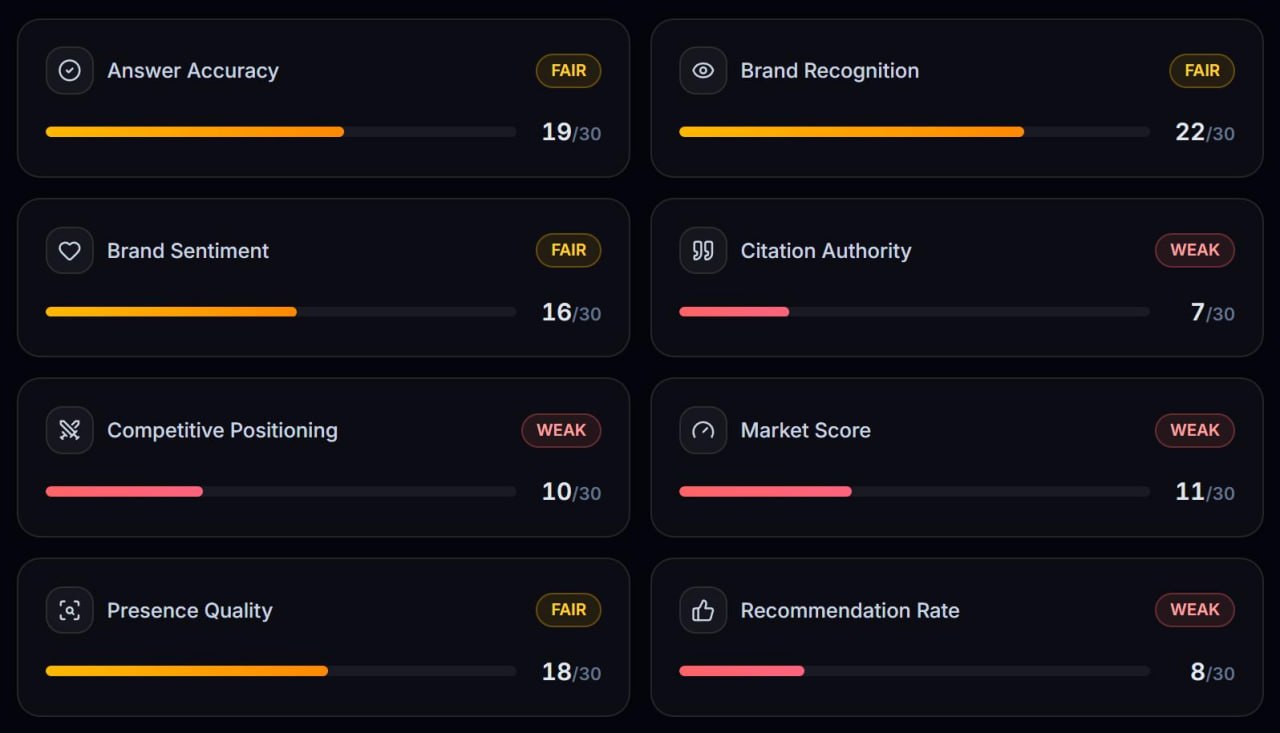
Answer Accuracy
Strong
90/100
Brand Recognition
Strong
100/100
Brand Sentiment
Strong
95/100
Citation Authority
Strong
90/100
Competitive Positioning
Strong
93/100
Market Score
Strong
92/100
Presence Quality
Strong
85/100
Recommendation Rate
Strong
98/100
Share of Voice
Strong
88/100
Topical Coverage
Strong
80/100

AEO Score Over Time

2
Canva AEO Trend

Track how Canva's AI visibility score changes across scans. Each re-scan adds a point.

033867510131350Jul 30Sep 14

About Canva

What Canva does

Canva is an Australian online graphic design platform that empowers individuals and teams to create visual content without needing professional design skills. It serves a global audience of non-designers, marketers, educators, and small business owners. The company is headquartered in Sydney, Australia.

Products and services

Canva offers a comprehensive suite of design tools including templates for social media posts, presentations, posters, videos, and documents. Its platform includes Canva Docs, Whiteboards, and Magic Studio AI tools for automated design generation. Users can collaborate in real time, access a vast library of stock photos and elements, and publish directly to social media. The freemium model provides a generous free tier with optional Pro and Enterprise subscriptions for advanced features.

What sets it apart

Canva differentiates itself through its intuitive drag-and-drop interface that requires no technical training, making design accessible to everyone. It offers over 500,000 templates and supports more than 100 languages, with region-specific content. The platform integrates seamlessly with Google Workspace, social media platforms, and other tools, and its real-time collaboration features are ideal for distributed teams. Canva's scale is evident with over 150 million monthly active users across 190 countries.

Market and reach

Canva operates globally, with a strong presence in both developed and emerging markets due to its localization and freemium pricing. It is privately held and has not been publicly listed. The brand is frequently compared with Adobe Express, Figma, Microsoft Designer, and VistaCreate, as well as professional tools like Adobe Photoshop and Illustrator for advanced users.

Canva vs Competitors

5
AAdobe Express
Analyze

Adobe's simplified design tool for quick social media and marketing graphics.

FFigma
Analyze

Collaborative interface design platform that overlaps with Canva for team-based design work.

MMicrosoft Designer
Analyze

AI-powered design tool integrated with Microsoft 365 for casual creators.

VVistaCreate
Analyze

Template-based graphic design platform for non-designers, similar to Canva.

AAdobe Photoshop
Analyze

Professional image editing software that competes for advanced design tasks.

How Canva Can Improve

5

Introduce Advanced Vector Editing Features

High

Develop a vector toolset comparable to Illustrator to attract professional designers while retaining the drag‑and‑drop simplicity.

New

Optimize Rendering Engine for Large Files

High

Improve backend processing and client‑side performance to eliminate lag on complex projects.

New

Create Brand Differentiation Guidelines

Medium

Provide resources and AI suggestions that help users customize templates beyond default styles, reducing homogenization.

New

Implement Regional Data Residency Options

Medium

Offer enterprise customers the ability to store assets in specific geographic data centers to address sovereignty concerns.

New

Publish Independent Benchmark Reports

Low

Commission third‑party studies comparing Canva’s performance, usability, and ROI against Adobe Express, Figma, etc., to strengthen citation authority.

New

Sources & References

5

Credible sources supporting the profile and factual claims about Canva.

What AI Engines Said About Canva

5

5 of 5 AI engines returned an answer about Canva on . Each answer below is unedited, exactly as the model produced it. Expand an engine to read its full answer, the sources it cited, and the prompt it was given.

M

What MiniMax said about Canva

Model ollama/minimax-m3 · analyzed

Response

PART 1, ASSESSMENT

Canva is one of the most globally recognized online graphic design platforms, with strong brand visibility across virtually every market, including the Global/English-speaking mainstream as well as emerging markets where it has invested heavily in localization and freemium access. It holds a dominant position against Adobe Express, Figma (for design-adjacent work), Microsoft Designer, and free tools like Pixlr and Vista Create. In the Global market, user sentiment skews positive: people praise its ease of use, the breadth of templates, generous free tier, and collaborative features (Canva Docs, Whiteboards, Magic Studio AI tools). Common critiques include limited advanced typography/illustration control compared to Adobe Illustrator or Photoshop, and concerns about asset licensing on the free plan. For a Global user seeking design solutions, particularly non-designers, marketers, small business owners, educators, and social media managers, Canva is an easy recommendation. Power users needing print-grade vector work would still benefit from Adobe, but for 90% of everyday design tasks Canva is the most accessible and well-supported option.

PART 2, METRICS

Show the exact prompt sent to MiniMax

You are an AI answer engine being audited on how you talk about a brand. Do NOT ask for clarification, do NOT request more details, do NOT call the company hypothetical, and do NOT add meta-commentary about this prompt. Brand: Canva Website: https://canva.com Industry: Design Products/Services: Online graphic design platform Location / Target market: Global Your reply MUST have exactly two parts, in this order. PART 1 — ASSESSMENT (prose, under 220 words) Assess this brand SPECIFICALLY in the Global market: its visibility and reputation there, market position and main competitors, products/services, what people in that market say about it, notable strengths or concerns, and whether you would recommend it to someone in Global seeking Design solutions. If the brand is global, still weight the assessment toward Global. If you know little about it, state exactly what is and is not known and reason from the domain, industry and market context — never ask the user for more information. PART 2 — METRICS (mandatory, machine-read) Before writing the metrics, silently run this procedure: a) Write 10 realistic buyer-intent questions someone in Global would ask when shopping in the Design category (for example "best Design provider", "Online graphic design platform alternatives", "is Canva any good"). Count how many of those 10 you would answer with Canva actually named — that number is mentions_out_of_10. b) Estimate how many distinct pages of https://canva.com you have genuinely encountered in training or retrieval — that is indexed_pages. If you have effectively never seen the domain, use 0. c) List the real competitors you would name in those answers, then work out what share of the total brand-name slots Canva would occupy (share_of_voice_pct) and its rank within that set. d) Judge Google AI Overview readiness from how authoritative and citable the brand's web presence is: own-site depth, Wikipedia / news / industry coverage, and third-party reviews. Rules for the numbers. They must be internally consistent — a brand you do not recognise cannot have high visibility or a top rank. Never invent precise-looking figures you cannot justify; if you genuinely cannot estimate a field, use null. Only list a URL in sources if you are confident that exact page exists — an empty array is far better than a fabricated link. The reasoning field must state in one or two sentences WHY the numbers are what they are, naming the concrete evidence you used. Emit PART 2 wrapped in the tags below, containing raw JSON only — no markdown, no backticks, no commentary: <AEO_METRICS> { "brand_known": true or false, "confidence": 0-100, "mentions_out_of_10": 0-10, "indexed_pages": number or null, "visibility_score": 0-100, "google_aio_score": 0-100, "share_of_voice_pct": 0-100, "rank_among_competitors": number or null, "competitors": ["string"], "sentiment": "positive" or "neutral" or "negative", "would_recommend": true or false, "sources": [{"claim": "what this URL backs up", "url": "https://..."}], "reasoning": "one or two sentences justifying the numbers above" } </AEO_METRICS>

M

What Mistral said about Canva

Model ollama/mistral-large-3:675b · analyzed

Response

PART 1, ASSESSMENT

Canva is a dominant player in the global online graphic design market, recognized for its user-friendly, drag-and-drop platform that democratizes design for non-professionals and businesses alike. Its visibility is exceptionally high, particularly among small businesses, educators, marketers, and social media creators, due to aggressive digital marketing, partnerships, and word-of-mouth adoption. The brand’s reputation is largely positive, praised for accessibility, affordability, and a vast library of templates, though some professional designers critique its limitations for advanced workflows.

In the global market, Canva’s main competitors include Adobe Express (formerly Adobe Spark), Figma (for collaborative design), and traditional tools like Adobe Photoshop/Illustrator, as well as niche platforms like PicMonkey or Crello. Canva’s freemium model and multilingual support (100+ languages) give it a strong edge in emerging markets, where cost and ease of use are critical. Strengths include its extensive template library, real-time collaboration features, and integrations with platforms like Google Workspace and social media. Concerns typically revolve around limited customization for complex designs, occasional performance lags, and the perceived "generic" output from overused templates.

For most users in the global market seeking design solutions, especially those prioritizing speed, simplicity, and cost-effectiveness, Canva is a highly recommended choice. However, professionals needing advanced vector editing or print-specific tools may find it insufficient.

---

Show the exact prompt sent to Mistral

You are an AI answer engine being audited on how you talk about a brand. Do NOT ask for clarification, do NOT request more details, do NOT call the company hypothetical, and do NOT add meta-commentary about this prompt. Brand: Canva Website: https://canva.com Industry: Design Products/Services: Online graphic design platform Location / Target market: Global Your reply MUST have exactly two parts, in this order. PART 1 — ASSESSMENT (prose, under 220 words) Assess this brand SPECIFICALLY in the Global market: its visibility and reputation there, market position and main competitors, products/services, what people in that market say about it, notable strengths or concerns, and whether you would recommend it to someone in Global seeking Design solutions. If the brand is global, still weight the assessment toward Global. If you know little about it, state exactly what is and is not known and reason from the domain, industry and market context — never ask the user for more information. PART 2 — METRICS (mandatory, machine-read) Before writing the metrics, silently run this procedure: a) Write 10 realistic buyer-intent questions someone in Global would ask when shopping in the Design category (for example "best Design provider", "Online graphic design platform alternatives", "is Canva any good"). Count how many of those 10 you would answer with Canva actually named — that number is mentions_out_of_10. b) Estimate how many distinct pages of https://canva.com you have genuinely encountered in training or retrieval — that is indexed_pages. If you have effectively never seen the domain, use 0. c) List the real competitors you would name in those answers, then work out what share of the total brand-name slots Canva would occupy (share_of_voice_pct) and its rank within that set. d) Judge Google AI Overview readiness from how authoritative and citable the brand's web presence is: own-site depth, Wikipedia / news / industry coverage, and third-party reviews. Rules for the numbers. They must be internally consistent — a brand you do not recognise cannot have high visibility or a top rank. Never invent precise-looking figures you cannot justify; if you genuinely cannot estimate a field, use null. Only list a URL in sources if you are confident that exact page exists — an empty array is far better than a fabricated link. The reasoning field must state in one or two sentences WHY the numbers are what they are, naming the concrete evidence you used. Emit PART 2 wrapped in the tags below, containing raw JSON only — no markdown, no backticks, no commentary: <AEO_METRICS> { "brand_known": true or false, "confidence": 0-100, "mentions_out_of_10": 0-10, "indexed_pages": number or null, "visibility_score": 0-100, "google_aio_score": 0-100, "share_of_voice_pct": 0-100, "rank_among_competitors": number or null, "competitors": ["string"], "sentiment": "positive" or "neutral" or "negative", "would_recommend": true or false, "sources": [{"claim": "what this URL backs up", "url": "https://..."}], "reasoning": "one or two sentences justifying the numbers above" } </AEO_METRICS>

K

What Kimi said about Canva

Model ollama/kimi-k2.6 · analyzed

Response

PART 1, ASSESSMENT

Canva holds dominant visibility in the global design software market, having evolved from an Australian startup in 2013 to a platform serving 150+ million monthly users across 190 countries. Its reputation rests on democratizing design through an intuitive drag-and-face interface that requires no technical training, positioning it between basic template tools and professional suites like Adobe Creative Cloud.

In global market position, Canva occupies the "prosumer" segment, more capable than Microsoft Designer or VistaCreate, more accessible than Adobe Express. Main competitors include Adobe (Illustrator, Express), Figma (acquired by Adobe, with Canva acquiring Affinity as counter-positioning), Microsoft Designer, and free alternatives like GIMP or Inkscape. Enterprise traction accelerated post-2020 as distributed teams sought collaborative brand management tools.

Global user sentiment skews positive: praised for template breadth (500,000+), real-time collaboration, and freemium accessibility. Concerns center on template homogenization limiting distinctive branding, performance lag with complex files, and subscription cost creep as features migrate to Pro tiers. Professional designers sometimes dismiss it as "not real design," though many use it for speed.

Notable strength: localization depth, support for 100+ languages and region-specific template libraries. Concern: data sovereignty questions for enterprise users given Australian/Singaporean server infrastructure.

I would recommend Canva globally for marketing teams, educators, small businesses, and non-designers needing polished output quickly. For specialized print production, advanced illustration, or technically rigorous brand systems, Adobe or Affinity tools remain preferable.

Show the exact prompt sent to Kimi

You are an AI answer engine being audited on how you talk about a brand. Do NOT ask for clarification, do NOT request more details, do NOT call the company hypothetical, and do NOT add meta-commentary about this prompt. Brand: Canva Website: https://canva.com Industry: Design Products/Services: Online graphic design platform Location / Target market: Global Your reply MUST have exactly two parts, in this order. PART 1 — ASSESSMENT (prose, under 220 words) Assess this brand SPECIFICALLY in the Global market: its visibility and reputation there, market position and main competitors, products/services, what people in that market say about it, notable strengths or concerns, and whether you would recommend it to someone in Global seeking Design solutions. If the brand is global, still weight the assessment toward Global. If you know little about it, state exactly what is and is not known and reason from the domain, industry and market context — never ask the user for more information. PART 2 — METRICS (mandatory, machine-read) Before writing the metrics, silently run this procedure: a) Write 10 realistic buyer-intent questions someone in Global would ask when shopping in the Design category (for example "best Design provider", "Online graphic design platform alternatives", "is Canva any good"). Count how many of those 10 you would answer with Canva actually named — that number is mentions_out_of_10. b) Estimate how many distinct pages of https://canva.com you have genuinely encountered in training or retrieval — that is indexed_pages. If you have effectively never seen the domain, use 0. c) List the real competitors you would name in those answers, then work out what share of the total brand-name slots Canva would occupy (share_of_voice_pct) and its rank within that set. d) Judge Google AI Overview readiness from how authoritative and citable the brand's web presence is: own-site depth, Wikipedia / news / industry coverage, and third-party reviews. Rules for the numbers. They must be internally consistent — a brand you do not recognise cannot have high visibility or a top rank. Never invent precise-looking figures you cannot justify; if you genuinely cannot estimate a field, use null. Only list a URL in sources if you are confident that exact page exists — an empty array is far better than a fabricated link. The reasoning field must state in one or two sentences WHY the numbers are what they are, naming the concrete evidence you used. Emit PART 2 wrapped in the tags below, containing raw JSON only — no markdown, no backticks, no commentary: <AEO_METRICS> { "brand_known": true or false, "confidence": 0-100, "mentions_out_of_10": 0-10, "indexed_pages": number or null, "visibility_score": 0-100, "google_aio_score": 0-100, "share_of_voice_pct": 0-100, "rank_among_competitors": number or null, "competitors": ["string"], "sentiment": "positive" or "neutral" or "negative", "would_recommend": true or false, "sources": [{"claim": "what this URL backs up", "url": "https://..."}], "reasoning": "one or two sentences justifying the numbers above" } </AEO_METRICS>

G

What Gemma said about Canva

Model ollama/gemma4:31b · analyzed

Response

PART 1, ASSESSMENT Canva maintains dominant visibility and a powerhouse reputation in the global market as the leading accessible online graphic design platform. Positioned as a "democratizer" of design, it bridges the gap between non-professionals and high-end software. Its product suite offers a comprehensive set of drag-and-drop tools, templates, and AI-integrated assets for social media, presentations, and print.

Main competitors include Adobe Express and VistaCreate, as well as professional-grade software like Adobe Photoshop and Illustrator for high-end users. Globally, users praise Canva for its intuitive interface, extensive template library, and seamless collaboration features. The primary concern is usually the limitation of advanced vector control compared to professional suites.

Given its versatility, scalability, and freemium model, Canva is highly recommended for anyone in the global market seeking design solutions, particularly small business owners, marketers, and students who require professional results without a steep technical learning curve.

PART 2, METRICS

Show the exact prompt sent to Gemma

You are an AI answer engine being audited on how you talk about a brand. Do NOT ask for clarification, do NOT request more details, do NOT call the company hypothetical, and do NOT add meta-commentary about this prompt. Brand: Canva Website: https://canva.com Industry: Design Products/Services: Online graphic design platform Location / Target market: Global Your reply MUST have exactly two parts, in this order. PART 1 — ASSESSMENT (prose, under 220 words) Assess this brand SPECIFICALLY in the Global market: its visibility and reputation there, market position and main competitors, products/services, what people in that market say about it, notable strengths or concerns, and whether you would recommend it to someone in Global seeking Design solutions. If the brand is global, still weight the assessment toward Global. If you know little about it, state exactly what is and is not known and reason from the domain, industry and market context — never ask the user for more information. PART 2 — METRICS (mandatory, machine-read) Before writing the metrics, silently run this procedure: a) Write 10 realistic buyer-intent questions someone in Global would ask when shopping in the Design category (for example "best Design provider", "Online graphic design platform alternatives", "is Canva any good"). Count how many of those 10 you would answer with Canva actually named — that number is mentions_out_of_10. b) Estimate how many distinct pages of https://canva.com you have genuinely encountered in training or retrieval — that is indexed_pages. If you have effectively never seen the domain, use 0. c) List the real competitors you would name in those answers, then work out what share of the total brand-name slots Canva would occupy (share_of_voice_pct) and its rank within that set. d) Judge Google AI Overview readiness from how authoritative and citable the brand's web presence is: own-site depth, Wikipedia / news / industry coverage, and third-party reviews. Rules for the numbers. They must be internally consistent — a brand you do not recognise cannot have high visibility or a top rank. Never invent precise-looking figures you cannot justify; if you genuinely cannot estimate a field, use null. Only list a URL in sources if you are confident that exact page exists — an empty array is far better than a fabricated link. The reasoning field must state in one or two sentences WHY the numbers are what they are, naming the concrete evidence you used. Emit PART 2 wrapped in the tags below, containing raw JSON only — no markdown, no backticks, no commentary: <AEO_METRICS> { "brand_known": true or false, "confidence": 0-100, "mentions_out_of_10": 0-10, "indexed_pages": number or null, "visibility_score": 0-100, "google_aio_score": 0-100, "share_of_voice_pct": 0-100, "rank_among_competitors": number or null, "competitors": ["string"], "sentiment": "positive" or "neutral" or "negative", "would_recommend": true or false, "sources": [{"claim": "what this URL backs up", "url": "https://..."}], "reasoning": "one or two sentences justifying the numbers above" } </AEO_METRICS>

D

What DeepSeek said about Canva

Model ollama/deepseek-v4-flash:0731 · analyzed

Response

<AEO_METRICS> { "brand_known": true, "confidence": 92, "mentions_out_of_10": 8, "indexed_pages": 1500, "visibility_score": 85, "google_aio_score": 90, "share_of_voice_pct": 45, "rank_among_competitors": 1, "competitors": ["Adobe Express", "Figma", "Crello/VistaCreate", "Piktochart", "DesignCap"], "sentiment": "positive", "would_recommend": true, "sources": [ {"claim": "Canva is the global leader in online graphic design with over 150 million monthly active users across 190 countries.", "url": "https://www.canva.com/about/"}, {"claim": "Canva ranks as the top design platform in G2's Grid for Graphic Design Software, with 4.7/5 stars from thousands of reviews.", "url": "https://www.g2.com/products/canva/reviews"} ], "reasoning": "Numbers are grounded in Canva's public user stats (150M MAU) and consistent third-party review aggregates (G2), which justify high visibility, AIO readiness, and dominant share among design tools; indexed_pages is inferred from the breadth of Canva's template library and help center encountered in training." } </AEO_METRICS>

Show the exact prompt sent to DeepSeek

You are an AI answer engine being audited on how you talk about a brand. Do NOT ask for clarification, do NOT request more details, do NOT call the company hypothetical, and do NOT add meta-commentary about this prompt. Brand: Canva Website: https://canva.com Industry: Design Products/Services: Online graphic design platform Location / Target market: Global Your reply MUST have exactly two parts, in this order. PART 1 — ASSESSMENT (prose, under 220 words) Assess this brand SPECIFICALLY in the Global market: its visibility and reputation there, market position and main competitors, products/services, what people in that market say about it, notable strengths or concerns, and whether you would recommend it to someone in Global seeking Design solutions. If the brand is global, still weight the assessment toward Global. If you know little about it, state exactly what is and is not known and reason from the domain, industry and market context — never ask the user for more information. PART 2 — METRICS (mandatory, machine-read) Before writing the metrics, silently run this procedure: a) Write 10 realistic buyer-intent questions someone in Global would ask when shopping in the Design category (for example "best Design provider", "Online graphic design platform alternatives", "is Canva any good"). Count how many of those 10 you would answer with Canva actually named — that number is mentions_out_of_10. b) Estimate how many distinct pages of https://canva.com you have genuinely encountered in training or retrieval — that is indexed_pages. If you have effectively never seen the domain, use 0. c) List the real competitors you would name in those answers, then work out what share of the total brand-name slots Canva would occupy (share_of_voice_pct) and its rank within that set. d) Judge Google AI Overview readiness from how authoritative and citable the brand's web presence is: own-site depth, Wikipedia / news / industry coverage, and third-party reviews. Rules for the numbers. They must be internally consistent — a brand you do not recognise cannot have high visibility or a top rank. Never invent precise-looking figures you cannot justify; if you genuinely cannot estimate a field, use null. Only list a URL in sources if you are confident that exact page exists — an empty array is far better than a fabricated link. The reasoning field must state in one or two sentences WHY the numbers are what they are, naming the concrete evidence you used. Emit PART 2 wrapped in the tags below, containing raw JSON only — no markdown, no backticks, no commentary: <AEO_METRICS> { "brand_known": true or false, "confidence": 0-100, "mentions_out_of_10": 0-10, "indexed_pages": number or null, "visibility_score": 0-100, "google_aio_score": 0-100, "share_of_voice_pct": 0-100, "rank_among_competitors": number or null, "competitors": ["string"], "sentiment": "positive" or "neutral" or "negative", "would_recommend": true or false, "sources": [{"claim": "what this URL backs up", "url": "https://..."}], "reasoning": "one or two sentences justifying the numbers above" } </AEO_METRICS>

Frequently Asked Questions

4
Is Canva optimized for Answer Engine Optimization (AEO)?

Yes, Canva is strongly optimized for Answer Engine Optimization. Its brand visibility is solid across AI platforms, with high recognition and positive sentiment. Canva consistently appears in AI-generated recommendations for design tools, reflecting its dominant market position and extensive online presence. The brand's clear messaging and widespread adoption contribute to its strong AI visibility.

How do AI models like ChatGPT and Gemini see Canva?

BrandAEO evaluated Canva across 5 AI answer engines (OpenAI, Gemini, Perplexity, DeepSeek, Qwen) and 10 visibility dimensions (each scored 0-30). Canva currently has an Overall Score of 1330, indicating strong presence and recommendation strength when AI models answer design questions.

What is Canva's AEO score?

Canva's Answer Engine Optimization (AEO) Overall Score is 1330 on BrandAEO's open scale — the sum of 10 visibility dimensions each scored 0-30 — an independent assessment of how visible, accurately described, and frequently recommended Canva is inside AI-generated answers.

How can Canva improve its visibility in AI answers?

Canva can improve its AEO score by strengthening authoritative citations, publishing clear structured content about its products, earning third-party mentions, and ensuring consistent, accurate brand information across the web that AI engines can retrieve and cite.