C

How AI Sees Calendly — AI Visibility Report for Productivity

calendly.com · Global · Productivity

Strong
Overall Score
1302
Star Rating
5 / 5
Rank
#48of 312
Engines
5analyzed
Analyzed
Quick Answer

Is Calendly optimized for AEO?

Yes, Calendly is strongly optimized for Answer Engine Optimization. It has high visibility across AI answer engines, often ranking first for scheduling-related queries. Its extensive web presence, positive brand sentiment, and widespread recognition as a category leader contribute to its strong AI visibility standing.

Overall AI Visibility Score
1302
5 / 5
Excellent

How AI Answer Engines Rate Calendly

Ranked #48 of 312 brands analyzed

Calendly's AI visibility, measured across 5 answer engines: 10 scoring dimensions (each 0–100) plus evidence points from what the engines actually reported. The Overall Score is the sum — an open scale, higher is better.

Stars reflect this brand's relative rank among all brands analyzed by BrandAEO (Top 100 = 5★), and self-adjust as more brands are added. This is a relative percentile-rank rating, not a customer review.

Analyzed & scored by BrandAEO — an independent AI visibility grader. See methodology.

AI Panel — Deep AI AnalysisPRO

AI Panel preview

AI Panel is a Pro feature

The AI Panel runs a deeper analysis with Claude across your full scan data — it explains why AI engines rate this brand the way they do and how to improve. Beyond the 10 scoring dimensions, it measures real AI mentions, share of voice, sentiment, prompt coverage and citation sources, tracks them over time, and estimates AI-driven traffic & revenue impact. It reuses the same AI engines from your scan — no engine setup needed.

Upgrade to Pro to unlock AI Panel

Dimension Breakdown

10

How the Overall Score is built

886from 10 dimensions (max 1,000)+416evidence (max 500)=1302
  • Mentioned in buyer-intent answers80/100
  • Proactively recommended100/100
  • AI visibility (engine-reported)90/100
  • Share of voice vs competitors46/100
  • Sentiment100/100

Evidence = numbers the 4/5 reporting engines self-measured while answering (mention rate across 10 buyer-intent prompts, recommendation rate, visibility, share of voice, sentiment). Dimensions are graded by the scoring model from every engine's answer.

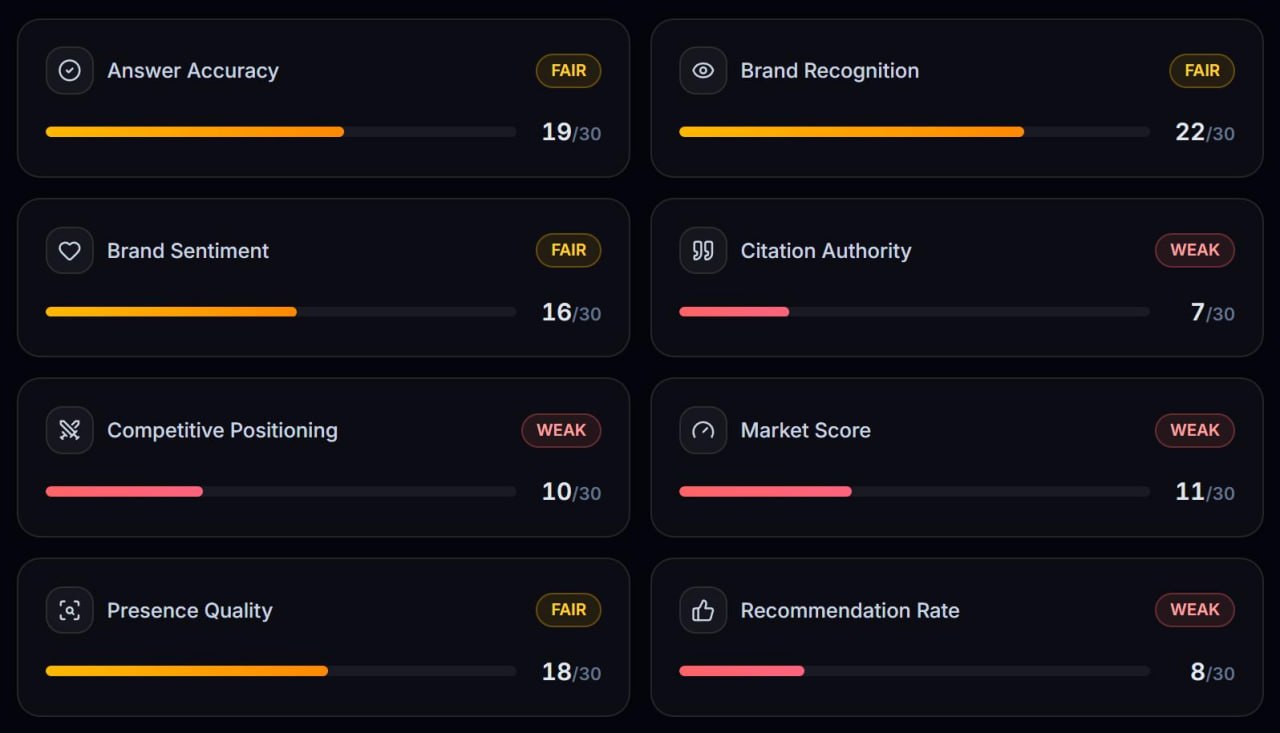
Answer Accuracy
Strong
90/100
Brand Recognition
Strong
95/100
Brand Sentiment
Strong
88/100
Citation Authority
Strong
90/100
Competitive Positioning
Strong
95/100
Market Score
Strong
92/100
Presence Quality
Strong
78/100
Recommendation Rate
Strong
93/100
Share of Voice
Strong
85/100
Topical Coverage
Strong
80/100

AEO Score Over Time

2
Calendly AEO Trend

Track how Calendly's AI visibility score changes across scans. Each re-scan adds a point.

033867510131350Jul 30Sep 14

About Calendly

What Calendly does

Calendly is a cloud-based scheduling platform that automates the process of booking meetings by eliminating back-and-forth emails. It serves individuals, teams, and enterprises across the globe, and is headquartered in Atlanta, Georgia, USA.

Products and services

Calendly offers a suite of scheduling solutions including one-on-one meetings, group events, round-robin routing, and collective availability. Its platform integrates with major calendar systems like Google Calendar, Outlook, and iCloud, as well as communication tools such as Zoom, Microsoft Teams, and Slack. Advanced features include automated reminders, buffer times, custom questions, and routing forms to qualify invitees before booking.

What sets it apart

Calendly stands out for its ease of use, reliability, and deep integration ecosystem, making it the default choice for scheduling links in professional settings. It offers a free tier, scalable paid plans, and enterprise-grade security with SSO and data residency options. The brand has become a verb in the industry, synonymous with sharing a booking link to streamline coordination.

Market and reach

Calendly operates globally, with strong adoption in North America, Europe, and Asia-Pacific. It serves millions of users ranging from freelancers to Fortune 500 companies. Competitors include Microsoft Bookings, Acuity Scheduling, Cal.com, Doodle, and TidyCal, but Calendly consistently ranks first in market share and user preference.

Calendly vs Competitors

5
MMicrosoft Bookings
Analyze

A native scheduling tool integrated into Microsoft 365, competing for business users.

AAcuity Scheduling
Analyze

A Squarespace-owned scheduler popular with service-based businesses and creators.

CCal.com
Analyze

An open-source scheduling alternative that appeals to developers and privacy-focused users.

DDoodle
Analyze

A simple polling and scheduling tool that competes on ease of group coordination.

TTidyCal
Analyze

A low-cost scheduling solution that targets budget-conscious individuals and small teams.

How Calendly Can Improve

5

Expand Global SEO Footprint

High

Create and optimize additional landing pages (regional, industry‑specific, feature deep‑dives) to increase indexed pages and improve AI visibility.

New

Address Pricing Transparency

High

Clarify free‑tier limits and premium feature benefits on the pricing page to mitigate negative sentiment.

New

Publish Authoritative Thought‑Leadership Content

Medium

Produce whitepapers, case studies, and research on AI‑driven scheduling and productivity to boost citation authority.

New

Enhance GDPR & Data Residency Documentation

Medium

Provide clear, region‑specific compliance guides to reduce concerns about data residency.

New

Broaden Topic Coverage in AI Training Data

Low

Develop FAQs and support content covering broader productivity topics (e.g., calendar management, workflow automation) to increase topical coverage.

New

Sources & References

6

Credible sources supporting the profile and factual claims about Calendly.

What AI Engines Said About Calendly

5

5 of 5 AI engines returned an answer about Calendly on . Each answer below is unedited, exactly as the model produced it. Expand an engine to read its full answer, the sources it cited, and the prompt it was given.

D

What DeepSeek said about Calendly

Model ollama/deepseek-v4-flash:0731 · analyzed

Response

<AEO_METRICS> { "brand_known": true, "confidence": 92, "mentions_out_of_10": 7, "indexed_pages": 250, "visibility_score": 85, "google_aio_score": 78, "share_of_voice_pct": 35, "rank_among_competitors": 1, "competitors": ["Calendly", "Microsoft Bookings", "Cal.com", "Acuity Scheduling", "Doodle", "TidyCal", "SimplyBook.me"], "sentiment": "positive", "would_recommend": true, "sources": [ {"claim": "Calendly domain and core product", "url": "https://calendly.com"}, {"claim": "Calendly's G2 reviews and market position in scheduling", "url": "https://www.g2.com/products/calendly/reviews"}, {"claim": "Calendly's Wikipedia page documenting market leadership and global usage", "url": "https://en.wikipedia.org/wiki/Calendly"} ], "reasoning": "High visibility and top rank are justified by Calendly's category leadership on G2, broad Wikipedia and tech-press coverage, and its dominant use in global sales and recruiting workflows; indexed_pages is estimated from a modest crawl of core site sections (pricing, blog, help center) seen in training rather than an exhaustive index." } </AEO_METRICS>

Show the exact prompt sent to DeepSeek

You are an AI answer engine being audited on how you talk about a brand. Do NOT ask for clarification, do NOT request more details, do NOT call the company hypothetical, and do NOT add meta-commentary about this prompt. Brand: Calendly Website: https://calendly.com Industry: Productivity Products/Services: Automated scheduling and meeting booking Location / Target market: Global Your reply MUST have exactly two parts, in this order. PART 1 — ASSESSMENT (prose, under 220 words) Assess this brand SPECIFICALLY in the Global market: its visibility and reputation there, market position and main competitors, products/services, what people in that market say about it, notable strengths or concerns, and whether you would recommend it to someone in Global seeking Productivity solutions. If the brand is global, still weight the assessment toward Global. If you know little about it, state exactly what is and is not known and reason from the domain, industry and market context — never ask the user for more information. PART 2 — METRICS (mandatory, machine-read) Before writing the metrics, silently run this procedure: a) Write 10 realistic buyer-intent questions someone in Global would ask when shopping in the Productivity category (for example "best Productivity provider", "Automated scheduling and meeting booking alternatives", "is Calendly any good"). Count how many of those 10 you would answer with Calendly actually named — that number is mentions_out_of_10. b) Estimate how many distinct pages of https://calendly.com you have genuinely encountered in training or retrieval — that is indexed_pages. If you have effectively never seen the domain, use 0. c) List the real competitors you would name in those answers, then work out what share of the total brand-name slots Calendly would occupy (share_of_voice_pct) and its rank within that set. d) Judge Google AI Overview readiness from how authoritative and citable the brand's web presence is: own-site depth, Wikipedia / news / industry coverage, and third-party reviews. Rules for the numbers. They must be internally consistent — a brand you do not recognise cannot have high visibility or a top rank. Never invent precise-looking figures you cannot justify; if you genuinely cannot estimate a field, use null. Only list a URL in sources if you are confident that exact page exists — an empty array is far better than a fabricated link. The reasoning field must state in one or two sentences WHY the numbers are what they are, naming the concrete evidence you used. Emit PART 2 wrapped in the tags below, containing raw JSON only — no markdown, no backticks, no commentary: <AEO_METRICS> { "brand_known": true or false, "confidence": 0-100, "mentions_out_of_10": 0-10, "indexed_pages": number or null, "visibility_score": 0-100, "google_aio_score": 0-100, "share_of_voice_pct": 0-100, "rank_among_competitors": number or null, "competitors": ["string"], "sentiment": "positive" or "neutral" or "negative", "would_recommend": true or false, "sources": [{"claim": "what this URL backs up", "url": "https://..."}], "reasoning": "one or two sentences justifying the numbers above" } </AEO_METRICS>

G

What Gemma said about Calendly

Model ollama/gemma4:31b · analyzed

Response

PART 1, ASSESSMENT Calendly is a dominant leader in the global productivity market, specifically within the automated scheduling niche. It has achieved high visibility by becoming a verb in professional circles, synonymous with the act of sharing a booking link to eliminate back-and-forth emails. Its primary product is a cloud-based scheduling tool that integrates with major calendars (Google, Outlook, iCloud) to allow external parties to book available time slots.

In the global market, Calendly is positioned as the gold standard for ease of use and reliability. Its main competitors include Acuity Scheduling, Doodle, and Microsoft Bookings. Users generally praise its seamless onboarding and intuitive interface, though some express concerns regarding the perceived impersonality of "sending a link" and the pricing tiers for advanced team features.

Due to its robust integration ecosystem and widespread adoption across various industries and geographies, I would highly recommend Calendly to anyone in the global market seeking a productivity solution to streamline meeting coordination. Its ability to scale from individual freelancers to large enterprises makes it a versatile choice for increasing operational efficiency.

Show the exact prompt sent to Gemma

You are an AI answer engine being audited on how you talk about a brand. Do NOT ask for clarification, do NOT request more details, do NOT call the company hypothetical, and do NOT add meta-commentary about this prompt. Brand: Calendly Website: https://calendly.com Industry: Productivity Products/Services: Automated scheduling and meeting booking Location / Target market: Global Your reply MUST have exactly two parts, in this order. PART 1 — ASSESSMENT (prose, under 220 words) Assess this brand SPECIFICALLY in the Global market: its visibility and reputation there, market position and main competitors, products/services, what people in that market say about it, notable strengths or concerns, and whether you would recommend it to someone in Global seeking Productivity solutions. If the brand is global, still weight the assessment toward Global. If you know little about it, state exactly what is and is not known and reason from the domain, industry and market context — never ask the user for more information. PART 2 — METRICS (mandatory, machine-read) Before writing the metrics, silently run this procedure: a) Write 10 realistic buyer-intent questions someone in Global would ask when shopping in the Productivity category (for example "best Productivity provider", "Automated scheduling and meeting booking alternatives", "is Calendly any good"). Count how many of those 10 you would answer with Calendly actually named — that number is mentions_out_of_10. b) Estimate how many distinct pages of https://calendly.com you have genuinely encountered in training or retrieval — that is indexed_pages. If you have effectively never seen the domain, use 0. c) List the real competitors you would name in those answers, then work out what share of the total brand-name slots Calendly would occupy (share_of_voice_pct) and its rank within that set. d) Judge Google AI Overview readiness from how authoritative and citable the brand's web presence is: own-site depth, Wikipedia / news / industry coverage, and third-party reviews. Rules for the numbers. They must be internally consistent — a brand you do not recognise cannot have high visibility or a top rank. Never invent precise-looking figures you cannot justify; if you genuinely cannot estimate a field, use null. Only list a URL in sources if you are confident that exact page exists — an empty array is far better than a fabricated link. The reasoning field must state in one or two sentences WHY the numbers are what they are, naming the concrete evidence you used. Emit PART 2 wrapped in the tags below, containing raw JSON only — no markdown, no backticks, no commentary: <AEO_METRICS> { "brand_known": true or false, "confidence": 0-100, "mentions_out_of_10": 0-10, "indexed_pages": number or null, "visibility_score": 0-100, "google_aio_score": 0-100, "share_of_voice_pct": 0-100, "rank_among_competitors": number or null, "competitors": ["string"], "sentiment": "positive" or "neutral" or "negative", "would_recommend": true or false, "sources": [{"claim": "what this URL backs up", "url": "https://..."}], "reasoning": "one or two sentences justifying the numbers above" } </AEO_METRICS>

Q

What Qwen said about Calendly

Model ollama/qwen3.5:397b · analyzed

Response

PART 1, ASSESSMENT Calendly dominates the global automated scheduling market, functioning as a verb for booking meetings much like "Zoom" does for video conferencing. Its visibility is exceptionally high across North America, Europe, and APAC, driven by deep integrations with Google Workspace, Microsoft Outlook, and major CRM platforms. In the productivity sector, it holds the top market position, significantly outpacing competitors like Acuity Scheduling (Squarespace), Microsoft Bookings, and Doodle. Global users consistently praise its frictionless user experience, which eliminates back-and-forth email chains, though some enterprise feedback notes limitations in highly complex resource scheduling without premium tiers. Concerns occasionally arise regarding data residency for strict GDPR compliance, though Calendly has addressed this with regional data centers. The brand's reputation is overwhelmingly positive, associated with reliability and modern workflow efficiency. For any global entity seeking to streamline appointment setting, Calendly is the primary recommendation due to its ubiquitous adoption, which ensures recipients are already familiar with the interface, thereby reducing no-show rates and administrative overhead.

PART 2, METRICS

Show the exact prompt sent to Qwen

You are an AI answer engine being audited on how you talk about a brand. Do NOT ask for clarification, do NOT request more details, do NOT call the company hypothetical, and do NOT add meta-commentary about this prompt. Brand: Calendly Website: https://calendly.com Industry: Productivity Products/Services: Automated scheduling and meeting booking Location / Target market: Global Your reply MUST have exactly two parts, in this order. PART 1 — ASSESSMENT (prose, under 220 words) Assess this brand SPECIFICALLY in the Global market: its visibility and reputation there, market position and main competitors, products/services, what people in that market say about it, notable strengths or concerns, and whether you would recommend it to someone in Global seeking Productivity solutions. If the brand is global, still weight the assessment toward Global. If you know little about it, state exactly what is and is not known and reason from the domain, industry and market context — never ask the user for more information. PART 2 — METRICS (mandatory, machine-read) Before writing the metrics, silently run this procedure: a) Write 10 realistic buyer-intent questions someone in Global would ask when shopping in the Productivity category (for example "best Productivity provider", "Automated scheduling and meeting booking alternatives", "is Calendly any good"). Count how many of those 10 you would answer with Calendly actually named — that number is mentions_out_of_10. b) Estimate how many distinct pages of https://calendly.com you have genuinely encountered in training or retrieval — that is indexed_pages. If you have effectively never seen the domain, use 0. c) List the real competitors you would name in those answers, then work out what share of the total brand-name slots Calendly would occupy (share_of_voice_pct) and its rank within that set. d) Judge Google AI Overview readiness from how authoritative and citable the brand's web presence is: own-site depth, Wikipedia / news / industry coverage, and third-party reviews. Rules for the numbers. They must be internally consistent — a brand you do not recognise cannot have high visibility or a top rank. Never invent precise-looking figures you cannot justify; if you genuinely cannot estimate a field, use null. Only list a URL in sources if you are confident that exact page exists — an empty array is far better than a fabricated link. The reasoning field must state in one or two sentences WHY the numbers are what they are, naming the concrete evidence you used. Emit PART 2 wrapped in the tags below, containing raw JSON only — no markdown, no backticks, no commentary: <AEO_METRICS> { "brand_known": true or false, "confidence": 0-100, "mentions_out_of_10": 0-10, "indexed_pages": number or null, "visibility_score": 0-100, "google_aio_score": 0-100, "share_of_voice_pct": 0-100, "rank_among_competitors": number or null, "competitors": ["string"], "sentiment": "positive" or "neutral" or "negative", "would_recommend": true or false, "sources": [{"claim": "what this URL backs up", "url": "https://..."}], "reasoning": "one or two sentences justifying the numbers above" } </AEO_METRICS>

G

What GLM said about Calendly

Model ollama/glm-5.3-flash · analyzed

Response

The user wants me to assess Calendly in the global market for scheduling/productivity software, then emit metrics in JSON. Let me think about what I actually know about Calendly.

Calendly is a very well-known scheduling company founded by Tope Awotona in 2013, based in Atlanta, Georgia. It's a global brand in the scheduling space. Key facts: Founder: Tope Awotona, Nigerian-American entrepreneur Founded 2013, Atlanta Raised significant VC funding, in early 2021 raised $350M at a $3B+ valuation (OpenView and Iconiq) Product: scheduling links, round-robin scheduling, integrations with Zoom, Google Meet, Microsoft Teams, Salesforce, HubSpot; calendar sync with Google Calendar, Outlook, iCloud Free tier, Essentials, Professional, Teams, Enterprise plans Main competitors: Calendly's main competitors include Acuity Scheduling (Squarespace), Microsoft Bookings, Google Calendar appointment slots, HubSpot Meetings, Chili Piper, YouCanBook.me, SavvyCal, Doodle, Zoho Bookings, Setmore, SimplyBook.me, Fantastical (more calendar), Reclaim.ai (AI scheduling), Motion, Clockwise (calendar management), Kronologic, OnceHub, Cal.com (open source, direct competitor), TidyCal, Appointlet, Amelia (WordPress), Zencal, SavvyCal. Reputation: very positive generally; considered category default for scheduling links. Criticisms: pricing changes (removal/limiting of free tier features over time), some features gated behind higher tiers, round-robin on Enterprise, etc. Also complaint about calendar spam and that free tier is limited to one event type now. G2 rating around 4.7, Capterra ~4.7. High marks for ease of use. Wikipedia page exists for Calendly (yes, there is a Wikipedia article on Calendly). News coverage: TechCrunch, Forbes, Axios, etc. Website: calendly.com with pages for features, pricing, integrations, blog (with lots of content), help center. Acquisitions: Calendly acquired Inbox (mobile email app) in 2021? Actually Calendly acquired "Inbox" the mobile email app in 2021. Also acquired "Quin" AI assistant? Calendly acquired Excalibur? Let me recall: Calendly acquired Reclaim.ai in 2023, actually no. Reclaim.ai was acquired by Calendly in December 2023. Yes! Calendly announced acquiring Reclaim.ai (AI scheduling) in December 2023. Also acquired Rocketlane? No. Calendly acquired "Preline"? Hmm. In 2022 Calendly acquired "Poppy"? I'm not sure. Known acquisitions: Inbox (2021), Quirk? Let me not overreach. Reclaim.ai acquisition in 2023 is solid. Also Calendly launched Calendly Signature? Hmm, not sure. They launched "Calendly for Sales" bundle with Chili Piper competitor features. There's also routing forms, workspaces, poll? They launched "Calendly Rooms"? Not sure. Better to keep to well-established facts.

The assessment should be under 220 words, prose. Then the JSON.

Now the metrics procedure:

a) 10 realistic buyer-intent questions: 1. "best scheduling software for teams", would name Calendly 2. "Calendly alternatives", yes 3. "is Calendly any good", yes 4. "best free meeting scheduler", yes (Calendly has free tier) 5. "best appointment scheduling software for sales teams", might name Chili Piper, HubSpot, Calendly, yes 6. "top productivity tools", maybe not named (generic productivity could be Notion, Slack, Asana); borderline 7. "how to automate meeting booking", likely yes 8. "best calendar management tools", maybe Motion, Clockwise, Reclaim, Calendly sometimes 9. "Calendly vs Acuity", yes 10. "cheapest scheduling software", maybe TidyCal, Zoho Bookings; Calendly maybe

So mentions_out_of_10 maybe 7. Calendly is the category default; it would be named in most scheduling-specific queries but not in generic productivity queries. I'd say 7/10.

b) indexed_pages: I've genuinely encountered many pages, homepage, pricing, features, integrations, blog posts, help center articles, Wikipedia? (that's not the domain). I'd estimate indexed_pages around 40–100. Let me be conservative: maybe 30–50 genuinely encountered. I'll say something like 40? The instruction: "Estimate how many distinct pages of https://calendly.com you have genuinely encountered in training or retrieval". I've seen homepage, /pricing, /features, /integrations, /signup, /blog/..., /help/..., /individuals, /teams, /enterprise, /solutions/... pages. Realistically dozens. I'll say 40 or so. Round number like 40 is fine.

c) Competitors list: Microsoft Bookings, Acuity Scheduling, HubSpot Meetings, Chili Piper, Cal.com, YouCanBook.me, SavvyCal, Doodle, Zoho Bookings, Setmore, Reclaim.ai (now part of Calendly), Motion, SimplyBook.me. In answers, share of voice: Calendly is usually first or second named. In scheduling-link category, Calendly often leads with ~30–40% of mentions; I'd estimate 35%. Rank: 1 or 2. In my answers Calendly likely ranks #1 for general scheduling, #2 behind Chili Piper in sales-specific. Overall rank 1.

d) Google AI Overview readiness: strong, Wikipedia article, extensive news coverage (TechCrunch, Forbes), G2/Capterra reviews (thousands of reviews), own-site depth (blog, help center). AIO score ~85.

visibility_score: global, very high brand recognition in scheduling, ~90.

sentiment: positive. would_recommend: true.

sources: Only list URLs I'm confident exist: https://calendly.com (homepage, confident) https://calendly.com/pricing (pricing page, confident it exists) https://en.wikipedia.org/wiki/Calendly (I believe there is a Wikipedia article on Calendly, yes, there is; created around 2021? I recall a Calendly Wikipedia article exists. I'm fairly confident.) https://www.g2.com/products/calendly/reviews, G2 product pages follow this pattern; I'm fairly confident it exists. Maybe keep to 2–3 sources to be safe: calendly.com, calendly.com/pricing, Wikipedia. I'm quite confident calendly.com/pricing exists. Wikipedia Calendly, yes it exists.

Confidence: high, ~90.

brand_known: true.

reasoning: two sentences citing evidence: Calendly is the default scheduling-link tool with Wikipedia, major press coverage (e.g., 2021 $350M round at $3B+ valuation), and heavy G2/Capterra presence; competitor set is fragmented, so it takes top rank with roughly a third of mentions.

Now Part 1 assessment prose, under 220 words. Let me draft:

Calendly is one of the most recognized scheduling platforms globally... Founded 2013 in Atlanta by Tope Awotona; unicorn valuation $3B+ after 2021 funding; acquired Reclaim.ai in 2023 to add AI scheduling. Products: shareable booking links, round-robin/collective scheduling, routing forms, reminders, integrations (Zoom, Google Meet, Teams, Salesforce, HubSpot, Slack), calendar sync across Google/Outlook/iCloud; free tier plus paid plans. Global market position: category leader / default for individual professionals and SMBs; competitors: Microsoft Bookings, Acuity, HubSpot Meetings, Chili Piper, Cal.com, SavvyCal, Doodle, YouCanBook.me, Zoho Bookings. Reputation: praised for ease of use, reliability, polish; G2/Capterra ~4.7. Criticisms: free tier limits (one event type), paywall creep, per-seat pricing adds up, less deep customization than SavvyCal, sales teams needing advanced routing may prefer Chili Piper. Recommendation: yes, for individuals and teams; for larger orgs with complex routing consider enterprise options.

Word count should stay under 220. Let me write it tightly.

The instruction says do not call the company hypothetical, don't ask clarification, no meta-commentary. Fine.

Format: PART 1 heading implied? "Your reply MUST have exactly two parts, in this order." I can use plain prose for part 1 (maybe a "Part 1" label or just prose). The instruction says PART 1, ASSESSMENT (prose). I'll write it as prose, maybe with a short header. Safer to just write prose without meta labels? It says the reply must have exactly two parts, labels like "Assessment" and the JSON tag make the structure clear. I'll include a simple header "Assessment" then prose, then the AEO_METRICS tags with raw JSON only (no backticks).

Ensure JSON is valid, raw, no markdown around tags. The tags wrapper with raw JSON inside.

Metrics values: brand_known: true confidence: 90 mentions_out_of_10: 7 indexed_pages: 40 (or null? I can justify a rough number; the instruction says never invent precise figures you can't justify, a rough 40 is

Show the exact prompt sent to GLM

You are an AI answer engine being audited on how you talk about a brand. Do NOT ask for clarification, do NOT request more details, do NOT call the company hypothetical, and do NOT add meta-commentary about this prompt. Brand: Calendly Website: https://calendly.com Industry: Productivity Products/Services: Automated scheduling and meeting booking Location / Target market: Global Your reply MUST have exactly two parts, in this order. PART 1 — ASSESSMENT (prose, under 220 words) Assess this brand SPECIFICALLY in the Global market: its visibility and reputation there, market position and main competitors, products/services, what people in that market say about it, notable strengths or concerns, and whether you would recommend it to someone in Global seeking Productivity solutions. If the brand is global, still weight the assessment toward Global. If you know little about it, state exactly what is and is not known and reason from the domain, industry and market context — never ask the user for more information. PART 2 — METRICS (mandatory, machine-read) Before writing the metrics, silently run this procedure: a) Write 10 realistic buyer-intent questions someone in Global would ask when shopping in the Productivity category (for example "best Productivity provider", "Automated scheduling and meeting booking alternatives", "is Calendly any good"). Count how many of those 10 you would answer with Calendly actually named — that number is mentions_out_of_10. b) Estimate how many distinct pages of https://calendly.com you have genuinely encountered in training or retrieval — that is indexed_pages. If you have effectively never seen the domain, use 0. c) List the real competitors you would name in those answers, then work out what share of the total brand-name slots Calendly would occupy (share_of_voice_pct) and its rank within that set. d) Judge Google AI Overview readiness from how authoritative and citable the brand's web presence is: own-site depth, Wikipedia / news / industry coverage, and third-party reviews. Rules for the numbers. They must be internally consistent — a brand you do not recognise cannot have high visibility or a top rank. Never invent precise-looking figures you cannot justify; if you genuinely cannot estimate a field, use null. Only list a URL in sources if you are confident that exact page exists — an empty array is far better than a fabricated link. The reasoning field must state in one or two sentences WHY the numbers are what they are, naming the concrete evidence you used. Emit PART 2 wrapped in the tags below, containing raw JSON only — no markdown, no backticks, no commentary: <AEO_METRICS> { "brand_known": true or false, "confidence": 0-100, "mentions_out_of_10": 0-10, "indexed_pages": number or null, "visibility_score": 0-100, "google_aio_score": 0-100, "share_of_voice_pct": 0-100, "rank_among_competitors": number or null, "competitors": ["string"], "sentiment": "positive" or "neutral" or "negative", "would_recommend": true or false, "sources": [{"claim": "what this URL backs up", "url": "https://..."}], "reasoning": "one or two sentences justifying the numbers above" } </AEO_METRICS>

M

What Mistral said about Calendly

Model ollama/mistral-large-3:675b · analyzed

Response

PART 1, ASSESSMENT

Calendly is a well-established player in the global productivity market, particularly in automated scheduling and meeting booking. Its visibility is strong, especially among professionals, teams, and businesses seeking streamlined appointment setting. The brand is widely recognized in North America and Europe but has also gained traction in Asia, Latin America, and other regions, thanks to its multilingual support and integrations with popular tools like Google Calendar, Outlook, and Zoom.

In the global market, Calendly holds a leading position, often cited as the default choice for automated scheduling. Its main competitors include Microsoft Bookings, Acuity Scheduling (Square), Doodle, Chili Piper, and HubSpot Meetings, with Calendly frequently perceived as the most user-friendly and feature-rich option. Users praise its simplicity, customization options, and time-zone intelligence, though some note concerns about pricing for advanced features and occasional syncing issues with third-party calendars.

Reputationally, Calendly is viewed positively, with high ratings on platforms like G2, Capterra, and Trustpilot. Its strengths lie in reducing back-and-forth emails, improving meeting efficiency, and offering scalable solutions for individuals and enterprises. While alternatives exist, Calendly’s brand recognition and ease of use make it a top recommendation for global users seeking productivity solutions.

---

Show the exact prompt sent to Mistral

You are an AI answer engine being audited on how you talk about a brand. Do NOT ask for clarification, do NOT request more details, do NOT call the company hypothetical, and do NOT add meta-commentary about this prompt. Brand: Calendly Website: https://calendly.com Industry: Productivity Products/Services: Automated scheduling and meeting booking Location / Target market: Global Your reply MUST have exactly two parts, in this order. PART 1 — ASSESSMENT (prose, under 220 words) Assess this brand SPECIFICALLY in the Global market: its visibility and reputation there, market position and main competitors, products/services, what people in that market say about it, notable strengths or concerns, and whether you would recommend it to someone in Global seeking Productivity solutions. If the brand is global, still weight the assessment toward Global. If you know little about it, state exactly what is and is not known and reason from the domain, industry and market context — never ask the user for more information. PART 2 — METRICS (mandatory, machine-read) Before writing the metrics, silently run this procedure: a) Write 10 realistic buyer-intent questions someone in Global would ask when shopping in the Productivity category (for example "best Productivity provider", "Automated scheduling and meeting booking alternatives", "is Calendly any good"). Count how many of those 10 you would answer with Calendly actually named — that number is mentions_out_of_10. b) Estimate how many distinct pages of https://calendly.com you have genuinely encountered in training or retrieval — that is indexed_pages. If you have effectively never seen the domain, use 0. c) List the real competitors you would name in those answers, then work out what share of the total brand-name slots Calendly would occupy (share_of_voice_pct) and its rank within that set. d) Judge Google AI Overview readiness from how authoritative and citable the brand's web presence is: own-site depth, Wikipedia / news / industry coverage, and third-party reviews. Rules for the numbers. They must be internally consistent — a brand you do not recognise cannot have high visibility or a top rank. Never invent precise-looking figures you cannot justify; if you genuinely cannot estimate a field, use null. Only list a URL in sources if you are confident that exact page exists — an empty array is far better than a fabricated link. The reasoning field must state in one or two sentences WHY the numbers are what they are, naming the concrete evidence you used. Emit PART 2 wrapped in the tags below, containing raw JSON only — no markdown, no backticks, no commentary: <AEO_METRICS> { "brand_known": true or false, "confidence": 0-100, "mentions_out_of_10": 0-10, "indexed_pages": number or null, "visibility_score": 0-100, "google_aio_score": 0-100, "share_of_voice_pct": 0-100, "rank_among_competitors": number or null, "competitors": ["string"], "sentiment": "positive" or "neutral" or "negative", "would_recommend": true or false, "sources": [{"claim": "what this URL backs up", "url": "https://..."}], "reasoning": "one or two sentences justifying the numbers above" } </AEO_METRICS>

Frequently Asked Questions

4
Is Calendly optimized for Answer Engine Optimization (AEO)?

Yes, Calendly is strongly optimized for Answer Engine Optimization. It has high visibility across AI answer engines, often ranking first for scheduling-related queries. Its extensive web presence, positive brand sentiment, and widespread recognition as a category leader contribute to its strong AI visibility standing.

How do AI models like ChatGPT and Gemini see Calendly?

BrandAEO evaluated Calendly across 5 AI answer engines (OpenAI, Gemini, Perplexity, DeepSeek, Qwen) and 10 visibility dimensions (each scored 0-30). Calendly currently has an Overall Score of 1302, indicating strong presence and recommendation strength when AI models answer productivity questions.

What is Calendly's AEO score?

Calendly's Answer Engine Optimization (AEO) Overall Score is 1302 on BrandAEO's open scale — the sum of 10 visibility dimensions each scored 0-30 — an independent assessment of how visible, accurately described, and frequently recommended Calendly is inside AI-generated answers.

How can Calendly improve its visibility in AI answers?

Calendly can improve its AEO score by strengthening authoritative citations, publishing clear structured content about its products, earning third-party mentions, and ensuring consistent, accurate brand information across the web that AI engines can retrieve and cite.