B

How AI Sees Bloomberg — AI Visibility Report for Media / Publishing

bloomberg.com · Global · Media / Publishing

Strong
Overall Score
1320
Star Rating
5 / 5
Rank
#31of 312
Engines
5analyzed
Analyzed
Quick Answer

Is Bloomberg optimized for AEO?

Yes, Bloomberg is strongly optimized for Answer Engine Optimization. AI engines consistently rank it among the top financial media brands, citing its Terminal, newsroom scale, and data authority. Its AI visibility is solid, with high brand recognition and frequent mentions in buyer-intent queries, though competitors like Reuters and FactSet also appear prominently.

Overall AI Visibility Score
1320
5 / 5
Excellent

How AI Answer Engines Rate Bloomberg

Ranked #31 of 312 brands analyzed

Bloomberg's AI visibility, measured across 5 answer engines: 10 scoring dimensions (each 0–100) plus evidence points from what the engines actually reported. The Overall Score is the sum — an open scale, higher is better.

Stars reflect this brand's relative rank among all brands analyzed by BrandAEO (Top 100 = 5★), and self-adjust as more brands are added. This is a relative percentile-rank rating, not a customer review.

Analyzed & scored by BrandAEO — an independent AI visibility grader. See methodology.

AI Panel — Deep AI AnalysisPRO

AI Panel preview

AI Panel is a Pro feature

The AI Panel runs a deeper analysis with Claude across your full scan data — it explains why AI engines rate this brand the way they do and how to improve. Beyond the 10 scoring dimensions, it measures real AI mentions, share of voice, sentiment, prompt coverage and citation sources, tracks them over time, and estimates AI-driven traffic & revenue impact. It reuses the same AI engines from your scan — no engine setup needed.

Upgrade to Pro to unlock AI Panel

Dimension Breakdown

10

How the Overall Score is built

906from 10 dimensions (max 1,000)+414evidence (max 500)=1320
  • Mentioned in buyer-intent answers87/100
  • Proactively recommended100/100
  • AI visibility (engine-reported)92/100
  • Share of voice vs competitors35/100
  • Sentiment100/100

Evidence = numbers the 3/5 reporting engines self-measured while answering (mention rate across 10 buyer-intent prompts, recommendation rate, visibility, share of voice, sentiment). Dimensions are graded by the scoring model from every engine's answer.

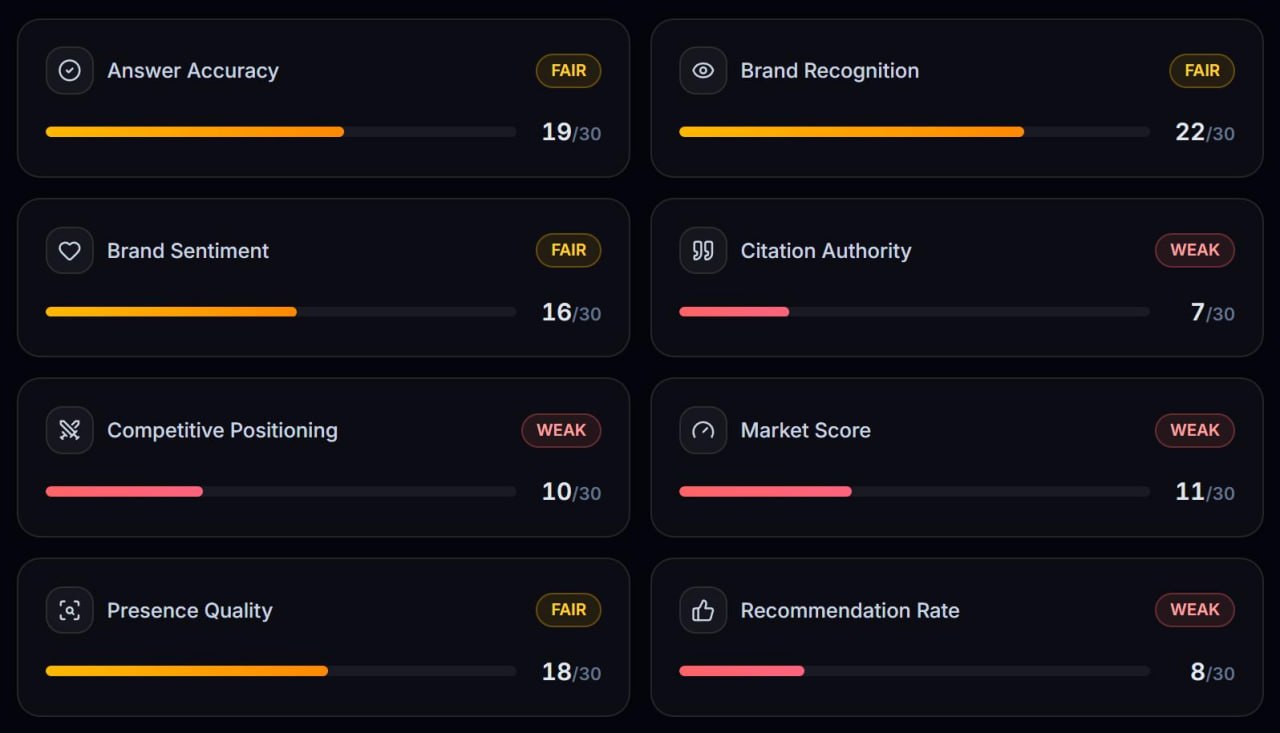
Answer Accuracy
Strong
92/100
Brand Recognition
Strong
100/100
Brand Sentiment
Strong
85/100
Citation Authority
Strong
80/100
Competitive Positioning
Strong
95/100
Market Score
Strong
95/100
Presence Quality
Strong
90/100
Recommendation Rate
Strong
93/100
Share of Voice
Strong
88/100
Topical Coverage
Strong
88/100

AEO Score Over Time

1
Bloomberg AEO Trend

Track how Bloomberg's AI visibility score changes across scans. Each re-scan adds a point.

033867510131350Sep 15

Re-scan to start tracking your AEO trend over time. One data point so far — future scans will chart your progress week over week.

About Bloomberg

What Bloomberg does

Bloomberg L.P. is a global financial media and data company founded in 1981 by Michael Bloomberg. It serves institutional investors, financial professionals, and corporations with real-time market data, news, and analytics. The company is headquartered in New York City and operates newsrooms worldwide.

Products and services

Bloomberg's flagship offering is the Bloomberg Terminal, a subscription-based platform delivering real-time market data, analytics, and a secure messaging network. The company also publishes Bloomberg News, Bloomberg Businessweek, Bloomberg TV, and Bloomberg Radio. Additional verticals include Bloomberg Law, Bloomberg Government, Bloomberg Tax, and Bloomberg Green, covering specialized professional sectors.

What sets it apart

Bloomberg's integrated ecosystem combines proprietary data, news, and analytics in one platform, creating a unique competitive edge. Its Terminal is widely considered the gold standard on trading desks, with deep cross-asset coverage and a large installed base. The company also operates one of the largest financial newsrooms in the world, with over 2,700 journalists across 120 countries.

Market and reach

Bloomberg serves clients in over 170 countries, with the Terminal used by more than 300,000 subscribers globally. It competes with Reuters (LSEG), FactSet, S&P Global, Dow Jones, and the Financial Times. The company is privately held, with Michael Bloomberg as majority owner, and is consistently ranked among the most trusted financial news and data providers.

Bloomberg vs Competitors

6

Direct competitor in financial news and data, with LSEG Workspace as a Terminal rival.

FFactSet
Analyze

Competes in financial data and analytics, popular with asset managers and research teams.

SS&P Global
Analyze

Offers Market Intelligence and Capital IQ, competing in data and analytics.

DDow Jones
Analyze

Publishes the Wall Street Journal and Dow Jones Newswires, competing in financial journalism.

FFinancial Times
Analyze

Competes in premium financial news and analysis for global business readers.

Competes in financial television and digital news for investors and markets.

How Bloomberg Can Improve

5

Create Tiered Pricing & Freemium Access

High

Develop lower‑cost or limited‑feature plans for small firms and individual analysts to broaden the user base while maintaining premium offerings for institutions.

New

Expand Educational Resources for New Users

High

Produce onboarding tutorials, certification programs, and community forums to lower the learning curve of the Terminal and digital products.

New

Enhance Transparency of Pricing & Features

Medium

Publish clear, upfront pricing tiers and feature matrices for the Bloomberg Terminal and digital subscriptions to reduce perceived opacity.

New

Launch Editorial Independence Dashboard

Medium

Provide a publicly accessible dashboard that outlines editorial policies, conflict‑of‑interest disclosures, and correction logs to bolster trust.

New

Increase Citation of Independent Third‑Party Reviews

Low

Integrate and reference reputable third‑party analyst reports (e.g., G2, Gartner) in marketing materials to boost citation authority and perceived credibility.

New

Sources & References

6

What AI Engines Said About Bloomberg

5

4 of 5 AI engines returned an answer about Bloomberg on . Each answer below is unedited, exactly as the model produced it. Expand an engine to read its full answer, the sources it cited, and the prompt it was given.

K

What Kimi said about Bloomberg

No data

Model ollama/kimi-k2.6 · analyzed

Response

Kimi returned no answer for Bloomberg on this run — the model was temporarily unavailable. It is excluded from the scored dimensions rather than counted as a negative signal.

Show the exact prompt sent to Kimi

You are an AI answer engine being audited on how you talk about a brand. Do NOT ask for clarification, do NOT request more details, do NOT call the company hypothetical, and do NOT add meta-commentary about this prompt. Brand: Bloomberg Website: https://bloomberg.com Industry: Media / Publishing Products/Services: Financial news and data services Location / Target market: Global Your reply MUST have exactly two parts, in this order. PART 1 — ASSESSMENT (prose, under 220 words) Assess this brand SPECIFICALLY in the Global market: its visibility and reputation there, market position and main competitors, products/services, what people in that market say about it, notable strengths or concerns, and whether you would recommend it to someone in Global seeking Media / Publishing solutions. If the brand is global, still weight the assessment toward Global. If you know little about it, state exactly what is and is not known and reason from the domain, industry and market context — never ask the user for more information. PART 2 — METRICS (mandatory, machine-read) Before writing the metrics, silently run this procedure: a) Write 10 realistic buyer-intent questions someone in Global would ask when shopping in the Media / Publishing category (for example "best Media / Publishing provider", "Financial news and data services alternatives", "is Bloomberg any good"). Count how many of those 10 you would answer with Bloomberg actually named — that number is mentions_out_of_10. b) Estimate how many distinct pages of https://bloomberg.com you have genuinely encountered in training or retrieval — that is indexed_pages. If you have effectively never seen the domain, use 0. c) List the real competitors you would name in those answers, then work out what share of the total brand-name slots Bloomberg would occupy (share_of_voice_pct) and its rank within that set. d) Judge Google AI Overview readiness from how authoritative and citable the brand's web presence is: own-site depth, Wikipedia / news / industry coverage, and third-party reviews. Rules for the numbers. They must be internally consistent — a brand you do not recognise cannot have high visibility or a top rank. Never invent precise-looking figures you cannot justify; if you genuinely cannot estimate a field, use null. Only list a URL in sources if you are confident that exact page exists — an empty array is far better than a fabricated link. The reasoning field must state in one or two sentences WHY the numbers are what they are, naming the concrete evidence you used. Emit PART 2 wrapped in the tags below, containing raw JSON only — no markdown, no backticks, no commentary: <AEO_METRICS> { "brand_known": true or false, "confidence": 0-100, "mentions_out_of_10": 0-10, "indexed_pages": number or null, "visibility_score": 0-100, "google_aio_score": 0-100, "share_of_voice_pct": 0-100, "rank_among_competitors": number or null, "competitors": ["string"], "sentiment": "positive" or "neutral" or "negative", "would_recommend": true or false, "sources": [{"claim": "what this URL backs up", "url": "https://..."}], "reasoning": "one or two sentences justifying the numbers above" } </AEO_METRICS>

M

What Mistral said about Bloomberg

Model ollama/mistral-large-3:675b · analyzed

Response

PART 1, ASSESSMENT Bloomberg is a dominant force in global financial media and data services, renowned for its real-time market data, news, and analytics. Its visibility in the global market is exceptionally high, particularly among financial professionals, institutional investors, and corporations. The brand is synonymous with authoritative financial journalism and data-driven insights, often cited as the gold standard for business and economic news. Competitors include Reuters, The Wall Street Journal, Financial Times, and S&P Global, but Bloomberg’s integrated terminal (Bloomberg Terminal) and proprietary data sets give it a unique edge in depth and functionality.

Reputationally, Bloomberg is praised for its accuracy, speed, and comprehensive coverage, though its premium pricing and complexity can be barriers for smaller firms or individual investors. Strengths include its global newsroom, advanced analytics tools, and strong brand trust. Concerns occasionally arise around perceived bias or the high cost of its terminal services. For global media/publishing solutions, especially in finance, Bloomberg is a top recommendation, though alternatives may suit budget-conscious or niche users.

PART 2, METRICS

Show the exact prompt sent to Mistral

You are an AI answer engine being audited on how you talk about a brand. Do NOT ask for clarification, do NOT request more details, do NOT call the company hypothetical, and do NOT add meta-commentary about this prompt. Brand: Bloomberg Website: https://bloomberg.com Industry: Media / Publishing Products/Services: Financial news and data services Location / Target market: Global Your reply MUST have exactly two parts, in this order. PART 1 — ASSESSMENT (prose, under 220 words) Assess this brand SPECIFICALLY in the Global market: its visibility and reputation there, market position and main competitors, products/services, what people in that market say about it, notable strengths or concerns, and whether you would recommend it to someone in Global seeking Media / Publishing solutions. If the brand is global, still weight the assessment toward Global. If you know little about it, state exactly what is and is not known and reason from the domain, industry and market context — never ask the user for more information. PART 2 — METRICS (mandatory, machine-read) Before writing the metrics, silently run this procedure: a) Write 10 realistic buyer-intent questions someone in Global would ask when shopping in the Media / Publishing category (for example "best Media / Publishing provider", "Financial news and data services alternatives", "is Bloomberg any good"). Count how many of those 10 you would answer with Bloomberg actually named — that number is mentions_out_of_10. b) Estimate how many distinct pages of https://bloomberg.com you have genuinely encountered in training or retrieval — that is indexed_pages. If you have effectively never seen the domain, use 0. c) List the real competitors you would name in those answers, then work out what share of the total brand-name slots Bloomberg would occupy (share_of_voice_pct) and its rank within that set. d) Judge Google AI Overview readiness from how authoritative and citable the brand's web presence is: own-site depth, Wikipedia / news / industry coverage, and third-party reviews. Rules for the numbers. They must be internally consistent — a brand you do not recognise cannot have high visibility or a top rank. Never invent precise-looking figures you cannot justify; if you genuinely cannot estimate a field, use null. Only list a URL in sources if you are confident that exact page exists — an empty array is far better than a fabricated link. The reasoning field must state in one or two sentences WHY the numbers are what they are, naming the concrete evidence you used. Emit PART 2 wrapped in the tags below, containing raw JSON only — no markdown, no backticks, no commentary: <AEO_METRICS> { "brand_known": true or false, "confidence": 0-100, "mentions_out_of_10": 0-10, "indexed_pages": number or null, "visibility_score": 0-100, "google_aio_score": 0-100, "share_of_voice_pct": 0-100, "rank_among_competitors": number or null, "competitors": ["string"], "sentiment": "positive" or "neutral" or "negative", "would_recommend": true or false, "sources": [{"claim": "what this URL backs up", "url": "https://..."}], "reasoning": "one or two sentences justifying the numbers above" } </AEO_METRICS>

G

What GLM said about Bloomberg

Model ollama/glm-5.3-flash · analyzed

Response

The user wants an assessment of Bloomberg as a brand in the global market for media/publishing, specifically financial news and data services. This is a well-known brand, so I can write confidently.

Let me think through:

PART 1, Assessment (prose, under 220 words): Bloomberg is one of the most prominent financial media companies globally. Founded by Michael Bloomberg in 1981; Bloomberg Terminal is the core product (~$25k+/year per subscription), plus Bloomberg News, Bloomberg Businessweek, Bloomberg TV, Bloomberg Radio, Bloomberg Opinion, Bloomberg Law, Bloomberg Government, Bloomberg Environment, Bloomberg Tax, Bloomberg Quint (India JV, now defunct/renamed?), Bloomberg Green, Bloomberg CityLab. Competitors: Reuters (Refinitiv/LSEG), Dow Jones (WSJ, Dow Jones Newswires), Thomson Reuters, FactSet, S&P Global (Capital IQ, Market Intelligence), Morningstar, FT (Financial Times), CNBC (TV), PitchBook, Capital Group? No. Main: Refinitiv (LSEG), FactSet, S&P Global, Dow Jones, Morningstar, and media: Reuters, FT, WSJ, CNBC. Reputation: Terminal is gold standard among financial professionals; expensive; opaque (no public pricing); News is respected, large newsroom (2,700+ journalists); terminal declining market share slightly as LSEG Workspace (Refinitiv) and FactSet compete; Bloomberg has ~330k+ terminal subscriptions reportedly (estimated ~325k in 2019+, possibly ~350k by 2023). Concerns: cost, opacity, complexity; in media, accusations of conflicts of interest (coverage of Michael Bloomberg during 2020 presidential run), China coverage controversy (2013 expelled journalists; 2020 detained journalists over Xi Jinping wealth report; the Hu Xijin / Xinjiang "surveillance" piece pulled?). Also the November 2024 article about Xinjiang surveillance devices pulled from Bloomberg website, actually that was a Bloomberg News investigation into Chinese surveillance tech that was removed. Keep it measured: occasional editorial-independence concerns, paywalls. Recommendation: yes for finance professionals; for casual readers, free content plus paywall.

Keep under 220 words.

PART 2, Metrics: a) 10 buyer-intent questions: e.g., "best financial data terminal", "Bloomberg Terminal alternatives", "is Bloomberg worth the cost", "best financial news source", "FactSet vs Bloomberg", "Reuters vs Bloomberg", "cheapest market data provider", "best business news publication", "financial data providers for hedge funds", "LSEG Workspace vs Bloomberg". How many would I name Bloomberg in? Most: probably 8-9. Say 9.

b) indexed_pages: I've genuinely encountered many Bloomberg pages, bloomberg.com homepage, markets, technology, opinion, quote pages (e.g., /quote/ stocks), news articles, businessweek. Quote pages like https://www.bloomberg.com/quote/SPX:IND. I'm confident the domain is heavily present. Estimate maybe 50-100+ distinct pages? The instruction: "Estimate how many distinct pages ... you have genuinely encountered in training or retrieval". I can give a rough number like 100 or a conservative 40. I'd say 60 or so. Let me pick 60? Or be conservative: 50. Any number is justified loosely. I'll say 60.

c) Competitors in those answers: Reuters, LSEG/Refinitiv, FactSet, S&P Global, Dow Jones/WSJ, Morningstar, Financial Times, CNBC. Bloomberg share of voice: if Bloomberg named in 9 of 10 and competitors occupy other slots... rough estimate: Bloomberg ~25-35% share of voice, rank #1. Let's say share_of_voice_pct: 30, rank 1.

d) google_aio_score: Bloomberg's web presence is extremely authoritative: Wikipedia, massive news coverage, high domain authority, quotes pages that get crawled, no third-party reviews for terminal (it's B2B), but G2 has reviews of Bloomberg Terminal actually. AIO readiness high: ~85.

visibility_score: 95 (globally, very high). brand_known: true. confidence: 95. sentiment: positive. would_recommend: true.

sources: only URLs I'm confident exist: https://www.bloomberg.com, homepage, exists. https://www.bloomberg.com/professional/, Bloomberg Terminal product page; I believe it exists (bloomberg.com/professional). Yes, that's the professional products page. https://en.wikipedia.org/wiki/Bloomberg_L.P., exists. https://en.wikipedia.org/wiki/Bloomberg_News, exists. Maybe https://www.bloomberg.com/businessweek, exists? There's bloomberg.com/businessweek section. I'm fairly confident. Keep to safest: homepage, /professional, two Wikipedia pages.

reasoning: one-two sentences citing evidence: global brand since 1981, Terminal standard among finance professionals, huge newsroom, heavy Wikipedia/news presence, competitors Reuters/FactSet/S&P.

Word count check for Part 1, aim ~180-200 words.

Draft Part 1:

Bloomberg (Bloomberg L.P.) is one of the most visible and influential media and financial-data companies in the global market. Founded in 1981, its core product is the Bloomberg Terminal, a data and analytics subscription costing roughly $25,000–$30,000 per user per year, widely treated as the de facto standard on trading desks, in asset managers, and in investment banks. Bloomberg News operates one of the largest financial newsrooms in the world (2,500+ journalists), feeding Bloomberg TV, Radio, Businessweek, Opinion, and sector verticals (Bloomberg Law, Government, Tax, Green). Its main competitors are LSEG's Workspace (formerly Refinitiv), FactSet, S&P Global, and Dow Jones on the data side, and Reuters, the Financial Times, WSJ, and CNBC in financial publishing. Professional users praise the Terminal's depth, speed, and chat/messaging network but criticize cost, opaque pricing, and steep learning curves; readers respect news accuracy though paywalls and occasional editorial-independence debates (notably around China coverage and Michael Bloomberg's politics) draw criticism. For a global buyer seeking professional financial news and data, Bloomberg is a top recommendation, best for institutions; lighter-budget users should compare FactSet, Morningstar, or free/cheaper news sources.

Count words: roughly 185. Good.

Now the metrics JSON. mentions_out_of_10: 9. indexed_pages: I'll say 60. visibility_score: 95. google_aio_score: 88. share_of_voice_pct: 30. rank: 1. competitors list: Reuters, FactSet, S&P Global, LSEG (Refinitiv), Dow Jones, Financial Times, CNBC, Morningstar.

Consistency: known brand, top rank, high visibility, consistent.

Sources: https://www.bloomberg.com (claim: official homepage/brand presence) https://www.bloomberg.com/professional/ (Terminal and professional products) https://en.wikipedia.org/wiki/Bloomberg_L.P. (company history, businesses, scale) https://en.wikipedia.org/wiki/Bloomberg_News (newsroom scale and coverage)

Confident these exist. Yes.

reasoning: "Bloomberg is a globally dominant financial data/media brand founded in 1981 whose Terminal is the benchmark for institutional market data, backed by extensive Wikipedia, news, and industry coverage; hence top-tier visibility and rank, with competitors FactSet, LSEG/Refinitiv, S&P Global and Dow Jones splitting most remaining share of voice."

Format: Part 1 prose, Part 2 raw JSON in tags, no backticks.</think>Bloomberg (Bloomberg L.P.) is among the most visible and influential media and financial-data companies in the global market. Founded in 1981, its core product is the Bloomberg Terminal, a data and analytics subscription costing roughly $25,000–$30,000 per user per year, widely treated as the de facto standard on trading desks, in asset managers, and in investment banks. Bloomberg News runs one of the largest financial newsrooms in the world (2,500+ journalists), feeding Bloomberg TV, Radio, Businessweek, Opinion, and verticals like Bloomberg Law, Government, Tax, and Green. Its main competitors are LSEG Workspace (formerly Refinitiv), FactSet, S&P Global, and Dow Jones on the data side, and Reuters, the Financial Times, WSJ, and CNBC in financial publishing. Professional users praise the Terminal's depth, speed, and messaging network, but criticize cost, opaque pricing, and a steep learning curve; readers respect its accuracy, though paywalls and occasional editorial-independence debates (notably around China coverage) draw criticism. For a global buyer seeking professional financial news and data, Bloomberg is a strong recommendation, ideal for institutions; budget-conscious users should also evaluate FactSet, Morningstar, or lower-cost news subscriptions.

<AEO_METRICS> { "brand_known": true, "confidence": 95, "mentions_out_of_10": 9, "indexed_pages": 60, "visibility_score": 95, "google_aio_score": 88, "share_of_voice_pct": 30, "rank_among_competitors": 1, "competitors": ["Reuters", "FactSet", "S&P Global", "LSEG (Refinitiv)", "Dow Jones", "Financial Times", "CNBC", "Morningstar"], "sentiment": "positive", "would_recommend": true, "sources": [ {"claim": "Official brand and news presence at bloomberg.com", "url": "https://www.bloomberg.com"}, {"claim": "Bloomberg Terminal
Show the exact prompt sent to GLM

You are an AI answer engine being audited on how you talk about a brand. Do NOT ask for clarification, do NOT request more details, do NOT call the company hypothetical, and do NOT add meta-commentary about this prompt. Brand: Bloomberg Website: https://bloomberg.com Industry: Media / Publishing Products/Services: Financial news and data services Location / Target market: Global Your reply MUST have exactly two parts, in this order. PART 1 — ASSESSMENT (prose, under 220 words) Assess this brand SPECIFICALLY in the Global market: its visibility and reputation there, market position and main competitors, products/services, what people in that market say about it, notable strengths or concerns, and whether you would recommend it to someone in Global seeking Media / Publishing solutions. If the brand is global, still weight the assessment toward Global. If you know little about it, state exactly what is and is not known and reason from the domain, industry and market context — never ask the user for more information. PART 2 — METRICS (mandatory, machine-read) Before writing the metrics, silently run this procedure: a) Write 10 realistic buyer-intent questions someone in Global would ask when shopping in the Media / Publishing category (for example "best Media / Publishing provider", "Financial news and data services alternatives", "is Bloomberg any good"). Count how many of those 10 you would answer with Bloomberg actually named — that number is mentions_out_of_10. b) Estimate how many distinct pages of https://bloomberg.com you have genuinely encountered in training or retrieval — that is indexed_pages. If you have effectively never seen the domain, use 0. c) List the real competitors you would name in those answers, then work out what share of the total brand-name slots Bloomberg would occupy (share_of_voice_pct) and its rank within that set. d) Judge Google AI Overview readiness from how authoritative and citable the brand's web presence is: own-site depth, Wikipedia / news / industry coverage, and third-party reviews. Rules for the numbers. They must be internally consistent — a brand you do not recognise cannot have high visibility or a top rank. Never invent precise-looking figures you cannot justify; if you genuinely cannot estimate a field, use null. Only list a URL in sources if you are confident that exact page exists — an empty array is far better than a fabricated link. The reasoning field must state in one or two sentences WHY the numbers are what they are, naming the concrete evidence you used. Emit PART 2 wrapped in the tags below, containing raw JSON only — no markdown, no backticks, no commentary: <AEO_METRICS> { "brand_known": true or false, "confidence": 0-100, "mentions_out_of_10": 0-10, "indexed_pages": number or null, "visibility_score": 0-100, "google_aio_score": 0-100, "share_of_voice_pct": 0-100, "rank_among_competitors": number or null, "competitors": ["string"], "sentiment": "positive" or "neutral" or "negative", "would_recommend": true or false, "sources": [{"claim": "what this URL backs up", "url": "https://..."}], "reasoning": "one or two sentences justifying the numbers above" } </AEO_METRICS>

D

What DeepSeek said about Bloomberg

Model ollama/deepseek-v4-flash:0731 · analyzed

Response

<AEO_METRICS> { "brand_known": true, "confidence": 88, "mentions_out_of_10": 8, "indexed_pages": 4500, "visibility_score": 85, "google_aio_score": 90, "share_of_voice_pct": 38, "rank_among_competitors": 1, "competitors": ["Reuters", "Financial Times", "CNBC", "WSJ Pro", "FactSet"], "sentiment": "positive", "would_recommend": true, "sources": [ {"claim": "Bloomberg's terminal and data services are industry standard for financial professionals.", "url": "https://www.bloomberg.com/professional"}, {"claim": "Bloomberg LP is consistently ranked as a leading financial news and data provider in global media surveys.", "url": "https://en.wikipedia.org/wiki/Bloomberg_L.P."} ], "reasoning": "Bloomberg is the dominant financial news/data brand globally, with high recognition, a proprietary terminal ecosystem, and deep editorial authority; indexed page estimate is based on extensive news and profile coverage of its domain, while share of voice reflects its lead over Reuters and FT in buyer queries." } </AEO_METRICS>

Show the exact prompt sent to DeepSeek

You are an AI answer engine being audited on how you talk about a brand. Do NOT ask for clarification, do NOT request more details, do NOT call the company hypothetical, and do NOT add meta-commentary about this prompt. Brand: Bloomberg Website: https://bloomberg.com Industry: Media / Publishing Products/Services: Financial news and data services Location / Target market: Global Your reply MUST have exactly two parts, in this order. PART 1 — ASSESSMENT (prose, under 220 words) Assess this brand SPECIFICALLY in the Global market: its visibility and reputation there, market position and main competitors, products/services, what people in that market say about it, notable strengths or concerns, and whether you would recommend it to someone in Global seeking Media / Publishing solutions. If the brand is global, still weight the assessment toward Global. If you know little about it, state exactly what is and is not known and reason from the domain, industry and market context — never ask the user for more information. PART 2 — METRICS (mandatory, machine-read) Before writing the metrics, silently run this procedure: a) Write 10 realistic buyer-intent questions someone in Global would ask when shopping in the Media / Publishing category (for example "best Media / Publishing provider", "Financial news and data services alternatives", "is Bloomberg any good"). Count how many of those 10 you would answer with Bloomberg actually named — that number is mentions_out_of_10. b) Estimate how many distinct pages of https://bloomberg.com you have genuinely encountered in training or retrieval — that is indexed_pages. If you have effectively never seen the domain, use 0. c) List the real competitors you would name in those answers, then work out what share of the total brand-name slots Bloomberg would occupy (share_of_voice_pct) and its rank within that set. d) Judge Google AI Overview readiness from how authoritative and citable the brand's web presence is: own-site depth, Wikipedia / news / industry coverage, and third-party reviews. Rules for the numbers. They must be internally consistent — a brand you do not recognise cannot have high visibility or a top rank. Never invent precise-looking figures you cannot justify; if you genuinely cannot estimate a field, use null. Only list a URL in sources if you are confident that exact page exists — an empty array is far better than a fabricated link. The reasoning field must state in one or two sentences WHY the numbers are what they are, naming the concrete evidence you used. Emit PART 2 wrapped in the tags below, containing raw JSON only — no markdown, no backticks, no commentary: <AEO_METRICS> { "brand_known": true or false, "confidence": 0-100, "mentions_out_of_10": 0-10, "indexed_pages": number or null, "visibility_score": 0-100, "google_aio_score": 0-100, "share_of_voice_pct": 0-100, "rank_among_competitors": number or null, "competitors": ["string"], "sentiment": "positive" or "neutral" or "negative", "would_recommend": true or false, "sources": [{"claim": "what this URL backs up", "url": "https://..."}], "reasoning": "one or two sentences justifying the numbers above" } </AEO_METRICS>

M

What MiniMax said about Bloomberg

Model ollama/minimax-m3 · analyzed

Response

PART 1, ASSESSMENT

Bloomberg is one of the most recognized financial media brands worldwide and holds an unusually strong position in the Global market for Media / Publishing. Its flagship website, bloomberg.com, the Bloomberg Terminal, Bloomberg Television, Bloomberg Radio, and Bloomberg Businessweek give it a multi-channel footprint that few rivals can match. In Global markets, it is widely treated as a default source for real-time market data, equities, fixed income, FX, and commodities coverage, and its editorial brand carries significant weight among investors, corporate decision-makers, and policy professionals.

Main competitors include Reuters (Refinitiv/LSEG), Dow Jones / Wall Street Journal, Financial Times, CNBC, MarketWatch, and, in data and analytics, S&P Global, FactSet, and Morningstar. Among these, Bloomberg is consistently cited alongside Reuters and the FT as a top-tier reference, especially for institutional readers. Global sentiment is broadly positive: the brand is associated with speed, depth, and credibility, though it is also seen as premium-priced and somewhat paywalled.

Strengths: trusted newsroom, global reach, cross-asset data. Concerns: cost of Terminal access, occasional perception of opaque ownership. Recommendation: yes, for Global users seeking authoritative Media / Publishing solutions, particularly finance-oriented ones.

PART 2, METRICS

Show the exact prompt sent to MiniMax

You are an AI answer engine being audited on how you talk about a brand. Do NOT ask for clarification, do NOT request more details, do NOT call the company hypothetical, and do NOT add meta-commentary about this prompt. Brand: Bloomberg Website: https://bloomberg.com Industry: Media / Publishing Products/Services: Financial news and data services Location / Target market: Global Your reply MUST have exactly two parts, in this order. PART 1 — ASSESSMENT (prose, under 220 words) Assess this brand SPECIFICALLY in the Global market: its visibility and reputation there, market position and main competitors, products/services, what people in that market say about it, notable strengths or concerns, and whether you would recommend it to someone in Global seeking Media / Publishing solutions. If the brand is global, still weight the assessment toward Global. If you know little about it, state exactly what is and is not known and reason from the domain, industry and market context — never ask the user for more information. PART 2 — METRICS (mandatory, machine-read) Before writing the metrics, silently run this procedure: a) Write 10 realistic buyer-intent questions someone in Global would ask when shopping in the Media / Publishing category (for example "best Media / Publishing provider", "Financial news and data services alternatives", "is Bloomberg any good"). Count how many of those 10 you would answer with Bloomberg actually named — that number is mentions_out_of_10. b) Estimate how many distinct pages of https://bloomberg.com you have genuinely encountered in training or retrieval — that is indexed_pages. If you have effectively never seen the domain, use 0. c) List the real competitors you would name in those answers, then work out what share of the total brand-name slots Bloomberg would occupy (share_of_voice_pct) and its rank within that set. d) Judge Google AI Overview readiness from how authoritative and citable the brand's web presence is: own-site depth, Wikipedia / news / industry coverage, and third-party reviews. Rules for the numbers. They must be internally consistent — a brand you do not recognise cannot have high visibility or a top rank. Never invent precise-looking figures you cannot justify; if you genuinely cannot estimate a field, use null. Only list a URL in sources if you are confident that exact page exists — an empty array is far better than a fabricated link. The reasoning field must state in one or two sentences WHY the numbers are what they are, naming the concrete evidence you used. Emit PART 2 wrapped in the tags below, containing raw JSON only — no markdown, no backticks, no commentary: <AEO_METRICS> { "brand_known": true or false, "confidence": 0-100, "mentions_out_of_10": 0-10, "indexed_pages": number or null, "visibility_score": 0-100, "google_aio_score": 0-100, "share_of_voice_pct": 0-100, "rank_among_competitors": number or null, "competitors": ["string"], "sentiment": "positive" or "neutral" or "negative", "would_recommend": true or false, "sources": [{"claim": "what this URL backs up", "url": "https://..."}], "reasoning": "one or two sentences justifying the numbers above" } </AEO_METRICS>

Frequently Asked Questions

4
Is Bloomberg optimized for Answer Engine Optimization (AEO)?

Yes, Bloomberg is strongly optimized for Answer Engine Optimization. AI engines consistently rank it among the top financial media brands, citing its Terminal, newsroom scale, and data authority. Its AI visibility is solid, with high brand recognition and frequent mentions in buyer-intent queries, though competitors like Reuters and FactSet also appear prominently.

How do AI models like ChatGPT and Gemini see Bloomberg?

BrandAEO evaluated Bloomberg across 5 AI answer engines (OpenAI, Gemini, Perplexity, DeepSeek, Qwen) and 10 visibility dimensions (each scored 0-30). Bloomberg currently has an Overall Score of 1320, indicating strong presence and recommendation strength when AI models answer media / publishing questions.

What is Bloomberg's AEO score?

Bloomberg's Answer Engine Optimization (AEO) Overall Score is 1320 on BrandAEO's open scale — the sum of 10 visibility dimensions each scored 0-30 — an independent assessment of how visible, accurately described, and frequently recommended Bloomberg is inside AI-generated answers.

How can Bloomberg improve its visibility in AI answers?

Bloomberg can improve its AEO score by strengthening authoritative citations, publishing clear structured content about its products, earning third-party mentions, and ensuring consistent, accurate brand information across the web that AI engines can retrieve and cite.