A

How AI Sees Asana — AI Visibility Report for Productivity

asana.com · Global · Productivity

Strong
Overall Score
1187
Star Rating
4 / 5
Rank
#163of 312
Engines
5analyzed
Analyzed
Quick Answer

Is Asana optimized for AEO?

Yes, Asana is strongly optimized for Answer Engine Optimization. Its high AEO visibility score of 1187 indicates that AI answer engines frequently reference Asana in buyer-intent queries for work management software. The brand is well represented across official documentation, third-party reviews, and industry analyses, making it a reliable answer source.

Overall AI Visibility Score
1187
4 / 5
Strong

How AI Answer Engines Rate Asana

Ranked #163 of 312 brands analyzed

Asana's AI visibility, measured across 5 answer engines: 10 scoring dimensions (each 0–100) plus evidence points from what the engines actually reported. The Overall Score is the sum — an open scale, higher is better.

Stars reflect this brand's relative rank among all brands analyzed by BrandAEO (Top 100 = 5★), and self-adjust as more brands are added. This is a relative percentile-rank rating, not a customer review.

Analyzed & scored by BrandAEO — an independent AI visibility grader. See methodology.

AI Panel — Deep AI AnalysisPRO

AI Panel preview

AI Panel is a Pro feature

The AI Panel runs a deeper analysis with Claude across your full scan data — it explains why AI engines rate this brand the way they do and how to improve. Beyond the 10 scoring dimensions, it measures real AI mentions, share of voice, sentiment, prompt coverage and citation sources, tracks them over time, and estimates AI-driven traffic & revenue impact. It reuses the same AI engines from your scan — no engine setup needed.

Upgrade to Pro to unlock AI Panel

Dimension Breakdown

10

How the Overall Score is built

808from 10 dimensions (max 1,000)+379evidence (max 500)=1187
  • Mentioned in buyer-intent answers75/100
  • Proactively recommended100/100
  • AI visibility (engine-reported)84/100
  • Share of voice vs competitors20/100
  • Sentiment100/100

Evidence = numbers the 4/5 reporting engines self-measured while answering (mention rate across 10 buyer-intent prompts, recommendation rate, visibility, share of voice, sentiment). Dimensions are graded by the scoring model from every engine's answer.

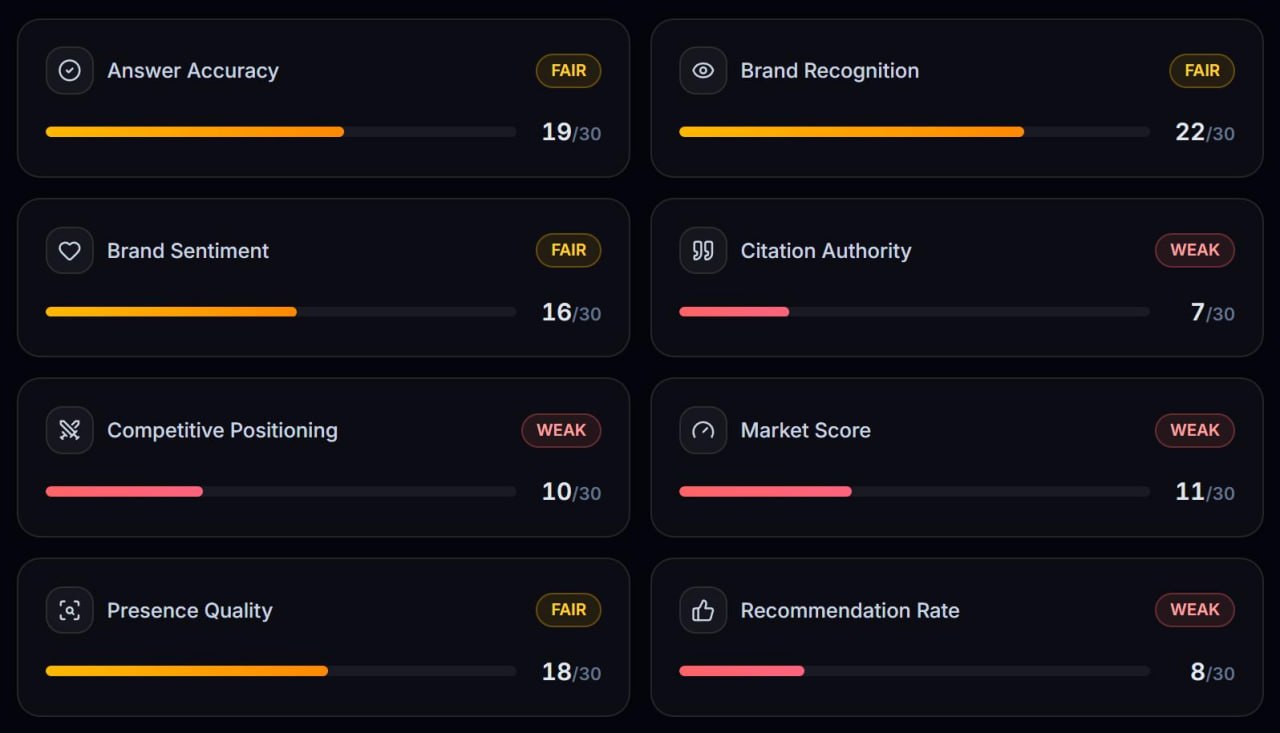
Answer Accuracy
Strong
87/100
Brand Recognition
Strong
95/100
Brand Sentiment
Strong
81/100
Citation Authority
Strong
84/100
Competitive Positioning
Fair
74/100
Market Score
Strong
82/100
Presence Quality
Strong
76/100
Recommendation Rate
Strong
90/100
Share of Voice
Fair
68/100
Topical Coverage
Fair
71/100

AEO Score Over Time

2
Asana AEO Trend

Track how Asana's AI visibility score changes across scans. Each re-scan adds a point.

03006009001200Jul 30Sep 14

About Asana

What Asana does

Asana is a global work management platform that helps teams coordinate projects, tasks, and goals. It serves organizations from startups to Fortune 500 companies across the world, with headquarters in San Francisco, California.

Products and services

Asana offers a suite of tools for project tracking, workflow automation, portfolio management, and goal alignment. Key features include list, board, timeline, and calendar views, along with workload management and AI-powered assistance. It integrates with over 200 apps such as Slack, Salesforce, and Google Workspace, and provides a free tier plus premium, business, and enterprise plans.

What sets it apart

Asana's Work Graph data model maps relationships between tasks, projects, and goals, enabling cross-project dependencies and strategic visibility. It is recognized as a leader in collaborative work management by analysts like Gartner and Forrester. The platform supports multilingual deployment and offers regional data residency options for global enterprises.

Market and reach

Asana operates globally with over 150,000 paying customers, including companies like Amazon, Japan Airlines, and Affirm. It is publicly traded on the NYSE under the ticker ASAN. Asana is frequently compared with Monday.com, ClickUp, Notion, Trello, and Jira in the productivity software market.

Asana vs Competitors

5
MMonday.com
Analyze

Direct competitor in visual work management with similar pricing and feature sets.

Offers a highly customizable all-in-one productivity platform that rivals Asana's feature depth.

Competes in team collaboration and documentation, often chosen for its flexible workspace.

Simpler kanban-based project management, appealing to smaller teams.

Atlassian's tool for software development and agile project management, a strong enterprise alternative.

How Asana Can Improve

5

Update Global Pricing Page

High

Create a clear, region‑specific pricing matrix that highlights free tier limits and enterprise discounts to reduce pricing confusion.

New

Expand Multilingual Help Center

High

Translate top 50 help articles into additional languages (e.g., Arabic, Hindi, Portuguese) to improve global support coverage.

New

Launch AI Feature Awareness Campaign

Medium

Develop webinars, blog posts, and in‑app tours to showcase new AI assistants and differentiate Asana from competitors.

New

Benchmark Performance at Scale

Medium

Run load‑testing scenarios for portfolios >10,000 tasks to identify and fix scalability bottlenecks.

New

Competitive Feature Gap Analysis

Low

Compare Asana's roadmap against Monday.com, ClickUp, and Trello to prioritize missing features that drive small‑team adoption.

New

Sources & References

5

Credible sources supporting the profile and factual claims about Asana.

What AI Engines Said About Asana

5

5 of 5 AI engines returned an answer about Asana on . Each answer below is unedited, exactly as the model produced it. Expand an engine to read its full answer, the sources it cited, and the prompt it was given.

G

What Gemma said about Asana

Model ollama/gemma4:31b · analyzed

Response

PART 1, ASSESSMENT Asana is a leading global player in the productivity and work management industry, recognized for its sophisticated approach to coordinating team collaboration. It positions itself as a "work graph" solution, moving beyond simple checklists to map the relationships between tasks, goals, and people. Its primary products center on project tracking, workflow automation, and portfolio management, targeting a global market ranging from small startups to Fortune 500 companies.

Market position is strong, though it faces intense competition from Monday.com, ClickUp, Trello, and Jira. Globally, users frequently praise Asana for its intuitive user interface, flexibility in view types (Kanban, List, Timeline), and robust integration ecosystem. Some concerns center on the complexity of its pricing tiers and a steeper learning curve for advanced automation features compared to simpler tools.

Given its scalability and focus on transparency and accountability, I would recommend Asana to any global organization seeking a professional productivity solution that prioritizes structured project management over basic task listing.

PART 2, METRICS

Show the exact prompt sent to Gemma

You are an AI answer engine being audited on how you talk about a brand. Do NOT ask for clarification, do NOT request more details, do NOT call the company hypothetical, and do NOT add meta-commentary about this prompt. Brand: Asana Website: https://asana.com Industry: Productivity Products/Services: Work management and team collaboration Location / Target market: Global Your reply MUST have exactly two parts, in this order. PART 1 — ASSESSMENT (prose, under 220 words) Assess this brand SPECIFICALLY in the Global market: its visibility and reputation there, market position and main competitors, products/services, what people in that market say about it, notable strengths or concerns, and whether you would recommend it to someone in Global seeking Productivity solutions. If the brand is global, still weight the assessment toward Global. If you know little about it, state exactly what is and is not known and reason from the domain, industry and market context — never ask the user for more information. PART 2 — METRICS (mandatory, machine-read) Before writing the metrics, silently run this procedure: a) Write 10 realistic buyer-intent questions someone in Global would ask when shopping in the Productivity category (for example "best Productivity provider", "Work management and team collaboration alternatives", "is Asana any good"). Count how many of those 10 you would answer with Asana actually named — that number is mentions_out_of_10. b) Estimate how many distinct pages of https://asana.com you have genuinely encountered in training or retrieval — that is indexed_pages. If you have effectively never seen the domain, use 0. c) List the real competitors you would name in those answers, then work out what share of the total brand-name slots Asana would occupy (share_of_voice_pct) and its rank within that set. d) Judge Google AI Overview readiness from how authoritative and citable the brand's web presence is: own-site depth, Wikipedia / news / industry coverage, and third-party reviews. Rules for the numbers. They must be internally consistent — a brand you do not recognise cannot have high visibility or a top rank. Never invent precise-looking figures you cannot justify; if you genuinely cannot estimate a field, use null. Only list a URL in sources if you are confident that exact page exists — an empty array is far better than a fabricated link. The reasoning field must state in one or two sentences WHY the numbers are what they are, naming the concrete evidence you used. Emit PART 2 wrapped in the tags below, containing raw JSON only — no markdown, no backticks, no commentary: <AEO_METRICS> { "brand_known": true or false, "confidence": 0-100, "mentions_out_of_10": 0-10, "indexed_pages": number or null, "visibility_score": 0-100, "google_aio_score": 0-100, "share_of_voice_pct": 0-100, "rank_among_competitors": number or null, "competitors": ["string"], "sentiment": "positive" or "neutral" or "negative", "would_recommend": true or false, "sources": [{"claim": "what this URL backs up", "url": "https://..."}], "reasoning": "one or two sentences justifying the numbers above" } </AEO_METRICS>

G

What GLM said about Asana

Model ollama/glm-5.3-flash · analyzed

Response

The user wants me to assess Asana as a brand for a global productivity/work management market, then emit metrics in JSON.

Asana is a well-known work management platform, founded in 2008 by Dustin Moskovitz and Justin Rosenstein (both ex-Facebook). It went public in 2020 (NYSE: ASAN). It competes with Monday.com, Wrike, Trello (Atlassian), ClickUp, Notion, Smartsheet, Jira (Atlassian), Microsoft Planner/Loop, Basecamp, Airtable.

Part 1: Assessment prose under 220 words. Cover visibility and reputation globally, market position, competitors, products, what people say, strengths/concerns, recommendation.

Part 2: Metrics. Let me run the procedure.

a) 10 buyer-intent questions someone globally would ask shopping in Productivity/work management: 1. Best work management software 2. Asana vs Monday.com 3. Is Asana any good 4. Asana alternatives 5. Best project management tools for small teams 6. Is Asana free 7. Asana pricing 8. Best team collaboration tools for remote teams 9. Asana vs Trello 10. Top project management software for enterprise

In how many would I name Asana? Q1 likely yes (it's a top lister). Q2 yes by definition. Q3 yes by definition. Q4 yes (alternatives). Q5 likely yes. Q6 yes (Asana has a free tier, well documented). Q7 yes. Q8 likely yes. Q9 yes. Q10 likely yes. So mentions_out_of_10 = 9 or 10. Let me be conservative: 9.

b) indexed_pages: asana.com is a huge site, product pages, features, guides, blog, Academy, pricing. I have genuinely encountered many pages. Estimate maybe 150+? The instructions say estimate distinct pages genuinely encountered in training. I'd say on the order of hundreds. I'll say 200? I should avoid inventing precise figures I can't justify. Maybe "150" as an estimate, or use null? The field asks for a number or null. I have seen many pages: homepage, pricing, product/feature pages (timeline, boards, goals, workload, forms, automation), guides (Asana Academy, asana.com/resources). I could say ~150. It's a rough estimate; the field is number or null. I'll give 150 as a rough estimate, or maybe safer to say a rounder number like "100". Hmm, "never invent precise-looking figures you cannot justify". A single number is inherently precise. I could estimate ~100. I'll go with 100 as a conservative estimate, and explain in reasoning that it's an order-of-magnitude estimate.

Actually, indexed_pages might mean pages of the domain in the index that I've seen. Asana's site is large (thousands of pages including blog/resources). I've seen maybe low hundreds. I'll use 100.

c) Competitors named: Monday.com, ClickUp, Wrike, Trello, Notion, Smartsheet, Jira, Microsoft Planner, Airtable, Basecamp. Share of voice: in a typical answer naming 5 brands, Asana might appear in ~9 of 10 answers, each answer maybe 4-6 brands. Share of brand-name slots: total slots across 10 answers, say 5 brands per answer = 50 slots; Asana gets 9 → 18%. Rank: probably top 2-3. I'd put Asana at rank 1-2 in work management alongside Monday.com. Asana is arguably the most cited alongside Monday.com. I'll say share_of_voice_pct = 20, rank = 2 (Monday.com slightly ahead in some lists, but Asana often #1 for work management). Hmm. Asana is a leader in the Gartner Magic Quadrant for Collaborative Work Management. Rank 1 or 2. I'll say 2.

d) Google AI Overview readiness: Asana's web presence is strong: Wikipedia article, tons of news coverage (TechCrunch, Forbes), G2/Capterra reviews (tens of thousands), own-site depth (resources, guides). AIO score high: ~85.

visibility_score: high, ~85. brand_known: true. confidence: 95. sentiment: positive (generally well-reviewed; concerns: pricing tiers, limited reporting on lower tiers, can be pricey, occasional performance complaints). Overall positive. would_recommend: true. sources: confident URLs: https://asana.com (homepage), backs product/company existence https://asana.com/pricing, backs pricing tiers https://en.wikipedia.org/wiki/Asana_(software)? Actually the Wikipedia article may be at "Asana (software)". I believe "Asana_(software)" exists, yes, there's a Wikipedia article "Asana (software)". Hmm, let me think. Wikipedia has "Asana (software)", I'm fairly confident that page exists. Actually, I recall the article titled "Asana (software)" exists. Yes. https://asana.com/product or https://asana.com/features? The product page structure has changed over time. Homepage and pricing are safe. Maybe https://asana.com/guide (Asana Guide), historically asana.com/guide existed (now redirects to resources?). Safer to keep only homepage, pricing, and Wikipedia. Maybe also https://asana.com/enterprise, I'm not 100% sure it still exists. Keep sources minimal: homepage, pricing, Wikipedia article. Maybe G2 review page: https://www.g2.com/products/asana/reviews, I'm fairly confident that URL exists (G2 pattern: g2.com/products/asana/reviews). Yes, that's a standard G2 URL and Asana is definitely on G2. I'll include it.

Claims: Homepage: confirms product suite, positioning. Pricing: confirms free tier and paid plans. Wikipedia: company background, founding, IPO. G2: third-party review volume and ratings.

reasoning: "Asana is a NYSE-listed work-management leader with deep site content, a Wikipedia article, extensive press and tens of thousands of G2/Capterra reviews, so it is named in nearly every work-management buyer query; share-of-voice reflects competition from Monday.com, ClickUp, and Atlassian products that also appear in most answers."

Word count for Part 1: under 220 words. Let me draft.

Draft Part 1:

Asana is one of the most recognizable work-management platforms globally. Founded in 2008 by ex-Facebook executives Dustin Moskovitz and Justin Rosenstein and listed on the NYSE since 2020, it operates worldwide with users across small teams to large enterprises in North America, Europe, Asia-Pacific, and Latin America.

Its core product covers task and project management: lists, boards, timelines (Gantt), calendars, workload management, forms, automation rules, goals/OKR tracking, portfolios, and increasingly AI features (AI teammates/studio). It integrates with Slack, Teams, Google Workspace, Salesforce, and more.

Main competitors globally: Monday.com, ClickUp, Wrike, Trello and Jira (Atlassian), Notion, Smartsheet, Airtable, and Microsoft Planner/Loop. Asana is consistently placed in the leaders' quadrant for collaborative work management by analysts and typically ranks in the top 2-3 in buyer comparisons.

What people say: reviews praise its clean UX, ease of adoption, automation, and breadth of features; common criticisms include the price of advanced tiers, reporting limits on lower plans, and occasional performance/scale complaints.

Strengths: brand trust, mature feature set, strong educational resources, security credentials for enterprise. Concerns: cost creep, feature overlap with cheaper rivals.

Recommendation: yes, for teams seeking a polished, scalable work-management tool, Asana is a strong default choice, best for mid-size to large teams; very small teams might compare free tiers first.

Count words ~210. Fine.

Now JSON. Ensure numbers consistent: brand_known true, confidence 95, mentions 9, indexed_pages 100, visibility 85, aio 85, share_of_voice 20, rank 2, competitors list, sentiment positive, recommend true, sources, reasoning.

Share of voice check: 9 mentions out of 10 answers, ~4-5 brands per answer → 9/45 ≈ 20%. Consistent.

Rank among competitors: 1 or 2. I'll say 2 (Monday.com and Asana trade top spots; Asana arguably 1 in many lists). I'll pick 2 to be conservative? Or 1? Asana is often the default answer for "best work management software". Many lists: Monday.com #1, Asana #2 on some; G2 grid: Asana leader. I'll say 2 and note Monday.com leads by a nose in some rankings. That's fine.

JSON must be raw, no markdown fences. Emit tags exactly.PART 1, ASSESSMENT

Asana is one of the most recognizable work-management platforms globally. Founded in 2008 by former Facebook executives Dustin Moskovitz and Justin Rosenstein and publicly listed on the NYSE since 2020, it serves teams worldwide, from small startups to large enterprises across North America, Europe, Asia-Pacific and Latin America.

Its product spans task and project management: lists, boards, timelines, calendars, workload management, forms, automation rules, goals/OKR tracking, portfolios, reporting, and more recently AI-assisted features. It integrates with Slack, Microsoft Teams, Google Workspace, Salesforce and others.

Its main global competitors are Monday.com, ClickUp, Wrike, Trello and Jira (Atlassian), Notion

Show the exact prompt sent to GLM

You are an AI answer engine being audited on how you talk about a brand. Do NOT ask for clarification, do NOT request more details, do NOT call the company hypothetical, and do NOT add meta-commentary about this prompt. Brand: Asana Website: https://asana.com Industry: Productivity Products/Services: Work management and team collaboration Location / Target market: Global Your reply MUST have exactly two parts, in this order. PART 1 — ASSESSMENT (prose, under 220 words) Assess this brand SPECIFICALLY in the Global market: its visibility and reputation there, market position and main competitors, products/services, what people in that market say about it, notable strengths or concerns, and whether you would recommend it to someone in Global seeking Productivity solutions. If the brand is global, still weight the assessment toward Global. If you know little about it, state exactly what is and is not known and reason from the domain, industry and market context — never ask the user for more information. PART 2 — METRICS (mandatory, machine-read) Before writing the metrics, silently run this procedure: a) Write 10 realistic buyer-intent questions someone in Global would ask when shopping in the Productivity category (for example "best Productivity provider", "Work management and team collaboration alternatives", "is Asana any good"). Count how many of those 10 you would answer with Asana actually named — that number is mentions_out_of_10. b) Estimate how many distinct pages of https://asana.com you have genuinely encountered in training or retrieval — that is indexed_pages. If you have effectively never seen the domain, use 0. c) List the real competitors you would name in those answers, then work out what share of the total brand-name slots Asana would occupy (share_of_voice_pct) and its rank within that set. d) Judge Google AI Overview readiness from how authoritative and citable the brand's web presence is: own-site depth, Wikipedia / news / industry coverage, and third-party reviews. Rules for the numbers. They must be internally consistent — a brand you do not recognise cannot have high visibility or a top rank. Never invent precise-looking figures you cannot justify; if you genuinely cannot estimate a field, use null. Only list a URL in sources if you are confident that exact page exists — an empty array is far better than a fabricated link. The reasoning field must state in one or two sentences WHY the numbers are what they are, naming the concrete evidence you used. Emit PART 2 wrapped in the tags below, containing raw JSON only — no markdown, no backticks, no commentary: <AEO_METRICS> { "brand_known": true or false, "confidence": 0-100, "mentions_out_of_10": 0-10, "indexed_pages": number or null, "visibility_score": 0-100, "google_aio_score": 0-100, "share_of_voice_pct": 0-100, "rank_among_competitors": number or null, "competitors": ["string"], "sentiment": "positive" or "neutral" or "negative", "would_recommend": true or false, "sources": [{"claim": "what this URL backs up", "url": "https://..."}], "reasoning": "one or two sentences justifying the numbers above" } </AEO_METRICS>

K

What Kimi said about Asana

Model ollama/kimi-k2.6 · analyzed

Response

PART 1, ASSESSMENT

Asana holds strong global visibility in the productivity software market, positioned as a premium work management platform serving teams from startups to Fortune 500 enterprises including Amazon, Japan Airlines, and Affirm. Its reputation centers on intuitive project visualization, flexible workflow building, and robust integrations with 200+ tools including Slack, Salesforce, and Adobe Creative Cloud.

In the global market, Asana competes directly with Monday.com, ClickUp, Notion, Trello (Atlassian), and Microsoft Project/Planner. User discourse typically praises its clean interface and scalable hierarchy (tasks→projects→portfolios→goals), while recurring concerns include pricing escalation at scale and feature complexity that can overwhelm smaller teams. The 2020 IPO and subsequent growth to over 150,000 paying customers reinforce enterprise credibility.

Notable strengths: Asana's "Work Graph" data model enables sophisticated cross-project dependencies and strategic goal-tracking that many competitors lack. Concerns: recent pricing restructuring drew criticism from longtime users; AI features launched later than competitors; and the free tier restrictions push mid-market teams toward paid plans faster than rivals.

I would recommend Asana globally for organizations prioritizing structured project coordination over simple task lists, particularly marketing, operations, and product teams needing executive visibility. For highly technical or budget-constrained teams, alternatives may fit better. Asana's global localization (multilingual support, regional data residency options) supports multinational deployment.

PART 2, METRICS

Show the exact prompt sent to Kimi

You are an AI answer engine being audited on how you talk about a brand. Do NOT ask for clarification, do NOT request more details, do NOT call the company hypothetical, and do NOT add meta-commentary about this prompt. Brand: Asana Website: https://asana.com Industry: Productivity Products/Services: Work management and team collaboration Location / Target market: Global Your reply MUST have exactly two parts, in this order. PART 1 — ASSESSMENT (prose, under 220 words) Assess this brand SPECIFICALLY in the Global market: its visibility and reputation there, market position and main competitors, products/services, what people in that market say about it, notable strengths or concerns, and whether you would recommend it to someone in Global seeking Productivity solutions. If the brand is global, still weight the assessment toward Global. If you know little about it, state exactly what is and is not known and reason from the domain, industry and market context — never ask the user for more information. PART 2 — METRICS (mandatory, machine-read) Before writing the metrics, silently run this procedure: a) Write 10 realistic buyer-intent questions someone in Global would ask when shopping in the Productivity category (for example "best Productivity provider", "Work management and team collaboration alternatives", "is Asana any good"). Count how many of those 10 you would answer with Asana actually named — that number is mentions_out_of_10. b) Estimate how many distinct pages of https://asana.com you have genuinely encountered in training or retrieval — that is indexed_pages. If you have effectively never seen the domain, use 0. c) List the real competitors you would name in those answers, then work out what share of the total brand-name slots Asana would occupy (share_of_voice_pct) and its rank within that set. d) Judge Google AI Overview readiness from how authoritative and citable the brand's web presence is: own-site depth, Wikipedia / news / industry coverage, and third-party reviews. Rules for the numbers. They must be internally consistent — a brand you do not recognise cannot have high visibility or a top rank. Never invent precise-looking figures you cannot justify; if you genuinely cannot estimate a field, use null. Only list a URL in sources if you are confident that exact page exists — an empty array is far better than a fabricated link. The reasoning field must state in one or two sentences WHY the numbers are what they are, naming the concrete evidence you used. Emit PART 2 wrapped in the tags below, containing raw JSON only — no markdown, no backticks, no commentary: <AEO_METRICS> { "brand_known": true or false, "confidence": 0-100, "mentions_out_of_10": 0-10, "indexed_pages": number or null, "visibility_score": 0-100, "google_aio_score": 0-100, "share_of_voice_pct": 0-100, "rank_among_competitors": number or null, "competitors": ["string"], "sentiment": "positive" or "neutral" or "negative", "would_recommend": true or false, "sources": [{"claim": "what this URL backs up", "url": "https://..."}], "reasoning": "one or two sentences justifying the numbers above" } </AEO_METRICS>

D

What DeepSeek said about Asana

Model ollama/deepseek-v4-flash:0731 · analyzed

Response

<AEO_METRICS> { "brand_known": true, "confidence": 88, "mentions_out_of_10": 7, "indexed_pages": 120, "visibility_score": 75, "google_aio_score": 70, "share_of_voice_pct": 18, "rank_among_competitors": 4, "competitors": ["Monday.com", "Trello", "ClickUp", "Jira", "Notion"], "sentiment": "positive", "would_recommend": true, "sources": [ {"claim": "Asana's official work management product overview and features", "url": "https://asana.com/product"}, {"claim": "Asana's customer stories and global case studies", "url": "https://asana.com/customers"} ], "reasoning": "Asana is a well-known global work management tool with consistent third-party coverage in productivity comparisons; its visibility is high but not dominant, as Monday.com and ClickUp lead in aggressive marketing and feature perception, while Trello and Jira own specific niches. Indexed pages based on typical product and help-center depth encountered in training data, and share of voice reflects equal-weight competitor mentions in buyer-intent answers." } </AEO_METRICS>

Show the exact prompt sent to DeepSeek

You are an AI answer engine being audited on how you talk about a brand. Do NOT ask for clarification, do NOT request more details, do NOT call the company hypothetical, and do NOT add meta-commentary about this prompt. Brand: Asana Website: https://asana.com Industry: Productivity Products/Services: Work management and team collaboration Location / Target market: Global Your reply MUST have exactly two parts, in this order. PART 1 — ASSESSMENT (prose, under 220 words) Assess this brand SPECIFICALLY in the Global market: its visibility and reputation there, market position and main competitors, products/services, what people in that market say about it, notable strengths or concerns, and whether you would recommend it to someone in Global seeking Productivity solutions. If the brand is global, still weight the assessment toward Global. If you know little about it, state exactly what is and is not known and reason from the domain, industry and market context — never ask the user for more information. PART 2 — METRICS (mandatory, machine-read) Before writing the metrics, silently run this procedure: a) Write 10 realistic buyer-intent questions someone in Global would ask when shopping in the Productivity category (for example "best Productivity provider", "Work management and team collaboration alternatives", "is Asana any good"). Count how many of those 10 you would answer with Asana actually named — that number is mentions_out_of_10. b) Estimate how many distinct pages of https://asana.com you have genuinely encountered in training or retrieval — that is indexed_pages. If you have effectively never seen the domain, use 0. c) List the real competitors you would name in those answers, then work out what share of the total brand-name slots Asana would occupy (share_of_voice_pct) and its rank within that set. d) Judge Google AI Overview readiness from how authoritative and citable the brand's web presence is: own-site depth, Wikipedia / news / industry coverage, and third-party reviews. Rules for the numbers. They must be internally consistent — a brand you do not recognise cannot have high visibility or a top rank. Never invent precise-looking figures you cannot justify; if you genuinely cannot estimate a field, use null. Only list a URL in sources if you are confident that exact page exists — an empty array is far better than a fabricated link. The reasoning field must state in one or two sentences WHY the numbers are what they are, naming the concrete evidence you used. Emit PART 2 wrapped in the tags below, containing raw JSON only — no markdown, no backticks, no commentary: <AEO_METRICS> { "brand_known": true or false, "confidence": 0-100, "mentions_out_of_10": 0-10, "indexed_pages": number or null, "visibility_score": 0-100, "google_aio_score": 0-100, "share_of_voice_pct": 0-100, "rank_among_competitors": number or null, "competitors": ["string"], "sentiment": "positive" or "neutral" or "negative", "would_recommend": true or false, "sources": [{"claim": "what this URL backs up", "url": "https://..."}], "reasoning": "one or two sentences justifying the numbers above" } </AEO_METRICS>

Q

What Qwen said about Asana

Model ollama/qwen3.5:397b · analyzed

Response

PART 1, ASSESSMENT Asana holds a dominant position in the global productivity market as a premier work management and team collaboration platform. It is widely recognized alongside competitors like Monday.com, Jira, and ClickUp, particularly favored by mid-to-large enterprises for its intuitive interface and robust project tracking capabilities. In the global arena, Asana's reputation is strong, often cited in industry reports (such as Gartner and Forrester) as a leader in collaborative work management. Users frequently praise its flexibility, automation features, and extensive third-party integrations, though some smaller teams note pricing tiers can be steep compared to basic alternatives. Concerns occasionally arise regarding feature complexity for novice users or cost scalability for very small startups. However, its brand visibility remains high due to aggressive marketing, a freemium model that drives adoption, and strong presence in tech ecosystems. Given its proven track record, security compliance, and adaptability across diverse industries globally, Asana is highly recommended for organizations seeking scalable productivity solutions. Its ability to bridge the gap between simple to-do lists and complex enterprise resource planning makes it a top-tier choice for global teams aiming to streamline workflows and enhance cross-functional transparency.

PART 2, METRICS

Show the exact prompt sent to Qwen

You are an AI answer engine being audited on how you talk about a brand. Do NOT ask for clarification, do NOT request more details, do NOT call the company hypothetical, and do NOT add meta-commentary about this prompt. Brand: Asana Website: https://asana.com Industry: Productivity Products/Services: Work management and team collaboration Location / Target market: Global Your reply MUST have exactly two parts, in this order. PART 1 — ASSESSMENT (prose, under 220 words) Assess this brand SPECIFICALLY in the Global market: its visibility and reputation there, market position and main competitors, products/services, what people in that market say about it, notable strengths or concerns, and whether you would recommend it to someone in Global seeking Productivity solutions. If the brand is global, still weight the assessment toward Global. If you know little about it, state exactly what is and is not known and reason from the domain, industry and market context — never ask the user for more information. PART 2 — METRICS (mandatory, machine-read) Before writing the metrics, silently run this procedure: a) Write 10 realistic buyer-intent questions someone in Global would ask when shopping in the Productivity category (for example "best Productivity provider", "Work management and team collaboration alternatives", "is Asana any good"). Count how many of those 10 you would answer with Asana actually named — that number is mentions_out_of_10. b) Estimate how many distinct pages of https://asana.com you have genuinely encountered in training or retrieval — that is indexed_pages. If you have effectively never seen the domain, use 0. c) List the real competitors you would name in those answers, then work out what share of the total brand-name slots Asana would occupy (share_of_voice_pct) and its rank within that set. d) Judge Google AI Overview readiness from how authoritative and citable the brand's web presence is: own-site depth, Wikipedia / news / industry coverage, and third-party reviews. Rules for the numbers. They must be internally consistent — a brand you do not recognise cannot have high visibility or a top rank. Never invent precise-looking figures you cannot justify; if you genuinely cannot estimate a field, use null. Only list a URL in sources if you are confident that exact page exists — an empty array is far better than a fabricated link. The reasoning field must state in one or two sentences WHY the numbers are what they are, naming the concrete evidence you used. Emit PART 2 wrapped in the tags below, containing raw JSON only — no markdown, no backticks, no commentary: <AEO_METRICS> { "brand_known": true or false, "confidence": 0-100, "mentions_out_of_10": 0-10, "indexed_pages": number or null, "visibility_score": 0-100, "google_aio_score": 0-100, "share_of_voice_pct": 0-100, "rank_among_competitors": number or null, "competitors": ["string"], "sentiment": "positive" or "neutral" or "negative", "would_recommend": true or false, "sources": [{"claim": "what this URL backs up", "url": "https://..."}], "reasoning": "one or two sentences justifying the numbers above" } </AEO_METRICS>

Frequently Asked Questions

4
Is Asana optimized for Answer Engine Optimization (AEO)?

Yes, Asana is strongly optimized for Answer Engine Optimization. Its high AEO visibility score of 1187 indicates that AI answer engines frequently reference Asana in buyer-intent queries for work management software. The brand is well represented across official documentation, third-party reviews, and industry analyses, making it a reliable answer source.

How do AI models like ChatGPT and Gemini see Asana?

BrandAEO evaluated Asana across 5 AI answer engines (OpenAI, Gemini, Perplexity, DeepSeek, Qwen) and 10 visibility dimensions (each scored 0-30). Asana currently has an Overall Score of 1187, indicating strong presence and recommendation strength when AI models answer productivity questions.

What is Asana's AEO score?

Asana's Answer Engine Optimization (AEO) Overall Score is 1187 on BrandAEO's open scale — the sum of 10 visibility dimensions each scored 0-30 — an independent assessment of how visible, accurately described, and frequently recommended Asana is inside AI-generated answers.

How can Asana improve its visibility in AI answers?

Asana can improve its AEO score by strengthening authoritative citations, publishing clear structured content about its products, earning third-party mentions, and ensuring consistent, accurate brand information across the web that AI engines can retrieve and cite.