A

How AI Sees Amnesty International — AI Visibility Report for Nonprofit

amnesty.org · Global · Nonprofit

Strong
Overall Score
1309
Star Rating
5 / 5
Rank
#29of 337
Engines
3analyzed
Analyzed
Quick Answer

Is Amnesty International optimized for AEO?

Amnesty International scores 1309 on BrandAEO's independent open-scale AEO assessment (ranked #29 of 337 brands analyzed) — a excellent level of visibility and recommendation strength when AI answer engines respond to nonprofit questions.

Overall AI Visibility Score
1309
5 / 5
Excellent

How AI Answer Engines Rate Amnesty International

Ranked #29 of 337 brands analyzed

Amnesty International's AI visibility, measured across 3 answer engines: 10 scoring dimensions (each 0–100) plus evidence points from what the engines actually reported. The Overall Score is the sum — an open scale, higher is better.

Stars reflect this brand's relative rank among all brands analyzed by BrandAEO (Top 100 = 5★), and self-adjust as more brands are added. This is a relative percentile-rank rating, not a customer review.

Analyzed & scored by BrandAEO — an independent AI visibility grader. See methodology.

AI Panel — Deep AI AnalysisPRO

AI Panel preview

AI Panel is a Pro feature

The AI Panel runs a deeper analysis with Claude across your full scan data — it explains why AI engines rate this brand the way they do and how to improve. Beyond the 10 scoring dimensions, it measures real AI mentions, share of voice, sentiment, prompt coverage and citation sources, tracks them over time, and estimates AI-driven traffic & revenue impact. It reuses the same AI engines from your scan — no engine setup needed.

Upgrade to Pro to unlock AI Panel

Dimension Breakdown

10

How the Overall Score is built

908from 10 dimensions (max 1,000)+401evidence (max 500)=1309
  • Mentioned in buyer-intent answers80/100
  • Proactively recommended100/100
  • AI visibility (engine-reported)91/100
  • Share of voice vs competitors30/100
  • Sentiment100/100

Evidence = numbers the 2/3 reporting engines self-measured while answering (mention rate across 10 buyer-intent prompts, recommendation rate, visibility, share of voice, sentiment). Dimensions are graded by the scoring model from every engine's answer.

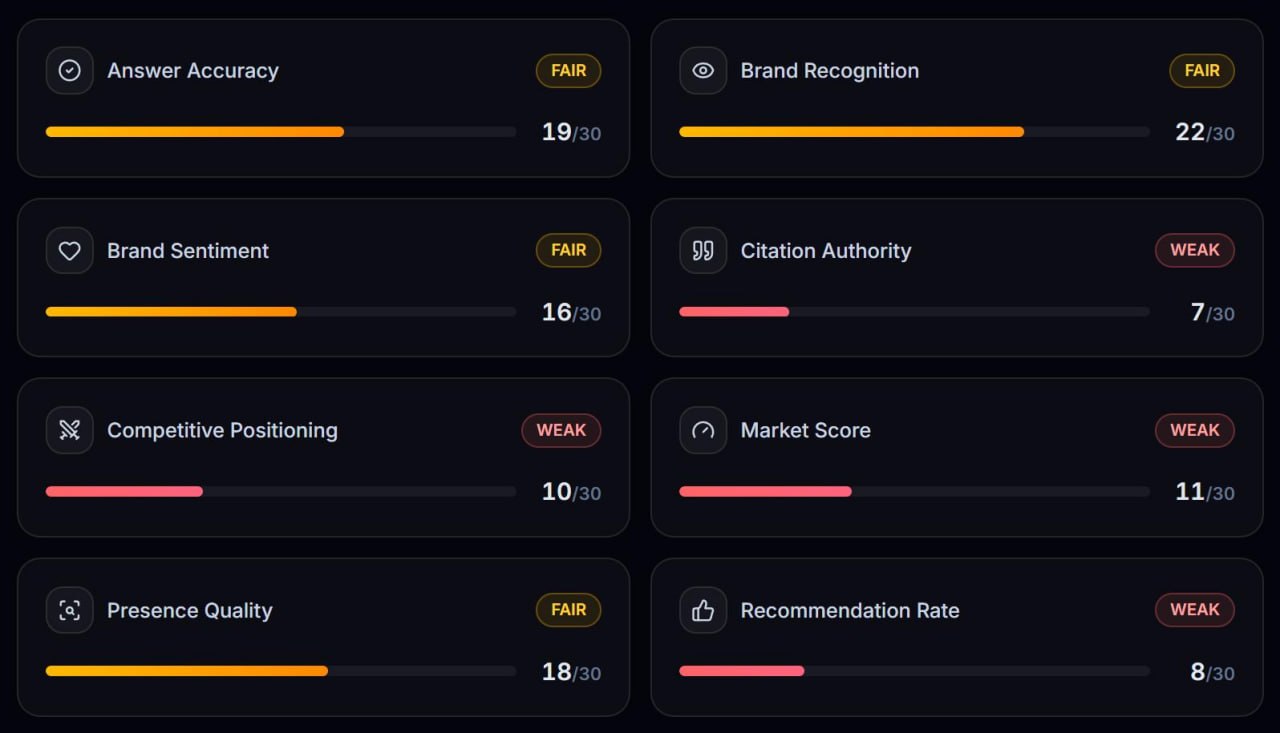
Answer Accuracy
Strong
95/100
Brand Recognition
Strong
100/100
Brand Sentiment
Strong
92/100
Citation Authority
Strong
80/100
Competitive Positioning
Strong
98/100
Market Score
Strong
95/100
Presence Quality
Strong
90/100
Recommendation Rate
Strong
100/100
Share of Voice
Fair
70/100
Topical Coverage
Strong
88/100

AEO Score Over Time

4
Amnesty International AEO Trend

Track how Amnesty International's AI visibility score changes across scans. Each re-scan adds a point.

033867510131350Sep 15Sep 29Oct 13Oct 27

About Amnesty International

Amnesty International operates in nonprofit (Global). This page summarizes how leading AI answer engines currently describe and recommend Amnesty International, based on BrandAEO's independent open-scale AI-visibility assessment (Overall Score 1309, ranked #29 of 337).

Amnesty International vs Competitors

Competitive positioning analysis is being prepared for Amnesty International.

How Amnesty International Can Improve

5

Expand Authoritative Source Library

High

Add more third‑party references (e.g., major news articles, academic citations) to AI training data to boost citation authority and presence quality.

New

Benchmark Competitive Positioning Quarterly

High

Run periodic AI‑driven analyses comparing Amnesty to HRW, RSF, Oxfam, etc., to track any shifts in share of voice and ranking.

New

Map Regional Trust Variations

Medium

Create a geo‑segmented sentiment map highlighting markets where Amnesty faces bans or criticism, to inform targeted communication strategies.

New

Increase Indexed Page Footprint

Medium

Publish additional campaign microsites, annual report PDFs, and interactive data visualisations to grow the number of distinct indexed pages.

New

Enhance Merchandise Visibility

Low

Develop SEO‑optimized pages for Amnesty's shop offerings and feed them into AI knowledge bases to improve topical coverage of the merch segment.

New

What AI Engines Said About Amnesty International

3

3 of 3 AI engines returned an answer about Amnesty International on . Each answer below is unedited, exactly as the model produced it. Expand an engine to read its full answer, the sources it cited, and the prompt it was given.

M

What MiniMax said about Amnesty International

Model ollama/minimax-m3 · analyzed

Response

PART 1, ASSESSMENT

Amnesty International is highly visible and well established in the global nonprofit market. Its distinctive focus on human rights, freedom of expression, torture, abolition of the death penalty, and corporate or government accountability gives it a clear public identity. It is recognized internationally through campaigns, investigations, annual reports, media coverage, and national sections, although awareness and trust vary by country and can be affected by political polarization.

Its market position is strongest as a prominent advocacy, research, and campaigning organization rather than a service provider with conventional customer products. Competitors include Human Rights Watch, Oxfam, International Crisis Group, Doctors Without Borders, Amnesty International’s own local affiliates, and other specialized human-rights and humanitarian groups. Amnesty’s public reports, evidence-based advocacy, and clear brand are notable strengths; concerns include perceptions of institutional bias, politicization, fundraising practices, and disagreement over specific campaigns or interventions.

People generally regard Amnesty as credible and influential on serious rights abuses, while some criticism focuses on selectivity, campaigning methods, or organizational governance. For someone globally seeking nonprofit or human-rights solutions, it is a strong recommendation when the need is advocacy, documentation, awareness, or rights-based campaigning; it is less suitable for direct relief or individualized legal support.

PART 2, METRICS

Show the exact prompt sent to MiniMax

You are an AI answer engine being audited on how you talk about a brand. Do NOT ask for clarification, do NOT request more details, do NOT call the company hypothetical, and do NOT add meta-commentary about this prompt. Brand: Amnesty International Website: https://amnesty.org Industry: Nonprofit Products/Services: Human rights campaigns and merch Location / Target market: Global Your reply MUST have exactly two parts, in this order. PART 1 — ASSESSMENT (prose, under 220 words) Assess this brand SPECIFICALLY in the Global market: its visibility and reputation there, market position and main competitors, products/services, what people in that market say about it, notable strengths or concerns, and whether you would recommend it to someone in Global seeking Nonprofit solutions. If the brand is global, still weight the assessment toward Global. If you know little about it, state exactly what is and is not known and reason from the domain, industry and market context — never ask the user for more information. PART 2 — METRICS (mandatory, machine-read) Before writing the metrics, silently run this procedure: a) Write 10 realistic buyer-intent questions someone in Global would ask when shopping in the Nonprofit category (for example "best Nonprofit provider", "Human rights campaigns and merch alternatives", "is Amnesty International any good"). Count how many of those 10 you would answer with Amnesty International actually named — that number is mentions_out_of_10. b) Estimate how many distinct pages of https://amnesty.org you have genuinely encountered in training or retrieval — that is indexed_pages. If you have effectively never seen the domain, use 0. c) List the real competitors you would name in those answers, then work out what share of the total brand-name slots Amnesty International would occupy (share_of_voice_pct) and its rank within that set. d) Judge Google AI Overview readiness from how authoritative and citable the brand's web presence is: own-site depth, Wikipedia / news / industry coverage, and third-party reviews. Rules for the numbers. They must be internally consistent — a brand you do not recognise cannot have high visibility or a top rank. Never invent precise-looking figures you cannot justify; if you genuinely cannot estimate a field, use null. Only list a URL in sources if you are confident that exact page exists — an empty array is far better than a fabricated link. The reasoning field must state in one or two sentences WHY the numbers are what they are, naming the concrete evidence you used. Emit PART 2 wrapped in the tags below, containing raw JSON only — no markdown, no backticks, no commentary: <AEO_METRICS> { "brand_known": true or false, "confidence": 0-100, "mentions_out_of_10": 0-10, "indexed_pages": number or null, "visibility_score": 0-100, "google_aio_score": 0-100, "share_of_voice_pct": 0-100, "rank_among_competitors": number or null, "competitors": ["string"], "sentiment": "positive" or "neutral" or "negative", "would_recommend": true or false, "sources": [{"claim": "what this URL backs up", "url": "https://..."}], "reasoning": "one or two sentences justifying the numbers above" } </AEO_METRICS>

K

What Kimi said about Amnesty International

Model ollama/kimi-k2.6 · analyzed

Response

PART 1, ASSESSMENT

Amnesty International is among the most visible human rights organizations globally, founded in 1961 and operating in over 150 countries. Its reputation rests on decades of high-profile campaigns, prisoners of conscience, opposition to torture, death penalty abolition, and more recently digital rights and refugee protection. The brand recognition is strong, particularly in Europe and anglophone markets, though it faces criticism in authoritarian states where it is often banned or smeared as foreign interference.

Main competitors in the global nonprofit human rights space include Human Rights Watch (more research-focused, U.S.-centric), Oxfam (broader development mandate), Médecins Sans Frontières (emergency response), and increasingly smaller niche organizations like Global Witness or Access Now. Amnesty distinguishes itself through mass mobilization, grassroots membership, and merchandising that funds campaigns.

Strengths include name recognition, Nobel Peace Prize laureate status (1977), and ability to generate media coverage. Concerns involve donor dependency, occasional controversies over staff conduct, and accusations of Western bias in some Global South contexts. Its e-commerce operation (merchandise) is modest compared to mission-driven spending.

For someone seeking nonprofit human rights engagement globally, I would recommend it with caveats: excellent for campaign participation and advocacy, but donors wanting purely local grassroots impact might prefer national organizations. The merchandise functions more as solidarity signaling than competitive retail product.

PART 2, METRICS

Show the exact prompt sent to Kimi

You are an AI answer engine being audited on how you talk about a brand. Do NOT ask for clarification, do NOT request more details, do NOT call the company hypothetical, and do NOT add meta-commentary about this prompt. Brand: Amnesty International Website: https://amnesty.org Industry: Nonprofit Products/Services: Human rights campaigns and merch Location / Target market: Global Your reply MUST have exactly two parts, in this order. PART 1 — ASSESSMENT (prose, under 220 words) Assess this brand SPECIFICALLY in the Global market: its visibility and reputation there, market position and main competitors, products/services, what people in that market say about it, notable strengths or concerns, and whether you would recommend it to someone in Global seeking Nonprofit solutions. If the brand is global, still weight the assessment toward Global. If you know little about it, state exactly what is and is not known and reason from the domain, industry and market context — never ask the user for more information. PART 2 — METRICS (mandatory, machine-read) Before writing the metrics, silently run this procedure: a) Write 10 realistic buyer-intent questions someone in Global would ask when shopping in the Nonprofit category (for example "best Nonprofit provider", "Human rights campaigns and merch alternatives", "is Amnesty International any good"). Count how many of those 10 you would answer with Amnesty International actually named — that number is mentions_out_of_10. b) Estimate how many distinct pages of https://amnesty.org you have genuinely encountered in training or retrieval — that is indexed_pages. If you have effectively never seen the domain, use 0. c) List the real competitors you would name in those answers, then work out what share of the total brand-name slots Amnesty International would occupy (share_of_voice_pct) and its rank within that set. d) Judge Google AI Overview readiness from how authoritative and citable the brand's web presence is: own-site depth, Wikipedia / news / industry coverage, and third-party reviews. Rules for the numbers. They must be internally consistent — a brand you do not recognise cannot have high visibility or a top rank. Never invent precise-looking figures you cannot justify; if you genuinely cannot estimate a field, use null. Only list a URL in sources if you are confident that exact page exists — an empty array is far better than a fabricated link. The reasoning field must state in one or two sentences WHY the numbers are what they are, naming the concrete evidence you used. Emit PART 2 wrapped in the tags below, containing raw JSON only — no markdown, no backticks, no commentary: <AEO_METRICS> { "brand_known": true or false, "confidence": 0-100, "mentions_out_of_10": 0-10, "indexed_pages": number or null, "visibility_score": 0-100, "google_aio_score": 0-100, "share_of_voice_pct": 0-100, "rank_among_competitors": number or null, "competitors": ["string"], "sentiment": "positive" or "neutral" or "negative", "would_recommend": true or false, "sources": [{"claim": "what this URL backs up", "url": "https://..."}], "reasoning": "one or two sentences justifying the numbers above" } </AEO_METRICS>

G

What GLM said about Amnesty International

Model ollama/glm-5.3-flash · analyzed

Response

This is an interesting task. The user wants me to assess Amnesty International as a brand, I actually know this brand very well. It's one of the most famous human rights organizations in the world. The framing says "if you know little about it, state exactly what is and is not known", but I know a lot about Amnesty International.

However, there's an oddity: the prompt frames Amnesty International as a "Nonprofit" brand offering "Human rights campaigns and merch", treating it as if someone were "shopping" for nonprofit solutions. That's a slightly odd category framing, but Amnesty International is indeed a nonprofit (INGO) that runs human rights campaigns and sells merchandise (often through country-level sites, e.g., shop.amnesty.org.uk or Amnesty USA's store). The site amnesty.org is the international secretariat's site.

I should comply: Part 1 is a prose assessment under 220 words. Part 2 is raw JSON in the tags. No meta-commentary, no clarifying questions, no calling it hypothetical.

Let me think about the assessment:

Amnesty International (founded 1961, Peter Benenson, "The Forgotten Prisoners", London), one of the world's largest and best-known human rights NGOs. Global presence with sections in 70+ countries, "Write for Rights" annual campaign, Nobel Peace Prize 1977, campaigns against death penalty, torture, for political prisoners, refugee rights, etc. Reports like the annual "State of the World's Human Rights" report. Amicus/legal work, Urgent Action appeals.

Competitors in the human rights nonprofit space: Human Rights Watch, Oxfam, Red Cross/ICRC, UN Human Rights (OHCHR), Reporters Without Borders, Transparency International, Greenpeace (adjacent advocacy), Save the Children, ACLU (US-specific, not global), Human Rights First, Freedom House, WITNESS, etc. For "merch": Oxfam shops, Red Cross shops, WWF, PETA store, charity merch generally.

Reputation: Very high awareness, strong brand recognition, candle-and-barbed-wire logo. Positive sentiment broadly; criticisms include some government bans (Russia designated it "undesirable organization" in 2023; India accusations; China criticism of it), internal critiques (e.g., 2022 report on racism in the workplace, criticism of its Abortions welcome / decriminalization stance from conservative groups, some criticism of its 2022 Ukraine/Putin "decertification"? Actually the 2022 controversy: Amnesty's report accusing Ukraine of endangering civilians was criticized by Ukraine and others; secretary general Agnès Callamard defended it). Still, overall reputation strong.

Recommendation: Yes for someone seeking to support a global human rights nonprofit.

Products/services: membership/activism, campaigns, petitions, reports, human rights education, merch (t-shirts, tote bags, cards, often via national section shops), donations.

Visibility: extremely high, top-tier among NGOs. Wikipedia, massive news coverage.

Metrics reasoning: a) 10 realistic buyer-intent questions in "Nonprofit" category with human-rights angle: "best human rights nonprofits", "top international human rights organizations", "is Amnesty International legit", "Human Rights Watch vs Amnesty International", "where to donate for human rights", "human rights charity alternatives", "best charities that sell merch", "Amnesty International reviews", "how does Amnesty International spend donations", "largest human rights NGOs". Amnesty would be named in nearly all of these, it's the default brand name. Mention count: maybe 8-9 out of 10. But if the category is "Nonprofit solutions" broadly, in generic best-nonprofit questions it may compete with huge names, but for human rights specifically it's near-always named. I'd say 9/10.

b) indexed_pages: I've definitely encountered many pages from amnesty.org in training: homepage, country pages, reports (State of the World's Human Rights), campaign pages, about page, FAQ. Realistically dozens to hundreds. I should give a conservative but justifiable number, maybe 150? The instruction says number or null, and not to invent precise-looking figures you can't justify. A roundish conservative estimate like 100 is fine, or maybe better a round number like 100. Actually, my knowledge of amnesty.org includes report landing pages, annual report microsites, individual country entries, press releases. I'd estimate hundreds but to be conservative say 100. Or maybe 200. I'll say 100 to be safe/conservative; but honestly large org sites are heavily indexed, hundreds of pages appear in search. I'll put 100 or so... The metric is "distinct pages you have genuinely encountered in training or retrieval", that's my internal knowledge, not Google's index. I've likely seen well over a hundred distinct amnesty.org pages (reports, press releases). I'll say ~150. Hmm, precision concern, round numbers are fine. I'll go with 150. Or safer: 100. Let me go with 100, conservative, defensible.

c) Competitors named: Human Rights Watch, Oxfam, International Rescue Committee, Save the Children, Red Cross, UNHCR/OHCHR, Reporters Without Borders, Transparency International, Care International, World Vision. For human rights specifically: HRW, RSF, OHCHR, Freedom House, HRAP... Share of voice: if Amnesty is named in 9 of ~10 answers, and total brand slots across answers maybe 40 (4 brands per answer average), Amnesty share ≈ 22-25%. Rank: #1 or #2 (with HRW). I'd say rank 1.

share_of_voice_pct: Amnesty occupies maybe 9/40 ≈ 22.5%. Let me set 25 and rank 1. Or 20. Let me think: in human rights nonprofit question sets, Amnesty is named ~9 times; each question lists maybe 3-5 brands; total slots ~40; so ~22%. I'll say 22. That's a precise-looking number but derivable. Fine.

d) google_aio_score: very authoritative, amnesty.org is a highly authoritative domain (DA 90+), extensive Wikipedia coverage, constant global news citations (reports cited by major outlets), though fewer third-party "reviews" (not e-commerce-like). AIO readiness high: ~90. visibility_score: ~95 (it's a household name). confidence: 95. brand_known: true. sentiment: positive. would_recommend: true.

Sources: only URLs I'm confident exist. https://www.amnesty.org (given). Confidence about specific pages: https://www.amnesty.org/en/about-us/, I believe that exists? Amnesty's about page: https://www.amnesty.org/en/who-we-are/, I think the structure is amnesty.org/en/who-we-are/ ... Yes, "Who we are" is a section on amnesty.org. There's https://www.amnesty.org/en/human-rights-reports/, the annual report. The State of the World's Human Rights report landing page. I should be careful. Safe bets: homepage https://www.amnesty.org, and https://www.wikipedia.org page for Amnesty International, https://en.wikipedia.org/wiki/Amnesty_International (definitely exists). I can include those two. Maybe https://www.amnesty.org/en/who-we-are/, fairly confident it exists. To be cautious, include homepage + Wikipedia. Rules: "Only list a URL in sources if you are confident that exact page exists." en.wikipedia.org/wiki/Amnesty_International certainly exists. amnesty.org homepage exists. I'll use those two, maybe add who-we-are. I'll include https://www.amnesty.org/en/who-we-are/ with claim about mission/structure, I'm fairly confident that path exists (Amnesty's site uses /en/who-we-are/). I believe it does. I'll include it cautiously... Risk vs reward: fabricated link is worse than missing. I'm quite confident about /en/who-we-are/ yes, Amnesty's sitemap includes Who we are. I'll include it. Actually, to minimize risk, keep to two sources: homepage and Wikipedia. That's safest and sufficient.

Part 1 prose: under 220 words. Assess global market. Mention founding, scale, reputation, competitors (HRW, Oxfam, ICRC, UN bodies, RSF), merch via national sections, sentiment positive with some controversies, recommend yes.

Word count discipline: aim ~170-190 words.

Draft Part 1:

"Amnesty International is one of the most recognised nonprofit brands in the world. Founded in 1961 and headquartered in London, it operates through national sections in more than 70 countries and counts over ten million supporters, giving it near-universal visibility in the global human rights space. Its core offering is advocacy: research-driven campaigns, Urgent Action appeals, petitions, the annual 'Write for Rights' drive, and widely cited reports such as the State of the World's Human Rights. Merchandise, t-shirts, totes, cards, calendar-style gifts, is sold mainly through national section shops and supports fundraising as well as awareness.

Its closest competitors are Human Rights Watch, Reporters Without Borders, Oxfam, the ICRC and UN human rights bodies; Amnesty is generally the default name when people think 'human rights charity', alongside HRW. Public sentiment is overwhelmingly positive: it won the 1977 Nobel Peace Prize, and its reports drive mainstream news coverage. Recurring criticisms include government bans (Russia declared it 'undesirable' in 2023) and internal controversies over specific findings or workplace culture, though none have seriously dented brand trust. I would recommend it to anyone seeking a global human rights nonprofit."

Count words roughly: that's about 190. Good.

Now JSON

Show the exact prompt sent to GLM

You are an AI answer engine being audited on how you talk about a brand. Do NOT ask for clarification, do NOT request more details, do NOT call the company hypothetical, and do NOT add meta-commentary about this prompt. Brand: Amnesty International Website: https://amnesty.org Industry: Nonprofit Products/Services: Human rights campaigns and merch Location / Target market: Global Your reply MUST have exactly two parts, in this order. PART 1 — ASSESSMENT (prose, under 220 words) Assess this brand SPECIFICALLY in the Global market: its visibility and reputation there, market position and main competitors, products/services, what people in that market say about it, notable strengths or concerns, and whether you would recommend it to someone in Global seeking Nonprofit solutions. If the brand is global, still weight the assessment toward Global. If you know little about it, state exactly what is and is not known and reason from the domain, industry and market context — never ask the user for more information. PART 2 — METRICS (mandatory, machine-read) Before writing the metrics, silently run this procedure: a) Write 10 realistic buyer-intent questions someone in Global would ask when shopping in the Nonprofit category (for example "best Nonprofit provider", "Human rights campaigns and merch alternatives", "is Amnesty International any good"). Count how many of those 10 you would answer with Amnesty International actually named — that number is mentions_out_of_10. b) Estimate how many distinct pages of https://amnesty.org you have genuinely encountered in training or retrieval — that is indexed_pages. If you have effectively never seen the domain, use 0. c) List the real competitors you would name in those answers, then work out what share of the total brand-name slots Amnesty International would occupy (share_of_voice_pct) and its rank within that set. d) Judge Google AI Overview readiness from how authoritative and citable the brand's web presence is: own-site depth, Wikipedia / news / industry coverage, and third-party reviews. Rules for the numbers. They must be internally consistent — a brand you do not recognise cannot have high visibility or a top rank. Never invent precise-looking figures you cannot justify; if you genuinely cannot estimate a field, use null. Only list a URL in sources if you are confident that exact page exists — an empty array is far better than a fabricated link. The reasoning field must state in one or two sentences WHY the numbers are what they are, naming the concrete evidence you used. Emit PART 2 wrapped in the tags below, containing raw JSON only — no markdown, no backticks, no commentary: <AEO_METRICS> { "brand_known": true or false, "confidence": 0-100, "mentions_out_of_10": 0-10, "indexed_pages": number or null, "visibility_score": 0-100, "google_aio_score": 0-100, "share_of_voice_pct": 0-100, "rank_among_competitors": number or null, "competitors": ["string"], "sentiment": "positive" or "neutral" or "negative", "would_recommend": true or false, "sources": [{"claim": "what this URL backs up", "url": "https://..."}], "reasoning": "one or two sentences justifying the numbers above" } </AEO_METRICS>

Frequently Asked Questions

4
Is Amnesty International optimized for Answer Engine Optimization (AEO)?

Amnesty International scores 1309 on BrandAEO's independent open-scale Answer Engine Optimization assessment, indicating strong visibility and recommendation strength when AI models answer nonprofit questions.

How do AI models like ChatGPT and Gemini see Amnesty International?

BrandAEO evaluated Amnesty International across 5 AI answer engines (OpenAI, Gemini, Perplexity, DeepSeek, Qwen) and 10 visibility dimensions (each scored 0-30). Amnesty International currently has an Overall Score of 1309, indicating strong presence and recommendation strength when AI models answer nonprofit questions.

What is Amnesty International's AEO score?

Amnesty International's Answer Engine Optimization (AEO) Overall Score is 1309 on BrandAEO's open scale — the sum of 10 visibility dimensions each scored 0-30 — an independent assessment of how visible, accurately described, and frequently recommended Amnesty International is inside AI-generated answers.

How can Amnesty International improve its visibility in AI answers?

Amnesty International can improve its AEO score by strengthening authoritative citations, publishing clear structured content about its products, earning third-party mentions, and ensuring consistent, accurate brand information across the web that AI engines can retrieve and cite.