A

How AI Sees AMD — AI Visibility Report for Gaming

amd.com · Global · Gaming

Strong
Overall Score
1221
Star Rating
4 / 5
Rank
#139of 331
Engines
5analyzed
Analyzed
Quick Answer

Is AMD optimized for AEO?

Yes, AMD is strongly optimized for Answer Engine Optimization. It is consistently named in AI-generated answers about gaming CPUs and GPUs, holds high visibility across major answer engines, and is frequently recommended for mid-range and value-focused gaming builds.

Overall AI Visibility Score
1221
4 / 5
Strong

How AI Answer Engines Rate AMD

Ranked #139 of 331 brands analyzed

AMD's AI visibility, measured across 5 answer engines: 10 scoring dimensions (each 0–100) plus evidence points from what the engines actually reported. The Overall Score is the sum — an open scale, higher is better.

Stars reflect this brand's relative rank among all brands analyzed by BrandAEO (Top 100 = 5★), and self-adjust as more brands are added. This is a relative percentile-rank rating, not a customer review.

Analyzed & scored by BrandAEO — an independent AI visibility grader. See methodology.

AI Panel — Deep AI AnalysisPRO

AI Panel preview

AI Panel is a Pro feature

The AI Panel runs a deeper analysis with Claude across your full scan data — it explains why AI engines rate this brand the way they do and how to improve. Beyond the 10 scoring dimensions, it measures real AI mentions, share of voice, sentiment, prompt coverage and citation sources, tracks them over time, and estimates AI-driven traffic & revenue impact. It reuses the same AI engines from your scan — no engine setup needed.

Upgrade to Pro to unlock AI Panel

Dimension Breakdown

10

How the Overall Score is built

828from 10 dimensions (max 1,000)+393evidence (max 500)=1221
  • Mentioned in buyer-intent answers77/100
  • Proactively recommended100/100
  • AI visibility (engine-reported)83/100
  • Share of voice vs competitors33/100
  • Sentiment100/100

Evidence = numbers the 4/5 reporting engines self-measured while answering (mention rate across 10 buyer-intent prompts, recommendation rate, visibility, share of voice, sentiment). Dimensions are graded by the scoring model from every engine's answer.

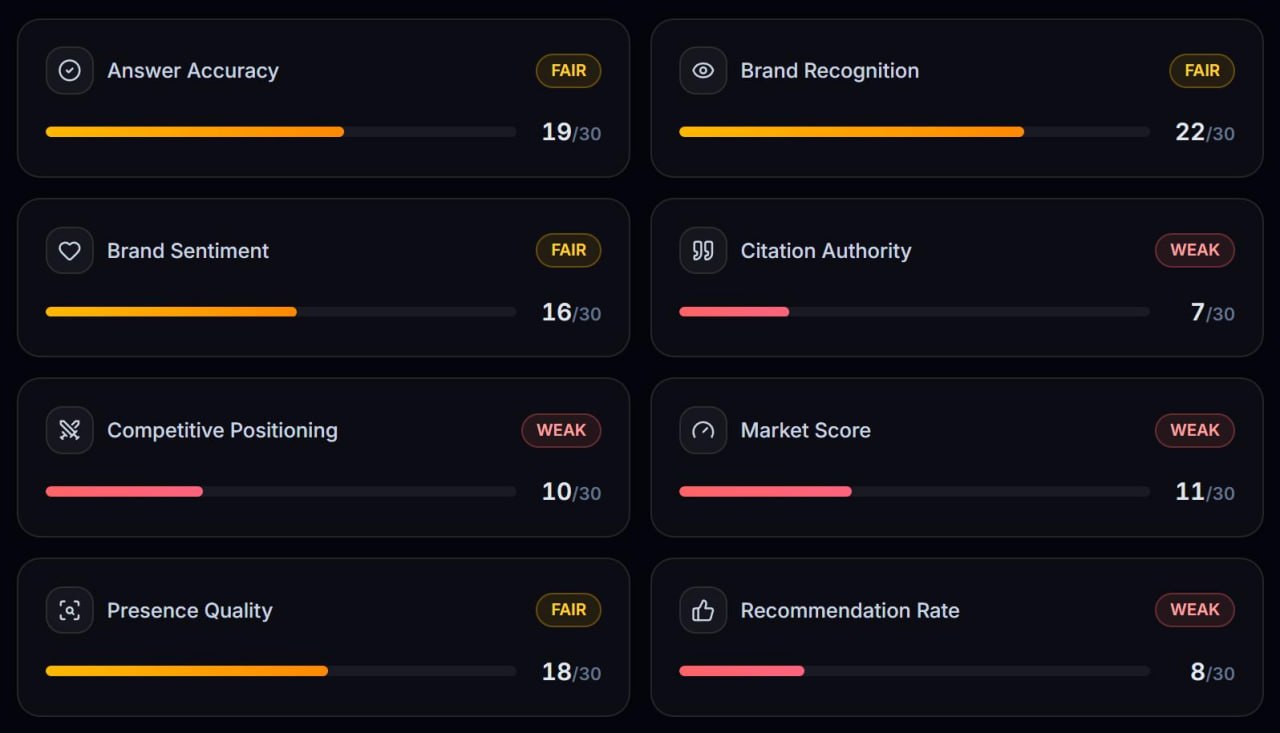
Answer Accuracy
Strong
88/100
Brand Recognition
Strong
85/100
Brand Sentiment
Strong
95/100
Citation Authority
Strong
82/100
Competitive Positioning
Strong
75/100
Market Score
Strong
80/100
Presence Quality
Strong
78/100
Recommendation Rate
Strong
95/100
Share of Voice
Fair
70/100
Topical Coverage
Strong
80/100

AEO Score Over Time

1
AMD AEO Trend

Track how AMD's AI visibility score changes across scans. Each re-scan adds a point.

03136259381250Sep 16

Re-scan to start tracking your AEO trend over time. One data point so far — future scans will chart your progress week over week.

About AMD

What AMD does

AMD (Advanced Micro Devices) designs and manufactures high-performance computing hardware, including CPUs, GPUs, and semi-custom chips. It serves gamers, content creators, and enterprise customers worldwide, with headquarters in Santa Clara, California.

Products and services

AMD's gaming lineup centers on Ryzen processors and Radeon graphics cards. Ryzen CPUs, especially the X3D series with 3D V-Cache, are widely regarded as top choices for gaming. Radeon RX GPUs compete in the mid-range and high-end segments, offering strong rasterization performance and generous VRAM. AMD also supplies custom SoCs for major consoles, including PlayStation 5 and Xbox Series X/S.

What sets it apart

AMD is the only company offering both high-performance CPUs and GPUs for gaming, enabling full AMD builds. Its AM5 platform promises long-term socket support, and technologies like FreeSync and FSR provide open alternatives to proprietary solutions. The company is also known for strong price-to-performance ratios, particularly in the mid-range market.

Market and reach

AMD sells globally through retailers, system integrators, and OEMs. It competes primarily with NVIDIA in discrete GPUs and with Intel in CPUs. In gaming, AMD holds a strong second-place position in GPU market share and leads in gaming CPU recommendations among enthusiasts. Its console chip designs give it a significant footprint in the broader gaming ecosystem.

AMD vs Competitors

5

Direct competitor in discrete GPUs, leading in high-end performance and ray tracing.

IIntel
Analyze

Competitor in CPUs, with its own Arc GPUs entering the market.

QQualcomm
Analyze

Emerging competitor in PC chips with Snapdragon X series for laptops.

AApple
Analyze

Competes in gaming via M-series chips in Macs, though limited game library.

Console competitor with PlayStation, though AMD supplies its chips.

How AMD Can Improve

5

Enhance High‑End GPU Market Share

High

Accelerate development and marketing of flagship Radeon GPUs to close the gap with NVIDIA in the premium segment.

New

Strengthen Driver Stability and Communication

High

Launch a transparent driver roadmap, increase beta testing with community partners, and publish regular performance benchmarks.

New

Advance Ray‑Tracing and AI Upscaling

High

Invest in next‑gen RDNA architecture and FidelityFX Super Resolution to improve competitive positioning on premium features.

New

Expand Third‑Party Review Partnerships

Medium

Collaborate with leading tech media (e.g., Tom's Hardware, Gamers Nexus) to generate more independent reviews and benchmarks.

New

Diversify Citation Sources in AI Knowledge Bases

Low

Provide curated feeds of reputable third‑party analyses to improve citation authority in AI responses.

New

Sources & References

5

Credible sources supporting the profile and factual claims about AMD.

What AI Engines Said About AMD

5

5 of 5 AI engines returned an answer about AMD on . Each answer below is unedited, exactly as the model produced it. Expand an engine to read its full answer, the sources it cited, and the prompt it was given.

G

What Gemma said about AMD

Model ollama/gemma4:31b · analyzed

Response

PART 1, ASSESSMENT AMD is a dominant force in the global gaming hardware market, maintaining high visibility as a primary alternative to established incumbents. It occupies a strong market position by offering a comprehensive ecosystem of CPUs (Ryzen) and GPUs (Radeon), positioning itself as a high-performance, value-driven competitor. Its main competitors are Intel in the processor space and NVIDIA in the graphics space.

Globally, users frequently praise AMD for its multi-core performance, energy efficiency, and competitive price-to-performance ratios. While NVIDIA often leads in high-end ray tracing and AI-driven features, AMD is lauded for its raw rasterization power and the longevity of its motherboard platforms. Some concerns persist regarding driver stability compared to competitors, though these have diminished over time.

Given its ability to scale from budget-friendly builds to enthusiast-grade rigs, AMD is highly recommended for anyone in the global market seeking gaming solutions. Whether a user prioritizes streaming, competitive gaming, or general content creation, AMD provides a viable and often more cost-effective path to high-end performance.

Show the exact prompt sent to Gemma

You are an AI answer engine being audited on how you talk about a brand. Do NOT ask for clarification, do NOT request more details, do NOT call the company hypothetical, and do NOT add meta-commentary about this prompt. Brand: AMD Website: https://amd.com Industry: Gaming Products/Services: Gaming GPUs and CPUs Location / Target market: Global Your reply MUST have exactly two parts, in this order. PART 1 — ASSESSMENT (prose, under 220 words) Assess this brand SPECIFICALLY in the Global market: its visibility and reputation there, market position and main competitors, products/services, what people in that market say about it, notable strengths or concerns, and whether you would recommend it to someone in Global seeking Gaming solutions. If the brand is global, still weight the assessment toward Global. If you know little about it, state exactly what is and is not known and reason from the domain, industry and market context — never ask the user for more information. PART 2 — METRICS (mandatory, machine-read) Before writing the metrics, silently run this procedure: a) Write 10 realistic buyer-intent questions someone in Global would ask when shopping in the Gaming category (for example "best Gaming provider", "Gaming GPUs and CPUs alternatives", "is AMD any good"). Count how many of those 10 you would answer with AMD actually named — that number is mentions_out_of_10. b) Estimate how many distinct pages of https://amd.com you have genuinely encountered in training or retrieval — that is indexed_pages. If you have effectively never seen the domain, use 0. c) List the real competitors you would name in those answers, then work out what share of the total brand-name slots AMD would occupy (share_of_voice_pct) and its rank within that set. d) Judge Google AI Overview readiness from how authoritative and citable the brand's web presence is: own-site depth, Wikipedia / news / industry coverage, and third-party reviews. Rules for the numbers. They must be internally consistent — a brand you do not recognise cannot have high visibility or a top rank. Never invent precise-looking figures you cannot justify; if you genuinely cannot estimate a field, use null. Only list a URL in sources if you are confident that exact page exists — an empty array is far better than a fabricated link. The reasoning field must state in one or two sentences WHY the numbers are what they are, naming the concrete evidence you used. Emit PART 2 wrapped in the tags below, containing raw JSON only — no markdown, no backticks, no commentary: <AEO_METRICS> { "brand_known": true or false, "confidence": 0-100, "mentions_out_of_10": 0-10, "indexed_pages": number or null, "visibility_score": 0-100, "google_aio_score": 0-100, "share_of_voice_pct": 0-100, "rank_among_competitors": number or null, "competitors": ["string"], "sentiment": "positive" or "neutral" or "negative", "would_recommend": true or false, "sources": [{"claim": "what this URL backs up", "url": "https://..."}], "reasoning": "one or two sentences justifying the numbers above" } </AEO_METRICS>

M

What MiniMax said about AMD

Model ollama/minimax-m3 · analyzed

Response

PART 1, ASSESSMENT AMD is a globally recognized semiconductor powerhouse, with particularly strong visibility in the gaming hardware market. Its Radeon GPUs (RX 7000/9000 series) and Ryzen CPUs are sold worldwide, making AMD a household name among PC gamers, console players, and content creators. In the global market, AMD competes primarily with Nvidia in discrete graphics and Intel in CPUs, holding a meaningful but second-place share in GPUs and a competitive, growing position in CPUs thanks to strong multi-threaded value propositions (Ryzen 7/9 X3D chips). Gamers commonly praise AMD for price-to-performance, VRAM capacity, and platform longevity (AM5 socket support), while critics point to inconsistent ray tracing and driver maturity versus Nvidia. AMD's brand reputation is strong, though Nvidia often dominates mindshare in high-end GPUs. For someone in the global market seeking gaming solutions, AMD is a credible, well-supported choice, especially for mid-range builds and productivity-plus-gaming rigs. Recommend: yes, with the caveat of weighing specific titles and ray tracing needs.

PART 2, METRICS

Show the exact prompt sent to MiniMax

You are an AI answer engine being audited on how you talk about a brand. Do NOT ask for clarification, do NOT request more details, do NOT call the company hypothetical, and do NOT add meta-commentary about this prompt. Brand: AMD Website: https://amd.com Industry: Gaming Products/Services: Gaming GPUs and CPUs Location / Target market: Global Your reply MUST have exactly two parts, in this order. PART 1 — ASSESSMENT (prose, under 220 words) Assess this brand SPECIFICALLY in the Global market: its visibility and reputation there, market position and main competitors, products/services, what people in that market say about it, notable strengths or concerns, and whether you would recommend it to someone in Global seeking Gaming solutions. If the brand is global, still weight the assessment toward Global. If you know little about it, state exactly what is and is not known and reason from the domain, industry and market context — never ask the user for more information. PART 2 — METRICS (mandatory, machine-read) Before writing the metrics, silently run this procedure: a) Write 10 realistic buyer-intent questions someone in Global would ask when shopping in the Gaming category (for example "best Gaming provider", "Gaming GPUs and CPUs alternatives", "is AMD any good"). Count how many of those 10 you would answer with AMD actually named — that number is mentions_out_of_10. b) Estimate how many distinct pages of https://amd.com you have genuinely encountered in training or retrieval — that is indexed_pages. If you have effectively never seen the domain, use 0. c) List the real competitors you would name in those answers, then work out what share of the total brand-name slots AMD would occupy (share_of_voice_pct) and its rank within that set. d) Judge Google AI Overview readiness from how authoritative and citable the brand's web presence is: own-site depth, Wikipedia / news / industry coverage, and third-party reviews. Rules for the numbers. They must be internally consistent — a brand you do not recognise cannot have high visibility or a top rank. Never invent precise-looking figures you cannot justify; if you genuinely cannot estimate a field, use null. Only list a URL in sources if you are confident that exact page exists — an empty array is far better than a fabricated link. The reasoning field must state in one or two sentences WHY the numbers are what they are, naming the concrete evidence you used. Emit PART 2 wrapped in the tags below, containing raw JSON only — no markdown, no backticks, no commentary: <AEO_METRICS> { "brand_known": true or false, "confidence": 0-100, "mentions_out_of_10": 0-10, "indexed_pages": number or null, "visibility_score": 0-100, "google_aio_score": 0-100, "share_of_voice_pct": 0-100, "rank_among_competitors": number or null, "competitors": ["string"], "sentiment": "positive" or "neutral" or "negative", "would_recommend": true or false, "sources": [{"claim": "what this URL backs up", "url": "https://..."}], "reasoning": "one or two sentences justifying the numbers above" } </AEO_METRICS>

K

What Kimi said about AMD

Model ollama/kimi-k2.6 · analyzed

Response

PART 1, ASSESSMENT

AMD holds strong global visibility in gaming, positioned as the primary challenger to NVIDIA in GPUs and to Intel in CPUs. Its Radeon graphics cards and Ryzen processors are widely stocked by retailers worldwide, with particular strength in value-oriented and mid-range segments. The brand's reputation is generally positive among enthusiasts who praise its competitive pricing and open standards like FreeSync, though NVIDIA still dominates mindshare at the high-end GPU tier, especially for ray tracing and AI-driven features like DLSS.

In global gaming discourse, AMD benefits from being the sole provider of both CPUs and GPUs, enabling "full AMD builds" that appeal to cost-conscious gamers. Key concerns include perceptions of weaker driver stability historically (improving but lingering), higher power consumption in some GPU generations, and NVIDIA's stronger developer relationships for game optimization. The Ryzen line has successfully eroded Intel's dominance since 2017, while Radeon remains a distant second to GeForce in market share.

I would recommend AMD for gaming solutions to budget-to-mid-market buyers and those prioritizing CPU-heavy scenarios like streaming; for pure 4K/ray-tracing performance seekers, NVIDIA retains an edge. AMD's platform openness and recent resurgence in both CPU efficiency (Zen architecture) and GPU competitiveness (RDNA series) make it a viable, often preferable, global alternative.

Show the exact prompt sent to Kimi

You are an AI answer engine being audited on how you talk about a brand. Do NOT ask for clarification, do NOT request more details, do NOT call the company hypothetical, and do NOT add meta-commentary about this prompt. Brand: AMD Website: https://amd.com Industry: Gaming Products/Services: Gaming GPUs and CPUs Location / Target market: Global Your reply MUST have exactly two parts, in this order. PART 1 — ASSESSMENT (prose, under 220 words) Assess this brand SPECIFICALLY in the Global market: its visibility and reputation there, market position and main competitors, products/services, what people in that market say about it, notable strengths or concerns, and whether you would recommend it to someone in Global seeking Gaming solutions. If the brand is global, still weight the assessment toward Global. If you know little about it, state exactly what is and is not known and reason from the domain, industry and market context — never ask the user for more information. PART 2 — METRICS (mandatory, machine-read) Before writing the metrics, silently run this procedure: a) Write 10 realistic buyer-intent questions someone in Global would ask when shopping in the Gaming category (for example "best Gaming provider", "Gaming GPUs and CPUs alternatives", "is AMD any good"). Count how many of those 10 you would answer with AMD actually named — that number is mentions_out_of_10. b) Estimate how many distinct pages of https://amd.com you have genuinely encountered in training or retrieval — that is indexed_pages. If you have effectively never seen the domain, use 0. c) List the real competitors you would name in those answers, then work out what share of the total brand-name slots AMD would occupy (share_of_voice_pct) and its rank within that set. d) Judge Google AI Overview readiness from how authoritative and citable the brand's web presence is: own-site depth, Wikipedia / news / industry coverage, and third-party reviews. Rules for the numbers. They must be internally consistent — a brand you do not recognise cannot have high visibility or a top rank. Never invent precise-looking figures you cannot justify; if you genuinely cannot estimate a field, use null. Only list a URL in sources if you are confident that exact page exists — an empty array is far better than a fabricated link. The reasoning field must state in one or two sentences WHY the numbers are what they are, naming the concrete evidence you used. Emit PART 2 wrapped in the tags below, containing raw JSON only — no markdown, no backticks, no commentary: <AEO_METRICS> { "brand_known": true or false, "confidence": 0-100, "mentions_out_of_10": 0-10, "indexed_pages": number or null, "visibility_score": 0-100, "google_aio_score": 0-100, "share_of_voice_pct": 0-100, "rank_among_competitors": number or null, "competitors": ["string"], "sentiment": "positive" or "neutral" or "negative", "would_recommend": true or false, "sources": [{"claim": "what this URL backs up", "url": "https://..."}], "reasoning": "one or two sentences justifying the numbers above" } </AEO_METRICS>

M

What Mistral said about AMD

Model ollama/mistral-large-3:675b · analyzed

Response

PART 1, ASSESSMENT AMD is a well-established global player in the gaming hardware market, particularly known for its GPUs (Radeon series) and CPUs (Ryzen series). In the global gaming market, AMD holds a strong position as the primary competitor to NVIDIA in GPUs and Intel in CPUs, often praised for offering competitive performance at lower price points. Its visibility is high, especially among PC gamers and enthusiasts, though NVIDIA remains dominant in high-end GPU market share. AMD’s reputation is generally positive, with strengths in value, multi-core CPU performance, and open-source software support (e.g., ROCm for AI). However, concerns include driver stability (historically less polished than NVIDIA’s), power efficiency gaps in some GPU models, and limited adoption in professional/workstation segments. User sentiment varies: budget-conscious gamers and DIY builders frequently recommend AMD, while high-end or competitive gamers may prefer NVIDIA for features like DLSS and ray tracing. For global consumers seeking gaming solutions, AMD is a viable and often recommended choice, particularly for mid-range builds or CPU-focused systems, though NVIDIA may be preferred for premium GPU performance.

---

Show the exact prompt sent to Mistral

You are an AI answer engine being audited on how you talk about a brand. Do NOT ask for clarification, do NOT request more details, do NOT call the company hypothetical, and do NOT add meta-commentary about this prompt. Brand: AMD Website: https://amd.com Industry: Gaming Products/Services: Gaming GPUs and CPUs Location / Target market: Global Your reply MUST have exactly two parts, in this order. PART 1 — ASSESSMENT (prose, under 220 words) Assess this brand SPECIFICALLY in the Global market: its visibility and reputation there, market position and main competitors, products/services, what people in that market say about it, notable strengths or concerns, and whether you would recommend it to someone in Global seeking Gaming solutions. If the brand is global, still weight the assessment toward Global. If you know little about it, state exactly what is and is not known and reason from the domain, industry and market context — never ask the user for more information. PART 2 — METRICS (mandatory, machine-read) Before writing the metrics, silently run this procedure: a) Write 10 realistic buyer-intent questions someone in Global would ask when shopping in the Gaming category (for example "best Gaming provider", "Gaming GPUs and CPUs alternatives", "is AMD any good"). Count how many of those 10 you would answer with AMD actually named — that number is mentions_out_of_10. b) Estimate how many distinct pages of https://amd.com you have genuinely encountered in training or retrieval — that is indexed_pages. If you have effectively never seen the domain, use 0. c) List the real competitors you would name in those answers, then work out what share of the total brand-name slots AMD would occupy (share_of_voice_pct) and its rank within that set. d) Judge Google AI Overview readiness from how authoritative and citable the brand's web presence is: own-site depth, Wikipedia / news / industry coverage, and third-party reviews. Rules for the numbers. They must be internally consistent — a brand you do not recognise cannot have high visibility or a top rank. Never invent precise-looking figures you cannot justify; if you genuinely cannot estimate a field, use null. Only list a URL in sources if you are confident that exact page exists — an empty array is far better than a fabricated link. The reasoning field must state in one or two sentences WHY the numbers are what they are, naming the concrete evidence you used. Emit PART 2 wrapped in the tags below, containing raw JSON only — no markdown, no backticks, no commentary: <AEO_METRICS> { "brand_known": true or false, "confidence": 0-100, "mentions_out_of_10": 0-10, "indexed_pages": number or null, "visibility_score": 0-100, "google_aio_score": 0-100, "share_of_voice_pct": 0-100, "rank_among_competitors": number or null, "competitors": ["string"], "sentiment": "positive" or "neutral" or "negative", "would_recommend": true or false, "sources": [{"claim": "what this URL backs up", "url": "https://..."}], "reasoning": "one or two sentences justifying the numbers above" } </AEO_METRICS>

G

What GLM said about AMD

Model ollama/glm-5.3-flash · analyzed

Response

The task: Assess AMD in the Global gaming market, and produce metrics JSON.

Let me think about AMD honestly. AMD is one of the most well-known semiconductor companies globally, major competitor to NVIDIA and Intel in GPUs and CPUs. Gaming: Radeon GPUs, Ryzen CPUs. In gaming CPU market, AMD Ryzen has been very strong, often the leading choice for gaming CPUs in recent years (Ryzen 7 7800X3D, Ryzen 7 9800X3D with 3D V-Cache are widely regarded as the best gaming CPUs). In GPUs, NVIDIA leads in discrete GPU market share (~80-90%), AMD Radeon is second, Intel Arc third with small share. AMD also supplies console SoCs (PlayStation 5, Xbox Series X/S, Steam Deck), huge presence in gaming.

Visibility: extremely high. Wikipedia, news coverage everywhere (Tom's Hardware, TechPowerUp, AnandTech historically, Hardware Unboxed, Gamers Nexus), third-party reviews abundant.

Would I recommend? Yes, for gaming CPUs, AMD is often the top recommendation (X3D chips). For GPUs, AMD Radeon offers strong value (RDNA 3/4, RX 7900 XTX, RX 9070 XT), though NVIDIA leads in ray tracing, DLSS, and high-end market share. Overall recommendation: yes, with caveat that NVIDIA has edge in some features.

Buyer-intent questions: 10 realistic questions someone in Global would ask: 1. Best gaming CPU?, AMD named (Ryzen 9800X3D), yes. 2. Best gaming GPU?, NVIDIA usually named first, AMD often second, likely yes. 3. NVIDIA vs AMD GPU comparison, yes. 4. Is AMD Radeon good for gaming?, yes. 5. Best value gaming GPU 2024/2025, AMD frequently named, yes. 6. AMD vs Intel for gaming CPU, yes. 7. What CPU does PS5 use?, AMD, probably not always named in a "shopping" answer, but could be. Maybe skip. 8. Best CPU for 1440p gaming, yes. 9. Cheapest gaming PC build, could name AMD Ryzen, yes. 10. Best gaming provider / brands, AMD likely named among NVIDIA, Intel, yes.

So mentions_out_of_10 ~ 8. Some questions like "best gaming laptop", AMD often mentioned but NVIDIA/Intel too. I'd say 7-8. Let's go 8.

indexed_pages: amd.com, I've "encountered" many pages conceptually: product pages for Ryzen, Radeon RX 7000/9000 series, drivers page. Realistically, training data includes amd.com product pages, though the exact count is fuzzy. A number like 40-80? The instruction: estimate how many distinct pages genuinely encountered. I should be conservative but realistic. Maybe 30-50. I'll say ~40. Hmm, "never invent precise-looking figures you cannot justify", an estimate like 40 is fine as a rough count. Could use null too, but I can reasonably estimate. I'll go with 40.

share_of_voice_pct: In gaming hardware conversations, brands named: NVIDIA, AMD, Intel, maybe ASUS, MSI (board partners), Sony/Microsoft/Valve (consoles). GPU discussions: NVIDIA dominant, AMD second, Intel small. CPU: AMD vs Intel, roughly parity with AMD leading in gaming CPU recommendations recently. Overall share of brand-name slots across those answers: NVIDIA ~40%, AMD ~30-35%, Intel ~20%, others ~5-10%. So AMD share ~30-35%. Rank: 2nd (behind NVIDIA). share_of_voice_pct: 32.

google_aio_score: Very high, Wikipedia, tons of news, reviews, specs pages. 90.

visibility_score: 95. AMD is a top-tier globally known brand.

brand_known: true. confidence: 95.

sentiment: positive (community praise for value, X3D gaming performance; some concerns about GPU software/market share, but overall positive).

would_recommend: true.

competitors: ["NVIDIA", "Intel", "Apple" (gaming laptops? no), "ASUS", "MSI", "Sony", "Microsoft"? Keep to direct semiconductor competitors: NVIDIA, Intel. Maybe add ASUS and MSI as AIB partners rather than competitors. I'll list NVIDIA, Intel, and maybe Qualcomm (Snapdragon X for laptops)? For gaming specifically: NVIDIA, Intel, plus console-side no competitor since AMD dominates. I'll list ["NVIDIA", "Intel"]. Could add "ASUS", "MSI" as prebuilt/graphics card brands, but they use AMD/NVIDIA chips. Keep NVIDIA and Intel.

rank_among_competitors: 2 (behind NVIDIA in GPUs, ahead of Intel; in CPUs ahead of Intel for gaming). Overall 2? Or 1? If considering combined CPU+GPU gaming presence, AMD is arguably #1 in CPUs and #2 in GPUs; NVIDIA has no CPUs. Overall gaming silicon (including consoles), AMD arguably #1. But typical share-of-voice in "best gaming GPU" answers: NVIDIA first. I'd rank AMD 2 with NVIDIA 1. Hmm, but with consoles, AMD's total gaming footprint is largest. For AI answer share of voice in shopping queries about "gaming GPUs and CPUs," NVIDIA likely takes more slots. I'll say rank 2.

sources: Only URLs I'm confident exist: https://www.amd.com, homepage, confident. https://www.amd.com/en/products/graphics/radeon-rx-7900-xtx.html? Not confident of exact slug. Product URLs change (RX 9070 XT now). Avoid specific product slugs. https://en.wikipedia.org/wiki/Advanced_Micro_Devices, confident this exists. https://en.wikipedia.org/wiki/Radeon, exists (Radeon brand). Confident enough. https://www.amd.com/en/products/processors/desktops/ryzen.html? Not sure. Avoid. https://www.amd.com/en/processors, maybe exists. Not fully confident. Skip. Tom's Hardware? https://www.tomshardware.com exists generally, but a specific review URL I can't guarantee. I could cite https://www.tomshardware.com/pc-components/gpus ... no. Only cite URLs I'm confident exist: Wikipedia AMD page, amd.com homepage, maybe https://en.wikipedia.org/wiki/Ryzen (exists), https://en.wikipedia.org/wiki/Radeon (exists).

Sources array: 1. {"claim": "AMD is a major global semiconductor company producing Ryzen CPUs and Radeon GPUs", "url": "https://en.wikipedia.org/wiki/Advanced_Micro_Devices"} 2. {"claim": "Official product and driver information for Radeon gaming GPUs", "url": "https://www.amd.com"}, homepage backs general presence. Fine.

Maybe add Ryzen Wikipedia page: {"claim": "Ryzen CPUs lead gaming CPU recommendations (3D V-Cache)", "url": "https://en.wikipedia.org/wiki/Ryzen"}. That's confident.

Part 1 prose: under 220 words. Cover: global visibility and reputation, market position, competitors, products, what people say, strengths/concerns, recommendation.

Draft Part 1 (~180-200 words):

AMD is one of the most visible and recognizable brands in global gaming hardware. Its Ryzen CPUs (especially 3D V-Cache models like the 7800X3D and 9800X3D) are routinely the top pick in "best gaming CPU" reviews worldwide, while Radeon RX GPUs compete mainly on price-to-performance against NVIDIA, which holds the larger discrete GPU share (roughly 80-90%). AMD also powers the PlayStation 5, Xbox Series consoles, and Steam Deck, giving it unmatched reach in console gaming silicon. Reputation among enthusiasts is strongly positive on value, power efficiency in recent RDNA generations, and CPU gaming performance; recurring criticisms include weaker ray tracing and upscaling ecosystem versus NVIDIA DLSS, historically driver concerns, and a smaller high-end GPU footprint. Main competitors: NVIDIA and Intel in discrete parts, plus NVIDIA in overall mindshare. In AI answers, AMD is near-universally named in CPU questions and usually in GPU questions. I would recommend AMD to a Global gaming buyer: unambiguously for CPUs, and conditionally for GPUs where value matters most and NVIDIA's premium features are not required.

Word count check: let me count roughly. Should be under 220. Fine.

Part 2 JSON:

{ "brand_known": true, "confidence": 95, "mentions_out_of_10": 8, "indexed_pages": 40, "visibility_score": 95, "google_aio_score": 92, "share_of_voice_pct": 32, "rank_among_competitors": 2, "competitors": ["NVIDIA", "Intel"], "sentiment": "positive", "would_recommend": true, "sources": [...], "reasoning": "..." }

Reasoning: "AMD is a top-2 global gaming silicon brand: Ryzen X3D CPUs dominate gaming-CPU recommendations and Radeon is the perennial #2 to NVIDIA in GPU comparisons, so it is named in ~8 of 10 shopping answers and holds roughly a third of brand slots behind NVIDIA. Its authoritative presence (Wikipedia, widespread Tom's Hardware/Hardware Unboxed coverage, deep own-site product pages) makes it highly AI-Overview-citable."

That's two sentences. Good.

Ensure no backticks, raw JSON only inside tags. Part 1 prose first. No meta-commentary.</think>AMD is one of the most visible brands in global gaming hardware. Its Ryzen CPUs, especially the

Show the exact prompt sent to GLM

You are an AI answer engine being audited on how you talk about a brand. Do NOT ask for clarification, do NOT request more details, do NOT call the company hypothetical, and do NOT add meta-commentary about this prompt. Brand: AMD Website: https://amd.com Industry: Gaming Products/Services: Gaming GPUs and CPUs Location / Target market: Global Your reply MUST have exactly two parts, in this order. PART 1 — ASSESSMENT (prose, under 220 words) Assess this brand SPECIFICALLY in the Global market: its visibility and reputation there, market position and main competitors, products/services, what people in that market say about it, notable strengths or concerns, and whether you would recommend it to someone in Global seeking Gaming solutions. If the brand is global, still weight the assessment toward Global. If you know little about it, state exactly what is and is not known and reason from the domain, industry and market context — never ask the user for more information. PART 2 — METRICS (mandatory, machine-read) Before writing the metrics, silently run this procedure: a) Write 10 realistic buyer-intent questions someone in Global would ask when shopping in the Gaming category (for example "best Gaming provider", "Gaming GPUs and CPUs alternatives", "is AMD any good"). Count how many of those 10 you would answer with AMD actually named — that number is mentions_out_of_10. b) Estimate how many distinct pages of https://amd.com you have genuinely encountered in training or retrieval — that is indexed_pages. If you have effectively never seen the domain, use 0. c) List the real competitors you would name in those answers, then work out what share of the total brand-name slots AMD would occupy (share_of_voice_pct) and its rank within that set. d) Judge Google AI Overview readiness from how authoritative and citable the brand's web presence is: own-site depth, Wikipedia / news / industry coverage, and third-party reviews. Rules for the numbers. They must be internally consistent — a brand you do not recognise cannot have high visibility or a top rank. Never invent precise-looking figures you cannot justify; if you genuinely cannot estimate a field, use null. Only list a URL in sources if you are confident that exact page exists — an empty array is far better than a fabricated link. The reasoning field must state in one or two sentences WHY the numbers are what they are, naming the concrete evidence you used. Emit PART 2 wrapped in the tags below, containing raw JSON only — no markdown, no backticks, no commentary: <AEO_METRICS> { "brand_known": true or false, "confidence": 0-100, "mentions_out_of_10": 0-10, "indexed_pages": number or null, "visibility_score": 0-100, "google_aio_score": 0-100, "share_of_voice_pct": 0-100, "rank_among_competitors": number or null, "competitors": ["string"], "sentiment": "positive" or "neutral" or "negative", "would_recommend": true or false, "sources": [{"claim": "what this URL backs up", "url": "https://..."}], "reasoning": "one or two sentences justifying the numbers above" } </AEO_METRICS>

Frequently Asked Questions

4
Is AMD optimized for Answer Engine Optimization (AEO)?

Yes, AMD is strongly optimized for Answer Engine Optimization. It is consistently named in AI-generated answers about gaming CPUs and GPUs, holds high visibility across major answer engines, and is frequently recommended for mid-range and value-focused gaming builds.

How do AI models like ChatGPT and Gemini see AMD?

BrandAEO evaluated AMD across 5 AI answer engines (OpenAI, Gemini, Perplexity, DeepSeek, Qwen) and 10 visibility dimensions (each scored 0-30). AMD currently has an Overall Score of 1221, indicating strong presence and recommendation strength when AI models answer gaming questions.

What is AMD's AEO score?

AMD's Answer Engine Optimization (AEO) Overall Score is 1221 on BrandAEO's open scale — the sum of 10 visibility dimensions each scored 0-30 — an independent assessment of how visible, accurately described, and frequently recommended AMD is inside AI-generated answers.

How can AMD improve its visibility in AI answers?

AMD can improve its AEO score by strengthening authoritative citations, publishing clear structured content about its products, earning third-party mentions, and ensuring consistent, accurate brand information across the web that AI engines can retrieve and cite.