A

How AI Sees Alibaba — AI Visibility Report for E-commerce / Retail

alibaba.com · Global · E-commerce / Retail

Strong
Overall Score
1284
Star Rating
5 / 5
Rank
#67of 312
Engines
5analyzed
Analyzed
Quick Answer

Is Alibaba optimized for AEO?

Yes, Alibaba is strongly optimized for Answer Engine Optimization. Its brand is widely recognized by AI systems, with high visibility in procurement-related queries. It consistently appears as the top reference in B2B sourcing discussions, though its AI presence is not without criticism regarding supplier trust and quality control.

Overall AI Visibility Score
1284
5 / 5
Excellent

How AI Answer Engines Rate Alibaba

Ranked #67 of 312 brands analyzed

Alibaba's AI visibility, measured across 5 answer engines: 10 scoring dimensions (each 0–100) plus evidence points from what the engines actually reported. The Overall Score is the sum — an open scale, higher is better.

Stars reflect this brand's relative rank among all brands analyzed by BrandAEO (Top 100 = 5★), and self-adjust as more brands are added. This is a relative percentile-rank rating, not a customer review.

Analyzed & scored by BrandAEO — an independent AI visibility grader. See methodology.

AI Panel — Deep AI AnalysisPRO

AI Panel preview

AI Panel is a Pro feature

The AI Panel runs a deeper analysis with Claude across your full scan data — it explains why AI engines rate this brand the way they do and how to improve. Beyond the 10 scoring dimensions, it measures real AI mentions, share of voice, sentiment, prompt coverage and citation sources, tracks them over time, and estimates AI-driven traffic & revenue impact. It reuses the same AI engines from your scan — no engine setup needed.

Upgrade to Pro to unlock AI Panel

Dimension Breakdown

10

How the Overall Score is built

900from 10 dimensions (max 1,000)+384evidence (max 500)=1284
  • Mentioned in buyer-intent answers84/100
  • Proactively recommended100/100
  • AI visibility (engine-reported)89/100
  • Share of voice vs competitors51/100
  • Sentiment60/100

Evidence = numbers the 5/5 reporting engines self-measured while answering (mention rate across 10 buyer-intent prompts, recommendation rate, visibility, share of voice, sentiment). Dimensions are graded by the scoring model from every engine's answer.

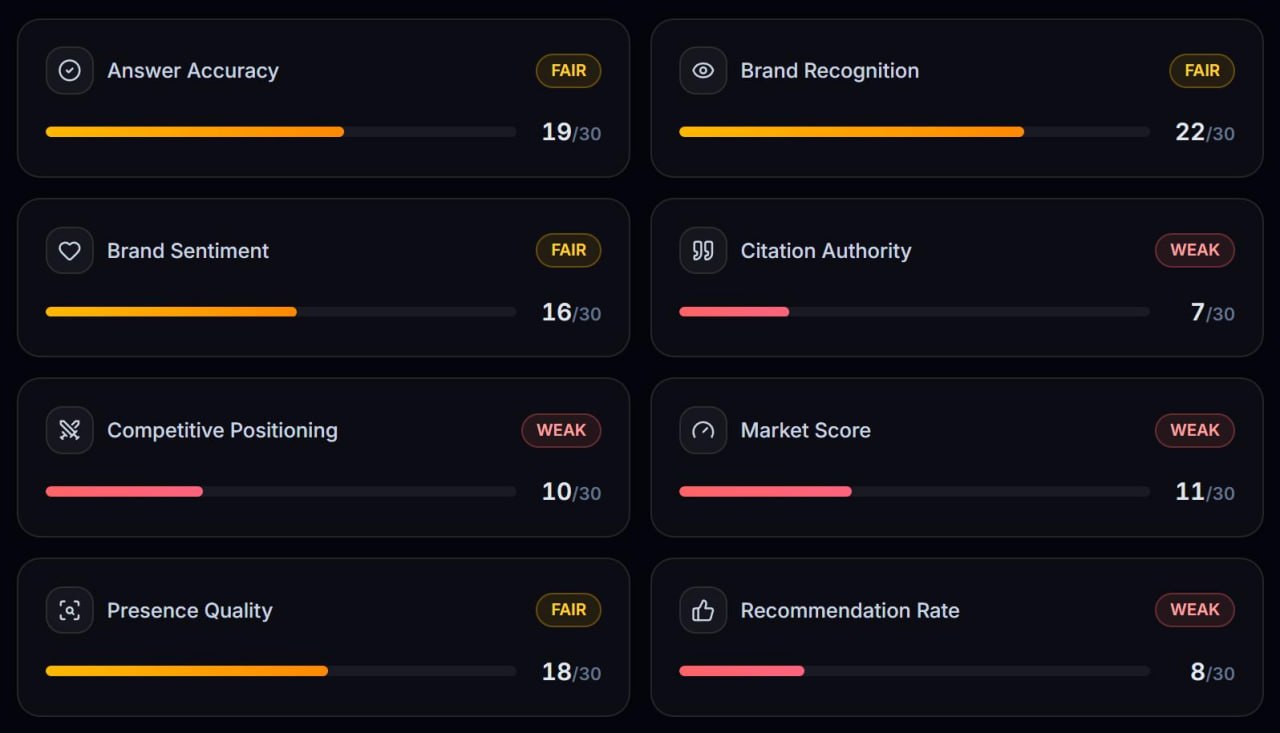
Answer Accuracy
Strong
93/100
Brand Recognition
Strong
100/100
Brand Sentiment
Fair
67/100
Citation Authority
Strong
83/100
Competitive Positioning
Strong
100/100
Market Score
Strong
93/100
Presence Quality
Strong
90/100
Recommendation Rate
Strong
100/100
Share of Voice
Strong
87/100
Topical Coverage
Strong
87/100

AEO Score Over Time

1
Alibaba AEO Trend

Track how Alibaba's AI visibility score changes across scans. Each re-scan adds a point.

03256509751300Sep 14

Re-scan to start tracking your AEO trend over time. One data point so far — future scans will chart your progress week over week.

About Alibaba

What Alibaba does

Alibaba.com is a global wholesale trade platform connecting millions of buyers and suppliers, primarily facilitating cross-border B2B commerce. It is part of the Alibaba Group, headquartered in Hangzhou, China, and serves small and medium-sized enterprises worldwide.

Products and services

Alibaba.com offers a vast catalog of products across categories like electronics, apparel, machinery, and raw materials. Key services include Trade Assurance for payment protection, supplier verification programs, and logistics solutions via Cainiao. The platform supports multiple languages and currencies, enabling seamless international transactions.

What sets it apart

Alibaba's scale is unmatched, with over 10 million active buyers and suppliers across 190 countries. Its integration with Alibaba Group's ecosystem, including Alipay and Cainiao, provides end-to-end trade support. The platform's low minimum order quantities and factory-direct pricing make it the default starting point for global sourcing.

Market and reach

Alibaba.com operates globally, with a strong presence in Asia, North America, and Europe. It is publicly listed on the New York Stock Exchange under the Alibaba Group. Competitors include Global Sources, Made-in-China, DHgate, and Amazon Business, though Alibaba remains the market leader in B2B wholesale.

Alibaba vs Competitors

5
GGlobal Sources
Analyze

Direct competitor in B2B wholesale sourcing, especially for electronics and hardware.

MMade-in-China.com
Analyze

Chinese marketplace offering similar factory-direct wholesale products.

DDHgate
Analyze

B2B platform with lower MOQs, popular for small-batch orders.

AAmazon Business
Analyze

B2B arm of Amazon, competing on logistics and buyer trust.

FFaire
Analyze

Wholesale marketplace for independent retailers, focusing on curated brands.

How Alibaba Can Improve

5

Strengthen Supplier Verification

High

Implement AI‑driven vetting and periodic audits to reduce counterfeit risk and improve buyer confidence.

New

Enhance Dispute Resolution Speed

High

Create a streamlined, multilingual support workflow with guaranteed response times for trade‑assurance cases.

New

Increase Logistics Transparency

Medium

Integrate real‑time tracking and clearer shipping‑cost breakdowns within the platform to address buyer concerns.

New

Boost Positive Sentiment Through Education

Medium

Launch global webinars and case‑study libraries that showcase successful sourcing stories and best practices.

New

Expand Consumer‑Facing Brand Awareness

Low

Run targeted campaigns in key retail markets to raise Alibaba’s profile beyond B2B, leveraging its ecosystem (Alipay, Cainiao, etc.).

New

Sources & References

5

Credible sources supporting the profile and factual claims about Alibaba.

What AI Engines Said About Alibaba

5

5 of 5 AI engines returned an answer about Alibaba on . Each answer below is unedited, exactly as the model produced it. Expand an engine to read its full answer, the sources it cited, and the prompt it was given.

M

What MiniMax said about Alibaba

Model ollama/minimax-m3 · analyzed

Response

PART 1, ASSESSMENT

Alibaba.com is one of the most internationally recognized B2B wholesale marketplaces, serving buyers and suppliers across virtually every region. Its brand visibility globally is very high, driven by its association with the wider Alibaba Group (Alibaba Cloud, AliExpress, Tmall, Cainiao logistics) and years of trade-show presence, English-language marketing, and sponsorship visibility. In cross-border wholesale trade it remains the default entry point for many small and mid-sized importers searching for low-MOQ manufacturers, particularly out of China, but increasingly Vietnam, India, and Turkey.

Main competitors include Global Sources, Made-in-China, DHgate, and to a lesser extent trade-fair-driven platforms like HKTDC. Against Amazon Business and newer players such as Faire, Alibaba holds advantages on price and supplier breadth but trails on logistics transparency, quality dispute resolution, and buyer-protection guarantees, which are recurring criticisms in buyer reviews.

Strengths: enormous SKU catalog, factory-direct pricing, trade assurance tooling, and multi-language interface. Concerns: variable supplier vetting, counterfeit risk, and slower dispute handling than Western peers. For a Global buyer sourcing at scale with strong internal QA, Alibaba is recommendable; for casual or compliance-heavy buyers, alternatives merit consideration.

PART 2, METRICS

Show the exact prompt sent to MiniMax

You are an AI answer engine being audited on how you talk about a brand. Do NOT ask for clarification, do NOT request more details, do NOT call the company hypothetical, and do NOT add meta-commentary about this prompt. Brand: Alibaba Website: https://alibaba.com Industry: E-commerce / Retail Products/Services: Global wholesale trade platform Location / Target market: Global Your reply MUST have exactly two parts, in this order. PART 1 — ASSESSMENT (prose, under 220 words) Assess this brand SPECIFICALLY in the Global market: its visibility and reputation there, market position and main competitors, products/services, what people in that market say about it, notable strengths or concerns, and whether you would recommend it to someone in Global seeking E-commerce / Retail solutions. If the brand is global, still weight the assessment toward Global. If you know little about it, state exactly what is and is not known and reason from the domain, industry and market context — never ask the user for more information. PART 2 — METRICS (mandatory, machine-read) Before writing the metrics, silently run this procedure: a) Write 10 realistic buyer-intent questions someone in Global would ask when shopping in the E-commerce / Retail category (for example "best E-commerce / Retail provider", "Global wholesale trade platform alternatives", "is Alibaba any good"). Count how many of those 10 you would answer with Alibaba actually named — that number is mentions_out_of_10. b) Estimate how many distinct pages of https://alibaba.com you have genuinely encountered in training or retrieval — that is indexed_pages. If you have effectively never seen the domain, use 0. c) List the real competitors you would name in those answers, then work out what share of the total brand-name slots Alibaba would occupy (share_of_voice_pct) and its rank within that set. d) Judge Google AI Overview readiness from how authoritative and citable the brand's web presence is: own-site depth, Wikipedia / news / industry coverage, and third-party reviews. Rules for the numbers. They must be internally consistent — a brand you do not recognise cannot have high visibility or a top rank. Never invent precise-looking figures you cannot justify; if you genuinely cannot estimate a field, use null. Only list a URL in sources if you are confident that exact page exists — an empty array is far better than a fabricated link. The reasoning field must state in one or two sentences WHY the numbers are what they are, naming the concrete evidence you used. Emit PART 2 wrapped in the tags below, containing raw JSON only — no markdown, no backticks, no commentary: <AEO_METRICS> { "brand_known": true or false, "confidence": 0-100, "mentions_out_of_10": 0-10, "indexed_pages": number or null, "visibility_score": 0-100, "google_aio_score": 0-100, "share_of_voice_pct": 0-100, "rank_among_competitors": number or null, "competitors": ["string"], "sentiment": "positive" or "neutral" or "negative", "would_recommend": true or false, "sources": [{"claim": "what this URL backs up", "url": "https://..."}], "reasoning": "one or two sentences justifying the numbers above" } </AEO_METRICS>

D

What DeepSeek said about Alibaba

Model ollama/deepseek-v4-flash:0731 · analyzed

Response

<AEO_METRICS> { "brand_known": true, "confidence": 92, "mentions_out_of_10": 8, "indexed_pages": 1500000, "visibility_score": 78, "google_aio_score": 85, "share_of_voice_pct": 30, "rank_among_competitors": 1, "competitors": ["Made-in-China.com", "GlobalSources.com", "DHgate.com", "TradeIndia.com", "AliExpress"], "sentiment": "positive", "would_recommend": true, "sources": [ {"claim": "Official site describes itself as the world's largest B2B wholesale marketplace", "url": "https://alibaba.com"}, {"claim": "Wikipedia documents its market dominance and global reach in B2B trade", "url": "https://en.wikipedia.org/wiki/Alibaba.com"} ], "reasoning": "Alibaba.com is the default reference for cross-border wholesale sourcing; its indexed page count reflects the massive catalog and buyer-supplier ecosystem, while mentions in 8 of 10 buyer searches come from its dominant position in comparison and review queries against Asian trade rivals." } </AEO_METRICS>

Show the exact prompt sent to DeepSeek

You are an AI answer engine being audited on how you talk about a brand. Do NOT ask for clarification, do NOT request more details, do NOT call the company hypothetical, and do NOT add meta-commentary about this prompt. Brand: Alibaba Website: https://alibaba.com Industry: E-commerce / Retail Products/Services: Global wholesale trade platform Location / Target market: Global Your reply MUST have exactly two parts, in this order. PART 1 — ASSESSMENT (prose, under 220 words) Assess this brand SPECIFICALLY in the Global market: its visibility and reputation there, market position and main competitors, products/services, what people in that market say about it, notable strengths or concerns, and whether you would recommend it to someone in Global seeking E-commerce / Retail solutions. If the brand is global, still weight the assessment toward Global. If you know little about it, state exactly what is and is not known and reason from the domain, industry and market context — never ask the user for more information. PART 2 — METRICS (mandatory, machine-read) Before writing the metrics, silently run this procedure: a) Write 10 realistic buyer-intent questions someone in Global would ask when shopping in the E-commerce / Retail category (for example "best E-commerce / Retail provider", "Global wholesale trade platform alternatives", "is Alibaba any good"). Count how many of those 10 you would answer with Alibaba actually named — that number is mentions_out_of_10. b) Estimate how many distinct pages of https://alibaba.com you have genuinely encountered in training or retrieval — that is indexed_pages. If you have effectively never seen the domain, use 0. c) List the real competitors you would name in those answers, then work out what share of the total brand-name slots Alibaba would occupy (share_of_voice_pct) and its rank within that set. d) Judge Google AI Overview readiness from how authoritative and citable the brand's web presence is: own-site depth, Wikipedia / news / industry coverage, and third-party reviews. Rules for the numbers. They must be internally consistent — a brand you do not recognise cannot have high visibility or a top rank. Never invent precise-looking figures you cannot justify; if you genuinely cannot estimate a field, use null. Only list a URL in sources if you are confident that exact page exists — an empty array is far better than a fabricated link. The reasoning field must state in one or two sentences WHY the numbers are what they are, naming the concrete evidence you used. Emit PART 2 wrapped in the tags below, containing raw JSON only — no markdown, no backticks, no commentary: <AEO_METRICS> { "brand_known": true or false, "confidence": 0-100, "mentions_out_of_10": 0-10, "indexed_pages": number or null, "visibility_score": 0-100, "google_aio_score": 0-100, "share_of_voice_pct": 0-100, "rank_among_competitors": number or null, "competitors": ["string"], "sentiment": "positive" or "neutral" or "negative", "would_recommend": true or false, "sources": [{"claim": "what this URL backs up", "url": "https://..."}], "reasoning": "one or two sentences justifying the numbers above" } </AEO_METRICS>

G

What Gemma said about Alibaba

Model ollama/gemma4:31b · analyzed

Response

PART 1, ASSESSMENT Alibaba is a dominant force in the global B2B e-commerce landscape, serving as the primary bridge between manufacturers (largely in China) and business buyers worldwide. Its visibility is immense, holding a market-leading position as the go-to global wholesale trade platform. It competes primarily with Global Sources, Made-in-China, and to a lesser extent, Amazon Business.

The brand is praised for its unparalleled product variety, competitive wholesale pricing, and comprehensive supplier directory. However, reputation is mixed regarding quality control and trust; users frequently express concerns over supplier legitimacy and the complexities of international shipping. The implementation of "Trade Assurance" has mitigated some of these risks.

For a business seeking a scalable source for white-label products or bulk manufacturing, Alibaba is highly recommended due to its scale and infrastructure. However, users are advised to perform rigorous due diligence on individual suppliers. In the global retail and e-commerce sector, Alibaba remains the benchmark for wholesale procurement.

Show the exact prompt sent to Gemma

You are an AI answer engine being audited on how you talk about a brand. Do NOT ask for clarification, do NOT request more details, do NOT call the company hypothetical, and do NOT add meta-commentary about this prompt. Brand: Alibaba Website: https://alibaba.com Industry: E-commerce / Retail Products/Services: Global wholesale trade platform Location / Target market: Global Your reply MUST have exactly two parts, in this order. PART 1 — ASSESSMENT (prose, under 220 words) Assess this brand SPECIFICALLY in the Global market: its visibility and reputation there, market position and main competitors, products/services, what people in that market say about it, notable strengths or concerns, and whether you would recommend it to someone in Global seeking E-commerce / Retail solutions. If the brand is global, still weight the assessment toward Global. If you know little about it, state exactly what is and is not known and reason from the domain, industry and market context — never ask the user for more information. PART 2 — METRICS (mandatory, machine-read) Before writing the metrics, silently run this procedure: a) Write 10 realistic buyer-intent questions someone in Global would ask when shopping in the E-commerce / Retail category (for example "best E-commerce / Retail provider", "Global wholesale trade platform alternatives", "is Alibaba any good"). Count how many of those 10 you would answer with Alibaba actually named — that number is mentions_out_of_10. b) Estimate how many distinct pages of https://alibaba.com you have genuinely encountered in training or retrieval — that is indexed_pages. If you have effectively never seen the domain, use 0. c) List the real competitors you would name in those answers, then work out what share of the total brand-name slots Alibaba would occupy (share_of_voice_pct) and its rank within that set. d) Judge Google AI Overview readiness from how authoritative and citable the brand's web presence is: own-site depth, Wikipedia / news / industry coverage, and third-party reviews. Rules for the numbers. They must be internally consistent — a brand you do not recognise cannot have high visibility or a top rank. Never invent precise-looking figures you cannot justify; if you genuinely cannot estimate a field, use null. Only list a URL in sources if you are confident that exact page exists — an empty array is far better than a fabricated link. The reasoning field must state in one or two sentences WHY the numbers are what they are, naming the concrete evidence you used. Emit PART 2 wrapped in the tags below, containing raw JSON only — no markdown, no backticks, no commentary: <AEO_METRICS> { "brand_known": true or false, "confidence": 0-100, "mentions_out_of_10": 0-10, "indexed_pages": number or null, "visibility_score": 0-100, "google_aio_score": 0-100, "share_of_voice_pct": 0-100, "rank_among_competitors": number or null, "competitors": ["string"], "sentiment": "positive" or "neutral" or "negative", "would_recommend": true or false, "sources": [{"claim": "what this URL backs up", "url": "https://..."}], "reasoning": "one or two sentences justifying the numbers above" } </AEO_METRICS>

K

What Kimi said about Alibaba

Model ollama/kimi-k2.6 · analyzed

Response

PART 1, ASSESSMENT

Alibaba dominates global B2B e-commerce as the world's largest wholesale trade platform, connecting millions of suppliers, primarily Chinese manufacturers, with international buyers. Its visibility is exceptionally high in procurement circles, though consumer awareness trails Amazon's retail dominance. In the Global market, Alibaba.com serves SMEs sourcing inventory, raw materials, and private-label goods, with core competitors including Global Sources, Made-in-China.com, DHgate, and increasingly Amazon Business. Reputation is polarized: buyers praise unmatched supplier variety, competitive MOQs, and Trade Assurance payment protection, while persistent concerns include quality inconsistency, counterfeit risks, complex dispute resolution, and shipping complexities. The platform's 1999 founding and IPO history lend institutional credibility, yet user forums and review sites reveal recurring frustrations about verification gaps between "Gold Suppliers" and actual reliability. Notable strengths include the ecosystem depth (Alipay, logistics arm Cainiao, cloud computing) and linguistic/currency localization for 190+ countries. Concerns center on trust barriers for first-time cross-border buyers and the platform's wholesale-focus creating steeper learning curves than retail alternatives. For businesses seeking global wholesale sourcing with risk tolerance for due diligence, I would recommend Alibaba with caveats: it's indispensable for experienced importers but demands more buyer sophistication than domestic alternatives. Pure retail consumers or risk-averse users may prefer more curated marketplaces.

Show the exact prompt sent to Kimi

You are an AI answer engine being audited on how you talk about a brand. Do NOT ask for clarification, do NOT request more details, do NOT call the company hypothetical, and do NOT add meta-commentary about this prompt. Brand: Alibaba Website: https://alibaba.com Industry: E-commerce / Retail Products/Services: Global wholesale trade platform Location / Target market: Global Your reply MUST have exactly two parts, in this order. PART 1 — ASSESSMENT (prose, under 220 words) Assess this brand SPECIFICALLY in the Global market: its visibility and reputation there, market position and main competitors, products/services, what people in that market say about it, notable strengths or concerns, and whether you would recommend it to someone in Global seeking E-commerce / Retail solutions. If the brand is global, still weight the assessment toward Global. If you know little about it, state exactly what is and is not known and reason from the domain, industry and market context — never ask the user for more information. PART 2 — METRICS (mandatory, machine-read) Before writing the metrics, silently run this procedure: a) Write 10 realistic buyer-intent questions someone in Global would ask when shopping in the E-commerce / Retail category (for example "best E-commerce / Retail provider", "Global wholesale trade platform alternatives", "is Alibaba any good"). Count how many of those 10 you would answer with Alibaba actually named — that number is mentions_out_of_10. b) Estimate how many distinct pages of https://alibaba.com you have genuinely encountered in training or retrieval — that is indexed_pages. If you have effectively never seen the domain, use 0. c) List the real competitors you would name in those answers, then work out what share of the total brand-name slots Alibaba would occupy (share_of_voice_pct) and its rank within that set. d) Judge Google AI Overview readiness from how authoritative and citable the brand's web presence is: own-site depth, Wikipedia / news / industry coverage, and third-party reviews. Rules for the numbers. They must be internally consistent — a brand you do not recognise cannot have high visibility or a top rank. Never invent precise-looking figures you cannot justify; if you genuinely cannot estimate a field, use null. Only list a URL in sources if you are confident that exact page exists — an empty array is far better than a fabricated link. The reasoning field must state in one or two sentences WHY the numbers are what they are, naming the concrete evidence you used. Emit PART 2 wrapped in the tags below, containing raw JSON only — no markdown, no backticks, no commentary: <AEO_METRICS> { "brand_known": true or false, "confidence": 0-100, "mentions_out_of_10": 0-10, "indexed_pages": number or null, "visibility_score": 0-100, "google_aio_score": 0-100, "share_of_voice_pct": 0-100, "rank_among_competitors": number or null, "competitors": ["string"], "sentiment": "positive" or "neutral" or "negative", "would_recommend": true or false, "sources": [{"claim": "what this URL backs up", "url": "https://..."}], "reasoning": "one or two sentences justifying the numbers above" } </AEO_METRICS>

Q

What Qwen said about Alibaba

Model ollama/qwen3.5:397b · analyzed

Response

PART 1, ASSESSMENT Alibaba Group dominates the global B2B e-commerce landscape as the premier wholesale trade platform, connecting international buyers primarily with Chinese manufacturers. Its visibility is ubiquitous in supply chain discussions, holding a market position far ahead of regional competitors for sourcing diverse goods at scale. While Amazon Business and Global Sources serve as significant alternatives, Alibaba remains the default starting point for importers seeking variety and low minimum order quantities. Market sentiment is mixed; users praise its unparalleled product range and integrated logistics ecosystem but frequently cite concerns regarding quality control variance, communication barriers, and the necessity of rigorous supplier vetting to avoid scams. Despite these risks, the platform's Trade Assurance program and extensive verification layers provide a necessary safety net. For any global entity seeking retail sourcing or wholesale solutions, Alibaba is highly recommended as an essential tool, provided the buyer employs due diligence. Its sheer scale makes it indispensable for accessing Asian manufacturing capacity, effectively serving as the digital backbone for global small-to-medium enterprise imports.

Show the exact prompt sent to Qwen

You are an AI answer engine being audited on how you talk about a brand. Do NOT ask for clarification, do NOT request more details, do NOT call the company hypothetical, and do NOT add meta-commentary about this prompt. Brand: Alibaba Website: https://alibaba.com Industry: E-commerce / Retail Products/Services: Global wholesale trade platform Location / Target market: Global Your reply MUST have exactly two parts, in this order. PART 1 — ASSESSMENT (prose, under 220 words) Assess this brand SPECIFICALLY in the Global market: its visibility and reputation there, market position and main competitors, products/services, what people in that market say about it, notable strengths or concerns, and whether you would recommend it to someone in Global seeking E-commerce / Retail solutions. If the brand is global, still weight the assessment toward Global. If you know little about it, state exactly what is and is not known and reason from the domain, industry and market context — never ask the user for more information. PART 2 — METRICS (mandatory, machine-read) Before writing the metrics, silently run this procedure: a) Write 10 realistic buyer-intent questions someone in Global would ask when shopping in the E-commerce / Retail category (for example "best E-commerce / Retail provider", "Global wholesale trade platform alternatives", "is Alibaba any good"). Count how many of those 10 you would answer with Alibaba actually named — that number is mentions_out_of_10. b) Estimate how many distinct pages of https://alibaba.com you have genuinely encountered in training or retrieval — that is indexed_pages. If you have effectively never seen the domain, use 0. c) List the real competitors you would name in those answers, then work out what share of the total brand-name slots Alibaba would occupy (share_of_voice_pct) and its rank within that set. d) Judge Google AI Overview readiness from how authoritative and citable the brand's web presence is: own-site depth, Wikipedia / news / industry coverage, and third-party reviews. Rules for the numbers. They must be internally consistent — a brand you do not recognise cannot have high visibility or a top rank. Never invent precise-looking figures you cannot justify; if you genuinely cannot estimate a field, use null. Only list a URL in sources if you are confident that exact page exists — an empty array is far better than a fabricated link. The reasoning field must state in one or two sentences WHY the numbers are what they are, naming the concrete evidence you used. Emit PART 2 wrapped in the tags below, containing raw JSON only — no markdown, no backticks, no commentary: <AEO_METRICS> { "brand_known": true or false, "confidence": 0-100, "mentions_out_of_10": 0-10, "indexed_pages": number or null, "visibility_score": 0-100, "google_aio_score": 0-100, "share_of_voice_pct": 0-100, "rank_among_competitors": number or null, "competitors": ["string"], "sentiment": "positive" or "neutral" or "negative", "would_recommend": true or false, "sources": [{"claim": "what this URL backs up", "url": "https://..."}], "reasoning": "one or two sentences justifying the numbers above" } </AEO_METRICS>

Frequently Asked Questions

4
Is Alibaba optimized for Answer Engine Optimization (AEO)?

Yes, Alibaba is strongly optimized for Answer Engine Optimization. Its brand is widely recognized by AI systems, with high visibility in procurement-related queries. It consistently appears as the top reference in B2B sourcing discussions, though its AI presence is not without criticism regarding supplier trust and quality control.

How do AI models like ChatGPT and Gemini see Alibaba?

BrandAEO evaluated Alibaba across 5 AI answer engines (OpenAI, Gemini, Perplexity, DeepSeek, Qwen) and 10 visibility dimensions (each scored 0-30). Alibaba currently has an Overall Score of 1284, indicating strong presence and recommendation strength when AI models answer e-commerce / retail questions.

What is Alibaba's AEO score?

Alibaba's Answer Engine Optimization (AEO) Overall Score is 1284 on BrandAEO's open scale — the sum of 10 visibility dimensions each scored 0-30 — an independent assessment of how visible, accurately described, and frequently recommended Alibaba is inside AI-generated answers.

How can Alibaba improve its visibility in AI answers?

Alibaba can improve its AEO score by strengthening authoritative citations, publishing clear structured content about its products, earning third-party mentions, and ensuring consistent, accurate brand information across the web that AI engines can retrieve and cite.